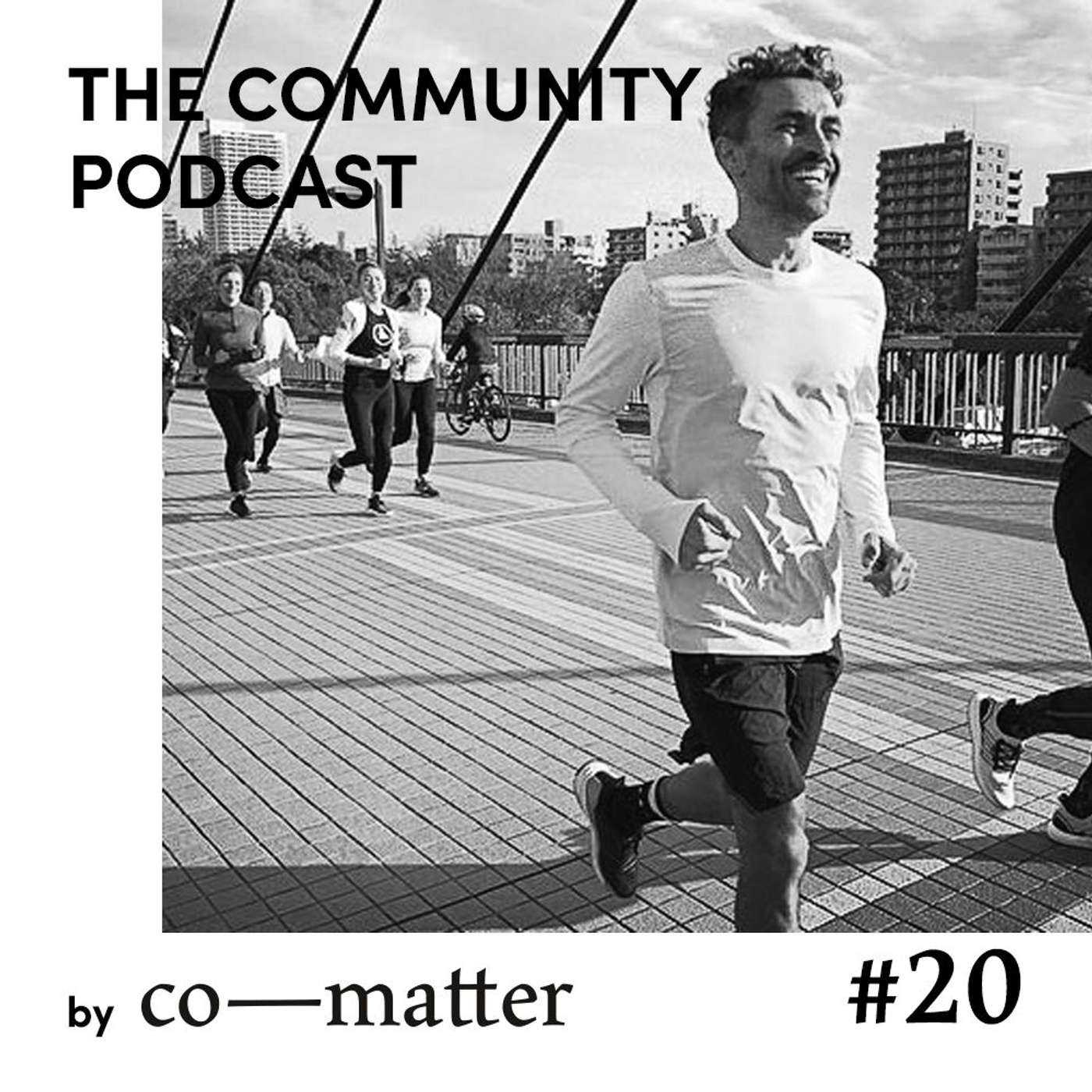
Community relationships, any of that. I always like to compare it with a tree with something that grows organically. You cannot just put a seed into the soil and pull out a whole tree tomorrow. You'll have to nurture it, you have to water it, you have to make sure it is getting everything it needs and you have to wait and be patient. And then ideally, the outcome everyone has fruits and shadows. Hello and welcome to the Community Podcast by CoMatter, a series of conversations about how people connect, engage and participate in today's hyperspeed world. My name is Seren Matozek, this is episode 20, and today's guest on the show is Yusef Hamuda. Yusef is the global director of culture and community at Adidas running. He's one of the founding fathers behind Adidas runners, the global running community that unites thousands of runners in more than 65 cities worldwide. You might have seen them if you live in a bigger city. It's usually groups of 10 to 30 people, glad in black, with the AR logo on their back, running through the streets and mostly having fun doing so. In my opinion, Adidas runners is really a prime example of how a brand can build a community. So how exactly did they do it? That's what I wanted to find out from Yusef when I met him at the Adidas run base in Berlin. But that's not the only thing I was curious about. As a listener to this podcast, you might know that we're not only talking about brand communities here, but a lot about things like democracy, power distribution, technology, and transparency. Some of the ingredients that are crucial to building communities in today's time and age. And usually brands have a very hard time with that. Why is that so? First of all, because people don't trust brands as much as they used to, especially when they're big global players. Secondly, brands usually rather think in terms of short term success, instead of long term, making it very hard for them to invest in building authentic relationships in a long run. And thirdly, because by nature, the goal of a brand behind building a community is ultimately to sell products. And that makes it hard to build an authentic community. Our brand community is being planned in big conference rooms by a team of marketing experts with millions of dollars in the bag. Yeah, sometimes. But those are mostly those that don't really happen by coincidence that are being planned top down instead of bottom up. Mostly they don't really work from my experience. But that's not the case with Adidas runners. Like many of the most successful communities I've seen, this project has humble beginnings and grew by carefully listening to its audience. Its success does not lie in a white paper marketing strategy or budget. But in the people that drive it, people with a vision, a certain mindset and a passion for what they do. That's what I learned from this conversation with YouSafe. But you'll see for yourself. Here's the community podcast with YouSafe Hamola. Welcome to the community podcast. Thank you for having me. You said you recently ran a marathon in Boston. How was it? It was absolutely horrible. Simply because it is a very, very tough marathon with a lot of hills and the heartbreak hill. One of the steepest hills has a reputation. But I must say that it is absolutely insane to see hundreds of thousands of people from before the starting line until the very, very end supporting the crap out of you. It is absolutely insane. I've never seen something like that. I live in Berlin. I did the Berlin marathon three times. There's already a great audience, especially if the weather is nice. But what Boston has shown there was support on another level. So that was something I take home as a very remarkable thing that helped me soothe my pain. Now let's talk about your role here at Adidas. You are the global head of community of Adidas runners. Can you tell us what does this role mean? What do you do on a day-to-day basis? And what is Adidas runners? Adidas runners is a global community of runners in more than 60 cities at the moment. We have probably 350,000 registered participants. We are organized in city groups where in each of the cities we have captains. We have captains and coaches to organize, manage and operate the community. The idea is that starting from our brand DNA, from our belief, which is through sport, we have the power to change lives, to really understand and translate that into something that is meaningful. And that can really help people thrive in their personal athlete career. And my perspective on that is, if we want to be the best sports brand in the world, it is not going to be enough to just deliver the best product in the world. Because it takes a lot of guidance. And we know that building up a network of community members that would not only in their respective city, find coaches and captains to help them understand their potential and help them unfold it, but also build connections across cities, across continents, all over the world. That is something that we feel is very unique to the program we are running. And that has just delivered on awesome results on the business side, but also very, very emotional, very interesting personal stories behind these people who are doing this every day. And Adidas has been around for 100 years or 80 years. For 70 years. Was it always clear to Adidas that it is not only about the product, it is about telling people how to use the product? A very good question. I believe it is a little bit the nature of our times that Adidas realized we have to do things differently. I started off as a city manager in Berlin in 2014. And the key challenge was that Nike, our key competitor, was dominating the city. In all key performance indications as in brand love or business success. We have done a lot of research to find out what actually is expected from a brand like Adidas. What people need. And we found out that we live in times where people are actually highly distrusting us brands. And therefore what brands need to do is to gain back trust. You cannot buy trust, you have to deserve it. And that's the key thing to understand. It's not only a great shoe that would help people trust you. It requires more than that. And the more here is the factor relationship. And we believe in relationship as a universal concept. As in no matter if you have a relationship with your pet, with your kid, with a colleague, with your partner, it always follows a simple three step process, which is it starts, it has to be fun. Most of the brands end there. They create fun experiences and that's it. But relationships are more than that. Second one is you have to have a conversation in exchange on eye level. You have to understand each other and be ready to also understand a different opinion and act on it. And the third level. That's where hardly any of the brands I know get. And that's where we feel the beauty in this kind of marketing approach lies is when you as a team, as a relationship, grow to something that you would never be able to achieve on your own. That is the highest form of relationship. And if we look at this model and apply that to what we're doing, then this is exactly starting from, let's just have fun. There can be races, there can be in store events, parties, whatever. But it also means the next step is understanding each other. And that requires you to reach out, to have conversations, to listen to your target audience, but also to people who you know don't, they don't have a positive opinion of you. But listening to those people especially will help you to better understand what you have to actually change. And that in some, to cut it short, has automatically based on the DNA that we have, changing lives through sports, created an approach that would be relationship focused, focused on a positive transformation in people's lives, and therefore complementing our product portfolio with that relationship element to it and changing people's lives for real. Like, have you got any, what do you say is a very modern approach to marketing. It's very people based, it's very, it's based on transparency, it's based on actually taking the risk to open up to other opinions, which is to a lot of brands, very new, like because brands and corporates usually want to control everything. They are very uncomfortable with giving away power, freedom to people to create something that they can't control. So, has there been any voices within the company or within the organization as Adidas runners grew and developed, whether like, are we sure we want to do this? Is there a danger to that? Yes, definitely, definitely, on all ends. And it's okay, and it's understandable, because if you are in charge of like significant budget and you need to have your shareholders trust in you making the right decisions, you of course want to know exactly how you can achieve that controllability in this regard and communities and relationships and all that kind of stuff, it's not necessarily the easiest to control and to measure, like try to measure love, like what is the KP, are the ROI of your mother, right? So, that kind of talk always leads to a level of trust, and I was very, very lucky to have the chance to work with leaders within the company and within my specific organization who would trust this approach and who would understand the mechanics behind it and who would see this unique and genuine opportunity for us to stand out, stand out because there's no other brand that has a global brand community.
that is actually authentic, that's living, where people use our platform, not only to have a relationship with us as a brand, but to build new relationships with each other. So, you have no idea how many couples have actually come together because of Adidas Rana's and how many babies are on the way. I mean, for real, that's something that chose me with doing something right, but coming back to your question. I think that the pushback has led to the following situation. We will always challenge with the measureability of success, of course. And the key question was in the beginning, what do we actually want to achieve with Adidas Rana's, with his community approach? Is it, do we want to sell more shoes? Is it like simply commercial success we want to imagine? Or is it brand love, brand heat, net promoter score, things like that? It was very clear from the beginning that what we're doing is clearly going in a direction to change the way people see the brand. If you want to be the brand that changes people's lives through sports, then this community approach would definitely be a great opportunity to really apply that and be tangible about that. And that would change people's minds about it. Because if a brand tells you, hey, if you use this shoe, you will be the fastest runner, is less credible as if a friend tells you, man, I have just finished my first marathon. And I did this together with these Adidas Rana's guys, and it was amazing. So that's why it was a lot of trust involved. And it forced us to create a set of KPIs, keep performance indicators that would help us to prove our approaches right. And it took us a couple of years, I must say, until we were able to deliver these results. Because community relationships, any of that, I always like to compare it with a tree with something that grows organically. And then ideally, the outcome, everyone has fruits and shadow. And therefore, I'm really, really happy that we had the chance to grow this over quite a few years now, and now deliver on KPIs that everyone is very, very happy about. And now we finally have the chance to give back to the organization and to provide success data that would also, like, silent those voices, would continue to doubt what we're doing. I'm super curious now what these KPIs are. Are you, can you give one or two examples of KPIs that you developed over the years? Of course. In order to give people a proper idea of what we're doing, and in order to take everyone who would be doubtful about this series, we decided to create a very, very indefinistic set of KPIs. It starts with the memberships, and along with the memberships, we have a whole funnel from people who are interested as part of our Facebook groups to being registered, to coming to our runs for five times because you have to earn your way up. For example, the Adibis run is sure that you see you would never be able to buy it, you have to earn it, and you can only earn it if you run with us at least five times. So the number of people who have unlocked that to the number of people who come on a monthly basis, which we believe is the right way to measure relationships because, you know, relationship is always if you continue to exist together and not just like, "Oh, get your free shirt," and then rock off again. That's the membership part. Of course, then we have share of voice. We count how many brands people wear when they come to us and then see how it develops over the time, like how many of the running shoes people are wearing are Adidas. Some people are scared. They post that on Facebook, "Oh, I'm having shoes from a competitor, can I come?" And we always be like, "No, of course you can come. There's no obligation to wear our brand. It's just our opportunity to show us what we can do for you." Then we have the whole brand heat measurement, which is called NPS, Net Promoto Score. I'm sure you're familiar with the concept that will help us to get a better understanding because we measure that not only within the community, but also measure it in retail. We measure it on our e-commerce. We measure it anonymously in cities to really understand how the different peer groups react differently when it comes to deciding if they want to recommend a brand or not and how the level of identification actually changes. These dynamics between these different KPIs give us a great idea of how it works, but that's not even all. We also measure the market share in the respective cities. We measure the number of test shoes people are using, etc. One of the things that we always heard is guys, we are investing a lot of budget in this. How many people do we actually have active members and they were expecting that we say millions? Maybe a couple of 10,000 across the world. I mean, 65, 66 cities as per today. That's quite a good number, I think, but for a global cooperation, people are used to a lot of zeros more. And people were like, "Why are we investing so much money for those few people?" And we were like, "Because those people are the ones that are going to recommend us as a brand for real, they're really going to do that." They're not going to just say, "Yes, I say nine or ten when they're being asked, they're actually actively going to do that." And now we did a so-called earned social media analysis using a service called Picodash that would help us to track our hashtag users on public Instagram posts. And the result was that in the time frame between July 18, and we've officially launched a global framework in May 18 until end of March 19, we had probably 18,500 people posting on Instagram using the hashtag "Are there foreigners?" Like individuals with, I think it was probably 150,000 posts creating an engagement of 30 million likes and comments, which already is quite a great ratio. And those 10, sorry, 18,500 people have reached a unique audience of 100,000. 43 million people and created an organic, earned social audience of nearly 1 billion. And we've benchmarked that against the competition and against own other projects and realized that that is a huge success. And that was surely one of the arguments that helped us a lot to get to the next level and really keep on pushing the envelope. Awesome. So let's go back to 2014 when you started as a city manager, you guys looked at the competition and then you came up with a concept of Adidas runners. And now it's a global thing, 65 cities, thousands of members. What happened in those five years? First of all, when I started, I didn't have that much gray here. No, seriously. In September 2014, launch of what we call Adidas runners today was actually a project called Boost Berlin. It was a different approach. It was not as holistic as it was today where mindset nutrition recovery, movement, gear are key pillars of our approach to really meet all the runners needs on all certain levels. It was rather something, let's try to create a good group of people. In a three month pilot, where we just meet, run together and understand what we actually want to achieve. It has turned out that that's the pilot phase where we just invited five people from the Berlin ecosystem and had them invite 10 people. And we just organized everything, like a little party here, a little speaker session there. Of course, a lot of runs and workouts in between, including yoga and you have not. And it turns out that that created such a great vibe, not necessarily because we were like the best runners or we had the most awesome scientific approach to getting people running faster, but just because we really managed to create an authentic community. And I always said that it is impossible for brand to create a community, what you can do is you can create a great framework, pull in the right people and hope for the best. And the better the quality is of your framework, the better quality is of the people and the better the fit to the DNA of your brand, the more likely it will work out. And that's the thing that we've learned in these three months, that people were just loving to hang out with each other, that they wanted to be with each other, that they had shared ideas, shared values, shared beliefs, shared convictions. And that's what a community is compared to an network, is people believing in each other. And since that was a close group, all these people around these group wanted to be part of that because they realized it's fun, they could see it on social media and from what people talked about. And therefore it was easy for us to scale. We had to actually always stop people to, we only like send out like in the start of work, you know, had a few invitations that we were available and then we limited. And that way we created a little bit of a desirability around this. And while we did that, we learned a lot about what people actually need and what a beginner needs and what a what a pro needs, it's actually the same, you know. So what we've understood is that while there are communities out there for the past runners, for the cool runners, for the female only runners and you have not, we were understanding that our window of opportunity, our niche where we can be the right answer to a lot of questions is we are the community of runners that makes every runner better. And that requires competence. That requires a holistic approach to meet the needs of the runners. requires right locations, the destinations and
the right partnerships. So that means building these little, distant groups with a boost Berlin team, building local partnerships, creating these research projects with all these individual runners and captains and coaches, back then they were called hosts, has resulted in the creation of the Berlin brand experienced ecosystem that I could then utilize for all the other categories, for all the other initiatives, product launches, et cetera, as well. The new Ferrell Williams Supercola, Superstar launch in the original sphere, the biggest fans of that were our runners, right? And when we had something special going on with a football product where the national German team would launch their new jersey at the football base, then we had people from the originals, from the running and from the football landscape and the basketballers as well, coming along having a few drinks. And that way what we've created was this community that would actually go beyond running, beyond football, beyond category, it was a brand community, and it was a real one, was authentic. People got to know each other, people liked what we were offering. We increased the life quality to a certain extent for people who were part of the ecosystem. And that made it so successful that after three years, the market share doubled in running, our NPS value has increased massively and the delta to our competition has decreased massively. That has led to not only the competition focusing a lot of funds to re-attack on Berlin, but also on the company understanding that using this model and rolling it out in other cities might be a good choice. So they kind of started a little internal pitch where different categories were allowed to offer concepts of community. And we had the opportunity to start there with our running concept of the Adidas runners. And we were the category that convinced the senior management, so we got funds and we got the resources we needed. And that's what we are doing since November 17. - Okay, so how did you replicate this framework that you created here in other cities? - Yeah, that's a very, very good question because that was probably the hardest challenge at all because while we were doing this Adidas runners thing in Berlin, Frankfurt Munich and Hamburg as well, I must say, it was in that time frame I was in charge of these four cities. There were a lot of similar projects being launched in other cities because they saw, "Ah, this is cool, it could work, let's just try it too." So they used the same brand, they just took our logo that we've created for the local region. And then we had Adidas runners all over the place in pretty much every continent already. But the concepts were completely different, as you said. There was no alignment, no clear central idea message that we wanted to get out. So the biggest challenge when I took over in November, 2018 together with my partner in crime, Eduardo Rodriguez, was to build a framework. And that means use what we already had and rework it in a way that would be applicable in every city in the world. What we did was really break it down to what the key aspects of this philosophy are. So we did a lot of education in the beginning about relationship building, about the difference of fireworks, which is marketing and just like next day you don't know who paid the drinks and fire, which is the exact opposite of investing the money over 365 days 24/7, which is a little bit harder because it's not easy to just say, hey, tomorrow we have a launch and then it's gonna be, we can choose day, we know the results, you know, you have to kind of like believe in it, continue doing it. It means internal education, then what we did was really do a thorough assessment of what profits to inforcapance and coaches. We worked together with those departments in our organization who are in charge of having relationships with influencers and entertainment specialists, et cetera. But then again, we also wanted athletes. So it was a little bit of a different, difficult situation because our organization was set up but still is that on the one hand, we have the lifestyle influencers that's called the entertainment influencers. And then we have the sports influencers, which are the sports marketing assets. And actually we wanted to find something in between. So we have to actually create a new profile that usually wasn't existing in our organization and started to brief all the key city teams and all the city teams, marketing teams in the markets. We're finding the right scope of people. Some of them already had them, some of them had to be changed, but that was a surely a very important element to it. So building a 500 slides framework, which we call it the Bible. People hate us for their document a lot as they still think that none has actually ever read it through. But except for you, Lina. But then the recruitment brief was the second, most important one. And then creating global activation elements. For example, like this year, we've realized that we need to do something for the female running audience. And that's why we decided one of the key projects we wanna push is a program for female beginners, running beginners to run their first half marathon. That's simply because we've learned from one of our focus groups that for the female runner, running has a very, very interesting aspect in their, let's say, in their grow-up phase, especially when it is early in their life, when they say that they create this breakthrough moment, when they've accomplished the first marathon, they didn't believe in it, they even hated running, which we often hear, that for them was something that showed them how powerful they actually are, and how amazingly influential they can be. And they compared it to the first time they broke up with their boyfriend, or the first time they told their dad that they don't wanna study what he told them, what he asked them to. So this kind of possibility to assist a certain demography to reach their goals, unfold their personalities in the best way, using running as a vessel was a great thing for us. And it checked so many boxes that we decided to use this, create a, let's say, a toolkit around it, which is a 20 to 30 slide PowerPoint, of course, send it out to the markets and give them, let's say, often two or three hour sessions on the phone, virtual through Skype, or whatever people and markets use, to guide them through it, coach them and ask them questions, and help them, so I'm not asking questions, but answer their questions. And then have regular calls with markets and people so that my day to day life is 60, 70% update calls with markets and cities to answer their questions, to get interesting feedback, to understand their situations, and learn from it, to better work on new, to its new activation concepts that would then be relevant in the next season. - Okay. From your experience now with Adidas runners, what difference does Adidas as a brand make in the back? What makes it unique that Adidas is part of it? - That's a good one. Let me put it this way. I was surprised by how much easier it was to operate Adidas runners when we changed the name from boost per lint to Adidas runners, because the one reason we had in the beginning was because Adidas reputation wasn't necessarily where it was supposed to be back then, and we shied away from using Adidas as a name for this thing, as well as as you can see that we don't want to compete against crew culture, right? That's why we're not a crew or community. And crew culture as in the Paris-Rung Club, the Brooklyn runners, the bridge runners, black roses, NYC, however they're called, every big city has their crews, and they always manage to get a lot of respect and a lot of attention and follow-orship, but not necessarily a bigger impact as in, it wasn't the interest to create a global movement. It was rather an interest to create a local movement, and many of them succeeded highly with that. Many of the crews connected to become the bridge, the gap movement, which was probably the first time, 10, 12, 13 years ago, where running has actually grown out of this dull running on tracks or running very long distances with no meaning to become something that's culturally relevant. When we decided to rename it to Adidas runners, it was simply the mind of a strategist to understand how to connect the dots between building this program that would result in brand love. Trying to, how can we make this brand hot again, using running as a vessel, understanding what the DNA, the core of this brand is, which is through sport we have to power to change lives. So it was a natural conclusion that what we did now actually came out of it. It was nothing that was just a crazy idea of someone who was something that has naturally evolved out of this core. And that's what I love about my job is to be able to do like a very logical hands-on strategy work with a brand that really has a great core and has something that creates value in people's lives and has the sense of sustainability. And you know, while we decided in the beginning of this conversation to not get too corporate not get too.
to be emotional about it. I must say these are my personal convictions. I really think that I work for the right brand, and that's why I do that. That's something that only Adidas can bring to the table and the other way around. That's something that if Adidas would do it, it has to be the way Adidas does it. And that's why the way we do it convinces people and creates a lot of recognition, acceptance, respect by those people who would usually shy away from working with bands. And that again, in their peer groups, in their social cultural surroundings, creates some kind of disruptive effect because they usually think, well, brands are always bad, always commercial, they always want to fool and manipulate us into buying stuff we don't need. And why is this person that I always deem to be a superhero of my subculture working with this brand? Why are they even putting their brand on their shirt and being proud of it and posting about it all day? It's because we share the same values. It's because we have created something that really make a difference in people's lives. You know, the way it works now, you have a Facebook group in every city. And as a member, you know, you can just go to Toronto or you can go to Dubai and just enter the Facebook group and say, hey, I'm Zevarin from Vienna or wherever. And I'm Adidas Rones and I want to see the city. I've never been here. How can I join? And it will always be someone who's like, hey, cool that you're here, come along and you'll have friends immediately. You'll see the city from the eyes of locals without having to study books and you'll be invited to the best parties that you would never see on any online guide. And all that kind of stuff is what makes it so special. So the success of Adidas Rones that started in 2014 here is driven by people like you who live and breathe these values, who run themselves, who see this platform as an able for themselves to pursue their passion. So over the last six years, did you have down moments where like, I hate running. I don't want to do this anymore, but I stand for this community. I can't do this anymore. Or what keeps you going? I just last looked at my CV for a couple of months ago, just to I think it was preparing a speaker profile or something. And I realized that I have actually, except for the companies that I found it myself, I've never been, and even those I actually always skipped jobs or switched jobs after three to four years, was my natural rhythm. And it was because I get bored quite fast. And I must say that the reason I am still doing this is because first of all, the city manager role. It was the first city manager in the world of Adidas, who like seven months after they hired me, actually officially pronounced their key city driven business strategy. So that was, there was no reference. I had to invent this myself. It was the opportunity to work as an entrepreneur as a startup within a big cooperation with all the freedom and also all the hustle that comes along with it. Then I had a down moment there in the last six months of that role. That was the second half of 2017, because I just realized as someone who has very driven by entrepreneurial ideas, that I wanted to do more than the infrastructure that I was actually able to work with, was able to deliver. That created a lot of frustration for me. And for a lot of people I work with, the agency company, people, the team, and Herzogunov. And I must say that I just had to really learn that it is so important to focus on the most important things and understanding those things, especially those that you cannot necessarily measure in success so well, as the weekly sales report, that was surely something I learned a lot about. So when I came to the global role, I worked more in a bubble, where you work with others who work in a bubble, because they create concepts that then are being sent out to the markets, which then would send it out to the cities for those other people who actually apply it and understand and learn from all the experiences. So that is not necessarily bad thing for me, because I like working high level and very strategic and very global. I really love that. And it's an amazing opportunity. I can do that. But it is true that after a while it was clear. So we have produced this 500 slides toolkit in, let's say, six months, which was insane. It's a book, actually. And we have a briefed, everyone. And everyone is now doing and operating this. And except for some people starting a new city-- and I just-- Adios Rones, there's not much changing. That's what I thought. Before I then realized that we have delivered work that would have made the brand curious about how the insights and benefits that come along with what we've been doing the last couple of years can be applied to other areas of business as well. And that's, of course, where we've got interesting, where I was happy to be invited in conversations around. How can we use these learnings and then maybe take it to another level? So that's something that I'm currently very interested about. So that's where us, like you and me, are very similar interested in how community, relationship building can actually change the way consumer marketing is being done. Because I'm a strong believer that the last six, seven, eight, maybe 10 decades back from when Edward Bernay started with propaganda in 1928, this book, till today, that we have a great opportunity to change what was manipulation to be inspiration, to change what was very, very commercial and very driven by the interest of a few to something that sees brands as properties that belong to all of us, where agencies stay cold as the shareholders, as well as the customers and the employees would work together collaboratively to create something that is helping everyone, and not only a few, and that's something that drives me. Fantastic. Thank you so much. Thank you very much. Hey, I'm still here. First of all, thank you, Josef, again, for doing this interview and sharing your insights with us. I really find it very interesting and left very inspired after this interview. I also want to thank David Noel, who made this happen in first place because he introduced the two of us back in 2018, who then took a while to actually make the interview happen, but now it happened, and I'm very glad for it. Another big thanks to Sabina, who's our amazing podcast producer and makes these episodes happen every two or three weeks. And Adidas Global, for allowing us to do this interview, I know we're a fairly small podcast in Adidas Global terms, and I was very glad that we could take the time to actually chat in detail about all the stuff that's behind Adidas runners. I also want to thank the two people who came back to us last week, who listened to a previous episode and gave some feedback and ideas. Thanks a lot. We really love it, and we really encourage everyone who listens to this podcast to just reach out to us at
[email protected], with feedback, with ideas, with critical notes, and so on. Last but not least, we're currently running a survey about the state of communities 2019. It still runs until mid-June 2019. So if you want to take part in that, it's 18 questions about the future of communities and about how we connect in 2019. You can find the link on our Twitter profile and our LinkedIn profiles. Just check it out. It only takes a few seconds or a few minutes to fill it out. And the results are very interesting so far. So we hope that you might participate as well. If you're interested in a topic that we just talked about with Adidas runners, you might want to check out episode 13 of this podcast as well. This is where I talk to Sarah Clark from the Rafa, the cycling brand from the UK, who is also doing a pretty fantastic job at building a community around their brand. So check that out if you're interested in a topic. And yeah, subscribe to this podcast. We have new episodes every two or three weeks. Tell a friend about it. Listen, give us feedback.
[email protected]. We'd love to hear from you. Thank you and have a great day.
 PodcastTranscript AI