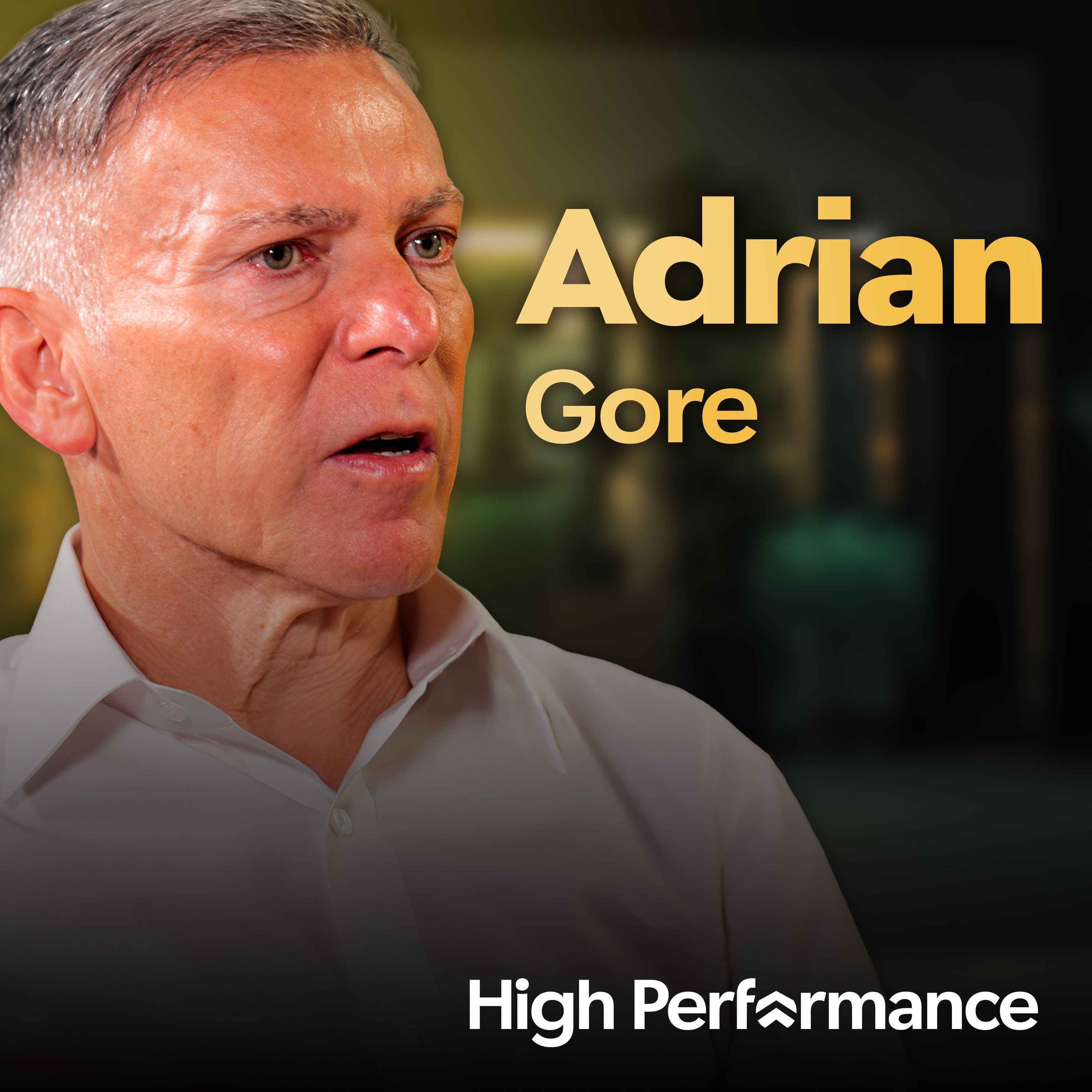
You Only Have 20% of Your Life to Make an Impact - Here's How To Make It Count | Adrian Gore (E430)
from The High Performance Podcast
61m 7s
The conversation centers on Adrian Gore’s book, "The Four Principles," which explores why some people create immense impact while others with similar or greater talent do less. Gore argues that success is not solely about innate ability but about understanding and correcting our "miscoded" brains, evolved for ancient savanna survival, which makes us overly focused on threats and blind to opportunities. The first principle, disciplined optimism, is not naive positivity but a deliberate tactic to seek positive signals in every situation, countering our natural tendency to miss half of them. Gore illustrates this with Discovery’s project fixing 380,000 potholes in Johannesburg, which not only addressed physical danger but also shifted public mood and hope, demonstrating how positive signaling can transform networks and organizations. He emphasizes that pessimism, though often mistaken for realism, is primitive and lazy, while optimism is sophisticated and essential for collaboration and execution. The second principle, focused urgency, addresses the perception of time speeding up, noting that time is not linear in perception, and urges a proactive approach to making an impact before it feels too late. Overall, the book’s core message is that by recoding our ancient instincts, anyone can multiply their impact in life and leadership, regardless of baseline talent.
(soft music) Adrian, welcome to High Performance. - Thank you. - Great to be here. - The reason why I was so excited about having this conversation is because I think in this world, we think there are two types of people. People with incredible talent who do incredible things and people with less talent who seem to do less incredible things. But your book, The Four Principles, Multiply Your Impact in Life and Leadership, I think is testament to the fact that really what you're saying here is life is not actually about talent. It's about understanding the world better and if we can understand the world better and understand the core principles for high achievement, then it almost sounds like anyone can achieve great things. - I think that's true. I mean, the central question in the book is, why some people create an amazing impact and others with similar talents, often better talents, more talented, more intelligent, maybe, actually do a lot less. So the other factors, their drive impact, they just kind of core abilities and talent and therefore I'll show you a view. I think that the key issue is, I think not anyone can achieve anything but for given that of talents, the ability to make dramatic impact is much more powerful and easier than people think and that's how kind of we got to the Four Principles. - Before we start talking about those Four Principles, just a little bit about you for people that aren't aware of your own business journey. I mean, if they want to find out a bit more about you than as soon as they type your name into the internet, it's, you know, as is the modern world. Now all it wants to talk about is your net worth. I mean, that is very high. It wants to talk about your business successes. That is hugely impressive as the founder of Discovery, which over here in the UK, we would recognize us by talented insurance, one of the biggest insurance businesses on the planet. So I really wondered why you decided to write this book. - It's a great question. I mean, a lot of people have said to me, "Why not a book about Discovery?" - Yeah. - Kind of the story of the business. But it's actually the Four Principles is our story. You know, it's kind of, it's the why, rather than the what, you know, of our story. We built a business very much based on people. We never consumed a lot of capital. So we never raised a lot of capital to build a big business. It was really built on the quality of amazing people. And I was early on obsessed with what makes people exceptional. And we had this, one of our values is liberate the best in our people. You know, we wrote that very carefully with a real belief that there's greatness in everyone. And that sounds kind of fluffy, but truthfully, as a business leader, how do you get the best out of people? And that obsession became something that over decades are kind of my team and I kind of look carefully. We developed ideas and ways of training and developing people. And that is the book. You know, all of those, all of their thinking is really our story. So I wrote the book about our business in the sense of the why, you know, kind of the purpose and the principles around getting the best out of people. I think the trans-actional story of a business is interesting, but it's less impactful, you know, I'm hoping that the book actually gets people to excel. I mean, that's the idea. I think we have as a team and I'd love to see that extrapolated. And I think, you know, when you talk about setting up and running a business, that's not for everyone, but finding your own edge, I think it's for everyone. And I think that's why this conversation is so interesting because it doesn't matter the business people are in, the stage of life that people are in, they can learn a lot from this. And before we get into the four principles, I think it's really worth just understanding the sort of bit of the groundwork of a book that it sounds like has been about 30 years in the making, not 30 months in the making. And I think the best way to explain this to people is, you know, if they get the latest bit of tech, then it also has the latest software. Yet we're all walking around with brains that don't have the latest software, right? Well, that's the core, I mean, that's the core, finding in a sense of the book that we are miscoded, you know, and that's the issue, you know, for sure, for sure, IQ education, privilege, all of those things are multiplier effects. And if you have them, you're lucky and you should be grateful. But the miscoding is a wonderful thing because it turns out to be miscoded for the world we're in. And that's recoding or remedying that coding is a much greater multiplier. That's the issue, you know. I mean, we evolved on the savannas for like two, three million years ago, hand together as where they were scarcity of food, physical threats, you know, being eaten by a lion or whatever. And we lived in simple linear clans, small groups of people, you know, today we completely, the opposite, abundance of food nets, the problem is that our business tries to deal with, you know, we live with systemic threats, so threats of systems breaking down, government, governance, health care systems, you know, war, things that are kind of systemic. And we live in complicated networks, cities and millions of people, organizations of tens of thousands of people. But you know, the thing about physical threats is an interesting one. If you look at some of the stuff we did in the book, you know, the life expectancy of people was a lot, people died young and they died violently. I mean, our fossil record is like a record of catastrophe. If you look at all of these findings, like the, the, the tongue child or, or Lucy, you know, these famous finds, you find they were killed terribly. I think the tongue school is like an eagle that, you know, kind of smashed the skull of this person, an eight-year brain or the eye, whatever. So we lived terrible deaths, but I tell you what is always intrigued me, you know, you think about it kind of academically, but child immortality was, I think, 50% of children died before they were five. So statistically, most mothers would have experienced massive loss. You know, actually everyone would experience the loss of a child. So this is an environment where, where, where all we did was seek our danger, you know, around every corner we seek danger. Today, that's the opposite. We don't have that, we don't have that problem, you know, in a world that actually requires the opposite. So the, this miscoiling is led to kind of an undermining of, in the book, four categories that I think are fundamental to, in fact, kind of attitude, how you use time, how you are motivated and driven, and importantly, how you make decisions, you know, and take actions. And so, to your earlier point, this is not about, it's not about the simplicity of anyone can just make it. You know, I think anyone can, but to an extent, the potential of really multiplying, in fact, if you can recode on these things is massive, you know, because we truly are, to your, to your, to your, and, and energy, we've got the wrong software, and it can be changed. So interesting, 'cause I often think we make the mistake of thinking that we were born the day that we were arrived on the earth, but actually our ancestors who've been around for decades, we are all there lived experiences as well. And the people that survived were the people who were anxious, who were fearful, who did spot the danger. So, there were people who didn't, and we're very happy, but they were eaten. Thank you. We're not the guys who are nervous and worried, but you know, the important point is that these changes, the agricultural revolution, 12,000 years ago, the industrial revolution, 250 years ago, the technology, we're going through AR now, that I think is going to be a complete, different issue. But, you know, if you think about 5,000 years ago, 3,000 years ago, that's 150 generations. I mean, it's quite scary. That's only 100, if you land up your ancestors, 150 deep, it's not a lot of people, it's from here to across the street, that should take you back. There's not enough time to change your coding, you know. That means that these changes took place 12,000 years ago. We're still living with millions of years ago coding. We're completely, we're not coded for some of the things we deal with today. You know, it's not a complete miss coding. I don't know the state there, but in the key issues of performance, I think we are. We'll be right back after a quick word from our partners. Okay, well, let's take these ancient brains then, let's talk about how they can exist in this modern world. And let's talk about disciplined optimism. First of all, how would you define discipline optimism on one of your key tenants in the book? It's not optimism as in being happy and being not easily happy, and you know, running down the streets of the smiling face. It's about the discipline of seeking positive signals. That's the core issue. The coding is that we seek the negative and we see them everywhere. The book, the research we did, there's some great work on this stuff, but in particular, I found that we kind of, we miss 50% of the positive signals. So if you presented with a hundred stimuli of opportunities and threats, you'll see, and soon they're 50/50, you'll see the 50 threats for sure. That's in your coding. You're alive to them. But the 50 opportunities, you'll see 25 of them. So you're missing out that 25 opportunities. And that's the issue in the world today where you're not facing threats every day. Impact is about spotting opportunities. You're missing half of them. So discipline optimism is about in every situation trying to say, "We're the opportunities here." You know, it's not about simply being happy. It's about trying to grab a positive mindset around where opportunities in every situation you face. And that's a fundamental issue, because I think impact is about spotting opportunities and exuding on them, which is another part of discipline optimism. So for people who might be listening to this and thinking, "Well, I know that I'm a pessimist. I know that I always see the negatives. I know that I spot the danger before anybody else." What can we say to them to help them rewire their brain to be a disciplined optimist? I think firstly, the prejudice about being an optimist is as seen as naive. You know? So pessimists have a great place in society. to be realistic, being conservative. That's our coding. We can't have Lord.
Yeah. Like realists. You know, and I get this all the time, you need to be realistic now. You know, enough of all this. You know what I mean? But the point is I would say getting rid of that, that preconceived idea, which is in our coding, that being pessimistic and looking at the risk only is a good thing. It's not because you're missing all the signals. So it's not about forgetting them because I think that's unrealistic. You know, see those 50 negative things. And can you find the 25 positive you're not seeing? So it's not about saying to that individual is a pessimist, you know, back up and get happy. It's not the issue. It's more tactical issue of kind of use discipline to try and find an every situation of the opportunity. So I'm missing something. I'm opposite on the opportunity side. The fear people have is if you do that, they feel that exposing themselves to risk, I'm not going to see the negative. You see the negative. It's coded in you. You will never miss those negative signals. I'm an exuber training. It's our training, risk management, pricing risk. I can see that stuff. But am I seeing what the positive probably not? So it's kind of a change of attitude, I think. It's not about being a happy optimist. It's a more tactical principle. I think one of the other risks with pessimism, and again, you talk about this in the book, is that it can be pervasive. You know, if you have a group of pessimistic people and a group of optimistic people, the optimists can be pulled down often by the pessimists. And actually in your book, you say pessimism is knee jerk, it's lazy and it's primitive. Well, it's primitive, of course, it's in your coding. Optimism is sophisticated. It's a sophisticated emotion in a way. It's not what we normally do. But the, you raise a very good point. The other critical issue about success is today, any of the successes about working in a network, whether it's the sports team, whether it's an organization, it's a political party, you're working in a complex network. You're not in a small clan of people. And the research we did for the book shows quite clearly that when you have kind of positive signals in a network, when you're working with people, you get better participation, you get better diffusion of information, better collaboration. It's hard to get a network to work on negative things to your very point. So spotting opportunities and then executing on them is why? You get a small supplier that's dramatic when people actually are optimistic in a disciplined way. The ability to spot and execute is fundamentally different. I've never seen in my, many times I've done some really stupid things and not laid well, but I've never seen kind of a negative pessimistic approach with a team of people, an organization of 15,000 people, you know, work well on negative signals. It doesn't work. When we talk about the famous broken window study, which points to the fact that if you live in a world where you feel pessimistic or negative about your surroundings, it genuinely impacts people's behaviours, right? You talk about that in the book. You also talk about the fact that you took on a challenge as discovery to change the way that people felt about the city that they were living in. Would you tell us the city, tell us the challenge and tell us what you did? So I hit off as in Johannesburg. The big city, it's a complex city, five, six million people in the area, just massive, a whole lot of issues that are going to be dealt with. But the most visible one that upsets people around the world is potholes for some reason. I mean, it's physically dangerous, you know, if you're a cyclist, cause, get damaged, you're a, we're a motor insurer as well. So we see the damage, but it's emotionally absolutely devastating for people. It's kind of a physical manifestation of decline, you know, it kind of people from that feel this declineism, which is an actual human instinct incidentally that we see to climb us and we've got things getting worse. Yeah, and this is physical evidence of it. It's a good example of dissonant optimism. Our team kind of had this view, you know, exactly this is a terrible thing. What do you do? I mean, flipped around and said, what if we fix these things? You know, we're going to fix a whole lot. You're not going to fix one of them. We're going to, this is going to be a, you know, it's kind of like a moonshot idea. Forget about the reality and the realism. What if he just fixed all the potholes? You know, it's a bad idea. We've seen some technology that does this, some, you know, some guys that approached us earlier about it, that's some really good potholes technology of how they fix it and we invested in these trucks and these teams and we began fixing these potholes. And today, I think today we fixed close to 380,000 potholes. I mean, it's quite unbelievable. Oh, wow. And I know that I've been out on the road with the guys, you know, it's amazing to see when people see the only part of doing it when it's unknown. The people were, people were drive past us and be absolutely exhilarated by this because it talks to the point you've made. It's not just about the pothole and the physicality of you fixing a pothole in my home. It's kind of, we're on the mend here, you know, things are going to get better. That ability to shift the curve, you know, I'd rather be at the bottom on the way up than at the top on the way down, you know, it's a slope of the curve that determines how people feel. And that pothole fixing has that ability to pull the slope up, you know, selling this hope, this kind of positivity starting to work through the network. And for our own people doing it, our own organisation is a feeling of like nation building, you know, it's a perfect example of kind of how through a network, through positive signaling, you can create a much bigger change, you know, and have people think about things. And in countries with challenges, you know, led inside Africa, which is a, it's a beautiful country with considerable challenge and often despair and hope and, you know, the ability to create those positive signals is a fundamental leadership attribute, I think. And in the book, it's a fundamental principle of impact. And the other thing that I didn't realise actually until I read the book was the impact of negative things on us as human beings that when something negative happens, the emotional impact is double the impact of something positive. So if something positive happening to you is a plus 10, something of a similar level that's negative is a minus 20. Yeah. It's a really deep impact. I had no idea about that. It's an amazing, I mean, this is the Nobel Prize when we work with Daniel Kahneman and Amos Tursky, the CEO of DevLossa version, that we are much more programmed to fear loss than to appreciate gain. It's back to the same thing because of the physical threats, you know, we are worried about loss all the time, you know. So that is an incredible driver of behaviour. So as soon as you give people a sense of something to lose, they become motivated. They are not motivated about potential gain. It's a critical issue. The first lesson in the book is disciplined optimism. At the end of this part of the conversation, what sentence would you like to leave people thinking about for how they can put disciplined optimism into their life right now? What's the first thing that you think they could do? I think to rid themselves of the view of the pessimism is realism. You know, there's something appealing about it. I think an longitudinal change. And they're not critical points you made earlier and not to believe you need to be empirically optimistic to get those two records left there. It's a simple tactic of spotting the positive. Brilliant, right? Onto the next lesson. And the book I think is fantastic. The four principles multiply your impact in life and leadership. And as soon as you open the front cover, it lays out the four. And the second of the four principles is focused urgency. Why your perceived time to make an impact is shorter than you think. Now, this is a very interesting one for me because I'm a little younger than you. Not a lot younger. I'm 48 this year. And I feel like the last 10 years of my life, my boy, you met Sebastian. He's here today. He's 10 years old. I feel like since having children, for whatever reason, someone has turned up the speed up dial on my life. And I know that a lot of our audience have this same problem. A lot of them are a similar age to us. And they reach out to us saying, I feel I'm running out of time. Have you seen Hamilton the play? Sure. There's that moment where they sing where Alexander Hamilton says, there's a million things I haven't done. I feel a lot of our audience have this same sense of time passing by. So can we talk about this focused urgency? And it's so interesting in the book that you explain why we feel like time is speeding up. Well, time is not linear. We know that. We think it is. We think it really accounts the same. You know, through Einstein, in quantum physics and whatever, time is a function of everything. It's a minute and a minute and an hour. So we think it's living. And the year's once around the earth. But the question how you perceive time, you know, that's the issue. So time is linear, you know, for all of our relative speed and gravity for all of us. But for us, individuals throughout journey, as you get older, the years get quicker. I've never met anyone who doesn't agree with that. Who doesn't agree that years get quicker. They kind of say, well, I was busy. I know it's not that. The issue is a year in perception is a function of how long you've been here. So when you're a year old, the year is 100% your life. When you're 10 years old, like your boy, that's 110th your life. When you 48, it's 2% your life, what they're about. So the years are shorter. They proceed to be shorter over time. So it's actually, you kind of burn time very quickly and then you asymptote towards death. That's what happens. So at 48, what's great about this is we're both in the last 20%. You know, it doesn't really matter. You burn the first 70% of your life by the time you educate. If you go to my logarithmic scale, people typically get 40, say, I say 40 or how much of your life if you live there will save, lift off. How did that calculate it? Well, I say 40 divided by 80. I'm going to lift to 80, say, you know, it's off. But if you go on my, proceed, don't mind. I'm saying the book, how the research we did is you need to recalculate it. The first year counts one, second year counts a half, third year counts a third. You'll 48 if you count one of the 48. So you must add that up. Divide that by one plus or half to one over 80.
That's a much you've lived in. And that's one of the scariest things that we've ever discussed on high performance. And we've recorded well over 400 episodes of this show, you know. But it gets to the issue of the rule of 20 recording book that you've got 20% of your life to make a difference. That's the impact zone, you know. You get educated. And as I said before, you may go to beautiful universities and of all that privilege, you may not, but that's where you get to the 75% but then it's that 20% when you present yourself in that 20% that determines your impact. The rest doesn't matter. And just to be really clear for people, we're talking here about I effectively have 20% left because of this concept of logarithmic time. The time is now going so fast for me compared to when I was younger. That I now I'm in the final 20. The perception of it. The perception. Not the amount of time left on earth, but the perception of my time left on earth. If I put a clock next to you, well, you've got the full yours, you know, it's timing you with how you perceive it, how you travel through time. You know, our pathesis is it gets faster as you get older. And any doubt you can speak to anyone, your boy, you're enough for him is a long time. It's a long time. He's been about three weeks of holiday of the month of the summer, 100 days. So he's going to do it himself. Which I remember is good to say that summer holidays last. It's whatever. I give you three weeks now that I'll be gone. I'll be. I'll be sure you can feel it. So it's that 20% sorry, the 20% there, but the 20% in the middle of 75, 25, there are time and years is small. That 20% is your impact zone. And what you do at that time is critical. You don't have any time. And it's an existential problem. It's not soluble. You know, in the book, you know, health is an important issue because it makes you more effective. The only thing that is a remedy for effectiveness is knowledge. Because knowledge is the opposite. The more you know, the easier it is to know more. So every unit of knowledge, that next unit of knowledge is actually easy to acquire than the previous one. So it's exponential. More knowledge leads to quicker knowledge acquisition. You feel that like at university, your first year as a killer, and then you start to move, you know, as you so it has the opposite effect. And impact is how much time you've got, how much knowledge you've got. You had infinite knowledge. You don't need any time, right? You do it right now. If it's infinite time, you could be a fool. You'll do it at some point. It's an optimization between the two. So at an extent, the only thing that lets you get the 20% most effective is to be healthy if you can. You need that energy. Because your physical health also has an impact for your mental health. And the key to more energy. So your work rate is, you know, if you're unhealthy and you've got all kinds of curiosity, you know, your ability to work is less. So simply just a utility issue that you've got, you know, you're healthy. You know, you look for it, say, you're probably working like you'd work at 20. Yeah. Knowledge is a much more interesting idea, but you've got an inculcator and that's the point of the principle. You've got an inculcator sense of urgency. You know, that's something I, from a gikgo in my career, I had this innate concern about time. I don't know why. I've always been urgent. There's no time. I've got to move. I still feel there today. Does that take away the enjoyment in some respects though if you're always focused on the urgency of it? I think it's, I don't think it does. I mean, I think that it's about focus. The very point of that is what we call the focus urgency. It's not about doing everything urgently. What's important to you? When it comes to work-life balance, which I cover in the book, that I think that work-life balance is, once you understand that they're 20%, you can't spend eight hours sleeping, eight hours at leisure. You've got to optimize your time, whatever's important to you. Whether it's being apparent or building an NGO or building a business or sports career or whatever, you've got to focus your time on that issue. I'll shoot not going to get there. If we focus on our physical health, I would imagine 90% of the women in the men listening to this conversation are in this 20% window of urgency. If they focus on their physical health with more clarity and more urgency, and if they focus on being a lifelong learner and not imagining that the days of learning new information are over, does that slow down the concept of the time passing? No. What does it just mean that no? Okay. That's the target. There'll be more. Yeah. I just feel their time passing, but I think that it allows me to get impact for their given time. I think I want to talk about a story in the book if I may at this moment, because I think that urgency is a really powerful tool. I know that in my life, on a couple of occasions, things have happened that I didn't see coming, and that's forced an urgency, which is forced an answer. And I've got to the answer a lot quicker. And I actually think urgency is a really powerful thing for human beings, because exactly as we've just been speaking about, we have this concept of all the time in the world, which we simply don't have. Can we talk about the day that you received a letter at your business, which forced urgency on an incredibly aggressive scale? So we'd start our business in the early 90s, and the business growing incredibly quickly was kind of really exciting stuff for the stock market and whatever, as we were taking the business, public as excited about it. I mean, you were a real South African success story. And people excited about it, and we're going to now list the company, take it public, and concurrently with that, the laws of insurance, the tools to change to a much more kind of almost sickness funds where everyone has entry, you can't price risk, accurately. So that's the actual complexity. An entire business model. We call upon you the idea of medical savings accounts. So, part of your in South Africa is not NHS, so everything is funded in health insurance, primary care going to the GP. So we had these medical savings accounts. It was an amazing set of breakthroughs that I think our team achieved. Everything that law was kind of nullifying it. And to an extent, you can't just recover from that because you start losing healthy lives, right, it's called the death spiral. The sickle lives always stay, and then your process is up, and then the fairly healthy lives leave, so you get into it called the death spiral. So those, that sort of laws posed a dramatic threat to us. And did you see them coming? We saw them coming, but they were not as, and we interacted to be fair to regulators with a complex process of dealing with it, but effectively the day after we listed the company, we were headlined about, you know, government warns, discovery, you know, and we had a, it looked like we were really, we were absolutely, we were finished. And we looked at every single option, and I remember one of my spotters, guys in our team said, "I don't think we can survive this thing." It looks unlikely. Wow. So this kind of government dictap, you believe that that would kill the company. And how long do you think you had to kind of save the company or do something? We had about, we had about two weeks to respond to kind of some of the issues, and it's unbelievable and I think about the rate of development of our thinking, you know, we've been, she came up with a structure that, that just accelerated us. That's quite unbelievable. And it gets to both the urgency, but also the first principle. As soon as you say there's an opportunity here. As soon as you stop running, you know, from the negative in your cell, listen. This is it. What do we do to, are they not opportunities here? And to an extent, we interpreted, or we used the regulation in a way that gave us a different structure, that gave the, the organizational competitive advantage. And while government's intentions in this, I think we're completely noble. They wanted a much more egalitarian system, et cetera. It's a good thing. Our competitors were egging this on because we really decimated them. But we turned around this thing and the organization just started to eat up market share, you know. So the issue though, is I think in their principle, is when things are forced upon you, urgency happens, you know, at the time of war, you get massive development, you know, this kind of thing. But the, the art of invent is to create the urgency yourself, you know, to find ways because else you don't get any impact because most people don't have that force on them. You know, so you've got to find ways to create the urgency. And that's the idea of focus, you know, what's important, how do you get the urgency? And what ways have you found to create focus urgency? In the organizations, short challenges, 90 day challenges. So a lot, you know, I see a lot of organizations with business pens are never manifest. As is like 90 days, we get their things done and we roll on 90 day cycle. The other thing that we do, and I think great companies do, and Apple is famous for it. These like annual launches, you know, you've got a year. It's amazing what happens when their deadline starts coming. It's going to be a countrywide launch, same in the UK and in the UK, and by the way, we continue to evolve. And that's a, it's not based on, we've got an idea or some event based stimulus. It's actually the deadline of a launch. As soon as we got their deadline, it's amazing how things change. If you don't have the deadline, my experience, it doesn't happen. Well, this plays very nicely into the third pillar from the book, which is this idea of declared goals. So as soon as you declare a goal, you are, of course, creating a deadline. I think that the general concept of goal setting is that it's a bit mundane. It's a bit boring. It's a bit corporate. It's all about hitting your KPIs. Why is actually declaring a goal publicly so important? Because it gets to the point you made before the loss of version. As soon as you set a goal and you declare it in somewhere, it's visible. It's there. You've got something to lose. And as soon as you got something to lose, you have a closer version. If you, without the goal, all you've got is potential gain. It may happen. You don't know where it is without the goal. So you can't have go through life. Maybe something happens. When you set a goal, suddenly you got something to lose. I'll tell you one goal I didn't realize how declared it was is writing this book. You know, as soon as you, that goal, I'm going to say, I'm going to say, I'm going to say, I'm out.
the amount of work I've done to get to this podcast. I've killed myself. Yeah, really? Because it's a goal that has to be of a certain quality. So setting a goal is critical. But the one thing I've found, and when you review it, the one thing I've found in research shows is that the, like, there are goals, people know them, but they're not set goals. Goals are set for them in their first 75% of their lives. You've got to do, you've got to get certain marks at school to get into the degree or whatever. Of course you want to do, then you've, you've got to get into the first team in whatever sport. So goals are there, but they're not yours. They're set for you. Very few people I find in that 20% of the making, in fact, actually set goals. In corporate facilities, mundane goals are know that. Corporate's goal, great skill. They really do. Because we set goals for remuneration. So we know we're going to hit them. Lots of version we set a goal that you can really lose. You know, something that you've got a chance of not making. In fact, great goal is one that's just outside of your ability. You know, that creates loss of version. And that drives an energy that, I mean, I'm a CEO, I'm working hard to write a book. It's not the best use of time. Yeah. But I've grafted like a dog too. Because of that loss of version. I don't mean then in A, in A, what's the word? Can't if you're saying the real sense. I realize it's something that's taken. I've got to make this count. You know, so I agree with you. People have goals. I don't think that's the kind of goal setting that he works loss of version. Quite the opposite. People set goals and now they're going to make. That's not a goal. You've got to be a vocalociver. And what is this? How do you set a loss of version goal? I think you set something that is important for you. That's towards, hopefully, a noble purpose. And then you announce it. Well, I think it's, declared means that in some way it's visible. You know, I don't mean that in the country. I have to really. I have a five minute mark that we're on about. I remember reading about it because you did. I remember you put it on LinkedIn, didn't you? You said I'm going to do, I mean, that's a, that's lunacy. That is, I was about to say that's not just a declared goal. That is ridiculous. That's an idiot. But the point is, the point is putting it out there. It's amazing what they've got me to do. And this was your publicly announced. I would have gone a mile in five minutes. Our team had this in our mortality. Our whole idea is physical activity and kind of that's, it's amazing at the day. So, so we felt this we are incredibly, what's the way to open up the dialogue and narrative about, you know, goals setting in any sense. And the third, we had an amazing time. But for me personally, I had this coach, I was up at five in the morning, turned out I'm not capable of it. I was 50, eight years old at the time. I got to like five, thirty five of their about in Johannesburg, which is higher. I thought I got into Cape Town and do the run, which is foster. You know, I had to see, but I never had any, I tore a calf muscle doing it. But I tell you what's amazing. My running went through, I've never been the same. I've never been the same. I did a, I did the Boston Marathon, now three thirty or three thirty one. That's pretty fast for my, I found something. I found something. Forget about this is not a relative of you. It's not an absolute, say relative to my ability. I've never been the same since that goal. No, been the same. And the goal was too far for me. I couldn't have achieved it. I'm not a great writer. I don't have that ability. But the truth is, it got me into a completely, I learned about myself. I learned about running. It's an amazing thing. Hey, you said a goal, go and, you know, it's an obscure thing. But you've got to sit, you've got to sit goals in some way that are visible in your vocal or subversion. I don't think most people do sit goals. That's my view. In there, in there, in there twenty percent to make an impact. I don't think they do. One of the interesting things about hosting a show called High Performance and talking about these kinds of things on a weekly basis. And we've been doing this now for seven years. We've had 250 million plus downloads of our show. So a quarter of a billion people have listened to these kinds of conversations. And the result of that is regularly me getting messages from people saying, I don't feel I've achieved. I'm often there over a similar age to me. I feel like there's the next step I haven't taken. And one of my, one of the questions I ask people most often, just DMs over Instagram and stuff, is like, how safe is the life around you? And it's amazing how often they get, they stop and think about it and go, actually, yeah, I'm so safe and so comfortable. I tell myself I want this goal that's out of reach, but do I really? Because of the comfort. And your stories are a really interesting one for someone that was looking to find the discomfort to grow. And you didn't achieve the goal you set out to achieve, but you certainly grew. But it's not just people like you and I, you know, who are ambitious amateurs. And some research in the book and I've felt this was incredible about golf. And the greatest golfer in the world is impacted by the psychological concept of loss of action. Tell us about it. I also found their research unbelievably. Because golf is on any sport at their level. You know, people are at their absolute extreme, you know, skill and pushing. But what their research found was done was a sophisticated study. The culture of all the covariates and selection looked at the core issues. Looking at PGA golfers that they find they pat statistically better for a par than they do for a bogey. That's an amazing finding because if you, if you miss a par, you lose. Let's perceive there's a loss. Whereas if you, if you get a birdie, it's perceived as a gain. Yeah. So patting for a par, there's loss aversion, patting for a birdie is a potential gain. And just that, their difference. So their mind is quite focused for patting for a par. Yeah, they're trying to avoid that. Because they don't want to be embarrassed and get a bogey, right? Yeah, that's right. Whereas a birdie is almost like, well, if I get this, it's a bonus. But is that level? You would think. Yeah. And there are. I'm sure they think that. But when you look at the data, and on it's good. But you imagine if Tiger Woods on a couple of holes at every single competition of his career had had the mindset that I'm putting here for par, not putting for a birdie, that probably makes it. They've done better. A lot better. Would it make millions of pounds worth of difference to his career? But I don't think you can change it. Sorry, the conclusion of that, I felt was that when you're dealing with a Tiger Woods or a PGA golfer or any sportsman at their level, they are mixing outward they can do. But you can't cheat loss aversion. You can't, that's why it's so important to say those goals. Unless you have something to lose, you can't rise to that level. Even at that level, it's so small of a difference. But between your example, someone sitting at home being fairly safe and not putting anything out there versus someone putting something at risk, the difference in impact is it's a multiplier. It's a two times multiplier. Yeah. I remember, so aside from this, I have a production business called Whisper Group. It's an independent production company. It'll be the biggest independent production company in the UK, probably top five in the whole of Europe. And when we produce a lot of live sport and when we went into, when COVID happened, 99% of our business was producing live sport for various broadcasters. And I remember I'm calling my co-founder, who's our CEO, and I said, like what's happening? He said, they're shutting everything down. And we had never really taken money out of the business. So I thought we'll be fine. My next question obviously will be okay. And he said, well, we'll last a few months, because your power when business is good is your offices and your head count and all of the things that cost a lot of money. But the minute something like COVID happens, that's what can kill your business in a matter of days. And at that moment, we decided that not only would we urgently lean in and support all of our people, but also we would rewrite the business and be not just sports, but also a documentary maker and an entertainment program maker. We went into COVID and I'll get these numbers slightly wrong, but with about 60 staff, we came out of the COVID pandemic with 150 staff. Sure. We're now nearly 400 staff. And we make good documentaries for every single one of the OTT providers, Apple, Disney, Amazon, Netflix. We work for all of them and produce two of three of the biggest entertainment shows in the UK as well as still doing all the love sport. Without the urgency of COVID, Whisper Group would look no different, I don't think, to how it looked in 2020. Absolutely. So I also can fully understand the power of this idea of. You've already thought they'd lost coming and you have no intensity. 100%. 100%. Well, look, that's my experience of running a production company, but there's a couple of really great bits of evidence in the book that I think people would find interesting. The first one, can we talk very briefly about the Apple Watch experiment that you did at Discovery because this absolutely lays playing the importance of hurting a loss. So we were trying to get people to be physically active. And we did a fantastic kind of venture with Apple where the idea was that you get to watch almost for free. That was the idea. That's of course not affordable. So what we do is create a structure where you pay for the watch over two years, kind of you know, the price of out about 24 every month. But the key issue is if you physically active, the payment in that month is zero. So to an extent, you mute your physical activity goals in the month you don't pay for the watch. Inevertently, it creates. We didn't realize it at the time, I think, of its power, but it was a loss of framed structure. You got to watch and you had something to lose. And it's amazing. The day to we did some amazing, we actually launched that data here in the UK around the effect of it. People are, I think, 30% or 34% more physically active. And they sustained that. A lot of these programs, people do something. And at the time, kind of, you know, the whole life is pretty quick. The data was unbelievable. And the reason for it was. loss immersion. People have something that they perceive they've got. Yes, so you made them feel like the watch was theirs. There's, but you can lose it. They're kind of sublural force. I just, here's an amazing fate on people. And for people that are listening to this thinking, I just don't have this in me. I don't feel that I've got the ability to find an edge, to get to this limit. You cite the Olympics gear Jesse Diggins in your book. This conversation about superhuman grit. And I think that plays nicely into what we're talking about, doesn't it? Well, I mean, the issue that you find is that no matter how hard you're working, you can work harder. You know, I don't mean then the callous sense. I mean, you've got a goal. And if you're lost in a version there, you can get there. I was struck by that New York Times article about her what you went through. You know, she ended up in, you know, I think I'm second to your blind couldn't hear anything. You know, that level of pushing to get to a goal that sports people do is unbelievable. Most people in their 20% of their lives don't push at all. Really, you know, I've done to work with Tom Lokes, a great sports scientist. He developed this idea of the governor theory in running, you know, that effectively fatigue is actually your brain just telling you I don't like this. I'm making a field tie. It's not a real physical issue. You can push harder. And he asks a question, if you came second, why didn't you die? You know, you didn't push hot enough. I mean, it's just that's an existential question. Yeah, yeah, yeah. Sounds callous, but it's an actually quite powerful argument. If you still alive, you didn't push hot enough. Jesse, as you heard, push nearly to death, but that's the point. And I think when you set a goal that's important to you, you can work a lot harder than you think to get there. A lot harder. Again, I think most people in their careers, and I don't mean this in a callous way, on pushing to the extreme, you can push harder. And again, I think setting a goal and a goal that's authentic, that's, you know, that's noble to you. Because I think if it isn't, you can't push hard, but if it is, and it's out there, I think that loss of aversion, if you do amazing things. And I think that's an important point to make is this is about setting something that matters to you. Because I think what we don't want to do is talk about pushing yourself to the limit, you know, breaking down, finding an edge, sacrificing everything you love, sacrificing relationships, sacrificing family, sacrificing time, sacrificing happiness, just to achieve a goal. What we're really talking about here is if someone's listening to this thinking, there's something I've always wanted, there's something I know would bring such joy and happiness to my life. And it could be being with my kids more, it could be regenerating a relationship with an elderly parent. You know, it could be traveling the world. If it's something that you really want, then you have it in you. So we've created a foundation for my performance. And the phrase we use for the young people we work with is it's within. The message we give them is everything you need is already there. And I think that's really what you're saying, this is inhuman beings already. Yeah, you put it across totally, in my view, this is not about how to make money or you know, it's about what it is that's important to you. And how you use your life, which is shorter than you think to get there, that's what it's about. Because I think ultimately you don't want regrets. You want to feel you or the most of you you could have been. So totally this is not about you know, an inauthentic or making, working for a company and making them reachable. It's none of that counterfeit stuff. It's a real, what makes a difference to you. And I think the worst, that's my, always be my fear to kind of live a life of regrets that you get to the end and I didn't spend enough time with my kids. You know, what's important to you? That's the issue. But then makes it out. The final theme then in the book that you talk about is the Pareto tale. Tell us about that. Well, the Pareto tale is really the combination of all those three principles get you into the tale. The tale is how you make decisions. That's the issue. How you do, how you take action. The issue here is that people, we kind of code us to think that things are uniform. We totally universe it. You know, the bell shaped curve. Yeah, things all in the middle and there's things on others and two tales. In a network, well, that's not the case. You can never find it anywhere. Everything has a power law, long tale. Small number of things in the tale, determine the whole system. You see that down the soft markets in a few companies with AI, you know, five or six companies and a big share of the entire market capitalization of the entire capital markets. So as you get a more network world, you get a longer tale for me. You get power laws for me 80, 20, etc. Pareto is one of the distributions, but I like the term of the Pareto's house. It was an Italian economist, etc. But the Pareto principle of a small 80, 20 rule, it's not always 80, 20, but that idea. But the principle thing is a small number of things make a difference. But the key issue here, which I try to get across in the book is your own life is a highly network system. So if you look at all the decisions that you make every day in action, you take, right? And you plot it on a chart about low impact or high impact. What you'll find, I mean, I've done a million things today, ready decisions. I decided to wear the suit. I wasn't sure if it was casual or not. I had a cup of coffee. There's a million things I've done. There's no impact at all. There's a few in the tale, you know, I started discovery one day. I'm married my wife. We're children. You know, I saw with your boy, that's a that's a tale event. You know, those things in the tale are what determine your life. It's a fantastic, it's a great conclusion because what it shows you once you've got a power law is it doesn't matter how badly you've done, doesn't matter what's happened, you can change the system in the tale. You know, just a few things in the tale change your impact. So, so you know, that's the, it has a whole lot of in the book. I've got through a lot of different implications of the tale theory, but I think the strength of it is, is a few things in the tale make the difference and the question is how do you get to the tale? And that's the first three. If you, you know, if you're setting goals, if you're focusing your time and being urgent and if you have the right positive spotting opportunities and executing one of them, you end up in the tale and I gave the story in the book called The Puffin in the Both, the whole vitality idea of sitting in the bath and the idea came out and it led to the global business, but actually the story of the business is not what we did after the bath. It's how I got to the bath, you know, now I got to their bath, our team was in my own issue, was all that other stuff. We were so fired up with this goal of making people healthier, that when we had this, someone gathered this idea of selling our health insurance into these gyms, we flipped around and said, what if the gyms were free for people in insurance, you know what I mean? What if we made them healthier? So kind of that obsession with this, like, urgency, the goal setting and this feeling of anything's possible. We are looking at every opportunity later that epiphany, the actual role that I'm very proud of, I'm team is very proud of it, but it was getting to the tale that kind of gave me this obsession with you, you've got to be in the tale as a leader, as in every way, if you're only in their tale and pushing their distribution to the right, you're not giving it impact you should get. And one of the challenges I think for people is how do they know if they're in the tale, like how do they know if they're in that rare, rare, if they're in their final 5% because often we spend our life assessing where we are against everybody else, and if we think we're 1% above everyone around us then we must be doing fine. I think that's one of the challenges I think actually as human beings is this constant comparison of other people rather than understanding that they have no bearing on our own journey. Yeah. The tale is relative to all the other things you do, so it's a personal set of actions and decisions you take. You never know you're in the tale. I think you do. When we launched Vitality, I knew this was, you know, when I left my job and started to scurry, you must have a similar story. I knew this was, I remember holding my doorbell, she was just born and I thought, this is an idiotic thing to do, leaving a well-paid job on my own, you know what I mean? That was a tale event. But the issue is, no matter how much you're in the tale, a tale will form. That's the Brato, the statistical dynamic. So if you're really pushing the tale, the whole thing just moves to the right, you follow, your tale gets further. So the whole thing is to be pushing the tale all the time, and that's why, you know, coming back to your earlier, your starting point, you can be smart and you can have all the talent and education and whatever. But if you can get into the tale, it's a 20 times multiplier. That's what the book shows, you know, six times two times two. If you look at it mathematically, the tale is 20 degrees of freedom away from where you are in the average. If you can get into that tale, that's the 20x and that that trumps intelligence and education. And that's why it's in all of us. You just gotta get into the tale. So to spot all the things you've achieved and all the success that you've had in this book certainly counts as one of those successes, is your drive as great as it's ever been? Do you feel a bit like Alexander Hamilton? There's a million things I haven't done. I do feel that. But I think I'm feeding it through things like writing a book. It's putting something out there. I think that if I didn't do that, I would wiggle away with good intention. Before we finish, we have our quickfire questions. And you'll know this, our quickfire questions are in partnership with Vitality. Because I've known Guck or Greg Levine who works for Vitality here in the UK. I've known him for many years and it was really interesting. The very first time I met him, I was talking about your business and I was talking about high performance and realizing that we both stand for exactly the same thing. Our show and I think your business as well is all about outcome, not income. The income will happen, but it will only happen if the outcome is great. I think you're helping to change lives with what you're doing. I like to think we're doing the same thing here. I'm really pleased that our quickfire questions are in partnership with your amazing business Vitality. You know and we know because you find this out from your amazing customers is that the habits are the things that make a difference in life. The habits are the things that stack up and they multiply. We're going to run through a few of your habits to find out exactly what you've done in life the turn.
those made a big difference. So the first one of our quick file questions in partnership with Vitality is what are the three most important non-negotiable behaviors for you in your life? Time with my family. Yeah. Physical activity and sleep. I put them, they are shooting from the hip. Very good. Those are them. What is the greatest advice you've ever been given? Don't peek in the trick. Explain that. Well, it was your school. It was a trick wherever you call it. You know, you have so many people at peak at school. First, you see this brilliant marks and then they live a mediocre life. You know, it's part of like the I'm scared of mediocrity. There's no litus in my thinking. It's more fear of mediocrity. I think it was like that, just don't peek in the trick. What is the one habit that's changed everything for you? I think short, intense exercise. I know it sounds kind of what's the word, unauthentic or simple, but it's not. It's given me the ability to manage time better and to be really fit for everything. I mean, to fit in, I do a one-fost kilometer in the morning. It's mad. I've, you know, gone it out of the door and I'm back. I wore my dislikely, but I'm saying the ability to manage time because that's the one, you know, as per the book, that you can ever get back. You know, so I have to make sure that I use it carefully. And you know, that kind of created a whole cascading and just using time well. Have you ever had a Shane Farnham? No, he's a guy that wrote the Farnham Street blogs. Again, he's a conversation on high performance that you'd really enjoy because his whole thing is about positioning. He's like, if you don't get a job, you didn't have a bad job interview. You didn't prepare for the job interview two, three weeks ago. If you did bad in your exams, you didn't have a bad exam. You had bad positioning. It's exactly what you're talking about. You're skating. Your early morning kilometer is your positioning for the day and everything leads from there. What's the one goal that you still have that you haven't yet set out loud? I need to form it better, but I think our organization are making people healthier. The global goal of that in the scale we're working on now, you know, I hope you will see their play out in a more clear form. But the ability to make people of longer healthier is going to be the key issue for societies. There's no money for national health governments, no debt. The ability to compress mobility is going to be one of the biggest social issues. So we have that in what we do with AI, with data, the ability to make an impact on people. We're going to get the goal right, I think, you know, exciting. And before we say farewell, a lot of the things that we've spoken about today are about the human being and the human mind. We're moving into a world of AI. And actually, if I look at the things that we've spoken about today, the discipline optimism, will AI is very easily disciplined because it just works relentlessly, not just at the same level, but to an ever-improving level. Focused urgency, you know, it is as urgent as we are as human beings, you know, operates as a fast. This idea of being derailed by a loss, AI doesn't suffer from that problem. You know, if AI was a goal for it, would play the birdie part exactly the same way as the par-putt. So the things that the concepts that we've spoken about today, how do you feel that they will be impacted by the growth that they are? I think that AI may allow us to be in the tail more, leave more of the the groundwork, the, you know, the infigathering, the analysis to AI and let us with our creativity, use that power. Of course, it has massive threats to humanity, you know, who are a lot about that. That's a non-trivial risk, I believe. But at the same time, I've chosen a optimistic view of embracing this and can it help me in my role, you match more in the tail, I think it can. One of the great things about vitality is that they're not just there when you need the most, but they're there for you all the time. Which person in your life has been there for you all the time, not just when you needed the most and why? My wife, I would say, and equivocally, you know, kept me on the straight and narrow, you know. Some of those who cares about your toes when you're out of control, you know, you, you being, you being, you know, does supports and keeps you on the straight and narrow, definitely my wife. What should biggest strength? I think the ability to seek positive, not to be an optimist, I think the ability to see the positive. It's a relative comment, it's not a, I'm not suggesting it's been an out of the time, I own, you know, something I've worked on, your greatest weakness. For crest donation. I'm a, I like to mull things over and drive people mad. And inspired by the book, The Four Principles, Multiplayer Impact in Life and Leadership, what's the one change you've made to your life in the last few years that you think has helped you to maximize your impact in life and work? I think that five minute mile demonstrated the power of stretch goals to me, you know, and gave me a, the running is irrelevant, they actually gave me a much more clarity about the power of these things, what they do, you know. The other stuff I'm
plicitly new, yeah, but the power of their goal of that, of kind of setting those things as you get older and as you go through your journey was quite, I think, for me quite an epiphany. Among the interesting conversations we've had on this show is we had a guy called Nick Cox, who at that time was the Academy Manager at Manchester United. And you'd find that very interesting, if you get a chance to listen, because he talks about the importance of those stretch goals on the young minds, you know, by the time they got to Manchester United, they were all good young footballers, they all had good technical skills and you would have said a lot of them had good mental strength and resilience. So their job when was to test and reward. So you can stretch these young people to the breaking point as long as they're rewarded afterwards. And he said as soon as you had games on really bad pitches or games where you specifically employed a bad referee to make all of the wrong decisions or when you purposefully played them against kids two years old or without telling them they were playing against older kids, he said that's when you really understood. So this idea of having a stretch goal, I think, is very interesting. And the final question to leave people pondering on, what do you believe is the one golden rule for people to live their own high performance life. I think the principles about getting to an impact, but I think that impact needs to be noble and authentic. I think impact to that authentic purpose is hollow. So the principles about getting impact, but my sense is the golden rule is having a purpose in life in a business that is authentic and powerful, that when you put your head down at night, you feel good about it. I think authenticity and purpose are two of the most important things that we can be chasing. That's it for the quickfire questions just to remind you that vitality on average help their people who are in shore with them to live up to five years longer. So if you would like to live a longer and healthier life, then you can find out more about vitality at vitality.co.uk. And that brings us to the end of our conversation. Thank you so much, Adrian, for letting me read the book. It is a fascinating, brilliant book. And I've read many over the years and there are so many things in here that I want to take away and that I'm already, I was talking to Seb on the train on the way in this morning about some of the lessons. So thank you so much for the book. And thank you for coming on high performance and sharing those lessons with us. Thank you. The real honor. Thank you. I think the big thing that stood out to me from that conversation with Adrian is this idea of living our life with intentionality. You know, he talks about the urgency, he talks about the fact that almost all of us watching this video right now are in the final 20% which is kind of scary. But actually that final 20% can be offset by this idea of living with urgency and living with an intentional mindset. You know, we spoke during that conversation about golf and I remember interviewing Matt Fitzpatrick, one of the world's top golfers a few years ago and Damien and I were talking to him about his practice. And you know, he told us that he's got a little book and every single shot he's ever played when practicing, he's written down in this book. And it's not just about writing down what he did. It's about practicing with intentionality. So I remember him saying that before a major, he'll see golfers chucking the ball in the rough and then practicing getting the ball out of the rough. And in his mind, in Matt Fitzpatrick's mind doing that is just training your mind for the fact that during the tournament you're going to end up in the rough rather than training your mind for the fact that actually in the tournament you're more likely to be on the fairway. So why don't we get the ball on the fairway and actually practice the kinds of things that life is going to throw at us. And I kind of got that feeling actually from the conversation with Adrian. I really liked how he took the lessons and learnings into the things that he's done with his business, whether it's repairing roads, handing out Apple Watches, announcing his own five minute mile. But I also really enjoy the fact that so much of what was in the book and so many of the things that he spoke about are based on psychological research. The kind of things that Damien loves, the kind of things we talk about so often on this show. So I think my big takeaway and certainly I felt this one I was talking to him is that I think I can still do a better job of being intentional. You know, when he spoke about getting up every day and doing a fast kilometre, I definitely firmly believe that the most important thing in life forgetting to where we all want to get to is positioning. It's not about delivering when we get to the place where we have to deliver. It's how we position ourselves to deliver well when we get there. So I mentioned my son a few times who plays football.
Like if he has a bad game of football, it's not necessarily about a bad game of football, it's about what have you done in the week, what have you eaten, have you trained, have you worked hard, have you thought about the opponents, have you watched the people you're playing against? This idea of positioning ourselves and getting ourselves into the ultimate place for success is far more important than having to deliver in that moment. So I thought it was a great conversation. I hope that you really enjoyed it. His book is out now, so you can get your hands on it and have a read. Thank you as always to Vitality as well for being part of the high performance family. We're really proud that they partner with the show. I hope you enjoyed the conversation and don't forget, keep on checking back for more episodes like this, where you and I can just sit, listen, and learn about how to optimize our own lives, but optimize it in a healthy way, not optimize it in a toxic way. Please make sure you share this conversation with anyone in your circle who you think could benefit from hearing the wisdom of Adrian Gore and hit subscribe, make sure you like the shows, and I'll see you next time for another episode of High Performance.
Podcast Summary
Key Points:
The book "The Four Principles" argues that impact is not determined by talent alone, but by understanding and recoding innate human tendencies for high achievement.
Human brains are "miscoded" from ancestral savanna environments, causing us to over-focus on threats and miss opportunities, which limits modern performance.
Disciplined optimism is a tactical principle
Pessimism is primitive and pervasive, hindering collaboration and network success, while disciplined optimism enables better participation and execution.
Discovery’s pothole-fixing initiative in Johannesburg (380,000 potholes) exemplifies using positive signals to shift collective mood and inspire hope.
Negative events have double the emotional impact of positive ones, rooted in loss aversion, making disciplined optimism a critical leadership tool.
Focused urgency addresses the perception that time speeds up, emphasizing that time is perceived non-linearly and must be managed with urgency.
Summary:
The conversation centers on Adrian Gore’s book, "The Four Principles," which explores why some people create immense impact while others with similar or greater talent do less. Gore argues that success is not solely about innate ability but about understanding and correcting our "miscoded" brains, evolved for ancient savanna survival, which makes us overly focused on threats and blind to opportunities. The first principle, disciplined optimism, is not naive positivity but a deliberate tactic to seek positive signals in every situation, countering our natural tendency to miss half of them.
Gore illustrates this with Discovery’s project fixing 380,000 potholes in Johannesburg, which not only addressed physical danger but also shifted public mood and hope, demonstrating how positive signaling can transform networks and organizations. He emphasizes that pessimism, though often mistaken for realism, is primitive and lazy, while optimism is sophisticated and essential for collaboration and execution. The second principle, focused urgency, addresses the perception of time speeding up, noting that time is not linear in perception, and urges a proactive approach to making an impact before it feels too late.
Overall, the book’s core message is that by recoding our ancient instincts, anyone can multiply their impact in life and leadership, regardless of baseline talent.
FAQs
The central question is why some people create amazing impact while others with similar or better talents achieve much less, focusing on factors beyond core ability and talent.
He wrote it to share the 'why' behind Discovery's story, focusing on principles and purpose for getting the best out of people, rather than just the transactional business story.
Miscoding refers to how our brains are wired for ancient survival on savannas, which is mismatched for today's world, causing us to seek threats and miss opportunities, and this can be recoded for better impact.
Disciplined optimism is not about being naively happy but about the discipline of seeking positive signals and opportunities in every situation, countering our natural tendency to focus on threats.
Yes, by recognizing that pessimism is primitive and not realism, and tactically using discipline to find the positive opportunities they are missing, while still seeing the negatives.
Focused urgency is about perceiving time as shorter than it is to drive action. Time feels faster because our perception is not linear, and this principle helps multiply impact by acting with urgency.
Chat with AI
Loading...
Pro features
Go deeper with this episode
Unlock creator-grade tools that turn any transcript into show notes and subtitle files.
 PodcastTranscript AI