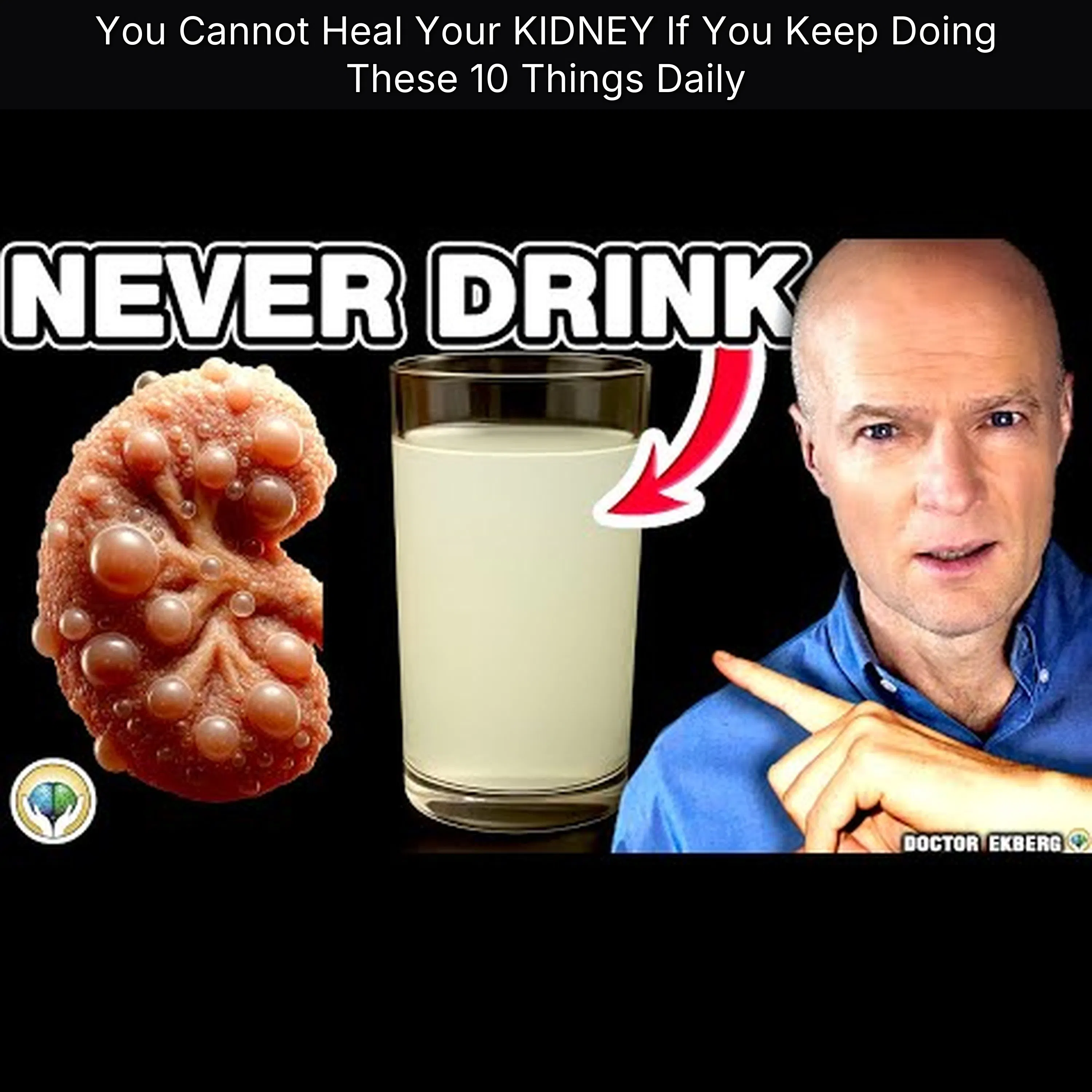
You Cannot Heal Your KIDNEY If You Keep Doing These 10 Things Daily
36m 50s
The transcript warns that kidney damage often progresses silently, with no symptoms until significant function is lost. The speaker outlines eight common habits that sabotage kidney health and offers solutions. First, blood sugar spikes from refined carbs and sugars cause microvascular damage to kidney glomeruli; monitoring glucose after meals and adopting a low-carb, whole-food diet can prevent this. Second, processed foods containing phosphate additives increase the kidney's detoxification burden, so home-cooked meals are recommended. Third, regular use of NSAIDs reduces renal blood flow, and natural alternatives like turmeric, omega-3s, and magnesium can manage inflammation. Fourth, chronic dehydration concentrates waste and impairs filtration; adequate water and electrolytes are vital. Fifth, high blood pressure (especially over 140/90) damages kidney vessels; managing insulin resistance is the top priority. Sixth, excess sugar, particularly fructose, triggers metabolic dysfunction and uric acid buildup, harming kidneys. Seventh, while protein does not harm healthy kidneys, very lean protein in excess can create urea waste; eating fatty cuts of meat is safer. Eighth, ignoring lab markers like eGFR (with optimal function at 90+) and BUN can lead to missed early intervention; understanding the stages of chronic kidney disease is essential. The speaker emphasizes that early awareness and dietary changes can prevent or reverse damage.
A man walks into his doctor's office for a routine checkup. He feels fine, just a little more tired than usual. His blood pressure has been creeping up a bit, but nothing serious. And he's been waking up once or twice a night to go to the bathroom. Just part of getting older, right? A week later, the doctor calls and says, "Your kidneys are only working at 30 percent. That's Stage 3B chronic kidney disease. No pain, no warning, just silent failure." Hello, all champions. Today, we're going to talk about how to not sabotage your kidneys. And your kidneys are absolutely amazing. They filter 200 liters of fluid per day. That's 400 of your typical water bottles per day. And in doing that, they help regulate minerals. They regulate fluid. They do a major job of eliminating toxins as well. But they can't do that if you sabotage them. So today, we're going to talk about the top 10 worst habits that people have that sabotage the kidneys and how to avoid them and what to do instead. The first thing that sabotage your kidneys is if you have a habit of eating things like bread. And then that's especially white bread, but all bread tends to spike blood sugar. If you drink soda, if you eat pasta, if you have pastries, and if you drink pressed fruit juices. All of those things on a regular basis tend to spike blood sugar. And the problem is that high blood sugar and spiking blood sugar, even temporarily tend to create micro-vascular injuries to the kidney. They damage the glomeruli of the kidney, which is the smallest functional unit of the kidney. It consists of micro-vessels that are very sensitive. And this micro-damage starts occurring long before you have full-blown type 2 diabetes. So what you want to do instead, you want to cut these foods out, these processed foods out. And instead, you want to eat foods, non-starchive vegetables, leafy greens, that have low-carb content, and you want to eat whole food. You want to eat meat, fish, chicken, etc. Beans that are whole foods, and you want to supplement with good fats. So you eat certain things, and then in order to get enough calories and get full, then you top it off with good quality fats, like butter, extra virgin olive oil, coconut oil, and lard and tallow. And because these blood sugar spikes can create damage, even if your fasting blood sugar is okay, then you want to measure your A1C. You want to make sure you check that on your blood test. And if it is greater than 5.4, then you're not in the absolutely optimal range of blood sugar. And there's a chance that your spiking blood sugar after meals. And what you want to do then is you want to monitor for these spikes. And the way you do that is that you use a glucose meter, which is a cheap little device. You can buy with a little finger prick, and you can check 60 to 90 minutes after a meal, or even better if you can get a doctor to write you out a CGM, a continuous glucose monitor. Then you can see what your blood sugar is doing minute by minute throughout the day, and you just wear that for a period of time. And what you're looking for is that your blood sugar shouldn't jump a whole lot just because you ate. And if your fasting blood sugar is between 80 and 90, which is a good level, then after a meal, it should still not be over 110 if you are good at controlling your blood sugar, and you eat whole food. And that's equivalent to 6.1 milli moles per liter. Now, if your blood sugar rises a little bit more, it gets over 110, but it stays under 130, that is borderline. That means you are not really good at controlling your blood sugar anymore. You are becoming insulin resistant, and you're having too much of a fluctuation of your blood sugar. And most doctors would never react to that. They would say that all the way up to 150 or even higher, that is perfectly normal after a meal, but it's only because so many people are insulin resistant, and they eat so much sugar and processed food. So 110 to 130 in milli moles would be 6.1 to 7.2. And if your blood sugar after a meal rises to above 130, now that is too high. That would be above 7.2 milli moles per liter. And what you want to do then is you want to start understanding that there is an issue, and these blood sugar spikes can start damaging your kidneys, and you go for low-carb foods, like we talked about, and how much carbs you have depends on your situation. So you basically want to eat in a way that you stay under 110, and especially over time. This may not happen overnight, but you cut back your carbs. And if you start getting down, but then it gets up again, then that's above your tolerance level. So you want to keep it below 110 after a meal. The second thing that damages your kidneys is processed foods. And this is especially true if it contains additives with phosphates. And these are very often hidden in soft drinks, in the dried fruit. And that's something that a lot of people think is healthy, but not only is it concentrated sugar in dried fruit, but they also add these phosphates quite a bit. Also in snacks and in delimites, you'll find a lot of phosphates. The processed foods is also very low in nutrition. They process out a lot of the things that is in the food to start with that your body wants. So they deplete it of nutrition. And in addition to that, it contains other preservatives besides the phosphates. It has other additives and a lot of other synthetic ingredients such as flavorings and conditioners and so forth. So this processed food now, it increases the phosphate load. It contains a lot of unhealthy fats and other toxins that now will add to the burden that the kidney has to process and detoxify. So the solution obviously is to stop eating these processed foods and learn how to cook and how to make food at home. And if you have a habit of eating fast food and processed food, of course this is not going to happen overnight, but do it as fast as you can and realize the difference that real food cooked at home has a completely different nutritional value. And once you learn how to do it, it's going to taste so much better. The third way you damage your kidneys is by using over the counter drugs, non-steroidal anti-inflammatories on a regular basis. And these are things that contain ibuprofen, naproxen, or dichlofenac. And what these drugs do is they reduce the supply of blood. They reduce the blood flow to the kidney. And in doing that of course, you are cutting off some of the resources that the kidney needs to heal because all of the resources, all the nutrients, all the building blocks are also in the blood. And if you get less of that to the kidney now, it's not getting those resources. And this is especially true if you're also dehydrated on top of that because now the blood volume as a whole goes down as well. So what you want to do instead is of course you reduce the inflammatory load by eating whole food instead of processed food. But in addition to that, there are some things that you can use to control inflammation naturally. And one of the most powerful is turmeric. And it is also important to get a good source. I'll put a link down below for you that actually gets absorbed and gets into the cells at about 40 times more than just the turmeric that you eat as a spice. You also want to make sure that you get some Omega 3 fatty acids, the EPA and the DHA, unless you eat a good quality fatty fish like sardines or salmon or macro at least three times a week. And another thing that can help is magnesium. And that is pretty easy to get if you eat a wide variety of non-starchive vegetables and leafy greens. And make sure that you get a lot of that multiple servings every day. If you don't, I would suggest that you supplement, you find a good magnesium supplement or you take maybe an electrolyte powder that has magnesium in it. The fourth way you damage your kidneys is with chronic dehydration. So if you don't drink water on a regular basis, but you just rely on coffee and tea and soda and all these other drinks instead, it's sort of like if you're washing your car and you're putting suds all over it and if you now try to rinse it with anything but clean water, it's just not going to get quite clean. And what happens now in the long run is that you increase the concentration of waste and you also increase the risk of stone forming.
minerals. And if there's less water in your body, your blood gets thicker. There's less blood volume. And now you're reducing your filtration efficiency. You can't send enough blood through the kidneys for them to do their job and everything becomes more concentrated. The solution of course is to drink clean water regularly. And if you have a work that takes you outside or if you sweat a lot on a regular basis, it is also a great idea to supplement with some electrolytes. And make sure that it's a good brand that doesn't just have salt, but that it balances out all those electrolytes. And I created a product like that called ULIGHT. And I'll put a link down for you. The fifth thing that damages your kidneys is high blood pressure. And this is an important one because a bad kidney can create high blood pressure and then the high blood pressure damages the kidney further. But what is high blood pressure? Well, typically they call normal blood pressure 120 over 80 and they want to put you on medication as you hit 121. Soon as you're over 120, they consider that high or at least by 125. But you don't really have to worry until it's over 140 because between 121, 140 there's minimal damage unless you're very, very insulin resistant. If you already have a lot of inflammatory problems and type 2 diabetes, now you want to watch it a little bit extra. But there is lots of ways you can do that. You can reduce insulin resistance. You can do breathing exercises, etc. And I've done plenty of videos on blood pressure. And if you get above 140 between 140 and 159, now there is increased risk, especially over time. But the real danger starts at around 160. Now there is clear and consistent damage to your blood vessels and to your kidneys. And what happens now is that there are those micro vessels inside the kidneys that we talked about. And the high blood pressure creates extra friction on the inside of those blood vessels and it damages them because they're very, very tiny. And what happens now is the surface of these blood vessels harden and you reduce the ability to filter out the fluids. And there is also less oxygen delivery. There is less exchange of the things that need to get across. And this is very, very important for the kidney because even though the kidney receives a lot of blood, there's an enormous amount of blood that actually goes through the kidney. Most of that blood is not for the kidney. Only a small portion is absorbed and used by the kidney. And the kidney is very, very vulnerable to hypoxia, meaning a reduction or a lack of oxygen. So even a slight variation can start create damage in the kidney. So how do we protect the kidneys from high blood pressure? Well, the number one thing that you can do is to reduce insulin resistance because insulin resistance contributes to high blood pressure, but insulin resistance also causes inflammation and damage. So that's the number one thing that you can do is to reduce insulin resistance because it's the number one cause of kidney damage and kidney failure. So what about sodium? Well, sodium doesn't cause damage, but sodium can kind of perpetuate the high blood pressure if you already have some other problems. So you want to watch your sodium and probably reduce it some if you already have chronic kidney disease in stage two or three A and you also have insulin resistance like prediabetes or type two diabetes. If you have all of those hypertension, reduced kidney filtration and insulin resistance, now is the time to start watching that sodium. And stage two chronic kidney disease means that you have gone down from the normal filtration rate of 19 milliliters per minute to between 60 and 89. And if you have stage three, it's divided into two parts. There's three A and three B for some reason. And three A means that you are between 45 and 59. So you could have lost as much as half of your kidney capacity at that point. And now what's really important to understand is that if you have even more kidney damage, now you want to reduce both sodium and potassium significantly because the things that are good for healthy people now become dangerous when your kidneys are damaged, they cannot regulate the fluid and the minerals the way they're supposed to. They can't get rid of them the way they're supposed to. And if you're in chronic kidney disease stage three B, now you're filtering 30 to 44 milliliters per minute. And this was the example that I started the video with that very often people don't have significant symptoms even at this point. And if you have some kidney damage, if you're at any of these stages, but especially if you're at three B or worse, now you want to work with a nephrologist so they can really monitor your potassium and your sodium and regulate your diet that way. The sixth thing that damages your kidneys is if you eat a lot of sugar. And now we're not just talking about what it does to your blood sugar because bread, which is primarily glucose and rice is primarily glucose, they can raise your blood sugar a lot more than even pure sugar like table sugar. But the problem with sugar is that it's 50% glucose and 50% fructose. And what this does is it creates metabolic damage. We can often find these things in condiments, in snack food, in juices, snack bars. Often things that you think would be healthy like granola bars or protein bars, they can be loaded with sugar. And of course, anything containing high fructose corn syrup is going to be even a little bit worse because it's going to have even more than 50% fructose. And this fructose is going to push your liver into metabolic damage and fatty infiltration called non-alcoholic fatty liver disease. But in addition to that, it's going to increase your uric acid, it's going to increase your inflammation and increase your triglycerides as well. And this will interfere with the kidneys and cause impaired filtration. So now you're putting an extra burden on that kidney. And that means if you have any sort of kidney damage that you're trying to reverse, you want to cut your sugar intake to virtually zero. And that includes things like fruit juice because fruit juice in terms of sugar, in terms of what hits the kidneys hits your organs and your bloodstreams is just as bad as the added table sugar. Now nutritionally and holistically, fruit is a whole lot better. But in terms of the sugar that it actually brings into the bloodstream, it's about the same. So you want to focus on berries which are very low glycemic in comparison. And if you ever have some fruit, make sure that it's whole fruit and low glycemic and stay away from those fruit juices. And the seventh thing that can damage your kidneys or prevent them from recovering is excess protein. But we need to understand what excess protein is. You do not need to be paranoid about eating animal products. So there is a myth that says that protein harms healthy kidneys. And that's not true at all. But there is a real risk if we eat an excess. If we really push ourselves to try to eat a lot of protein and the protein we eat is very lean. Now that is a problem. And this very lean protein is what we find in things like rabbit meat, deer meat, and lean chicken breast without any skin. And if we eat that without any added fat. So now if you already have some kidney damage and your filtration rate, your estimated glomerular filtration rate, which you get on your blood test, is less than 60. And you really load up on this type of meat without added fat. Now what happens is you create excess urea and nitrogen waste. And that becomes a huge extra burden on the kidneys. It's become a big stress on the kidneys to filter all that out. And a big reason that we have this confusion about protein is that if we do a urine analysis and we find protein in the urine, now that could be a sign of a damage kidney. So now people get this mixed up and they think that if we have protein in the urine and the kidney is damaged, the protein must have caused the damage. This is not true because the protein does not create damage it's a sign of prior damage so if you have it
leaking kidney, you have protein in a show up in the urine, but the protein didn't cause that damage. So instead of overloading on lean protein, what you want to do is you eat whole food and you choose the nice tasty cuts of chicken and meat and fish that have plenty of fat in them. So here you could eat eggs, sardines, grass fed meat, or if you really like game, like rabbit and deer, that's fine, but make sure that you eat plenty of fat with it. And if you already have some damage, if your kidney filtration rate is less than 60 milliliters per minute, then you want to probably moderate your protein intake a little bit. You don't have to be totally paranoid, but don't go overboard. And you want to also maybe take advantage of some supplements that can help, that can assist the kidney in healing and also maybe to work with a doctor understands these things so that he can help you understand what's really happening. And the two supplements that really stand out for kidney support in my experience are from standard process, they're called Drenemen and Drenatrofen PMG. And if you have some kidney issues and you want to give those a try, I'll put a link down below for you. And the eighth way you can sabotage your kidneys is by not paying attention and ignoring your lab markers and not really understanding what they're trying to tell you. So the EGFR, estimated glomerular filtration rate is calculated, it's estimated based on creatinine. And it's good to have a doctor help you understand that because this gives you a number, but there are some different factors that you have to know to put that number in context. And I created a blood work course that will explain that in more detail. And the other marker you want to understand is bun or blood urea nitrogen because if that goes sky high, that could also be an indication that your kidneys are falling behind. And the biggest problem is if you don't even check, if you don't run your blood markers at all, but also a lot of people are ignoring mild elevations. They don't really understand what it means. They get their blood test back and all they know is they either have a flag or they don't. But what about that zone in between? What does that mean? So completely dead kidney is going to filter about zero. And then a functioning one, a normal, good one's going to filter about 90. So in between, we have different stages 30 to 60. And optimal would be 90 and up. That is interestingly what they call stage one chronic kidney disease. I don't know why they name it that way. But 90 and up is normal. That's where you want to be. Now below 90 to 60 is what they call stage two. And this is something that it's already stage two, but it's not flagged on your blood work. So it basically you read the blood work and it looks normal even though 90 is where it's supposed to be. So this can get very, very confusing and you're going to miss that early window if you don't understand this. And then the next level down is going to be between 59 and 45. That's what we call three A. And then 30 to 45 is 3B. And below that we have stage four from 15 to 30 and we have stage five between zero and 15 when the kidney is almost completely shut down. So if you don't understand these nuances and how strangely they call these different stages of optimal and what they flag, you might find yourself like the guy in the introduction that you don't really have any symptoms. But you go in and one day you find yourself in stage three and you've missed that early window where you could have done something about it pretty easily. So I would recommend that you get a blood test at least once a year and also what you do is you don't just go by the lab results and check if there's a flag or no flag, but whatever markers you get, you track them and compare them versus optimal ranges. And the ninth way that you sabotage your kidneys is with chronic stress and poor sleep. And it could be that you're in a chronic state of anger. You have a lot of irritation. You're frustrated a lot. You feel overwhelmed a lot. Now these are the worst because they're also associated with a negative emotion, but there are also people who feel good about what they do, but they're just burning the candle at both end, that you're going, going, going, never giving them self a break. And now what happens is that you will increase your cortisol levels. You will run your body in the sympathetic dominant state, which will change all the priorities in your body while healing. And that stress will also create a higher blood pressure, which is really bad for your kidneys. You'll also tend to promote insulin resistance and chronic inflammation. And this is why it's so important that we take stress and sleep seriously, that we don't just push through and think, oh, I'll make it another year because it's taking a toll. And we need to understand how important it is and we need to make it a priority to sleep. We need to make certain times to go to bed, a priority and allow ourselves enough sleep. And in addition to that, we need to learn some techniques to shut off that stress response because you could have a moment of stress and you create all of these stress chemicals in the body. But if you don't know how to turn it off, your body could maintain that stress response for hours afterwards. Whereas if you know some simple techniques like breathing exercises, you just take some nice slow breaths for a minute or two and you have completely reset that stress response, all those chemicals down to their base levels. And there's another part of a healthy lifestyle. You also want to see if you can include some meditation, some exercise and get plenty of sunlight and exposure to nature, which is very healthy. And the 10th way you sabotage your kidneys is if you have insulin resistance, but you don't do anything about it or if you could either simply ignore it or you may not really understand what it is. So a lot of people don't understand how to measure it. They don't understand what it does to the kidney and they don't know how to fix it. So insulin resistance is the number one cause of kidney failure. It is also the number one cause of blindness and amputations, but it is a number one cause of kidney failure. However, it starts causing damage long before you have full-blown type 2 diabetes. And for so long, for decades, they've been hyper focused on your blood sugar. They monitor your diabetes based on your blood sugar, but by the time your blood sugar goes up, you've already lost 10, 15 years that you could have used to turn it around. By the time your blood sugar is high, you already have the full-blown problem. So yes, you can track it with blood sugar, but you also want to track it with A1C, which is a three-month average of blood sugar. But more importantly, you track it with insulin and with a calculation called HOMAIR, homostatic model assessment of insulin resistance. And it's not that complicated. I've made some videos about that, but what it does, it measures both insulin and blood glucose. You put it into a formula, and now you're not just looking at blood glucose, you're looking at how hard does the body have to work? How much insulin does it take to keep the blood sugar under control? Because that is the true measure of insulin resistance. And if you track it that way, you will catch it decades before you have the full-blown type 2 diabetes. And the next problem is most people don't know how to fix it, and a big part of that is that the official agencies, such as the American Diabetes Association and the National Kidney Foundation, still basically promote the food pyramid. They have rebranded, they have reformatted a little bit, but they still recommend that you eat a lot of grain and that you eat 50 to 60 calories of your diet from carbohydrates. And that is way, way too much. It can work for an active, young, healthy person. It can work for a long, long time and maybe never create a problem. But if you have insulin resistance, and if you have kidney problems, you do not want to eat that way. You want to lower your carbs and you want to increase your movements. You basically want to cut out all your sugars or virtually all your sugars. You can have a few.
few grams per day, such as in berries or in one piece of dark chocolate or a couple of pieces, that's the sugar and you should keep that like 10 grams or less. You want to reduce your carbs so basically cut out all your grains and all your starches. You can still eat carbohydrates but they should be leafy greens and non-starchive vegetables. And then you get your healthy proteins and you fill out with fat until you're satisfied. So that is how you reduce insulin resistance. And the recipe is a little different for different people because we are all different. But by monitoring, by learning more about it, by monitoring these markers, you can figure out how much carbs is appropriate for you. If you enjoyed this video, you're going to love that one. And if you truly want to master health by understanding how the body really works, make sure you subscribe, hit that bell and turn on all the notifications so you never miss a life-saving video.
Podcast Summary
Key Points:
High blood sugar spikes from processed carbs (bread, soda, pasta, fruit juice) damage kidney glomeruli even before diabetes.
Processed foods with phosphate additives increase kidney toxin burden; home-cooked whole foods are better.
Regular use of NSAIDs (ibuprofen, naproxen) reduces kidney blood flow; natural anti-inflammatories like turmeric and omega-3s are alternatives.
Chronic dehydration concentrates waste and reduces kidney filtration efficiency; clean water and electrolytes are essential.
High blood pressure (especially above 140/90) damages kidney microvessels; reducing insulin resistance is key.
Excess sugar, especially fructose, causes metabolic damage and increases uric acid, burdening kidneys.
Very lean protein in excess can increase urea waste; fatty cuts of meat are safer, especially with existing kidney damage.
Ignoring lab markers like eGFR and BUN can miss early kidney decline; understanding stages (e.g., stage 2 at 60-90) is crucial.
Summary:
The transcript warns that kidney damage often progresses silently, with no symptoms until significant function is lost. The speaker outlines eight common habits that sabotage kidney health and offers solutions. First, blood sugar spikes from refined carbs and sugars cause microvascular damage to kidney glomeruli; monitoring glucose after meals and adopting a low-carb, whole-food diet can prevent this.
Second, processed foods containing phosphate additives increase the kidney's detoxification burden, so home-cooked meals are recommended. Third, regular use of NSAIDs reduces renal blood flow, and natural alternatives like turmeric, omega-3s, and magnesium can manage inflammation. Fourth, chronic dehydration concentrates waste and impairs filtration; adequate water and electrolytes are vital.
Fifth, high blood pressure (especially over 140/90) damages kidney vessels; managing insulin resistance is the top priority. Sixth, excess sugar, particularly fructose, triggers metabolic dysfunction and uric acid buildup, harming kidneys. Seventh, while protein does not harm healthy kidneys, very lean protein in excess can create urea waste; eating fatty cuts of meat is safer.
Eighth, ignoring lab markers like eGFR (with optimal function at 90+) and BUN can lead to missed early intervention; understanding the stages of chronic kidney disease is essential. The speaker emphasizes that early awareness and dietary changes can prevent or reverse damage.
FAQs
Key habits include eating blood sugar-spiking foods like bread and soda, consuming processed foods with phosphates, overusing NSAIDs, chronic dehydration, uncontrolled high blood pressure, high sugar intake, excess lean protein, and ignoring lab markers.
High blood sugar causes micro-vascular injuries to the kidney's glomeruli, even before full-blown type 2 diabetes. Monitoring A1C and post-meal blood sugar levels can help prevent damage.
Processed foods often contain phosphate additives that increase the kidney's burden, along with unhealthy fats and toxins. They also lack nutrition, so cooking whole foods at home is recommended.
NSAIDs like ibuprofen reduce blood flow to the kidneys, cutting off essential resources. Alternatives include turmeric, omega-3s, and magnesium to manage inflammation naturally.
Chronic dehydration concentrates waste and increases stone risk, reducing filtration efficiency. Drinking clean water and supplementing with electrolytes when sweating is key.
High blood pressure damages tiny blood vessels in the kidneys, causing hardening and reduced filtration. Reducing insulin resistance is the top way to protect kidneys.
Chat with AI
Loading...
Pro features
Go deeper with this episode
Unlock creator-grade tools that turn any transcript into show notes and subtitle files.
 PodcastTranscript AI