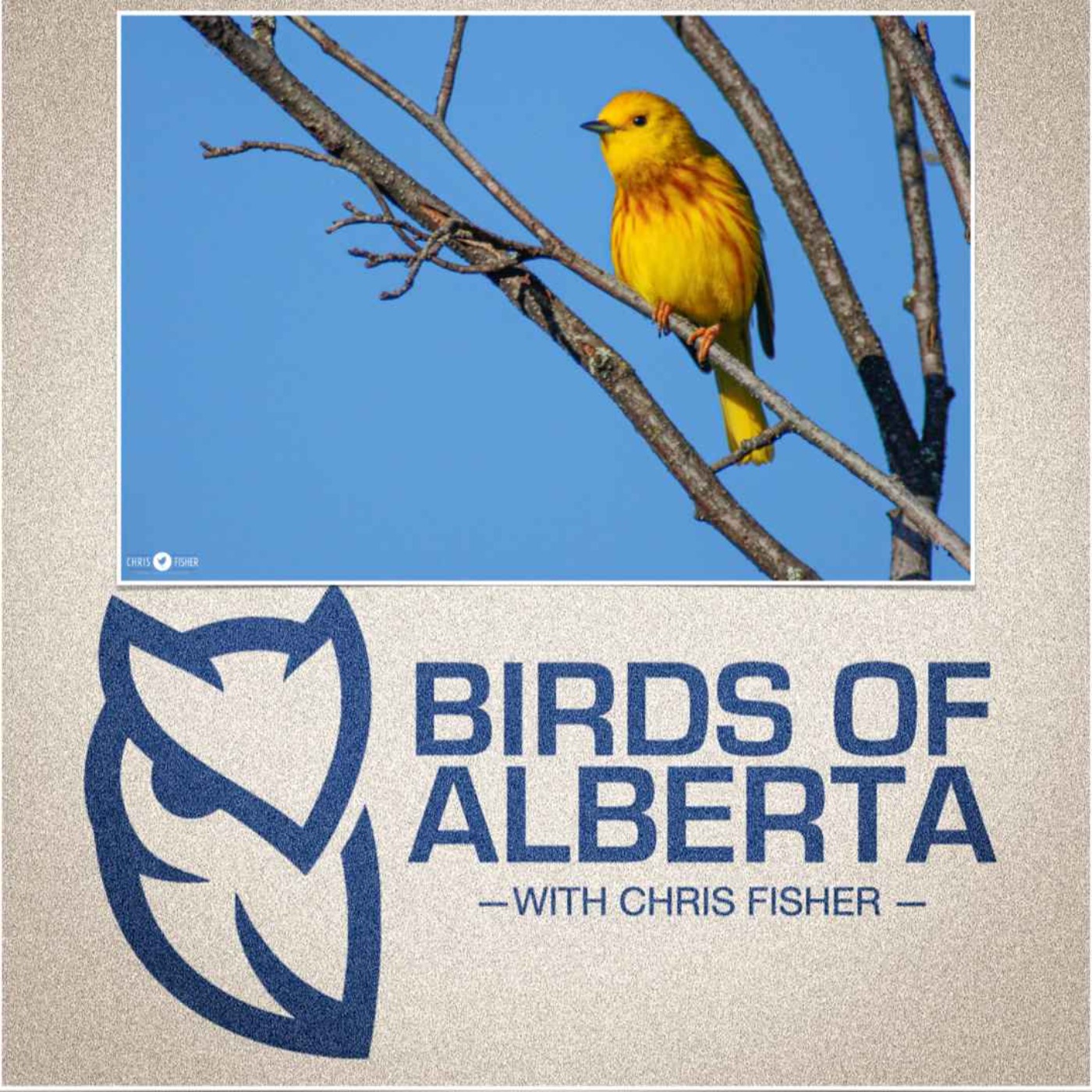
The podcast highlights the yellow warbler as Alberta's standout yellow bird, emphasizing the rarity of yellow in nature. These birds are common across the province, especially in aspen forests and river valleys, where their bright plumage and distinctive "sweet sweet sweet" song make them easily noticeable. Their yellow color derives from carotenoids, pigments ingested from food during winter in tropical regions. Yellow warblers face challenges like brood parasitism from brown-headed cowbirds but counter with strategies such as building new nests over parasitized ones and using specific alarm calls. Adaptable to small aspen patches, they thrive where understory shrubs are dense, avoiding heavily grazed areas. While other birds like the American goldfinch also share yellow hues, the yellow warbler’s prevalence and vocal presence make it a defining feature of Alberta’s summer soundscape, offering a reliable and soothing backdrop across the province.
Welcome to the Birds of Alberta podcast. I'm Chris Fisher, co-author of the best selling field guide, Birds of Alberta. Now here in Alberta, nature's palette is a big part of our technical outdoor experience. We have big blue skies, whether it's plus or minus 30 degree day outside, and paired with that blue is gold. Alberta's other official color that represents our beautiful prairies. We are a time to place the wintery whites, rocky mountains, grey, serulean glacial waters, aborial greens, and even, even at special magical times, the auroras treat us to shimmery neons overhead at night. But the color yellow, well that's pretty rare indeed, or as the poet Emily Dickinson put it, nature rarer uses yellow. So you miss Dickinson's poem? Well it's concise, I'll share it, as it's only eight lines, and she makes the case beautifully for yellow. Nature rarer uses yellow, then another hue. And she all for that sense is prodigal of blue. Spending scarlet like a woman yellow she affords, only scamply and selectly like a lover's words. Now this short poem celebrates the scarcity of yellow in nature, highlighting its preciousness, and it is indeed true for us here in Alberta that there is not much yellow to be seen in our bird life. But if you're only familiar with fictional birds, the kinds you meet in cartoons and kids programming, you might not think that this is true at all. After all, aren't big bird, tweety bird, woodstock from Charlie Brown, and even chuck from angry birds, aren't these all yellow birds? Well the truth is that yellow is quite selective, even in a bird. However, as Miss Emily put it, then just about any other feather color. But it does clothe one critter that showcases this sunny dress with audacity, proximity, and pizzazz. It is the yellow bird of Alberta. It is our yellow warbler. Now how lucky are we that really one of our most common warblers is also one of our most incandescent. Yes yellow warblers are indeed special. They are really one of our most visible warblers, catching our eye and here of really anyone who hangs out in river bottoms or upland, aspen stands anywhere in the province. All you have to do is walk through these aspen forests with a tall under story as the dappled light of the under story mixed in with shards of sun poking through the leaves and you'll be in the company of these wonderful yellow birds. They are indeed yellow, both the male and the female. The females are all yellow, save for a beady ink black eye that stands out wonderfully. The male looks very similar except for it is adorned in red streaking around the collar and then down along through its chest and to its lower belly. They are indeed very very striking birds visually, but also they sound very distinctive as well. As the soundtrack of June is really the feature of the yellow warbler even though ironically enough they're almost silent. By the time the season of summer is officially underway. Their song? Well their song, once you know it, you'll hear it so commonly throughout our province. Is a zippy, sweet sweet sweet, I'm so so so sweet. This hallmark song is featured in the background of your favorite camping experiences, your favorite walks in river bottom parks. It is a classic voice even though it is largely unrecognized by many who live here in the province. It's heard multiple times every minute in the early morning hours and as the day extends on well the males become less enthusiastic with their singing but still punctuating songs every minute or so over the course of the new hour and then dropping off in the heat of the afternoon only to revitalize their sonic energy in the evening hours and pump out the tunes in great volume once again. One of the reasons why we don't tend to have a lot of yellow bird lives here in Alberta or really elsewhere through the world. I mean there are yellow birds certainly but they're not very very common compared to other types of colors is because the pigments required for the yellow color carotenoids actually don't naturally occur as pigments. They need to be ingested see carotenoids are unique in that they cannot be synthesized in the body. Therefore they have to be ingested with the food. And I suppose since the molt occurs when these birds are down in the tropical regions we have to thank all those wonderful tropical fruits and insects for the wonderful colors that the yellow warblers arrive with in their breeding grounds here in Alberta when they arrive in the evening. Now owing to their unique coloration here in Alberta well yellow warblers are often referred to as wild canaries. American gold finches another small songbird. The males are all yellow indeed but they have vivid black tails and black wings while they're also often called canaries. Perhaps a little bit more rightly so as the gold finches are a finch. Canaries are finches as well. But in truth yellow warblers are probably a little bit more conspicuous in many areas of the provinces so they get both tagged. I've heard it both ways both tagged with the canary moniker. And does a little bit of injustice to both birds as they are incredibly special to our avifana here in Alberta and don't need to be referred to in reference to some captive animals native to distant places off the coast of Africa. Now one of the reasons why yellow warblers are frequently encountered is because they really don't need much of a clump of trees to call home any small patch of aspen which is one of the most common trees in the province particular the southern two thirds of the province will be perfectly fine for them to call home as long as there is a fairly dense layer of understory shrubs. Things like red oizure dogwood but also wild rose and hazelnuts. These wonderful shrubs that make it very difficult to walk through these sort of places like Elk Island National Park or Nikolomal Lake, provincial park in central Alberta all host numerous breeding pairs of yellow warblers as does pretty much any clump of aspen. The only thing that really deters them taking up residence in some of these aspen clumps is if there's a little bit too much heavy grazing by cattle. Elk can make short work of understory vegetation so if you do drive by a pasture and you see a nice clump of aspen trees with cattle grazing underneath them and very few shrubs well that won't be a very attractive place for these understory loving yellow warblers. They do nest pretty much at eye level in these shrubs so they're nest are actually not all that difficult to find. Myself and many other wildlife biologists do a lot of nest sweeps, particularly during May and June for industrial purposes so that there are no disturbance or destruction occurring to nests such as these that are protected and we do end up to find quite a few yellow warblers nests because while they nest in the shrubs these shrubs don't tend to be all that dense and the parents do a pretty good job of defending at least alarm calling and flying around so you have a pretty good idea when you're close to a nest and the nest because it's at eye level is usually fairly easy to observe in these particular cases. So while they're fairly easy to find well they do take other protective measures to defend their nests from not only wildlife biologists but natural predators as well. Now one of the classic concerns for nesting yellow warblers comes from a type of blackbird called a brown headed cow. Now you've seen them around and they are in fact closely associated with cattle but historically they would have been associated with planes bison that move around the great planes historically if you're closely tied to a migratory animal it's very difficult to set up a permanent residence so that is what I'm talking about.
why cowbirds are what is called a brood parasite. They dump their eggs, the female will lay their eggs in the nests of other birds and leave those foster parents to raise. The little brown-headed cowbirds has chicks of their own. Many people see these things, particularly later in June, you'll see a nice little yellow worbler, some other songbird feeding a large and gangly and quite frankly, ugly young that is voraciously taking the food much more aggressively than the genetically related young of these particular birds. So going to the fact that yellow worblers are frequent victims of nests parasitism by brown-headed cowbirds, they do have a couple of tricks up there, sleep the most famous one, is that oftentimes when they do recognize that a cowbird egg has been laid in their nest and in certain studies around western Canada, that occurs about 20% of the time. Well, the female in the male can recognize that and rather than boot the egg out, they'll in fact often build another nest, a brand new nest, overtop of the original nest and then lay another clutch of eggs and unfortunately sometimes those are parasitized as well, but just as frequently they are not. So that is one of the primary defenses that yellow worblers have to deter nesting brown-headed cowbird. The other really cool defense that they have is that the males actually have a very specific call. It's called the seat call and it is an alarm call that warns the female that there are brown-headed cowbirds in the area. So it turns out that teamwork is in fact one of the most important strategies to success for these yellow worblers, unlike some species of birds where there's very little involvement from the male while both parents are actively involved the female, primarily incubating the eggs and the male, flitting about not only provisioning, but also warning the female and what has been determined from studies is maintaining a vocal communication back to the female who is sitting at the nest. In fact, there are certain studies that have looked at the female responses and if she is not panicky and looking out, in fact just relaxed and calm in the nest, the chances of success are even greater. In fact, the females who tend to be a little bit more panicky, not in verbal contact with the male in the territory, has a lower chance of successfully rearing the young and in those situations. If there is time for re-nesting, well the female will divorce that low life and find another male who is a little bit more verbal and capable of maintaining contact while the female does the incubation and rearing while on the nest. Well, it probably wouldn't be too appropriate to talk about the yellow bird of Alberta with out, well without talking about the most popular yellow bird song. Now it isn't a current musical masterpiece, but it was very popular in the Calypso movement of the late 1950s and early 1970s. Many people will attribute the song "Yellowbird" to Clipsus singer Harry Belafonte. However, when he did the song, the title was "Don't Ever Leave Me." It wasn't until the 1960s that that particular song, based on a Haitian poem, was rewritten by Alan and Marilyn Bergman to Yellowbird and simply recorded and recorded again, first by Norman Lubof and then many many others. And it became quite a hit during that time, the featured lyrics "Yellowbird" sitting high in banana tree. Could very well be attributed to the yellow warblers who do spend their winters down in the Caribbean and other parts of Central and South America or may not, but it does remind me of a time when I was down and not part of the world as well. Now remember the time we were doing a mangrove tour down in the rivers of coastal Costa Rica and we were weaving our way up. A lazy river through these mangrove swamps and as we iled up to the top of that, like a dead end, we had to turn around and as we were doing so, I saw a flash of yellow that caught my eye and there in the jungle of Central America was a yellow warbler, but it wasn't quite just any warbler like we see in Alberta. It was a special yellow warbler. You see yellow warblers are actually a complex of 43 different subspecies based on plumages, color and patterns. We really only have one of these complex throughout most of North America, but when you get down to all the little Caribbean islands and all these non-migratory populations down in Central and Southern America, you end up having all these wonderful variations that sing just a little bit differently and instead of the red being solely isolated on the males to the collar and onto the breast. Some of it extends to different degrees to the head. So if you do go and spend your winters as our yellow warblers do down in the south, keep an eye out for them. You might see those with Canadian passports that you'll easily recognize, but some also that will be speaking a little bit of Creole or Spanish that may feature a little bit more red on their heads and those are always exciting to find down there. So you know our yellow warblers here in Alberta are really one of our special birds of the summer. They are species that I suppose that someone in Alberta could miss out on, but really only if they're really aren't paying any attention to our natural wildlife. You know, just walk any trail along the the North Saskatchewan River in Edmonton or the Bowen Calgary stroll through the cottonwood flats of Lethbridge or medicine house. You know, paws at the Aspen Grove, a hentric cattle pasture were along the the cut lines of Northern Alberta and then get away from the racket, the center of that well pad and chances are very good that doing so in in June that you'll see a flash of yellow zipping from leaf to leaf and and their song is even more mainstream. You know the yellow warblers are probably the lead vocalist on their summer playlist that sweet sweet sweet. I'm so so sweet is the perfect accompaniment to the rustling Aspen leaves of our early summer days. And while the song of the loon or the hoot of our provincial Great Horned Al may be more iconic, they are in truth far removed and removed for most of our lives. And in comparison, well, this little bird provides the soothing background mix for our ears, province-wide. It's nature's white noise machine or in our case the yellow noise machine of this yellow warbler is a song that offers the most reliable and reassuring voice of any of the birds of Alberta.
Podcast Summary
Key Points:
Yellow is a rare color in nature, including in Alberta's birdlife, making yellow warblers particularly special.
Yellow warblers are common, visually striking birds with distinctive songs, often heard in aspen forests and river valleys.
Their yellow coloration comes from carotenoids, pigments they must obtain through their diet, especially during winter in tropical regions.
Yellow warblers face brood parasitism from brown-headed cowbirds but employ defenses like rebuilding nests and alarm calls.
They are widespread across Alberta, adaptable to small aspen groves, and symbolize summer with their persistent, sweet song.
Summary:
The podcast highlights the yellow warbler as Alberta's standout yellow bird, emphasizing the rarity of yellow in nature. These birds are common across the province, especially in aspen forests and river valleys, where their bright plumage and distinctive "sweet sweet sweet" song make them easily noticeable. Their yellow color derives from carotenoids, pigments ingested from food during winter in tropical regions.
Yellow warblers face challenges like brood parasitism from brown-headed cowbirds but counter with strategies such as building new nests over parasitized ones and using specific alarm calls. Adaptable to small aspen patches, they thrive where understory shrubs are dense, avoiding heavily grazed areas. While other birds like the American goldfinch also share yellow hues, the yellow warbler’s prevalence and vocal presence make it a defining feature of Alberta’s summer soundscape, offering a reliable and soothing backdrop across the province.
FAQs
The yellow warbler is the most common and incandescent yellow bird in Alberta, frequently seen in river bottoms and aspen stands across the province.
Both male and female yellow warblers are yellow with black eyes. Males have distinctive red streaking on the chest and belly, while females are entirely yellow.
The yellow warbler's song is a zippy, sweet phrase often described as 'sweet sweet sweet, I'm so so sweet,' commonly heard in early summer mornings and evenings.
Yellow is rare because the pigments (carotenoids) required for yellow feathers cannot be synthesized by birds and must be ingested from their diet, such as tropical fruits and insects.
Yellow warblers nest at eye level in dense understory shrubs, such as red osier dogwood or wild rose, often in aspen groves across the province.
Yellow warblers may build a new nest over a parasitized one or use a specific 'seat call' alarm from males to warn females of cowbirds in the area.
Chat with AI
Loading...
Pro features
Go deeper with this episode
Unlock creator-grade tools that turn any transcript into show notes and subtitle files.
 PodcastTranscript AI