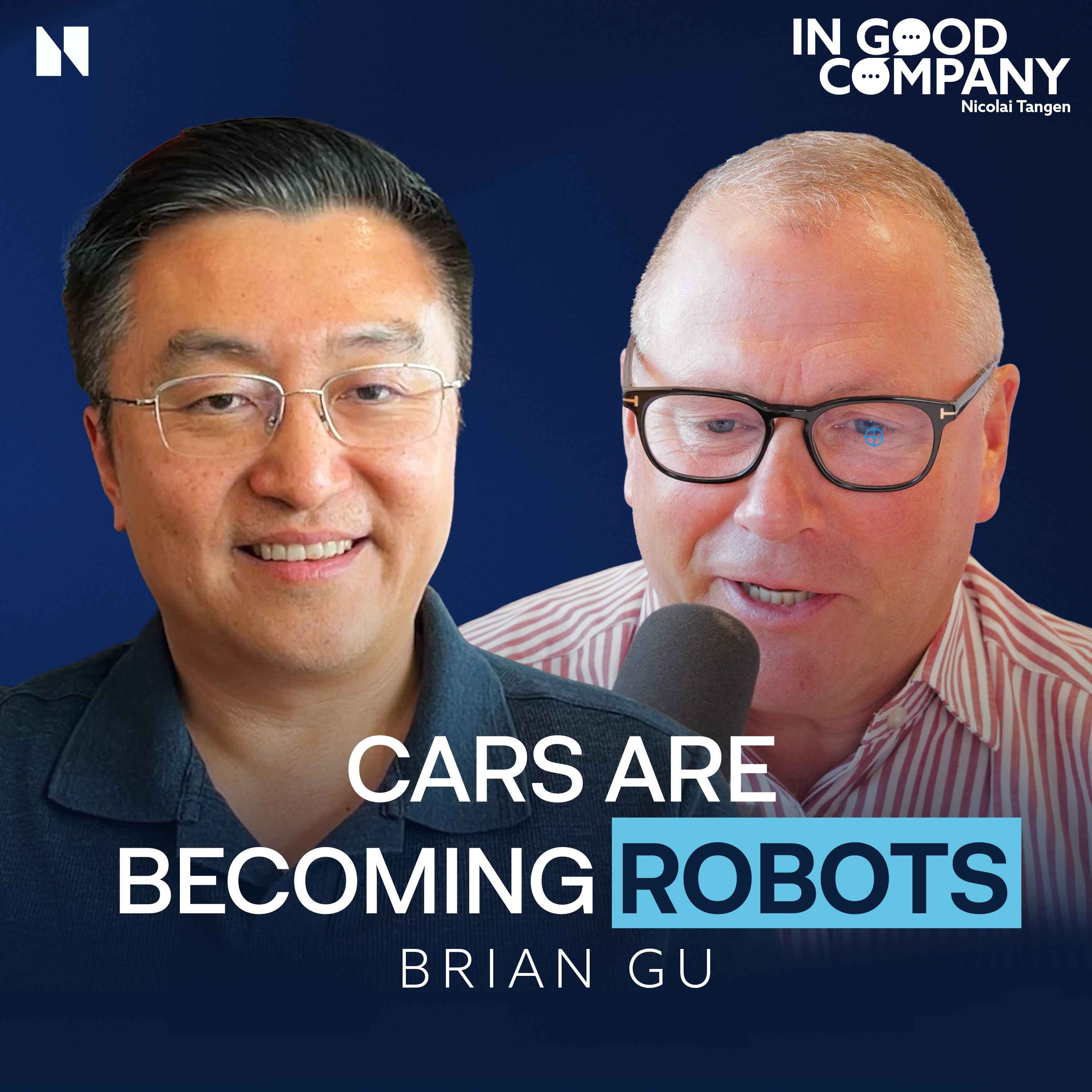
XPeng Co-President: China's EV Race, Flying Cars and Humanoid Robots
49m 22s
Chinese EV producers are now leading key areas such as electrification and AI-driven vehicle intelligence, fueled by a massive domestic market, strong battery technology, and rapid innovation. Companies like Ex-Peng are redefining the automotive sector as "physical AI" platforms, applying unified intelligence across electric vehicles, flying cars, and humanoid robots. The Chinese EV market has crossed the 60% penetration threshold, making EVs a mainstream product, which has reduced reliance on subsidies and triggered shifts in infrastructure, such as the decline of gas stations and rise of charging stations. Innovation cycles are significantly faster—shortened by three to five years—due to competitive pressures, software expertise, and consumer adoption. Despite this, Chinese brands face challenges in global market trust and brand recognition, requiring lessons from European and American multinationals in operations and service delivery. The rise of physical AI is reshaping mobility: autonomous driving, flying cars, and humanoid robots are advancing toward commercial reality, with data collection through real-world deployment proving essential. Chinese companies are also building synergies between EV and robotics supply chains, including in-edge computing and powertrain design. While Chinese AI chips have reached Western parity in edge computing, cloud and GPU capabilities still require catching up. Ultimately, the future of cities will be more dispersed, three-dimensional, and robot-integrated, with autonomous delivery and humanoids handling routine tasks, freeing people for more meaningful activities. The rapid pace of change and technological convergence signals a transformative era in mobility and daily life.
How far ahead of Europe and the US do you think Chinese producers are now?
Well I think we are leading a few areas. I think in electrification Chinese players obviously
has an advantage of having in a strong battery technology capacity cost advantages
in the automotive side because China is the largest automotive market in the world.
But what's really driving the, I was a competitiveness in China is also the fast evolution of technology.
Hi everybody, I'm Nikola Tangyan, the CEO of the Norwegian soap and wealth fund,
and I'm really excited about this podcast. Ex-Peng is one of China's fastest growing EV makers,
but it doesn't call itself a car company. It calls itself a physical AI company, betting that
the same technology that can drive a car, pilot a flying car, and power a humanoid robot.
My yesterday is Brian Gu, vice chairman, and president of Ex-Peng. Brian, warm welcome.
Thank you Nikola, very happy to be on the podcast. Brian, what is Ex-Peng?
Well, I would say Ex-Peng, first of all, is a technology company. But as we now dive into the
depths of all things physical AI, I think we'll consider ourselves really going to forefront
of this physical AI movement. We're building EVs, as you mentioned. It's one of the leading brands
in China as well as globally, but increasingly we have brought in our product scoop to be
including more areas and directions, including robots, flying cars, and other modalities as well,
by using the same core. A lot of people think that electrical vehicle is a car with a battery,
but you say it's about the intelligence that's to differentiate or not the electrification.
What do you mean by that? Well, that actually is what we actually
has done differently over the years. Even when we were a very, very small startup,
let's say about nine years ago when I first joined Ex-Peng, that time I think everyone is looking
at starting an EV company. So the big pitch was the electrified energy transition for automobiles.
But even then, we have told investors as well as our partners that we believe the long-term
differentiation is not with electrification only. It's actually in the intelligence, and that's why
I think for us, we have consistently focused on building a full stack approach on the intelligence
areas that includes hardware, software, and now increasingly moving to the era of AI.
So when you enter a car, as a professional, how do you judge whether this is a great car?
From an intelligence point of view. Well, first of all, I think when you're getting to a car,
you have to really understand whether the car can understand you. There's obviously various
degrees of understanding. First of all, it has to understand you personally, your behavior,
your preferences, where you want to go to, the way you interact with the car, you feel like at ease.
So that's the first thing you actually understand. The second thing is when the cars start moving,
I think an intelligent car can handle a lot of these driving conditions on its own. Obviously,
I'm not talking about level four yet, but even at a level two plus, I would say regime, you can feel
the difference. The more intelligent, the better trained models will handle the roads smoothly,
handles very tricky situations, very nicely, without causing any concerns or anxiety.
So all of that actually translates to the intelligence aspect of it. And ultimately, I think is,
you know, how do we unify the experiences? So what we're working on right now is to unify the
autonomous driving intelligence and the smart cabin intelligence and merge them. I was actually
just in the car this morning. We are going to launch our latest, I would say, the intelligent driving,
the VL 2.0 editions. One of the features is actually using the smart cockpit interaction to
commend driving. Say, I want to pull over a little bit. The car knows what to do. I want to actually
make a quick stop. They can actually do that for you along the planning as well as delivering you
there. So all of that, I think combined together with delivering a intelligent mobility experience.
What is this going to look like in 10 years time, you think? Well, I think with advancement
and technology, I would say, you know, the level four capability were just a matter of time.
It's going to happen. It's going to happen now or lifetimes. It's going to happen in a lot of
and also the ubiquitous scenarios that you encounter. So if that capability becomes everywhere,
they can imagine the current way of life, current mobility experience will be completely transformed.
You are not limited to a certain location. You are not limited to spending time planning your time
to handle the driving. The driving is as part of your daily work or daily, you know,
entertainment as part of your mobility time spent. So I would say you will change people's time
allocation, your change industries like real estate, change industries like communications,
and also change pretty much everything I would say. You can actually handle inside the vehicle now.
What's going to happen on the range side in terms of how long how far a car can travel? I mean,
I'm sorry, just to inject here, level four is totally autonomous, right? Yeah, level four is
fully autonomous without human intervention, for example, without the steering wheel, yes.
Yeah. So what is what's happening with with with range and charging times going forward?
I would say the range with the current chemistry. I think that current chemistry will last for,
you know, quite some time before we get to maybe solid state, I would say that's more than five
years away to be commercially feasible. So with the current chemistry, I would say the range will
stay similar to what we see today. Let's say between 500 to 1000 kilometers given the size of
battery, obviously. But the charging time and the charging experience will change dramatically.
Obviously, you you saw the super fast charging become very, very popular in China already,
and it's spreading around the world. The charging time and charging speed will allow people's
you know, downtime to be very similar to a gas station stop. So, for example, used to be taking,
I don't know, half an hour to an hour of charging, you know, time now it's maybe five to ten minutes.
So that I would say also changes people's mobility behavior. So with charging as well as the
efficiency, I would say you don't need a large battery. You don't need a car that has, you know,
2000, 5000 kilometers of range. That just adds to the cost and weight of the vehicle. But I think
it definitely addresses a lot of people's range anxieties already with availability of network
and the charging speed improvement. What's the range where you think it's enough and beyond that,
you don't need more range? I think 1000 kilometers outside sort of limit. Anything more than that is
waste. I mean, in my mind. Do you make your own batteries? What do you use C8L or who do you use?
Well, we don't make our battery sales. So we actually source from very high quality suppliers,
you know, that there's actually a couple other names, which is large battery companies in China we
work with, not C8L. But we do design our own, you know, battery technology utilizing those sales,
for example, you know, the battery management system, the packing technology, the really the,
you know, the electric platform that make our vehicle more efficient, higher and faster charging.
So those technologies actually would do ourselves. Where do you see the Chinese EV market going?
This past month, Chinese new energy penetration exceeded 60 percent, maybe even close to 65 percent.
That's a staggering number, which means that we have more EV sold in China than ICEs today.
So this is actually the first time the battery electric vehicle crossed the ICE and obviously adding
on the plugging hybrid, the new energy segment is now more than 60 percent of the new car sales,
which means actually, you know, the EV or new energy vehicle is actually a mainstream product.
A few years ago, people always see EV as a niche product, right? I mean, it's only a small portion
of people buying EVs compared to the, you know, people, most people still go for the ICEs. But today,
because of the change, because the change that, you know, EVs and hybrids become mainstream,
all the rules are different now. So for example, you know, we're now getting rid of all the subsidies,
because now you don't need to subsidize a mainstream product. You don't need to encourage the use
of them anymore. You know, people are naturally buying them. But at the same time, you know,
I think those are behavior. For example, you start to see gas stations disappearing, replaced by
charging stations. You got to start to see, you know, people actually now utilizing the electrified
vehicles, EVs and hybrids, because they have a battery, they have computing power. A lot of
those intelligence become more and more prevalent. So that actually leads to a whole new trend,
not just because of energy, but also intelligence and other behaviors.
How is the competitive landscape developing? It seems from the outside that is becoming, I mean,
it's just like fiercely competitive. Absolutely. I think China, the new energy vehicle market,
which includes the EV market, is probably the most competitive segment or industry in the
world. We have a lot of very, very high quality players competing with each other. I would say,
you know, China is probably
the fittest gym in the world for automotive industry, right, you know, whoever can actually survive this gym
I think has a good chance of, you know, really become a, you know, leading players globally. Who's going to survive that gym?
Well, I think, you know, we have a decent chance, but also there's a very very uphill battle for everybody because, like I said,
one is it's very competitive. Two, it actually requires a lot more to compete than the past.
I think in the past, automotive company can focus on their segments. They use a lot of, you know, tier one suppliers, tier two suppliers.
They actually source technology from outside, but today, given the development of this physical AI, you know, cars become more and more like robots, right?
I mean, not only it's electrified, but also because he has the intelligence I mentioned, it's because they have, you know, the automotive capabilities I need to demonstrate.
In order to build a very competitive product, you need to be both a good automotive engineering, but also at AI and software, you also be good at, you know, understanding the new electric powertrain.
And at the same time, you need to also make sure you deliver the best services as required for building the brands.
So having all these capabilities are making the competition at a different level compared to before. So the people who can survive and be and winning the race will have to be the people who has a full stack technology, but also has a scale and global reach in order to be competing.
Well, I think we are leading a few areas. I think in electrification, Chinese players obviously has a advantage of having, you know, strong battery technology capacity, cost advantages in the automotive side because China is the largest automotive market in the world.
Like I said, China being competitive, being a market where consumers really embrace new technologies. So the speed of change and also the customer adoption of new technologies faster in China than in other parts of the world.
So I think with these kind of background and coupled with also the manufacturing advantages in supply chain, manufacturing efficiencies, etc. I think China does, I think, possess, I will say lead in some of those key areas in the EB development.
But at the same time, I think Chinese players also have to be learning a lot from global players. First of all, I think Chinese players still not, you know, used to be a leader in a multinational world.
So that's an area I think Chinese players do need to learn how to behave as a company that can be a leader in multiple continents, multiple regions, building up random people trusts, building a service that people rely on and also building local relationships that allow you to stay for the long run.
All of that, I think, takes a long time to invest. So those are things that we should learn from multinational leaders in Europe as well as in the US.
And at the same time, do you think it will take expand to role-loads globally because you've, in a way, started in the Nordic region to a certain extent with the dealer network and so on. But just where are you on that journey and what will you take?
Well, you know, we started journey as you pointed out in Norway about six years ago when we actually launched the first store in Norway, I think the end of 2020.
It's been a very interesting, I would say, and very, very educating process. You know, we went through a lot of changes in our business model internationally.
We entered Europe as a whole. We also entered into other regions in Southeast Asia, Middle East, Australia, and also Latin America now. So we're selling over some of the countries at the moment. But I would say the biggest challenge is to making sure that we, you know, really adjust our models to becoming a locally accepted brand and product.
As you know, you know, Chinese brands in the past has been viewed as, you know, coming from, you know, possess, you know, lack of quality or some, you know, brand recognition issues.
So for us is not only we are entering these countries, but also have to build the local capabilities and brand that supports our growth. And also another challenge for us is how to differentiate from the, you know, does another brand that currently also is trying to go global out of China.
So those are things actually, you know, a top of mind at the moment.
When you compare and contrast X-Pang with let's say European producers, what do you, what are you seeing when Volkswagen has a stake in you and you also produce cars in Europe. So you've got a pretty unique opportunity to compare. How do you compare?
I would say we're, you know, looking at a number of dimensions when we actually see ourselves competing with global peers on the technology front. I think we, you know, as a small company, a young company, I think we're probably more nimble than lot of the global players.
We make decisions quicker. We can actually also make technology innovations faster. So that's one of the reason that I think some of the global peers are working with us, such as Volkswagen. But at the same time, also we are really understanding how global multinationals operate.
That's something I think we're learning from the bigger players, you know, from German OEMs as well as, you know, American and Japanese OEMs. How they can actually sustain, you know, many generations of product development and cultivate a local recognition and brand loyalty.
That is something I think we're learning from them as well. At the same time, I think also given the development in EV and also the technology in intelligence, I think there's also a thesis to be made is that you would see more collaboration between Chinese players and international players, such as the ones that you saw between Volkswagen and expand and some other examples as well.
Because I think there is a very strong complementarity that we actually bring to the table, you know, we're bringing fast innovation, we're bringing, you know, I would say some of the consumer understandings from a Chinese market and also, you know, being able to deploy in a faster pace.
But at the same time, I think, you know, coupled with international players like Volkswagen, that actually can help us really achieve scale also and have you as, you know, making sure we can monetize some of those investment in a much wider segments.
So those benefits, I think come together, I think I actually could encourage more collaborations down the road.
What explains the difference in speed and innovation and generally in speed? I mean, what explains the, what we call the Chinese speed?
Well, I think the Chinese speed appeared because multiple factors are driving it.
First factor is your China has proven to be a very, very strong player in the software, Internet, consumer electronics area. So those expertise allows, you know, the Chinese development, I know team, you know, R&D side working with automotive engineers to really think creatively how we can utilize those learnings and make cars smarter and make more consumer friendly.
On the other side, you have the market forces. As I mentioned, you know, there's a lot more competition in China that forced you to be more innovative to push you to, you know, really be faster in turning some of these technology development into actual product and features.
And then the third piece of that is, you know, the consumer adoption rate is much faster. So in China, people willing to, you know, embrace new technology, you saw that Internet, you mobile Internet, mobile payment, all of that actually points to the same thing.
So those three forces together, as well as obviously the supply chain manufacturing advantage dimension makes Chinese innovation much faster.
How much faster would you say? I think there are two ways to look at one is vehicle development cycles. I think we probably shorten by, you know, maybe five to three to five years to about, you know, two years.
So I think there's definitely shortening of vehicle development. The other one is how quickly you actually launch new features. I think, you know, every OTA we add features to our products.
So that's product cycles much faster than the traditional automotive product cycle because now you have the software and OTA feature adding to that.
And why, so why can you do that so much faster than, let's say European producers.
First of all, it is the DNA of the company is different. I always say that, you know, X pen, even though we're obviously automotive company, but the core DNA is tech.
You know, we obviously, the founders came from both automotive world as well as the software internet world and not increasingly with AI capabilities.
So I would say the DNA at the top really drives the way we think about product and development.
Second answer, I think to this is that we're small, we're young, you know, we don't have department walls, we don't have processes that has been placed for decades.
So it's very difficult to change. We also don't have stakeholders, we need to maneuver to make those changes happen.
Some of the global players, you know, you have make a decision in their headquarters and one that soon reaches China or reaches.
their end market, it's already that maybe a year later. So those speed, it's not able to match
the speed we see on the ground in China. How much harder do you think you work? Well, I think I
I would say, you know, our team probably works very hard. In a way, I think it's both the China
work ethic and speed of innovation, but same time also we have a sense of entrepreneurship
because company is only 12 years old. So we still, I think the management team and team here
still have that spirit. I experienced when I first got here. We still keep that entrepreneurial spirit.
So I think, you know, those two characters really drive, you know, the work ethic and I think,
you know, teamwork much, much harder. Flying cars. When will cars fly? It's already flying, you know,
we actually, but we are flying a different way. We have this company called Erich that she
is a company that we incubated. And the company currently is now only invested. We might not
show that moment, but we consider that company in our ecosystem. They have been designing
flying cars for over 10 years. It was actually founded by a very charismatic founder who used to be,
you know, individual pioneering the development of flying motor and flying vehicles on his own,
with only a few people, very small. But now with obviously our support with, you know,
the development of the last 10 years, he's built that, you know, business into, you know, a very,
very substantial business. And they actually have a product ready to launch, obviously,
pending the final approvals in China at the moment. It is a considered flying car, but it's actually
what we call the aircraft carrier, the land aircraft carrier. It's a car that carries a EV toll
inside the vehicle and can be separate automatically and be used flying for, you know, 30 minutes,
and then you can actually take two people with, you know, the vertically took off and then it can
actually come back automatically and be loaded into vehicles. So that actually is something,
I would say, it's very, very close to commercial reality. The company actually already collected
more than 7,000, you know, inductive orders around the world, not just in China. So I think you're
actually seeing the low altitude economy, which is a Chinese buzzword for the last few years.
Same time, also, a flying mobility. That's actually, I will say, the Western world, you know,
become probably reality in the next year or two. Yeah, we'll cut in some, some footage here,
so people can see. But when do you think there'll be a mass market? Flying EV toll business,
I think it will take, in my opinion, longer adoption time. Clearly, it's heavily regulated area.
For example, we are waiting, you know, the company area is waiting for Chinese CAC approval,
which you'll take, you know, I would say longer than regular vehicle approvals.
At the same time, I think for, you know, companies or individuals who are willing to, you know,
buy and operate these vehicles. I think it will take a long educational process. So I think,
you know, in terms of the curve of penetration, I think it will probably take, probably three
to five times longer than what we typically see in automotive or in some autonomous driving
technologies. So you will be a graduate process. But at the same time, I think I see a lot of
ensuesism for this space, because ultimately liberated, I would say, will liberate a vast
economy, which is not tapped at the moment, both in China and globally. So I think there is a
tremendous potential for this, you know, segment to become a mainstream industry.
Ryan, let's move on to another incredible, incredibly area, the, the humanoid robots.
Why, why are you going into robots? You know, the reason that we're going to robot, it's actually
very natural. First of all, as I mentioned earlier, X-Pen has always believed in intelligence.
It's our core differentiation. That intelligence obviously in the automotive world is
autonomous driving smart cabin. But with now the, the advent of AI and physical AI development,
that means that we have to develop a core capabilities, for example, including, you know, edge
computing. Now we have our semiconductor chips in our vehicles with ourselves. We have to build
models for handling, you know, the VLA that, you know, make, you know, autonomous decisions for
vehicles. We have to also build AI infrastructure that handles data inputs, collection and training.
So all that capability actually is naturally very transferable to thinking about the robotic
development. Because at the core issue is a very similar physical AI fundamental building blocks.
So for example, in the robotic world, we're utilizing the same edge computing system,
which including the chips, the models, the data and the training. But also the same times,
we're using, you know, our learnings from, you know, the power train had, you know, the efficient,
you know, electric power train, the, the, the, the, the motor, electric motors, which can be
utilized also in, in, in, in human row up robots. And I think those capability is synergistic
in terms of development, because they share that same core. Ultimately, you know, in fact,
if you look at the, the, the process of, you know, vehicle development, it's increasingly becoming
more similar to a robotic robot than, than a traditional automobile. So that's why I think there's
significant, significant synergies that we can actually share because the core that we focus on
is actually on the intelligence. And why we're going to human row bias because we think ultimately
with all the capabilities I mentioned, the most versatile form that can impact people's daily
lives is a human-noir robot. Because think about it, you know, the environment that we live in, the,
the room here, the office there, the store, you know, the, the, the, the restaurants, all built
for human movements and human occupation. So having a human-like human robot, which is what we
trying to do, unlike some of the other robotic company, is to make sure that we can, you know,
design something that can be widely, you know, applicable, deployable. And that also helps us
getting the information and data collect that can continue to train and improve the robot.
So that is actually thinking behind it. Yeah. No, I personally, I can't wait. I think it's
going to be absolutely great. And I also think it will get divorce rates down because you'll stop
doing all the boring things like taking out the rubbish and emptying the dishwasher and all these
kind of things that creates divorces. But no, you are a very serious player here and you just
raise capital and have support from Alibaba and Tencent and so on. Tell me about the landscape,
there seem to be a lot of very serious players here. Yeah. Well, I mean, human-noir robot has
seen quite a boom in the last, I would say, two, three years. Internationally, you have the big
boys like Optimus, you know, Fontesla, as well as figure and others that's been very showing
showing various degrees of capabilities, attracting attention and capital. But in China, I think
you also see a really robust industry that, you know, you see emergence of a lot of startups that
actually has been focused on various type of development in robotic industry and the process.
But I would really say that, you know, what we see here in China, you can group those companies
into certain different types, right? You have one type which is really focused on the body,
which you can see the company like UniTree, like Ingenia, that shows very cool, very,
you know, high-calibre, you know, motion capabilities. They can run, they can jump, they can kick,
they can perform and dance. But, you know, they're really good at the body. But obviously, you know,
we want to see them become more intelligent. That's obviously something, you know, that they
haven't been focused on. The other group of the companies that focus on more on the brain and
the intelligence side, they are training the robot to handle certain specific tasks. But because,
you know, their resource and focus on the upper body, they actually, you know, did not really
design anything that has, you know, nice in the motion and movements. And then there's the third group,
I would say, is, for example, the dexterous hands, you know, the companies that really try to build,
keep building blocks as well as, you know, was combined with some models that can perform certain tasks.
So those are the types companies. But where I would say a company that can really put these
three pieces together and make that unified in a common, deployable, more volume-produced,
human robot, is that something that we aim to do? And which actually we have now, you know,
completed, I would say, the development for these different pieces. I think, ultimately,
there's different views on our robots. You know, certainly there are industry players,
okay, robots need to, you know, immediately go to industry factories to perform certain tasks.
But remember, you know, we already have robotic arms that's operating our automotive,
you know, both factories. So, you know, the robot that can be used to perform a fix, you know,
task is not as exciting as a robot that can handle more general and it can be general purpose robot.
[BLANK_AUDIO]
At the same time, I think, as I mentioned,
ultimately training the robot and with the relevant data
and had the data scaling capability
is gonna be the key to the success.
And we think the best way to train robots,
obviously there's a lot of data,
you can collect from internet, from simulations,
from egocentric, sort of video camera collections.
But ultimately, the best way to collect
the most accurate and useful data
is by deploying the body that actually
has the most general purpose application
and deploying them in a large quantity
that allows you to have best data collection and training.
So those are things actually, I would say,
in a word, focus on that's different
from the other players in the industry we've seen China.
- Is it right that Chinese training centers
provide a lot of humanoid robots to train them
and to actually collect that data
and then feed it back to the producers,
is that how it works?
- People do that mostly for deploying
into certain specific tasks, specific use,
which I think is still not,
I'm sure there are players ultimately
will be able to complete a business model
utilizing that approach.
But I would say is that the data collection
should come from regular deployment and use
and continue the improvement of that robot
that you have the fixed body.
- The fact that you have so many players in the EV space,
what does that do to the Chinese abilities
in the robotic space?
- Well, I think there's a lot of the capabilities,
I think EV players can empower robotic development.
For example, the process of providing electric powertrain,
lightweight sensors, compute.
So these capabilities, I think,
especially EV companies that has the AI capability,
a lot of them can actually also,
I would say empower the robotic development.
But also goes back to the roots of the company,
as I mentioned, if the root of the company
is automotive player,
it's already very difficult for them to pivot towards,
let's say software defined vehicle
and then moved towards the AI defined vehicle.
For them to be immediately jumped
from automotive company to robotic company,
I think it's a big cultural challenge as well.
So I think also it goes back to the DNA
and the roots of the company that who actually
can leverage that capability
and have the innovative thinking,
allow them to see the development needed
for human robots.
- What about the ecosystem of suppliers,
of the various components that go into these robots?
How would that compare in China with,
let's say, the US or Europe?
- First of all, I think the supply chain for robots
is still being formed.
There's no existing suppliers,
people can just pick and choose to build a robot.
Or you cannot pick and choose to build an advanced robot.
I would say what we do right now
is actually we spend a lot of our time
and effort working with our EV supply chain.
Identify players who has a capability
to be able to function in the robotic setting.
A lot of the parts that we use for our human robots,
including the Dexter hands, the powertrain,
the joints, the motors actuators.
A lot of those are actually designed by ourselves,
but obviously we don't make everything ourselves.
So we actually work closely with our supply chain partners
to make sure we have very, very solid supplier for these parts.
I would say the overlap between our EV supply chain
and the robotic supply chain is more than 50%.
But most of them are not readily available parts.
Those are parts that we actually have to work closely
and design together and make sure they can supply us.
I think that's probably gonna be how
a supply chain will be built for this industry.
Have you got access to all the chips you want?
And via chips, all these kinds of things?
We do actually design and build our own edge computing
mobility chips, for example, the Turing chip,
which is now used in our vehicles,
replaced the immediate chips we used before
as the go to high computing chips
for mobility driving technologies.
I would say for all the related chips,
we have full access and we don't have any limitations.
We do have to obviously sustain the same challenge
that we, everyone's facing on the memory chip,
and other on the cost and supply side.
But so far, I think it's within control.
But in the long run, I think we see that
a lot of those chips we actually can tap into
more locally sourced fashion.
So I would say the supply more secure and more available.
- So when do you think they'll be on par?
- Well, on the vehicle,
and I think we are already producing chips
that can rival the latest technology
that's provided in the West.
So for example, our Turing chip has 700 tops of compute,
which is similar to Auring SOAR,
the immediate SOAR, which is the latest chips.
So for these on board, edge computing mobility chips,
I think we're already there in a lot of Chinese players
all come up with similar capabilities.
But I do think there is still a generation's gap
exists in the GPU and other sort of cloud computing areas,
which I think Chinese companies are trying to catch up.
- When you think the Chinese language models
will surpass the American language models?
- I think it's, you know, at the different race,
I would say, you know, the two ecosystems are building
language models are trying to tackling different problems
and focus on different customers.
I would say in the US, you have the frontier models
that actually is, you know, focused on, you know,
delivering high value and also secured solution services
to Western governments and companies,
whereas I would say the Chinese models
are more focused on tackling, I would say,
small-medium companies, as well as, you know,
emerging market customers, including obviously
on the Chinese market as well, to, you know,
making sure the models can be easy to use, open source
and also have a low cost.
So I think those are different priorities.
At some point, I think, you know,
you will see separation of, you know,
the ecosystem that rely on these time
two different capabilities.
- Mm-hmm.
We talked about self-driving cars, flying cars,
humanoid robots.
What is the city going to look like in 20 years time?
- Well, I think, first of all, you know, the city,
it will be a lot more dispersed, my view.
It does not need to be a center.
Unlike today, you know, you have, you know, CBD
or in our center area, and then people commutes,
and then there are satellites, people rely on proximity
to do things with obviously the autonomous driving
or the robot taxi or level four, you know,
individual level four as well.
You probably don't need these clusters.
People can actually have much easier access
to remote areas.
So people actually can choose to live
in what distributed fashion, rather than a concentrated fashion.
I would say the second part is that with also the technology,
that there will be a lot of last mile solutions.
You know, for example, you know, the delivery, you know,
nowadays there's a lot of delivery.
These public can appear in your door front
or in your roof or some, you know, designed storage,
it will show up because it comes from low altitude
or come from autonomous delivered vehicles or robots.
So I think those also reduce this last mile
so need for a lot of the merchandise solutions.
I would say you'll see cities become three-dimensional
because a lot of these travel,
a lot of these highways are no longer just be on the ground.
They will be designated corridors
to travel in low altitude in certain, I would say,
routes that connect cities so much faster.
So it's pulled together the city sort of distance
and the travel time.
And ultimately, I think in home and businesses,
you see a lot of routine, repetitive
as well as workflow that can be handled by humanoids.
That, I think it's gonna happen very soon.
You know, obviously it depends on how quickly
the humanoids can acquire more and more tasks.
But I think you'll start to see the population,
you know,
maybe a scenario that you will see more humanoid walking on the street than humans. That could be a
very interesting site in a modern city, decades down the road. Do you think we're going to be happier?
Well, I think I would hope with the advance of technology and you save time, you save hassles,
you actually can travel much longer distance or you can actually have more time to enjoy.
Actually, you can allocate more time to things that matter. For example, you focus on things that
really can impact your emotions. You spend time to think about judgments. You have to make
not on a simple task, on a more philosophical sense. There are things that actually you can
actually add a different degree to really approach, because now 90% of our time is occupied by
routine tasks and items. Moving on to the personal side, what matters in your life?
You know, I joined X-Pen nine years ago. I joined my friend and partner, Xiaopong, with the
Chairman CEO. I think both of us, I think, want to do this because we already had a prior career.
We don't need to have a new career. We want to do this because we think that this is going to be
so much fun. We want to see the world really be shaped. We have our cars now. Now I go to different
countries. I'm so happy and excited to see our cars in different streets. Hopefully in the future
we'll see robots roaming in offices or in stores that are in our robots. I want to see the
really the lives being changed and transformed because the technology and innovation we brought to
this world. So yeah, this is something that drives us and also drives X-Pen. That's why I keep
really innovating and keep moving forward. No, I agree. We live in an incredible time.
So interesting. How does your day look like? Oh, I would say every day is different.
You know, we, for example, I can just tell you my today, you know, today I spent, you know,
a couple of hours. When you wake up, I wake up around, you know, 730. I, you know,
started my first meeting at around 839 and I, you know, talked about my upcoming, you know,
sort of a trip in Europe, which we'll have, you know, hopefully some exciting things to do
to pursue. And then I had, you know, two hours of really driving in our brand new vehicle,
the G9L. But most exciting is I should test drive the latest edition of our Thomas driving software
on that vehicle, which I drove the car all around the city and the test all kinds scenarios.
Very exciting. I see tremendous improvement. And I think that this give us more confidence that,
you know, we can launch probably more level four light capabilities, not just in China,
maybe hopefully next year is somewhere in Europe as well. So that's something also we're very
excited about. And also I'm going to go, you know, explore our development in Hong Kong when you
setting a new R&D plan for, you know, how to really work with Hong Kong, utilizing the capabilities
in that market, you know, with the talents and the support. And then, you know, and the night,
probably was a dinner was a partner to explore more exciting things. So, you know, every day is
different. You focus on both running the business, but also more importantly is thinking about the
future. How expand can bring technology to real life, how it can expand to more regions, more
markets, and get, you know, the global, you know, sort of the talents to join us to pursue this
mission together. What's the way you look into the future? Who do you speak to and what do you read?
I actually, you know, because of my background, I used to be a banker and also used to be a banker
who focused on technology. So I have a lot of friends in the intro for no world. A lot of people
who you talk to on this podcast are actually my friends. I, you know, those are solid leaders. For
example, Joe, Joe's high is a great friend. He is someone I, yeah, from Alibaba. So I talked to
him and really learning from not just him, but also a lot of Alibaba friends, you know, people from
you know, Tencent. You know, Tencent is a great, you know, I would say a person that, you know,
would learn a lot from. Obviously, we used to be, you know, collecting a lot when we are, you know,
utilizing video chips more. But again, I mean, I think along the way, I would say given what we do
and what we see, we went to a lot of very amazing accomplished minds and I was inspiring people.
So I think, for me, you know, having that exposure and having the ability to talk and learn from
these people is tremendously rewarding. I really enjoy it. We talked about all kinds of successors
and great things. But we've started also, it's important also to look at some of the failures.
What would you say if you were to pick your biggest personal failure in life? What has that been?
I would say, you know, I always regretted I did not pursue my first passion further, you know,
my background is, you know, actually my first career as a scientist. I was a chemist because
my mother was organic chemist when I started in college, which in my mom, you know, put down
major chemistry for me already. So I became accidental chemist. But I really enjoyed it. I got my
undergrad in chemistry and then went on to pursue a PhD in biochemistry. And actually my PhD
experience is probably one of the most rewarding process because I got to work with my professor,
David Baker. I don't know whether you know him. He actually won the Nobel Prize two years ago
in chemistry. And he and I actually started that lab together. We actually both arrived at
University of Washington at the same time. He needs a graduate student. I need a professor.
And that's how we started that lab, which now became obviously highly successful and he won the
Nobel Prize. But that is being a, you know, very absolutely. I was a rewarding process. And I would
say that I was at that time, wanted to be a scientist just like David and also tried to pursue
a scientific career. But in the middle, I think I want to say is maybe I want to also see the outside
world other than the lab and academia. So I sort of pivot away from science and went into business.
And obviously first was in Wall Street and then now in the X-Pen. But I would not say my biggest
failure. But I think that's one of my regret is if I actually continue down, you know, I will also
be very exciting to make sure I can solve big problems for the world in scientific area, which,
you know, David and I actually, the thesis was actually to unlock the protein folding problem,
which actually he did, you know, about 20 years later. Don't you think you would have been fun to
have five different lives and kind of shoot them off in different directions? Well, I think that's
something it's something I always dream about. But I guess, you know, at some point you should focus
on one thing at a time. But I think life is full of opportunities. And I think it just, you know,
focus on, you know, the next one. I think that's something I think it's, I always tell my kids,
you know, don't worry about changes. Change always bring opportunities. Just focus on the next one.
Yeah. And then just to kind of crystallize that a bit more, just what would be your advice to young
people generally? I always think for young people, never afraid of change, embrace change. Actually,
you know, I always think in looking back in the, you know, my career, you know, change make you
better, make you stronger. A lot of times we go into a new area, you know, whether it's a new
profession, a new region, a new language, a new culture, a new industry, you feel like you're
intimidated. Actually, you should feel really excited to learn. I mean, you can actually now
get into a new area that you absorb. What's there? So I think that attitude could actually, you know,
really reward the young people if they actually can adopt that attitude.
Well, and this has been just tremendous. I kind of think you are a scientist, you know,
and for sure, a very good one. And what you're doing with the company is totally mind-boggling.
And thanks for giving us, you know, kind of a glance into the future. It's been so interesting.
Thank you very much, Nikolai. Very nice talking to you.
Podcast Summary
Key Points:
Chinese EV producers lead in electrification due to strong battery technology, cost advantages, and a massive domestic market driving rapid innovation.
Ex-Peng defines itself as a "physical AI" company, integrating intelligence across EVs, flying cars, and humanoid robots using shared core technologies.
The core differentiator is AI-driven intelligence—enabling cars to understand users, navigate autonomously, and unify smart cabin and driving experiences.
Chinese market adoption of EVs has surged past 60%, making them a mainstream product, with fast innovation cycles and rapid consumer uptake accelerating change.
Chinese players face challenges in global brand trust and scale, learning from Western multinationals in operations, customer service, and cross-regional market integration.
Chinese speed in innovation stems from software expertise, intense market competition, and consumer openness to new tech, shortening product development cycles by 3–5 years.
Flying cars and humanoid robots are being developed with real-world readiness, especially in China, where flying mobility and robot deployment are gaining traction.
Success in robotics depends on integrating AI, edge computing, and electric powertrain technology, with data collection through widespread deployment being key to training intelligent robots.
Summary:
Chinese EV producers are now leading key areas such as electrification and AI-driven vehicle intelligence, fueled by a massive domestic market, strong battery technology, and rapid innovation. Companies like Ex-Peng are redefining the automotive sector as "physical AI" platforms, applying unified intelligence across electric vehicles, flying cars, and humanoid robots. The Chinese EV market has crossed the 60% penetration threshold, making EVs a mainstream product, which has reduced reliance on subsidies and triggered shifts in infrastructure, such as the decline of gas stations and rise of charging stations.
Innovation cycles are significantly faster—shortened by three to five years—due to competitive pressures, software expertise, and consumer adoption. Despite this, Chinese brands face challenges in global market trust and brand recognition, requiring lessons from European and American multinationals in operations and service delivery. The rise of physical AI is reshaping mobility: autonomous driving, flying cars, and humanoid robots are advancing toward commercial reality, with data collection through real-world deployment proving essential.
Chinese companies are also building synergies between EV and robotics supply chains, including in-edge computing and powertrain design. While Chinese AI chips have reached Western parity in edge computing, cloud and GPU capabilities still require catching up. Ultimately, the future of cities will be more dispersed, three-dimensional, and robot-integrated, with autonomous delivery and humanoids handling routine tasks, freeing people for more meaningful activities.
The rapid pace of change and technological convergence signals a transformative era in mobility and daily life.
FAQs
Ex-Peng differentiates itself by focusing on 'physical AI' rather than just electrification. It emphasizes intelligence across autonomous driving and smart cabin systems, using a full-stack approach in hardware, software, and AI to create a seamless, intelligent mobility experience.
Ex-Peng believes level four autonomous driving is imminent and will transform daily life by eliminating driving as a time-consuming task. This will change how people allocate time, impact industries like real estate and communications, and enable a more flexible, mobile lifestyle.
Ex-Peng expects current battery chemistry to maintain ranges between 500 to 1000 kilometers. However, charging times will drastically improve—down to 5–10 minutes—making charging experience comparable to refueling, reducing range anxiety and eliminating the need for excessively large batteries.
The Chinese EV market has surpassed internal combustion vehicles, with new energy vehicles accounting for over 60% of new car sales. This shift marks a transition from niche to mainstream adoption, leading to reduced subsidies and a growing network of charging stations.
Ex-Peng claims to develop vehicles 3–5 years faster than traditional automakers due to its tech-heavy DNA, agile decision-making, and rapid software updates via OTA. This speed comes from a combined focus on software, AI, and consumer-centric design.
Ex-Peng incubates flying car technology through a company called Erich, which has a product ready for launch pending approvals. It also develops humanoid robots based on the same 'physical AI' principles, aiming to create general-purpose, widely deployable robots that learn from real-world interaction.
Chat with AI
Loading...
Pro features
Go deeper with this episode
Unlock creator-grade tools that turn any transcript into show notes and subtitle files.
 PodcastTranscript AI