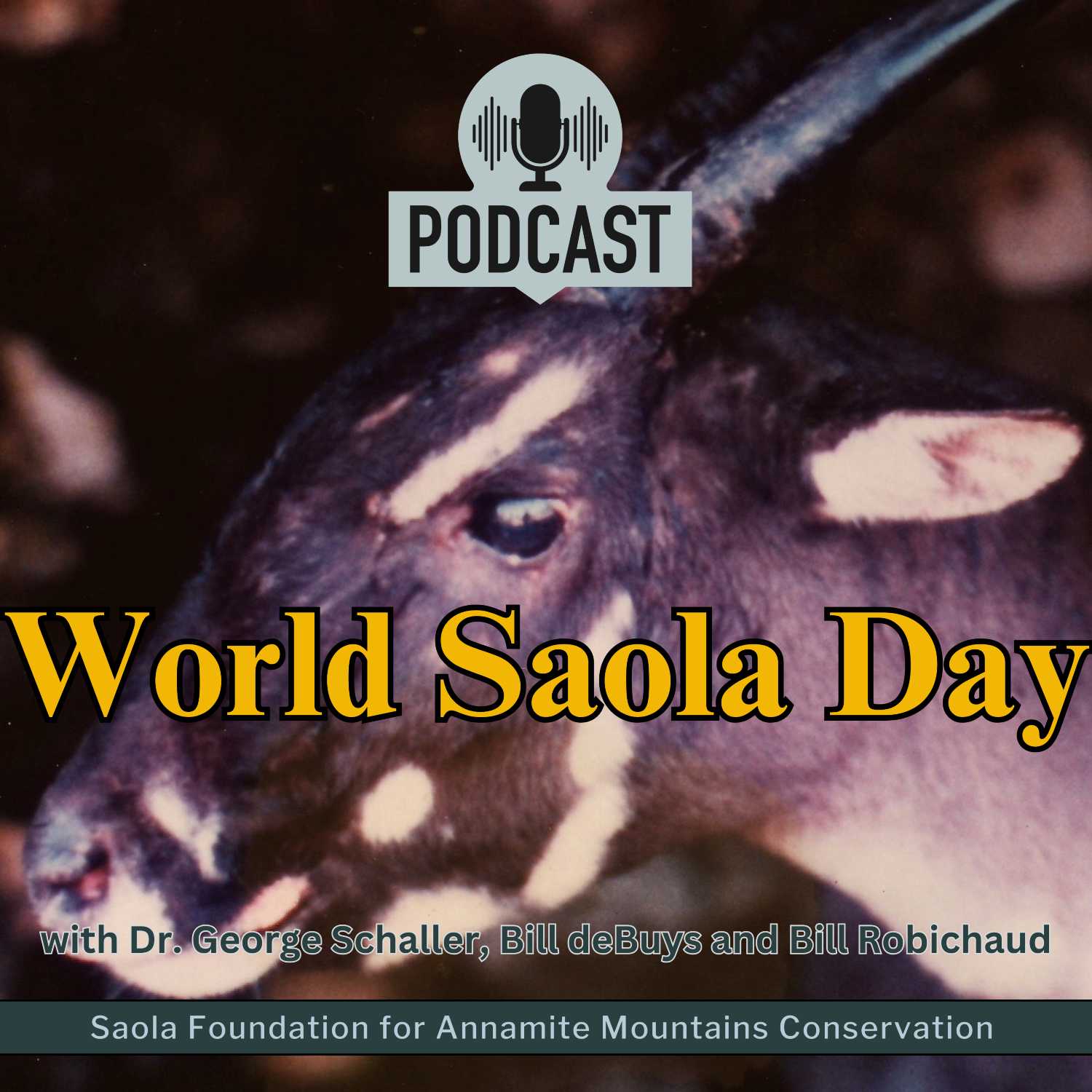
World Saola Day with Dr. George Schaller, Bill deBuys and Bill Robichaud
49m 47s
This conversation, part of the "Bill Robishow," features conservationists George Schaller and Dr. Bill Bues reflecting on wildlife conservation, particularly the saola in Southeast Asia. Schaller, celebrating his 90th birthday, emphasizes that successful conservation requires political stability, economic support, and active local community involvement to ensure mutual benefits. Both speakers express optimism for the saola due to its low commercial value and remote habitat, making it a viable flagship species for protecting the broader Annamite Mountains ecosystem. They argue that conservation is fundamentally an emotional and ethical pursuit, driven by a love for nature's beauty rather than just utilitarian benefits. The discussion highlights practical efforts, such as the Saola Foundation's work in Laos, which trains local residents as field workers to combat poaching and foster stewardship. Schaller and Bues stress the importance of mentoring young conservationists and adapting to challenges like rural depopulation and climate change, underscoring a hopeful, heart-centered approach to preserving biodiversity.
[Music] Well, welcome everybody. This is Bill Robyshow. I'm one of the co-founders and directors of the Salah Foundation and I'm really happy to be in conversation today with two people very important to the the whole Salah story and the history of its conservation. The first one is George Schauer. We're doing this conversation as chapter A, basically an honor of George's recently recent 90th birthday. That's just incredible to me. George has been doing field work for 70 years and for more than 60 years he's been defining his place as the preeminent field biologist of our time by being the first one or the first westerner to study charismatic or important ecological important large mammals in the field for the first time. He's the author of numerous books on his work and he's in inspiration to thousands if not millions of conservationists around the world. So welcome George. Well thank you very much. All right and our second guest is Dr. Bill Buees, another outstanding elegant writer on Topics of Conservation in the Environment. I spent time in Laos with George looking for Salah on other things in the 90s and then Bill Buees came out and we had quite some adventures in the animalite mountains of Laos in I think 2011 and out of that research another of the research Bill wrote the wonderful book about Salah on its conservation the last unicorn and builds with us from his home in the mountains of New Mexico today. Welcome Bill. Good to be with you Bill. Thank you. Yeah and Bill Buees and George Schaller also work together for several years with the major supporter of Salah Conservation, Liz Claper and Art Wharton Bird Foundation and we're very grateful to them so they know each other and have stolen a few horses themselves. So George, most of your career in the field you've done is an incredible field work. Most of it's been in Asia. You know looking back on a career of you know 60 plus years during conservation work in Asia and he thought sensory reflections around hopes for the future or conservation in Asia. Well that's a one of the general questions. Conservation depends in parts on political stability in the country that depends on the economics of the country. If it's reasonably well logic in the forehand conservation but also extremely important is to get the local communities involved in conservation so they benefit at preference and for the future and help protect the wildlife and habitat. So there's so a lot of environmentalists to protect but not of it is being parodized in this regard. Right yeah and I think that's where we're lucky with Salah because as you know um you know there's a lot of animals in Asia that have a very high price on their heads and it's uh you know an economic opportunity lost for people to conserve these animals or maybe they're in competition with their livestock or whatever or killing their livestock. We found quite good traction with getting community support for Salah conservation because there's no cost to builders really to not killing a Salah just being caught up as by catch you know you have in the commercial wildlife trade and poters. Bill Wies you have any thoughts on what you's reflecting on what you saw in Laos when things weren't quite as good for conservation in Laos when you were there I think they've got better sense that. Any thoughts on hopes for Salah and conservation in Southeast Asia? Well two days one is that the the cold of narrowing in the animalite mountain was really it was the defonation of the entire ecosystem that's for our hidden set you know there's the largest second the largest where you cannot encounter a animal larger than a potter's annual they're just all done but that's dead. The second big thing is just the validity of that environment the the potential if areas are reasonably protected for livestock to come back the fertility and the reproduction possibilities are simply enormous. One of the things that struck me about the Salah is that their habitat where where they occur is an area so remote that Salah never even showed up in the other ones in type of pediatric pharmacology of traditional Asian medicine. So as you think there was no particular price on their head they weren't left it after or one purpose or another so Gali if they're still there and if they're haven't that easy protected the prospects are really really good. And George if I may I'm going to quote you from your wonderful book Go To Bedwild that's one of my favorite books of yours about your experiences in this huge area the To Bed and Step in the Chantan and you spent a lot of time there searching for the cabin ground of the endangered To Bed and Aniloper Chiru and you wrote in To Bedwild quote "Whatever I do research in an area I select a total animal in which my heart can rest an animal of beauty and interest and in need of conservation and also one that you know can contribute to conservation of a large area and I think you did that with To Bed and Anilow in the Chantan and you know what does Bill said we have this amazing animal-like mountains and we're trying to use so long the same way. Well I've made only two trips to Vietnam in the late 80s and four trips to the dollars and the 90s and I was wonderfully impressed with the cooperation and the health of this and the development and the local people extended to me and American considering the horrible war America fought in that region so I think the people are open to helping others and themselves to have a good environment for the future for the solar line and other animals. Yeah yeah and certainly our experience of the Salah Foundation the supportive environment of the law government is fantastic now it's you know the best any of us have ever seen since we've been working in laws for 30 years the government is really committed to working with us to save Salah and they recognize also the importance of the animal-like mountains and they're really taking serious steps to protect it now. That's wonderful. Bill Rovich, what's your perspective looking forward? You spent more time on that region than either the other so in recent years. Yeah you know to be honest I mean the way I look at it is certainly all of us in the Salah Foundation we are absolutely convinced that there is time to save Salah and both of you know our technical director Rob Timmons he's just brilliant at finding rare wildlife in Southeast Asia he's been doing this for years and Rob's also a very pragmatic skeptic and he was he's the last person in the world who would go on like a wild goose chase for an extinct animal chase and he's convinced that there are Salah still to be found. So I'm very hopeful that said what we're doing with the Salah Foundation the way I look at it, Bill is you know Laos is a Buddhist country and you both work in Buddhist countries a fair bit both of you in Nepal you know in Laos you know the Buddha said no effort is wasted and even if we're not in time to find Salah and save it we're doing so much bit along the way by developing especially something that was so important to George your hat is important to George for his entire career is developing and encouraging and mentoring young conservation talent and we're doing that in Laos and whether or not this team is going to be in time to find Salah as we believe it will be this team is going to be together working on the next animals you know that need help in the animalite mountains things like the large antler munchak George and I in one of our surveys we rediscovered in munchak Roosevelt's munchak that hadn't been heard of for like 60 or 80 years so there's a lot of other species in line so yeah I at the Salah Foundation and myself I just get up every morning and I put one foot in front of the other and do the next right thing in front of me you know I don't have control over the outcome but we do have control over you know what could actually take so yeah I'm very hopeful that if that sounds hopeful so there's this white species that has been discovered in Laos and there's one of Richard's scouts
like animals with a spiral horn. Oh yeah. And the horn, sorry, this like was found in the chest like it is the solar, it's been long, it's never been found as a body. And wherever it is, it's terminators, you have to keep them up. Yeah. Jared, you're talking about the Cateen vor from Northern Cambodia, Southern Laos, area. Yeah. Yeah, actually I did some searches for that in Southern Laos. And as you said, some people are, it's known that some of the horns of what we're bleed to be this animal were, were faked out of cob horns. But I, others also believe that some of the horns that are in collections now are the real thing. So, yeah, it just, yeah, it's, it's, it also, you know, that's another window on, you know, we just still live in this incredible world. You know, with still amazing things a lot yet to be discovered. And if I may, and I know I'm going to quote from Bill de Buis's book, I'm pretty sure this is from, this is from actually this from the last unicorn. I love this passage. Bill wrote quote, "Uncounted species and not just charismatic animals like titers, gorillas, rhinos, and sala. But even a larger number of obscure rodents amphibians, birds and reptiles have been pressed to the brink. We hardly know them. And yet within the vastness of the universe, they and the rest of the earth's biota are only known companions. Without them, our loneliness would stretch to infinity." And that, that really, that's so beautifully said and that sums up for me, you know, when I'm still involved in sala conservation because, you know, the world's a better place to saline it than without it. And that's really the only reason I need. I actually have something that, that you and I discussed when we were on the trail to get to build it. The conservation movement has often justified its goals, only in terms of utilitarian values, you know, what wildlife can do for people. And we haven't in a way emphasized enough the, just the, the beauty of the wild world and the creatures that live in it. So, I think that the message that the sala foundation is doing a good job getting out there. No, thanks. And again, I, and this is something that's been central to George and his career. Here's another quote from by George from, I think, to Betwild, which I think really aligns with you and me, Bill. George wrote, "You can do the best science in the world, but unless emotion is involved, it's not really very relevant. Conservation is based on emotion. It comes from the heart and one should never forget that." Well, you look at the sala lot. Just a photograph. It is a beautiful animal with a white taste of markings, the white of both the hoofs and so forth. So, for no an achievement, it's beauty. Well, words, acting. Yeah, exactly. You know, George, you know, people often ask us, you know, me or you, or you know, why are you saving sala? I know what's the point. Well, one of my responses, I notice nobody ever asks like the guards of the Van Gogh Museum or the curators there. Why are you saving them? Goes paintings. Why are you doing all this work? Well, it's obvious. You don't have to ask people why they're doing that. It's this incredible thing of beauty that the world's better for it being in it. And I agree with you guys. That's really all the answer I need for sala. And Bill, I think you're right. In fact, the utilitarian arguments for conservation. They can be a bit risky because they can lack credibility or just sound a little bit ungenuine because, you know, if you go to a conservation conference and you have all these dedicated conservationists there, you know, people like you and me and Scheller, and you look out on that sea of faces, not one of them got into animals and conservation as a young person for utilitarian benefit. They got into it because they love it and they got into it with their heart. And I think we need to be confident enough to just say, look, I'm just doing this because I love it. And I think it's worthwhile. You know, we're always kind of feeling the need to make us, yeah, this utilitarian excuse for conservation. And I don't know if that's particularly helpful because that's not why any of us got into it. So we should just, you know, speak from the heart and speak honestly. I think people can respond to that better in some ways. How do you convince local people by just reasoning? Yeah. They can make so much money. And yet not be right out the last triangles. Right. Yeah. They make thousands of dollars. The title can bring several thousand dollars in product selling body parts to China. Yeah. If you'll pour your netbook on a worry about that kind of argument. Yeah. This is true. And you're also, yeah, you're not going to worry about the utilitarian arguments. But who knows? Maybe somebody, you know, it's actually some of the best kinds of local conservation allowances for reasons like, there's areas in Laos where you know where the local people protect givens, you know, the small eight because they say they're a lot like people. They look like people. They live in small family groups like people and we just like them so we don't kill them. So get it. The reason the reasons we see local conservation, they can be for economic benefit local people may do it. But as you said, it's such a challenge when the prices are so high and these animals are killing them. But in other cases, yeah, local people will conserve animals for more heart center reasons or spiritual reasons like taboos and killing rhinos or wild cattle. George, another thing you said along the lines and I think it's, you said, although conservation must be scientifically grounded, it is actually a moral issue of beauty, ethics and spiritual values and that's something very much that I very much resonate with. Getting back to the the animites which both of you got well all of us have spent a bit of time in the animites. One of the things George that you recognized is in one advantage of focusing on conservation of large animals, which you've done for your whole career, is you point out that a large animal needs a large area. So by definition to conserve a large animal like a saw lot or to bet an animal or you know tiger or a serengeting lion, you need a large area. And then by doing that, by protecting that large area to protect that animal, you get a lot of smaller animals in the package and the whole ecosystem. So is it fair to say that's a part of your approach in career? Well, that's very true, that's one reason. But if you're a few of our others, unless you have independent wealth, you depend on research grants. So if you take large animals that get some answers, you're more likely to raise the money you can do it, than if you are studying the strikes, rabbits, and you have non-enobligates, you need a local. Yeah, through the grant decalities of the economic rates that are at again in that root of fact. Yeah, indeed. George, I understand that you're planning to go back to Nepal and Brazil in the coming months in the next year. Is that right? Oh, it's a couple of months. It's been very cooperative and they have to come back. Yeah. So even at age 90, retirement does not seem to be on your radar or agenda. What do you mean by retirement? I just saw a brief Bruce Springsteen in Constitence, er, it was fantastic. And I saw an interview with him several years ago when he was in his 60s about 10 years ago, and they said, "Oh, Bruce, are you still going to be touring when you're in your 70s?" And without hesitation, he said, "Of course I will. This is what I love to do. It's what I've always loved to do. So why should I stop?" And I hear George Schaller and Fieldwork for a large wildlife in that answer as well. I enjoy just doing this. And it is something useful. George, what are you going to be doing in Nepal? Are you going back to Seoul? Yeah. The whole economy that area is changing or has changed rapidly. And I want to see what's been going on. I haven't been back since 2016. So is Dumpal, is Dumpal the area that you traveled with Peter Matheson when he did the book The Snow Leopard and the area, Bill de Bours traveled for his recent book The Trailer Kind of Robo? Is that Dumpal? Yes, yes. Bill, do you want to just say a little bit about this?
I mean, you were in Dopo just in the last several years. And certainly, you had a mine, and I think you were sort of tracing some of the trails that George Schauer had been on with Peter Matheson in the early '70s. Any reflections on changes that you saw in the intervening decades there? Well, it's like this complex situation of the recent year, the recent decade, especially since the Civil War and through the Civil War and the fall of many, many people left the rural areas and went to Katmaiju and other urban centers. And so the village world in Dolphow and other remote regions of the fall was substantially depopulated as people thought likely to have in the 50s. But the moment reversed that migration, because life in the city was as tolerable and people moved back to where they could raise booze because the tourist economy of the fall absolutely crashed. When we're in Dan, if that push and pull right now, I certainly could say I'll be really interested to hear what George Schauer and from his trip, because nothing stays the same and the ecological changes with climate change in that region are all the part of the push and pull and are very powerful. And we're seeing the same thing in the "Animic Mountains," where a lot of the villages that you and George went to, I've been to-- there is this sort of deep population of the young people moving down to the cities to accept jobs, working in restaurants or whatever. There's also the risk of some of them getting caught up in the human trafficking. It goes across the border to Thailand. One thing that we found as a consequence of this, it's harder to find local people in the villages, younger people who know as much about wildlife and the forest and the local ecologies as they did 10, 20 years ago. Because they seem less interested in going in the forest now. They want to go down where they have cell phone connection in the villages. One thing I'm proud of in the Salah Foundation is we put together this loud team to help us do the intensive Salah search. We've got about a team of about 30 loud field workers. They're going to be detection dog handlers and wildlife trackers and logistical support. And a lot of them are recruited from villages in the Salah's range. So we're finding a way for them to find employment, but to stay in the forest. And in our view, that's a good thing. The issue for Salah is a local people up in the forest killing their food. It's these organized commercial poaching games where often basin of cities coming in and poaching. And actually having local people in the forest can be a bit of a deterrent to that. Plus, they can also be the eyes and ears for both Salah and her threats. I think they think about some of the people we were with in when we went to the Nadiyaan in the 11th Bill. Art, have you been back to Ben and Lloyd for instance? Has it gone calm? I have been back, but actually not the God, it's been a few years 'cause COVID shut out really down. And so like you, I haven't been back to Laos now since COVID, but only to see about six months ago. So I've been wondering about Gong Chan, and if his liver is given out yet for his focus for the drink. But I really am planning to get back up there, see if Gong Chan is there in Mr. Saai, who was the great tracker and Salah expert. I did run into being Saai, who was kind of, he was the guy, he's great at a drinking party in the village, but he was a pain in the ass in the forest. He fought a job down in town. I ran into him working as like a security guard at a coat tower, something down on the top of the kayak afterwards. Oh, that's my blog. He was really a person in difficulty for a three-day long trip. Yeah, and I read about reading like to Ben Wilde and George's challenges with just some of his, the drivers, the truck drivers trying to get across the Tibetan staff who just decided they weren't going to drive the truck anymore. They had enough and what can you do? And certainly, George had a lot of experience with that and his adventures. So one thing that I'm wondering how do you solve the Pochet problem and analyze that anywhere else? Because as you mentioned, he can walk for hours days that he don't see an hour, not even a month in these areas. And you have narrow lines, fences filled, several hundred yards long with a snare each, and animals cancelize us. He said, in guard, he destroyed it. Where it wasn't people tolerating it. That's a really interesting question and something we've been looking at and well working on for decades now. So one answer is the local people do tolerate it. In fact, they're quite happy because at least I'll allow some of the border to be honest. Most of the snaring is done by Vietnamese coming across the border from Vietnam. Because Vietnam, the population is 100 million people with all these trade connections to China. And allow some populations, only six million people, mostly farmers. So the villagers are actually happy to have, you know, they're afraid of these organized culture gangs. And they're actually happy to have patrols go up and kind of take care of it so they don't have to run into and confront them. On the wider issue, and we actually, we had programs where villagers were earning money by collecting snares. They would go out and we would pay them like I think there was a while we were paying like 25 cents a snare. And if they collected hundreds of snares, they could make actually quite a lot of money. On the other question of how, you know, what you guys have talked about is, you know, at the end of the day, you know, conservation, you know, it doesn't need to come from the heart. People have to want to do it. They'll always find a way around the rules and regulations. And I think what's essential is the work of groups like wild aid that are working on the demand side with these like publicity campaigns in China using like Jackie Chang and Yao Men, the basketball player. Because I think my experience of human nature is, you have to get the demand countries and the people in the urban centers to just stop wanting to buy wildlife. But that takes a generation, I think, for those attitudes to change. So the way I look at what we're doing is you've got these great organizations like wild aid, working on reducing the demand for wildlife and source countries like China and urban centers and Vietnam. But at the same time, you need other conservation organizations on the ground like WCS or WWF or the Cell Off Foundation trying to keep some of these animals alive long enough until those that demand can go away, you know, in 20 years. And wild aid is having quite a lot of success in reducing demand for things like shark fin and other wildlife. And our hope in the Cell Off Foundation is keep some of the beautiful Cell Offs alive until areas of the forest aren't under such pressure from the poaching. So because as you've seen George and Bill both of us, you know, we did a lot of snare collection. We collected hundreds of thousands of snares. But you get in the economic bind where as these animals get rarer, the price goes up. So the motivation for the portrait to go into the forest and keep setting more snares increases. So we finally concluded, well, not just us, the International Union for the Conservation of Nature, I UCN and the IUCN Cell Off Working Group. Everybody finally recognized that we couldn't save Cell Off in the forest. And I think Bill the Bweeds, you saw that, you know, in the kind of tone that we were there together. The snaring despite all the efforts of the increased patrolling, the snaring was outpacing it. And so we only hope for Cell Off. Now it's to get some of them into safe captivity and then work on, you know, getting these landscapes protected to where you can eventually release them someday. So I think the extraordinary energy George has got to have long-term vision and people working at both sides of the issue. Both the immediate killing of the animals in the forest, trying to limit that as much as possible and doing what you can for the animals while you reduce the human desire for to do these things. Do you have any idea what my new motivation has for this Catholic brain? It certainly is a risk. I mean, as you know, cello has never been kept in captivity successfully, you know, but also cello has never been kept by anybody with professional expertise in the keeping of hooked animals. Though all the cello that have been in captivity in Lausanne, Vietnam, just been kept in a ad hoc fashion by Department of Forestry guys or, you know, villagers. And certainly a captive breeding program for an animal which there are none in captivity now is very risky. But our belief is that leading salon the forests of all the snares is riskier. So we do.
don't have a risk-free option to save cell law and we're just going for what basically the global conservation community has agreed is the least risky option that we have. And build the captive breeding of old counties. Yeah. Sort of an inspiration along the line, hasn't it? Yeah it has and in fact on the advisory council of the Salah Foundation is Steve Schur. And Steve Schurter is one of the guys who figured out how to find a copy, which is another large rare tropical ungulate rarely seen. I mean most people know in a copy but it's this giraffe relative of Central African forests that like Salah was discovered very late. I think it wasn't discovered till like 1901 or 1910. And Steve Schurter is one of the guys who figured out a find a copy, capture them and how to keep them successfully in captivity. So that's exactly why we brought his expertise into the Salah Foundation. Can I, I want to share a little story about George's very famous for snow leopards. I think George, weren't you the first one to photograph a snow leopard in the wild? Can I have that fact correct? I don't know if I was the first one but people were climbing. Okay well we'll climb it for you. So when you and I were doing a survey together in Laos, it was probably about 1995 and we're out in this forest area and we passed a big, we're headed towards a campsite and we passed a big fig tree in fruit which often tracks a lot of animals. Then we went another hour or so and we made camp and we were with our pal and we used to come coon. And then our destination, we were going to a village. We were trekking towards a village for our next stop that night. There were no roads in this area or just on hiking trails. And I, what I asked for, I said, why don't the next, early in the next morning I even go high like before dawn under this fig tree and just see what animals come into it. And why don't you and come coon in the port as you keep going down the trail and I'll catch up to you in the village, you know, later in the day. So I did that and I had a fantastic morning. It's like this gibbons came into this fig tree and these great hornbills, you know, these huge birds and it was full of birds and I was so excited and I just had to tell the great George Schauer about all this. And because I just was, you've been very important to my family for a long time. We don't even know. My late older brother has been calling you Serengeti George for years and I think he gave me the Serengeti lion as my high school graduation gift. And then when he heard I was working with you, you said, oh, God, today I have a Serengeti George for me, you know, and so forth and so on. So anyway, I catch up with you in the village later that day and I just run on and on about all the great things I saw. And you got this little mischievous, shite eating grin on your face. And then I finally saw it. And you can come and see anything on the walk of the village and you say, yeah, saw a cloud and leopard right in the middle of the day, 20 yards. First one I've ever seen. It's got a good believe it. You were walking to the village and like you always do, you walked in front so you could see the wildlife and you came around a corner on a trail where there was a cloud and leopard sitting on the trail. The first cloud and leopard ever seen by George Schauer. Are you still the only biologist who seen all of the big, ancient cat firsthand? I have no idea. I thought that reported about you at that time point. I can't remember the story. I just keep trying to talk to him. And you know, when you were in law, so we were both working for the Wildlife Conservation Society. I remember I started my career, sort of like you. We both started studying birds in college and in high school. When you were in laws in the mid 1990s and you went out with the late Alan Rubinowitz. It was my boss at the time, his director of the Asia program. You and Alan did one of the first field surveys for Sawalow and you published a paper on that in the journal orics about all this stuff you'd found about Sawalow in the field in Laos. And I remember I asked you, I said, George, look, you've defined your career. You were in your mid 60s then. You're still very young. And I said, you defined your career as being the first biologist to study some little known large animal in the wild. I mean, you started with Mountain Gorilla in 1959. Then you went on to Tiger as a Serengeti lion and Jaguar. The first westerner allowed into China as study giant pandas. And I said, why aren't you settling down in Laos and making Sawalow your retirement project? I just thought you were going to lay, you and Kay were going to move to Laos and you're going to start studying Sawalow. And you just said, well, thank you for leaving it to me. But I remember what you said. You said, well, hideous study an animal you can't even see. I'm going back to the Tibetan Plateau where I can actually see when I'm studying. That was your answer. Perfect. I still haven't seen Sawalow in the wild. I've seen Martha the captive, but I still haven't seen one in the wild. I know of. Well, that's the nearest. All these rare species from that animal are doing to discover as horns and actual nails to go as long. Yeah, that's what you and I do in Concoun. When we were at another part of Laos, we were down in a village in the province in St. Climbe, which is one of the most bombed areas of the war. You know, US Air Force turned Laos in the most bombed country in history and part of that was around this area where we were. Yeah, we were down in the village and we found in the village that a pair of very small munchock antlers, that a little antler trophy. But the antlers, these barky deer antlers were tiny. And it's like the bit strange. So we paid a bit of money for this, you know, a couple dollars for this set of antlers. And then your colleague at W.S.S. time, George Amado, did a genetic analysis and it turns out that you'd rediscovered Roosevelt's barky deer, Roosevelt's munchock, which was known from one specimen collected by the sons of Teddy Roosevelt in northern Laos in like the 1920s and hadn't seen since. So yeah, in Rob Timman's Art Technical Directorate of Salah Foundation, he discovered that strike rabbit from a specimen in a food market in Laos. He discovered an entirely new mammalian family. This weird rodent, the con, you from a food market in Laos. We discovered, you know, first records of some birds in Laos by going to the fresh food markets, fortunately. Good news is that's much less common. I mean, the markets that are selling wildlife for food that people shoot. And that was really common in the 1890s. And the government really has made a lot of good progress in, you know, making that more difficult for people to do. So we're not as discovering as many new species anymore, so we can't find them in the food markets. So I guess we have to get out of the forest. And wonderful thing is, you now have this technology by George Monterrey, who is the DNA to separate the difference. You know, I think makes sure that the separate species and so forth. That was the veil of those two years ago. Right. And that's one thing we're really grateful to WCS the Laos conservation society for. We partnered with their molecular genetics laboratory. And in the last year they developed for us this Salah specific rapid DNA test kit. So we find some Salah sign, like, you know, some droppings that we think are Salah. Thanks to this WCS test kit, we can test it and get an answer within an hour in the field. And that's a, that's a potential gain change here for finding and protecting Salah. Excellent. Bill the Ways. I want to read another quote from, I think from the last unicorn. You're wonderfully eloquent book. And again, I think it's, you know, Salah is a different kind of animal to conserve because it's, you know, it's never been seen in the wild biobiologist. And so we're always just kind of out there with hope. And we often get asked, kind of, well, how do you keep up your enthusiasm? How do you do this? And for me, I think you said it succinctly. You wrote a quote, put a horse in an empty meadow and the meadow becomes animate. What is Salah? Even a Salah you cannot see in a forest. And the forest is, though it held a unicorn, acquires an energy that cannot be named. It becomes luminous. It gains the polar gravity, the weight of water, the float of a feather. And that's so beautifully said. I don't know why you, Bill and George, but you know, when we were, when we walk around the kind of lights, just knowing there are Salah probably there and you could meet one if you come around a corner like George met a cloud of leopard. I mean, that's enough juice to keep me going when I'm there. I don't know if you guys feel the same way. Well, Bill, one thing I should say about the last unicorn, if that book had any merit, it's not least because your spirit runs all the way through it. You are so.
eloquent yourself that it made it feel like easier for me to write about those challenges and that landscape. Thank to your narrowing of it and we travel through it. Oh well thank you very much. Thank you. You know it's it's an incredibly inspiring place and I think again I'm always I take a lot of pages out of George Scheller. One thing that George did you know the Tibetan analog and the Chantang is he just stuck with it. He kept going back to Chantang and searching for the calving ground of Tibetan analog. You know George took you on like 20 years to find those calving grounds but you stuck with it and you made a tremendous cup you made a tremendous contribution by picking that place and becoming committed to it and that's something that you know all of us at the Salah Foundation have picked up with the animalite mountains now. What do you think the Tibetan Azul now are increasingly going to be close to Chantang? It's a better protection. Yeah and I think we're seeing the same thing play out with Salah and Laos. The Laos government has really gotten you know serious about saving it. You know whether we're in time or not you know with the support of the world because we can't do this alone we're gonna find out very soon within the next two years so it's quite an exciting time. You know like you search for Tibetan analog for years. We're searching for Salah. Yeah. I know the fellow rich now I can keep on my nose across the plains. Yeah I end I read it to that wild end you oh we saw like 2000 Tibetan analog today I said God lucky son of a god it would be nice you know but you know they're similarly beautiful animals I mean the the Jiru the Tibetan animal is so freaking beautiful but it really wasn't that well known like until you put it on the radar but I see a lot of kingship with Salah. Well yeah it was too well known to the people buying the stars for sure. Yeah. Yeah and you and Tibetan analog I think had something stacked against you that Salah doesn't have is people actually trying to kill it you know for those of them over the story in the 1990s these scars shot toosh made from the incredible fine underworld Tibetan analog that they would sell for thousands of dollars the only way you could get this is to kill these Tibetan analogues and they were being wiped out for this trade and George was a significant player in bringing attention to this to the world but you really have you know people were out trying to search for those Tibetan analog and kill them and you were kind of racing the potters the last Tibetan analogues that's something you know we don't we're not having to deal with with Salah nobody's out trying to find the last Salah so hopefully that'll give us you know a little bit of hope and edge and saving it from extinction. Oh it's very fun George you out there connecting these powerful folks there. Bill I've got a question for you and then can you just get for a little bit the timeline as you see right now in the third quarter of the line I know Rob and the rest of the field team are are moving into the field now are they not? They are yeah in fact Rob flew to Laos two days ago two to three days ago our expert wildlife tracker based in Wisconsin like me Matt Nelson he's one of the best wildlife trackers in the United States and part of the world he was helping a neighbor shovel something last week and like the handle of the shovel slip and knocked off the like the meniscus is kneecap or something so his flight his trip to Laos is delayed he's got to go for an infrared MRI in the next few days but I just texted him and he thinks he's okay and I'll be able to travel soon. So things are accelerating so Rob is going back to the field the field team has assembled the dogs the first detection dogs are doing arriving the next couple months so as you know our goal is to feel this entire innovative integrated team and keep them fully supported for 24 months in the field we think that's the best chance for Salah and we're just about to start that and I just like to give a shout out we just heard in the last couple of days Ocean Park, the zoo in Hong Kong has joined our Salah Gold Circle and they've just contributed $50,000 to the Salah search and we're so grateful because it's that kind of support that's gonna get this done and it's so cool to see you know an institution in Asia because you know Salah is an Asian species and now we have this institution in Hong Kong you know supporting you know the conservation of the other Asian species. So things are going the other good news Bill is you know we we're not positive how to identify a Salah tracks at least not yet because you know there's other animals hooked animals and it's raged about the same size and that's what we need these side detection dogs to verify but in the area where the team is you know been starting to do some preliminary searching based on information of local people they've been finding a lot of ungulate sign and ungulate droppings a lot of it is probably this wild goat type thing that's found there the zero but certainly some of the tracks that finding are consistent with what could be Salah. In fact one of them took a just a photo of a video a long video with this film camera of a zero walking around the forest and the zero is about the same size as the Salah and if they're still there and like sort of semi-tainment enough to be filmed with a with a smartphone this gives us hope that there's still can be Salah's there as well so so far the news is all really good we're finding sign of ungulates at a much higher rate than we expected going into this area so this is an area that we found that hasn't been wiped out yet by all the snowing in the poaching so the news is good news is that good. That's really wonderful and I did get to see the video of the hero and it was amazing is that the animal was plainly aware of the human who were making the video and and get it stay in the area so it seems enchanted to see that. Right yeah and well I just want to think both of you for your time and I want to wrap up again a couple pages out of George's book one thing to remember is you know George said very stupid I think he wrote there are never victories in conservation if you want to say the species or have it it's a fight forever more you can never turn your back that conservation isn't a destination you know it's a journey it's something you always have to do. George also reminded us of a quote the dolly this holiness the dolly mama said ultimately the decision to save the environment must come from the human heart and both of you guys have contributed a lot to that just through George of his example of working from the heart you know for 70 years George Charles been doing field work from the heart and bill your beautiful book the last unicorn I mean written with the heart you know I've asked donors that you know given us big chunks of money and I'll say how did you ever find us and find Salah and one of them said that recently that book the last unicorn that's what got me involved and both of you just you're always working from the heart that's so inspirational because at the end of the day that's what conservation needs most is inspiration so I just wanted to thank for the shout out to both of you all right thanks George George when are you coming back to Laos well why don't you come visit us from quick thoughts and working at a quality stage yeah we're fantastic our our law programs director O'Lay who I known since he was a kid he's just brilliant and he's put together just a really fantastic team George how about you come visit the first Salahs when we get them into the captive breeding program yeah well look at it's one of the few large animals in the world you haven't seen so I think you need to come to love I'm gonna give you a call when we have some and you can come to cross that tea in your career all right George thank you very much and build weeds and we want you to get back to Salah habitat you can do some more eloquent writing about this search so I hope we can work that out I'd love to do it and uh love you get the ass on the trail which you build one of these days likewise thanks very much
Podcast Summary
Key Points:
The discussion honors George Schaller's 70-year field biology career and his role as a pioneering conservationist, alongside Dr. Bill Bues's contributions to saola research.
Effective conservation depends on political stability, economic conditions, and crucially, involving local communities to ensure they benefit from and participate in protecting wildlife.
The saola is a conservation priority because it is not heavily targeted by trade, offering hope for its survival, and protecting such large, charismatic species helps conserve entire ecosystems.
Conservation should be driven by emotional and ethical values—such as appreciating beauty and biodiversity—rather than solely utilitarian arguments, as passion is what motivates most conservationists.
Fieldwork and community-based efforts, like the Saola Foundation's local team in Laos, are essential for monitoring wildlife, deterring poaching, and mentoring the next generation of conservationists.
Summary:
This conversation, part of the "Bill Robishow," features conservationists George Schaller and Dr. Bill Bues reflecting on wildlife conservation, particularly the saola in Southeast Asia. Schaller, celebrating his 90th birthday, emphasizes that successful conservation requires political stability, economic support, and active local community involvement to ensure mutual benefits.
Both speakers express optimism for the saola due to its low commercial value and remote habitat, making it a viable flagship species for protecting the broader Annamite Mountains ecosystem. They argue that conservation is fundamentally an emotional and ethical pursuit, driven by a love for nature's beauty rather than just utilitarian benefits. The discussion highlights practical efforts, such as the Saola Foundation's work in Laos, which trains local residents as field workers to combat poaching and foster stewardship.
Schaller and Bues stress the importance of mentoring young conservationists and adapting to challenges like rural depopulation and climate change, underscoring a hopeful, heart-centered approach to preserving biodiversity.
FAQs
Conservation depends on political stability, economic conditions, and involving local communities so they benefit and help protect wildlife and habitats.
The saola's remote habitat means it hasn't been heavily targeted in traditional medicine or trade, so there's no high price on its head, making protection more feasible.
Large animals require large areas to protect, which in turn conserves entire ecosystems and many smaller species within those habitats.
The foundation recruits local people as field workers, trackers, and dog handlers, providing employment that keeps them in the forest and acts as a deterrent to commercial poaching.
Conservation is driven by emotion and passion for wildlife; it comes from the heart, and utilitarian arguments alone are not the primary motivation for most conservationists.
High monetary value of wildlife products, like tiger parts, can incentivize poaching, making it difficult to convince local communities to protect animals solely for economic reasons.
Chat with AI
Loading...
Pro features
Go deeper with this episode
Unlock creator-grade tools that turn any transcript into show notes and subtitle files.
 PodcastTranscript AI