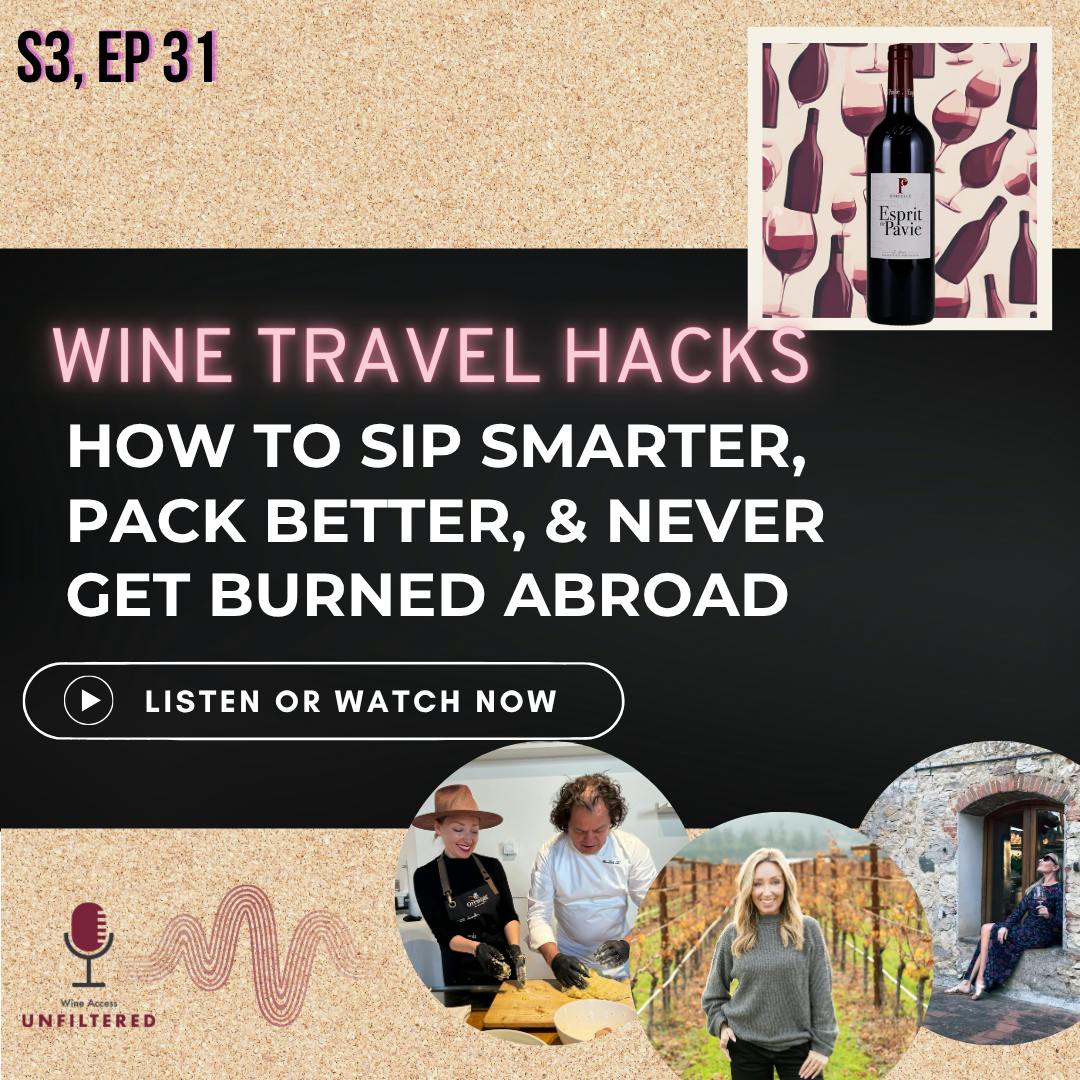
Wine Travel Hacks — How to Sip Smarter, Pack Better, and Never Get Burned Abroad
53m 27s
In this episode of the Wine Access Unfiltered Podcast, the host shares hard-earned tips for a stress-free wine trip to Europe, drawing from years of travel experience. Key pre-travel advice includes getting Global Entry for faster customs, using Apple AirTags to track luggage, storing credit cards on phones for tap-to-pay, emailing passport copies, packing a carry-on with essentials, and practicing language apps like Duolingo. On the plane, the host recommends sleep masks, noise-canceling headphones, changing into comfortable clothes, using liquid IV with caffeine instead of airplane coffee, and disposable washcloths for freshness. Booking a hotel for the arrival night can help combat jet lag. For packing, layers are crucial due to day-to-night temperature swings and cool wine caves, while white clothing should be avoided to prevent stains. The host also highlights a cultural difference: European wines are labeled by region (e.g., Bordeaux) rather than grape variety, with strict regulations on blends and aging. As an example, the podcast’s featured wine, a 2019 Esprit de Pavie from Bordeaux’s right bank, offers a taste of high-end Château Pavie at a lower cost. Overall, these tips aim to help listeners pack smarter, taste better, avoid tourist traps, and enjoy an unforgettable wine adventure.
[Music] Well, hello and welcome to the Wine Access Unfiltered Podcast. So, you did it. You booked that dream wine trip to Europe, but now the question remains. How do you actually do it right? What are the things that you need to know to make your trip a little more aprey love and a little less national lampoons European vacation? Ouch! It occurred to me while I was in Germany a few weeks ago that over the last few years, thousands of miles, hundreds of vineyards and wineries, countless, countless wines, and of course the dozens of wine regions that I've traveled to, plus, my time spent living in the major wine region in Napa Valley, that I have accumulated a few hacks and tips in the travel and more specifically, wine travel department. And it occurred to me in Germany because it seemed like every day I would encounter some seemingly random issue and immediately I would just like have this solution for it. Now, I assure you that was not the case five years ago. These tips were earned over time and in many cases the hard way. For example, if you're traveling to a wine region that gets a little rain, you should probably travel with, wait for it because this is a great hack that I'll go over later, presoved sponges so that you can clean your muddy shoes when you return. I'm telling you this is a great hack. Also, as it turns out, ginger candies and a little whiff of your camera lens wipes, these are actually the perfect solution to getting rid of that car sickness that you're definitely going to encounter when you are traveling around the windy roads of places like Tuscany and Portugal. Been there, done that, seen green. Don't want to do it again. So I've gone back through all of my notes, Amazon Order History, and of course, saved Instagram videos to put together this episode to help you travel a little bit more stress-free on your wine journey. Because I know that all you want to do when you get there is sit down and relax, take in the scenery, look around, drink some wine, and you don't want to worry about whether you packed the right thing. So that's really what this episode is all about. I'm going to warn you, this is going to be filled with a few hot takes, some divisive thoughts that not everyone will agree with. And that's okay, this is all based on my personal lived experience, which is an all-likelihood, very different than your lived experience. And so as you're listening to this or watching this episode, I encourage you to just keep an open mind. I've been through these things before, and of course, some of the wine travel that I've done is more for work than for plays. So at the end of the day, you do you enjoy your wine trip in whatever way you can. Let this be just a little help, a little consideration as you're planning this adventure. Now, of course, this is going to be an episode that is a little more geared toward travel in Europe specifically. Because that is the place where things can get just a little bit more complicated. But I will be focusing on more of our domestic wine radens in a later episode. So just keep that in mind. Now, I should mention that wine travel is a little more different than regular travel. You've got timing, you've got logistics, reservations, you've got some gear, you've got some things to consider, you've got alcohol, of course, to consider. So this is really going to be the episode that helps you to pack smarter, to taste better, avoid tourist traps, and just make your wine trip absolutely unforgettable. That's really what I am after because I love traveling for wine. You guys know this. We've talked about this before. It is by far one of the best, if not the best way to learn about wine. Sure, you can learn about wine through podcasts and books and all the ways that we provide for you. But really getting out there into the vineyards, tasting wines, meeting people, experiencing the culture, there is no substitute for that. So with that in mind, let's talk about the wine that I'm going to be talking about a little bit on this episode, of course, the wine that is part of your unfiltered podcast wine club. It is, of course, a wine from Europe. It is a room place that I know a lot of you are going to, whether by foot or by boat. The region, of course, in question is going to be Bordeaux. This is the Esprit de Pavi. And this is going to be sort of a third wine from one of the best estates in Bordeaux. But to 2019, I love wines like this. Pavi, Chachopavi is quite expensive, but most of the Bordeaux houses, they make second, third and fourth labels. And they usually make it from younger vines. Sometimes they're sourcing from sister properties. And that's exactly what's happening in this glass here. It is coming from some of the vines, Chachopavi, but it's also coming from some of the vineyards that the owner also owns. So, you know, really great way to experience part of Bordeaux at a fraction of the praise. This is a 2019. It is 2025 now, which means it's got about six years of age on it. That is going to show really, really nicely in the glass, especially if you're someone who loves these Bordeaux wines that show a little bit more of those like pencil shavings, that graphite, that leather, all of those quote unquote secondary tertiary aromas. Now, something to note. This is coming from Bordeaux, but it's actually coming from the right bank of Bordeaux. Bordeaux is really divided into these two different very wide, very sort of general areas. The left bank and the right bank. And the right bank is where you're going to find more of your Merlot and Cabernet-Franck dominant wines. And that is exactly what's in this glass. It is mostly Merlot, a little bit of Cabernet-Franck, and of course, to round it all out, you're going to get a little bit of Cabernet-soving on in there as well. In Bordeaux and in Europe, I will note at the top of this episode, you're going to find that mostly they're not talking at the top of the show about rape varieties. They're going to mention it. It's going to be part of the conversation. But if you've ever looked at your European labels, you've probably noticed that most of them don't actually say the grapes on the label. And if they do, they're usually on the back somewhere just sort of in small font. And that's because Europe labels their wines by place, not by the grape variety. Now this is a shift from what they normally do in places like California, Oregon, Australia, New Zealand, South America, where they normally label by grape variety. Europe is all about place. This is really what makes it really, really unique from the rest of the world. They're very specific about it. And there's laws that ensure that when you see something like Bordeaux on the label, that it's sort of of the general type, the general feel of what you can expect from that particular region. Italy is probably where you're going to see this more often than not. They get really, really hyper-specific to the point where they actually have tasting panels that ensure that if it's coming out of, say, Chianti Classico, Brunello de Montecino, Brunello, these are wines that usually have to pass a series of tasting panels in order for them to make it to you outside of the market. Now this is on top of the fact that they are only legally allowed to put certain grapes into that blend or a single variety. They're only allowed to farm a certain way. They're only allowed to age a certain way. There are a lot of legal things that designate what you can and can do to the wines that they're making. And a very big distinction from what we talk about when we talk about the new worlds. That is definitely something to keep in mind when you're traveling to Europe. To me, it is the biggest difference and it's the biggest hurdle that we all have to get over. So if you're somewhere like Burgundy and you're going to Shabli, we can expect not to see the fact that Shardinay is on the label. We can expect to see Shabli on the label and just know because we know Shabli means something that that's going to be Shardinay in the glass. Same goes for, as I just mentioned, Cianci Classico. If you go to Cianci Classico, it is going to be San Jovese, which is the grape, that's going to be the dominant grape in the glass. So I just wanted to get that out of the way because I think that is incredibly important information to start with if you're heading to Europe. As you continue about your travels as we get into this podcast, I will talk a little bit about what some of the things you should and shouldn't be doing before you actually make your way over to the region. So get ready for that, grab your glass if you have it and if you don't, this is your reminder to get into the club. Subscribe to the unfiltered podcast Wine Club. It's four wines every other month, ish. And they're all going to be selected by me. They all correspond with a show. They all get their own separate tasting video. So in addition to the fact that they're in this podcast, we're talking about this, you can also sit down for a few minutes and just sort of taste with me. So you really get the specifics of the wine, not just necessarily a generalization like I'm doing today. So you can find everything you need in the description below. It's 120 bucks plus tax, but including shipping. And you're going to get 10% off all of your wine access purchases. All right. Are you guys ready to jet set with me across the pond into Europe, into your favorite wine region? All right. Let's go.
So my future mother-in-law was just about to head to Sicily a few weeks ago and I was going over some of the things that I felt like she needed to know before she even got onto the aircraft and she was like wow you have so many tips for travel and I never even realized how many tips I had for travel these are just things that I've sort of accumulated all the way. So this sort of first part is going to be all the things that you really need to know to travel smart before you go. Things like of course global entry if you don't have global entry please do yourself a favor and just get global entry. It truly does make your life that much faster and easier and when you come back into the country you're going to be zooming right through customs. It's also going to give you TSA pre-check. It's a process that is not super super easy. There's like two different layers to get through but once you have it you have it and I've actually renewed mine online and had no issues so it's one of the things that you just like rip off the bandaid and get going. The second thing, Apple Air Tags, I know some of you have probably seen all of the videos on Instagram. I am telling you this was such a game changer for me. I wish that I had done this sooner and I'll tell you a story about when I was in Portugal a few years ago my fiance was coming over separate on tap era into Portugal they lost his bag. It was a direct flight but they lost his bag somehow. And so what happened was he landed and found out that in Portugal tap error which is their sort of national airline. They actually outsource their baggage mishandling to another company and the unfortunate part is that they don't really talk to each other it was a really complicated process and I'll spare you the details but the short version is we spent about three days trying to track down a guy on like a scooter that had his bag and if we just had the damn Apple air tag we could have figured out exactly where it was instead we spent like an entire day on the phone trying to figure out what his bag is trying to figure out where we're going to meet him because we were in an A. We didn't have a hotel to receive the bag it was just kind of a logistical nightmare and thankfully we had a long time in the city of porto so it didn't feel like we lost that much time but if we had only had like two or three days it really would have impacted the trip so my recommendation to you is definitely grab some Apple air tags they're not expensive you just throw it in your bag it connects your phone in like two seconds and you can always see where your bag is whether it's lost whether it's on the plane whether it's making its way out onto the baggage carousel I can tell you how many times I've done that I've looked to see like okay the bag hasn't been unloaded yet which means I have time to go to the bathroom. Yay. So these are that's that's definitely something that I recommend grabbing the other thing that I always recommend is putting your credit card on your phone in your Apple wallet the last thing that you want to do when you're getting to Europe start trying to like get into your office to get go get coffee just have your phone out scan it everywhere in Europe has tap to pay it's really really easy it also encrypts your credit card numbers so there's no chance of credit card theft take photos of your passport and email it to yourself email it to your loved ones I have been in situations where people I've been with have either lost or had their passport stolen it's a lot easier if they just have a copy of it so when you go to the embassy they can go ahead and find that for you to more before we actually get to the make sure when you're packing if you're packing a carry on that you're carrying on two days worth of clothes and necessities I feel like that goes without saying but if you're a travel newbie of rits been a little while baggage these days is really really rough especially in the summertime when a lot of you are about to start embarking on your adventures make sure that you have a carry on the two days it's a pain in the ass to go shopping in Europe it sounds really lovely in theory it's a lot more difficult in practice and then last but not least language apps dual lingo it's easy it's gamified it's really fun just start learning the phrases that you might need to know you know for getting around for getting coffee for fighting you know where is the tasting room what kind of wine is this start practicing those phrases get comfortable you'll probably be like me and get to the get to the country and completely freeze and not know anything but what I find is that it starts to get a little bit more and with a glass of wine and you you start in a little more confidence you start practicing those skills once you're on the plane this is always the hardest part right going to Europe is lovely we all love it but that flight over regardless of what what seat you're sitting on whether it's the front of the plane the back of the plane the middle of the plane sleeping on planes is tricky right so you're going to want an I'm asking because Lord knows that people are going to have their screens on there's lights going you might want to sleep a little longer or before they start shutting the lights off I'm asking is always great I always change clothes when I get on the plane so soon as I board or even right before I'm going to change clothes into what I want to sleep in and then I'm going to change back out of them that way when I got the plane I don't feel gross and grimy net pillow obviously sleep headphones this was sort of a game changer for me I don't know for some of you if sound really affects you for me like I need no light no sound. And so I found these like sleep headphones I think it's music cozy I will link my Amazon storefronts you can have all these things that I talk about on there all all of my personal favorites you can of course buy whatever you want. But there are these sleep headphones that basically wrap around your head like a headphone they're really really comfortable and what I do is I will turn on on my phone or I'm I had the background noise so I get white noise on the plane and that way I'm not distracted by all of the noises that are happening overnight I have been on a flight before you guys I'm telling you it was the worst I was on this flight and the people behind me decided they were not sleeping they were going to play cars the entire time thank God I have these headphones to block all of that noise out I also love in the morning. Because we all know that airplane coffee is trash we're going to have a much longer conversation about coffee in a little bit but if you're fans of liquid I be I know some of you are some of you aren't I really love it liquid I be makes a liquid I be with caffeine it's a hundred milligrams of caffeine which is about a cup and a half of coffee I skip the coffee on the plane as soon as those lights go on and breakfast starts coming around I get a club soda little bit of ice and I put that liquid coffee that liquid I be with coffee. That liquid I be with caffeine in there and not only is it going to hydrate me now that I'm super dehydrated I'm also going to get a hundred milligrams of caffeine without having to drink that disgusting nasty coffee on planes roast. This is sort of a game changer for me I know some ladies gentlemen if you are face washers there is nothing quite like a little refresh when you're about to go to sleep or get off the plane disposable washcloths. My goodness I am telling you this was such a game changer and again this is going to be one of those things that comes in handy once you actually land clean cloth club I started using these in my everyday life they're dry they're disposable it's the perfect way to go to bed fresh wake up wipe your face and feel like you're a million bucks getting off of that plane. One half that I have heard that some people do and I've actually had someone do this on my behalf is booking the hotel the night before so that when you arrive you can just sleep when you get to the hotel this is obviously an additional cost but it's a little less expensive than booking something like first or business class even premium economy it's a less expensive way to feel like you got a decent nights rest. So you just get in you sleep for like two hours three hours you get up and then you start moving about your day one other thing that I will mention this is related to airports if anyone is flying through he throw this is such a weird weird sort of inside hack that maybe relevant maybe not if you are flying in and out of he throw whether you're connecting or not you're going to have to go through a very specific type of screening in TSA in which if you have your cosmetics if you have a lot of things that you can do. If you have any of those any of your liquids it has to fit in one clear plastic bag not to not three must be clear must be one they will throw it out it is a disaster it takes for a bird to get through he throw TSA I don't know why I don't know what the deal is I'm telling you just plan accordingly. Okay next what are we packing and what are we not packing wardrobe what are the things that can handle the vineyards the cobblestones the vines the seller the dinners all of the things it I will I will straight up tell you packing for a wine trip is complicated but here are the things that I have found makes it a little bit easier number one layers wine regions are notorious for big day to night temperature swings it's what vines. Love it is very very normal it's actually very usual for to stay warm at night I'm here in Pennsylvania where we have these like really lovely warm summer nights that is not the case in places like not the valley in places in Europe where it might be 80 degrees during the day but then it's going to drop to like 50 degrees at night and so you really want to plan accordingly not only for that but also because you're going to be moving in and out of spaces that are going to be quite different than what you might have been. Then what you might have previously had so you might be starting the vineyards and then going into the wine caves which are underground and quite cool so for that reason layers are always great please leave your white at home I feel like this goes without saying but I see a lot of people in white and then they regret it when they have wine or dirt or food white should just stay at home you want neutrals you want earth tones you want things that are going to be easy to swap in and out of also for your fabrics walls and cashmere is believe it or not. Kashmir is believe it or not, even in the summertime, your light and you know, wolves. These
These are fabrics that are number one really great for temperature control, but also they are sort of anti-microbial. So they're not going to smell if you wear them more than once. That said, if you have things that you feel like you want to wash, one of the things that I learned a few years ago, maybe some of you know this already, did you know that they make laundry detergent sheets, like flat sheets that just slide right into your suitcase and then dissolve in water? Oh, I don't know where this has been my whole life. I don't know if this is a new thing and I just missed it. This was amazing and allows you to you know, wash the things that you might want to wash on a more regular basis. And then what I do is normally if I'm washing like shirts or undergarments or whatever, most of the time in European hotels, they're going to have your heated drying rack for the towels and just throw it all in there makes it very, very easy. Also, silken cashmere scarves, it's worth the splurge. It's a great way to look, you know, very fancy in European. Well, also providing those layers will also being really easy to like work in and out of outfits. It's worth it. I promise you. Close to our shoes, obviously you're going to be walking around vineyards, no stilettos, stilettos belong in Miami, New York, LA, Vegas. You don't need them. I can't think of a single wine region in Europe where stilettos would be like an appropriate shoe choice. You don't need them. If you want a little heel, a small little block heel would be lovely if you really want that. But honestly, acute sneaker, acute sandal that's easy to walk in, a slide, all of these things are great. You know, Europe is not really known for being, you know, a place that has the same stare situation, this team infrastructure that we have here in the States. You can expect some like slightly wonky things happening. It's part of the charm. It's what we love about Europe. So plan your shoe choice accordingly. And of course, if you're going to be traveling somewhere that might get a little rain because it's rainy season or because it's just a place that gets more rain, i.e. in the sparkling regions of the UK, you definitely want a waterproof shoe. I mean, wet feet stink. Vines hate having wet feet. People hate having wet feet. It's just, you know, you don't want it. The other thing that I would recommend against, I'm sorry, ladies, athletes, leave it at home, unless you're going to work out. Your athletes, your doesn't belong in Europe. They really, really hate seeing athletes. So if you want to feel like you fit in, you want to feel very European, you know, stick to your cashmere, your wools, your linens are also really great. Your scarves, athletes, your constate, home, you still be super comfy. You don't have to see feel super fancy, but keep your athletes at home and speaking of working out. So you're going to be doing a lot of walking. So if you don't feel like you want to walk workout, that's totally fine. But I will just throw this out there. I have been in situations where I looked up, you know, some of these very cute European charming hotels and they're like, oh, it has a hotel gym. Let me explain to you what this hotel gym looks like. This is a closet under stairs with a treadmill. This is a real situation, a treadmill that when you plug it in, like the entire, like, like it just blew a whole circuit and the entire four. It had like one set of weights. This is like very normal unless you're staying at a, like a chain, like an American chain, like a Marriotta Hilton, a high at something like that. If you're staying in like one of these quaint European hotels, it's likely to not have a gym. And if it does, you can expect it to not be awesome. So with that in mind, if you do feel like you want to work out, one of the things I found really helpful is the Peloton app, which I can have on my phone. I can do workouts in my room. I bring resistance bands from now from, you know, a time to time. And then the other thing is if you're staying in a place like a city or if you're even staying at a place that's like in the vineyards, you know, go for a walk, go for a jog, getting out into the vineyards in this way. And we talked this before, but like seeing the vineyards in this way on foot, feeling how it feels in the morning, it's a great way to experience a wine region in a completely different way. And it's also just so unadulterated and beautiful and a great way to just start your day. So I love, I love starting my day that way. Last but not least, on the wardrobe front, this is so extra. And again, one of those device of things that some people are going to be like, that is wild and ridiculous. I take pictures of all of my outfits. I'll show, I'll put like a screenshot of like what this looks like. So I take pictures, I stand up in the mirror, I take pictures of all of my outfits. I then like copy, paste it into my notes app so that I have a visual representation of my entire closet in front of me. I do this for two reasons. One, I have found that most European hotels do not have full-length mirrors. So I cannot see what is going on below my waist. Number two, which is honestly sometimes a good thing. But number two, it's a little like having shares closet and clueless where you're just like, you wake up in the morning and you're like, I don't really want to think about too much. Let me just like scroll through my notes app and figure out exactly what I went to wear. So don't have to think about it. It's a great way to take out some of guesswork from outfit planning, wardrobe, all of those things. The things that are not clothing related, wine accessories, you don't need a lot. They're going to have most of it. Things that you may want to consider bringing in a corkscrew, a lot of your hotels will have them, but maybe you want it on hand because you have a day to yourself, you want to go on a picnic or something. So corkscrew is always great to have. One thing that they won't have that I always bring, that people always forget to bring, is a champagne stopper, Bouchon. I have found more often than not that one of the things that I'm always craving, unless I'm in a sparkling wine region, is champagne or a sparkling wine or some sort of bubbles. And so what I'll do is I'll buy a bottle from the local wine shop or from the hotel, but I usually won't finish it because you're in wine region. You've been drinking all day. You don't want to finish a whole bottle of bubbles. And so what I'll do is I'll bring a champagne stopper, I'll put the champagne stopper on tap, put it back in the fridge. If they have one, if they don't, because it's Europe, and they don't often have fridges and refrigerations, like a whole thing, it's just a great way to ensure that you use to the bubbles, but they're not going to go bad. And last but not least, on the wine accessories front, wine skins, wine skins, the wine angels, there's all different versions of them. Again, these will all be linked. This is a really great way to take wine with you if the wineery is not going to ship it for you. So these are basically just sleeves that your bottle is confident to. There's usually bubble wrap in the inside, and then they kind of fold up so that if the bottle does break in your suitcase, even though it is protected, the wine generally stays contained within the whole packaging. To bring, obviously, you're going to want outlet adapters. I find three is the right number, one for the bathroom, one for by your bed, and one in your bag, because there is a high probability that if you're changing hotels, you're probably going to forget it. Get the one with multiple ports, by the way. Portable charger, you're going to be using your phone a lot more than usually do to take photos and videos, make sure you put a portable charger on the beauty front. I already mentioned this, disposable washcloths. I am someone who needs a washcloth. I don't know how some of you feel about this, ladies, you might understand with makeup. I need a washcloth and you describe this off. Europe doesn't normally provide washcloths, but they provide is like some sort of like long hand towel that is way too big for a washcloth. And when you try to get it wet and you try to use it as a washcloth, there's like water over the floor, and then I have to get a shower. And then I, anyway, I have started bringing these disposable washcloths and they have sort of changed the game for me. And these are the clean towel club ones curling iron and hair dryer. Oh, you guys, it's hair dryer let over there. Again, if you are not staying in a chain American hotel, you can expect to have a hair dryer that sometimes looks like a vacuum cleaner that will sometimes burn your hand and your hair that will maybe take an hour to dry your hair when it should take five minutes. So if you feel like this is you, you can either bring your own hair dryer that's of course approved for European voltage or just plan on bringing some dry shampoo. I like to point that out because this really throws a whole wrench in your plans. Sunscreen, of course, the Syrivy sunscreen sticks I'm addicted to. They're like, I get this small one and then I put in my bag. That way there's no leak, no mess, no like lotion running everywhere. I also just started using these subtle beauty stacks for makeup. They're like, they show a picture of them. They're great. They're great to throw in your bag. Again, if you're just like, I'm not ready for makeup, but maybe like before dinner, you want to throw a little something on these are fantastic. I already mentioned the launch of the surgeon sheets can't recommend them enough and then last on the packing cross body bags that zipper shut you guys. If you're going to be in European city, if this goes for any major city, not just in Europe, but if you're going to be in a city where you know, theft and pickpocketing, pickpocketing happens, you want a bag that completely zipper shut. I've been in so many situations where I've seen like, like I've been in Paris where someone has literally followed us and I caught them out of the corner of my eye and it was like, "All right, pull over." And so you just want to make sure that like everything is really attached to you. Medication and anti-naudier remedies. I cannot stress this enough. A lot of these wine regions do not have the best roads. So you can anticipate if you're someone that even gets like the slightest bit carcic or nauseous from, you know, too much weird motion, you know, prescription medication like Zofranus great, but having just even like ginger candies, so like ginger chews, ginger candies, I like the tummy drops. Those are just great. You pop them in and it really takes everything away. But the craziest thing that you should also have on hand just in general because you're going to be filming and videoing so much are lens wipes. I get like the little portable ones or they're self-contained. They're usually rubbing alcohol. And what I find and this is like a proven thing is when you take it out and you sniff it, it takes away your nausea. It's the craziest, craziest thing. So sort of a two for one deal. Obviously travel with antibiotics or tamiflu if you feel like you're someone that gets sick often and can get that kind of prescription that's never a bad bad idea. And then I will have more
tips on packing when I get to my morning routine. Alright, let's talk about planning your wine region. I tend to worry you guys still with me? This is a lot. Take a sip of wine. I know. Let's take a moment and think about why we're doing this. Let's take a moment and think about the fact that you're going to be walking the vines and having the best freaking time. Are you so excited? I'm excited for you. Okay. I said it once. I'll say it again. Less is more. Hear that? Repeat after me. Less is more. I'm talking the ideal being two experiences per day. And there's a few reasons for this. Number one, everything moves slower in Europe. I feel like a lot of you know this, but I feel like we forget just how much slower things move in Europe. It's not just the experiences. It's also the long lunches. There is no such thing as grab and go unless you stop at like you know the gas station. When you go to lunch, you sit down for lunch. It's two to three courses. Take your time. This is the beauty of being in Europe. Take your time. Enjoy it. Soak it all in. Have that bottle of wine. Have that glass of wine at lunch. It's the best. This is what we love about being in Europe. The other thing is things are much more spread out in Europe than they are in other places. So in Napa Valley, the winery is the rannix or each other. You know, most we're talking like 20 to 30 minutes and that is if they are on the opposite ends of the valley. In Europe, this is normal. It's really normal to have things, you know, really far from each other. And also you've got to plan for the fact that the roads are going to be a little, you know, choppy as I've alluded to earlier. They're windier. They might be bumpy or they might be hillier. You might just want to take your time getting there and that's totally, totally fine. So just plan accordingly, leave time for other things, leave time for serendipity, leave time for, let's say you go to lunch or you go to dinner and someone's like, hey, are you visiting this winery that, you know, is the best and it's in the region and hey, they have an opening, like leave time for the possibility of having a slightly more magical adventure. There are some regions where that's not going to be the case, burgundy, champagne. But, you know, in some of these, like, importical or in Italy, like that's very normal for things like this to happen. How are we finding these producers that are worth visiting? Number one, importers. We talked about this before, you know, I love importers like True North, German wine collection. And so what I'm doing is I'm going to their website. I'm going through their roster of producers and I'm just starting to reach out to those producers because they've already been vetted. The other thing is I know that I can get those wines when I come back home, which is really cool. And then from there, you can start sort of exploring and branching out. But I think that's one really great way. You can talk to the Psalms at different restaurants. Hey, what are some of your favorite producers in some of these regions? Now, not all of those producers are going to have the ability to taste and I do want to make that clear. There are some places that just don't do visitation. Visitation in Europe is very different than visitation in somewhere like California. Wineclubs, of course. You know, people like me that are, you know, telling you where to go. Visavite, like a spree to Pavi, you know, you can go visit Chatat Pavi. It's pretty cool. And then the other thing is smaller boutique tour companies. This is a great way to sort of take out the guesswork of where to go. They're planning everything for you. They're doing the driving. Highly, highly recommend going that route because, you know, they can take you to places you wouldn't normally get to go. And then maybe you can fit in a few other things that look interesting to you. Cruises, another great way to go. I know a lot of you are probably going on river cruises down the Doro. You're going to Bordeaux. You're going down the Mosul in Germany, traveling to Europe can feel really, really overwhelming. And cruises take the guesswork out of a lot of that. So I definitely recommend considering a cruise. You definitely want to book in advance where and when you can. France, as I mentioned before, is a little trickier. In some regions more so than others. And then of course, whether or not you're going to hire a driver or rent a car. Car rentals are, you know, totally fine in Europe. I've done it myself. Please make sure you do take lots of photos of the car before you leave the garage because I have gotten dinged on that one. And then the other thing that you can also do as you're planning is take a look at the region to see if there's any festivals, any markets going on, any celebrations, things like that can really be a fun way to kind of mix it up along your wine journey. Research, I alluded to this in the beginning, what to research, how to research, things that you definitely want to get to know that are important. You want to get to know the geography of the place a little bit. You want to get to know how it's shaped, how it's broken down, what some of the major geographical and geological references are. Are there mountains? Is there a river? Peak of the soil. If you feel like that's interesting to you. Get to know the place a little bit. The grape. This is also going to be really helpful, I think, for a lot of us who are struggling with the fact that Europe labels their wines by place and not by grape. This is a great way to start getting ahead of this marriage that you're naturally going to start to understand once you're there. But even having a general idea of what is the Sans Yovese grape, what does it do? Where is it found? How is it different? You're answering those questions for yourself before you get to the region so that you can ask the other questions once you get there. The other thing that you may want to consider doing is even going to your local wine shop and buying some bottles, doing a little wine tasting so you can kind of get to know familiarize yourself with some of the wines that you might be tasting over there. Then you can go and have a conversation with the wine shop person or with the salmon at the restaurant if that's what you want to go. Have a conversation about why that wine tasted the way that it did if you have questions about that. It's just a really great way to get ahead of the curve. Then podcasts, of course, this is a podcast in which we've done several episodes on specific regions. There's also the Guildsum podcast, but then there's also, and this is my little plug for the episode, I am starting, I've done already, another podcast called Wine Tripping that is specifically focused on wine travel. We go through each different major region that I've been to that I'm familiar with and I break it down for you so that when you get over there, you've got a little bit of a familiarization so we're talking about the region, we're talking about the grapes, we're talking about the geology, we're talking about the culture, we're talking about some of the restaurants that I really love, the places that you should consider visiting outside of just the wineries. Those are some reference points for you. Let's talk about one of my favorite things in this next segment, which is mastering your mornings and getting acclimated, getting acclimated to another time zone can be a little brutal and it can make you feel more hungover than as if you drank a whole bottle of wine on an empty stomach. It sucks. I'm sure some of you who've been there before, it's the worst. The morning that you will arrive, it will be early, normally we're taking a red eyes over there. Number one, make sure that you know the address of where you're staying. Sometimes your internet won't work right away and that's a really tough conversation to have with the customs agent when you pull up and they're like, "We're staying." You're like, "I have no idea. I can't remember anything right now because I am wasted, not because I'm drunk, but because I am so effing tired." So there's that. Some of you will be horrified that I don't just adapt to the culture. I do. I do adapt to the culture. I recommend that you adapt to the culture. I recommend living as the locals do, learning some of the language, trying to speak some of the language, being respectful of the fact that you're in someone else's environment and really just getting in there. But I have learned that mastering my mornings is sort of the key to unlocking the rest of my day and by extension the rest of my trip. It's also the key to unlocking getting on their time, not feeling like shit and I'm going to say something that might resonate with a few of you and I'll say, "Staying regular." Do you know what I mean by staying regular? I mean, you know, after coffee in the morning, making sure that the clock stays on time. You got what I'm saying? Okay. So you're going to be eating great food and drinking great wine the rest of the day. Breakfast in Europe is not really a big thing. So what I will say is that you're not really missing much by doing what I'm suggesting. This is just a suggestion. This is what I do. And there's a few different options for this. The laziest, easiest option is just order room service. I say this because you want to order room service. This is so silly. But sometimes I'm so effing tired on the first day or the second day. I can't even get out of bed. And so what I'll do is I will order room service the night before for an earlier start in the morning so that when that comes on the door, I have to physically get up out of bed and that sort of forces me to get up out of bed. Even if it's just coffee, right? Even if it's just like, "I want a cappuccino at 7 a.m. and that's going to be the thing that tells me, like, all right, get your ass out of bed. Let's do this." Speaking of coffee. And this is where it starts to get divisive. One thing, coffee in Europe, surely it will be great. I have found that similar to here in the United States, great coffee is more the exception than the rule. Most hotel coffee is at best going to be Nispresso, which I'm actually fine with. But that is usually best case scenario. A lot of times it's not great. How do you feel?
What do we caffeinate if the coffee sucks? Because I can't start my day without coffee. I know a lot of you can't start your day without coffee. So what do we do? Number one, we can find a coffee shop. We can find a coffee shop where there is great coffee. And you will do that if you know where to look. Like any great region in the world, there is going to be coffee culture. You just have to know where to look for it. And likely it's not going to be in your hotel lobby. Google Maps. What I'm looking for is a simpler menu. I'm looking for listing origins. I'm looking for things like pour overs or arrow press. There are little keys that give me this idea that like, OK, these people actually care about their coffee. The other thing that I've done is there's a website called EuropeanCoffeeTrip.com. And this is a sort of aggregate of various places in many, many cities in many, many countries where people have done the dirty work for you and have found great coffee shops. So there's that. I have not been at all of them. So I cannot tell you for sure if they're all great. And this is a great way. If you have time in the morning to explore the city, wake up a bit, feel the culture of the place, go in a little stroll. What I will say is that Europe is not known for being an aggressively early place. They're not an early people. They like the morning, but they like leisurely morning. So don't be surprised if your coffee shops are not open at 7 or 6. The other option that you can do-- I've already mentioned this before-- would I be with caffeine? This is sort of my tried-and-true method. And this is where people will roll their eyes and tell me that I'm crazy. And that's fine. But this is how, as I alluded to, I ensure that I stay healthy and hydrated and regular. OK, so here's what I do. I started doing a version of this when I went to Bordeaux for the very first time-- 10 years ago. And I did it because-- this is so silly-- I did it because when I went to Bordeaux, they said a whole bunch of people on the last trip came home with Gout. Did I take the time to research what Gout was? No, all I heard was they eat cheese and fatty foods the entire time and came back with a disease. I didn't know what Gout was, but I was like, that won't be me. I'm not getting a disease. I now understand that Gout is not that anyway. Going back to the origin of the story, I started bringing over green powders and started doing shakes in the morning. I'm telling you, this was such a game changer for me. Did it hurt sometimes not to always have the delicious French breakfast? Yes. Am I saying you should skip the croissant? Absolutely not. You should have the croissant. You should have the pastries, but it's not going to be the highlight of your trip. And so with this in mind, here is my concoction that I have-- I've started. Number one, the liquid IV with caffeine. Number two, vital proteins, a little collagen protein powder, 20 grams of protein per serving, about. Number three, armura colostrum. You can look up what colostrum is on your own. I'll let you figure that out. But great for immunity and all things staying healthy. Number four, metamusyl, fiber. Yes. We want to keep things moving. And number five, some sort of green powder. As I already mentioned, AD1, super greens. There's lots of different versions of them. For everything but liquid IV, I measured out. I put it into individual ziplocs. And I zip it up. It does look a little nefarious, but it's fine. And then I bring a bottle. I bring my own shaker bottle because you're not going to find that anywhere in Europe. I put it all in there. I add water. I shake it. I usually pour it over ice. If I can find it, good luck finding ice in Europe. It is quite the feat. And here is where things get fun. So you've already done the shaking. You pour it or you drink it or do it ever, right? Now you have this dirty ass water bottle or bottle, shaker bottle. What do you do? You don't want to use hands open, right? This is where the sponge hack comes in. So I saw this in Instagram once and I was like, I'm going to try that because that looks really smart. And then you take a brand new sponge, you just load it up with dish soap. You'll let it sink in and you're going to cut that sponge into cubes and put it into a zip lock bag. Now this is going to be great for, of course, cleaning your dirty bottle that you're going to be using every single day. But it's also going to be great for cleaning your dirty shoes after you've been in the vineyards all day. So like those sneakers that you need a little gentle, like sudsy scrub, great for that. I have actually stepped in like goat shit and that has been a horrific ordeal. And sort of what I alluded to earlier where someone was like, what are you going to do now? I'm like, I'm going to tell you what I'm going to do now. I'm going to go back to my room. I'm going to get one of those sponges that I brought that's loaded with dish soap. I'm going to clean my shoes because I'm not an animal. So that is how we rectify situations like that. It's an easy, easy hack for your food. You know, there's usually breakfast buffet in the morning. And as you know that I also love to do a lunch meet roll up. European they love their sliced like hams and turkeys and cheeses. I'll do some roll ups for that. So that's my, that's my morning. It's aggressive. It's mine. I know some of you are going to be like, you're crazy. You just eat your croissant. I do eat the croissant. I love the croissant. But this is how I stay healthy and revitalized because I am drinking a lot in these, regardless of whether I want to or not, on these wine trips you're drinking a lot. You're doing a lot of intense work to your body that is not working out. So with that in mind, I just feel like this is my best way to keep things classy, to keep it moving. All right. Let's start getting down to our final tips, tasting room, etiquette and insider hacks. Tipping culture. In European wine regions, I feel like this goes without saying, but they don't tip the way that we do here in states. You can of course say, thank you through a gratuity, but don't feel like it's necessary. Spitting, please. Guys, it's a marathon. Not a sprint. If you want to spit, if you want to drink, please do so. But it's also totally okay to spit out the wine's request. Dispetune spit on the ground if they say that's okay. It's not expected to finish every poor. In fact, they will kind of respect you more if you do spit. So just worth noting snacks. Avoid the four tastings in an empty stomach scenario, right? So I'm a snack packer. I will bring my own protein bar as my own beef jerky, fruit snacks, things like that cracker. If you don't want to bring them with you, stop at a guest station and grab some things. You're a great snacks in Europe. When you were at the winery, if you want to purchase wine, that's great. But if you're like, hey, I just want to be able to find this when I get back. The winery is not going to know what shop, you know, their wine is in Missouri. They're just, they can't know everything, right? But they will likely know who their importer is. And that is more important information. So when you're at the winery, if you want to know how to find it, when you get back home, all you're going to do is, hey, who is your importer for this in the United States? You're going to write that down. And when you get back, you're going to look up that importer, you're going to contact the importer. Hey, I live in the little place. Can you help me find some of the stories where I can find this wine? I had a great time, right? That way, number one, you can find the wine too. You start actually establishing a relationship with the importer so that, you know, maybe when you go back to that region, now you can have this previous conversation around, hey, I visited, you know, one of your producers before. I've had some others that you love, you can recommend. It's a great way to start getting a conversation going. The other thing that you can do, and this is going to be related to buying and shipping wine, a lot of wineries, believe it or not, will ship wine for you. I have seen so many wineries that I'm like, yeah, we'll ship your wine free for you, which is so, so nice, because I feel like that's very expensive, but they will do it. The other thing that you could ask for are wine shippers. These are boxes that have styrofoam in them. Sometimes the winery will sell them to you. Sometimes they'll just have them so you can ask for wine shippers so that you can ship it yourself if you don't want to do it. These do research what the allowed amount of alcohol is back in the United States for you, so you don't get caught red-handed, do illegal things. Then the other thing that I will always recommend, if you're at the tasting room or at the winery, ask them what their favorite local dishes, so that when you go to a restaurant or go to dinner later that night, you can maybe look for that. One of the great things about European wine culture is it really is where what grows together goes together came out of. These dishes that have become so famous in different regions normally go really, really well with the wines that are made there. This is not by accident. This is what really separates Europe from the pack. You really see that no more better place than in Italy. So especially if you're in Italy, if you're in places like Tuscany, if you're in Piedmont, there are very specific regional dishes that you should be asking for. You can of course ask at the restaurant as well, but asking some of the producers what their favorite dishes are and what wines they recommend is a great way to go to make sure that you have this really beautiful cohesive, comprehensive experience. Okay, buying and shipping wine. There's a few different ways to go about this. I already mentioned the wine sleeves that you can pack in your suitcase. They take up no room when you go and of course take a little more space in my way back so make sure you pack accordingly. So there's that option. The wine shippers are great options, but again, please make sure that you are asking how much you are legally allowed to bring back. And then the other option is wine suitcase. So I have the Vingarde Valise, which is great for actually bringing wine in this suitcase with you. They have all different configurations, but I found that usually I will bring one of those and allow half of it for the wine and the other half for my clothes. In terms of what you should be bringing home versus drinking at the actual winery, just always ask, does this get imported into the United States? Not everything does. So for the things that don't get imported, maybe that's the thing that you bring home with you because you're not going to be able to get it again. And then the things that you want to drink while you're there, or maybe the things that you can get at home, just a thought. You guys, this has been a lot of information. I feel like I'm losing my voice and I'm not even in a wine region right now, but I hope you found this helpful. I hope you were drinking wine along the way. I do encourage you to send me questions. I will just full out, full disclosure tell you, I do not plan itineraries. I'm so sorry.
I wish I had the bandwidth to do it. It would be fun. I don't do that for a living. But if you have questions around what to pack, how to navigate things like that, I'm happy to help you. The Wine Tripping Podcast is going to be available on all of your major platforms. I will link it below. I have specific recommendations within those different episodes. So please utilize those. And again, we've done regional specific episodes on wine travels. So that's a great way to sort of get to know a wine region before you actually go. I hope this has been as fun as it has for you as it has been for me to do. Please, again, make sure you take time to relax, build in those free days, build in some time, just get to know. I cannot stress you enough how much slower everything moves in Europe and how nice it is. They're always snacking and eating. Make sure you're always eating-- excuse me, they're always snacking and drinking. They're always eating and drinking. There's rarely a time when you're in Europe where you don't have something to eat with what you're drinking. It's very unusual. And when people come back from Europe and they're like, hey, I was able to drink the wine there. I had no hangover, blah, blah, blah. Why is it-- you know, medically speaking, I don't know. But what I will tell you is most of the time you're drinking bottled water that has minerals in it, right? So you're staying on top of hydration with your electrolytes and your minerals. But also, you're usually eating something, which is going to slow you down. It's going to affect how you're metabolizing everything. Eating and drinking are really supposed to go hand in hand. So make sure you're doing that while you're there. You're going to have so much fun and be so much more enjoyable for you. Make sure you take notes where and when you can. Even if it's just on your iPhone, bring a book with you if you can. There's a lot to take in. And don't feel like you have to rate the tasting notes in your book. Write down like, oh, this is the winery that had the really beautiful painting that I loved. Or this is the winery where the guy worked at the same restaurant that my friend really loved. Like, write those things down that you're actually going to remember down the line. Because pictures are great. Videos are great. But there are things that make you remember places that have nothing to do with how the wine tasted. And those are going to be more memorable than anything. And then the other thing that I'll just mention is book an experience, book something that's not wine tasting, do a cooking class, do a cheese tasting, do a trouble hunt. All of those things are really fun. I've done most of those in Europe. And they're so enjoyable and a great way to break it up. Believe it or not, you actually can get a little exhausted, just wine tasting all day every day. So make sure you have a way to switch it up for you. If you were drinking with us, we had the Esprit de Pavi from Bordeaux 2019. I hope you guys loved it. I hope you found it a great wine to enjoy as you're considering traveling to Europe if you're not going to Europe. Well, let this be your sign to maybe put that on your bucket list for when you have the ability to do that, when you have the time and the resources to make that happen. And this podcast will be there waiting for you when the time comes. You guys, I hope you're having a great start to your summer already. I'm having a fantastic one. I'm off to Aspen in just a few days. So without any further ado, I will say good night. Good luck. Cheers. Bon voyage. And happy wine travels to you all. Cheers. [MUSIC PLAYING]
Podcast Summary
Key Points:
The podcast host shares personal wine travel tips for Europe, emphasizing practical hacks for a smoother experience.
Pre-travel essentials include Global Entry, Apple AirTags, digital credit cards, passport copies, carry-on with two days of clothes, and language apps.
On-plane tips
Packing advice
A key cultural note
The episode features a 2019 Esprit de Pavie from Bordeaux’s right bank, a Merlot-dominant blend from Château Pavie, as an example of affordable wine travel experiences.
Summary:
In this episode of the Wine Access Unfiltered Podcast, the host shares hard-earned tips for a stress-free wine trip to Europe, drawing from years of travel experience. Key pre-travel advice includes getting Global Entry for faster customs, using Apple AirTags to track luggage, storing credit cards on phones for tap-to-pay, emailing passport copies, packing a carry-on with essentials, and practicing language apps like Duolingo. On the plane, the host recommends sleep masks, noise-canceling headphones, changing into comfortable clothes, using liquid IV with caffeine instead of airplane coffee, and disposable washcloths for freshness.
Booking a hotel for the arrival night can help combat jet lag. For packing, layers are crucial due to day-to-night temperature swings and cool wine caves, while white clothing should be avoided to prevent stains. , Bordeaux) rather than grape variety, with strict regulations on blends and aging.
As an example, the podcast’s featured wine, a 2019 Esprit de Pavie from Bordeaux’s right bank, offers a taste of high-end Château Pavie at a lower cost. Overall, these tips aim to help listeners pack smarter, taste better, avoid tourist traps, and enjoy an unforgettable wine adventure.
FAQs
Get Global Entry for faster customs, use Apple Air Tags to track luggage, add credit cards to your Apple Wallet for tap-to-pay, email a copy of your passport to yourself, pack two days of clothes in your carry-on, and use language apps like Duolingo to learn basic phrases.
Change into sleep clothes on the plane, use a neck pillow and sleep headphones for white noise, skip airplane coffee and use a caffeine liquid IV with club soda, and bring disposable washcloths to freshen up.
Travel with pre-soaked sponges to clean muddy shoes, especially if visiting rainy wine regions.
Ginger candies and sniffing camera lens wipes can help relieve car sickness on windy roads in places like Tuscany and Portugal.
Pack layers to handle temperature swings from warm days to cool nights, and avoid wearing white as it can easily get dirty in vineyards.
Europe labels wines by place, not grape variety, because of strict laws that define what grapes and methods can be used in each region, like Chablis being Chardonnay or Chianti Classico being Sangiovese.
Chat with AI
Loading...
Pro features
Go deeper with this episode
Unlock creator-grade tools that turn any transcript into show notes and subtitle files.
 PodcastTranscript AI