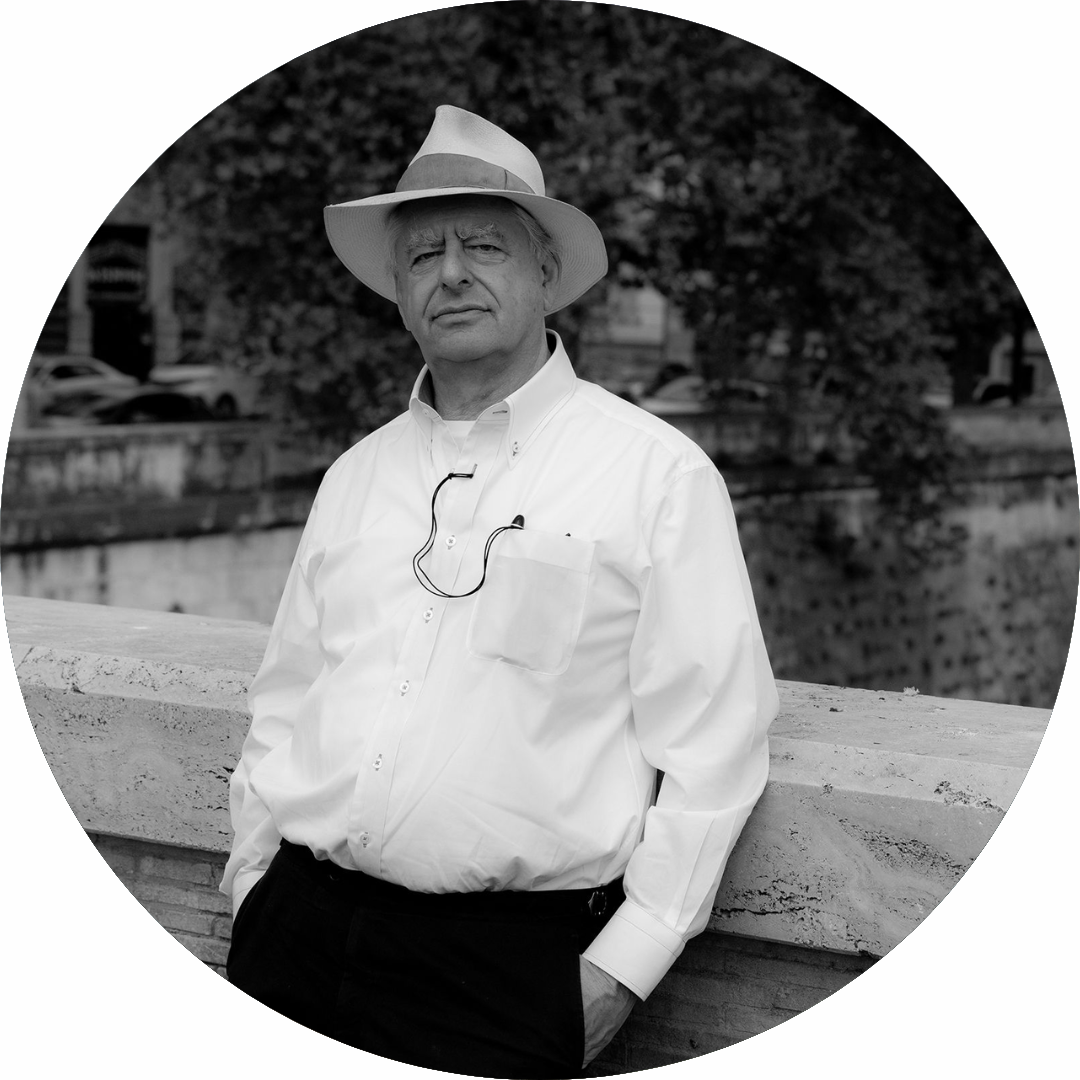
This podcast is supported by National Geographic documentary films presenting Sugarcane. Set amidst an investigation of unmarked graves on the grounds of an Indian residential school, Sugarcane follows a community finding the strength to persevere. The New York Times calls it one of the best films of the year. Winner of the National Board of Review for Best Documentary and Winner of Two Critics' Choice documentary awards, Sugarcane, now streaming on Disney+ and Hulu. The artist William Kentridge has created a nine-part series called Self-Portrait as a Coffee Pot. It's funny and insightful and full of dazzling images. I'm Tom Powers and this is Pure Nonfiction. William Kentridge is a well-known figure in the world of museums and galleries. Now in his late 60s, he is a wide-ranging artistic career that includes printmaking, drawing, sculpture, animation, opera, and more. If you're a stranger to his work, see our show notes for a link to a helpful introduction from the Royal Academy of Art in London that staged a major retrospective two years ago. Kentridge is from South Africa. His parents were lawyers and prominent anti-apartheid activists, and the country's history often as a presence in his art. His work has taken him around the world, but that came to a halt with the pandemic in 2020. Confined to his studio in Johannesburg, he began filming himself at work using all of his disciplines to create the nine-part series Self-Portrait as a coffee pot. It made its world premiere at the Toronto International Film Festival in 2022 and is now available on Mooby. Almost all the action takes place inside his studio. It's like being inside his brain. We watch him create wall-sized charcoal drawings and invite in other South African artists for music and dance. And we listen to him ruminate with his dry wit on the personal and the political. Here he is in chapter 1. When I was three years old, I wanted to be an elephant. I say of it that. When I was fifteen, I wanted to become a conductor of orchestras. And then I was told that to be a conductor you had to be able to read music. So I was reduced to being an artist. Kentridge is always dressed in the same outfit, a white button-down shirt and dark slacks. He clearly draws inspiration from the silent film era in both his consistent appearance and in his camera tricks. One of his favorite techniques is to appear on camera alongside another version of himself as if he had a twin. In this scene, he sits at a messy table of half-finished ink drawings. He's having a disagreement with his other self about what happens in the studio. Can you at least admit that the two of us are here together in this room? Is that possible? No. I write down "yes". But what can we admit? Can we admit to the solidity of this table? The table is also a much-abused tree. It's the memory of a tree. It's also the premonition of a fire, the smoke and the ash. But this coffee pot, you will admit that that is a real coffee pot sitting on the table. This is not a coffee pot. It is a paint holder. But can you then at least agree to what is not here? Now can we agree that there is no thunderstorms, no mouth-opening, there's no rhinoceros here in the room with us? Can you not see its absence? I can see everything that you can see and more. Here's an infectious glee to this series that's like an invitation for each of us to explore our own creativity. I spoke to Kentridge in October by Zoom when he was visiting New York City. We discussed therapy, optimism, and how he worked with the esteemed editor Walter Merch as a consultant on this project. To begin, I asked if he had role models for being an artist when he was growing up. My grandparents and my parents were all lawyers, because they are family of lawyers. In fact, my grandparents had good friends with a Welsh artist who lived in Johannesburg. My parents were friends with Cecil Scottness, another Johannesburg artist. It wasn't as if I thought I knew that artists were real people. You could go and have separate their houses. They had other children. They didn't have to live in a garage. There were kind of real in that sense. It was never even though it was not the field that my parents or grandparents were in. It was not an impossible image of what it was to be an artist. Not sure that made things easier. When I went as many children to piano lessons or to drawing lessons, that continued. I was an adolescent. My mother and I went together to life drawing classes, which was embarrassing for the first 17 minutes, seeing a naked woman with your mother sitting next to you, both of you drawing what was in front. It felt embarrassing and quite grown up at the time to be 14 in that context. Then I forgot to stop. I went on with lessons and then working in a studio while I was at university, doing both theatre and visual arts. As a student at a small time at school, there was no course, there was no work there. I was studying academic subjects at university. I was acting. At a certain point I was telling my students, this is ridiculous. You're going to be an academic, an artist, an actor. Don't try to do everything. I thought very good advice. I closed the etching studio. I said, I'm not going to be an artist. I didn't go to any postgraduate studies at university and went to become an actor. Where I discovered after three weeks in theatre school in Paris I was a modern actor. That's a short amount of time to figure it out. Well, it was very clear. I did the whole year at the school. I didn't drop out. I stayed on and learned a huge amount both about directing and about what it is to be an artist. What it is to give an impulse, the benefit of the doubt, whether it's a gesture or a line, but not to have to work everything out in advance. To say there's a different way of understanding of the world that's completely different to the linear logic of the legal world of my family. There was always had to deal in the back of my head with a skepticism of a logical way of seeing the world, with the need for me to work in a very different way. In fact I was 30 by the time I could say, what am I? I am an artist. This because a friend of mine who I said, I really don't know what I'm going to do when I grow up. At a certain point he said, you're nearly 30. You've never had a job. You are now unemployable. No one will ever give you a job. Either sink or swim with what you're doing. I thought, okay, let's recalibrate. I am an artist. Practice saying that is. Given that your parents were lawyers and working against apartheid in their work, it's a heavily politicized time that you're growing up in. How did that affect the path for you to go into the arts? As the beginning, it was very much a kind of a lannanous view of artmaking. What is to be done? What are the images that need to be made in the world? What is a shopstewed need to. What can I show a shopstewed to understand? At a certain point I understood, actually, I have no idea what someone outside of me understands or doesn't understand or wants to learn. That's when I gave up. That's when I saw the ancient press and went to try to become an actor. When I came back to my studio a couple of years later, there was a three-hyeatus of not making any drawings, not being in the studio. When I came back, it was at the age of 30. It was on the basis of not working that way, saying, I'm not going to write the essay in advance. I'm not going to work out what the meaning is. What somebody else should understand. Let the image lead the way. It's start with images that I'm interested in. Let me work it then conscientiously and let's see what that means in the end. Certainly the perspective of the cases that my parents were involved with gave me very much a sideways view at South African society. The difference between that view of understanding the world and the view of the world given by the all white, all boys government school that I was attending as a student, as a pupil. Now this project, Self Portrait, is coffee pot. You describe that it kind of grows out of the practice of giving artist talks when a museum or school will ask you to subscribe your
work and I know that some artists bristle at that process. They feel like the work should speak for itself. I wonder what's your relationship to talking about the work? The two things. The one is that public speaking was always a low-stress activity for me, from school onwards. So I didn't resist the idea. But the other one, the other point and more important, was that I understood at a certain point that in the shape of the world today, the artwork today, there was always going to be this demand or this need or the request for an artist to talk about the work or to be present to. And I thought rather than bristling at it and rather think, oh my god, there's another talk to give, let me rather try to make that a form of the, so the lecture to become one of the art forms and mediums in which I work. So instead of saying, damn, I'm giving the set of lectures at Harvard or somewhere. This is going to take me away from my work. So, all right, for these six months, that is my work, that is the project. And I gave myself a rule when I was doing the lectures at Harvard, no drawing allowed before lunchtime. It's sort of reach for the charcoal and slap my hand and say, no, go on, go on with the much harder work of writing, writing the lectures. And so from that, there's a sense of both being present in the videos, which are accompany the lectures and in conversation with that and thinking what images work together with what argument, what's aware of not just trying to convince someone with words, but to show them something on the screen, if you're giving a lecture that is more convincing than simply proclaiming something. So when it came to do the series, there was a sense of a thinking language and a visual language and working with film that was already there that obviously got expanded and developed and enlarged for the series. So you've been making stop motion animation projects since the late 80s. And that work can be painstaking and technical, time consuming. I have to imagine prone to frustration if you make a small mistake and a lot of work gets undone. How did you learn to embrace that process? Well, I first made an animated film in the form of a friend said he had a 16 millimeter film that took single frames and he left it. I said, leave it in the studio for two days. I said, do you ever come into the studio or shoot some frames? So it was a remote, bolex, clockwork, camera. And so my granddaughter then came into the studio and my wife and friends and sort of a hobo from the street. I said, come in and shoot a few frames. And that also filmed some drawing. And I said, let me see if I can film the process of making a drawing. So filming it from the blank sheet of paper, gradually the drawing filmed itself. And then I showed it to a friend, the editor, who edited the first film. And he said, yeah, this is all fine, but in fact the interesting part is this charcoal drawing. And I said, are you crazy? That took two days and it's four seconds. He said, I know, but why don't you go and make another film like that? I said, it's going to take months. He said, maybe, but that will be more interesting. And I started on that. So it's first just making a drawing coming into being. But then understanding once the drawing is there can continue. The marks can continue being erased and added. And so the drawing does more than come into being. It continues its story. And so that's how the series began. And yes, they are. So about, it's about a nine-month thought and years job to do a nine-minute film. It's kind of a rough length of time it seems to seem to take with some other things in between. Which in terms of animation is not so slow. There are people I know, animators, great animators. That would spend years on a five-minute film. But so this is kind of the edge, but it becomes very obsessive. If it's an ordinary drawing, I can't work beyond half-possed ten or eleven at night. My focus goes. Whereas this can really just go on because it's slow process of accretion frame by frame by frame. I mean, that's an equation that would frustrate a lot of people a year's worth of time for nine minutes of work. So I'm curious about the mentality. So one of the ways of thinking about it, yes, nine, you know, or a year or nine months of working to arrive at a nine-minute film is slow. But also there is all the drawings, the residue of the film. So there are not thousands of different drawings the way would be of the conventional animated film. But there may be twenty drawings. And so in the end you can say well here's an exhibition. I've produced an exhibition of drawings in a year for an exhibition is not so unreasonable. So that's one way of justifying it and keeping some kind of track on it. So a key technique in self-portrait as a coffee pot is you putting yourself in the frame alongside yourself. Sometimes three of you or more of you. Did you have an aha moment when you realized you could do that? I think I had an aha moment when I saw some films of George Melius made in the 1890s. Before there was any digital technology and it was all be optical closing a blocking of part of the lens and part of the negative to shoot the roll the film back and reshoot it and he became a master of those techniques. He would have one of him, two of him, three of him, take his head off, put it on the table. All in quite you know in out termed extremely simple and but enormously skillful techniques. So I think that was so it was his aha moment which I thought oh I can I can do that also because A with modern with video technology this is around the year 2000 you can actually run it was possible to start running film backwards. So I could without shooting it on film you could immediately see how a video runs backwards and then film it on film and also run it backwards. So I was doing both at the time but using the flexibility of a video camera to understand what was possible and then doing it carefully with 16 millimeter film and then gradually by 19 2010 or 15 I started working just with the digital cameras. The laboratories processing film had stopped in South Africa you couldn't buy the film you couldn't get it they weren't the laboratories anymore. But the sense of the doubling I suppose it began with an understanding in the studio how one is always there's so many different conversations going on in one's head. In the episodic series now they started under lockdown in Johannesburg and so in the first weeks of that the first 10 weeks of lockdown meant it was really just me in the studio and one assistant who was living in our property and so was part of the bubble. It was either going to be just voice over which I didn't want or no voice and I didn't want an external voice and that kind of documentary talking about it it was quite early on I thought that would be the voice would be the conversation which is sometimes me with myself but often I hear I'm channeling my father skepticism or my brother's voice different people I realize are inside me who hadn't I thought were far enough away. Here's a portion of that dialogue with himself from episode two of self-portrait as a coffee pot and how do you see yourself? I need to see myself in other people's looking at what I have made. My regard is not enough. You're looking you're a god your judgment your opinions are always suspect to me don't take it personally. Why do you think I spend all these years leaving a snail's trail of drawings of objects behind me to keep a black depression at bay Marzipan or dark chocolate. I prefer Marzipan. At least there is no conflict here. When I look in a mirror you can't resist appraising me. Yes it is always a disappointment. You spy on me in shopwinder. Can't you do something about your hair? I ask you please not to burden me with your and yet it is your spine that is inclined to the left to the right. I ask Cantridge how much of that dialogue was scripted versus improvised. Well it's it's improvisation in the sense that there's not a script for a whole episode but in the morning that I'd say all right I want to talk I have this idea of what it likes and dislikes of myself which are the contrary like so I said what do I have. One person saying I like A and the other one saying I like B and I like C and I prefer D. Then in that morning I would write it out very roughly in a notebook and then I would actually have that notebook in front of me and read it so that when I came to do the second person there was some trace of what the first person I'd remember okay leave a longer pause because he had a longer sentence here and look surprised look around where you think he was standing in it. Insofar as I had to redo it sometimes it was quite often just because my eye line looking out into space was on the end we ended up sticking a tripod with the sock on top to know okay that's the eye line that's where I'm meant to be looking and then a lot of careful work by the editors to slow things down to speed it up to keep the conversation flowing and in sync and later on even cutting to close up so that we could jump across all witnesses and
and things like it. But you are to do it in tireless improvisation was too hard to improvise two people at the same time. Well, I mean it's a delightful process and as I'm as I'm watching it, I feel like I'm watching the work of magician with that sense of, oh I think I know how he's done this, and then you'll do something, you'll change the angle, and I'll feel confounded again trying to figure out. I mean, do you think that it's due to the correlation between magic and and the art making? There is a correlation, but the key one is I once saw a small circus called a circus imagine there, just two men and a woman and a half-trained goose, and that was the the cast. But there was one moment in which the man had soap and a bubble and a stick and he blew bubbles, and then he picked up a little hammer and as he hit each bubble they turned to glass, they were astonishing, they're shattered as glass, and I thought how on earth is this done? And then he kept doing it and then he just revealed the flap of his westeret, and under his waistcoat he had a little bell, and as he tapped each bubble he just rang the bell, and the sound of the bell turned the soap into glass. But the extraordinary thing was, okay so see how it's done, I understand exactly how it's done, it didn't stop them being glass. So you could say I know it's a soap bubble and I know he's pressing the bell, but still each time there's something in me that can't resist the belief that that is glass shattering. So that for me was a kind of revelation of saying there's an extra pleasure when you see how something is done, but you still are held by the illusion. So it's not a willing suspension of disbelief, it's an unwilling suspension of disbelief, it's your body needing to make sense of different fragments that come in. So in that sense showing how things are done and making it transparent, you know, and they're kind of obvious for not really trying to fool anyone. Sometimes there are a few extra things that are put in and we leave out a middle stage, but by and large you can see how the drawing is done. It's fairly obvious that there's a camera filming me twice. Some people do ask if I have twins, if I'm a twin. And I could have made things one was probably more difficult because they need to be in real disagreement. Here if one of me gets out of control the other one can pull him back in quite easily by just turning his back. We'll be back with more of William Countryage after the break. This podcast is supported by national geographic documentary films, presenting sugar cane. Set amidst an investigation of unmarked graves on the grounds of an Indian residential school, sugar cane follows a community finding the strength to persevere. Winner of the National Board of Review for best documentary and winner of two critics choice documentary awards, sugar cane, now streaming on Disney+ and Hulu. You were working with the editor Walter Merch as a consultant. Can you describe what kind of input he was giving? Yes, when I started I invited Walter to say, would you like to edit the series I've met him before we'd had a friendly conversation with another occasion? And he said he would, but he's busy writing a book and that was going to take him six months and I said well by then we'll finish the series. He agreed he would be a consultant and also in lockdown. He was in England with his wife Aguille and I was in Johannesburg. So what it became is a weekly conversation. Conversation, sometimes about the specifics of the episode, sometimes about the chapter he was busy writing in his new book about editing. And sometimes very specific. It's a piece of film you said, me I've tried trimming it five frames here and extending the other side by eight, but if you let the music go on for a second and a half, take it down 3 dB, I think it will you'll find it's much clearer. So it was a master class in editing for me and for the three editors who were in the studio working on the on the episodes. And then when it came to the sound mix, he was in charge of the sound mix and then came, as it got closer, we had more meetings in person and really going through each one. So in the end it was a perfect way to work. It would have been very difficult editing everything long distance, sending everything and not having the ease of as it's being filmed. It doesn't work these two people next to each other or how does that. But none of us, neither me nor the editors had worked in this long form or anything like this. So it was a very reassuring hand on the rudder. I mean, you described this as a COVID era project. It was, you did a good amount of the work in the 18 months of lockdown. And I've seen you give interviews where you talk about inviting people in the studio and trying to take precautions, but getting COVID and getting through it. And now here we are, you know, a couple of years past that. It was such an intense period of our lives as we were going through it. There's, I guess, each person's experience is individual, but I think for a lot of people, there's been this kind of switch back to normality. And I wonder how you've experienced it having done this concentrated work inside that pandemic bubbled. Do you feel like you've kind of gone back to a before time or do you think it's changed you? Well, I've gone back to a before time in the great thing about not the great thing, as an artist working in a studio, one of the compensations of the period of COVID was these months of not traveling. And the ongoing week after week and month after month of being able to be in your studio, since that has ended, that glorious time of quietness has gone. So there are theatre productions, there are exhibitions, there are many things that take me away from Johannesburg. And so it becomes a much, it goes back to being a much more fractured existence. I mean, I can't blame anyone but myself. I should be able to say, right, these next four months I'm not traveling at all, exhibitions I won't go to and performances have to happen without me. But that's often difficult to do in terms of expectation. But fundamentally it does feel, feel back. There are some people in the studio who work at home more than they used to and that's also fine to have clearer, fewer people around in the studio. But fundamentally it is back to pre-COVID, trying to remember what it was like. So the series is not a diary of COVID but it does correspond to the first episode at the beginning of the lockdown as it eased, as it went on. And in the series every now and then there's a listing of the numbers. I'm sure, like so many people I became a kind of obsessive amateur statistician of how the numbers went in each continent, in each city which was growing quicker and slower. And there's fragments of that in the series. So there's a big theme of self inquiry making a self portrait in the title. It comes up in other episodes, you interrogating yourself. And I wonder what have been the most useful pathways to self exploration for you? Is it art? Is it other means that other people turn to the therapy conversation, friendships? I mean, friendships, conversations are obviously vital. I went through many years of therapy at one point in my life. And I was kind of, it was, it was useful. I think it was like going to the gym. When you go into the gym, you're fit and it's great. But it's not like, oh, I've been to the gym for two years now fit for the rest of my life. And the way one expects therapy to. I've been, I've spoken about all these questions that should be over. When I was in therapy, I felt much more alive to media dreams, to thoughts, to questions. And then you get out of fitness, you get out of therapy fitness. So the studio, well, it is, I suppose I was maybe hoping that there'd be more revelations coming from those conversations, but self protection, repression, all of those things were still, couldn't quite get them out of the way. Do you find your collaborations bringing other people in, become provocations to help breaking down some of that? That's right. I think the collaborations are very central to so much of my work. If it's just a drawing, it doesn't help to have anyone else in the studio or an animation that's me on my own. But as soon as it's either a sculpture to make or a complicated print to make, or obviously, of course, the music in a film or the movement of an actor or performer in the works, then collaborations are not just assistance that becomes part of the authorship. What is the combination, what arrives through the combination of my sensibility and the sensibility and skills of the people I'm working with, sometimes the work is shaped by those possibilities, a project which I never thought of might come into fruition because of the work.
of what I know someone else can do, what they've shown. So in that sense, the collaborations are very, the nod of the age, they're very central to the work. And there's some people that I've worked the same with the same people for 20 years are this change with each project. I want to reflect on the final episode that's called "Indefensive Optimism." And I wonder what brings you optimism? I think the argument or the-- what I was trying to show there is that the optimism is in the activity of making. It's not about saying, oh, this is a happy picture, so that's optimistic. Or this is a picture of a terrible circumstance, so that's a pessimistic drawing. Sometimes it's read that way by people who see the work afterwards and take the subject matter, bowl of flowers, oh, that's optimistic. Body lying in the filter, dead body lying in the filter, that's pessimistic. I'm saying the optimism and pessimism is in the activity of making. If you're drawing that bowl of flowers or that body, the energy of drawing feels not so dissimilar. So inside the studio, the optimism is in that moment as the pencil or the charcoal or the touches that sheet of paper. And it's both from you, but more than you. You can withdraw from it and that trace remains. And that's where I kind of locate the optimism. I mean, I can see how work brings happiness, which can be translated into optimism. I think it's the surrounding world that's harder to contend with. And I wonder how you think about that. That's much harder to contend with. And that's where the series is very deliberately stuck inside the studio. The studio has a kind of artificial utopian space that all this kind of thinking you can run time backwards, you can stop time. All the things that are impossible in the world, you can deal safely with anger inside that space, which are things that are too difficult outside the studio. It's the privacy of one's own head of thoughts going around, which can be, as we know, angry, generous, self-accusatory, all those different things, which get expanded onto the walls of the studio. And that's kind of the special space of it. In a way that the studio has an enlarged head is in many ways the theme of the whole series. I want to thank William Kentridge for speaking with me. His nine-part series, Self Portrait as a Coffee Pot, is now streaming on Moobie. See our show notes for details. [MUSIC PLAYING] If you'd like to follow what we're doing, please subscribe to our newsletter, Doc Voices, written by Bella Racklin. You'll find it on Substack. If you want to advertise to our 40,000 readers, send an email to
[email protected]. Thanks to our team, series producer, Hannah Nordenswan, and web designer cross-strategy. Our theme music is composed by Andre Williams, and our executive producer is Rafael and A. Howson. I'm Tom Powers. Follow us on Instagram and visit our website at purenonfiction.net. [MUSIC PLAYING] [MUSIC PLAYING]
 PodcastTranscript AI