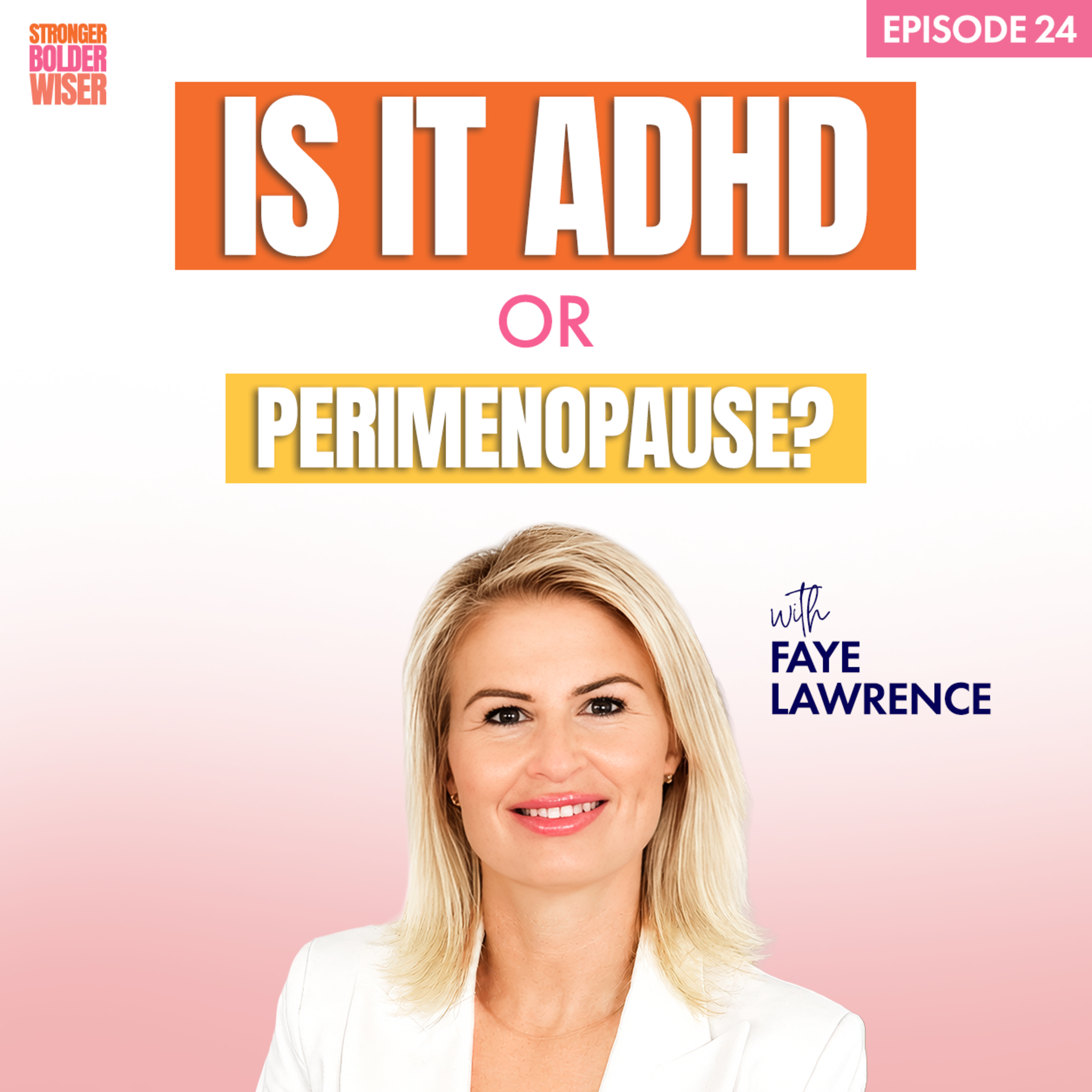
Why Your Coping Strategies Stopped Working in Perimenopause - with Faye Lawrence
from Stronger Bolder Wiser
71m 44s
The conversation between Sarah and Faye Lawrence explores the intersection of ADHD, perimenopause, and alcohol use in women. Faye, a counselor and ADHD coach with lived experience, explains that up to 43% of individuals with ADHD develop alcohol use disorder, as the ADHD brain is prone to addiction, including binge eating and other compulsive behaviors. She emphasizes that hormonal changes during perimenopause disrupt neurotransmitters like dopamine, exacerbating ADHD symptoms and breaking down the compensatory strategies women have used to cope, often leading to crisis. Historically, ADHD was underdiagnosed in women because research focused on males and presentations differ—females may show daydreaming or high achievement rather than hyperactivity. Undiagnosed women face higher risks of depression, substance use, and alcohol issues, as evidenced by studies showing five times higher alcohol problems and 12 times higher drug issues. Faye highlights rejection sensitive dysphoria (RSD), where perceived rejection causes intense, physical-like pain and rumination, leading to avoidance and accumulated shame from a lifetime of feeling "not enough." Late diagnosis brings relief but also grief for lost opportunities, yet understanding ADHD reduces shame and allows for treating both ADHD and addiction simultaneously. Faye concludes on a positive note, noting strengths like creativity and agency, which can be leveraged when embracing neurodivergence.
the number of people with ADHD who develop alcohol use disorder, it's really high. Up 43% of ADHD's will experience alcohol use disorder. Wow. That's just the alcohol. Vingeting disorder, massive. The ADHD brain is like a magnet for addiction. When you understand that, it helps reduce the shame and then we can start to deal with them both. The hormonal fluctuations in parry and menopause impact neurotransmitters, one of which is dopamine and that's hugely implicated in ADHD. Is this normal? Is this parry menopause or is this more than that? It's not that women are suddenly now presenting the ADHD. It was always there. It just wasn't recognised. I want to finish on a positive. There are so many positives to an neurodivergent brain. There are so many positives to ADHD. Creativity, the sense of adventure, the need to have agency. When we can embrace the fact that we are different, this can really work in our advantage. Faye Lawrence, welcome to Stronger Boulder. Why is that? I am so glad to have you here. How are you going today? I'm really well-speccer. Thanks so much for being part of me on. The reason I really, really wanted us to have this conversation is because I think what you bring is a combination of skills that I don't see in anyone else, Faye. That is your real understanding from a counselling and psychology perspective around mental health, particularly for women in midlife and parry menopause, particularly those who have been using alcohol in a grey area drinking style and particularly those who also have ADHD. There is this myriad of different things going on for women in their 40s, 50s and 60s. I send so many women your way because I am like Faye Lawrence is the guru to go and help to put all of this together. Do you want to share how you have ended up in such an incredible unique niche space that helps so many people? Oh, thanks Sarah. What a beautiful intro. My goodness. I sound great when you put it like that. So, basically a lot of it has come about through a lived experience really. I mean, I was always very interested in human behaviour and how we organise ourselves, why people do the things they do since I was a teen really. I grew up in an environment where there was a lot of internet generational trauma and addiction and so I think it was natural for me to be curious about those things because they impacted everything around me and I went through my own journey with the alcohol side of things. I was heavy drinker for a long time until I quit in 2017 and that was because I did have a problem. I'd gone from the sort of grey area drinking to this really being quite a big issue and I went into impatient detox to help me in that process and a month after I got sober, I graduated from my psychology degree. I was in my 40s at the time and then it was, I think it was about four or five years later that I got diagnosed with ADHD and I was in the throes of peri at that time as well. So it was sort of this real storm, massive storm tsunami actually of all of this stuff that was sort of happening in that short space of time that was massively impacting my life and I could really see things made a lot of sense once I sort of looked at it in retrospect and I continued with the studies. I became an ADHD coach, grey area, a drinking coach. I did a post-grad study in counseling and so I really try and bring from lots of different disciplines into the mix because I think we silo information and approaches when we deal with whatever we're seeing as mental health practitioners and I just don't believe we operate in that way as humans. I think it's body, mind and soul. I feel like so many women in my life and I'm 50 so lots of people in my life are late 40s to late 50s and so many women are considering that they have ADHD and I'm curious to discuss this with you because I want to know is it that it's being talked about more? Is it that and that's why so many more people are seeking diagnoses at this age and is it that in perimenopause and I think I've heard you say this before, we might have been coping okay and the symptoms might not have actually been so apparent but once we have this change in hormones, the symptoms actually become more and more apparent in our life and more impactful. What's going on there? What happens is the hormonal fluctuations in perimenopause impact neurotransmitation. So the chemical messengers in the brain, one of which is dopamine and that's hugely implicated in ADHD. So we are not only at a time of in our lives where we're carrying probably the most parents or that might be elderly, we've got, you know, we might be in the pinnacle in our careers, we've got probably kids at home as well and so we're trying to juggle all the things anyway then we're hit by this hormonal shit show really and that's, you know, leading to fatigue, it's leading to irritability, it's leading to overwhelm but it's also messing with neurotransmitters. So if you do have ADHD, suddenly now the things that we've been used to push through, often with root force, aren't working that well anymore. And suddenly all these coping mechanisms that you've had, your left floundering going every day is like waiting for some mint. I just, you know, don't know how I've been doing it and nothing I walk into a room and I can't remember my name barely, you know. So because with women with ADHD, we use a lot of compensatory strategies, even when we're on diagnosis, we don't realise this is what we're doing. So we've got a lot of things going on behind the scenes that we're using to be able to assist us to perform at say neurotypical levels. So you know, that might be a lot of like over-converoluted organisational systems and things like that, for example, it's taking a toll, whatever those strategies are, alcohol is one of them as well. So once these things stop working, when the hormones start fluctuating, it's like, oh, what now? And so that is one of the major reasons. The other major one is that women were never believed to really have ADHD because the research was all done. I know there's probably no surprises here on males and it was also believed that people grew out of ADHD even males. So it was considered that very few people who had it in childhood would continue on and have it in adulthood. You just grew out of it. And what we know now is that is not true. We also know that it presents differently in females because we're socialised differently. And so, you know, you're less likely to see that sort of bouncing off the wall's hyperactivity, for example, that you do in boys, you might see the daydreaming looking out the window type of ADHD, often quite high achieving as well. So we're not showing up the same way and it's often missed, but also the research just wasn't there. The moment to actually sit back and go women are being failed systematically in the medical system because once again, research is done on males and so we don't get a chance to actually understand what our symptoms might be and the impact of our hormones and how we show up in the world. So it's not that women are suddenly now presenting the dayd ADHD, it was always there. But it just wasn't recognised. Actually when you look at the research, there was a paper in the Journal of Psychiatry. I think it was a British Journal of Psychiatry recently and they did like a massive cohort of health data. What it showed was for an ADHD women were part of that. What it showed was the toll that it took on the undiagnosed women that had gone through childhood. All the signs were there. They were experiencing more mental health issues. They were having difficulties at school. There were so many things, but it just wasn't recognised. It wasn't picked up because they were female. So they went on undiagnosed. It meant that later in life when they were diagnosed and this study actually only went up to 25. So that was considered to be late diagnosis. They were five times more likely to have an alcohol problem than the women with our ADHD, 12 times more likely to have a drug.
issue and 50% of them had experienced depression were depressed. So it's not just a failure of all the research didn't catch up, all people are struggling with, you know, it's like it's all there. There's like significant toll this is taking and when you compare the ADHD population of undiagnosed women with the neurotypical population. So it's not this sort of fluffy thing that people talk about. There's a lot of strengths as well. I don't want people to go away thinking that it like it's all bad news, but it's quite rage inducing for me because I, at a personal level went to CSI cartridge in 2014 and was dismissed. Basically 20 minutes in the session, yep, now it's probably go off and read the untethered soul and I didn't get diagnosed until 2022 and in that period and I'm not necessarily blaming, you know, I've got to take personal responsibility here, but that was the descent into significant problems with alcohol. I'd always had them, but this was when it went really gnarly and I do look back and think might that have played out differently had I received that diagnosis at that point and, you know, who knows. But it's this sort of systemic dismissal of women about their health, about their mental health, about their concerns with their children that really is causing serious harmful women, but it's incredibly, incredibly rage inducing for me particularly because I see it with clients day in, day out. They've been diagnosed with bipolar, borderline. They've been heavily medicated. And that's why it's so important that we have this conversation. And so what I'm hearing you say is that ADHD presents quite differently in boys and girls and we'll explore that in a minute. And that for many women, the coping strategies that they've been using all their life have, in many ways, been masking some of the symptoms and then in parry menopause when we have this change in hormones, it's when the shit hits the fan, the wheels come off, those coping strategies don't work anymore and that's when so many women are actually questioning, is this normal? And that's what I want to ask you next is let's unpack some of those signs for a woman who is in parry menopause and is likely to have ADHD as to what they show up as compared to someone who is experiencing standard parry menopause symptoms because when you came into my alcohol reset challenge and you delivered a presentation, I literally sat there with my jaw on the floor as you went through some of the signs and symptoms of not just ADHD but neurodiphyl virgins and it was astonishing to me to see because I just thought ADHD was, oh it's someone that can't concentrate and can't sit still and you just think of all the little boys that are just throwing things around the classroom and raging and shouting and just won't listen. Whereas it's so much more than that. So let's just talk about that for a minute. If you want to maybe go through some of what those symptoms look like. It's really tricky. I will say that the ADHD isn't necessarily easy to diagnose because there is such an overlap with other things. One of those things being complex trauma and other mental health things that might be in the mix and particularly because with ADHD, about 80% of ADHD has at least one other diagnosable mental health thing going on. So it's quite up there. So this is why- Such as what? So what would be the other likely mental- that they're usually the main ones substance use disorder? Because the stats you've just shared around alcohol are pretty high, right? The number of people with ADHD who develop alcohol use disorder is significant, right? It's really high. Yeah, it's up to in the most recent metronalysis where they basically look at all the research that's available. That was in 2021. It was up 43% of ADHD as well experience alcohol use disorder. Wow, that's almost hard. That's not taking into account shopping, tech, food is another massive one. Binge eating disorder, massive. For guys, tends to be more things like gambling, porn. So the ADHD brain is like a magnet for addiction. And when you understand that and understand the why, it helps reduce the shame and then we can start to deal with them both at once which is what we have to do because they feed each other. A big part of the struggle for ADHD is the emotional liability. So because we're spending more time in the limbic system and the emotional part of the brain, we and the prefrontal cortex has got less influence. It's got less, the message is coming the signals aren't as strong, let's just say. And so it means that moods and our emotions are so strong and can feel very, very potent. We get derailed a lot. So things like rejection sensitive dysphoria, some of these things can feel like physical pain, which sounds ridiculous. But whenever you talk to an ADHD or about the emotional side of it, it's often the thing that we struggle with the hardest because. So let's just talk about RSD rejection, what's it called? Rejection sensitive dysphoria. Yeah. Because I hear about that a lot. Let's see what is that? Well, it's where there is real or perceived rejection. So say for example, you haven't heard back from somebody, you've sent them a text and it's been 24 hours. And so you are imagining the worst case scenarios in your mind related to that about yourself. So I will get off this podcast with you Sarah. And I will probably. And I've got all the tools and the tricks now to deal with it. But I will be probably ruminating on it for some time about how it's going to sound terrible. How. No one's going to listen to what I've got to say. How I've done this wrong. And you might go, okay, well, that's just part of the human experience. That's, you know, everyone has doubts about themselves and so on. But with RSD, it can be quite debilitating. But for some people, so say, for example, you've rambled on about something, which is your particular area of interest, which of course, I do all the time. You'll come away from that setting and you might be in a spiral for days after that. Wow. Yeah, because you feel like you've blurted out or you've gone on too long or you've embarrassed yourself or you've pissed people off. And for a lot of people, they do describe it as like a physical pain. It feels like, you know, someone has actually punished you in the guts. And it can be quite hard to pull yourself out of it. So it means that ADHD is often really struggling behind the scenes about something that might not even be real. It might just be that you've perceived it to be a rejection when actually it's not. And this is, you know, some of the stuff that I teach with my clients is, you know, some of the things that we can do about this. But once we understand what is actually happening, it can help us have that little bit of a space between ourselves and the response to go to to send check a bit more, you know, because you can go, oh, it's my RSD rather than it's me. It's like that part of ADHD rather than and that helps. I've got a couple of friends in that scenario and they've said to me that when they've experienced, it wasn't even a direct criticism, but they took it as a criticism. And they said it feels like a physical pain in their body that it's visceral how deeply it hurts them. And of course, nobody likes criticism. So I don't think I have ADHD. And so my reaction to something like that might be, like you were saying before, or I might sit and ruminate over how I came across on that podcast, I would do the same, but I would probably be more like, oh god, I hope I didn't sound like a dick. Was I a dick on that podcast? Oh, I hope that's really, but then I can just move on. Whereas what you're saying, the difference for you is you will sit with that for quite some time. And that's going to then be really debilitating it in how you show up in other aspects of your life for that period of time that you're ruminating on that. I can imagine that must be really hard. Absolutely, not just that instance. It means that you start avoiding things where you might potentially be putting your head above the parapet, so to speak, even at work, or in friendships, or it means that we, because ADHD has experienced a lot of shadows,
that is accumulated over a lifetime of being told either directly or indirectly through micro expressions or non verbal communication that you're not doing it right, you're too much, you're too loud, you're too sensitive, you can't adjust, etc, etc. And if you're undiagnosed, you've got no clue what you can't, you're like, I don't know, I'm really trying, I don't get it, I don't I'm trying to understand. And so you really internalize that and you're carrying it, which means that by the time you're saying you're 40s and there's been a perceived rejection, you're not just dealing with that perceived rejection in the here and the now, you've got this accumulation of the sort of body of evidence that's being activated in that moment and that's why also it's so potent. And there's always this sense with neurodivergent people because I don't just work with ADHDers of this being on the outer of the not quite getting it, not really understanding, not quite fitting, but not really knowing why. And that usually originates from school, from from young, you know, and so this sense of always being sort of on the outer and not quite belonging is something that is also being activated in those harvesting moments because it's human nature is part of an innate human need to belong. And the thing that is really striking me from what you're saying, Faye is I just had a moment then when you when you said, oh, but you might stop doing things, you might stop putting yourself in situations because you're worried about that. And then I think about the all the women who get diagnosed in their 40s, but had they had a diagnosis when they were 10 or 11 or 12, their whole life might have been completely different because they might have reached for different goals. They might have taken a different path because they had more self belief, they had more confidence, whereas if you're continually feeling you're not quite good enough, you don't quite fit in. Your emotions are really, really too big and too strong and they consume you too much. You're not going to go out there and and set yourself big dream goals and work out how to get them. You're going to keep yourself small, right? You're going to hold back and you're going to try and prevent putting yourself in a situation where you might get hurt, you might be upset, you might get found out for not being good enough or whatever. And that makes me really sad because I think about the number of people whose lives they may not have had the opportunities that they could have had, had they had a diagnosis earlier on. That must be something that comes up a lot for you in counselling with people who get a diagnosis later in life. It really is the grief, the grief that had people post-diagnosis. There is often this sense of relief, but there is also often, and it's different for everybody, but an immense amount of rage or anger and a lot of grief for the suffering of your younger self. And this whole thing that you've carried your whole life thinking there was something wrong with you. Now you're like, "Yeah, there is, I've got ADHD or you know, Audi HD or I'm autistic or OCD or whatever the things are coming to terms with, you know, the first thing I said when I got diagnosed or the first thing sorry that went through my head was I could have done a PhD by now. And that was very real because and he actually stood to me in my psychologist. He was amazed that I'd done the managed to do the psychology degree because my severity of my ADHD at that point was really up the pointy end. But on the other hand, we've become, you know, a lot of us can, if we can find the right conditions, it's not about becoming neurotypical, it's about finding ways to work with your brain. And a lot of people, you know, we are overrepresented for example in things like entrepreneurship. We need autonomy, we need to be, we're not good in this sort of cookie cutter being forced into a square pick into a round hole sort of thing. We have to have that agency to be able to try and work out that out for ourselves and to be able to do things in a way that makes sense to add brain in the way that we operate because we're just never going to fit into the norm in many ways. And I say embrace it. So I didn't really answer your question, which was about the peri-menopause and the ADHD. That is a trickier one because working memory is impacted in peri and menopause, the difficulty in sort of being able to, your executive functioning, which is things like planning and, you know, being the theoretical and, you know, longer term, thinking longer term instead of just in the here and the now because that's what the ADHD brain does. It's like now or not now. Those are the two forms of time. That's it. Something I just wrote down actually as you were talking when you, when we talked about the grief that you might experience when you get a diagnosis and the anger that would come with that. But where does that anger go? Because it's not our parents fault because there was, as you say, there was very little being discussed, you know, you and I are in our 50s going back 30, 40 years that no one was being diagnosed or the only people that were with the naughty boys, right? And so there's, there's, it's not our parents fault. They didn't fail us in any way because there wasn't. The system was not in place to offer diagnoses in the way that it is now. And so it's really hard to even know where you can point that rage towards because we're talking about a moment in time when the system was not set up to support people with an ADHD diagnosis like it is today. And so how did you manage that? ADHD is 80% heritable. So that means, you know, you probably want to have your parents realistically, the only thing more heritable is height. So you've got it from somewhere. Yeah, yeah, yeah, yeah, yeah, yeah, okay, conversely, my two children are adults and I didn't pick it with them. So one of mine got officially diagnosed after my diagnosis, but, you know, she was in 20s and I'm none of us new. So, you know, I mentioned that because it would be wrong of me to blame parents that didn't know who were also newer than her. Now, looking back, we all are. And, you know, I remember someone saying to me about my eldest daughter being ADHD when she was a small one and I was like, I don't think she's ridiculous. She's just, this is what I'm like. Because it's not what's wrong. It's not what's to you. You don't know. And so, really, usually, you see happening is kids getting diagnosed and then the mum gets diagnosed, but it was the other opposite. Yeah, that's happened to a lot of my friends. Yeah. It was the other way around. And that's because I got sober and when I've for about three, four years, something's wrong. Right. Everyone's talking about how calm they are and how peaceful everything is and how and I'm literally like, in my head, never stops. And it's like a motor in the body because I've got the combined type. So, it's like this inner restlessness that's just like churning all the time, never being able to relax properly. And it wasn't until I took the alcohol out that I realised how you know, but it had been a number of years. So, that was why I pursued the diagnosis again. No, we're talking a second about, I want to talk about why alcohol becomes so alluring for people who have ADHD and but before that, I just want to run through like some of these signs and symptoms because I'm really, really keen for my ladies listening now to be able to to just consider either for themselves or their kids or people they know because when you shared that checklist in the slides that you presented in the presentation you did, I was surprised because there was aspects that I didn't realise. So, you just mentioned then the concept of time. People with ADHD, they have two times and it's now or just doesn't matter kind of thing. And often, yeah, now or not now. And so, I'm impulsive, I'm going to do this right now or because planning can become problematic for people with ADHD. Can you talk about that a little bit? Oh yeah, yeah. Because ADHD impacts the executive functioning, the prefrontal cortex is not as, it doesn't have as much influence the messages are not as strong. So, think about it like a teacher at the front of the class and it's a busy, noisy class and the ADHD kids right up back. It's, when we think about dopamine and ADHD, we think about it in like terms of the deficiency, that's not quite actually what it is. It's actually the messages between say the teacher at the front of the class and the kid at the back of the class and this noisy environment, the quiet, can't quite hear. The information's there from the teacher, the kid just just not receiving. It's not receiving it. So, we don't
actually have a lack of attention. We've got everything coming in at once with equal priority. So the noise is the information, the movement, the internal thinking, it's just everything at once. And so because it's coming in with equal priority, we're like it's really difficult to sift through all that and go, "Where do I put my stuff down? What am I doing? I don't know." So some of the things that are impact, so you've got three times of ADHD, you've got the inattentive, so that's the type that you probably might not notice as much. So that is the daydreamer, the staring out, going off into the distance. The forgetting is a big one, inability to pay attention, so often for us we're paying attention, but because we need to be moving quite often, so we might be like looking around the room, it looks to all intents and purposes like we're not paying attention, but actually we need that sort of movement or stimulation in other ways to be able to pay attention. That's one thing the forgetfulness, the difficulty with putting things into steps. So exactly like you said, just then thinking about, "Well, I'm planning for the next five years." There's just so many sources of things that I have to pull into that, so many what we call steps, that it just becomes too overwhelming and we go, "I can't do it." Task initiation can be a real problem as well, so just getting things started. So we really need things like novelty, challenge, urgency, these sorts of things to be able to fire the brain up even with medication. And then the other type is the hyperactivity, so that is the jiggling, the moving about, the blurting out in the middle of a conversation with someone else is speaking, not being able to wait your turn impatient, all about the short term, the impulsivity in the here and the now. So with alcohol, best of intentions, yeah, I'm driving tonight, suddenly becomes on leaving the car. So that sort of ability to stick to things that require long term motivation is massively impeded. So you've got the inattentive and the hyperactive, and then you've got the combined, which is when you've got both, which is what I've got. If any of you are wondering, well, what on earth do you do instead of drink? What do you do when you're stressed, when you're angry, when you're lonely, when you're disappointed, when you feel like celebrating, you know you want to change your drinking habits, but you don't know what to do instead. Simply go to the notes below this where I have got a free guide for you, 100 things to do instead of drink. It's the perfect, perfect guide where I go through every emotion and 10 things you can do instead head down to the show notes below this episode and download your free guide. Something you shared in the presentation, I think some of the checklists that you went through was that you didn't have that perception of time was, oh, I'm going to do this, this, and this all throughout the day, but then there was no amount of time to be able to get through it. And so just couldn't actually think about how long a task would take. And so that would be something that many people they'd actually struggle with. Yeah, we really, really struggle with time. We do not think about time in a linear way at all. And also because we are, we've got interest-based brains and nervous systems, that can work both ways. So we can get sucked into something that is so stimulating to us that we completely lose track of time. So we will, you know, in that period where you're so focused, we call it hyperfocus or hyperfixation, you might forget to eat, you might forget to go to the loo, you're probably you're just immersed in it. And then suddenly the time's gone and you're legitimately shocked. But we really struggle as well with quantifying time. So for example, you know, I need to go to my yoga class. It's 15 minutes up the road. And then suddenly I think just before I'm about to leave, I've got time to put a load of washing on, do the, the, feed the cat, and then it's like, oh, and then there's traffic on the road. So, oh, whoops, Mr. Yoga class. You know, we, we, we really struggle with that sort of putting those pieces into place, but also very much underestimating how long things are going to take because we legitimately think, ah, it's a five minute job. And then two hours later, no, it's, it's, it's not a five minute job. So I always say to clients, usually double or triple it at least. However long you think it's going to take because the other thing we really struggle with this, all the steps involved. So for example, one of the things that I remember really struggling with when my kids were smaller and still now is like food planning or food prepping or any of that, like, how, how, it's still a misbrute to me. How do people do it? I just, there's too many steps involved. You've got to think about what you want, you've got to think about what recipes, you've got to think about all the ingredients, you've got to map all that out, you've got to get down there, buy it all, not miss anything, get it home, cook it, you've probably forgotten something, although they didn't have it in stocks. And now what do you do? That throws a whole carbosh on the thing, cook it, clean, and what if I don't want that thing that night? What if I can't stand Shepherd's pie and that is what it's like? It's exhausting. The mental fatigue is exhausting. Absolutely. And the thing that I'm thinking as well is particularly if you're undiagnosed, the way you talk about time and how much that would impact relationships, whether that's friendships or whether that's a partner that you live with because for a neurotypical person who doesn't have the same issues with time, they're just going to see the other person as rude as failing, as why you late all the time, why are you doing that? You said you were going to be back at this time. No, no, no, and that's going to cause a huge amount of conflict. And I imagine that's then going to make the person with ADHD feel shit, feel like they've failed again, like what's wrong with me? Why couldn't I? And then that internal voice would become more and more negative. Whereas I guess this is the positive of having a diagnosis is you get to start to understand yourself. And then if you're in a relationship with a neurotypical person, you both get to understand each other. And it's not about making one right and one wrong. It's simply about understanding. But if you don't have that, both people are going to end up pissed off and resentful with the other, which is going to lead to I guess a lot of conflict. It does cause a lot of problems in relationships. The research bears this out. And there's also things like object permanence. So sometimes if it's outside, it's literally out of mind. So it's not malicious. It's like literally you might forget people. Because if you haven't seen them for a while and it sounds odd, I know. I would go to the shops and buy something, for example, like a piece of clothing that I already had because of this object permanence. Because I couldn't see it, it didn't exist. So I can't hold that in my mind because there's nothing reminding me about it in the here and in the now. So and that can be not for everybody, but it can be the same for people. So you might actually legitimately forget friends that you have because you're not able to hold it in your mind. And then you see them pop up on Facebook and you're like, oh my god, yes, I've got to get in touch with them and around your ketchup. But it's, these might be people that you genuinely absolutely love. But it's the way the brain works. And when I think about the friends I have who have ADHD, they, I'm like, I'm very close to all my girlfriends and family back in the UK. I speak to them all the time. They're very rarely a day goes by that I don't. And sometimes they'll be like, what? You still buy birthday presents and Christmas presents to for friends you went to school with. Like and they just don't have that connection with their friends back home anymore because they're not in their daily life. And so it just doesn't occur to them to maintain that friendship, not because they don't love them. But it's just different, right? Yeah, absolutely. And this is where when that intersection between the ADHD and the hormones happen, we've got even less in the tank cognitively to be able to do those sorts of things, even responding to texts. If we're because we're much more prone to burnout as well, which also was something that was happening in that intersection between the the ADHD before the diagnosis and the parry for me was a massive burnout. And it can get to the point where you just don't have the mental energy to even respond to text messages. And it's not because you don't want to, you just don't have this
spoons for the mental exertion to be able to do it. So that's another reason why a lot of women are getting diagnosed as well, because they're hitting this level of burnout. And I've seen women have been hospitalized with this because the toll of the masking and this compensatory stuff we're doing in the background is very real, like it's going to have implications. I've been looking a lot about the negatives here, but because I see it and have experienced it, and with that as well often as part of that sort of presentation is a lot of complex health things going on too, because we have higher prevalence in things like autoimmune conditions and things like chronic fatigue, pots, dysautonomia, digestive issues, like the research is all now coming out. This sort of whole raft of conditions that affect the whole system, the whole body are much more prevalent in neurodivergent populations, hypermobilities and other ones. The chronic pain you're often seeing like this presentation with women and men, but particularly women that encompass all of this. And so it's really difficult then to, for these women to find someone who can help them, because it's like what is it? Is it the hormones? Is it my health issues? Is it burnout? Is it perimenopause? Is it neurodivergence? I don't know, everything feels like it's going wrong. And it's such a distress in place for people to be. And something I hear a lot is many people with ADHD, both men and women, would fit into that category of being chronic people pleases and wanting to make others happy and doing so much for other people. I think we're naturally deeply sensitive and empathetic people, which sounds potentially counter to some of the things that we've been discussing there about forgetting trends and things like that, or not being able to apply to text messages, we feel everything deeply. And Sarah, you may have found in your work, we're working with people who are trying to change their relationship with alcohol, you may have noticed this threat as well around sensitivity, because I definitely see that with anyone who sort of drawn to using alcohol as a sort of coping mechanism. But yeah, there's a deep sensitivity there and there's a natural desire to want to help. Like it's innate for us. And one of the things that I work with with clients is because of the time blindness, we're overcommissing all the time, because we legitimately think we've got the time. Yeah, I'll volunteer, yeah, I'll do the thing. Yeah, I'll, you know, and we like to. We just love, you know, yeah, there's a way I can help. But what happens is it then ends up contributing to our overwhelm. Our being completely burnt out, hitting the wall, the continuation of those sorts of things like the people pleasing and the lack of boundaries, etc. That just perpetuate this cycle essentially. So yeah, you're absolutely spot on. I think it's also a way to be a value when you don't quite fit. It's sort of a way that we've adapted to that situation by making ourselves useful almost and not necessarily intentionally, but as an adaptation. This is exactly what we're talking about. Like we get to four, four, five, these for a lot of women and realise the coping strategies and the adaptations that have been in place are actually just making us reach burnout. We're absolutely exhausted. The alcohols stopped working if we have been using alcohols and we remove the alcohol because alcohols are really, really good thing right for turning off a busy brain. That's why it's so attractive to people with ADHD because it helps us switch off. It comes on nervous system. It is a depressant. And so it's going to be a luring. It's going to be attractive. But then that leads to then further issues that increase anxiety when we're not drinking, disrupt our sleep, you know, everything else. So the woman that decides to remove alcohol then discovers what I'm still in my corporate job trying to like juggle all the things, trying to do everything and reaches burnout, multiple health conditions. And so what would you say to her for the woman who's listening now going, wow, this is starting to feel like it's a bit like me. What are the pros and cons to seeking diagnosis? Everybody wants to get medicated and it is somewhat hit and missed with medication. You know, it doesn't work incredibly well for a lot of people. I'm not sure what the stats are on that actually, but I know for myself it was, I thought it was going to be the magic bullet. Brilliant. I'm going to be neurodivocal. I'm going to be able to fully achieve my potential. And then that was another thing to come to terms with that is just, yeah, there was some help there, but it wasn't what I was hoping it was going to be. So I think for people that are considering getting diagnosis, it can be a long, a long or is an expensive process. Sometimes if you don't want to go down the medication path, which is a personal choice, of course, and understandable if that's not for you, then self diagnosis might be sufficient. So what I would recommend is the, I think it's called the ASSR. It's on my website. I'll send you the link Sarah. It's the adult self report scale. So maybe it's the ASRS. That is like an initial screener to see whether, you know, it's likely that it might be in the mix and that is something you would then take to your GP and say, hey, I've done these results. I would always recommend to people to drop down on the note pad or something. Why you think this might apply to you? What they're looking for is because it's a neurodevelopmental condition, which means that it's for most people. And again, this is somewhat contentious. There's a lot we don't know about ADHD, but it's seen before the age of 12. So they want to see that this is impacting you across these various areas of your life and that it was in place not just now, but before the age of 12. So for some people, they might have been doing really well before the age of, you know, at that time of life. But this is, you know, just because you've got a high IQ, for example, which many people might have that have ADHD. It doesn't mean that these symptoms weren't impacting you, but it does a new use slightly. It makes them perhaps less impactful with the higher IQ. So do that screen at first. Drop down your notes as to why you think this might be applicable to you. So what you've been noticing in yourself and they take it from there. They'll refer you to go and see somebody for an assessment if that's what you want. But I think these days a lot of, for a lot of people, self-diagnosis is adequate. If you're not going to actually be accessing the meds or anything like that, there's very much personal decision. So I want to come on and talk about how some of the ways that your clients manage the symptoms without medication, because I know that there are some great things that we can do. And I want to talk about the positives of people for people with ADHD, because there's so many. But before we do that, I just want to make sure that we've covered all of the signs and symptoms, particularly for women in perimenopause. So can I just tell you what I've written down and then just tell me if there's any that I've missed. So I've written down. So RSD and feeling very viscerally reactive to criticism or to, like, just feeling very defensive when something is said where we feel like someone might be rejecting us or criticizing us. Very strong emotions. So I think from what you said, you're very much led by the emotional part of your brain rather than the prefrontal cortex, which means that you're going to maybe what explode with temper more easily and be more reactive. Would that be a common sign? Yes. Yes. Just generally feeling more sensitive and just feeling, you know, finding that you might receive something more sensitively than your friend and you've both heard the same information. But for you, it just lands that little bit differently. People pleasing and often putting other people's needs wanting to make sure that everybody else is okay and doing all these things for other people, struggling with the concept of time. So how long it will take to do something, the planning and the process and the steps of doing something. Yeah. Addictions, whether that be alcohol food, technology, pornography, gambling, shopping. Working memory. Having a lot of working memory. Yeah. And one. Difficulty with prioritizing. Yeah, difficulty prioritizing. I've written down procrastination. So struggling to.
start things and having just like a long list of to-do's, but really struggling with knowing how to start, where to start, what to start first. And then a friend of mine said that she just has this constant voice in her head telling her how bad she is because she can't finish things. And so she'll get halfway through something, but then something else feels like it might be more important. So then she'll swap to doing that. As she has all these unfinished tasks that then drives this constant negative commentary in her brain of just telling her she's not good enough because she'd never actually completes what she starts. - Yeah, that's very, very common. Perfectionism often I find is a compensatory strategy. Strong levels of shame and self-criticism. So internalized shame and self-criticism. Impulsivity, risk-taking, perhaps less slow in your 40s and 50s, but definitely younger. Oh, inattentive, distractible. - Yeah, so the inattentive person will while away half a day on something because they just got caught in that. And whoops, there's half a day gone because I got interested in a particular thing or I was off day dreaming or I needed to research. We go down the rabbit hole for researching the, you know, and it's difficult to pull ourselves out because we're struggling with that direction of the attention. So that's the issue that we've got. Everything's coming in all at once. We don't know like your friend was saying. And so it's like, oh, this other thing feels more urgent now. This other thing or someone's calling, that's pulling me, you know, out of, we struggle when we get pulled out of something to get back in as well. So that trying to put your attention somewhere and keep it there is, yeah, there's a lot of cognitive effort in trying to keep the things in your mind that you need just even in the immediate future. - Fage, you know what? Like there's a part of me that is just sitting with this. And for any woman who's listening and is recognizing any of this, I just hope you feel seen and heard right now and I hope you feel validated because all I can think is how hard it must be to try and live in our modern world and the way the modern world is set up, if you're struggling with all of these symptoms and but never actually being told why and how many people must go through their whole life, basically just feeling like I'm failing and I'm not good enough. And no wonder alcohol becomes so appealing as a way to just escape that constant feeling. Like my heart goes out to anybody right now listening to this who's recognizing this because how hard it must be. - Yeah, thanks Sarah. That is, yeah, thank you. I appreciate that. I mean, even things like opening Instagram, I've had to come off it. I still have to use it for social purposes but I'll uninstall the app and put it back on because it feels a lot like you're constantly fighting yourself. Which I know we all struggle within the modern day with the technology and everything but you open Instagram and it will be oh, they're doing so much better than me. Oh, I've got to remember that. Oh my God, I'm falling behind here. (humming) It's just sort of, you always come away feeling worse about yourself. I see there's a lot with clients as well and podcasts too. I mean, we all love a podcast. I love a podcast. But it becomes another, all this stuff I should be doing that I can't get myself into gear to do. And it's adding to this list of the way that I'm failing because everyone else manages to do it and they're all running marathons and by hacking and list that in the other and I can't even get out front door in the morning without being 20 minutes late. And you know, I'm in my 50s. Why? Why can't I, it took me about two years to be able to be able to take my supplements that I need to take every day because there's quite a few of them. And they need to be taken through times a day. But I'd go to my practitioner and say, literally, I can't do it. And I had to put them up on the kitchen bench so I'd remember I had to have a checklist, I have a tracker to be able to do it because it was just I'd get to the end of the day and be like, I don't know how, I haven't managed to do it. (laughs) Something so simple and so you're constantly berating yourself. But I, and then you hop on something like Instagram and everyone's talking about these amazing routines and this and that and all these things they're doing and you're like, I can't even take my vitamins. (laughs) Properly and consistently. Because we can't, this is why, when we're looking at the alcohol and ADHD piece together, it has to be together because you can't for really treat one without the other because the ADHD is creating such an amount of overwhelm and this sort of negative self-talk and shame spirals that it's feeding the alcohol and then the alcohol's feeding, you know, the worsening of the ADHD as well in many ways and also the shame and dopamine deficiency. So it's this really sort of chicken and egg type of thing we have to treat both at the same time because when we're dealing with these things we think it's just us and we feel really terrible about it particularly because we're constantly seeing how everyone else is optimizing everything and you know, we're like, Christ, I can't get through the week without everything falling to pieces. How's everyone else making it look so easy? I can't even food plan. So it's this constant sense of falling behind, failing, not being good enough but just not really understanding why or how I can do anything about that. It makes so much sense to me but I'm also thinking, so let's just say the only point of getting a proper diagnosis surely is just to get medication because otherwise if you're recognizing enough of these traits what more do you want to do with that unless it's to get the medication but what else can people do in order to support themselves? I highly recommend reaching out to you and looking at the resources and I know you do group coaching, I know you do want to want to know but I think this is important because I can imagine even doing a course or something like that would just feel quite overwhelming. And so I know that there are certain supplements that are meant to be excellent for, I've interviewed Dr. Rachel Gao before who talks about the meeting point of ADHD with nutrition and she talked a lot about amiga and the importance of amiga three and that is just like the number one supplement to be starting with if you suspect you have ADHD and a diet that's very high in your oily fish and your vegetables and really getting out the sugar and the processed foods where possible but I imagine that they're also really alluring to an ADHD brain because of the addiction side of things. But what else apart from that? Yeah, so definitely the amiga three is high in both EH, is it EH, a DHA in EPA? I think it is. Magnesium is another really important one to be taking a lot of us are deficient in iron and ferritin so something that addresses that we seem to be prone to deficiencies in that. But honestly the lifestyle factors are probably, you know, in my experience anecdotally, just as important as the medication. So that is things like, and the irony here is they're all things we really tend to struggle with. So very high portion of people with ADHD struggle with sleep. We tend to have a lower, later, circadian rhythm so we don't we're more often night hours and really struggle with difficulties in night games sleep because the brain's so busy, it doesn't switch off. So that can be challenging. Sleep's one of the best things we can do, exercise movement of any kind we have to, and I would recommend this throughout the day as much as you possibly can getting up, doing lots of the desk all day. We're not designed for it. Young men go into trades, you know, women, something that we're moving if possible or at least if you can incorporate that during the day because that's really going to be beneficial. We need that movement. Nature, really important. Those things like regulating activities. So, you know, being out in nature, movement, dance, singing, creative pursuits, co-regulation with people, with animals, all of these sorts of things we absolutely really need to be doing. Diet is, you know, protein at every meal if we can have protein in the morning as well for breakfast. That's going to be really important. It's setting us up for the day. Water, one of the other things we're doing,
the main HD is we often struggle with what's called interception so that's picking up on the cues of the body and so often we will go long periods of time without food or water because we're just not noticing that with thirsty or hungry or that something's uncomfortable at all. We're not picking up on those cues so we really need to make a concerted effort where possible to try and find ways to remind ourselves to prompt ourselves to get the water in, to get the nutrition in, reducing stress levels is going to be really important. I think the other thing is honoring your capacity because it's one thing to be frustrating and want things to be different and that is completely understandable but I think as women anyway we're often sort of rewarded in a way for exceeding our capacity as though that's an expectation of you know from the people around us that we're just giving, giving, giving, giving endlessly whether that's at work, whether it's with our families or you know that's how we're socialised but the reality is something that's going to give eventually and so one of the things that I work with clients is like how can we look at that energy management versus time management because your capacity is your capacity and if we continually exceeding that there's going to be a price to pay and this sort of working out do we want to be a human being or a human doing. And that practice of being for women it's so hard because most of us have been raised to believe our role is to be of service to others to make sure everybody else is okay to put others needs before our own and that's at the detriment of our own mental, physical and emotional wellbeing and you know you sent me a beautiful email after you listened to my message on boundaries and said Sarah that was brilliant thank you I'm sharing that with all my clients because that was the heart of the work I've been doing. I you know and I definitely recognise some of the traits you've mentioned in myself and I think it's important to recognise as well that ADHD is a spectrum right it's not a okay your black or white in terms of the diagnosis I guess some people would be way way more extreme with their symptoms than others that might be more mild would that be right. Yeah 100% and that's one of the things that they're going to look at if you do go down the assessment and diagnosis path is like how much is it impairing in terms of your life and also it's important to know that this fluctuates as well so your symptoms are going to fluctuate massively depending on things like your stress levels where you are in your cycle the amount of demands that you've got on your sleep you know all of these sorts of things so you might be nailing it for a while and it might be all going really well brilliant hang on hang on to that you know because then there's other times when that is not the case because of something that's shifted in the hormones again for a massive role even just with a monthly cycle. So when you say that just just the monthly cycle will impact your symptoms so perimenopause is going to that's why so many women are really really noticing the severity of the symptoms it's not that you're suddenly waking up to it is that they are getting worse they are becoming more impactful when you've got this change in hormones. And PMDG the monthly you know for some women is debilitating from your divergent women you know there's a lot of research coming out about this now but I've had plants who've been suicidal every month with the interaction between their neurodivergent and the hormones so yeah it's not in your mind but what you speak to there Sarah is like at certain times in your life where your life is set up it might be less impactful so you know it just depends on things like our environment as well if I'm sitting down at a desk 10 hours a day my symptoms might be presenting differently than someone who's working in a hospital. I've just had a question come to mind and you might or might not know the answer but does is there any evidence or research out and I've got Dr Louise Newsom coming on the podcast in a few weeks so I will go deeper into this but I want to know is there any evidence showing that HRT or Menopause hormone therapy as it's called now can help with symptoms around for women in perimenopause with ADHD? Yeah and again not my area of expertise in terms of you know the medical side of that but yes my understanding is and from what I see with myself with clients is that yes because the impact of the hormones is so significant we need to try and get the hormones back in balance in some way because then that is going to lessen the impact on the in terms of the ADHD presentation. I want to finish on a positive because there are so many positives to a neurodivergent brain there are so many positives to ADHD you talk before about creativity about the sense of adventure the needing to have agency and when you have that agency you get to go out there let's talk about that let's end with all of the positives. This is the beauty of it when we can embrace the fact that we are different this can really work in our advantage because if you look at anyone over history who ever did anything important they were all people that went against the grind right whether they were inventors whether they were creatives musicians what you know they were all people that basically thought about things differently and approached it differently so we're really great with pattern recognition with systems thinkers we see the absurd in you know a lot of the things that we do but we also see potential we see possibilities the ideas that we generate. Is insane you know like if I knew that was enough time to do it all we usually hilarious of course and that you know I think yeah highly empathetic as well so usually an ADHD if you can handle things like them sometimes be like a lay and a bit forgetful usually there will be a really strong bond and affection and loyalty and we'll do anything for you type of friendship so that's yeah some of the good things about us is that we you know we really do think outside the box and yeah I think we're interested in people we've got a lot of different diverse interests and we can yeah adapt to situations if you're going to ever have a situation where adaptability is key the ADHD is your person. Absolutely because you have to spend your whole life trying to adapt to the crazy modern world right. Yeah and actually with one of the key theories is around this hunter gatherer gatherer sorry a hunter farmer that we weren't designed the there's a reason that we've survived in the in the in the genetic pool and and part of that is because the theory goes that we were the hunters we were the ones that spotted the threats and the opportunities we weren't the farmers twirling in the field doing the same thing day in day out we were up there working in bursts and they're needing to rest because that's how we do it with sprinters not marathon runners and then yeah spotting the opportunity spotting the threat and that's not doing the same thing day in day out that's not we can't do that. And I think I've heard it said before as well that people with ADHD find it quite hard to be told what to do and to follow instructions from other people and to conform they want to be free spirited want to kind of just go and and live life on their terms but with kindness and compassion not to just like you know be horrible type thing but just to be able to have that autonomy and that agency as you say. Absolutely yeah that's exactly right we can comply as long as it makes sense to our way of thinking if it doesn't yeah yeah absolutely yeah. Yeah say I have loved this conversation and ladies I really hope that you have taken a lot from it and whether it is speaking directly to you or to a woman in your life please share this episode with them because I'm on a mission to to help women feel seen to feel understood to feel validated and to age in a way that actually is a positive and exciting way to look at our lives as we go into our 40s 50s 60s 70s and beyond and that's why I called this podcast stronger bolder why is that. Faye where can people find more about you because I think there's going to be lots of ladies going I need more Faye in my life. Yeah thanks Sarah um they can just hop on over to my website probably the
the best place to go, that's FAYE, Lawrence with the w.com.au. I am on socials, but not very often. I've got a 10 week AHD and alcohol group program that I'm launching again in August. So the wait list is open now, if anyone's interested in that. But yeah, I'd love to hear from anyone that's interested. There's blogs on my website and so on as well about what people can do if they wanna explore diagnosis. Those sorts of steps that they might wanna go through as well. If someone not through me, but the information's there, should that be of interest? - You work one-to-one with clients as well. So if you want to do a group program. - Yeah, I work one-to-one with clients as well. So yeah, I'd love to hear from anybody that's interested in doing that too. - Thank you for your hard-earned name. - Thank you. - No worry, I'm here, I've got you, girl. - No, no. - Thank you, I'm sure you're up all way. There'll be so many things that I forgot to say. - No, I think we've covered a lot. I think like we've gone off on tangents that I wasn't expecting, but I think it's important. And I love having these conversations. So ladies, please do come into the Women's Well Be In Collective and share your reflections on this episode. And please do hit subscribe and follow to this podcast on YouTube, Spotify and Apple because that is what allows me to get more incredible guests just like Fay. - Thank you, Fay. I will speak to you soon. - Thanks so much for having me on Sarah. (gentle music)
Podcast Summary
Key Points:
ADHD is strongly linked to addiction, with up to 43% of individuals with ADHD developing alcohol use disorder; the ADHD brain is prone to addictive behaviors.
Perimenopause and menopause cause hormonal fluctuations that impact neurotransmitters like dopamine, making ADHD symptoms more apparent and overwhelming for women.
ADHD is often missed in women due to research focused on males and different presentations (e.g., daydreaming, high achievement) compared to boys' hyperactivity; it's not new onset but unrecognized.
Undiagnosed ADHD in women leads to higher risks of mental health issues, including depression, substance use, and alcohol problems, with significant tolls over time.
Rejection sensitive dysphoria (RSD) is a key ADHD symptom, causing intense emotional reactions to perceived rejection, leading to rumination, avoidance, and accumulated shame.
Late diagnosis brings relief but also grief and anger for past suffering, yet understanding ADHD helps reduce shame and enables addressing both ADHD and addiction together.
There are positives to neurodivergent brains, including creativity, adventure, and agency, which can be leveraged when embracing differences.
Summary:
The conversation between Sarah and Faye Lawrence explores the intersection of ADHD, perimenopause, and alcohol use in women. Faye, a counselor and ADHD coach with lived experience, explains that up to 43% of individuals with ADHD develop alcohol use disorder, as the ADHD brain is prone to addiction, including binge eating and other compulsive behaviors. She emphasizes that hormonal changes during perimenopause disrupt neurotransmitters like dopamine, exacerbating ADHD symptoms and breaking down the compensatory strategies women have used to cope, often leading to crisis.
Historically, ADHD was underdiagnosed in women because research focused on males and presentations differ—females may show daydreaming or high achievement rather than hyperactivity. Undiagnosed women face higher risks of depression, substance use, and alcohol issues, as evidenced by studies showing five times higher alcohol problems and 12 times higher drug issues. " Late diagnosis brings relief but also grief for lost opportunities, yet understanding ADHD reduces shame and allows for treating both ADHD and addiction simultaneously.
Faye concludes on a positive note, noting strengths like creativity and agency, which can be leveraged when embracing neurodivergence.
FAQs
Up to 43% of people with ADHD experience alcohol use disorder, according to a 2021 meta-analysis. The ADHD brain is often drawn to addiction, which can increase the risk.
Hormonal fluctuations during perimenopause impact neurotransmitters, including dopamine, which is crucial for ADHD. This disrupts coping strategies, making symptoms more noticeable and harder to manage.
Historically, ADHD research focused on males, and it was wrongly believed that people outgrew it. Women present differently, often with inattentive symptoms, and are socialized to mask them, leading to missed diagnoses.
RSD is intense emotional pain from real or perceived rejection, often feeling like physical pain. It can cause rumination and avoidance, and it's a common struggle for people with ADHD.
ADHD makes the brain more prone to addiction, including alcohol and binge eating. For women, undiagnosed ADHD increases the risk of alcohol problems, with studies showing they are five times more likely to have an alcohol issue than neurotypical women.
About 80% of people with ADHD have at least one other mental health condition, such as substance use disorder, depression, or anxiety. These often overlap and can complicate diagnosis.
Chat with AI
Loading...
Pro features
Go deeper with this episode
Unlock creator-grade tools that turn any transcript into show notes and subtitle files.
 PodcastTranscript AI