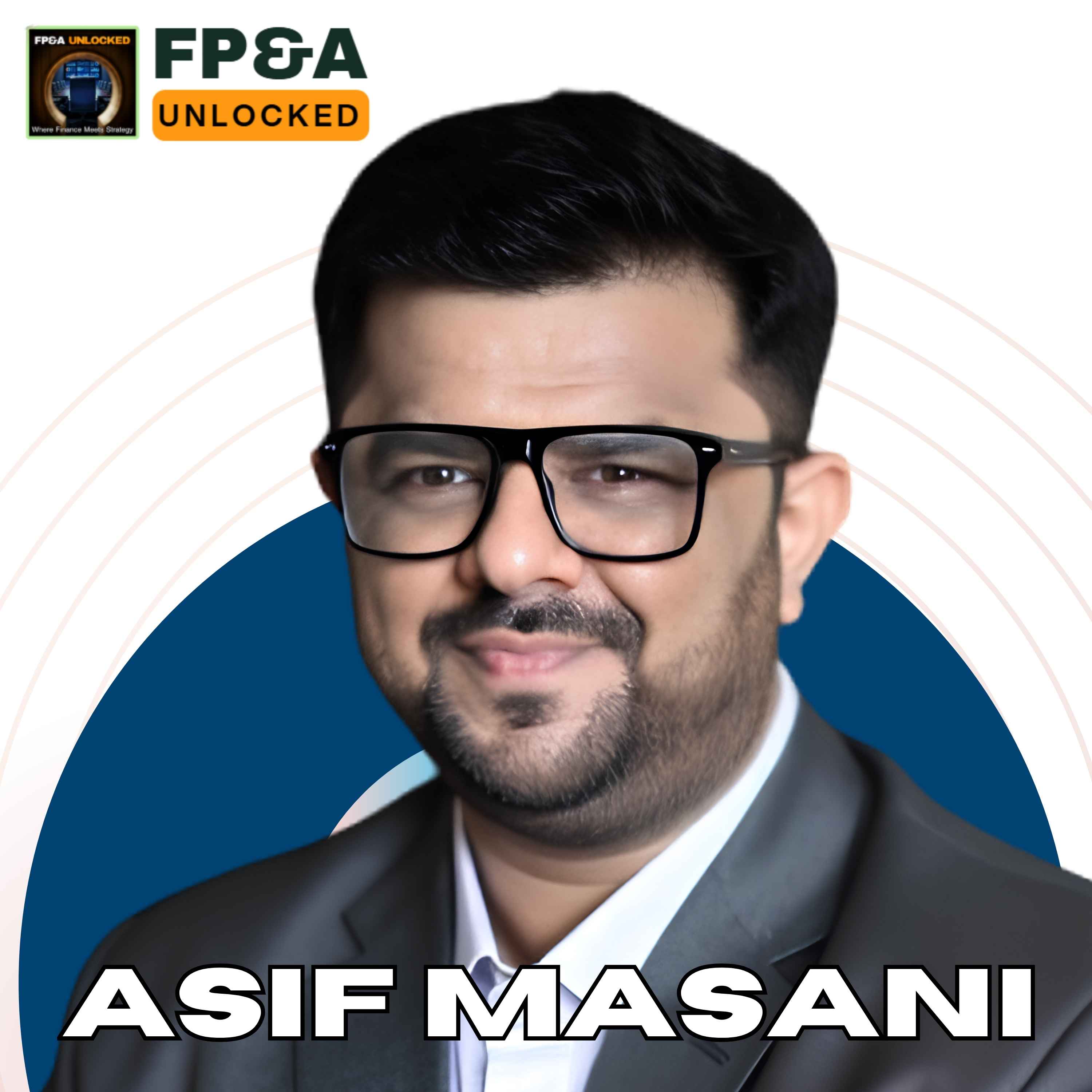
Why Your Brilliant Financial Analysis Gets Ignored: The Precision Trap with Asif Masani
47m 2s
Finance professionals are trained to deliver precise, accurate numbers but often fail to influence timely business decisions, creating a gap known as the "precision trap." Asaf Masani, a leading FPNA expert and author of *The Precision Trap*, argues that this issue stems from outdated financial training and a business environment where decisions are now reversible and require speed over perfection. He emphasizes that finance teams should shift from chasing 100% accuracy to delivering timely, relevant insights by using tools like the accuracy dial—distinguishing between directional, working, and definitive numbers—and stakeholder contracts, which involve asking critical questions about purpose, audience, and timing before analysis begins. Masani highlights that organizations in the trap see zero finance input into decision-making, while individuals suffer when finance is seen as a reactive function. To break free, professionals must become proactive business partners by understanding the context of decisions and aligning analysis with business needs. His book, *The Precision Trap*, resonates not only with finance professionals but also with business leaders and CEOs, revealing that the core pain of the trap affects business outcomes more than finance operations. Asaf’s key advice is to ask five essential questions before any analysis and prioritize timely, 70% accurate insights over delayed, perfect ones. He also recommends mastering financial modeling, stakeholder communication, and prompt engineering for AI tools. The ultimate goal is for FPNA professionals to be invited into decision-making rooms, transforming finance from a back-office function into a strategic partner. Through training, awareness, and mindset shifts, both individuals and organizations can break free from the precision trap and drive faster, more effective business outcomes.
Finance people are way good at doing analysis, but they're not way good at
influencing decisions. If the business teams or people who you work with are
reaching out to you before making a critical decision or before making a decision
that is impacting the business, I would say that is what a great FPNA could look like.
Meet Asaf Masani, program director at the FPNA Professional's Institute,
project lead at FPNA Jobs and Udemy Instructor. With over 12 years of experience
across financial planning, budgeting, audit, and tax, he is also the author of the precision
trap. So the base of business today has changed so much. The decision that could wait earlier
for three weeks or can't wait today for three days. In the last six months, how many times did
the finance team help you influence or shape a decision? And if that answer is say zero, then that
would be a perfect example of your finance team stuck in the precision trap. How do individuals
get out of the precision trap, how do organizations get out of the precision trap?
There are a few tools that I have.
Welcome to another episode of FPNA on Lot, where finance meets strategy. I'm your host,
Paul Barnhurst, aka the FPNA guide. Each week we bring you conversations and practical advice
from thought leaders, industry experts, and practitioners who are reshaping the role of FPNA
in today's business world. Together, we'll uncover the strategies and experiences
to separate good FPNA professionals from great ones, helping you elevate your career and drive
strategic impact. This week's guest probably needs no introduction. If you were ever on LinkedIn,
you follow someone in the FPNA space you've probably heard of, read in one of his books,
seen one of his posts. So I'm going to welcome to the show, Asaf Masani. Asaf, welcome.
Thank you so much, Paul. And it is always great to be back on your podcasts. I think we did
one, two years back. And I still get people reaching out to me because of that podcast. So it's
always good to be back. Well, good. Welcome back. I'm glad I could send people to you. Remember to
send me referrals each time I'm kidding. No, I hear that a lot from people that somebody reached out
after being on the show. So it's fun to when people tell me that I love that people listen
and they get value. That's what it's all about. Before I get into the questions,
why don't you go ahead and take a minute, introduce yourself, tell us a little bit about your
background. Sure, Paul. So I do two things. One is I write about FPNA. So there are four books now
out on FPNA. One is all about FPNA, which was the first one back in 2022, which was
then followed by from accounting to FPNA, which came out in 2024. And then the latest one was
the data storytelling table, which happened in 25. And as we speak, the next book is in the pipeline,
which is the precision trap. So that is one. And the thing that I love is training people on FPNA
skills, which is where I have, or we have a certification, which is CDFP certification at the FPNA
profession institute. So I am the CDFP a certification director at the FPNA profession institute. So
those are the two things that I love doing. And I spend most of my time doing that. Got it. Now that's
cool. I know you did a lot of training. So four books now. When you wrote your first book,
did you have any idea that you'd be writing one a year? I did not actually. So I always wanted to
write one. Then the second happened as a result of people reaching out to me on more more questions
on the first book. So that is how the second book happened. The third book happened because of
money, I think the publishers paying me some money for that. So that is that is purely for money.
This one is more out of, I had a couple of more books in the pipeline, but this one was a book
which came out of instinct. So as soon as I got the idea from the time it was initiated till the time
of published, it was I think happened in four and a half months. I got the idea in February this year,
just four and a half months back. And I had so much, I had to get this out as soon as possible. And
it got pre-poned because of that reason and then came out this month. Got it. All right, so
before we get deep into the book and some more things about you, I like to start every show with
this question. I'm sure I probably asked something similar last time we chatted, but I'm going to
guess a lot of people haven't heard that interview or don't remember. So if I ask you to define
what grade FPNA looks like, how would you define it? I would say first is that somebody who's good
in FPNA should be reached out before the business makes a decision. So that is I would say the number
one quality if you are evaluating yourself as an FPNA professional. I could add so having a good point of view as a finance person for business is another good quality.
So if I am producing a report or if I'm sending an analysis, I just don't send the analysis,
but I send my recommendation which could be out of the five different recommendations
and why I would pick that one. So giving your own point of view is I would say another good quality.
I see in good FPNA professionals. Okay, appreciate that. I think that's a great point of they
want in the room when they're making decision. And so I could totally understand with that one.
So I know you started your career as an accountant. How did you end up ultimately getting into FPNA?
How did that change come about? Absolutely. So I started as an auditor back in 2010 with EY.
And to be honest, I really liked doing that job for a couple of years. So from 2010 to 2012,
I absolutely loved doing audits at some point after working there for a couple of years.
So the things I liked in the audit role was especially the respected commands from your stakeholders,
be the accounting team, be the finance team. So if you are an auditor, that is there was something
that I really liked when I started that if you ask for something that is something that they take
it as that is a wish that they need to fulfill as soon as possible. Otherwise, it could lead to
consequences. So that was the initial reason I used to absolutely love the audit role.
However, over a time, I think about a year or two years into the role, what I realized was
that respect was not out of will. It was more coming out of compulsion. Over time, I realized
that auditor is not somebody who you would like to talk to willingly, but it is more of a forced
conversation. And you don't get invited because of your work, but it is because of your designation.
So yeah, nobody wants the auditor in the room because they like the auditor. The reason the
auditors there is they want to stay out of trouble or they want a certification or so totally
understand that. I always, I will admit it. I hated working with the auditors because I didn't
want to deal with it. I mean, I get it. And I was nice, but there were more than a few times,
of like, can you guys just please leave me alone? Yes, yes. So over time, I realized that and also,
I was working on reports which were looking at numbers which happened in the previous year and
not being close to making decisions, which I could see was happening on the other side with my clients.
And yeah, those were the two reasons which led me to change after three years of working in audit.
Although I was very happy first couple of years, but at some point, I realized that I need to be
in a role where I am closer to decisions working close to with the business or other than working
after everything is done. So that was the reason. And at the time when I decided to move back in 2013,
2014, end of 2013, I did not know even what FPNA was. So my first choice or first few profiles that
I wanted to get in was as you mentioned, right, investment banking was your favorite as well. So
investment banking was very hot at that time and valuation. So those were the two profiles I wanted
to get in. And the number three was equity research. I could not get into investment banking,
I could not get into valuation, gave a couple of interviews did not make it through. I gave you
interviews on equity research, I got the offer, but the pay was too low compared to the other offer
which I got which eventually turned out to be an FPNA role which I did not know till the time I
got into the role. So what I would say is it's not that I chose FPNA. I did not even know what FPNA
was till my time till the time I got into my role into the first couple of weeks. It was FPNA who
chose me rather than me choosing FPNA. Yeah, I have a similar story in that sense of
I got into FPNA because the role was open, it was a promotion and they hired me.
So I was making more money. So I totally, I get it. I think a lot of us because it's not,
it's not something you hear about in college.
Very few universities have program or creative courses around FP and 8 so I totally agree with you all right
So you have been up to a lot since the last time I interviewed you you started you've started your own business
You've moved to the Middle East you've written a couple books one of which we're gonna talk a little bit about
But let's start tell our audience about your business FP and 8 professionals institute what exactly is it?
Who does it serve? What's that journey been like? Absolutely. So you mentioned it Paul right just in the previous
Conversation not a lot of people know about FP and a while they are in college. So that is what our mission is
One is to help
One million finance professionals upscale in FP and so that is a primary goal, which is why we started FP and also to build that awareness among university students and college
students you should look at FP and as an option
Especially in today's time in age other than audit other than accounting other than taxation
So those are the two reasons why we started FP and 1 is to
Create awareness about FP and a rules among young finance professionals who just come out of college come out of your CAC
PS and then to help people who are stuck in accounting audit taxation roles
Where they know that they need to get into FP and that is where the FP and a institute
Helps these professions, they're kind of trying to help those people either get out of their current roles find FP and a train them so they can be better at it
In terms of your other other question, which is on moving to the Middle East and getting into the business
So this was back in 2022 with when we first met I don't know if you remember that it is it was first when we had a small group
Of Anders Lieu Lindbergh, Kristen Wattig, Nicholas Birchow now they have all become very big names in their respective already they were big at that time as well
So it was inspired by actually you and Anders and Paul and Nicholas who were doing so well on LinkedIn in terms of educating the audience
And I saw that you started your own business back in 2021
Okay, so that was one of the reasons then I saw Kristen get into the FP and a training
Okay, when I saw Nicholas, okay, so that was the environment
I believe that was one of the biggest reasons for me to get into business because I saw this could be a real opportunity where you get to
Do something which you'd like and make money as well. So I would thank you and all the other people that I mentioned
For that in terms of moving to the Middle East. So while we were doing the LinkedIn content back in 2021 ready to
I also started writing on my first book which was
Basically using the same content and then creating a book out of it
And as soon as that book got published it became
Amazon best seller in the management accounting category for quite a while for good five to six months during 2022
And I started getting a lot of requests from people on LinkedIn on my DMs to
Who who read the book who figured out about the book and wanted to learn more and what it would do trainings
Structure trainings or FPNA. So that is when I reached out to my present business partner which you met the well
So I used to direct
All the people who you who used to come to my DMs to
The FPNA Foundation's course which novel had back from 2020
So he was already doing FPNA trainings on UDME and so used to that was only training available
Which I knew of at that point of time which was four years fires back
Uh, now there are plenty but at that time it was the only training that I knew of so I was giving or I was directing them to those
To the UDME course. I was just the FPNA foundations and at some point me and double connected
And he shared a similar mission like I did
And that's how we came together. So we did FPNA trainings on Saturdays and Sundays for good
One year before we went in full time. So we did it for one year
And then
Parallel we were talking to each other on on stack you mean Nicholas and I was looking at you guys doing it as well
So that's how it came right that's how I
Jaguar into the business I left my Korsera FPNA K-PAC role which was
2023 2023 end of 2023 and that's when we started FPNA professor's institute
Double was supposed to join me after one year, but looking at me
He immediately gave and he resigned after two months. So he joined me in March
24 so that's how we started and at that time double was already in the Middle East his CFO role was in the Middle East
And he had settled down with his daughter and five in the Middle East and he didn't want to move back to India and
we were evaluating different options for
Where should we have or where should we register our company or FPNA professors institute and
India and Middle East were the two options and
Middle East was the clear winner because of various reasons on the taxation
Benefits and the residency benefits and all of that
So we registered our company in the Middle East and I was in India for 20-25, but eventually
That will make me come to the Middle East eventually once once we are doing well on the one on the company
So that's how I moved to the Middle East just last year about six eight months back
Thank you for sharing a little bit of that journey and how he ended up in the Middle East. I appreciate that
So next I'm gonna ask in the three years you've been running the business
What's been the most rewarding experience? What have you enjoyed the most?
So I think you would resonate or relate with this
Because I know you do FPNA trainings and a lot of good things about that. So
What I would say is the best feeling is when somebody reads your book or watches your YouTube video or does do
Somebody takes those program like the CDFP program and after they do that they go to the interview and then
Are able to get into the FPNA at all. I think that is one of the best feelings that
You could ever get and that
Frequency has kept on increasing. So earlier you have to get one message a quarter back in 2022
It kept on increasing right now
I would be surprised if I don't hear from one person a week who's either read my book
Watch the YouTube video or take another one of our certifications and has cleared the FPNA interview
So I think that is the reason why we do this
Every day and day and day out
Yeah, no, I appreciate you sharing that it is always rewarding when you hear from people
All right, so let's jump into your book. I want to spend some time there
It's called the precision trap. I think you ended up deciding earlier this year to write it
How did that come about? Let's start with why did you pick this topic?
For the book FPNA guy here. I want to take a minute and share something I've been working on
I've spent several months
adding new
Affiliate programs to my website by wondering why affiliate programs. Well, I can't train you on everything
But I can show you and give you trusted resources with exclusive FPNA guy discounts in many cases on my website
I have several of the top FPNA AI people in the world. I have the top certificate programs
I also have other programs like Excel power BI
I'm bringing you some of the top people that train in the world
There's Nicholas Boucher with exclusive discounts David 14
Madden Carl Siedman with exclusive discount the top programs F-PAC
FMI and more
So go ahead and check it out on my website sign up and if you have a question on what program is right for you
Go ahead and message me. I'll get back to you LinkedIn or you can email me
So go to
the FPNA guy.com and check out my trusted list of resources for you to upskill yourself
So this was a pattern. I am sure you must have come across and I have been
Looking at since I was working in FPNA back in
2015 and over the 10 years I have noticed that pattern and that pattern became very very evident
Especially when you work with so many students taking your programs and after speaking to
I would say hundreds of
FPNA professionals who take our program certifications courses
that pattern which is
Finance people are very good at doing analysis, but they're not very good at influencing decisions
Which is what the underlying theme of the book is and at many places
Finance teams go so deep into analysis and are so
concerned about the numbers being 100% accurate that they miss the decision window and then the business stops asking them questions
The cfo stops expecting answers on time and the business usually moves on. So that is a pattern
I'm sure you must have seen and I have
Expedienced it while I was working in FPNA but at that time I I thought it was probably just me
But after working with so many students and listening to cfos and listening to FPNA people who have worked in finance
That pattern became very very evident
And what I try to do is I try to try to give that pattern a name, which is a book, which
is a precision draft.
So that is what the book does.
Okay.
Thank you for that.
So you started the book off by killing a story.
And I'd love for you to lay that out.
Kind of that story.
And why you started the book with that story.
So you start off.
There's a line says, honestly, most of the time, the business has already decided before our deck is ready.
Tell the story of someone who shared that with you and just kind of.
Set that up for the audience.
Absolutely.
So what the context of the story is that.
We as finance professionals, whatever we've learnt in our curriculums back in the college, back in the university.
Or in the professional certifications be CMA CPA or CA.
We have been trained for a world that has changed drastically.
So whatever we've learnt was built for I would say the early 2000s.
And that was rewarding people for being 100% accurate.
So what I would say is there needs to be some trade off between you being accurate.
And you delivering your analysis or your report on time which can influence the decision.
So the pace of business today has changed so much that the decision that could wait earlier for three weeks can't wait today for three days.
So that is the exact gap that we're trying to address.
Got it.
Kind of that whole gap of the decision taking too long.
And so is the primary reason for that then you think it's the way accountants are trained.
I mean, because yes, you have accountants in FPNA but you have people to come from finance or different backgrounds.
So there must be something more than just training.
Training I think is one you mentioned, but what are the root causes?
Training is one the other could be that finance is still still trained and mainly operated by people who have been.
So finance is mainly operated by people who have been in that environment for so long.
And now it's hard for them to change so that is what I would say in terms of apart from the training it could be the environment of the organization.
So just to take an example, if I was in the early 2000s and I needed to take a decision.
I could prepare a model wait for three weeks because everybody was on that slow clock and if I was late by a week or two, it did not really matter.
And the decisions at that point, largely irreversible.
So the fact that I need to wait and be very thorough and accurate made sense at that point of time.
But now as we are in 2026, lot of the decisions are fairly reversible.
Meaning if you want to test the pricing, you have to make some changes on the website.
If you want to try out a new payment plan, you could do that quickly and the consequences of that going wrong and not that high as it was back in the 2000s.
So it makes more sense to take the decisions quickly and for that to happen, you need to have a finance business partner that can help you do that.
So that is what I would say is changed apart from the training.
So it is the business environment that has made that switch.
Got it. So we have the training, we have a different business environment.
So obviously, a lot of people struggle with, I feel like they are in the trap, you know, exactly mentioned of, you know, they already decided before deck is ready.
A lot of times the decision is made before finance figures out what they were doing.
So how do we get out of, I want on two levels.
First, how do individuals get out of the precision trap?
How do organizations get out of the precision traps?
What the individual, I'm an individual, I notice I have this problem. What should I be doing?
There are a few tools that I have recommended or I've written about in the books, I'll mention a couple of them.
So one is about understanding how accurate your analysis needs to be given different parameters.
So for example, I would say there are, just to categorize it broadly, there are three different levels of accuracy that you need to understand about.
So first is something called as a directional number.
Okay. So if you are looking to make a quick decision within the next couple of hours, you don't need a number that is required for say an annual report or a bold report.
Okay, you could go and work with something called as a directional number.
So directional number is something which you should be able to easily pull up in the next 10 minutes and be reasonably confident about using that to make a decision.
The second is a working number. Say for example, if you want to use something for the CFO review or the CEO review, which is for internal decision or which is for internal monthly presentations or QBRs.
Okay, that is where you could use something called as a working number, which is slightly more detail or accurate than a directional number.
Where you understand where that number is coming from, what is the source, how does it reconcile to the final number.
So that is what the working number is and the final number is what we call it is as a definitive number, which is what you should be waiting for, which you should spend good amount of time.
These are the numbers that go outside of your organizations to investors for statutory filings.
So a lot of time what I have seen is finance professionals do not distinct are not able to distinguish between them and they end up spending the same amount of time.
Where they could have used a directional number and they are spending three days or five days or couple of weeks, assuming that a definitive number is required where a directional number could have done the job.
So that is one, which is what we call as the accuracy dial, where you need to understand where you need to use the directional number and where you need a definitive number.
Another one that comes in my mind is what I called as the stakeholder contract, where you need to ask your business stakeholder a few questions before even you start your analysis or you even open the Excel file.
So these are questions which are why do you need to analyze you need to understand the purpose of the analysis before you start doing the analysis.
Second question is where this analysis will be you so where are you going to use this analysis that could influence how much time you need to spend on the analysis.
The third question could be if I give once I give you this analysis what decision are you going to make on based on that case that could be another cue for you to be able to gauge how much detail the analysis need to be.
Another question could be what do you need in terms of the format of the analysis should it be Excel file should it be a PowerPoint is Excel file with the table OK or you need a 10 page detailed report.
So that is the fourth question and then finally when do you need this analysis so is it today end of the day or you could wait till the Friday end of the day so based on these four or five questions you can gauge what level of analysis you need to be able to perform to be able to address the stakeholders requirement for making that particular decision.
So I would say these are two of the ones that I can share one is the accuracy language I talked about and the second one is these questions that you should ask your stakeholders before you even begin or open the Excel file.
So I will talk to you in a minute and I will go back to the show in a minute this section is on scripted when I started my business I had two main goals to be trusted and for my content to come across as authentic and helpful.
I've heard from many of you that I've accomplished those today I have three goals to be trusted authentic and have the best beard in finance.
All right enough with the jokes enough with the fun what I'm asking for is I'm asking for you to help me out if you've enjoyed the show if you've enjoyed an interview if you found it helpful in your career can you please leave a rating and review that helps more people find the show helps me grow the show helps me grow my business.
So I'd really appreciate it if you could take a moment and leave me a review you can do it on Apple Spotify YouTube wherever you listen or you can go to my website the fpna guy dot com that's fp a n d a guy dot com go ahead and go to wallow love go down to the bottom and you can click to leave a testimonial.
Thanks for doing that thanks for listening make sense the questions you mentioned in the accuracy dial so great kind of frameworks.
To think about what about the organization how do they tell if they're in this precision trap and we talk about the individual like what is an organization do if they're seeing this you know if it's an organizational thing not necessarily an individual.
So first is if you are a business leader and you need to understand if you are in the precision trap you should be asking this question which is in the last expanse how many times did the finance team help you influence or.
shape a decision and if that answer is say zero then that would be a perfect example of your
finance team stuck in the precision trap where they are doing a lot of analysis however they are
not helping you influence a business decision or you're not they're not helping you in time to
be making decisions so that is one and second is for the CFO so this was first you know
so the business leader second one is for the CFO's if you notice that your business leaders
have stopped asking you questions or if you notice that you have been stopped getting
invitations to the meetings where the strategies made or where critical business decisions are made
I think that is another cue for somebody who's in a senior finance position to be able to identify
that they're suffering from getting into a lot more detail than they should be that's helpful
thank you I appreciate that I think what you said in both of those make a lot of sense so I'm
curious from you're from writing the book kind of step back for a second what was maybe the
biggest surprise or biggest learning that when you went into writing the book you didn't expect
and this is something which I just recently experienced so the book just went out two days ago
and the one of the surprising things that I I found out is my objective writing the book was to
address the senior finance leaders and CFO's and help finance professionals to become better
business partners and take more initiative in business decisions that was my objective writing
the book however what I noticed is after I start posting about it on LinkedIn I started business
leaders and CEOs take a notice of them and few of them message me about stories and situations where
they exactly came across that situation so I was not expecting it to resonate with CEOs and business
leaders as much as it would resonate with FPNA professors FPNA managers finance managers however
that was a little surprising that I got more DMs from people on the business side and the CEOs
rather than from people on the FPNA and the finance side that's interesting not I mean I wouldn't
have guessed that but as you share it I guess it's not surprising right because at the end of the day
if we're in the precision trap it's the business we're hurting not ourselves
surprising element is that I got more messages from the business where I was expecting maybe more
from finance and FPNA people that was a surprising so I was expecting the response but not in the
proportion that I saw sure that's that's interesting thank you for sharing that before we move
into our standard sections here last question what's the final advice you'd give to an FPNA
professional to avoid the precision trap what what's something they should start doing today so
two things so one is before you do any analysis or before you pour on any finance report ask
those five questions that we discussed why are we doing the analysis why are we preparing the
support who is it going for who is the audience what are the decisions that are going to be made
after somebody who is going to read the report when are they expecting that report so these are
some questions that you need to ask before you do any analysis or you prepare any report so that
would be my advice and many situations what you would notice is a 70% accurate analysis is going
to be much much better if it is coming on time rather than you being 100% accurate which comes
four weeks after the decision is made so what you should do is you should observe whatever you
are doing in the last six months and see if this hypothesis is making sense for you if it is then
you should definitely implement some of these frameworks that we discussed and that can help you
your great point when you said the 70% I remember I had a business leader where you know we had
data that was the told mess this is before I ever even worked in finance and I was working in
kind of some data integrity type roles and she goes as long we can get the data 80% accurate most
of the time that is good enough for the decisions I am making like if I need it better I will let
you know but let us try to keep it around 80% accuracy and just make a decision because it is too
costly to get to 100% and I think that is one thing that definitely people need to keep in mind
in addition to everything you said is it is a lot more costly and resources and time and effort to
try to be that 100% accurate what you can never do with the forecast anyway so all righty so here
is the FPNA section I got a couple questions I am going to ask you first one I ask everybody this
one what is the number one technical skill that FPNA professionals need to master I would see
financial modeling and this is maybe slightly biased because that is what some that is what has
helped me tremendously so I could picture myself not doing financial models properly or not using
the best practices in financial modeling and once I started doing that I could see rustic change
in my productivity in terms of at the analyst to manager level so yes so I would say financial
modeling and I could be slightly biased about it well we're all slightly biased we're all human
so that's all right but you're in good company a lot of people say financial modeling so you're not
alone on that I know for me learning proper design and modeling made a big difference so I get it
what's the number one softer human skill that FPNA professionals should master so I would say one
thing that I started with which was back in the days when I was in a finalist was
being able to interact with senior stakeholders so a lot of times what happens is because you are
in a junior position or if you are in analyst or a senior analyst position and if you are directly
dealing with the CEO or head of sales it can be slightly intimidating so what I would suggest is
that is a part of the role and you need to internalize it the earlier or the faster you do that
the more beneficial will it be for you so I would say being able to talk to somebody senior in
the organization as the number one soft skill that you could develop so basically the ability to
have conversations with those more senior than you absolutely yes what do you think is the most
important skill people need to master AI for finance so this is again very interesting so I would say
being able to ask the right questions to AI so that you are able to get the desired output it
may be called with the print name so prompt engineering for finance I have heard as a popular name
so based on whatever you are looking for as an output you should be able to interact with the AI
tool in the way that is giving you the best output so basically it is writing the prompt in
the way where you cover everything in detail so that you get a better output compared to what
somebody else which which is not doing that would get got it all right appreciate that and then
this is a first time I've asked this question but if you could share one framework
that you think would help FPNA professionals the most maybe the one that's helped you the most
in your career or that you've seen the most impact when you teach it to people what is that framework
yes so this is what what one of the frameworks we cover in our training which is
for being able to do variance analysis very effectively so we call it the DERP framework
so D stands for defining the variance where you talk about what the variance is
E stands for explaining the variance you get into the detail and the five eyes and you explain
what is the root cause of the variance you talk about the detailed root cause which is a second step
R stands for recommendations so where you recommend what should be done now okay
what has happened in the past has happened what what should you be doing now to get back on track
or what should be you doing in the next quarter that is what the recommend stands for
and P is optional but if you can you should do it which is projecting the impact of the
the recommendation so for example if you are projecting or if you're recommending some action
for the next quarter how would that impact the numbers for the next quarter so that is
called the projection which is basically forecasting the impact for the next period so that is DERP
where you cover all of these elements you have a way solid variance analysis commentary
thank you so we have DERP let me see if I got it right define explain recommend and then potential
kind of cost or outcome revenue expense just kind of projection absolutely right so there you go DERP
everybody next we're going to go into the get to know you section so this is where I ask a little
bit about you first one I'm going to ask this is a fun one I'm really curious to see what you say I've
never asked anyone this question before if you can only keep one app so just one on your phone
for the next year what would it be and why that's very easy actually so I feel a lot of our incidents
runs on WhatsApp. There are so many groups for our cohorts and they're like 25 different groups
that are for different courses, different cohorts. So I think if WhatsApp disappeared, we'll be in a
lot of troubles. I would say WhatsApp is the number one tool. You just made meta very happy.
True. We totally dependent on them. So you're going to be WhatsApp. If you had to give a TED talk
tomorrow on a topic outside your area of expertise. So outside finance, outside accounting,
outside FPNA, what topic you pick? I would probably talk about how to write better. So that is
what something I'm working on. I'm not yet an expert. So how do you write and become better
as a writer? So that is something I would like to talk about. And that is purely because
something it's it's developing as an interest as I start writing more and more. Interesting.
So what have you learned so far? What maybe is your key takeaways to being a better writer if you
could give one or two takes just real quick? So one would be that you should write in shorter
sentences. That is my number one key takeaway. So avoid longer sentences. Make sure that you have
shorter crisper sentences. And because the attention span has gone down so much because
of social media, make sure that you start with a pattern which starts with the hook,
which I'm sure you are aware of. You start with the hook and then give them the content and then
again end it with a cliffhanger and then again start with the hook. So you do that for every section
and that's how you try to engage. Basically do the same thing. The Instagram influences do on
reals while you're writing the book so that you maintain that sort of engagement. Got it.
All right. Next one. I'm curious to see where you take this because you could consider
industry training. You consider it finance FPNA but here's the question. What's something
everyone in your industry pretends to love but secretly finds tedious? So this could be
many things but I would say number one is the annual operating budgeting. I think we're going to
save that. So that would be the number one very close to a couple of others but yeah, number one on
if you're doing the budget for three months, you are pretending to like it but you don't you don't like
it. Eventually when you are on version 21, 22, 23. I told somebody I never really like the budget
process. I like working with people that go through all the versions and I love the partnering
more than the budget and I'm like well why are you an FPNA and I'm like well the budget was just
a small part of everything I had to do but I'm with you. If I think of most people are honest,
they don't love the budgeting process. Are there aspects of it that can be enjoyable? Sure but
especially when they drag on I've had six month budgets and you're like when will this thing end?
So I'm hoping they're getting shorter and shorter as we move along. That's what we keep
hoping for. I think I think we bait progress in the right direction. All right. Last one,
if you could recommend a book to our audience, not your own. What book are you recommending?
I would say the one that helped me a lot in terms of when I transitioned from my
employee life to the life of an entrepreneur is what I would recommend is called I'm sure you
must have heard about it's called thinking and growing which I don't remember the title. So
thing can go roadage by Napoleon Hill is the title. So think and growage by Napoleon. I must have
read that book at least three times four times now and every time I read that book I find something
new as a takeaway which I could implement and get something out of it. So purely because of that
because I've read it multiple times and every time I read it I find it that I should read it again
maybe next year. Got it. Well, thank you. That'd be a good one for our audience. And then where can
our audience find your book? If they're interested in your new book, when does it come out? Where will
it be available? Share a little bit of details about the book. Absolutely. So the books are always the
older ones are already available on Amazon.com. So that should be the good to place to get the books.
Right now at this point, the new book is available in India. It should be out by the time this
recording comes out. So it should be available on Amazon.com by end of August, early September.
August, September. Perfect. And then last question before we let you go here,
if you could give one final piece of advice to our audience to be better at their job,
what advice you give them? It would be the same which we talked about. So make sure that you become
that finance person who is in the room when the decisions are you become or you earn that position
where you are invited to the rooms where decisions are made. And the one of the ways you could do
that is by making sure that you understand all of the things that we discussed in the precision
trap conversation. So you make sure that you understand what level of analysis is required
for what purpose and then you decide your next steps accordingly. So that is what I would say.
So become better business partners and help represent finance teams in much much better way.
I like it. So thank you for joining me today, Asa. If I really appreciate you carving out some time,
if someone wants to get in touch with you or learn more about your things, what's the
best way to do that? Is it linked in? Is there a website? What's the best way for them to reach out?
So you could reach out to me on LinkedIn and message me there or the other way could be you could
go and do our website which is the FPNA Professions Institute website which is
FPNAProfessions.com which is the other way you could reach out to us.
Alrighty, well perfect. Thanks again for carving out some time and good luck with the book launch.
I hope it's a huge success for you. That's it for today's episode of FPNA Unlocked.
If you enjoy FPNA Unlocked, please take a moment to leave a five-star rating and review.
It's the best way to support the FPNA Guy and help more FPNA Professionals discover the show.
Remember, you can earn CPE credit for this episode by visiting earmarkcpe.com downloading the app
and completing the quiz. If you need continuing education credits for the F-PAC certification,
complete the quiz and reach out to me directly. Thanks for listening. I'm Paul Barners,
the FPNA Guy and I'll see you next time.
Podcast Summary
Key Points:
Finance professionals are highly skilled at analysis but often fail to influence business decisions, highlighting a critical gap in their role as business partners.
The "precision trap" refers to overemphasizing 100% accuracy in financial analysis, leading to delayed insights and missed decision windows in fast-moving business environments.
To overcome this, both individuals and organizations should adopt frameworks like the accuracy dial (directional, working, definitive numbers) and stakeholder contracts—asking key questions about purpose, audience, timing, and decisions before analysis begins.
Summary:
" Asaf Masani, a leading FPNA expert and author of *The Precision Trap*, argues that this issue stems from outdated financial training and a business environment where decisions are now reversible and require speed over perfection. He emphasizes that finance teams should shift from chasing 100% accuracy to delivering timely, relevant insights by using tools like the accuracy dial—distinguishing between directional, working, and definitive numbers—and stakeholder contracts, which involve asking critical questions about purpose, audience, and timing before analysis begins. Masani highlights that organizations in the trap see zero finance input into decision-making, while individuals suffer when finance is seen as a reactive function.
To break free, professionals must become proactive business partners by understanding the context of decisions and aligning analysis with business needs. His book, *The Precision Trap*, resonates not only with finance professionals but also with business leaders and CEOs, revealing that the core pain of the trap affects business outcomes more than finance operations. Asaf’s key advice is to ask five essential questions before any analysis and prioritize timely, 70% accurate insights over delayed, perfect ones.
He also recommends mastering financial modeling, stakeholder communication, and prompt engineering for AI tools. The ultimate goal is for FPNA professionals to be invited into decision-making rooms, transforming finance from a back-office function into a strategic partner. Through training, awareness, and mindset shifts, both individuals and organizations can break free from the precision trap and drive faster, more effective business outcomes.
FAQs
The precision trap occurs when finance professionals spend excessive time on highly detailed, 100% accurate analyses, missing critical decision windows. This happens because they're trained to focus on accuracy, but business decisions today are often reversible and need to be made quickly—sometimes within days rather than weeks.
Individuals should ask stakeholders five key questions before starting an analysis: why the analysis is needed, who will use it, what decisions will be made, and when the report is needed. This helps determine the appropriate level of detail and time required.
He recommends two key tools: the 'accuracy dial'—distinguishing between directional, working, and definitive numbers—and the 'stakeholder contract'—a set of pre-analysis questions that clarify purpose, audience, and timing to guide analysis depth.
Organizations should ask if the finance team has ever helped influence a business decision. If the answer is zero, it indicates the team is not involved in decision-making. Also, if business leaders stop asking finance for input or skip meetings where decisions are made, it's a sign of the trap.
FPNA professionals should be invited to decision-making meetings. This requires shifting from pure analysis to offering timely, actionable insights and recommendations grounded in understanding stakeholder needs and decision timelines.
DERP stands for Define, Explain, Recommend, and Project. It's a structured approach to variance analysis: define the variance, explain its root cause, recommend actions, and project the impact of those actions—ensuring clear, actionable insights.
Chat with AI
Loading...
Pro features
Go deeper with this episode
Unlock creator-grade tools that turn any transcript into show notes and subtitle files.
 PodcastTranscript AI