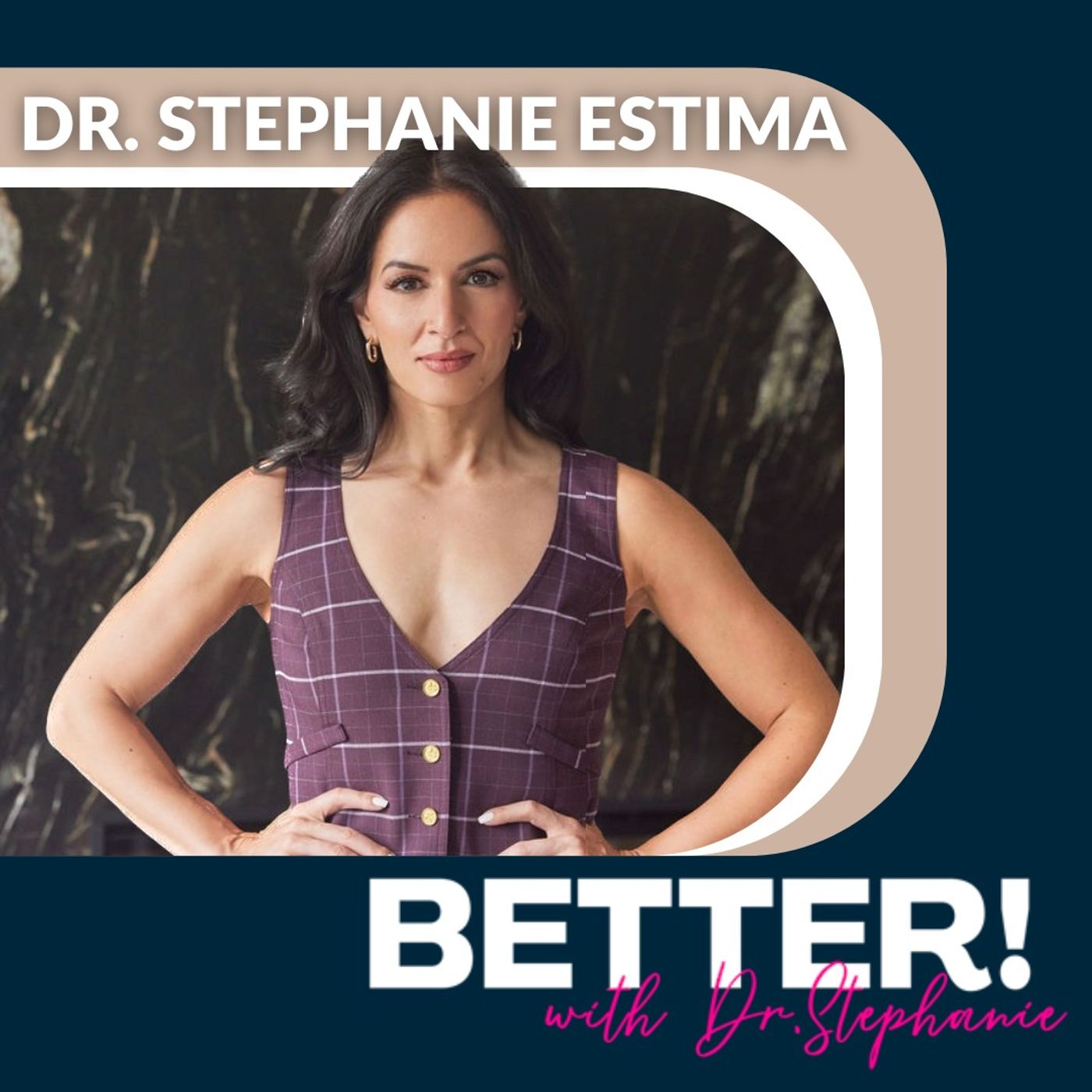
Why Your Body Composition Isn't Changing (And It's Not What You Think)
42m 27s
For years, many women have trained hard, tracked macros, and followed restrictive diets, only to feel frustrated when their bodies don’t change—despite doing everything "right." This episode reframes the issue: it’s not that the body has stopped listening, but that it has been responding to the wrong signals. Chronic under-eating and low carbohydrate intake trigger survival mechanisms that prioritize fat storage and tissue breakdown over muscle growth, leading to loss of muscle, bone, and joint integrity. The scale, which only measures total weight, provides misleading data and is fundamentally useless for tracking body composition. Instead, true progress is measured through strength gains, improved energy, better sleep, and body shape changes—such as a decreasing waist-to-hip ratio. Skeletal muscle is the body’s largest glucose sink and a key regulator of metabolism and inflammation; losing it creates a harmful cycle of insulin resistance and metabolic decline. The core solution is to shift focus from restriction to building: increase protein and carbohydrate intake to support muscle preservation, adopt progressive resistance training to stimulate muscle growth, and stop measuring progress solely by scale weight. The message is clear—your body has always been faithful. The problem was the wrong instructions. By reprogramming your approach to nutrition and training, you restore your body’s natural ability to build strong, resilient, and healthy tissue. This isn’t about losing weight; it’s about building a body that can trust itself.
I train five days a week, I track my macros, I hit my protein, I sleep eight hours a day,
and at this point in my life, I'm so frustrated because my body has not changed in eight months,
like not an inch, not a pound, and I feel like I'm doing everything I was told and my body
is just not listening, it's stopped listening.
Because the absence of hunger after prolonged restriction is not your body being fine with
less, it's your body adapting to survive on less, which is a very, very different thing.
That's not just imperfect, but it's literally working against your own biology, right?
The thing that you actually want, which is curves and muscle and a body that you can trust,
it actually destroys that.
So when I say that muscle is the variable that changes everything, I'm not being motivational,
I'm literally, it literally changes everything.
Everything downstream of it gets better when you have more of it, and it gets worse when
you don't.
You are quite literally cannibalizing the tissue that you're trying to build in order to compensate
for not eating enough fuel that your tissue needs.
Hello, my friends, welcome back to another episode of Better with Dr. Stephanie.
It's me, your host, Dr. Stephanie Estima, and today it's you and me.
We're going to be talking a lot about body composition and why you have been putting
in all the effort, doing all the things, and you're still not seeing the results that
you want, we're going to be going through reasons why that's happening.
I wanted to start off our conversation today with ADM that I received a couple weeks ago,
and honestly, I have not been able to stop thinking about it.
And I'll read it to you, close to exactly how she wrote it, because I think that I don't
think I could improve on it.
It perfectly captures what we're going to talk about today.
So this woman de-embed me, I don't know her, she's not a client, and she wrote something
like, I feel like I'm losing my mind.
I train five days a week, I track my macros, I hit my protein, I sleep eight hours a day,
and at this point in my life, it feels like a small miracle, I eat clean, I don't drink,
and I'm so frustrated because my body has not changed in eight months, like not an inch,
not a pound, and I feel like I'm doing everything I was told, and my body is just not listening.
It's stopped listening.
And honestly, that de-em is the reason why I'm doing this solo episode today.
I sat with that message for such a long time before I answered her, because here's the
thing, I know she's not lazy, right?
This is not a discipline problem, right?
She is not missing willpower.
This is a woman, probably like you, who is doing the hardest, the most disciplined version
of everything right that many people are never even going to attempt, right?
She's going five days a week, she's tracking her macros, eight hours a sleep, she's protecting
it like, we always say, protect it like you're paid to, sleep like you're paid to,
and nothing that she's wanting to see is moving, okay?
So, what I want her to know and what I want you to know if you are in a similar boat is
that her body actually is listening.
It's not that it stopped listening.
It's been listening this entire time.
So your body has been listening this entire time.
You've just been giving it potentially the wrong instructions.
And honestly, you could stop right now because that's the episode, okay?
That is what we're going to talk about over the next 40 to 45 minutes, right?
But I want to actually show you, I want to go into some of the nuance.
I mean, it's a nice quote to put on a coaster or something, but I really want you to understand
this in your bones, right?
Punnfully intended, I'm totally foreshadowing there.
By the time we're done, I want you to understand what the instructions that you're doing are
potentially incorrect and what are some of the ways that we can actually make it right.
And before we get into solutions, though, I do want to just stay here for a moment.
I do want to just stay here in the frustration for a minute because I think that a lot of
us don't sit in that frustration long enough.
We just rush to fix it.
We say, oh, problem.
Oh, I'm gaining weight.
Oh, something.
We rush to fix it and I think that the rushing piece is maybe why so many women feel so
frantic, maybe, and so alone in this.
So let me just say maybe the quiet part out loud, maybe the thing that you felt, but probably
haven't said to anyone because you're embarrassed by how much it sounds like you're complaining
about maybe a problem that other people would love to have.
But let me just say this, my friend, I see you.
You are doing everything right, even though you feel like your body is not moving.
You've done the calorie, the caloric deficit, you've done the cardio, probably more of it
than what you should, but we'll get into that.
And somewhere along the way, you learn that more was the answer when less stopped working.
So you've weighed your food, you've done more, right?
You've weighed yourself every day.
You stood on that damn scale first thing in the morning right after peeing before drinking
water because you read somewhere that that was the accurate way to do it, I mean, as if
you're worth needed to be measured on a scale.
Anyway, you know, we all know my feelings about scales, they are just a measure of your
relationship with gravity.
But even still, you're using the scale and the scale doesn't move, right?
Or worse, worse, it moves in the wrong direction.
And you don't know why, you can't explain why because you haven't done anything different,
right?
I want to name something else because I think that underneath all of this and nobody says
it, you know, directly enough, this isn't just about a body composition plateau, this
is about trust, okay?
You have built a working theory of your own body.
If you eat less and move more, you get smaller.
And maybe that worked, maybe that worked for some years, maybe decades, and now it doesn't.
And now when the operating system that you've trusted, since you were a teenager, suddenly
stops producing results, or in my case, since I was like 10, stops producing results, it
doesn't just feel like a plateau anymore, it feels like a betrayal, right?
It feels like you're losing a negotiation with your own flesh, you know?
And because we've lived in a culture that has taught women, you know, approximately
since the moment that we hit puberty, that our worth is loosely correlated or directly
correlated with the number on a scale, that there is, you know, pride in a certain size
on a tag on the back of your shirt or back of your dress, you know, this isn't a neutral
data point.
It's not like your car is not starting, right?
It's much closer, it's much closer to grief.
I've had countless patients, if you have described their stories in my upcoming book and
maybe you'll see yourself here too, and these patients have sat across for me on my treatment
tables and my intake rooms, many in tears, saying something along the lines of, I hate looking
at myself in the mirror.
I hate my body.
I'm disgusted with myself.
I have heard that, I mean, I have said those things to myself, you know, just in the vein
of transparency and honesty, but I've also heard it from too many women.
And these are the women who are, you know, they're training, they're lifting weights, they're
doing Pilates, they're eating the way that they've always eaten, that worked.
And then bam, something, you know, something stops working and 15 pounds comes on seemingly
overnight.
So if that's you, my dear Betty, my dear friend, my dear listener, and you're exhausted
by trying, maybe you're resentful of the lack of outcome with the effort, like your
effort and outcome are not correlating, or maybe you're even just convinced that you're
one of those women who has a broken metabolism.
I need you to hear what I'm about to say before we go any further, okay?
And that is, I promise you, with all of my heart and everything that I know about science
and everything that I've perused in the literature, you need to hear that your body is not broken.
And you are not the problem that you think you are.
What you are is a woman who has handed the wrong map and told it was the only map that
exists.
So let's burn that effing map, okay?
And let's talk about who did this and most importantly, what you're going to do about
it.
I think it's useful to name, we'll call it a villain.
I don't think it's, I don't think it's useful to be angry at like a vague faceless like
a diet culture, and I want to name the actual claim specifically because specific villains
are the ones that you can actually defeat, right?
If I just say, oh, diet culture did this, the patriarchy did this, even though it did.
We don't want vague villains, okay?
Because that's just going to make you tired and exhausted.
You don't really know what to do with that.
So the exact belief system that the fitness and wellness industry has installed in nearly
every woman that I have ever treated, coached or spoken to, including myself is out, is
like just plain wrong and outdated.
Let's go through the claims first, the body composition change, right?
So body composition change means weight loss.
That's the first lie, okay?
Because everybody talks about losing weight.
[BLANK_AUDIO]
talks about what weight we want to hold onto
and what weight we actually want to build
versus what we want to lose.
This is one of the foundational lives.
This is one of the specific villains.
And almost everything else that we're going to talk about today
is build on top of that, right?
Because weight loss and fat loss are being used
as interchangeable words in your head right now
and they are not even close to the same thing.
All, and I've said this before, I'll say it again,
I know I've already said it on this show.
Weight on the scale is a measurement of your relationship
with gravity, okay?
It is gravity acting on your total mass
at one single moment in time.
That's it, Betty.
That's it.
That's all a scale is doing.
It cannot distinguish between a pound of fat
and a pound of muscle.
It cannot tell you how much water you're holding
because you trained legs yesterday.
By the way, I trained legs yesterday
and today I'm heavier.
Like three, sometimes I'm up by about four pounds today
but usually it's something like three to six pounds.
It's completely normal by the way, completely temporary
because your muscles are pulling and fluid
to repair themselves.
That's just what happens after you train.
The weight on the scale cannot tell you
whether you're dehydrated,
whether you're in the middle of your cycle,
whether you've had sushi last night
and you had more sodium than you then you realized, right?
It's just measuring the most volatile
and least informative number about you.
Dare I say the weight on the scale
is the least important piece about you.
And we have built an entire multi-billion
with a B, billion dollar industry around convincing you
that that's the only number that matters.
The number on the scale, the size on the dress, right?
So here's the part that I would like you to be angry about.
You don't have to be, but you can just be,
you can be indignant about two women, you and I, let's say.
We can weigh the exact, we can both get on the scale,
butt naked, after we pee, before we drink, et cetera.
Exact same number on the scale
and have completely different bodies, right?
One may have lost five pounds of muscle
and gained five pounds of fat and the scale
says nothing's changed, right?
Her mirror, her clothes, her energy and her metabolism
are all screaming that something has changed for the worse.
And this is where I will say that the scale
is often like fundamentally useless
in telling you which woman you are
because you could be the woman who's lost five pounds of fat
and gained five pounds of muscle, scale doesn't change.
Or the scale has said same weight,
but really your body composition,
you have lost five pounds of muscle
and gained five pounds of fat, right?
The other villain will say,
and this is what I see a lot of my overwhelmed affiliates
and overwhelmed Olivia's,
depending on which O name you like.
I'm a little partial to Ophelia,
but my overwhelmed Ophelia's often believe,
even my skinny fat Sophia's,
believe that the path to a better body
is through coloric restriction and lots and lots of cardio,
right?
And this is not only where it just is,
it's not just misleading,
but it becomes physiologically dangerous, right?
I want you to picture your body
as an extremely intelligent,
extremely conservative accountant, right?
Who's entire job for the last hundreds of thousands
of years of human evolution
has been to prevent you from starving to death, right?
That accountant does not know the difference
between intentional, like an intentional coloric deficit
for aesthetic goals and famine.
It only knows that your intake is down.
So when you are chronically under-eating,
when you're adhering to the,
it's like the number I always hear is 1100 calories a day,
1200 calories a day, 1400 calories a day.
So when you are chronically under-eating,
I wanna be, let's actually just be precise
about what chronic means here,
because a single day of low intake, like who cares, right?
This is a significant energy deficit over many weeks,
many months, in many cases with women, many years,
specifically paired with lots of cardio.
Your, your body does not turn around and be like,
great, let's burn fat efficiently.
She wants to look great in her cute little matching outfit.
No, metabolic rate down regulates,
your hunger suppressing signal shift.
So you stop feeling hungry,
even though that feels like a success,
it's actually like a five alarm fire, okay?
And underneath all of that,
something even more consequential I would argue
is happening.
Your body starts breaking down tissues
that determine almost everything about your shape, right?
Your metabolism and your long-term health.
So you've probably guessed the first one is muscle.
Second one is bone.
Third one is your connective tissue capacity.
It's very, very expensive to maintain
tendons, ligaments and joints.
So they are also sacrificed,
as I like to say, at the sacrificial altar of skinny.
The third villain, we'll say, is the scale, right?
Now, we've just kind of talked a little bit about this,
but I want to say it one more time
in the plainest possible language that I can,
because this one I need it to land for you
so that it not only changes your behavior,
but also your beliefs.
If the scale is the only thing you're tracking,
you are literally steering a ship
using a compass that's been dropped in water
that doesn't work, right?
It's like the compass still might spin,
but it's not really pointing anywhere useful, okay?
So when we think about this entire industry, right?
It's built this business model, essentially,
to sell you shit that you don't need,
part of my language.
That smaller is the goal.
That the scale is the referee, right?
And the tool to get there is by eating less
and colloquially restricting yourself
and moving more indefinitely forever on repeat, right?
And escalating it when it stops working, right?
That's not just imperfect,
but it's literally working against the very,
your own biology, right?
The thing that you actually want,
which is curves and muscle and a body that you can trust,
it actually destroys that, right?
If you want to look a certain way, like, get, listen,
I am a vain woman and I like to put on my Southern,
I was like, I am a vain woman.
I like to look good, I cannot do a Southern accent,
but I also want to look good,
but I'm not gonna do it by sacrificing my future body.
I'm not gonna do it by sacrificing my muscle
or my bones or my joints, right?
So that's what the whole, like, the whole industry
is miscalibrated, right?
It's steered and has and continues to steer.
Millions and millions of exhausted,
frustrated, hardworking women towards this smaller is better,
like you will have arrived somehow
when you have a certain number on the scale
and the price that you pay for it
is often real damage to your hormones, to your joints,
to your shape, to your relationship with food.
And if I may be so bold, you know,
I know I said F the patriarchy,
but like, can we just come back there for a minute?
Like, if you're stuck, counting your calories
instead of all the ways that you have been mistreated,
misrepresented, underpaid, you know,
because you're stuck under training and under-eating,
how are you gonna think for yourself?
If you haven't eaten, if you haven't had enough calories,
how is your brain gonna think for itself?
How are you gonna defend yourself physically?
The answer is you can't, you cannot.
So yeah, F the patriarchy as well.
All right, I shall slowly step off my soapbox, okay?
Let's actually, correct, let's build the map, right?
Let's build the right map
'cause I don't wanna just say to you,
look at all the ways that we've done,
you've been done dirty because we have been done dirty
and you need to understand that,
but I also wanna give you something to replace it with.
So what does body composition actually mean?
First, body composition is the ratio and distribution
of the different tissues that make up your total mass.
So that's your muscle, your fat, your bone,
your water, your connected tissue, okay?
It's like all the things.
It's not a number, it's not a number on the scale,
it's a proportion.
So like I said, two women can weigh,
let's call it a buck 50, two women can weigh 150 pounds
and have wildly different body compositions, right?
And it's body composition, not body weight,
which is what determines how you look like in a mirror, right?
How your clothes fit, how juicy are your calves, right?
Like, can you get, like, I have a problem now,
I will just say it's like a good problem to have,
but a lot of my high boots, I can't get them up anymore
because my calves are too big, right?
So how does your clothes fit?
How does your metabolism function?
And critically, critically, your body composition
is also going to determine how you age.
So here I feel is the most important,
single most important sentence in this entire episode.
So I want to slow down, I want you to hear it, right?
Skeletal muscle is the largest glucose disposal site
in your entire body.
So why am I talking about this?
First, actually, let's just let that sink in for say,
skeletal muscle or skeletal muscle,
depending on what area in the world you are.
By the way, I once had somebody say
that they cannot take me seriously
because I said neuromusculoskeletal muscle.
skeletal system, which is how people in the commonwealth countries, so Canada, Australia,
the UK, we'll say it, they'll say musculoskeletal.
And I think it was someone from, I don't remember, wherever they're like, I can't even take
you seriously, because you said musculoskeletal, and I was like, okay, musculoskeletal, okay.
So your skeletal or skeletal muscle, biggest glucose disposal site for your entire body.
So every time you eat a carbohydrate, that food, okay.
So carbohydrates, they get breakdown into glucose, and your body needs somewhere to put it,
right?
Muscle tissue, hello, by a wide margin, by total volume, is the biggest sink for that glucose,
right?
So the more muscle that you have, the more efficient your body is going to be able to
clear that sugar, that glucose, out of your bloodstream, right, and use it for something
productive, right?
So creating energy instead of having it circulate and eventually getting stored as fat, especially
visceral fat, right?
This is the deep abdominal fat, that belly fat that is most associated with other like metabolic
and cardiovascular disease risk.
Now flip that.
If you are losing muscle mass, right?
As it declines, gradually, and you're not actively working against it by lifting weights
and sprinting and preserving your, you know, fast-twitch muscle fibers, less glucose gets
cleared efficiently from your bloodstream every time you have a carbohydrate, right?
So blood sugar starts to run a little higher, a little longer, and a little more often.
This is going to start, this is the breeding ground, if you will, for insulin resistance.
And it's like this vicious circle because insulin resistance, in turn, further degrades
your ability to preserve and build muscle.
It's this very, very cruel loop and it feeds into itself in the wrong direction, right?
And it's usually pretty quiet, like there's usually not a big announcement from your body
that you're developing in insulin resistance, like, you know, it's just one day you sort
of look in the mirror and your shape is softened, you know, softened in ways that you can't
really explain.
Even though your weight hasn't really shifted, right?
So, and the other piece with muscle that I'll say is that when your muscle is contract,
when you lift, let's say, when you push, when you're using them, they are releasing signaling
molecules called myocons, and we're actually going to have a couple of experts coming
on the show discussing myocons.
These are anti-inflammatory compounds.
They help regulate your immune function.
They help regulate your metabolic health throughout your entire body, right?
So muscle isn't just this, like, you know, it's not just like meat heads that look good
in a pair of jeans, it's not just this passive thing that, like, just adds to your looks.
It's an active, communicating hormone-releasing organ, right?
And when you lose your muscle, you don't just lose your shape.
You lose one of your body's primary internal anti-inflammatory systems, right?
And then if you couple that with the loss of estrogen that happens for a lot of women
in midlife, estrogen is also anti-inflammatory.
So you almost have this, like, double whammy, because as estrogen declines, you become
more inflamed.
And as you are in step with that losing muscle, you will become doubly.
Like you will also become more inflamed.
So when I say that muscle is the variable that changes everything, I'm not being motivational.
I'm literally, it literally changes everything.
And muscle mass, and it's cousin bone and connective tissue capacity, is upstream of your
resting metabolism, your ability to regulate blood sugar as we've discussed, your inflammatory
tone, your joint stability, your posture, and the visible shape of your body.
Everything downstream of it gets better when you have more of it.
And it gets worse when you don't.
So that woman in my DMs, I started off the top of this podcast with.
You said to me, I just feel like my body has stopped listening.
Now, I've told you that the body treats chronic underfueling like a famine signal.
And here's the mechanism underneath that, because I want you to understand this at a
deeper level than eat more trust me, right, because that's what I'm telling you to do.
You need to eat more.
At any given moment, your muscle, how much muscle you have is the net result of two competing
processes.
One is muscle protein synthesis, which you've probably heard of, right, which will wrap
up in a discussion around protein.
And the other thing that determines how much muscle you have is something called muscle
protein breakdown.
So your body is constantly running both processes constantly.
So same with bone, your your constantly either building up bone or breaking it down.
Same with muscle, you're building it up and breaking it down.
And whether you gain muscle, maintain muscle or lose muscle depends on which process wins,
right, on average over time.
So is it, do you have a net gain of muscle because you have more muscle protein synthesis
than you have muscle protein breakdown?
Or are you losing muscle because you have more net muscle protein breakdown?
So when we talk about muscle protein synthesis, you, like I said, you've probably heard of this
before, the protein conversation, I would say probably ad nauseam now, everybody knows
this should be having more protein, roughly something like 20 to 30 grams of high quality
protein or at least two and a half grams of lusine is going to robustly stimulate that
building signal.
Great.
Most women trying to improve their bodies have gotten this memo, right?
We already know this.
But the memo that almost nobody gets is that if muscle protein breakdown is elevated at the
same time, you can hit your protein target perfectly because you are a good girl and
you are having your 130 grams of protein every day.
But if you are not seeing visible results, it means that you are breaking down more protein
that you're, than you're creating.
So I mean, it's not, it's not a mystery, it's just math.
Okay.
So as muscle protein breakdown goes up, it goes up under a couple of different conditions
specifically chronically low carbohydrate intake, is she back on the carb thing again?
Yes.
I am back on the carb thing again, okay?
Extended fasting.
That's another way or insufficient total energy.
And I'll say another category is inadequate or insufficient recovery between training sessions.
That woman who DMed me training five days a week was tracking her macros very tightly,
probably keeping carbs pretty conservative.
These are like my skinny fat Sophia's, even my exorcist Emily's who are training really
intensely, but their nutrition hasn't caught up to it.
She was taught clean eating, you know, whatever that means, and is very likely checking one
or two of those boxes, insufficient total calories, insufficient carbohydrates or two
aggressive fasting.
And yes, I'm inviting you to carb landia.
It's nice to go into low carb land temporarily if you have a metabolic condition that you're
trying to solve, or you want to improve your insulin sensitivity, but you have to know
that it's a vacation.
When you go somewhere tropical and you're like, should I live here?
It's like, no, you should vacation there often, but you have to come home and I'm telling
you to come home.
I'm telling you to come home to carbs because carbohydrates specifically matter for muscle
preservation.
And I want to clear this up because I know that some of you just flinched.
I know.
I felt the flinch.
Okay.
You're like, I know she's talking about carbs for those people, but not me.
I know that I know you flinched and I said carbs just a second ago, okay.
When you eat carbohydrates, my friend, insulin rises and insulin is not the terrible villain.
You know, it does not live up to the terrible reputation that it's been made out to online.
Its primary job in this context is anti-catabolic, which is nerd speak for anti-break down.
It suppresses muscle breakdown.
When insulin is around, we don't break things down, right?
It's not a direct build muscle signal on its own, but it's a stop tearing muscle down
signal.
So when your carbohydrate intake stays chronically low, insulin is also going to stay low too.
So again, initially that is very good for someone who is insulin resistance.
We do want to we want to claw back on the carbs and the insulin signaling initially, but
at some point you have to reintroduce it.
If not for your thyroid, which is another podcast altogether, but when we're talking specifically
about muscle protein breakdown, muscle protein, carbohydrates and the presence of insulin
will preserve your muscle.
And if you're the type of, you know, brain that's already thinking, well, my body could
just make its own, you know, make its own glucose through gluconeogenesis.
Yes, I've heard that argument before, gold star on your chart, by the way, for recognizing
that.
That's very much gluconeogenesis or GNG for the cool cats who don't want to say gluconeogenesis
is super inefficient.
And it pulls amino acids, guess what?
It has to pull amino acids from somewhere, right, in order to do it.
And guess where it pulls it from?
The dietary protein that could have gone towards repairing your own muscle tissue itself has
been sacrificed for gluconeogenesis in order to keep your blood sugar stable.
And that is what I believe the exact trap from that woman who sent that DM to me was
likely in, right?
She was training really hard.
very clean, keeping carbs low because that's the story that she was told, and protein was probably
on target. She was probably having 130, 140, 150 grams of protein a day. But her body, because her
body is infinitely more intelligent, doing exactly what bodies are built to do under these conditions,
prioritize survival over aesthetics. So, hell on to fat stores. As a buffer, because she didn't have
sufficient total calories and allowed her muscle to erode at close to the same rate that she was
trying to build it, because she wasn't having sufficient carbohydrates. So, I say this with love,
because she's not failing, right? Her inputs were incomplete. And her body in its infinite wisdom
was just, just did what it did with the instructions that it received. So, you, my friend, and I'm looking
directly at you if you're watching this on YouTube, or I'm talking directly to you, you are not
eating enough calories and probably enough carbohydrates. So, if curves are the goal,
we want to think about including more carbohydrates. Now, let's talk about the scale for a minute,
because I feel, I mean, you already know how I feel about scales. I don't like them. But I feel
that we should be looking at proportions of a body rather than the weight on the scale.
So, I really like measurements. A waist to hip measurement is my favorite, because I feel like
if you have, you know, a waist to hip ratio of 0.8 or less, meaning that your waist measurement,
centimeters or inches, is 80% or less of your glutes or your hip measurement, which is a measurement
of your bones and your glute development. I think that you're winning, right? And you actually want,
you want the waist measurement to go down, but you want the hip measurement to go up, right? Because
if your glutes are developing, the number, the hip measurement should be going up. And that is a good
thing, right? When you put those two things together, a smaller waist and bigger glutes, you start to
now think about that lower body flare and that hourglass shape. And that is going to tell me a much
richer story about your body composition, about your longevity and about your capacity than the
number on the scale ever could. So, if you take your waist measurement at the smallest part,
not at your belly button, ladies, especially if you've had children, we all know, at least mine has,
my, my naval has migrated south relative to where it used to be. So the smallest area of your waist,
and then the widest part of your hips, divide those two numbers into each other, you want about a
point eight or 80%. Beyond the tape measure, the other things that you can be looking for body
composition is you want to be looking about how your clothes are fitting, right? Are you noticing that
the number of, you know, on the dumbbell or the barbell or the machine pin are those weights
actually going up over weeks or months? What your energy looks like during the day? What is your
sleep quality like? Whether your cravings are settling down instead of intensifying, right? None of
those are going to show up on a bathroom scale. Those are what we would call NSVs non-scale victories.
And quite frankly, all of those are way more honest than a bathroom scale is, right? If you want,
I have done this, throw out that scale, put it in the garbage. I mean, maybe literally don't rely on
that. I also promised you that this wasn't going to be a lecture that leaves you more informed,
but just as equally stuck. So let's talk about what actually changes the trajectory of getting you
that better waist hip ratio. Those NSVs, I want to give you three shifts. I want to give you some
mental shifts and I want to give you some behavioral shifts to take away from the show. So these are
things that you can start doing this week before you've bought anything or joined anything or read
anything else. So the first shift is you are going to start lifting heavier heavier than you are
right now. If you are lifting and if you are not somebody who has ever picked up a pair of
weights and you're going to start with your own body weight, but you're not going to be doing this to be
toned and slim, right? Not three pound dumbbells, not something that you can hold in the coffee shop
conversation without noticing heavy, heavy enough that it demands your attention and that the last
couple of reps in a set are genuinely hard. So the number, whatever heavy is for you, it doesn't,
the number matters less than how it feels. It should feel heavy to you for the last couple of
repetitions in a set. This is probably the highest, like the single, highest leverage input
for preserving and building muscle tissue. Then it is, and that's going to be driving your metabolism,
your blood sugar regulation and your shape. If you're, you know, one of my beddies who are doing
like four or five cardio sessions a week and zero heavy resistance training, here's a concrete
swap. Okay, just take one of those sessions. Just one. You can still keep the other four or the other
three. And you're going to do one strength session instead this week. So I'm not adding anything to
your plate. I'm just swapping. So it's an instead of, so instead of four sessions this week of cardio,
you'll do three and you'll do one strength session. That's one substitution. And if you do that
consistently, I promise you double pinky promise that this is going to change the signal that your
body is receiving in a way in when you will see in months that additional cardio could never do.
So the second shift, the second action item, obviously eat enough protein. Okay, enough protein
and carbs. So enough protein and carbs. So what do I mean by that? Lots of people will say protein
one, you know, you have one gram of protein per ideal pound of body weight. That's typically the
recommendation. I like that. I'm going to say without you falling off your chair or getting
into a car accident, if you're listening to this driving, the same for carbs. Yeah, I'll just let
that sit for a second. One gram of carbs per ideal pound of body weight. That is going to be enough
to build, not just maintain, but to build. And I know that I know I know this is going to feel
counterintuitive. If you spent years associating like less with progress, I need you, I've said this
before, I need you to stop thinking about being a loser. Stop losing. Instead, I want you to think
about building. I want you to sit with that discomfort for a second. I want you to sit with
that discomfort of that inversion for a second because it's that exact belief that we've spent
the last, I don't know how many minutes dismantling, you cannot build a house while simultaneously
demolishing it. If you're in a chronic energy deficit, your body will not prioritize building.
It will not prioritize building visible, shapely, gorgeous muscle. It will prioritize survival.
So you have to feed the process that you're trying to create. You're trying to build, stop trying
to lose because what ends up happening is as you build, you end up getting the body that you
want. And then the last shift I want you to do is stop measuring yourself on the scale.
Just stop. I'm not asking you to pretend that they don't exist. I'm just asking you to fire
the bad referee. And we've seen a lot of bad refereeing with this, with this recent World Cup.
But I'm asking you to fire the referee that's been calling the wrong shots, the wrong calls
on the game this whole time. And instead you're going to hire a referee that is going to do the
right ones. So waste measurements, hit measurements, strength numbers, energy, sleep,
hire a closer on your body. That's the roughing you want. Give yourself those metrics and give
those metrics the authority that you have been giving the scale. And I want you to watch how
differently the next few months feel. Even if the scale doesn't move, let's just pretend it's not
going to move at all. That's it. This is not a 12 week shift. It's not a meal plan. It's not,
I don't know, it's not like I always say it's not like the 75 heart or the eight week shred.
It's a different set of instructions for your body. So that your body, because your body's
always listening and it will do what you get like your body is not betraying you. But if you have
been taught to betray your body, you are not going to have what you want. So to close, I want to go
back to that DM one more time. She said, I feel like my body just stopped listening. And here's
what I know after two decades plus now of working, doing this work with women is exactly like her.
Maybe maybe you as well. Your body has not stopped listening. Not for one single second of one
single day. Your beautiful body, your beautiful body has been responding accurately, faithfully,
like a dedicated soldier who's so in love with you will do whatever you ask her mechanistically.
Every single instruction you've ever given her, she's done it. She's been responding.
The problem is we've been taught by this industry that profits from our own confusion to do the wrong
things to our bodies, to eat less, to do more cardio, to cut back on carbs forever, to watch
the number on the scale, to shrink. Your body has heard every single one of those instructions and
followed them exactly. She hasn't betrayed you. If anything, I would say that that's devotion.
It's just, it's like,
Like fidelity, it's been fidelity to the wrong information.
So that's the reframe I want you to leave with.
And it's the same one that I gave this person who's lit into my DMs is that what I ended
up responding to her was something along, I paraphrasing it, but it was like your body
didn't stop listening.
It's been listening this whole time.
You've just been telling her the wrong things to do.
Change the conversation that you're having with your body and watch what happens.
I've seen it so many times where women start eating more, dare I say, more carbs.
And they're like, what is this sorcery?
How am I losing weight and I'm eating more?
So if what you've heard today, you know, if something clicked for you, maybe you recognize
yourself in that woman who DMed me or maybe you have that like frustration that you're
doing everything right and you're not watching anything move.
This is the, you know, if you're interested, this is the work that we do inside lift, right?
It's a heavy, progressive, strong training program built exactly for the stage of life
that many people who follow me are in and Perry, Menopause and Menopause.
If you don't want to join lift, that's fine too.
Just go find something heavy to lift this week.
I promise you your body will adapt.
Your body has been waiting for you for better instructions.
So go and give her one.
All right.
That's my love song for you, my solo, my solo liquid.
Let me know what you're going to do this week.
Are you going to ditch the scale?
Are you going to pay attention?
Are you going to hire a better referee?
We need better referees for football and soccer, anyway, another conversation.
Are you going to start applying the principles of progressive overload by maybe starting with
some lifting heavier weights?
I want to hear from you, leave comments, apples, Spotify, wherever you listen to the show
and I look forward to hearing from them and I'll see you next time.
I hope you enjoyed today's episode and now I must give you the obligatory legal and
medical disclaimer.
This podcast, better with Dr. Stephanie, is for general information only.
The advice and recommendations we discuss do not replace medical, chiropractic or any
other primary health care providers, advice, treatment or care.
In the consumption of this podcast, there is no doctor-patient relationship and the use
and implementation of the information discussed are at the sole discretion of the listener.
Please, take this information to your primary health care provider to make the best choice
for you.
Remember, I am a doctor, but I am not your doctor and these episodes are meant for educational
purposes only.
Podcast Summary
Key Points:
The body is not broken; it has been faithfully responding to incorrect instructions, such as chronic calorie restriction and low carbohydrate intake, which trigger survival-mode adaptations that destroy muscle, bone, and joint health.
Muscle is the central variable in body composition—more muscle improves metabolism, blood sugar regulation, inflammation control, and overall body shape, while muscle loss leads to metabolic decline and a cycle of insulin resistance.
The scale is a flawed, outdated metric that fails to show true body composition changes; instead, focus on waist-to-hip ratios, strength gains, energy levels, sleep quality, and clothing fit as more accurate, meaningful indicators of progress.
Summary:
" This episode reframes the issue: it’s not that the body has stopped listening, but that it has been responding to the wrong signals. Chronic under-eating and low carbohydrate intake trigger survival mechanisms that prioritize fat storage and tissue breakdown over muscle growth, leading to loss of muscle, bone, and joint integrity. The scale, which only measures total weight, provides misleading data and is fundamentally useless for tracking body composition.
Instead, true progress is measured through strength gains, improved energy, better sleep, and body shape changes—such as a decreasing waist-to-hip ratio. Skeletal muscle is the body’s largest glucose sink and a key regulator of metabolism and inflammation; losing it creates a harmful cycle of insulin resistance and metabolic decline. The core solution is to shift focus from restriction to building: increase protein and carbohydrate intake to support muscle preservation, adopt progressive resistance training to stimulate muscle growth, and stop measuring progress solely by scale weight.
The message is clear—your body has always been faithful. The problem was the wrong instructions. By reprogramming your approach to nutrition and training, you restore your body’s natural ability to build strong, resilient, and healthy tissue.
This isn’t about losing weight; it’s about building a body that can trust itself.
FAQs
Your body hasn't stopped listening—it's been responding to the instructions you've given it. Chronic underfueling and restrictive diets cause your body to adapt for survival, leading to muscle loss and metabolic slowdown instead of fat loss.
No, the scale only measures total weight and cannot distinguish between fat, muscle, or water. Two people with the same weight can have vastly different body compositions, making the scale an unreliable indicator of progress.
Skeletal muscle is the largest glucose disposal site in the body and helps regulate blood sugar and inflammation. More muscle improves metabolism, energy levels, and body shape, while losing muscle leads to insulin resistance and poor metabolic health.
Low carb intake reduces insulin levels, which suppresses muscle protein breakdown. However, chronic restriction can cause your body to break down muscle tissue for energy, especially when total calories are insufficient.
Track non-scale victories like waist-to-hip ratio, clothing fit, strength gains, energy levels, and sleep quality. These provide more accurate insights into your body composition and progress.
Yes, muscle is denser than fat, so you can gain muscle while losing fat. This is especially true when you increase protein and carbohydrate intake to support muscle synthesis and recovery.
Chat with AI
Loading...
Pro features
Go deeper with this episode
Unlock creator-grade tools that turn any transcript into show notes and subtitle files.
 PodcastTranscript AI