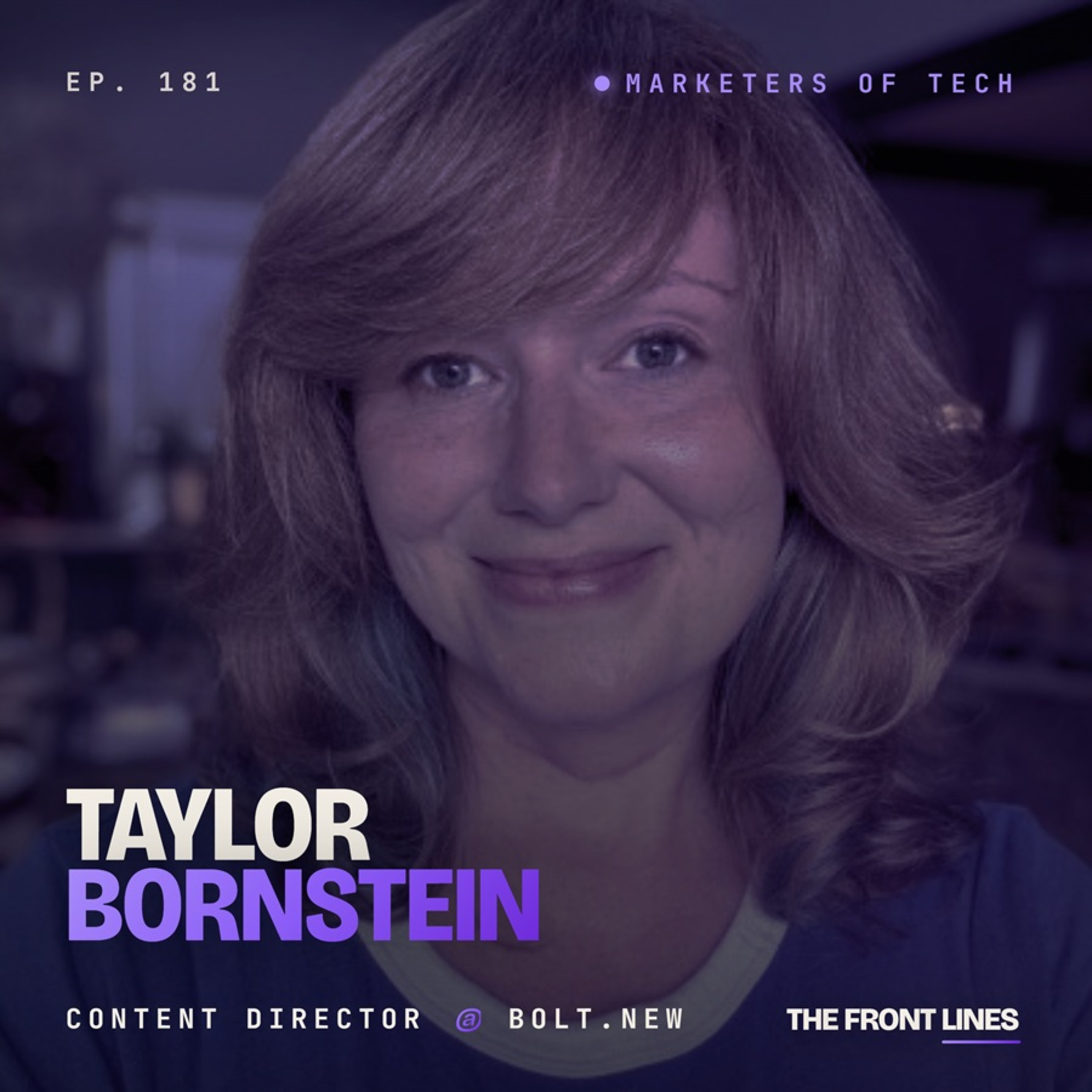
Why the product manager is Bolt.new's gateway buyer
from Marketers of Technology
23m 19s
Taylor Boranstein, content director at Bolt.new, discusses her journey from creative writing to tech marketing and the platform's role in the AI-driven software landscape. Bolt.new, a prompt coding platform, allows users to build apps and websites via chat in a browser-based IDE, powered by StackBlitz's web containers technology, which eliminates the need for downloads or local environments. The platform serves a dual audience: individual users like founders and SMB owners seeking custom solutions, and enterprise users, primarily product managers, who use it for rapid prototyping and to fit into their software development lifecycle through CLI integration and governance. This helps enterprises manage "shadow AI" by providing a controlled, token-efficient tool focused solely on building, unlike broad AI assistants that waste resources. Marketing efforts have been agile, leveraging newsletters, micro-campaigns, and a memorable "Sorry SaaS" billboard in New York City, alongside content like the "Four Horsemen of the SaaS Apocalypse" blog. Taylor highlights that Bolt.new disrupts traditional SaaS by enabling small businesses to build tailored, cost-effective software instead of paying for expensive, feature-heavy platforms like Salesforce, while acknowledging large enterprises still need those robust systems. The team has expanded from three to ten members, positioning them for more sophisticated full-funnel campaigns. Overall, Bolt.new empowers users to create fit-for-purpose solutions quickly, transforming how software is built and consumed.
I know if you've met a lot of CTOs, but they don't have a ton of vibes. Hey everybody, and welcome back to another episode of the Marketers of Technology. My name is Andreas Fignada, and I'm going to be your host for the day. This show is brought to you by the Frontline Studios, Silicon Valley's leading podcast production studio. If you're looking to launch your own show, we offer a full podcast as a service experience. You just show up in host and we handle everything else. And with that said, let's dive into today's episode. Today I'll be speaking with Taylor Boranstein, content director at Bolt.new, a platform that allows you to build stunning apps and websites by chatting with AI. And with that said, Taylor, it's a pleasure to have you on. How are you doing today? Very well, very well. Thank you. Glad to be here. Yes, no, we're very happy that you're here too. And would you just so that we can hit the ground running, would you be able to tell us a bit more about your background, how you came to be content director at Bolt.new, then what Bolt.new is in your own words? Sure. So how did it kind of around about way to marketing when I finished grad school with a degree in creative writing? I don't know that it was a root awakening, but it was a startling realization to realize that you don't really create health benefits in the states for writing books about dragons. So I had to find my way to being gainfully employed. I started out as actually a writer for medical journals out of grad school. And then I went to freelancing and then I found my way into enterprise content marketing and to have been there now for 10 years, 10 or 11 years. Wow. Wow. And wait, before we keep on going, did you write a book about dragons in the end or did you just leave it at that after you graduated? I have so many parts of books about dragons and magic and wizards and swords and none of them that are finished. So someday that's the dream to have a hobby farm and write books about dragons and wizards. But we're not there quite yet. In terms of how I got to Bolt, I've been here since March before that I was with Mendix, which is a low code platform in the Siemens suite of digital industry software. And I don't know that you can make more of an opposite jump than a enterprise company of 300,000 people to start up in the sort of like hottest, newest market out there in tech of 100 people. It's a very different rhythm for the day. It's for sure. Okay. Okay. And in terms of what Bolt is, how have you felt, Bolt.new, what they are? How have you felt the experience of being the content director for an AI company in this moment of time that AI is everything and it's trending so much? That's a big part of what I was so drawn to about the job. So Bolt.new is a prompt coding platform. Five coding was kind of the original term that sort of evolved out as AI coding, AI-assisted coding has become more established and a sort of a gets a better accepted or recognized tool in development across the software development lifecycle, both for enterprise buyers and developers as well as individual entrepreneurs and founders. I don't know if you've met a lot of CTOs, but they don't have a ton of vibes. So companies wanted to evolve away from that term. So it's just a wide open market and it's a big challenge because like I said, there are big huge multinational companies and organizations that want to use this type of technology and evolve to a more kind of a gentick and native SDLC and then there are tons of founders and entrepreneurs or even entrepreneurial people within organizations who are like, I don't want to wait to build this dashboard. I don't want to wait to go to the budget meeting to get approval for a content calendar and they can just build it themselves. So we have a lot of really great stories from customers either individuals or from companies who are changing how they work and what they do with software that they build themselves. And the receptivity on behalf of the customers that both gains, do you feel that you are being able to gather more B2B customers or B2C customers? That's a good question. I think we have kind of an interesting mix. B2C customers are faster. Obviously, they don't have to go get approval. They don't have to get their p-card purchases reviewed by their budget or their procurement departments. But we also have probably our biggest ICP in the enterprise is the product manager. They want to build prototypes. They want to build out their roadmap faster. And I don't think there's necessarily resentment in that sort of EPD triangle. I think the product managers understand that the engineers are busy, but they also want to get their stuff done. But they want to execute their ideas before the roadmap passes them by. So they're kind of the gateway user into the enterprise. So in terms of numbers, I think our individual users probably outweigh our total enterprise users at this point, but not by a huge margin. Okay. And what is your strategy for gaining new customers in the B2B space? How are you able to capture and make yourself stand out to them in this whole AI trend where I feel everything has AI in their name or what they do. So I feel it must be overwhelming for somebody who's looking for an AI service. And then you have these infinite amount of companies now that's just crazy. Hundreds and thousands, hundreds and thousands. That's tough. So a lot of questions that I've talked to the sales folks about recently. So we get product managers. They love it. They start building. They're like, this is so fast. Our code generation is really strong. It's really good. And code is always getting better as AI, you know, up front to your models and LLM's develop. But bolts always focused on making sure that output is usable outside of the bolt environment. Especially for enterprise buyers because it's not in our interest or in the interest of our customers for us to lock them in to our ID. And our ID is just a browser. So bolt.new is a child company, I guess, of stacklets, which created web containers, which turns any browser into a fully functional ID. It pulls from your own compute power to make that run really fast. So you don't have to download a terminal. You don't have to download any other kind of software or an ID or establish like a local environment. So you just build into browser and it's fast and it's clean. So for enterprise buyers, a big question that we come across with them to kind of circle back to that original question is, well, why would we need bolt? You know, there's clawed, there's codecs, like, Kimmy is developing really quickly. Like, why would we go to, like, why wouldn't we just have the front to your models? So where does it fit in that kind of like enterprise SDLC? And I think the big question there or the good answer there is it's in the sandbox you ship from. So you can secure, you can control and by you, I guess, like enterprise IT owners can control who has access to bolt easily. They can push things through our CLI from cursor or from cloud code or codecs wherever they're working. So we fit into the SDLC where we need to. And the other side is shadow AI IT is huge. People at big companies will go and find a way to fix their own problems if it's there. They're like, I'll paint. I've worked at big companies before for years. It's hard to just even get access to Adobe Acrobat. It's true. Literally, sometimes that can take three to four months out of big company just to be able to like edit a PDF. It's wild. So to have the allure of paying 20 or 25 bucks a month, even if it's out of your own pocket to just go fix this awful thing that is the drives you nuts at work all the time, more and more people are doing that. So I also think that if you don't provide people a governed way to do it, they're going to solve their own problems and who knows what kind of like big hacker scary, you know, enterprise vulnerabilities. They're opening up their systems too. That's true. I have talked with several companies who have expressed that same concern in terms that the employees are going to look for ways to optimize and make their work more efficient. And it's better if the company provides a safe space for them to do that with the proper AI than have them all just do it with the LLM that they prefer or which program they prefer to use. Because then you don't have that proper standardization of the company's outputs that they need and making sure that everything is properly aligned to what the company represents, even the colors and everything like that. So I do understand how that can be a pain point that Bolt can help solve as well. And in terms of that B2C customers, Taylor, is this like are you just looking for product managers and just sending them emails about Bolt.News and see if they want it or do you have another strategy there? It's definitely two-sided. So on the B2C world, there are a lot of storylines there. So one is the founder. I have a company I have an idea. I need to get that out there. It might be an idea for a software placement or software or a really cool game. Or it might be that they just have a website that their cousin Devon built in 1997 and it looks terrible. And three, four years ago, you were looking at probably 20K and three to six months to get a really good professional grade quality website for really any business. Now you can do it in a weekend. And it looks exactly the way that you want it to. It doesn't have anything that you don't want or need and it's completely fit for purpose. So that spins the gamut from individual SMB owners in all different industries. Like I said, founders and entrepreneurs actually spoke to a great customer example yesterday who was basically a consultant solutions architect in trucking in North America. And there are a few big established software options. They run on EDI, which is like kind of an old document like transfer protocol. And one of them is that when people often default to is called Boomi by Dell. So he would go and build this for them, like do the customizations to kind of get this software up and running. And when both at the market, he's like, oh, maybe I can just do something different. I can just fix this myself. But single and
and the tips that let him to go and build start building is this particular software or some other ones. It was between 15 and 25k just to be able to connect your APIs, those in additional charge. That would hit his customers and he was like, I can just wire this out myself. So now he's building a suite of software for that segment that kind of industry, his expertise, he has some, he does have a technical background, but he's building all the component parts and he already has 10 customers and he only started a little over a year ago. - Wow, that is a very nice success story. You think both.no. And in terms of campaigns that you've run, have you found success in the B2C space like with ads trying digital marketing channels? - Hi, digital marketing. We've hardly had a lot of success with newsletters for different groups, stuff like Morning Brew. There's a sort of like a micro angel investor firm called the Hasselfund out of San Francisco or Silicon Valley that we worked with that we've had some success with. So when I joined marketing at bull.no in March, there were only three other people, a designer, the head of marketing and product marketing manager. So we're also have rapidly built out the team in the last four or five plus months. So the kind of like full fledged, full funnel campaigns that I've run at previous jobs, we really weren't enabled to do that yet. So it was more launches, promotions, newsletters, sort of what I would think of as kind of like micro campaigns, building and testing and sort of seeing what works and then building off of that. So I'm excited to run like a full funnel campaign for sure. - Wow. And in about how long do you think you'll be able to run that properly? - Hopefully, super soon we actually have a new life cycle marketer starting on Monday. So I'm really excited to get like segmenting, sorted out through B2B and B2C, both launched with a tweet in October of 2024 and they went from almost shuttering a stack blitz to 20 million in ARR in two months. So they were going a million miles per hour. - Wow. - In a brand new market, AI at building platforms. So like I said, everyone was running a million miles per hour, completely under staff, just to sort of keep the lights out and keep customers happy and run a really good CX program and keep the program evolving. So I would say probably starting at the end of last year, they started to like build out, like marketing, build out different teams so they can enable better campaigns and better marketing. - Of course. Now, and I imagine that must be how it feels when you create a company in such a thriving space that is so in trend right now. It's like you in two months with just a tweet and you had over that much money in revenue. That is just crazy. And Taylor, how big is your team right now? I know you mentioned you were just like three at the beginning, but now that you've built it out, how many people do you have helping you? - Let me see. I think we'll be 10 on Monday. I think we'll be running it out of 10. We have one person who's out on pretzel leaves. And so she's still with us in spirit, obviously we count her. So we'll be sort of really up and running. Come November when she's back and we have a solid 10. So right now, I guess it'll be operational nine. But yeah, that's a big difference than a designer, one PMM. - Oh, yeah, it's how I started. It's a big difference there and I love it. And Taylor, regarding content, as content director, do you have any example of a nice campaign that you created? And because I feel since you come from a writing background and you enter in marketing, it's because you must be able to create stories around these products. And I feel like that I've met a lot of people that come from writing backgrounds or journalism and then they enter marketing. And it's like they always do these spinning stories about what they're working with. I just find so cool. So just wondering if you've come up with anything like that. - Absolutely. One brand, more brand awareness campaign that we're still working on came out of our offsite in May. So we were all together in the same room and our demand gently brought up the concept of the SaaS apocalypse that's been in the media and talking about that. And we've seen it in stock and how that's changing. I was like, oh, be funny if we did a billboard that said like, dear SaaS are bad, competitively yours. Bolt.new. And then the designer was like, what if it just said sorry SaaS as a billboard and we launched that in New York City and it started to get some traction. And it's interesting. It's a massive sanctioned event. Things like HubSpot, things like Salesforce, they're not gonna go anywhere. And if I had to guess, I think the language is gonna change. I mean, the language is a living thing. Like I think there's gonna become a different term for that. Or see subscription pricing is evolving. People want different. And everything you said, everything has AI in it. Everything is burning tokens. And that's in the enterprise become a huge budget issue. I think that getting back to that question about why does Bolt work? And the enterprise, if you give every single person in a company to say like Siemens, 300,000 people access to cloud, so many of them are gonna use it to manage their emails, use it to manage their calendar, make things easy. But they're also going to ask about why did their dog eat that? Or where's the best way to go get their nails done? Or what's trending for skin care lately? I mean, you don't think that those kind of questions really add up, but if 300,000 people are asking a dozen of those questions a day, that's a lot of tokens. So in a platform like Bolt.new, you can only build apps. You can only build websites. You can only build slides. You can't do anything else. So you're sort of hurting people to spend tokens where you need them doing the work that you want them to do. So getting back to sorry, SaaS, we, I brought a blog called the Four Horsemen of the SaaS Pocalypse, kind of talking about the different elements of where that's leading. And it's interesting because stocks around big, huge SaaS companies took an initial die, but they definitely bounced back because I think as people got into AI coding, there's like, that's too complicated. There's no way we're gonna build a new sales force. Like that's wild, but a custom CRM for an SMB that really needs sales force. So, or like I said, industry-specific software that either doesn't have enough features and functionality or has 100 and everyone only uses four or five. That kind of SaaS, I think, is gonna die. Why would you pay 70 grand a year for that old tracking software when you can pay three to five? Why would you do that for something better? And for something you can say to the owner, "Hey, I think that we should have this. It would be so nice if we could have this feature." And he's like, "Yeah, give me a week." No problem. - It's true. It's so tweakable that it really is a lot more recommended being able to use one of those platforms instead of an old school SaaS, like the ones we know of Salesforce or HropSpot, which are very expensive as well for those SMB. I get that. - And I think if you need all that robust features and functionality and you need the metrics, you're a huge company, you're running multinational campaigns across multiple GOs, you need Salesforce, you need HropSpot, you need something that has that depth of functionality. But if you're a company of 10 people, you might not need to pay those charges and they gate things, I mean, every SaaS company does they gate some of the best features behind like higher price tags so that you have to get the higher price tag. But again, you have 20 features in that that's one that you really need. Spilt the thing with the one. Figure it out. And I hadn't even thought of this. The customer I spoke to yesterday, he's like, "You know, at these big huge companies "or they'll acquire software." The people building it, the people changing it, they don't have expertise in that field. They didn't spend 20 years consulting with people in that industry. They're just trying to make the software run fast and as lean and as secure as possible. They don't look at that and think of the UI and think, "Well, that's not gonna make sense to that." You know, and I hadn't even thought of that. Like even just sort of consultants, solution architects, people out there being like, "Well, I'm just gonna take my expertise "and go and build something a thousand times better "than that." - I'm even seeing it with friends of mine that have small businesses or that are trying to start in the entrepreneurial world. It's crazy how they are really just trying to build off their own apps with exactly what they need. As you mentioned, why would you have 20 features when you just need one? Build one with that only feature and it's gonna be perfect for you. And I feel it's exactly that. It's the depth of sauce. I had not thought about it, but I love that billboard. And you know, I've seen also that with so much AI nowadays and so much noise, I've talked to few companies who have actually done physical marketing like a billboard or something and a place with a lot of traffic. And it's usually has gone very well 'cause I feel that people really believe and trust when a brand is able to place it in a physical place rather than just scrolling by an ad in their phone or anything like that because if not, you don't keep that attention as much as if you saw it somewhere else. - It's a different touch point. We live and die by a tight little rectangle, super computer, we keep in our hands, you know, 22 out of 24 hours a day, sometimes it feels like. So to have that experience, it kind of started with some tweets through our Twitter account. And it was like, "What is this? What is going on?" And they're like, "Oh, they're like, well done." But that was the kind of vibe that's kind of evolving. So we have some follow up stuff which you'll have to watch the space because it's gonna be really fun. But we have some video content and some other things we're gonna have some fun with. So like you said, more of a brand awareness campaign but if you don't open up the top of the funnel nobody's gonna be able to get down to the bottom. - It's true, it's true. And Taylor, not just that, then, what are your main goals for the next six months or mainly towards the end of this year, for December, for the finalization of 2026? - So a couple. So I also run PR. So I'm expanding our spokesperson database. It's all been on Eric Simon's up to this point, our CEO. And he is a player coach big time. He's still in the trenches with engineering, fixing things, addressing staff, having new ideas to take the product to a different place or a different direction, talking about launches. What do we wanna do next? So that's hard from PR perspective to have one person and for CEO, you also want to. want to target them to mostly tier one media. So expanding that to make Fulgner our new head of product, our product manager, our head of CX to make sure that we're telling you really broad, interesting story across the awareness level that is PR in the media. Also open that market from solely US also into the UK to try to kind of tap into that the edge of that European market as well as get into a new country because PR is a completely regional hustle. So that's one thing, tell better stories, tell more stories in PR. And again, always opening up that top of funnel. The other side is content, content, content. We have such a dearth of it. So that's two-sided different bombs around SMB and enterprise targeting SMB also is a pretty powerful middle of the bend diagram between that audience and entrepreneurs and founders. So we've had some early success with a few blogs we put out just around kind of DIY software. Like the website that you want does it cost 30K anymore. Come and build it yourself. And next week we're launching a template gallery with some absolutely gorgeous templates for websites, portfolio websites, calendaring tools, task management, all different kinds of things. I think we're going to launch with 25 or 30. And one click, build it out, make it how you want it to be and just keep rolling with it, just keep going. So that's on the SMB side and then on the enterprise side, kind of telling the story that I talked about earlier, like where does sort of a more fit for purpose AI tooling, building tool fit into an enterprise stock. Of course. Well, after hearing you, what all of your experience has been and how you manage yourself with bold.new and how clear you have the goals already set out, I'm 100% certain that you're going to be able to meet those by December or even earlier. It's so exciting to see what you guys are all doing at bold.new and how the company really is allowing anybody who uses your software to keep ownership and really own what they do and have their own products like made for themselves by using bold.new. I think it's amazing. But with that said, Taylor, I see that we're almost here at time. So just wanted to say thank you very much for hopping on the show with us, telling us your story, explaining to us everything you guys are doing and really just excited to see what the future holds for bold.new. Yeah, I was thrilled to stop by and chat with them, always happy to talk about content with anybody who will listen. No, no, it really has been a pleasure. And to anybody who is here with us and listening to us as well, we really appreciate you for hopping on to see and listen to all the different personalities that we're talking to and all the different industries that we're learning about. So if that said, have a good one. Well, that's all for today's episode of Builders brought to you by the front lines. If you want more amazing content like this, visit frontlines.io where you'll find the library of more than 1500 interviews with founders, marketers, and other GTM leaders where we unpack the tactical lessons from their journey. And of course, as always, if you do want to launch your own podcast, we'd love to have a conversation with you. Visit frontlines.io/podcast as a service, mention that you listen, mention you love the show, and we'll give you a 10% discount. Thanks for listening. We'll catch you in the next episode. [BLANK_AUDIO]
Podcast Summary
Key Points:
Taylor Boranstein is the content director at Bolt.new, an AI-powered platform for building apps and websites through chat, with a background in creative writing and enterprise content marketing.
Bolt.new evolved from StackBlitz's web containers technology, offering a browser-based IDE that pulls from user compute power, avoiding downloads and local environments.
The platform targets both B2C users (founders, SMB owners) and B2B enterprise users (mainly product managers), with individual users slightly outnumbering enterprise users but not by a large margin.
Enterprise adoption is driven by product managers wanting faster prototyping, with Bolt.new fitting into the SDLC via CLI integration and governance to reduce "shadow AI" risks.
Marketing strategy includes newsletters (e.g., Morning Brew, Hustle Fund), micro-campaigns, and a viral billboard campaign ("Sorry SaaS") in New York City, alongside a blog on the "Four Horsemen of the SaaS Apocalypse."
The team has grown from 3 to 10 members since March, enabling more full-funnel campaigns, which were previously limited by staffing.
Taylor emphasizes that Bolt.new is ideal for SMBs needing custom, niche software over expensive, feature-heavy SaaS like Salesforce, while acknowledging large enterprises still require robust platforms.
Summary:
new, discusses her journey from creative writing to tech marketing and the platform's role in the AI-driven software landscape. new, a prompt coding platform, allows users to build apps and websites via chat in a browser-based IDE, powered by StackBlitz's web containers technology, which eliminates the need for downloads or local environments. The platform serves a dual audience: individual users like founders and SMB owners seeking custom solutions, and enterprise users, primarily product managers, who use it for rapid prototyping and to fit into their software development lifecycle through CLI integration and governance.
This helps enterprises manage "shadow AI" by providing a controlled, token-efficient tool focused solely on building, unlike broad AI assistants that waste resources. Marketing efforts have been agile, leveraging newsletters, micro-campaigns, and a memorable "Sorry SaaS" billboard in New York City, alongside content like the "Four Horsemen of the SaaS Apocalypse" blog. new disrupts traditional SaaS by enabling small businesses to build tailored, cost-effective software instead of paying for expensive, feature-heavy platforms like Salesforce, while acknowledging large enterprises still need those robust systems.
The team has expanded from three to ten members, positioning them for more sophisticated full-funnel campaigns. new empowers users to create fit-for-purpose solutions quickly, transforming how software is built and consumed.
FAQs
Bolt.new is a prompt coding platform that lets users build apps and websites by chatting with AI, without needing to download software or set up a local environment.
Taylor came to Bolt.new in March after working at Mendix, a low-code platform, and has over 10 years of experience in enterprise content marketing.
Bolt.new serves both B2C users like founders and SMB owners, and B2B customers, with product managers being a key enterprise segment.
Bolt.new focuses on usable output outside its environment, integrates into enterprise SDLC via CLI, and offers a governed alternative to shadow AI.
It's a brand awareness campaign from Bolt.new, including a 'Sorry SaaS' billboard in NYC and a blog on the 'Four Horsemen of the SaaS Apocalypse,' highlighting how custom apps replace costly SaaS tools.
Bolt.new provides a secure, sandboxed environment where IT can control access, and it prevents token waste by limiting usage to building apps and websites.
Chat with AI
Loading...
Pro features
Go deeper with this episode
Unlock creator-grade tools that turn any transcript into show notes and subtitle files.
 PodcastTranscript AI