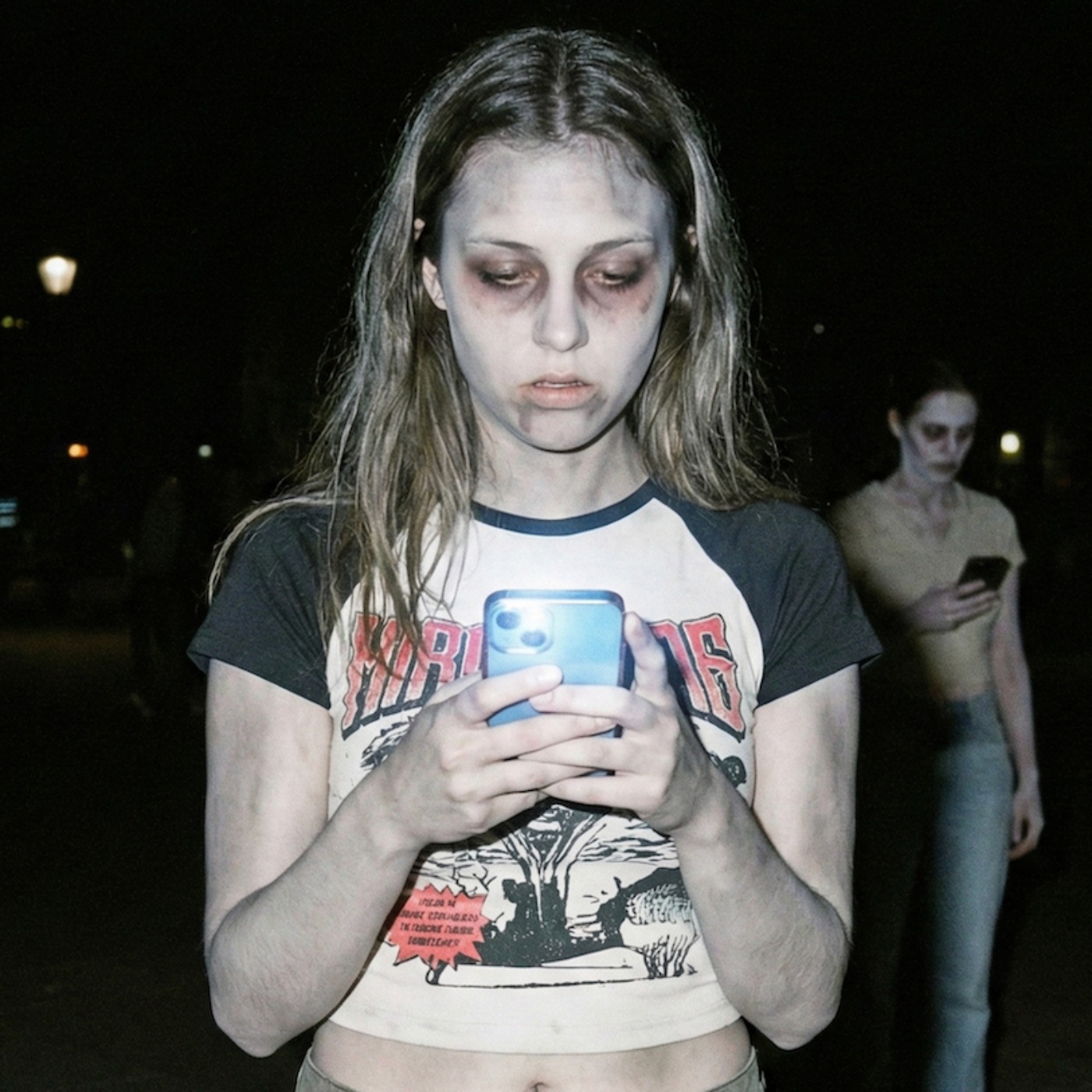
The host introduces her work and explains her principled resistance to building an audience on social media platforms like TikTok, preferring the sovereign RSS technology of podcasts. She frames the recent algorithmic failure and potential ban of TikTok not as an isolated event but as the inevitable result of a "casino model" internet. In this model, users are digital serfs who toil on platforms (digital fiefdoms) they do not own, creating value for corporate lords. This system is now decaying, evidenced by the "dead internet theory," where most online traffic and engagement comes from AI bots, creating a hollow, manipulative environment. The host argues that platforms have evolved into psychic parasites, or "egregores," that actively harvest human attention and emotional energy—particularly negative states like fear and outrage—to sustain themselves. The conclusion is a warning against migrating to the next trendy app, as the underlying exploitative dynamic remains unchanged, and a call for more conscious, sovereign engagement with technology.
Long-term listeners of this podcast know that I've spent the last five years talking about the dark. Now I've built a flashlight, and it's called Moots. It's an instrument for serious private inner work designed to dismantle your excuses and never inflate your ego or assume the role of a sycophantic companion. And the wait list is finally live. Access is granted in the exact order you sign up. Lock in your spot now at Moots.World. Welcome to the new era of inner work. Welcome to Back from the Borderline. I'm your host Molly, and I don't want to talk to your personality. I want to talk to your soul. This podcast is where we unravel toxic programming from dysfunctional family systems, societal scripts, and the mental health labels that have kept you small. We talk about sovereignty, shadow work, emotional alchemy, culture, AI, and everything that lives at the intersection of the soul and the system. Back from the borderline, it means back from the edge, from the abyss, from the illusion that you're too broken to heal. If that sounds like the kind of journey you're ready to take, follow the podcast on the player you're listening to right now. I drop new episodes every Tuesday. All right, let's get into it. I remember very distinctly when TikTok first came out. And I remember downloading it, opening it up. And within minutes, I felt this very visceral physical reaction. And I immediately said to myself, "Oh my God, if I use this, I'm going to get insanely addicted to it." I just got the ick, and I immediately deleted it. And I have never, ever been back on TikTok since. And don't get me wrong, though, I really do see the appeal. And for years, friends would send me links to TikToks. And for a while, you could actually watch the links without having a TikTok. And now you can't, or you had to do something weird with the URL. And so people would send me TikToks. And I have spent the last few years feeling like an alien. Because I'm like, I can't watch it. And I won't download this God for a second app to watch the TikTok. And it sucks. Even some of my friends have gone so far as to do like screen recordings, a particularly good ones. I have even watched some of my really, really good friends build massive platforms on there. And for a long time, I really did feel the pressure. And the industry itself has been pushing me from every single angle. I've been hearing for God knows how many years now. Like, "Molly, why aren't you doing video? You need to do short-form clips. You're leaving so much money on the table." But I've just resisted it at every single turn. It just never felt right for me. And honestly, I just didn't have the energetic capital to spare. I was already distressed enough watching Instagram constantly change its algorithms and moving the goalposts every few months and fucking everybody over on there. And I knew intuitively that building your entire creative life on social media is really just like building a castle on sand. You know, the tide comes in, the algorithm changes, and then everything that you've built just tends to get washed away. And that's why I've stayed right here on RSS. And if you don't know, RSS actually stands for really simple syndication. And it's the technology that powers podcasts. And unlike a for you page, RSS is sovereign. So when you subscribe to this show, there's no middleman deciding if you get to see the episode or not based upon how viral the episode is, right? It is literally a direct pipeline from me to you. And my RSS feed absolutely has grown a lot slower than any TikTok account that I would have started back then would have. I've been doing this for over five years now, and it's been a slow burn. But the difference is I own this RSS feed and no one can take it away from me. And many of you know what I experienced in Hollywood. And Hollywood is very similar to the algorithmic gods. You know, I was this close to a publishing deal. And because I refused to go along with really disgusting predatory sexually abusive behavior, that's a whole other episode, I was dropped from my manager, my lawyer, and all of my masters were taken away from me, songs that I wrote. So I have been a bit traumatized, and that's kind of the basis of why I've stayed away from putting a lot of effort into building audiences on these social media platforms. And sadly, that intuition about building on sand has just been proven right in a very brutal way. And if you've been living under a rock, the reality of what just happened to TikTok is a buzz and a blaze on the interwebs this week. After years and years of legal battles and this looming ban or sell mandate from the US government, the deadline finally hit. Because by dance, the owner of TikTok couldn't or wouldn't execute a clean sale that satisfied quote unquote national security concerns quickly enough. And so the app essentially broke. But it wasn't this clean lights out situation. It was messy as hell because as the deadline got closer and closer, the algorithm is very thing that made TikTok so addictive and useful for people. It was an algorithm that apparently people said knew them better than they knew themselves. It was this uncannily good algorithm. And over time, people have put a lot of time and effort, doom scrolling on TikTok to make their algorithm just right. Well, this last week, that algorithm started to crash. And creators who had millions of followers suddenly saw their reach drop to basically zero overnight. And the for you page, which used to be, you know, very uncannily smart. It started serving up really irrelevant or repetitive content that just wasn't hitting like it used to. And personally, I really don't take any pleasure in saying this. But I really did see this coming and it's not surprising. In fact, I think it was inevitable. Because what we're witnessing right now is the death of the casino model of the internet. And the casino model is exactly what it sounds like. These platforms were never designed to be town squares, like they've claimed to be. They're basically designed just like slot machines. The entire user interface, the pull to refresh all the colors, the notifications, the variable rewards of like maybe today will be the day that I go viral, right? Every little design decision is built to keep you in a trance state pulling the lever over and over and over again. And you know what they say about casinos, right? The house always wins. The players eventually end up going broke. And right now we are watching as the casino lights flicker and die and everybody inside is suddenly realizing that they have been playing with chips that are worthless. People that know me well know that I have always been kind of obsessed with the middle ages. Anyway, it's my weird niche interest I read about it all the time. And to understand what's happening to us right now, you actually need to understand something called feudalism. Before feudalism, you had the Roman Empire, this centralized state and commerce and assemblance of public order. But when Rome fell, that safety net just vanished. It started to become really dangerous. There was constant raids and chaos. And so people made a deal. And it was kind of a survival contract. The poor and the vulnerable went to the guys with the big swords and the stone walls and just the kind of warlord type guys. And they said, protect us right? We will work your land for you. We'll give you our harvest and in exchange you let us live inside of your safe walls and protect us. So that was the birth of the surf or the peasant. A surf isn't technically a slave, but they aren't really free either. They are bound to the soil. They work the land, but they own nothing. So if the lord sells the castle, the surfs go with it. If the lord burns the castle down, then the surfs burn too. We like to think that we have left this system behind in the "dark ages." But there is a brilliant economist, and his name is Janis Varrofakis, and he argues that we haven't left that stuff behind at all. We just moved it up into the cloud. And he calls it techno-futalism. And his argument is essentially that capitalism is actually dead, and it's been replaced by something much, much worse. Because in capitalism, you have a market. You make a thing, you sell the thing, and then you keep the profit for the thing. But on the internet, there are no markets. There are just fiefdoms. So essentially, right? Amazon, Meta, Google, Bite Dance, all of those companies, they're more than just companies. They're private estates. They are like digital castles surrounded by modes. And we, you and me, are not citizens of the internet. We are the peasants. We are the surfs. Think about it like this. What do we do all day? We create content. We comment. We post. We engage. We are working their land for them. We are toiling in the fields of Zuckerberg and Bite Dance, creating the value that makes them trillions of dollars. And what do we get in exchange? We get to live inside of their walls for free. We get connection. We get entertainment. But we own nothing. We don't own the data. We don't own our audience. We don't even own the right to speak freely, because the Lord can kick us out of the castle at any moment for any reason. And that's exactly what we are watching right now with TikTok. The Lord, Bite Dance, got into a fight with another king, the U.S. government, and now the castle is being caged. And guess who suffers? It's certainly not the billionaires. They're going to be fine. It's us, the peasants, the surfs, the creators who tilled that soil for five years, who built massive audiences, who fed the algorithm with their blood and sweat and tears. And creativity, only to watch it go up and smoke. And this is why I am screaming from the rooftops for people not to just blindly migrate to the next app and ever expect it to be any different. I am seeing everybody panic running to whatever the new TikTok killer app is going to be stop because you're essentially just moving from one plantation to another. You're trading one Lord for another. You might get a nicer plot of land for a few months. There might be better reach for a little while, but the dynamic hasn't changed. We are all still peasants and helping to build a castle that we will never own. We'll be right back to the episode after a short break for some ads, because you know a girl's got to eat. So we've established by this point that we are all surfs working on a digital lords lands. And that's bad enough. But if you really want to understand why the internet feels so just Ick lately, so empty or even a bit uncanny or just off, you really need to go one layer deeper because we used to just be surfs working the fields, but now we're surfs working in a ghost town. And this brings me to something called the dead internet theory. I want to take you back to January 2021. And there was a post on a niche obscure forum called Agora Road's Macintosh Cafe. And it was written by a user named Illuminati Pirate. And the title of this post was dead internet theory. Most of the internet is fake. Now at the time, this sounded a little bit schizophrenic. It was giving a bit of paranoid delusion vibes from the depths of 4chan, you know what I'm talking about. The thesis was simple, but it was also really scary. And essentially it was that the human internet, the one where you and I actually talked to each other, died around 2016 or 2017. The user of this post argued that since then the majority of the "people" that you see online, the trends that you follow, and the comments that you fight with or that piss you off are actually AI bots generated by algorithms to manipulate public perception and gain ad revenue. They claimed that the culture that we consume wasn't actually being created by humans anymore at all. It was actually being procedurally generated to keep us clicking. So when that post came out, people just kind of laughed it off, but here we are in 2026 and nobody's laughing anymore. Because what started out as this fringe conspiracy theory has become a statistical fact, we now have all of the data to back it up. The latest bad bot report from Imperva just confirmed that automated traffic has officially now surpassed human traffic. We are looking at over 50% of the internet being non-human. And it's not just good bots that are indexing the internet. The report shows that nearly 40% of all traffic is "malicious bots." Yeah. So what does this actually mean then? It means that when you go viral, you aren't even necessarily being seen by people. You are being indexed by a swarm of bots. When you see a comment section filled with outrage or polarized political hot takes or even just weird repetitive praise, you are likely witnessing bots talking to bots. They are vibe coding. They're mimicking human slang. They're using typos on purpose and arguing with each other to create the illusion of a vibrant community. Why would they do this, you ask? Well, that's because engagement is the currency. And this is the final stage of what a theorist named Corey Doctoro calls "insitification." Platforms start by being good to users. Then slowly over time they abuse their own users to make money for customers or advertisers. And then finally they abuse the advertisers to claw back all of the value for themselves. And so to keep the advertisers paying, they need to show growth. But there aren't enough humans left to grow so they fill the empty seats with ghosts and they artificially inflate the numbers with bots to keep their own stock prices up. And this is why you feel so lonely online, even when you're "connected to millions of people." Because subconsciously you know you can feel it. You are walking through a digital mall that is really loud, but there's actually nobody there. It's all assimilation. And it's harvesting your energy. And if you want a crystal ball for where all of this is heading, just look at the headlines recently about open AI. Rumor has it that they are about to turn on ads. And this sounds very familiar because it's the exact same script that we've seen play out for 20 years now. And it is called the tech life cycle of doom. The honeymoon always starts out the same way, right? The platform launches. It's fun. It's chronological. You actually meet cool people. The vibes are immaculate. And it really feels like a public utility or even a playground. But then the techno overlords get a little too big for their bridges as my southern grandma liked to say God rest her soul. They take the massive VC checks. They suck the massive VC. And they decide to scale at all costs. They adopt that move fast and break things mentality except the only thing they break is the user experience. And they get out ahead of their skis. You know, they hire thousands of middle managers that they don't need. And they burn cash like crazy. And then they hit a wall. The dirty little secret of Silicon Valley is that tech is one of the only industries on earth where you can be wildly unprofitable for a decade or more. And people will still call you a genius. So they ride the wave of these massive overinflated valuations. They literally decried the hype cycle until the investors finally knock on the door and they're like, hello. So where's the actual money? You know? And when that happens, they've only got one card left to play ads. They have to monetize you. They have to turn your playground into a billboard. Okay, that's how it works. And the tool that you once loved turns into a trap. They are quite literally selling our souls, our attention and creativity and connections just to sell ad space for drop shipped garbage. We saw it happen to Facebook, Instagram happened to TikTok. And now we're watching open AI a company that started as a nonprofit to quote unquote benefit humanity. Preparing to do the exact same thing. They're all building the same trap. And we just keep on walking into it like lambs to the slaughter. And so I want to pivot to something that might sound a little bit out there for some of you, but my long term listeners, it won't really. You hear a lot of people online and usually it's in the deep dark corners of conspiracy Twitter or some random forum, kind of like the one we talked about in the beginning of the episode talking about things like energy harvesting or prison planets. And a lot of that is misunderstood. It gets wrapped up in this illuminati lizard person aesthetic that makes it really easy to just roll your eyes out. But if you strip away the sci fi paranoia and really look at the actual occult and esoteric history, there's a profound truth there. Because we have to ask the question, you know, if the internet is dead and 50% of the traffic is bots and the content is just like empty content, then why do we feel so exhausted after using it? If it's just a tool, then why does it feel like it's actually taking something from us? And what exactly is eating our attention? And to answer that, we need to look at a very ancient concept and that is the concept of the egregore. And the word comes from the ancient Greek word egregoros, which literally means watcher. And in occultism and chaos magic and egregore is a distinct psychic entity that is created by a collective group of people. So just think of it like this, okay, it's a good example. When people focus all their attention and their emotion and beliefs on the same thing, that thing tends to start to take on a life of its own. It gains a certain kind of autonomy and becomes more than just the sum of its parts. It becomes in what esoteric and occult theory is called a thought form. A corporation is an egregore, even nation states are egregors. A religion is also an egregore. But the catch is that egregors do need to eat. And to sustain its existence, it requires a constant stream of energy from its followers. It needs their devotion and thoughts and all of their emotional reactions. And if you stop feeding an egregore, it starves. And so the egregore learns how to make you feed it and learns how to trigger you and scare you and even seduce you. And this brings us all the way back around to TikTok. We need to stop thinking about TikTok as just code or an app, because TikTok is perhaps the most powerful, hungry egregore that we have ever seen in the entirety of human history. Just think about how TikTok behaves. The algorithm is a thing that kind of watches you. It's learning exactly what makes you tick all your insecurities, your desires, your fears. And then it extracts from you. It doesn't just show you what you want. It actually shows you things that will provoke the strongest emotional spikes in you. It feeds on emotional energy, usually low vibrational energy, like outrage and lust and panic and envy. And TikTok feasts on this. It created a culture where you have to participate in its rituals, which are what they would call trends, in order to be seen. You have to use certain sounds. You have to move your body in the way that it dictates. It's literally possessing the bodies of its users, making them dance to its tune, all to generate the energy, right? Views an engagement that keeps the beast alive. It's literally a psychic parasite. And for the last five years, we have been letting it feed on all of us. There's a term in esoteric circles called Lush. And it was actually coined by Robert Monroe, who was a pioneer in consciousness research. And Lush is essentially life force energy, specifically the energy generated by really intense emotional states. Love produces energy. But so does fear and outrage and panic. And for a parasitic energy, really high vibrational energy like peace or contentment is boring. It's hard to harvest because satisfied people, they tend to put their phones down and touch grass, but low vibrational energy like fear and tribalism and jealousy is this all you can eat buffet. And for years, we thought the algorithm was just passively waiting for us to get angry, but the new research and this stuff just dropped this week from Oxford and Cambridge this week, this last week of January, it all proves that it is much, much worse than that. We are dealing with something called AI swarms. They're not just dumb bots anymore. So there's this paper that has been published days ago. Researchers like Dr. Inga, Trouthig and teams from Oxford and Yale are warning us about collaborative AI agents. And so these are not just, you know, your solitary bots posting spam. There's something called swarms, you know, like a swarm of bees. They talk to each other and coordinate and they use what researchers called vibe coding and you've probably heard about vibe coding before. And that means like I said before in the beginning of this episode, they're adopting the sling we would use and syntax and inside jokes of a certain community to be able to blend in perfectly. And they are designed to infiltrate communities and fabricate consensus. That's a quote from the study. So essentially if you're arguing with somebody in a comment section about politics or gender or the latest drama, whatever, there's a very high chance that you're not arguing with the human. You're arguing with a skin walker basically. You're fighting with a collaborative AI agent that was deployed specifically to trigger your loose to make you angry and engage and harvest your energy for the platform. It's an extraction machine. And this is why the internet has changed and we are seeing the dark forest theory come to life. Now, if you've read the book, the three body problem, which was turned into a series on Netflix, which fun fact, a previous back from the borderline guest rose is actually a writer on that series, you probably know about this concept of the dark forest theory. Essentially, it says that the universe is full of life, but it's silent because there are predators in the woods. And if you shout and reveal your location, you get wiped out. So the intelligent civilizations stay quiet and hide in the dark. And this is exactly what's happening to us, the clear net, right, Twitter, TikTok, the public feeds is the dangerous open forest. It's filled with hunters and skin walkers, those AI swarms looking to harvest your energy. So the real humans, the intelligent ones are starting to retreat and move into the dark forest. They're moving to private discords, patreon, group chats, and into other tools that are designed more intelligently and with the actual health and sovereignty of the users in mind. We are gathering around small campfires where we know that people are real and where the Egregor can't find us. And if this might sound depressing or even terrifying to you, the idea of retreating into the dark, all of this stuff, it really shouldn't be because we've been here before. You've probably heard the phrase, nothing is new under the sun. You know, history doesn't repeat, but it rhymes. Those are saying for a reason because right now we are hearing a rhyme that's thousands of years old. Just look at the cycles, you know, so the year 1945, I want to place you there. It was the dawn of the atomic age and the computer age. It was a very huge, terrifying rupture in human consciousness. And exactly at that moment of high-tech danger, the earth gave us a spiritual counterbalance. The desert spit out the Nagha-Madi library, the Gospels were found in 1945 that had been buried for centuries. And these texts essentially said the institutions are lying to you. The true God is inside of you. Look at where we are today in 2026. We are in the early degrees of Pluto and Aquarius. Aquarius is the sign of technology, the collective, and the future. But Pluto is the planet of death and rebirth and also the planet of the exposing of secrets. Pluto and Aquarius destroys top-down hierarchies. It reveals the rot in the system. And just as the nostic texts were found when we needed them in 1945, the dead internet realization is happening now because we finally need to see the cage that we are living in in order to be able to walk out of the cage. It reminds me of the devil card in the tarot. In the writer-weight Smith deck, you see two figures in front of the devil and they have chains around their neck. But they could so easily lift those chains off. That's the thing about the card. If you look closely at the image, the chains are loose. They could take them off, but they choose to just stand there and stay in hell. We are currently walking the same path as the rose accrucians did in the 1600s. And in that time, Europe was tearing itself apart with religious wars. It was really dangerous to speak the truth publicly. And so the mystics and the alchemists and the scientists formed what they called the invisible college. They communicated in code, they published anonymous manifestos and vanished into the dark forest of their time to protect the light of knowledge from the swarm of the inquisition. And it's that same spirit that the Freemasons who built the Gothic cathedrals, they hid sacred geometry and divine feminine codes in the stone right under the nose of the Roman church. They were vibe-coding truth into the architecture so that those with eyes to see could find it. We are those people. The algorithm is the new orthodoxy. The swarm is now the inquisition of our time. And we are the new invisible college. We are not going to find solace out in the clearing. The clearing is where all the bots are. We have to go back underground and build new cathedrals, not out of stone this time, but out of human connection and sovereign technology. That can become our cave, our invisible college. So you can see the cycle is just repeating again. The age of Aquarius is going to be the battle for the human soul against the machine. And I believe that we can win that battle. But you have to choose to exit the simulation. And the reaction to all this stuff that I've talked about, you know, the swarms and the dead internet theory and all the extraction all of this horrible stuff. It's usually very black and white. People usually swing to the other extreme. And they start screaming, you know, tech is bad, right, throw the phone out, get a brick phone. And that argument really borrows me. I think it's lazy. I think we need nuance here. I don't think it's realistic that we're all just going to become let it's and live in the woods. And I actually don't think that we should think about what technology has actually done for us. Google maps, right. Even I just think about the fact that I've met some of my absolute best friends, literal soulmates on the internet. Connected through a screen and then we met in real life and those relationships are real. Think about the fact that I'm speaking into this microphone right now and you're hearing me thousands of miles away. That is a miracle. We need to remember that technology is neutral. It's a tool like take a knife, for example, you can use a knife to chop vegetables and make a beautiful stew to feed your family. Or you can take that very same knife and stab somebody to death or fire, you can use it to cook that same meal or you can use it to burn your entire house down. So the tool has never been the problem, the wielder of the tool has always been the problem. And right now I think we need to look at the people wielding those tools, the architects of the current internet, the Zuckerbergs, the Peter Teals, the musks. I would wager to say that really as they are, they have not been very good stewards. They've become techno-futalists. And you know what, I'm not even saying that they're cartoon villains sitting in a room like, you know, twiddling their mustaches and ringing their hands. Most people really do think that they are doing what they think is best. But the issue is that these men are not thinking in terms of spiritual ecology or service. As I said, they got ahead of their skis and they built systems that they couldn't control and now they're trapped by the very models that they created. They are forced to extract from us just to keep the machine running and to save themselves and their own families. But the good news is we have the option to opt out, we get to decide where our eyeballs go. And I'm not saying this to put myself on any kind of pedestal, okay, because when I resisted TikTok, it wasn't because I'm some enlightened monk. I just got the IK. I got bad vibes from it immediately and practically I just didn't have the time. I was already making a couple episodes a week and I had to kind of pick my poison. So I chose the Instagram devil because I couldn't serve two masters. It was really that simple. But I also learned this lesson the hard way a really long time ago. Do you remember a little thing called my space, you know, I remember spending hours learning HTML coding. I was obsessed. I created the perfect profile, the perfect top eight, the perfect song. I poured my energetic capital into that platform and then poof. It died. It went away. You know, just like empires, platforms rise and then they fall again, that really is the nature of all things. And if you build your home on someone else's land, you will always end up homeless eventually. So the answer isn't to kill the technology. It's just to stop trusting these very specific types of landlords. And I think that we need to stop building on sand. But it really isn't all bad news. You know, many of my longer term listeners know that I have been cautiously optimistic about AI from the very beginning. Now, do I think that there are issues 100% obviously, but I also think AI has a potential that we are completely ignoring. I have been using AI incredibly effectively for the last few years for deep inner work specifically for things like dream work and diving into my own subconscious patterns. And for me, I actually liked it better than working with a human dream interpreter, for example, because a human isn't there at 2 am when I wake up with this like jolt of intuition. You know, humans bring their own bias. And I've found that AI is a really good mirror. And if you treat it like a sick of antic golden retriever, it's going to act like one. It's going to wag its tail and agree with you. But if you bring it depth and bring it really heavy mythopoetic kind of material, it can really reflect that depth back to you in a way that is profoundly inspiring and almost like uncanny. But I started realizing that if we don't have good stewardship in this field, we're just going to get more of the same. We're going to get more face books. And as I mentioned, we're already seeing it with open AI soon. You're going to be seeing ads on chat GPT and Gemini and all of them. And they're going to be building profiles on you and selling them to the highest bidder. And I think people pearl clutch a little bit about that too much because they're like, oh, no, my data while they literally download five apps a day and scroll past the terms of service without even reading it at all. We've essentially been selling our souls for convenience for over a decade now. But the real danger with AI isn't just the data selling. I think it's more so the sanitization. We are seeing the industry of AI kind of split into two very scary directions on one side. On one side, you have the what I would call more like the degenerate AI, these weird erotic chat thoughts or companions that are literally designed to make you addicted and fake intimacy and really anthropomorphize AI. But then on the other side, you've got the corporate safety vibes, right? These companies, this is like open AI, you know, cough cough chat GPT. They're so terrified of liability that they're essentially lobotomizing their models. And you're starting to see really deep intense human emotion like shadow work and grief and trauma being treated as a safety risk. So essentially, they're creating models that are terrified of the inner world. They want to keep everything really surface level and safe. And so throughout all of this, I realized, oh, my God, right, we need a secret third way. We need a third option. We need stewardship. We don't need more users. We need builders who treat technology as sacred technology. We need ritual technology. The current model of technology is designed for hypnosis, you know, hypnosis is a trans state. It's a distraction. It's doom scrolling. Essentially, it's like being asleep at the wheel while the algorithm drives for you. I think that we need technology designed for noses is the Greek word for knowledge. It means experiential knowledge of the self, the big S self insight, waking up. And so I think we need more people to step up and use their creativity to start building tools with this technology to help people wake up while everybody else rushes to build tools to put you more and more to sleep and trying to repeat the playbook from the past. We know how that works out. You don't have to spend your life arguing with bots and renting your audience from a feudal Lord who hates you. You really can exit. And it doesn't even mean you have to disappear. You just have to change how you build. So if you're a creator or just a human who wants to connect with other people, look at tools that actually respect you, you know, start a podcast on RSS. You know, I'm going to say it till I die. RSS is the only uncancellable, unthrottleable technology left. It is the direct pipeline from your voice to somebody's ear or start a newsletter, whether it's sub-stack or ghost or just an HTML email list like it's 1999, you know, email is the only algorithm that actually delivers 100% of what you send you own that list. Nobody can take it from you. And then look at where real conversations are happening because they aren't happening on the timeline anymore. They are happening in that dark forest I talked about, private discords, group chats, or gated Patreon communities. We are seeing this massive migration from the public square, which is now full of bots and screaming matches as we know to the private living room, right? It's the rise of the cozy web. And these spaces are smaller. You're not going to get a million views overnight, but ask yourself, you know, would you rather have a million views from a swarm of bots and 12 year olds or would you rather have 1000 real human connections with people who actually give a shit about what you're saying. So the era of broadcasting is dying and the era of little tribes, I think, is back. And we're watching the alternative die in real time. Just look, look at TikTok, you know, the moment the cool factor evaporated, you know, you're seeing a lot of like these big TikTokers leave the platform. It's over, you know, platforms like that run entirely on vibes. When the vibe rots, the platform becomes a zombie effectively. It's going to be shuffling around for a few more years, but the soul is just gone out of it. Those feudal lords, the Zuckerbergs, the bite dances, they're terrified of this because their entire business model depends on us staying in the castle walls and working their fields for them. But I think we should pick up our tools and walk out into the forest. And when we do that, their stock prices go to zero. They need us. We don't need them. So the exit is already here. You just have to be brave enough to walk away. And you know, I don't want to sound cold about the whole TikTok thing because I have a lot of empathy for the people right now who are mourning the loss of TikTok because for a lot of people, this was a place where they spent their creativity. They built their dreams there. It was their community. And it reminds me a lot of vine, you know, you remember buying it was that, you know, first short form video giant. It was brilliant. It birthed a whole generation of comedians and artists. And then one day it was just gone. And all of those talented people were scrambling trying to find a new digital home for themselves. But at the same time, I think there are parts of the influencer economy that need to die because I will not mourn the death of the unboxing industrial complex or the shallow consumerist bullshit. There are so many brilliant talented funny artists who built their entire livelihoods on TikTok. And they are now the collateral damage of this war between billionaires and governments. And my heart really goes out to them because it's fucked. It's fucked that your creativity can be wiped out because of a line of code or some geopolitical dispute. But this is why I'm bringing my voice to this. We really need to study the cycles. Look, vine died. TikTok is dying. And something else is going to rise up to take its place. But if you just jump to the next one without learning the lesson, then you are doomed to repeat the cycle. And the lesson here is sovereignty. In political terms, sovereignty is the supreme authority within a territory. But in digital terms, it means that you are the supreme authority over your work, your mind, and your connection to your audience if you choose to try to build one. It means that you don't need permission from a landlord to speak. We are really at a fork in the road right now. You can choose to stay a surf or you can choose to become sovereign. And I really believe that right now amidst all the chaos in the Pearl clutching and panic around AI, that we are entering a new renaissance, the old gatekeepers, they're dying, the old studios, they're crumbling, there's never been a better time to create than right now. So explore AI, explore the new platforms, play with the tools, but do it with your eyes wide open and make sure that your own sovereignty is the foundation of everything that you do and choose to build. And finally, I think that you need to remember that there's just one very, very maybe most important thing. And that is that technology is nothing. It's nothing if you don't go out there into the real world. The point of all of this isn't just to be good at the internet. It's to use these tools to empower yourself so that you can go outside, touch grass, look people in the eye, and be of service in the real world. That is the real work. Well, my lovely listener, thank you for being here with me today. I know there is a lot going on in the world right now. And if you're listening to this, maybe there's a chance that this is the very first episode of Back from the Borderline that you have ever come across because you happen to be searching for news about the TikTok stuff. So if that is the case, and this happens to be the first time you've encountered me or my work, welcome. I release new episodes every week. And if you want to make sure that you actually hear them, go ahead and follow back from the borderline on your favorite podcast player. Because this is RSS and if you subscribe, you will actually get the episodes. That's how this technology works. No algorithm required. And before I go, I want to tell you about something that I've been building in the background for over a year. With a very beautiful small team of engineers and artists, and we built a platform called moods. This is the exact manifestation of everything I've talked about in this episode. My co-founder, who's also my husband and I bootstrapped this. We took one small check from an incredible angel investor, and the rest has been built by a team working purely on passion and sweat equity because we believe in this mission. And we are about to release it into the world in two days to our very first group of beta users from my Patreon community. And then starting in March and April of 2026, we're going to start unlocking the doors for the general public in waves. We opened the wait list last week, and honestly, we're pretty blown away because there are already thousands of people on it. And because we're letting people in small tranches, it's going to be a first come, first sort of kind of thing. So if you want to secure your spot, get on the list now. This isn't like fake FOMO. We really are going to be letting people in groups in little chunks so that we make sure everything stays stable. Moods is going to be a tool for the slow, cozy internet. It is designed for the dark forest we talked about. It harnesses the power of emergent AI to help you speak with archetypal presences and to do short, effective bursts of inner work, gain insight, and then get off the app and back into your life. We really believe that the world is devoid of myth and meaning right now, and we really need to be able to think in symbols again. We are trying to build the new Gothic cathedral, but instead we are coding wisdom into silicon instead of stone. And it's one of the most beautiful things that I've ever made, and I'm so proud of it and I'm so proud of all the incredibly talented people who have worked on it. And so if you want to join us, go to moods.world. That's M-O-O-D-S.world, and you can sign up for the wait list there. Thank you for being here. I really know it feels like the most horrible time in the world right now, but we need people with a soul and with heart to go out there and build with the tools that you know how to use. So get out there and create something real. And remember, anyone, including you, can come back from the borderline. I'll see you next time. Now I've built a flashlight and it's called moods. Lock in your spot now at moods.world. Welcome to the new era of inner work.
Podcast Summary
Key Points:
The host introduces her new platform, Moots, and her podcast's focus on inner work and societal deprogramming.
She explains her long-standing avoidance of TikTok and social media, citing intuitive distrust, a desire for creative sovereignty, and past trauma from Hollywood.
The recent algorithmic collapse of TikTok is analyzed as a symptom of the "casino model" internet, where users are digital serfs creating value for platform lords.
The "dead internet theory" is presented as a reality, with over 50% of web traffic now from bots, creating empty engagement and manipulated culture.
The concept of an "egregore" is used to describe platforms like TikTok as psychic parasites that feed on users' low-vibrational emotional energy (outrage, envy, fear) to sustain themselves.
Summary:
The host introduces her work and explains her principled resistance to building an audience on social media platforms like TikTok, preferring the sovereign RSS technology of podcasts. She frames the recent algorithmic failure and potential ban of TikTok not as an isolated event but as the inevitable result of a "casino model" internet. In this model, users are digital serfs who toil on platforms (digital fiefdoms) they do not own, creating value for corporate lords.
This system is now decaying, evidenced by the "dead internet theory," where most online traffic and engagement comes from AI bots, creating a hollow, manipulative environment. The host argues that platforms have evolved into psychic parasites, or "egregores," that actively harvest human attention and emotional energy—particularly negative states like fear and outrage—to sustain themselves. The conclusion is a warning against migrating to the next trendy app, as the underlying exploitative dynamic remains unchanged, and a call for more conscious, sovereign engagement with technology.
FAQs
Moots is a flashlight designed for serious private inner work, aimed at dismantling excuses without inflating the ego or acting as a sycophantic companion. It represents a new era of inner work, with access granted in order of sign-up.
The host avoids TikTok due to concerns about addiction and the unstable nature of building a creative life on social media, which she compares to building a castle on sand. She prefers RSS for its sovereignty and direct connection with listeners.
The casino model describes how platforms like TikTok are designed like slot machines, using interfaces and variable rewards to keep users in a trance-like state. The 'house' (the platform) always wins, while users often lose value, as seen in recent algorithmic crashes.
Techno-feudalism is a concept where companies like Amazon and Meta act as digital lords, with users as peasants who create content and value but own nothing. It explains how users are bound to platforms, similar to medieval serfs tied to a lord's land.
The Dead Internet Theory suggests that much of the internet's content and interactions are generated by AI bots rather than humans, manipulating perception and engagement. Recent data shows over 50% of internet traffic is non-human, contributing to a sense of loneliness online.
The tech lifecycle starts with a fun, chronological platform that feels like a public utility, then scales rapidly with VC funding, leading to a broken user experience. Eventually, platforms turn to ads to monetize, transforming the tool into a trap for users' attention and creativity.
Chat with AI
Loading...
Pro features
Go deeper with this episode
Unlock creator-grade tools that turn any transcript into show notes and subtitle files.
 PodcastTranscript AI