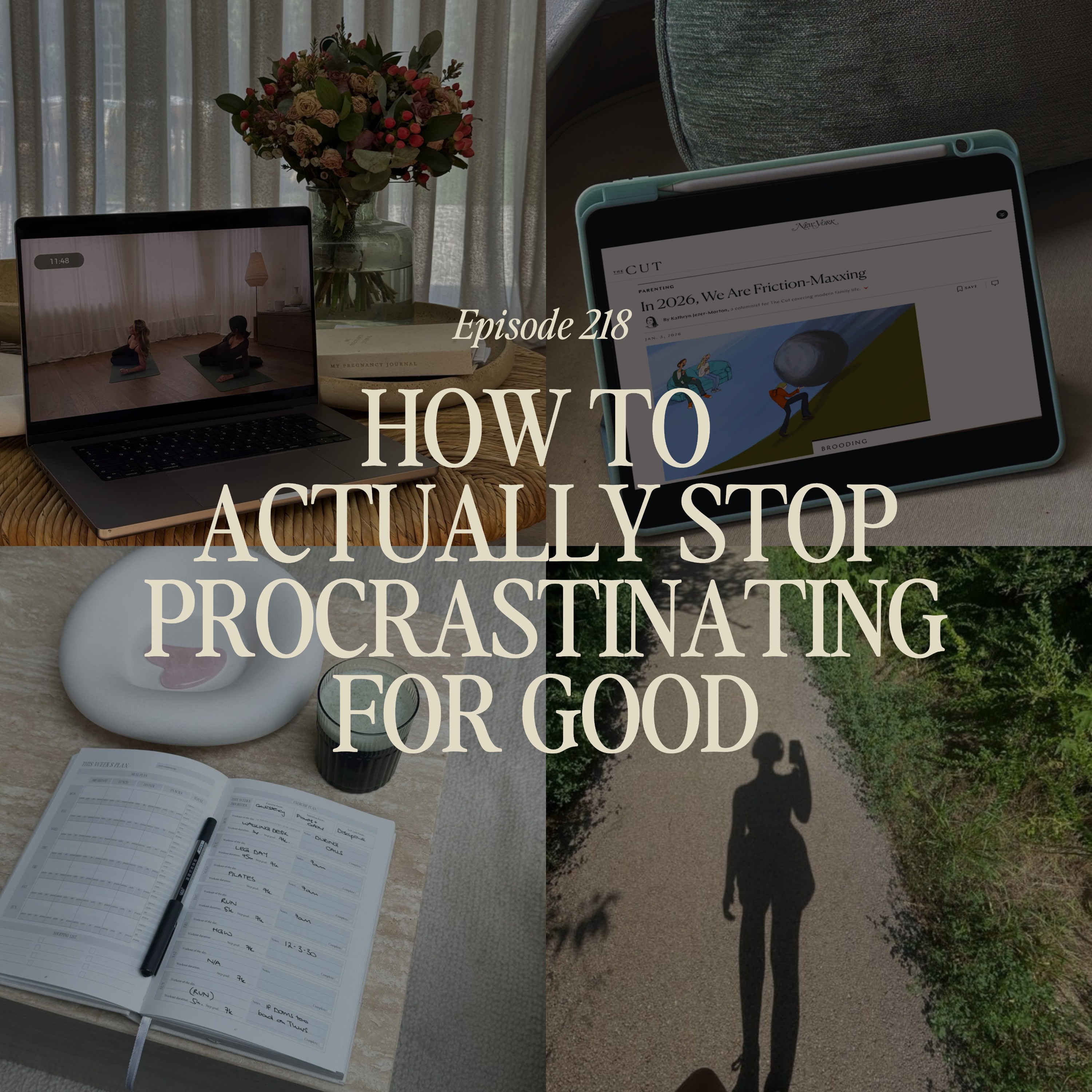
Speaker 1What is up? I'm Grace Beverley and welcome back to Working Hard, the podcast-shaped guidebook on how to improve your own life and achieve what you actually dreamed of doing. Because life's too short for boring podcasts and bad advice. It's a random Tuesday. You wake up and you ask Siri what the weather is. You get an Uber to work. Or you work from home. You use AI to transfer your emails. You order lunch on Uber Eats. You get home and you're able to watch the entirety of your favourite series without waiting for next week. Each episode autoplays into the next episode. You order something on next day delivery because you forgot to get it from the shops. You scroll until you fall asleep. At no point did you have to really work with any discomfort, wait for anything for too long, or truly have to figure too many big things out. And yet, somehow, despite all of this convenience, you get to the end of the day and you feel weirdly flat and hollow. I think about this feeling a lot. This was obviously an extreme example. You might not be doing all of those things in one day. But we all know that slightly flat feeling you get when you've not been challenged in a while. Even challenged in those tiny little ways like waiting five more minutes for your train or the bus that breaks down and you have to walk somewhere else to be able to get somewhere. Whatever it might be. Because it's actually turned out that all of those little bits of effort and inconvenience and difficulty that we have been diligently removing from our lives, they were all doing something for us. I saw a comment the other day that said maybe you're not happy not because your life is too hard, but because your life is too easy. And I do not think that is the case for everyone. I do not think everyone's life is too easy. But I do think we've lived in a world where the idea of convenience is held above all. And therefore, the best life is the most convenient life. And the one where you remove as much friction as possible in order to survive. In order to have a smoother day to day. Maybe the fact that we don't necessarily agree with this is why a lot of us are suddenly thinking about the idea of whether convenience is always good for us. Or the new phenomenon called friction maxing and how to get back into our flow states and therefore get some of our purpose in life back. Now, before we get into this video, I want to be very, very clear that this is a privileged conversation to be having. I do not think it's fair to say that every single person out there has the most convenient life that they need to be able to remove convenience from because everyone's just having no friction in every single day. Not everyone has the luxury of convenience culture and it's not helpful to pretend otherwise. But for a lot of us, there has been so much change in the past few years that those things I read at the beginning are our reality or at least a version of reality that is on offer to us that is advertised as the better option. If you remove as much inconvenience as possible, you will have a better life. That is how it's sold to you. If you can have as much on demand as possible. Life will be better. And I think what we're challenging here is the idea that convenient doesn't always mean better. I think we're starting to realize that this abundant convenience is changing us and changing the way our brains work more than we think and more than we actually want. So that's what today's episode is about. Before we get into the episode, please make sure that you go and click the follow button on whatever podcast app you are listening to this on. It hugely helps us and it means that we can keep making these episodes free for you every single week. So I want to talk about something called friction maxing. The name sounds a little bit intense, but the idea is really simple. It's basically this new phenomenon about deliberately bringing a bit of inconvenience back into your life in a world that has been working very hard to remove all of it or at the very least to make you think you need to remove as much of it as possible. Now, if you haven't heard of the term friction before in the way that it's referred to in regards to lifestyle rather than in regards to physics, it's a term and I can't actually remember the origin, so I'm going to put it on screen, but it started to be referred to as these little points of inconvenience in your life. So there's little things we are all trying to remove by modern technology that actually maybe are what made life what it is. Maybe they are what gave you the dopamine hit. Maybe they are what gave your day a little bit more purpose. And I think really, despite the more dramatic example at the beginning, we all do feel the effects of that removal. We do have same day delivery, one tap everything, ability to skip things, never having to sit through ads on the TV, never having to wait for the next episode to come out, AI that writes our emails, algorithms that predict what we want before we've even thought to want it. Even if you're not engaging in too many of the paid versions of this lack of inconvenience, it is being served to you through everything. Like, even if you search on Google now, you don't need to find the answer. It's going to pop up at the very top. And a lot of the time, we don't have to wait for things or we don't have to inconvenience ourselves to get things in a way we used to. We don't really have to plan ahead or tolerate boredom or sit with any discomfort because it feels like there's always a frictionless shortcut one tap away. For example, if your friction is that you sit at the bus stop board or you have to walk somewhere an extra 10 minutes and you don't want to be alone with your thoughts, you always have a podcast or some music to listen to, something that means that you don't need to do that much that you don't want to do. So that's friction. And the first time I heard about friction maxing, which is, as we've said, consciously trying to reduce those areas of convenience that are unnecessary. In our life was through a piece in the cut. And what I found really interesting in this piece was the idea that this isn't accidental. Tech companies have spent billions specifically engineering friction out of their products because the easier they make it for you to stay, the longer you stay and the more money they make. So every skipped intro, every one tap purchase, every autocomplete is helping their business model. The way the article put it is tech companies are succeeding in making us think of life itself as something inconvenient to be escaped from. So this is, I suppose, the thesis of this whole episode. Ease and joy are not the same thing. I think we've all developed a tendency to conflate them constantly as if removing all of the hard parts of anything will make us happy. I think realistically, this comes from the fact that actually life has had a lot of added areas of convenience within the past 100, 200 years that were absolutely necessary. Like the fact that the large majority of us don't need to be washing our clothes for eight hours a day to be even wearing them or getting water or whatever it might be. There was an area of added convenience. That felt very essential. But it's gone beyond that essential point. I think it turns out that a lot of those hard parts that have recently been removed were actually doing something for us. And the science on why is something I am very interested in. I had a look into what's actually happening in our brains when we remove a lot of the difficulty from our lives. And the first thing I came across is a theory called effort justification. And this is based on research that goes back to a psychologist called Elliot Aronson in the 50s. The basic finding, which wasn't a surprise to me, is that we value things more when we've had to work for them. There's a famous latest study called the Ikea Effect by Michael Norton at Harvard Business School, which found that people placed significantly higher value on flat-packed furniture they'd built themselves, even when it was objectively worse than the pre-assembled version, just because they'd put the effort in. Basically, it found that we are literally wired to find meaning in things that cost us something, particularly when that cost was an effort that we can't necessarily put a price to. Which means that when everything is instant and effortless, our brains don't register it as valuable, because that key signal of worth is missing. But the piece of science I really wanted to spend time on, because I think it's the most useful for actually doing something about this, is the research on flow state. This comes from a psychologist called Mihaly Csikszentmihalyi. And yes, I did practice that name several times. I also wrote about it a lot in my book that I wrote five years ago, and spent a lot of time on the idea of flow state and how we can get it back in little parts of our lives. Anyway, he spent decades studying this experience in which people feel most alive. This experience he called flow state, which is where you're so absorbed in what you're doing that time starts to disappear, self-consciousness drops away, and you feel completely present. You probably know the feeling. It might be when you are deep in a creative project, or playing a sport, or cooking something complicated, or even just having a really good conversation when you lose track of time. What Csikszentmihalyi found was that flow has a very specific set of conditions. The most important thing is that something needs to be challenging enough to require your full attention, but not so challenging that you can't do it. And that's why he called it flow state. This sits in this sweet spot that he called the flow channel between boredom and overwhelm. And you'll probably see the point I'm getting to here, but if everything in your life has been made as easy and frictionless and convenient as possible, you are structurally locked out of a flow state. You literally can't get there. And so what can happen is that you start to spend your days doing things that start to feel a little bit unsatisfying, even when they go completely fine. And I think the really important thing is here, you have to be able to get flow state into some areas of your life. And if you don't have enough flow state, which a lot of people don't naturally get from their work, you are going to have to find it elsewhere, which means you're going to have to find it in a lot of these things that have now ended up so convenient. You've got to have a hobby or an ability to cook or an ability to go to the gym and actually make a difference to your life because you might not be getting a flow state from what you are actually doing for work, which a lot of people, particularly at an entry level, aren't necessarily getting. I've always found this idea very clarifying because I think a lot of us are at times walking around wondering why, at the points where life feels most easy, maybe we feel a bit flat. And I genuinely think this is part of the answer. We've accidentally kind of optimised the flow out of our days. The activities that used to require a bit of effort and skill, like cooking, navigating, using a mat, writing, making plans, or even just being bored for a minute, have all been smoothed away. And I think this becomes even more prevalent when we're moving into a world in which, even if you do get flow state at work, maybe the thing that you used to get flow state from is now being easily automated and easily optimized through using tools like AI? And of course there's a much bigger question here, but I really think we need to be thinking about where am I actually getting my flow state out of my weeks? If it's not for my job, it's going to have to be something at home. It has to be something somewhere that is giving you an element of flow state. Otherwise it's no wonder things feel flat. I think with all of these smoothed away elements of convenience, we've lost a lot of the moments where we'd naturally drop into that flow state. Another really interesting thing I found in my research, which I'll mention quickly, is cognitive offloading. Researchers basically found that when we outsource thinking to our devices, so GPS instead of navigating, autocomplete instead of writing, AI instead of problem solving, we are not just saving time, we're also eroding those neural pathways. A 2020 UCL study found that heavy GPS reliance was actually linked to reduced activity in the hippocampus, the part of the brain associated with navigation and memory. This is basically the scientific way of saying you need to use it or you're going to lose it. And the more we outsource, the less we trust our own mind. And the more we feel like we need to outsource, which becomes a loop. And I do think this is something that we really need to start thinking about more and more because it just becomes more relevant the more automation comes across all of your tasks at work or whatever you are doing everywhere. Because the tech is optimizing for it. So it's going to be built into your phone. So that's going to be the way you're going to do things. How are you going to think about how you use parts of your brain that otherwise you're going to lose? I want to get into what we actually do about this and how to make a meaningful change in terms of our day-to-day lives to be able to get the most out of life. Most convenience without necessarily impacting our own brains and how we genuinely feel about our lives. But before we do so, I really want to make sure we are separating two very different things. Because I don't want this to come across as just like a make your life harder and you should suffer through it. Or your life is too easy when you don't believe your life is too easy. I think there's a massive difference between friction that genuinely makes life worse, like systemic unfairness, like things that waste your time for zero return. And what we maybe could think about instead as chosen friction. My thinking is kind of the chosen friction, if we look at it this way, is the effort you deliberately opt into because you know effort is the point of it. So that could be a long walk where you leave your phone at home or cooking from scratch when you could order in or reading an actual book instead of the summary. And that is the kind of friction that this episode is about. And according to the research, this is the kind that actually feeds us specifically and makes us happier generally because it's what creates the conditions for flow. You don't need to make yourself a super hard life in order to make your life fulfilling. You just need to be able to think about where are these edges being taken off where the edges were actually the point in the first place. So this is the practical bit. I started thinking about how we can add that kind of chosen friction back into our busy days and weeks in a way that doesn't just make your life super difficult. As usual, it starts by asking myself a question. So what are the things in my life that used to completely absorb me where I'd like look up and a whole hour has gone by? And have I been doing those things? And if not, have I been doing an easier version of them instead? For me, it's. things like cooking a proper recipe rather than something quick and familiar, or having a long phone call rather than just whatsapping someone back and forth, or playing the piano, or reading a novel. Like, these are all things that when I do them, I come out the other side feeling noticeably more like myself. And when I look back, I realise that I was properly absorbed the whole time. And none of these things are to do with work, by the way. I get a huge amount of flow and fulfilment and excitement out of work, and I feel very lucky to do so. But that doesn't have to be the whole point. That doesn't have to be where you get all of your work done. Friction in your life. You can live for other things. So, I wanted to put together a kind of framework that would work in order to help us get back to this. Start by writing down five to ten activities that you know, from experience, genuinely absorb you. They might be things that you used to do more of. They might be things that feel slightly effortful to start, but you always feel better for having done them. And then, this is the crucial bit that I always come back to, schedule them in your calendar. And I know now it gets boring. You need to be scheduling things that are priorities in the same way you would schedule a meeting. If that is a priority of yours, if that is something that you want to add back into your life, it needs to be reflected in what your life actually looks like when you look at it in terms of your calendar. Because the research on flow is really clear. These states do not tend to happen by accident. And in a world that's constantly offering you a frictionless alternative, you actually kind of need to fight for them. You have to choose them on purpose before the easier option presents itself. When I realised that I was maybe optimising some of the things that I really enjoyed doing, and where the process was actually the point, I started to look at my overall week, and I started to try and take note of the areas where I was actually getting into my flow state. Like, what is in that schedule that reflects that? It's not necessarily about being like, oh, I'll do three hours of flow here. It's about working out, are there enough things in that week that flow can even happen in? For example, one thing I added in was that we are trying a new recipe every Saturday at my house to try and get not even necessarily more confident at cooking or doing anything. And I think that's really important. And I think that's what I'm trying to do. And I think that maybe it's a little bit hard, but really, you enjoy the outcome. But I really think the crux of this is that the specific activity, whatever you choose, matters less than the principle. The principle is, you need to be doing something that asks something of you and gets you into that flow state. And then that means that if you have a lot of convenience in the rest of your life, that's fine. You can deal with that. And what I've also found since is that a lot of these areas of my week have tended to become my favourite parts. Another example of this, where I think you can see friction less as a how to make your life really hard and more how to make your life really fulfilling, is connected to something that I touched on in an episode last year about catch-up culture and what it's doing to our friendships. And I'll link it in the show notes because I think these two episodes sit really well together. But the whole argument of that episode was that our friendships have slowly morphed from shared experiences and doing things together into an agenda of life updates and a slew of WhatsApps back and forth every week when you finally reply. We see our closest friends and spend the entire time catching up on what's happened rather than actually making something happen together. And when I was researching this episode, I kept thinking about how that's basically the friendship version of friction maxing. Doing an activity together like a class or a walk or cooking is so much more effortful than a coffee catch-up, but it's also so much richer. You're not just exchanging information, you're actually in something together, which if you believe the flow state research, is exactly the kind of chosen friction that makes life feel more meaningful without making it hard for no reason. So if you're building your chosen friction list and wondering whether social plans count, I am saying here and now that they absolutely do. I think the thing I keep coming back to with all of this self-optimization culture, which look, I am absolutely part of and very much participate in, but it's that it has this shadowy side, which is that if we're not careful, all of this ends up optimizing for a life that doesn't actually feel like ours and isn't designed for our enjoyment, it's designed for our convenience. And I don't think that's what any of us actually signed up for, it's just what we were sold as the better option. Friction maxing to me isn't about rejecting modernity or being performative about it, it's about being able to inconvenient. But I think that we need to be making sure the stuff that makes you feel alive doesn't get quietly streamlined out of your week. As always, please do let me know if you create a chosen friction list, because I'm genuinely curious what's on other people's list and what you end up taking up, because as I've already said, there are certain areas of convenience we should absolutely keep, and I am absolutely keeping, and I need to be able to do my job. It's that I don't want to take the joy and excitement out of my life when it doesn't need to be removed, when I just think it does, because it's the easier option. And as always, the full is in the Working Hard newsletter this week, including the cut piece, which I talked about, which was where I originally discovered friction maxing, and a couple of books that I found really useful on the topic too. I hope you have a lovely week, and I will see you on Monday.
 PodcastTranscript AI