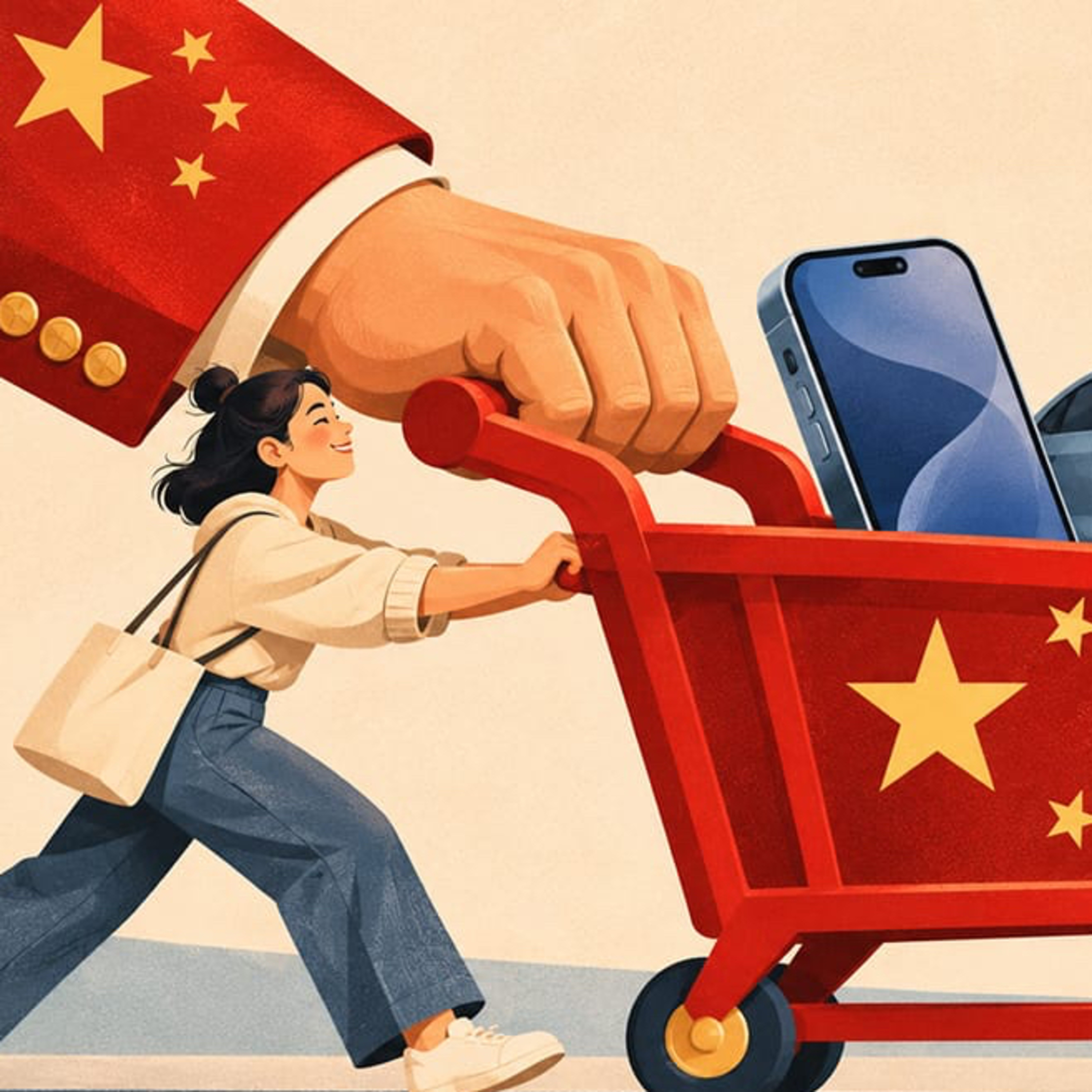
China is implementing a national trade-in program to boost domestic spending by subsidizing purchases of smartphones, electric vehicles, and other goods, aiming to counteract weak consumer demand. This strategy stems from deep-rooted economic challenges: prolonged pandemic lockdowns, the collapse of the property sector due to debt limits, and a sharp decline in household wealth tied to property. As a result, Chinese households have significantly reduced spending, with consumption accounting for only 40% of GDP—far below developed economies. While the government’s subsidies temporarily increase retail sales through a "pull-forward" effect, they do not address the underlying fear of financial insecurity. This fear is amplified by inadequate social safety nets, especially in healthcare and retirement, leading families to save heavily. Experts suggest that long-term solutions require structural reforms—such as expanding social spending in rural areas and improving the national pension system—to reduce household savings and encourage real consumption. Although the current program offers short-term relief, sustained economic growth depends on deeper reforms that build financial resilience. Without such changes, China risks remaining reliant on investment and exports, exposing itself to global trade volatility and industrial overcapacity. The transition will be gradual, but critical to ensure that household spending becomes a stable and reliable driver of national economic growth.
Hello folks, your tune into Finshaut's Daily, I'm Sad.
In today's episode, we look at how the Chinese government is subsidizing purchases of smartphones,
electric cars, and other goods to boost domestic demand.
And whether this can solve China's deeper economic problem.
Before we head to the story, here's a quick word from Team Ditto.
We're hosting a free two-day insurance masterclass that helps you build real financial security
by understanding health and life insurance the right way.
Right from understanding how to protect your family, choosing the right cover amount,
and knowing what truly matters during a claim to how hospitals process claims, the mistakes
buyers usually make, and how to choose a policy that won't disappoint you when you needed
the most.
We will explain it all in plain language.
Head to the link in the description and say your spot.
Now to the story.
Something strange is playing out in China right now.
The Chinese government is subsidizing purchases of everything from smartphones to electric
cars because it wants people to spend more.
Yup, you read that right.
It's called a national trade-in program.
And besides subsidizing purchases of appliances and electronics, it also covers the refurbishment
of old residential communities, elderly care institutions, and commercial complexes.
For this, the government has set aside 250 billion yuan this year.
And this isn't something new.
China has been running the program since 2024.
Last year, for instance, it spent 300 billion yuan on it, helping drive retail sales of
consumer goods up by 0.6% to 2.6 trillion yuan.
Including the 2024 program, these initiatives have generated sales worth 3.92 trillion yuan
so far.
But why is the world's manufacturing powerhouse persuading its own citizens to buy things
you ask?
Well, it all goes back to the pandemic.
Chinese households went through some of the world's longest pandemic lockdowns.
If you remember, China had something called the Zero COVID Policy.
Even as Western countries rolled out vaccines and returned to normal life, China continued
imposing sweeping lockdowns well into 2022.
This took a toll on an economy that had relied heavily on factories, infrastructure, and
exports for years.
And if that wasn't enough, in late 2020, Chinese regulators introduced strict debt limits
known as the Three Red Lines.
That's because property developers had been borrowing heavily to build more homes than
people actually needed, creating the makings of a housing bubble.
But when regulators tried to hit the brakes, they effectively restricted access to fresh
credit for heavily indebted developers.
Major players, most notably China's Evergrande Group, which had accumulated over 300 billion
dollars in liabilities, soon faced severe cash crunches and defaulted on their debts
in 2021.
This triggered a domino effect across the property sector.
Naturally, home buyers began to panic.
What if they bought a home and the developer went bust before completing the project?
Home sales plunged and property prices fell along with them.
And that's a big problem, because nearly 70% of household wealth in China is tied to
property.
So when home prices fell, families saw their wealth shrink too.
Many had bought homes, assuming they could sell them later to fund their children's education
or their own retirement.
Now that option looked a lot less reliable.
They would have to save more to meet those expenses.
Add to this a declining working age population, a rapidly aging society and youth unemployment
that touched 20% in 2023.
Put all of this together and you can see why Chinese households would rather save for
the future than splurge on eating out, buying a new phone or taking a holiday.
It also explains why household consumption accounts for only around 40% of China's GDP.
Sure, that's slightly higher than the 35% recorded in 2010.
But it's still much lower than the 60% average in many other major economies.
And when people spend less, businesses sell less.
Companies then cut production and hire fewer workers.
That makes households even more nervous about their finances, encouraging them to save
even more.
It's a vicious cycle.
And with household spending remaining weak, China became even more reliant on its tried
and tested model of investment, manufacturing and exports to drive growth.
But then, relying on investment and overseas demand indefinitely could be risky.
It leaves the country exposed to slowing overseas demand and trade barriers.
Years of investment have also created excess capacity in industries such as electric vehicles,
batteries and solar panels.
In simple terms, factories are producing more goods than the market can comfortably absorb.
And everyone produces more than customers want to buy, companies end up competing on
price, squeezing their profits.
So its factories simply need a more dependable source of customers.
And a stronger domestic market could provide one.
That's why Beijing wants its citizens to open their wallets.
But can discounts really solve China's problems?
Well, at the beginning of this story, we told you how the trade in programs had helped
boost retail sales.
So you might think they're actually working.
But here's the thing.
Of course, someone offers you a discount to buy a smartphone today.
You might decide to buy it immediately, even if you'd originally planned to purchase
one six months later.
But when those six months arrive, you won't need another phone.
You've already bought one.
And if millions of people do this, the result is simply that purchases get brought forward.
Retail sales rise temporarily, but there's no guarantee of additional spending over the
long term.
Economists call this the pull-forward effect.
That's the problem China has been facing too.
Some are spending declined in May this year for the first time in more than three years.
Besides, discounts can make purchases cheaper and encourage some people to buy things they
might otherwise have put off.
But they do little to address the financial worries that make households reluctant to spend
in the first place.
So the trade-in program is, at best, a temporary boost.
And the real cure might come only when China addresses its deeper economic problems.
For starters, perhaps the program itself needs a makeover.
Instead of focusing mainly on big ticket goods that people buy once every few years, the
government could give households more flexibility to spend on everyday needs, including entertainment
and eating out.
There's some evidence that this could help.
The International Monetary Fund estimates that doubling social spending in rural areas
could raise China's consumption to GDP ratio by 1.8% over the medium term.
But the government can't keep subsidizing purchases indefinitely.
For people to continue opening their wallets, they need something more important, a reliable
financial safety net.
China does have a social security system, but its coverage and benefits remain uneven.
And that means many households still have to save heavily for healthcare, education and
retirement.
In fact, a 2019 report by the Chinese Academy of Social Sciences warned that the National
Social Security Fund established in 2000 to help finance future pension obligations could
face depletion by 2035.
Strengthening its social safety net would also mean spending more on public services, such
as healthcare and education.
The catch is that this would require higher taxes or more government borrowing, neither
of which may be an easy political or economic choice.
Ultimately, China needs to make household consumption a stronger pillar of its economy,
rather than relying so heavily on manufacturing, investment and exports.
If families don't have to save so much for every possible emergency, they'll have more
room to spend on the things they actually want.
These reforms won't happen overnight, so China will have to make the transition gradually.
After all, its problem is much bigger than getting people to shop during a sale.
For now, discounts can buy Beijing sometime.
What it does with that time, will determine whether the shopping spree lasts beyond the
next sale.
Thank you so much for tuning in folks, I'll see you soon.
Podcast Summary
Key Points:
The Chinese government is running a national trade-in program, subsidizing purchases of smartphones, electric cars, and other goods to stimulate domestic consumption.
This initiative, costing 250 billion yuan in 2024, builds on prior spending and has boosted retail sales to 3.92 trillion yuan, though it only provides short-term stimulus.
The pandemic, strict property debt controls, and property market crashes have reduced household wealth and trust in long-term financial stability.
Weak household spending—currently at around 40% of GDP—has created a vicious cycle of reduced consumption, lower business activity, and job cuts.
The "pull-forward" effect means purchases are delayed and then made immediately, leading to temporary sales spikes without lasting increases in actual spending.
A more effective solution would involve targeting everyday spending on entertainment and essentials, not just big-ticket items.
Strengthening China’s social safety net—particularly in healthcare, education, and retirement—could reduce household savings and boost consumption.
Long-term growth depends on structural reforms, not just discounts, due to risks of overcapacity, reliance on exports, and unmet financial security needs.
Summary:
China is implementing a national trade-in program to boost domestic spending by subsidizing purchases of smartphones, electric vehicles, and other goods, aiming to counteract weak consumer demand. This strategy stems from deep-rooted economic challenges: prolonged pandemic lockdowns, the collapse of the property sector due to debt limits, and a sharp decline in household wealth tied to property. As a result, Chinese households have significantly reduced spending, with consumption accounting for only 40% of GDP—far below developed economies.
While the government’s subsidies temporarily increase retail sales through a "pull-forward" effect, they do not address the underlying fear of financial insecurity. This fear is amplified by inadequate social safety nets, especially in healthcare and retirement, leading families to save heavily. Experts suggest that long-term solutions require structural reforms—such as expanding social spending in rural areas and improving the national pension system—to reduce household savings and encourage real consumption.
Although the current program offers short-term relief, sustained economic growth depends on deeper reforms that build financial resilience. Without such changes, China risks remaining reliant on investment and exports, exposing itself to global trade volatility and industrial overcapacity. The transition will be gradual, but critical to ensure that household spending becomes a stable and reliable driver of national economic growth.
FAQs
It's a government initiative that subsidizes purchases of smartphones, electric cars, and other goods, as well as refurbishes old residential and commercial buildings, to boost domestic demand.
The government has set aside 250 billion yuan for the 2024 program, continuing a trend from previous years where spending reached 300 billion yuan in 2023.
The pandemic and strict property market regulations led to a sharp drop in household spending, with nearly 70% of household wealth tied to property, making families more cautious about spending.
It refers to the temporary rise in spending as people buy goods now instead of later, which boosts short-term sales but doesn't guarantee sustained long-term consumption.
Household consumption accounts for only about 40% of China's GDP, significantly lower than the 60% average in many other developed economies, indicating a structural weakness in domestic demand.
China has excess capacity in industries like EVs and solar panels, an aging population, youth unemployment, and a weak social safety net that forces households to save heavily for emergencies.
Chat with AI
Loading...
Pro features
Go deeper with this episode
Unlock creator-grade tools that turn any transcript into show notes and subtitle files.
 PodcastTranscript AI