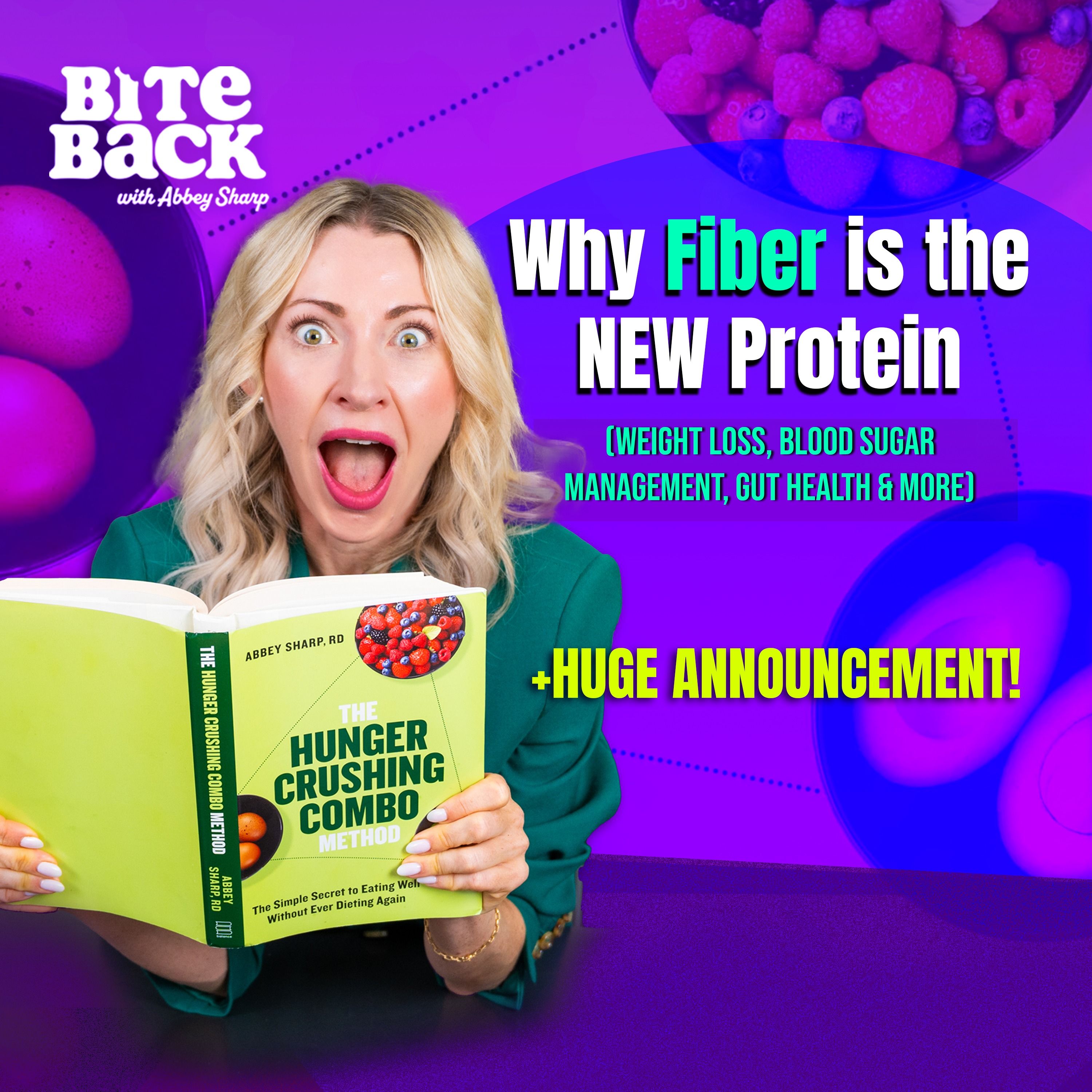
Why Fiber is the NEW Protein (Weight Loss, Blood Sugar Management, Gut Health & More) - PLUS MASSIVE ANNOUNCEMENT!!!
from Bite Back with Abbey Sharp
23m 35s
The transcript from the podcast "Bite Back with Abby Sharp" promotes the benefits of dietary fiber for weight loss and overall health, coinciding with the launch of the author's book, "The Hunger Crushing Combo Method." The speaker emphasizes that fiber is underconsumed in North America, with only 5% meeting recommended intake levels (25-38 grams daily). Fiber aids weight management through several key mechanisms: it slows digestion, increases fullness by stretching the stomach, stabilizes blood sugar, and reduces calorie density—meaning high-fiber foods like vegetables provide bulk with few calories. Additionally, fiber feeds the gut microbiome, which improves metabolic health. A metabolic ward study cited found that participants on a high-fiber diet lost an average of 217 calories per day (up to 400 for some) through bacterial fermentation, while also boosting satiety hormones like GLP-1. The speaker contrasts this with processed foods, which allow more calorie absorption. Practical tips include incorporating high-fiber foods like lentils, raspberries, barley, broccoli, avocado, and chia seeds. The overall message is that prioritizing fiber over trendy diets (e.g., juice cleanses or fasting) supports sustainable weight loss and long-term health without obsessive calorie counting.
Some participants in the fiber group who assumed had very active thriving microbiomes lost as much as 400 calories per day. That alone could create a big enough calorie deficit to result in almost a full pound of fat loss per week. The more good bacteria and the more diverse the party down there, the more calories they can gobble up. [music] Welcome to another episode of Bite Back with Abby Sharp, where I just mantle die culture rules, call it the charlatans spinning the pseudoscience and help you achieve food freedom for good. Guys, this is a super exciting day for me because it is officially book launch day. Yay! So the hunger crushing combo method, but baby that I have been growing and coddling and nursing day and night for the past two years is finally here and I am so excited about you getting your hands on it. So as I've been doing, I'm going to be leaving links in the show notes for where you can purchase the book, whether you prefer an audiobook, an e-book for reading on your devices, or a physical hard copy. You can also check out your local Barnes & Noble's or other bookstores if you prefer to support a brick and mortar location. To celebrate this momentous occasion, I am going to be giving you a sneak peek into one section of the book about fiber. I chose this excerpt because we are now in like full-blown nearest resolution mode, which if you're listening to my podcast right now, has probably burned you more than once. And perhaps you're feeling tempted by the call of the all-liquid detox systems, the punishing skinny talk mantras, the biohacking fasting protocols, or something even more outrageous that I haven't even heard of yet, which you are totally welcome to send my way to dismantle, of course. But social media's idea of a good diet is almost never something you could or really should do long-term. Never mind past the third week of January. But you know what you absolutely should do? Eat more fiber. I know it's not exactly the most sexy advice, but honestly, someone has got to get fiber the same PR agent that protein got because only around 5% of North Americans are getting enough. In the book, I talk about the many benefits of fiber between a variety of the chapters, including for blood sugar management, heart health, how it affects the gut microbiome, and the whole food matrix super stuffed micronutrient package deal that you get when you choose more high fiber foods like fruits and veg. As the new year tends to focus, it sites on losing weight above all else. I'm going to share a section of the book about some of the ways that it helps us do just that. And hopefully, this might just give you that extra pushed prioritize this critical nutrient over the juice cleanses, carnivore diets, and fasting protocols that ironically do not. What a damn shame. So this excerpt is found in Part 1, Chapter 2, Goodby Dietz, Hello, Satiety, and your Healthiest Weight. (upbeat music) Fabulous fiber, the slow digesting volumeizer. There is a reason that fiber rich foods like salads are also a mainstay across most popular diets. Research consistently shows that a diet rich in high fiber fruits and vegetables improves weight loss and prevents weight gain. According to one 24-year study, each additional daily serving of fruit yielded a.53 pound drop in body weight and each additional daily serving of veggies yielded a.25 pound drop in body weight over four years. None of that should come as a surprise. And yet, North Americans are notoriously lacking in their commitment to a produce rich, fiber full life. According to our dietary guidelines, we want to aim for around 14 grams of fiber per 1,000 calories we eat. So on average, that's 25 grams of fiber per day for women and 38 grams for men. In reality, most adults are consuming between 10 to 15 grams a day. It is a miracle any of us poop. But bathroom benefits aside, fiber is uniquely designed to help support a healthy weight in a number of important ways related to its effect on digestion, absorption, hormones, and the gut microbiome. Digestion. Unlike naked carbs, which are broken down into glucose and absorbed by your body quickly to provide energy, aka calories, fiber passes through our digestive system largely unaltered. Bacteria have the capacity to digest and utilize these fibers as their fuel, but humans lack the enzymes to break them down. So once our bacteria have had their fill, they end up excreted as waste. If you recall from chapter 1, there are two types of fiber, insoluble fiber, which does not dissolve in water, and therefore adds bulk to stool, and soluble fiber, which forms a gel-like substance as it moves through the gut. Both add volume and bulk, and typically a lot of water, that physically to extend your stomach and move the food more slowly through the digestive tract. Remember that vagus nerve? Well, the vagus nerve loves fiber. Just think about the last time you ate a BAS. It ate a big Sallad. Hopefully there was some protein and fats in there for satiety and satisfaction, but the base of that bowl was probably greens and other vegetables. In other words, it was a motherload of fiber, bulk, and fluid. And simply from volume alone, you probably felt really full. Absorption. Slow, Sally fiber, along with other HECs, protein, and fat, also creates a mini traffic jam in your gut, preventing the rapid absorption of sugars from the gut into your bloodstream. This means that you don't get a blood sugar spike or a subsequent blood sugar crash and hangar to follow, making it easier to maintain a calorie deficit. Apptite hormones. Fiber takes between four and ten hours to finally reach the colon. And during its lengthy journey to the ivory throne, it triggers the cells in your gastrointestinal tract to release a cocktail of our BFF fullness hormones. Namely, it reduces the hunger hormone and pumps out the satiety hormones leptin, GLP1, peptideYY, and colicistokinin. Calorie density. The indigestibility of fiber means you're not only eating a lot of bulk that makes you feel physically full for longer, but also that you're full on very few calories. For the most part, fiberage foods have the lowest calorie density of all the things we eat. Calorie density refers to the amount of energy or calories per unit of weight or volume in a food or beverage. Foods with high calorie density contain a large number of calories in a small package, whereas foods with low calorie density provide very little calories for a large volume of food. For example, a high calorie density food such as Ben and Jerry's Netflix and Chilled contains 200 calories for a pathetic third cup serving size. Hilarious, right? But if you tried to eat an equivalent amount of calories in spinach, your jaw would lock before you could finish the 30 cup serving. I'm absolutely not recommending anyone attempt at miserable feet, but this is one of the main reasons that it's much harder to overeat spinach than ice cream. As world-renowned obesity researcher Kevin Hall points out, calorie density is the strongest factor associated with how many calories someone eats in a meal. If your body needs 2,000 calories to thrive, it is going to be really hard to do it into thinking it's full on 1,000 calories because at the end of the day, total calories still do matter. But at least in the transient short term, the volume and calorie density of the meal actually play a significant role in helping us feel full. Research suggests that the total weight of food that we eat every day to feel full is generally pretty consistent day to day. In other words, if you have a big appetite, you might only feel satisfied if you fill a large dinner plate at every meal. However, even if the volume of the food on the plate remains unchanged, you can manipulate the total calories you eat in the day by tweaking their calorie density. The fewer calories in each bite of food, the fewer calories you're likely to consume in a meal across the day and over time. This is the end of the video.
is what I mean when I say that a specific food has the best satiety bang for its caloric buck. This concept of calorie density helps explain a lot of scientific findings related to weight loss success. For example, it explains why highly processed food consumption is linked to weight gain, whereas a whole food unprocessed diet packed with fiber-rich fruits and vegetables is linked to weight loss. Research consistently shows that folks who eat low calorie density foods report greater fullness and weight loss on fewer calories without ever needing to meticulously calculate or count. That's the goal here, people. No counting, no obsessing, just balance that feels good. That said, calories still play a role in satiety, and eating a low calorie density diet can really only take you so far. The premise of volume eating large amounts of low calorie foods can easily be misused, because a girl can't live on salad alone. While you might feel full in the moment, by the end of the day or several days of this trickery, your brain will catch on that it's been bamboozled into believing that lettuce is a good energizing meal. Thankfully, that is where fiber side kicks, protein, and fat will come into play. Sustainable weight loss isn't just about controlling hunger at one meal. It's about feeling satiated and satisfied for life. The low calorie density of fiber-rich foods as it relates to its slow digestion, volume, and water content all play an important role in promoting satiety. And researchers in Australia have actually attempted to categorize foods in terms of their fullness promoting potential by ranking them in their satiety index. White bread, a naked carb, was considered the standard that everything else was judged against. Not surprisingly, an extra sugary slice of cake was 33% less satiating than white bread, whereas a serving of boiled potatoes, which are rich in fiber and low in calorie density, was three times more satiating. In other words, you'd feel at least three times fuller by eating potatoes than a naked carb. Looks like it's time to rebrand the spud as a satiety superstar. [Music] Our mighty microbiome. There's another interesting perque to fiber that helps you manage your weight. It's role in feeding the gut microbiome, or the community of microorganisms living in the human gastrointestinal tract. It has been estimated that the average human gut harbors anywhere from 100 trillion to over a thousand trillion diverse species of bacteria. As we've briefly established, humans lack the enzymes to effectively digest and absorb any calories from the fiber components of plant foods. But that BAS that you had for lunch is like a Michelin star meal to our friendly bugs. To start, we need to clarify a few important, yet very confusing terms that all sound the same, but are actually quite different. Probiotics are the beneficial bacteria in our gut. Common genera of probiotics that you might find in foods and supplements include lactobacillus, bifidobacterium, streptococcus, entrococcus, asheresia, bacillus, and sacromyces. Technically, a yeast. These are further classified into specific species like lactobacillus rhamnosis, a bacteria commonly found in yogurt, and even further into strains like lactobacillus rhamnosis GG. If you're wondering how to get more beneficial probiotics to begin with, there are some key food sources that you can add to your day, most notably fermented foods. Fermented foods include yogurt, kefir, kimchi, sourcrout, kombucha, miso, tempe, sourdough bread, and natto. Obviously, I'm a dietitian, so food will always come first, and while incorporating more fermented foods into our diet, has been shown to offer several health benefits, like improved digestion, enhanced immunity, and greater weight loss. For a clinical dose of probiotics, consider adding a high quality probiotic supplement with at least two billion CFUs of bacteria. Prebiotics are the fiber-packed fuel that feeds the good bacteria. Some of the best sources of prebiotics include most fruits, vegetables, and whole grains. A few of that bacteria particularly like include green bananas, garlic, asparagus, and oats. But much more on that in chapter 3. Postbiotics are the beneficial byproducts from the fermentation or breaking down a fiber by our gut bacteria. Common examples include vitamin B12, fully vitamin K, short-chain fatty acids, or SCFA's, and certain amino acids. The health of our microbiome is associated with the health of virtually every other organ and system in our body. Digestion, immunity, brain health, mood, hormones, heart health, metabolism, and so much more. One of the more evolving areas of research is the link between our gut microbiome and our body weight. Research consistently shows that the gut microbiome of larger-bodied folks simply looks different from that of those who are thin. Studies also suggest that losing excess body fat is associated with increased gut microbial diversity. Here's how fiber fits in. Let's just say you had a simple meal of chickpea pasta with butter. The fat in the butter and the starches and protein in the pasta get broken down in your stomach, digested, and absorbed to be used as energy for your cells. But the fiber component or the prebiotics in the pasta moves along to the intestines where your gut bacteria, the probiotics, await their feast. The more fuel for the probiotics, the more diverse and plentiful the microbiome, the lower the chances of dysbiosis, or the disruption of a healthy diverse microbiome, and the fewer risk factors for obesity. One of the potential mechanisms that explains the association between body weight and specific species of gut bacteria comes down to how different types of foods calories are absorbed and utilized. Despite what common weight loss dogma will have you believe, not all calories are processed the same. Our ability to manage our weight is not so much about how many calories a package says a food contains, aka how many available calories are in the food. But rather, how many of those calories we can actually use and absorb. And that depends on the structure of the food and the vitality of our gut bacteria. In the simplest terms, imagine our body and our microbes are in a tug of war to fight over the calories in the food that we eat. The more simple and processed the food is, as with naked carbs, the more easily our body can extract calories from it. In contrast, higher fiber foods are digested much more slowly. So they can make their way to the large intestine where our microbes await their feast, bypassing our ability to absorb all of their calories. So if achieving a healthy weight is the goal, this is a fight we want to lose. The effect of diet and microbiome quality was demonstrated in a very rigorous, metabolic word study where they gave one subject group a diet packed with prebiotic fiber, so resistance starch, fruits, vegetables, beans, and whole greens. While the other group was given a diet rich in low fiber, ultra-process foods and naked carbs, like white bread, ground beef, American cheese, cheese puffs, cookies, and deli meats. When the researchers looked at the participants' stool samples, they found that the high fiber group "lost" on average 217 calories per day. While the processed food group "lost" only half of that. Some participants in the fiber group who assumedly had very active thriving microbiomes "lost" as much as 400 calories per day. And if you're thinking, well, wouldn't losing calories just make you hungerier for more calories? That is the beautiful thing about fiber. As we've established, fiber is super-satiating, so despite losing the fight for some of those calories, our brains still register our guts as full. And this is just part
of fibers' healthy weight superpowers. This study also found that in addition to augmenting how many calories participants absorbed in their day, feeding the gut bacteria also produced short-chain fatty acids a powerful postbiotic, which then increased the gut's release of the satiety hormone GLP1. The more prebiotics there are for our probiotics to ferment, the more satiety boosting postbiotics. I know a lot of biotics in the house. In chapter 4, we're going to get more into why eating a very diet is important for our own overall nutrition status, but getting a wide range of plant foods into our diet rotation helps to ensure all of our gut critters are satisfied and well fed. I probably didn't have to tell you that eating more salad would help to support a healthy weight, but now you've got a mother load of cool dinner party factoids to explain why. Bottom line, eat more high fiber plants. Okay, so friends, have we busted out the veggie chili and like the bean salad yet? Because I'm really hoping this inspired you to put some more plants on your plate today, but in the book, I walk through how the other two hunger crushing compounds, protein and healthy fat, also scientifically benefit weight loss. I also have a comprehensive cheat sheet of all of the most caloricly efficient sources of each of these critical meal components, meaning if weight loss is your goal, how can you get the most fiber bang for your caloric buck? You'll have to check out part 3, chapter 2 for the full rundown, but to get you started with fiber specifically, here are some of my favorite options to help you meet that 25 to 38 gram goal. So, I have a cup of cooked lentils or one cup of raspberries offers eight grams of fiber. One cup of cooked barley offers six grams and one cup of cooked broccoli, half an avocado or a tablespoon of chia seeds offers five grams. Yes, getting in your fiber can take some intention, but if we are focusing our sights on high volume whole food plants, it will become a lot more intuitive. If you're still feeling overwhelmed about where or how to even get started, the hunger crushing combo method walks you through everything you need to know with loads of resources, tips and actionable strategies. It offers the macro big picture on nutrition, while also giving loads of juicy science for those of you with a thirst for specifics. I honestly am so excited to hear what you all think, and for a limited time only, if you post on social media about the hunger crushing combo method and tag me using the hashtag #HungerCrushinComboMethod, you will be entered into a draw to win one of 50 new theory protein powder prize packs. So, there you go, a convenient source of one of the most critical hunger crushing compounds delivered right to your door. Well, folks, I love you all, and I'm so so grateful for all of your support, signing off with Science and SAS, and so of much excitement about this launch. I'm Abhi Sharpe. Thanks for listening. (upbeat music)
Podcast Summary
Key Points:
A high-fiber diet can lead to significant calorie loss (up to 400 calories per day) by feeding gut bacteria, which consume fiber and reduce calorie absorption.
Fiber promotes weight loss through multiple mechanisms
Most North Americans consume only 10-15 grams of fiber daily, far below the recommended 25-38 grams, despite fiber's proven benefits for weight management and overall health.
The gut microbiome plays a key role in weight regulation; diverse gut bacteria thrive on prebiotic fiber and produce postbiotics like short-chain fatty acids that boost satiety.
High-fiber foods (e.g., lentils, raspberries, broccoli, avocado, chia seeds) are low in calorie density, making it easier to feel full on fewer calories without counting.
A study showed that a high-fiber diet resulted in 217 calories lost per day on average, versus only half that for a processed food diet.
Summary:
" The speaker emphasizes that fiber is underconsumed in North America, with only 5% meeting recommended intake levels (25-38 grams daily). Fiber aids weight management through several key mechanisms: it slows digestion, increases fullness by stretching the stomach, stabilizes blood sugar, and reduces calorie density—meaning high-fiber foods like vegetables provide bulk with few calories. Additionally, fiber feeds the gut microbiome, which improves metabolic health.
A metabolic ward study cited found that participants on a high-fiber diet lost an average of 217 calories per day (up to 400 for some) through bacterial fermentation, while also boosting satiety hormones like GLP-1. The speaker contrasts this with processed foods, which allow more calorie absorption. Practical tips include incorporating high-fiber foods like lentils, raspberries, barley, broccoli, avocado, and chia seeds.
, juice cleanses or fasting) supports sustainable weight loss and long-term health without obsessive calorie counting.
FAQs
In a study, participants on a high-fiber diet lost an average of 217 calories per day, while those with thriving microbiomes lost up to 400 calories per day.
The dietary guidelines recommend about 14 grams of fiber per 1,000 calories, which is 25 grams per day for women and 38 grams for men.
Fiber adds bulk and volume, slows digestion, regulates blood sugar, releases satiety hormones, and reduces calorie absorption by feeding gut bacteria.
Probiotics are beneficial bacteria, prebiotics are fiber that feeds them, and postbiotics are beneficial byproducts like short-chain fatty acids from fiber fermentation.
One cup of cooked lentils or raspberries has 8 grams of fiber, cooked barley has 6 grams, and cooked broccoli, half an avocado, or a tablespoon of chia seeds has 5 grams.
Fiber passes through the digestive system largely undigested, so bacteria consume some calories from it, reducing the calories your body absorbs.
Chat with AI
Loading...
Pro features
Go deeper with this episode
Unlock creator-grade tools that turn any transcript into show notes and subtitle files.
 PodcastTranscript AI