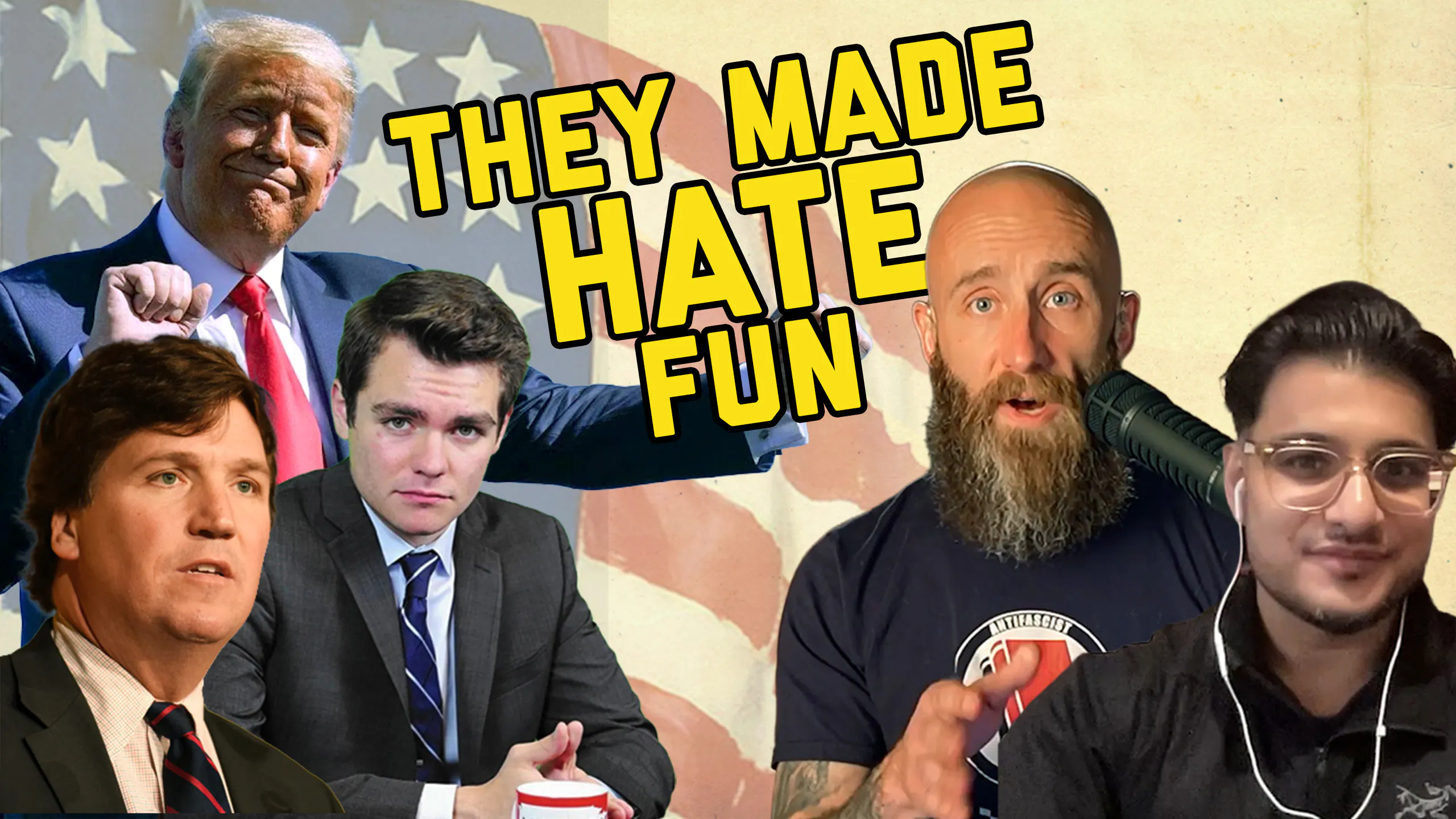
Why Fascism Keeps Coming Back in America | Omer Aziz
84m 28s
The transcription critiques the common belief that voting harder or winning elections alone can defeat fascism, arguing that fascism is fundamentally a cultural movement, not just a political one. It highlights how Donald Trump and Joe Rogan succeed as entertainers who use spectacle, randomness, and absurdity to capture attention, unlike left-wing figures like George Carlin or Stephen Colbert, who critique power. Fascists exploit attention through manufactured controversy and theatrical dominance, with algorithms amplifying their outrageous content. The left's focus on policy persuasion misses how fascism operates through identity, emotion, and belonging. Storytelling is presented as a key countermeasure, using narrative to convey the human stakes of fascism emotionally, as exemplified by Omar Ziz's op-ed and his book "Shadows of the Republic." Ziz argues that fascism is historically embedded in America, not imported, and that defeating Trump electorally is insufficient. He notes the paradox of fascism attracting minorities due to the erosion of civic institutions, which leaves people seeking meaning and purpose. The conversation emphasizes the need for a comprehensive anti-fascist playbook involving citizens and communities to resist this movement.
There are too many Americans who are under the illusion that fascism will be defeated if we just vote harder That if we vote for Democrats if we organize harder during election season if we do everything we can to win the next election We can undo the damaged Donald Trump has done and beat back fascism But that fails to recognize something fundamental Fascism is not just a political movement. It's a cultural movement And that is precisely what causes Democrats, pundits and journalists to underestimate Donald Trump and the broader maggot ecosystem time and time again After the November 2024 election one of the most common refrains from democratic strategists and political commentators Was that the left needs its own Joe Rogan that diagnosis reveals a misunderstanding of the problem itself Joe Rogan is not a political ideologue. He doesn't have a coherent set of moral principles shaping his worldview Like Donald Trump, he is highly impressionable and easily influenced by whoever occupied the room most recently Trump's own advisors have repeatedly described him as someone who tends to believe whatever the last person told him on any given issue Rogan often operates the same way and if you've ever listened to enough Joe Rogan episodes You eventually realize something important the guy's not all that bright He is entertaining Donald Trump he isn't a political philosopher either. He's an entertainer a gifted grifter a spectacle And that spectacle is precisely the point Trump and Joe Rogan can begin a conversation talking about a pandemic inflation or foreign policy and somehow end up discussing UFOs a weird thing they saw on TV or what they had for dinner the day before That intellectual chaos is not a bug Randomness and absurdity are entertaining And unlike what many Democrats seem to believe this is not something that can simply be replicated by building a progressive version of Joe Rogan The closest thing that the left has ever had to that ecosystem are people like George Carlin John Stuart or Stephen Colbert But comedians and satirists occupy a fundamentally different role they challenge power they critique they educate And they generally attract audiences interested in critical thought irony and reflection The audiences surrounding figures like Joe Rogan are often looking for something else entirely Then with the feeling of discovery the feeling of rebellion the feeling of being part of something exciting dangerous controversial or forbidden Rogan talks to MMA fighters conspiracy theorists politicians influencers provocateurs and extremists He has platform people accused of horrific violence racism sexual exploitation and abuse That is not something that most people on the left are willing to do And frankly our value system prevents us from doing it and that difference matters Because fascism has always understood the power of spectacle contemporary descriptions of Adolf Hitler often portrayed him not as a master intellectual But as an insecure rambling extremist whose intensity fascinated audiences Like Trump he monopolized attention and fascists understand that attention itself is power Through medium manipulation Manufactured controversy theatrical dominance and the glorification of violence fascists don't just radicalize people they entertain them That's why Nick Fuentes has just tens of thousands of really devoted followers who listen to all of his multi-hour stream of consciousness shows But he reaches millions more every day thanks to a small army of people who take clips from those shows and push them out into every internet platform The outrageous hate is infinitely clippable And it's far easier to manufacture its scale than thoughtful commentary comedy or intellectual analysis That algorithms would reward the same way That's one of the reasons why so many democratic movements consistently fail to understand the threat They approach politics primarily as policy persuasion Fascists approach politics as identity, emotion, belonging, performance, and culture That's what makes storytelling so important Because while democratic movements cannot and should not replicate the cruelty, nihilism, or spectacle of fascism powerful storytelling can still capture people's attention And academics, historians, investigators, and journalists can occupy some of the same cultural space as entertainers If they know how to tell the story correctly That's one of the reasons I wanted to speak with Omar Ziz Just days ago, I got a Google alert notifying me that my name had appeared somewhere online The result was in op ed in the Boston Globe titled "The Soldier Who Infiltrates Neonauty Groups" The accompanying artwork evoked the imagery of Shrawitzville, burning teaky torches, Nazi sluts, Confederate flags, and the aesthetics of modern American fascism Omar opened the piece by describing an incident I knew well In 2022, members of the Neonauty Group NSC-131 surrounded a drag story hour in Concord, New Hampshire They screamed homophobic slurs, banged on windows, and flash Nazi sluts while families sheltered inside Omar then traced how anti-fascists, researchers, and organizers work to expose those networks and hold them accountable He included my story and the work that I do with Task Force Buller Omar's op ed performed a sort of narrative jujitsu It opened by leveraging the same emotional response that the fascists exploit with their presentations of unbridled hate The same emotions that social media networks algorithms reward But he did it in a way that instead of spreading hate or fear, educated people, and hopefully will inspire them to action This is the kind of storytelling that can combat fascism Not by imitating fascist spectacle, but by helping people understand human stakes beneath it The piece carried tension, it was nuanced, it had momentum And it understood something that too many political writers miss People need to feel the stakes of fascism emotionally, culturally, and personally Not just intellectually That essay was adapted from Omar Zee's new book Shadows of the Republic The rebirth of fascism in America and how to defeat it for good Which argues that fascism in America is not some future threat approaching from overseas But something deeply embedded in American history and culture itself So I reached out to Omar immediately And in this conversation, we talk about why fascism repeatedly regenerates itself in America Why democratic societies consistently underestimate spectacle and identity politics How loneliness and alienation fuel radicalization And why defeating Trump electorally will not be enough to defeat the broader fascist movement that produced him Now before we begin, I want to ask a favor of you, the listener If we're going to succeed, I need you to help me get this storytelling in front of more people So right now, while you're thinking of it, do me a favor and make sure that you've subscribed to onoffense on your favorite podcast app And that you've said it to download every episode On YouTube, it's helpful if you like this video and leave a comment right now Wherever you're watching or listening, hit that share button And make sure that a friend gets exposed to this episode There's one thing that the far right does really well and I admit that I don't And that's getting the audience engaged early now without further ado This is my conversation with Omar Ziz I'm Chris Goldsmith and this is on offense Omar Ziz, author of Shadows of the Republic, the Rebirth of Fascism in America and how to defeat it for good Thanks so much for joining us on onoffense You and I spoke, I suppose a couple of years ago and I kind of didn't think about it again until I got a Google alert Saying that I had been in the Boston Globe And I was really excited to see that your book was finally coming out Can you tell us How your book evolved from the inception or the idea to what it became Yeah, that's a great question and thank you for having me Um from the inception I was thinking more about a historical book that would focus on Trump And you know when I was at Harvard at the Radcliffe Institute in the fall of 2022 Uh a group of neo-Nazis came and began protesting a book fair there a group that you know well the NSC-131 And that's when I thought that this is a much bigger issue that affects young men and that is affecting the streets of America And it's not a purely historical phenomenon When we spoke I think we
spoke in the fall of 2024 around then the the threat was worsening at that time. Trump got elected and then in 2025 I was as I was finishing the book and as I was doing the rewrites and the revisions the thesis as you know was being applied in real time under the Trump administration right across the board whether it's deportations whether it's wars whether it's changing the constitution and the laws or attempting to and so that gave the book a renewed urgency and towards the end of the book there is what I built an anti-fascist playbook in dialogue with academic scholars activists citizens etc and so that became a another focus around the book but I would say that the thesis was being applied in real time so that was quite disturbing to be working on the book working on edits and then leaving and seeing turning on the TV screen and seeing it being applied in real time and this has continued through the war in Iran through the striking down of the Boding Rights Act etc and so I would say that what's happened in America gave me and the book and this issue greater urgency I've never wished probably like you ever wished I was wrong about something as I do now unfortunately we are in this moment that we are in but I'm hopeful that with conversations like this one and others as we begin to think about how to resist this pushback and we see what's happening on the streets that you know we'll get to a better place eventually but it might get worse before it gets better why did you choose to write about fascism and not authoritarianism or totalitarianism or dictatorship what what it is about the word fascism the movement the the spirit of fascism that made you choose that word to focus on yeah that's really interesting because as we know fascism is not the same as authoritarianism or dictatorship you can have a military dictatorship that is not a fascist regime a fascist regime is a particular kind of regime and movement that includes a charismatic leader radicalized political party mass politics pageantry and spectacle an emphasis on the youth and so you one could argue it's a specific form of authoritarianism and that is what I was seeing on the streets in New England that's what I was seeing federally in politics in Washington that's what I was seeing across state governments and movements around the country so this was fascism to me I mean I detected it early on because I had done the reading early on I've been thinking about this for a while since college actually I've been thinking about this and if I made the reason why I was thinking about it for so long even before Trump was because of the wars on terror you'll recall there were a lot of these civilizational arguments that western civilization was the best and that everyone else was a barbarian and we're kind of bombing the savages and all this and so a much younger version of me wondered if western civilization was so great and there are many great parts of it but if it is so great or the greatest how did it produce Hitler was he just an aberration was Mussolini just an aberration and then we see some of these things playing out in America I was at Yale Law School when Trump was elected we all thought like many liberals we all thought Hillary Clinton was going to it it was her alma mater and yet Trump quotes Mussolini in that election he is endorsed by the grand wizard of the KKK and so you see it early on as well but if this was just a Trump phenomenon you know maybe it would come and it would go but clearly young men have been radicalized clearly people without any other pathway in life have joined this movement and you just go down the the list of defining qualities of a fascist regime and Trump mega and the broader kind of far right influencer militia network fits it to a T so I thought okay I need to go deeper into this and this was at a time and I'm sure you've dealt with this a lot in your in your work as well where people didn't want to use the F word they thought it was hyperbolic that it was a slur that it was unfair and and oftentimes it is it is used on social media a lot as as a term of derision for one's opponents but I thought I couldn't look away from this I wanted to understand it I wanted to put the pieces together in a way that made it indisputable that this is fascism let's agree on that here is why it's been here with us for a long time based on my research is worse than I thought and that we're going to have to come up with a plan a blueprint a playbook all citizens all communities all neighborhoods to push this thing back if millennials like you and I young people Gen Z Gen Alpha if we want to live in a liberal democratic society we have to win this battle you asked Brad Raffinsberger former Secretary of State of Georgia who got the call from Donald Trump requesting that he find 11,780 votes you got to ask him do you think that Trump is a fascist and he waffled you you write about how he gave a politician's answer do you think at this moment that Brad Raffinsberger believes that Trump is a fascist and that he's just too afraid to say it out loud yes absolutely and in that conversation that was fall of 2022 at Harvard at the Institute of Politics so it's full of like students and alumnus graduate fellows professors etc my name is Omar Ziz I'm a radical fellow here at Harvard and I'm studying and writing about fascism so Secretary Raffinsberger the former president calls you and he says I want you quote to find me I quote I want you to find 11,780 votes which is one more than we have we had a congresswoman Cheney here a few weeks ago and she was describing how the former president knew that the mob was armed and still encouraged them to storm the capital so my question for you was really simple do you believe Donald Trump is a fascist I try and stay away from labeling and using pejoratives to describe situations what I will say is that encouraging violence is always wrong and what I would really hope is that both sides would hold each other accountable but it doesn't do when our sides should be holding our side accountable the other side should hold their side accountable when we do this crosstalk and we want to you know look at your house and then you say we'll look at your house we don't accomplish anything and so the best thing that we could do is clean up our own backyard first and I think we still have some work to do when I asked that question there was a pin drop silence in the room there were scoffs in the room and the other panelists was the democrats of state secretary of state from West Virginia if I recall correctly and she scoffed as well and I kind of felt like oh am I am I saying something that's in polite disrespectful I'm asking a question and he yes he did waffle on that question I was ready to ask the follow up and to my surprise it was the moderator the moderator was Abby Phillips of CNN and she jumped it and she was like well based on what you know now do you think he was trying to get you to overturn the election and he finally answered and he said yes I do this was fall 22 just to to his question you said you didn't think you weren't sure at the time when he called you if he believed it based on everything that you know now do you believe that he knew that he had lost Georgia at the time that he called you the reports that I've read lately so that yes he did down and so he called you asking you to find votes that he knew were not there for him that's what the record seems to show doesn't it I think it was the day before the same day as Trump announced his his latest run for the presidency which if you recall came earlier then it would normally because of the indictments and the prosecutions today sitting here today I think there would be no doubt with Brad Raffsenberger with others at in the state like legislature secretaries of state Republican to the state level that Trump was trying to get him to overturn the election and that Trump exemplifies the hallmarks of certain fascist leaders yes and to my mind that's almost not even really a debate anymore it's sort of the second part is what do we do about it so I would hope that those who were on defense with the word or were thinking that it's not applicable here have eventually come around especially those who are in positions of power to administer presidential and state elections you write about how fascism didn't come from Italy didn't it wasn't invented in Italy and Germany it's it's actually been part of western culture and part of the United States for hundreds of years but you also write and and in the conception of that version of fascism in in exclusive society that murders people commits genocide the United States of America could not have formed without as it is exists they could not have formed but for the genocide of the native peoples but you also write that fascism is now attractive to people of color how is it that fascism is attractive to people who would be excluded who who would not have power in a fascist society yeah this is the interesting paradox now
because you would expect that it would just be kind of working class white men, maybe privileged white men, and yet there are more minorities who are joining racial minorities. There are people from the margins, LGBTQ women as well. And I view this as the growing strength of the fascist movement, the brand, the coolness. You know, why is a certain brand? Why does it become cool? There's many factors involved, many variables. And we can get into those variables, whether it's economics, security, the wars, changing trends, social media, the collapse of the left and the center and the common sense right, the Democrat party. And so what I found in my research was more and more minority men in particular were joining the far right movement. You saw this in the numbers in this 24 election, where Donald Trump won, you know, historic numbers of Latino men, for instance, and increases vote share among minorities. And I view it as a symptom of the breakdown of civic institutions and democracy within America. You know, there was a time where if you were more on the margins, you know, there was a path forward for you to move up in life. There were civic clubs, there were social clubs. Now it's what is there really? There is UFC and MMA, there is social media, there is these kind of gangs that offer identity and meaning and purpose. Right. And so that kind of becomes pan-racial in a way, like they can claim to be racist and yet they are attracting people of diverse backgrounds. Right. And so this was quite worrying to me, this paradox and yet it also really makes sense because even if you are a person of color, you've already been marginalized in many respects. And you are looking for meaning and purpose, it's no different than someone who is in the majority, right. It's unlikely that you're going to join a kind of minority only gang, which also offers purpose and direction and belonging, but doesn't have the political ideology. Like we are going to take the country back for us, for people like us, we are going to take power. Right. And this is also not anomalous by the way within fascism under Italian fascism, early fascism minorities, Jewish people were overrepresented in the fascist movement because Mussolini was presenting a pan-nationalist vision before he radicalized and became a racial nationalist movement. So this is all going on. It's accelerating, I believe. And when I speak to men of different backgrounds, one thing I find is a common denominator of some of these far right influencers, whether it is Jordan Peterson, whether it is Nick Fentess, whether it is others, there's a counter-cultural energy on the right. There's a rebellious revolutionary energy on the right, a fight club kind of energy, stick it to the man energy. And this attracts a toxic masculinity, toxic masculine energy. So this attracts a diverse range of followers. And it would make sense that as a movement mature as it grows, as it becomes more powerful, it would attract diverse believers and diverse followers. One final example on this, the leader of the AFD in Germany, the neo-Nazi far right party, which is pulling first right now, it's leader is a lesbian woman. So in some sense, identity gets pushed to the side in a way as the movement builds. And the movement's leaders know that they cannot win elections if they are only appealing to an exclusive constituency, even if that's what they believe. So even if the militias stay really racist, the broader political movement of the far right will continue to attract diverse people, because that's required to win absolute power. What happens afterwards after they get total power? Well, we're seeing that right now. You say and you write that fascism continues to be on the rise, that it is not on its way out. People have not become alarmed enough to reject it with full force. But the Democrats right now are feeling pretty confident about the midterms and a broad swath of Democrat voters, progressives, people on the left, however you want to label folks, feel pretty confident that the midterms are going to solve a lot of our problems. What do you think about that? Yeah, it's interesting. I would say overconfidence and politics is always something to be reticent about. And historically, we know that the party not in power does well in the midterm elections. So hopefully that pattern, that trend holds. But at the same time, over two years or a year and a half of the second Trump administration, what have the Democrats really done? A lot of them supported the war in Iran. There's talk about Kamala Harris running again. I mean, have Democrats truly learned their lesson in a way that they could retake the White House in 2028, put pressure on this administration and be able to pass a legislative agenda that actually addresses many of the root causes of fascism. So I would say it's you want to be cautious, cautiously optimistic and not take any vote for granted. People thought that Kamala would win in 2024 and Hillary would win with a 99% chance in 2016. It didn't happen. We've lived through politics, especially us millennials. We've lived through politics enough to know that we can't take any vote for granted and not assume the outcome of an election. We'll even be a free and fair election. That is up in the air. What's going to happen in 28? That's up in the air. So they have to get out there and really get out the vote, put forward an ambitious agenda, get first time voters to the polls and have a unified movement that also attracts people who aren't just like far left, but is a broad coalition that's able to win. The numbers are looking good right now because of the war in Iran, but again, this is politics. Things can change very quickly and Trump has in competency power and he has a mass movement and he's able to get out there and campaign and bring people out. So I would say let's take cautious about it. We're in May right now. There are some months to go and we can't, like this, we literally cannot lose this election in the fall. Did you get an opportunity and we're recording this in the early May of 2026, 60 minutes, which we've mentioned, I think on the last two episodes of this show, this weekend, this past weekend, featured Robert Rondo of the founder of these fight clubs, which is kind of like an off shoot of of Patriot Front in a way. These are what he calls active clubs, which for folks who've never heard of them, Sky Robert Rondo is kind of an infamous fascist. He became kind of a publicly known figure because he was involved in assaulting anti-fascist protesters and police at the Battle of Berkeley during the first Trump administration. He lived in hiding in Europe for several years because he was charged with several felonies and I believe that he's still wearing an ankle monitor, nowadays back here in the United States. But they gave him a platform to talk about how and the premise of 60 minutes's episode was that they were showing how extremist organizations show up to natural disasters as a way of whitewashing their image and branding themselves as truly helpful where the government is failing. Did you get an opportunity to see any of that 60 minute episode? I have not yet. No. We get together with the boys, we box, we travel. Do you think of it as fun? Of course. You know, this fun and fascism. So one of the things that is notable is that Rondo is not wearing a mask. He's not, he went from hiding in Europe to getting dressed up, wearing his little peri shirt and smiling for the camera and sitting down with one of the most well-respected news shows in the United States. What is this happening say to you? Do you think that journalists ought to be interviewing fascists in that way? Is it good for Americans to be exposed directly to the source that way? I think it depends on the context, right? I think any kind of informational interviews that doesn't glamorize the fascists and presents the information and contextualizes it. That is important. Give people the information. If this is about embellishing or making them inadvertently seem like they're cool or even putting out their propaganda for them, a conversation that we had, that can be detrimental and counterproductive. If there's a journalist or just chasing clicks and outrageous stories and now you broadcast a certain fascist perspective to hundreds of thousands or millions of people, that is harmful to the movement. I would say exercising discretion is incredibly important and the context and the questions really matter because the fascists like nothing more than free media and free propaganda, which they're very good at, right? They can embed symbols and words and phrases into their language that only the true believers will understand or those on the cusp of radicalization. It's almost like interviewing a jihadi, for example, right? If you're going to just let them speak monologues about why they're doing what they're doing and if it's really idealized,
logical, some of these folks are really ideological, then that can serve a propaganda function for them. So I think the rule is blurry here. We can't just not interview them, and at the same time we can't interview them all and give them free reign to speak whatever they want. You know what comes to mind is Hitler's first trial at the Beer Hall Putsch when he tried to overthrow the German government the first time and was convicted for it and should have been deported. Well, that entire trial was an open microphone and platform for Hitler to indict and condemn the Weimar government, how corrupt it was, how illegitimate it was, and he attracted more followers from that. Right? So the fascists know how to use media, they know how to leverage media to reach followers and new people who might follow them. So I think care, discretion, journalistic ethics, all these matter, considerably when interviewing them and treating it with respect and care in a way that respects readers and listeners so that you're not just doing the proper free work of propaganda for the fascists. How do fascists use spectacle? What is the role of spectacle? Why is that I don't think is something that think that most people discuss when it comes to politics? So why do fascists, why does this ideology focus so much on this idea? Because I think it understands emotions and it understands belonging in a way that liberals and others understand thoughts and arguments and debates. The fascists understand emotions and what really gets human beings going. Human beings love entertainment. You just look at America, television, social media, streams, etc. We love spectacle. We love pageantry. We love ritual. I mean, look at when the new president is inaugurated. Those are rituals, right? Those are ceremonies. Or even something more in the cultural sphere like a burning man or even a book festival. These bring diverse people together. It's a great time. And unfortunately for us, the fascists know how to put on the display of fun. And they knew how to do this before as well. There was considerable energy and time spent in the fascist regimes to put on ritual, put on ceremony, pageantry, theatrics, spectacle. To construct immense buildings, for example, that spoke to the greatness of Italy and Germany. Right? To have these massive Nuremberg rallies with cathedral of light and all kinds of amazing shows that just take one's mind and heart away from the present and into like transcendence. It almost becomes a religious ceremony. And certain observers would watch Nazi Germany had likened it to a religious entity. That this was reminiscent of the medieval Catholic church, for example. So human beings have a craving for this. It's community fundamentally. It brings people together. And the fascists understand this, right? So through their parties, through their networks, through their gatherings, through the fight clubs, you know, the New England militias doing shooting drills in the woods of New Hampshire, for instance, all this builds camaraderie and it builds fellowship. Right? So you look at other cults. They have mastered this as well. The Jim Jones death cult, for example, made its followers, swallow poison, for instance, in the Caribbean South America, all about bringing people together, giving them a sense of meaning, giving them a sense of purpose. That hey, you can escape the drudgery of your normal life. You don't have a good job. You know, school has been tough. You don't have many friends, but come to this party and all that will be given to you and all you have to do is agree to our principles, which will make you in the country stronger. And maybe this is something that we can actually learn from them in a way, for liberal, centrist conservatives, etc. That ritual is important. Celebration together is important. The mass political rally is a form of that kind of spectacle, right? Who does this exceptionally well in America today? It is Donald Trump in the Meg of movement. Right? If you were to look at like Kamala's rallies and Trump's rallies in 24, without knowing anything about the leaders or the movements, Trump's rallies would look a lot more fun. And I'm just being objective here. They're playing the YMCA song. He's dancing. He's calling out people. It seems like they're having fun. And that is something that attracts a lot of people in this movement and in this world right now. Donald Trump is at his lowest popularity rating ever throughout his first and now second term. What risk do you think there might be with him being charged with leading celebrations for the 250th anniversary of the founding of the United States, or 250th anniversary of signing of the Declaration of Independence? Do you believe that the pageantry is powerful enough because he's got exclusive access to the bully pulpit and the way that Congress has handed over the power of the purse to him, he could do whatever he wants. Will he be effective in eking those numbers back up because of the entertainment value around the 4th of July? Yeah, possibly. I mean around these celebrations and anniversaries, Americans tend to come together. Right? And again, his numbers are low. He's been around for a while. There's this war going on in Iran. Many people have written them off in a way. He's a lame duck president in a sense after these fall elections. But I've learned to never count out Donald Trump. I've learned to take him seriously and that he can come back from things that other politicians have never come back from. So it's possible that he's able to turn it around. But the presidency offers enormous and compensate value and privilege and power. The incumbent administers the presidential transition. The incumbent has the bully pulpit, as you said. It has the White House. It has all the trappings of power that the other candidate is not going to have. And so that offers him enormous privilege. The second is just an observation. I was in Washington, DC just a couple days ago. And it was my first time in DC under Trump's America. What did I observe? First of all, the city has completely lost its soul. It isn't disarray. It doesn't know what it stands for anymore. Second, there was a heightened security presence. Trump wasn't even in the city that day, but like the entire White House area was blocked off. A lot more secret service, I noticed. So it had this national guard. It had this militarized feel to it. And third was that the spectacle is already happening. I mean, there's talk of this kind of F1 race around for July 4th, the UFC match on the White House grounds. I mean, the spectacle is coming, right? And they're going to leverage it. And Trump is going to do everything he can to make himself seem like the savior of America on July 4th. What I anticipate will happen is they'll try and get some of these culture war things going. And that is always reliable for the base, right? Whether it is transports or racially or whatever it is. Any kind of distraction to get Americans, Americans minds off the war, off the rising energy prices, rising cost of living, everything across America is heading in the wrong direction. It seems. And Americans feel this as well. So what do you do? You take a playbook, take a page out of Joseph Goebbels' playbook, and distract them, distance them from what they are seeing. Give them something to believe in, something to hope for, spectacle, again, pageantry. And part of why I wanted to get this book out now was because July 4th is coming up, the 250th, there's going to be mass reflections on where we are at in America and in the world as well. And I anticipate that Trump will use every advantage that he can with the White House to try and change those numbers and to show that this is his moment. When the first year of his second presidency, he threw himself a birthday bash, a military parade in the style of Soviet Russia or North Korea, where he had tanks rolling down the street and literally ripping up the asphalt in Washington, D.C. And I saw from within organizing committees and everything that there was a very organized push to not protest that because the imagery would be very easy for Donald Trump to manipulate. If you have soldiers marching down the street and you have people protesting the event and it looks like in the stills and videos people are protesting the military, Donald Trump can take advantage of that very easily. The 250th anniversary, however, is not going to be treated like one day. This is being treated like a year-long experience. Will the tactic of not countering the military presence visibly with these protests? Will that work? In 2026, the way it did in 2025, denying Trump an opportunity to get more headlines because he's able to present protest, he might have been able to present protesters as un-American or unpatriotic. Should the left, broadly speaking, the organized left maintain the same posture or is confrontation appropriate right now?
It's a good question. I think Trump was right in his assumption that if that parade was protested, especially to aggressively, he'd be able to paint them as agitators and rioters and to American. And yet, the Constitution and the Bill of Rights gives this right to Americans to protest their government. It's in the First Amendment. I would say in the 250th anniversary, it probably makes more sense to protest, but the way they are done and the language that is used, I think, being more strategic with it. So it doesn't appear as though Americans are protesting the military, because the military's following orders under civilian command. They need to make it clear that they're protesting the regime, the protesting Donald Trump, the protesting MAGA, the protesting disavisoration of the Constitution. Excuse me. And so when we get to that point, like, look, the question you've asked, it assumes correctly that Trump understands perception. He understands how things will be received. So the left needs to do this as well with their protests. Maybe there are silent protests. Maybe it's the way the signs and symbols are used. And other things, so when the camera pans to them, it doesn't look like they're American. Maybe the protesters wrapped themselves in the flag, so we don't concede the American flag and American history to the fascists, which has been an issue over the last five years at least. Reclaim the flag, reclaim the Constitution, reclaim the Declaration. What was the Declaration? It was declaring freedom from tyranny. And that's what Americans have been trying to do for the last few years, arguably the last decade. So I think that we will see those protests. And I hope that they are strategically done with some of that intelligence around how propaganda works, how imagery works, how slogans work, so that the media or Trump can't pick up on one poster, one protester, and say, look, all these protesters are anti-American. When really, they are embodying the great American tradition of petitioning your government, protesting your government, free assembly, free speech. And I think those are the things that actually make America great. So we can champion those and push those forward and remind people that, hey, the military parade is one thing. And protesting our political leaders is an essential right that all Americans have. I think that could lead us to some steps towards victory. The risk, of course, is just chaos, any kind of violence, any kind of perception that this is anti-America, not anti-Trump. Then we get into trouble when it comes to the propaganda. Because again, he has the bully pulpit. So his message gets across. Your book ends with a prescription, with over 20 different actions that people can take to fight fashion. It is your anti-fascist handbook. Number 18, you write, work across the aisle to get big things done. The January 6th committee was, as bipartisan, as I think anything could get after January 6th, 2021. And we haven't seen anything even close to that since. Certainly nothing from Republicans that would actually hold accountable Donald Trump and the people in his circle for corruption, for violating the law. How do people follow your instruction of working across the aisle in this environment? Yeah, it's a good, great question. I would say that, look, certain issues we can't work across the aisle. There are fundamental differences. That's why we have a Congress. That's why we have debates. That's why we have mass movements and protests. Other issues, there's a possibility of work across the aisle. If you look at something like the excesses of big tech, well, that's something that certain mega Republicans and certain Democrats agree on. Big business, having too much control and monopoly power. That's something that both sides are certain elements of both sides agree on. Perhaps campaign finance reform is another issue so that billionaires in secret money are not controlling the outcome of elections. So there are these niche issues. I call them that because they're specific issues, but they have a disproportionate impact on American democracy and society writ large. I'm less optimistic about bipartisan work right now in the Congress, but when I travel across America, and I talk to people on the ground, local citizens, people who are not hardcore partisans at the state level, in particular, in the local level, there is a real appetite for getting things done because things like safe streets, good jobs, a working economy, clean air, these are things that all Americans want for their kids, right? As soon as you taint it with Democrat support, this Republican support that, and it becomes a partisan thing, then the poll numbers shift. But I think can we find a language of Americanism, unity, greatness even, take that from Donald Trump and Maga, like you're not making America great, America's always been great, we're just making it greater. If we can take all that back and focus on the issues in a way that appeals to people beyond their partisan identities, I think there could be room to get things done. And the alternative, of course, is we get nothing done, right? Which is something that I refuse to accept. But it comes down to the framing. Can you frame it in a way that it appeals to people so that a mother and father are thinking, do I want a safe neighborhood for my kids and want them to grow up and breathe in clean air? Do we want like dirty water and polluted air and we're all working as surfs for big tech? Is that the future that I want, right, for my kids? And I think when you put it in those personal terms to people, suddenly the polarization, the partisan identities, and the latest thing that they saw on Twitter or TikTok is moved to the background, and they're thinking about their actual life. And that's where we need to work on. So I'm not saying let's be polyannish and try and work on electoral reform with Republicans who want to steal the election. What I'm saying is find those issues and those members and those coalitions that we can build where we can actually get stuff done for people in a way that they feel in their lives and they're more likely to vote for those kinds of politicians in the future. - So you're getting into something else I wanted to bring up. - Sure. - I think number two on your list is tell better stories. That sounds like what you're doing right now is encouraging Democrats to seek those issues that affect people in their personal lives. One of the things that I kind of struggle with is like everything that I feel like, or I intuit that is gonna be a bipartisan issue. You mentioned like clean water, clean saving our environment from pollution. It seems to be stopped by nimbusm every time. Donald Trump right now is revoking leases and pressuring private companies that have already put tens of millions, if not hundreds of millions into building things like solar farms or wind farms off the coast of the Northeast, particularly. - MAGA doesn't seem to care that the alternative when those things are getting canceled, that means that we're doing more fracking in their geographic area. That means more pollution in their geographic area means more fossil fuels being burned and polluting the air. Is there really things that we can agree on without that nimbusm getting in the way? - I think that's a real issue. I think that's a real issue because people assume that it's always in someone else's backyard, right? And yet pollution affects the entire country. Wealthier zip codes in America live in an entirely different universe, right? They have gated communities, they have safe streets, they have clean air, they have clean water. If you're rich in America, it's a great country. If you're not, if you're anyone else that rest of the 90%, it's not so great. There are dysfunctions that exist, right? But again, I think it comes down to finding a language for it. Can we reach out to people on the ground when organizers are canvassing at the door? Can you reach people and tell them a story and a message of, hey, here are policies that will actually improve your life in your children's lives. Like set aside all the propaganda, the climate change, hope stuff, and all of that, right? People turn to lies, these politicians turn to lies to call on climate change a hoax, because the substance and the truth is something they cannot engage with, right? So if you can move the debate, the framing of the debate from the lies and the hyperbole to the tangible impacts on people's lives and on communities well being, then we can at least take a step forward and argue on our ground and our turf, right? So I think that's the first step. Second step is, look, you're not gonna win everyone. I mean, some people are gonna be opposed to your agenda. They are good people, but they're just hardcore conservatives or they don't believe in climate change. Fine, move on. There's a lot of other people who would be receptive to your message. And America has some of the lowest voter turnout in the federal elections of any Western democracy, right? Like it's much lower than Canada, Western Europe, et cetera. So already, the people who could and should be voting, especially young people, don't get out and vote, right? This is a major issue because young people, Millennials Gen Z. We have the longest to live with the consequences.
of this fascist movement. I mean maybe some, maybe we should get more votes, but we have the longest number of years to live in this dystopia. So if we don't have clean air, clean water, economy that doesn't work, not having unsafe streets, that's something that this generation, the next one is going to have to deal with, in a way that older folks are not going to have to deal with. And frankly, older folks had it a lot easier when it comes to a booming economy, easy credit, clean water, all these things that we take for granted, no social media, all these things that we take for granted. But I think it really begins at the neighborhood and the community level. Another point in the anti-fascist playbook is run for local office, like run for sheriff, run for judge, run for state legislator, because so much of power in America comes from the ground up. And so I'm not saying that would change everything, but it would begin to build a movement that has grassroots support, and that's able to instantiate change over the long term. But I think the second point was critical as well, which is that, get first time voters out, get young people out who are jaded and disillusioned, build a new coalition. One part of winning is bringing all your voters out who are already going to support you. The other part, and this is how Trump won in 2016 in Michigan, this is how he won in 2024, is getting those first time voters out. People who historically would not have voted or would have voted for the other party in our disillusioned, but they want to see change happen. And so, reach those people, get them to the polls, right? Now you've built a broader tent that can actually manifest change. And I don't want anyone to come away thinking that any of this will be easy. The anti-fascist playbook applies to everyone, policymakers, whether you're regular citizen, teacher, parents, students, and there's lessons in there that anyone can apply in their actual lives. But most of this is going to be incredibly difficult, and it's going to take the organizing force of regular people to get even a little bit of change done, right? But I'm still optimistic. When I meet millennials overall, Gen Z, the questions that they ask, the hope that they have for the future, the willingness to engage on this subject, I come away with a renewed confidence that, okay, if we can get all these people out to vote, them and their friends, this new coalition, then this old baby boomer mega, let's go back to the 1950s thing will be completely done, right? It will cause enormous amounts of damage that will be wreckage when we, when it is over, but hopefully we can be building now so that when it comes time to take power, we have an agenda to implement, and we can care for this country and set aside this mega nonsense. You write about how there's kind of been a loss of these third spaces, these, these clubs, these associations that people used to be involved in, and with that, there's been kind of a loss in faith spirituality. And that, you write in the 1980s, there was kind of a shift in the United States where capitalism started to fill that void and materialism started to fill that void. How do we, how do we undo that? And I, what, what makes me think about this is, as you were talking about how we have to live with the results of decisions that are being made today longer than the previous generations. A lot of millennials not having kids because they don't want to condemn the future, their, their children to live in this, in this world. If that's the baseline where, where a lot of millennials, people, our age, are choosing not to bring children into this world because they think the future is, is so fucked. How do we convince them that, that it's not, that, that it's worth, and to be totally transparent, I only had a kid a year ago, and that's, I'm 40 now. And a big part of the reason that I had never intended to have kids is because I kind of thought the world was fucked. And I felt like it was, it was cruel to condemn someone to, to live in a world where global warming is going to continue accelerating. Corporations are becoming more and more powerful. The fantasy movies that I love so much from the alien and predator universe, it's about monopolies and duopolis and, and, and, oligarchies, right? That is, the science fiction world that, you know, I used to think of as entertainment when I was a kid in the 90s, is becoming more and more and more real today. So, how do we get these people off the sidelines who've, who've gone that far, who've, who've decided, like I did it a few years ago, like I'm not having kids because things are so fucked. So, why don't I just focus on trying to keep myself safe? Yeah, I mean, this is something I encounter as well and it is a rational consequence of the world that we are living in. You know, what, what did millennials, what were the two defining kind of political events in our lives? And, you know, this really well from your veteran communities, the war's on terror, first of all, that went on for a long time, killed hundreds of thousands of Iraqis, Afghan, Afghans, and others around the world, but also destroyed American communities, veterans, parents, neighborhoods, hollowed out. First thing, which is a result, resulted in this massive mental health crisis and opioid epidemic that we're seeing now. Second is the economic and financial crisis. Never really addressed, came about as a result of extreme greed, you know, bankers taking bonuses, mainstream, not bailed out or not even helped at all. Again, the consequences of that still being felt, young Americans, price out of home ownership, the climate getting worse, all of the other things, the issues that we could have addressed, but we were too busy dealing with the wreckage of financial crisis and multiple wars. So, now we're in the place that we are in. Dispair is very high. Mental health epidemic has grown. There's a loss of third spaces, you know, bought puttin' them rights about this and bowling alone. I think it was like a decade ago or longer that Americans are not going to the bowling alleys anymore together, bowling clubs have declined. Same thing with all civic institutions. What is left as a third space? There's the mall, which is a commercial space. There is, I mean, I'd bookstore, I guess is another one. Unfortunately, not a booming space, but it's one of the few spaces left. And then the digital sphere, which is not, you know, it's virtual, it's not real. I would say, you know, we have a choice, first of all. We can choose to accept defeat and all retreat to our private lives, duck our heads under the table and hope that this thing will pass. Many people made the same decision in the 1930s, but politics will continue without us even if we disengage. As we know as your listeners know, you can be indifferent to politics. Politics is not indifferent to you. It will still impact your life. It will still impact your children's lives. And I think that it might sound cliche, but maintaining that sense of hope and faith in the future is incredibly important. I'm seeing the return of traditional religion in very interesting ways. When I was at Harvard for the book talk, several students were telling me that number of their peers were becoming Roman Catholics in a way. Now, some of them were on JD Vance's side and out the Pope's side, which I find alarming, but we're seeing this kind of return of traditional religion. Jordan Peterson preaches this as well. Catholicism has become a lot more popular. I think the reason why Catholicism in particular is becoming popular is because of the tradition, the hierarchy, the leadership structure, an organized form of religion that goes back 2000 years. So it lacks some of those innovations and modern movements have. So I think traditional religion and spirituality are part of the equation here. However people want to find it, some will become Catholics, some will go into yoga and astrology and the kind of new age religions that we are seeing as well. But spiritual sustenance is very important in these dark times that we live for something beyond us that it's not we're not just purely individual monopolized commercial entities that transact, right, we're beyond that. We're more than that. And America is more than that as well. It's not just an economy. There's a culture and a history and traditions here as well. And that's what we've lost sight of. I think that those connections have been entirely broken. Historically, by the way, when it came to the Third Reich, the Catholics and many clergy were prime opponents and protesters of those regimes as well. So I think we're living in a time where everyone lies. There is an enormous amount of propaganda, misinformation, misdirection, faith and sustenance and spirituality end up becoming the anchors of life. And this is why we're seeing more and more young people turning towards traditional religion. And what I would submit is that the left in the center need to make more room for religiosity and for spirituality and for community, which is what really it leads to, right, like you go to Mass on Sunday, you congregate with your fellow worshipers or if you're in yoga and other spirit, new age movements, you come together and you do your own form of worship. So this is not a luxury for human beings. This is fundamental to who we are since we were pretty evolved and looking up at the stars and wondering what else was out there. And what fascism does interestingly enough is it replaces this transcendence and spirituality, which is genuine with like a false political verse.
version, which is like you worship the dear leader, you know, all it's all about the party, nothing outside the state as Mussolini said. So I would encourage people to, if they're having those questions to pursue them, you know, like the answer is not going to be found in politics. This is beyond politics, greater than politics. And I think that this moment of rupture and breakdown can lead us to have those deep reflections on who we are, what do we believe, and how do we build back up? Just like when an individual's life is destroyed, you're humbled, first of all, the same root of the word humility, and you're forced to reckon with the wreckage, and what do you do next? Well, as a collective society, we are at that point now where we have broken down. We are looking internally. We are trying to figure out how we got here. I think the next step, as with an individual's to dust yourself off, come together and the community finds your strength, finds your purpose and path, and then to begin to walk it slowly. I'm hopeful this is something that will result in a positive outcome for Americans. It's religiosity and renewed spirituality. Now at the risk of, and full disclosure, I ordered this book, got it two days ago, and it's been cramming. At the risk of mixing up my books, I think that you wrote about anti-fascism, active anti-fascism as kind of feeling that spiritual void. That was you, right? Can you talk about that? That sounds profound to me. It sounds like exactly what I've been doing for, I don't know how many years. Anti-fascism has kind of become my religion. It has become my community. It has become my purpose. It has been very fulfilling. When you win, whether that's a judgment against Patriot Front based off of a report that we wrote or someone getting Nazi getting arrested, those are really fulfilling things to me. But, as you address anti-fascism as spirituality, what do you predict on the other side? If we win, I'm asking this for selfish reasons. If we win, and fascism is no longer a threat, what the fuck do I do? Do I literally dedicate my life to it? Do I become a historian and try to warn people on to do it again? I think you're going to have your hands full for a little while, even if we win. We were talking about how I wrote this book last year when I was writing it and going into it. Because whoever wins in 2024, this book shouldn't change because the issues that it addresses are going to outlast Trump. Trump could leave the scene tomorrow. Someone else will replace him. He won't be as good. He won't be as charismatic. They'll try and imitate Trump. They'll struggle with that. They will find their own far right language. But like the radicalization of young men is continuing. The proliferation of far right influencers, the far right algorithms that amplify this stuff. The loss of meaning, all of these structural, deeper issues are still going on, which means that the far right pipeline will continue. As you told me in our conversation a couple of years ago, there was a time when the far right militants were dissatisfied with Donald Trump. They were looking for new leaders. Those guys are not going to put their guns or their pens or their organizing marching boots away just because Trump loses. If anything, it could inflame those movements, especially if Trump says he was cheated out of the election or the next Republican president is a more traditional conservative. This energy, you cannot put this flame back in the bottle. This has come out. This has emerged now and we're going to have to deal with it. When I hear anti-fascism and spirituality, I hear anti-fascism. I also hear pro-democracy, which is another thing. The anti-part is one part of it. There's a pro part. Even if we push the fascist back, we roll them back. They're on their back heels. What are we going to do? What is the affirmative, positive message and policy and movement that we are building? Which is a much harder question. I think that's something that we're all going to have to reckon with going forward. The resistance is one part, but building something takes a lot more energy, time, attention, and the organizing force of regular people. I don't think this is going to disappear, even if Trump leaves. This isn't a Trump book. It's not a mega book, so to speak, as we've discussed this movement far extends beyond Trump. In fact, in some ways, Trump might be a footnote in certain respects for this movement. Again, it's on the ground. It's young men. It's online. UFC is the biggest sport in the country. There's this mental health epidemic going on as well. It's a loss of religion as we've discussed and those structural factors of a broken economy and these wars on terror. So we're still living through this. Nothing of this is going to change until we end up rebuilding from the ground up. Unfortunately or fortunately for you, regardless of Trump, I think you will have your work cut out for you and myself and others who are working in this space. The last thing we want to do is Trump leaves the White House or is kicked out or whatever happens. We resist the fascists on the street and we declare mission accomplished. And we're like, all right, time to move on to the next issue or to get complacent. No, that's how this movement arose in the first place until we address those deeper vulnerabilities in the brokenness within American society that will always be an audience for this kind of movement. And that's why I think in the short term, if you defeat the fascists in the long term, we all have our work cut out for us. This reminds me of a conversation that I just had with Tim Hefion, my last episode. He was an investigator for Charlottesville and then the lead investigator for January 6th. And I kind of, I pushed him on the idea that people are going to continue to work. Like I think I'm a pessimist now because of my experience in the anti-war movement after Obama won, everyone just kind of went back and sat on the couch and we're like, well, the wars are over now. We don't need to protest anymore. The Patriot Act is no longer a threat. We're just Obama's in charge. We're all going to throw up our hands. And Tim, to be fair to his position, he's an institutionalist, but he also said to me, he believes that there are more good guys than bad guys. I worry that the good guys are lazy. And maybe not the full-time good guys who are working and fighting right now every day, but the ones that we're trying to get off the sidelines right now, if after 10 years of this shit, they're not concerned enough to put in some work. I'm very worried about the prospect of getting them involved in election going in a positive light and then them not being interested in building community, in doing the hard work that is both local and national to erase the, to take away the fuel that helps fascism to grow. Do you think it's realistic for us to expect that people will remain engaged or that anything other than history repeating itself is going to happen? Yeah, that's a really good point because arguably everyone got complacent under eight years of Obama, including President Obama. As you read through the book, you'll find it's probably as critical or even more critical on the Democrats as it is on the Republicans because Obama had mass popular support, financial crisis, everyone was upset. He had a filibuster-approved supermajority in the House and Senate. What did we do with it? Did we got health care, but did we address those fundamental ills that allowed for this right-wing populism to emerge? Some of that was in response to him as well and who he was, but Democrats lost 1,000 seats under Obama at the state level. Right, his organizing force, his organizing group was just disbanded, it seems. Then the election afterwards, he and the Democrats, they lose that election and then they lose it again in 24 with some of these same characters. Complacency is a massive issue, laziness, despair and indifference also, like when you're so overwhelmed, it's easy to be passive. But this is something that I worry about, that even if we win and even if we get into power that, okay, games over, the show is over now, liberal or Democrat is in power, we can all go home. And that's not how it works. If anything, the insurgency, the counter-movement, strengthens as Democrats are in power. There will be new leaders emerging on the far right. My prediction is that whoever succeeds Trump will be a lot more articulate than he is and a lot smarter. So there won't be as comedic and funny as Trump is and like have that ability to work an audience and be good on TV because he has that experience going back decades. But that person might have gone to Yale Law School to successor. They will know the Constitution, they will know what to say and what not to say. will know how to get their message across without everyone
focusing on like the wrong word that they used right or like their trolling behavior. So I think if anything we will see fascism mature, it will become a more sophisticated movement as well, a more mainstream movement and a more educated movement in a sense. Well, it will be able to speak the right language and use the right words. You know, I think the generational turnover is necessary on this. Like I think that a lot of the boomers, a lot of the older generations, like they had their chance. This is the world that they gave us. So if our generation again gets complacent when we're in power or there's a millennial president, then what do we have no excuse? Right? If we're going to live with this forever and if we get complacent, complacency is not an option anymore. We've seen it. And like frankly, we're at a point now where complacency equals destruction because the climate is cannot get any worse. And if it gets worse, we're going to be in a national security crisis. Right? So if we're going to have a terror, the economy being broken for 95% of people, this is completely unsustainable. Right? And so if we want to live in a democracy, if we want to live in a society where everyone counts and everyone can make it and all the great things about the American dream, we're going to have our work cut out for us. And I think the major lesson from the Obama years for millennials should be this. It should be that just because a new savior emerges, they have mass support, mass movement, they have a filibuster proof majority that don't assume that they will get all the change done. If anything, we're going to have to keep putting pressure on that person from the outside to ensure that the change that is promised is actually delivered because as you know, there are so many special interests and classes of organizations and groups that are opposed to any kind of change that don't want to see climate action, that don't want to see America have a more restrained role in the world. And so we're still going to have to fight these battles. Right now we have a massive battle for the soul of democracy that we have to fight. But let's just say we win that and a sensible person comes into the White House. All we do is go back to the structural policy battles that we have, right? That we have been discussing. Like America is not going to be healed with the new president, all of a sudden. We're going to have our work cut out for us to fix this and it might take a generation to fix it and to build something better. But I really share your point though that complacency, laziness, and passivity, those are going to be the real issues that we have to contend with even if Trump leaves the office or you know, we get a Democrat in the White House. I think that history kind of recent history shows us generally speaking that each president has enough political capital to get one big reform or one big bill passed. For Obama, it was healthcare. For Trump most recently, it was the one big beautiful bill. Biden had the infrastructure bill. What should the next president spend all their political capital on knowing that it's very likely that they're not going to have a second bite of the apple? Hmm, that's an excellent question and there's so much to choose from here, right? One part of me wants to say let's reign in the excesses of big tech. Let's check big tech with big government. Let's work across the aisle as we discussed earlier to put some safety and guard rails on AI so it doesn't amplify this far right stuff or lead people to commit suicide or murder as we have seen. Unfortunately, that's going to be a rising issue for sure, giving people control over their data and just like rebalancing the relationship between the citizen and the state and big tech, right? It's a tall order because of the enormous amount of power that big tech has. So that's one thing they could definitely do. Another thing could just be pocketbook issues like let's raise taxes on the super billionaire class and cut taxes on people who make under $80,000 a year, right? Like let's give relief to people who are actually working their asses off and selling their labor and that don't have any benefits and let's increase taxes on the 0.01% who now have trillions of dollars of wealth. Like we cannot keep living even if we solve the fashions and problem, we're living in an economic oligarchy. So we have the oligarchy problem as well that we have a few economic actors who have made tremendous amounts of wealth pay very little taxes and that arguably whose consequences of whose digital empires are felt negatively by children, by students, by young people and others, right? So maybe there's a way to put these two things together like taking on big tech, take from the playbook of Theodore Roosevelt, the trust busting, Franklin Roosevelt taking on the wealthy classes, combine that with giving tangible relief to working people. Then I think we can start to have a conversation on rebalancing the economy because you know, the fascists have destroyed the unions, unions were destroyed in America and in Germany. It's very difficult to be a working person in America now. So much of those, so many of those jobs and industries are being outsourced like we have to address the fundamental economic mismatch and imbalance that people are facing. Otherwise economic tension and anxiety will lead people to continue to choose the fascists who by the way, many of the big tech oligarchs are either overtly in bed with or you know, eventually supporting, I saw Peter Thiel was giving a lecture recently on the anti-Christ. And so this is the world that we live in. We need the government to stand with and stand up for regular hard working people. That is the last outlet, that is the last line of defense. And so I would be hopeful that a new democratic president would put forward an ambitious economic plan and policy that tells to the little guy, hey, I got your back. And we're going to cut your taxes and we are going to increase taxes on the super billionaires. And we're going to rebalance this thing and make sure the American economy works for small business owners, entrepreneurs, regular people, working jobs and not just this elite class. Otherwise, you know, even if we solve fascism, extreme inequality leads to democratic breakdown as well. And it's a reason why we got here. So unless we address that extreme inequality that we are seeing now and fix this economic situation, we are going to always be on the cusp of another far right populist saying, hey, I'll fix it. And then they go and you know, give tax cuts to their friends. So the name of the show is on offense. And I ask all of my guests, what is the one thing that listeners can do, should do to go on offense and fascism? That's a great question. First thing I would say is we have to understand it and learn about it so that you're not under this misapprehension that this emerged out of nowhere, where it's only a Trump phenomenon. You have to go into the issues and the kind of stories and the narrative that led us here. The policy breakdown, the policy failures. For many millennials, we know that, but I think understanding it. I think understanding how deeply rooted this is in America that I didn't just emerge out of nowhere. And then I think the third part is getting together with friends, with family, with networks and coming up with a plan on how are you going to push this back and build something better in your community, in your actual life? Maybe that is starting a soccer club, right? Where afterwards you talk about politics and education, right? Like there are so many of these voluntary associations in America that make America great. I think that we need to lean into that. So what any individual can do, learn about it, get together with others, organize and make your voice and their voices heard. Each little action in our lives and in democracy really matters, right? Because when you add them all up, it leads to tremendous massive change. So even if you're reaching up to that one person who's been apolitical but thinking about voting the next time and you give them a phone call 10 minutes of your time and you're explaining why they should vote for candidate X over candidate Y and that person goes out and votes. Well, we've learned like through the Florida election in 2000, another moment that got us here by the way, that a handful of votes can change the outcome of any election, right? So I think that's fundamentally the playbook. Learn about it, organize with your friends, family and networks about it. Get out there, get off social media, get on into the real world and make some real tangible change. And in your actual life, don't let this far right nonsense go on answer. You know, if someone is at a party and they're telling you how much they love Jordan Peterson or whatever influencer they're following, don't let it go on answer it, say something back, right? We have the truth on our side. We have dignity on our side. I would say we have American history on our side. And I think we have the majority of the American population on our side, right? I don't think that 50, 60% of Americans are supportive of this far right populist nonsense. I think most people are good people. They have been led astray and have gone down this path because of reasons we have discussed. And then you have this core ideological base. But knowledge is power. Truth is power. Organization leads to power. And so understanding that putting these pieces together and doing it in community, in solidarity, right? Like we're not all alone in this. We're all in this together. And if we can manifest this day to day in our actual lives, step by step by step, we'll get to a renewed democracy, a better world, a better planet.
Well, one way that folks can do this, I wrote an instruction manual, go to veteransfightingfascism.org. The primary project of our nonprofit is to teach people how to create their own anti-fascist book clubs. And I will be adding your book, Shadows of the Republic, the Rebirth of Fascism in America, and how to defeat it for good by Omar Aziz. I will be adding this to the anti-fascist book club reading list. So as we sign off, please, Omar, let our followers know how they can follow you, how they can support your work, and where they can get your book. Yeah, thank you, and thank you for adding it to the list. You know, I'm active on social media, so you can follow me Twitter, Omar Aziz 12, Instagram, Omar Aziz 12, more professionally inclined. You can follow me on LinkedIn, drop me a line. You know, the book is available online everywhere, books are sold as well, and I'm really curious about how people respond to it. So, you know, if your listeners or anyone reads it and they have strong feelings or ideas, feel free to reach out to me and I do my best to respond. And you know, this is the way dialogue, community conversation, book clubs, like this is how we're going to defeat them. We're not going to defeat them by how we did in 1945, and we're going to have a large army because it's happening here in the country. It's our fellow citizens, neighbors, family members, etc. So, you know, you can find me, you can find the book. I wrote it as an act of public service and many respects. I didn't need to go. I was drawn to the subject for a while, and I'm hoping that, you know, as individuals read it, their lives are changed. They have renewed hope. They have greater understanding and just that confidence to go out and be like, okay, so my country is not the fastest country, and I'm going to work with my friends and family and community to take it back for me, for my kids, for the great American ideals and principles that so many people fought and died for. Omar Ziz, author of Shadows of the Republic. Thanks so much for coming on. Really appreciate all your time. I could talk to you forever, but, you know, I've got to let you go. So thank you. Thank you for having me. Omar Ziz's book is called Shadows of the Republic, the rebirth of fascism in America and how to defeat it for good. And I think one of the most important things about this conversation is that it forces us to think beyond Trump. Because while Trump may eventually disappear from the political stage, the cultural conditions that produced him are still here. The loneliness, the alienation, the collapse of civic life, the obsession with spectacle, the radicalization pipelines that reward outrage, hate, domination, and conspiracy theories. Those things do not simply vanish because Democrats win in election or two. And democratic movements continue to misunderstand fascism purely as a policy and electoral problem instead of as a cultural and emotional one. We're going to keep finding ourselves surprised by movements that we should have seen coming. That's one of the reasons conversations like this really matter. Not because reading books alone will save democracy, but because understanding how fascism actually functions, socially, psychologically, culturally, that's all necessary if we want to build something capable of defeating it in the long term. If you enjoyed this conversation, please make sure that you've set your podcasting up to download every single episode. If you want to help us grow, make sure that you're subscribed to Valor Media Network on YouTube. Wherever you're watching or listening to this, like it, leave a comment and share this episode with somebody who you think needs to learn about this. And if you want to support my work directly, you can subscribe to OnOffense with Chris Goldsmith on Substack. OnOffense is produced by Gina Kim and edited by the Lombardo's for Valor Media Network. Thanks for listening. [BLANK_AUDIO]
Podcast Summary
Key Points:
Many Americans mistakenly believe fascism can be defeated through electoral politics alone, ignoring its cultural and spectacle-driven nature.
Figures like Donald Trump and Joe Rogan succeed as entertainers and grifters, not ideologues, using randomness and absurdity to captivate audiences.
The left cannot replicate this by creating a progressive version of Joe Rogan, as comedians and satirists challenge power rather than platform extremism.
Fascists prioritize identity, emotion, belonging, performance, and culture over policy persuasion, leveraging spectacle and attention as power.
Algorithms amplify outrageous, clippable content over thoughtful commentary, making it easier for fascist ideas to spread.
Effective resistance involves storytelling that conveys the human stakes of fascism emotionally and culturally, not just intellectually.
Omar Ziz's book argues that fascism is deeply embedded in American history and culture, not just a foreign or recent threat.
Fascism attracts people of color and other marginalized groups due to the breakdown of civic institutions, offering identity and purpose.
Summary:
The transcription critiques the common belief that voting harder or winning elections alone can defeat fascism, arguing that fascism is fundamentally a cultural movement, not just a political one. It highlights how Donald Trump and Joe Rogan succeed as entertainers who use spectacle, randomness, and absurdity to capture attention, unlike left-wing figures like George Carlin or Stephen Colbert, who critique power. Fascists exploit attention through manufactured controversy and theatrical dominance, with algorithms amplifying their outrageous content.
The left's focus on policy persuasion misses how fascism operates through identity, emotion, and belonging. " Ziz argues that fascism is historically embedded in America, not imported, and that defeating Trump electorally is insufficient. He notes the paradox of fascism attracting minorities due to the erosion of civic institutions, which leaves people seeking meaning and purpose.
The conversation emphasizes the need for a comprehensive anti-fascist playbook involving citizens and communities to resist this movement.
FAQs
They see fascism as a political movement that can be defeated by voting, but it is also a cultural movement that thrives on spectacle, identity, and emotion, not just policy.
Fascism is a specific form of authoritarianism that includes a charismatic leader, mass politics, pageantry, spectacle, and an emphasis on youth, unlike a simple military dictatorship.
Fascists monopolize attention through theatrical dominance, manufactured controversy, and glorification of violence, making their hateful content highly shareable and entertaining.
Joe Rogan is an entertainer who platforms controversial figures, which conflicts with the left's values. The left's comedians challenge power and educate, while Rogan's audience seeks rebellion and forbidden content.
Powerful storytelling can capture attention by making people feel the stakes emotionally and personally, without imitating fascist spectacle, by educating and inspiring action.
Because fascism is a specific movement with a charismatic leader, mass politics, and spectacle, which he saw in Trump and far-right groups, making it distinct from general authoritarianism.
Chat with AI
Loading...
Pro features
Go deeper with this episode
Unlock creator-grade tools that turn any transcript into show notes and subtitle files.
 PodcastTranscript AI