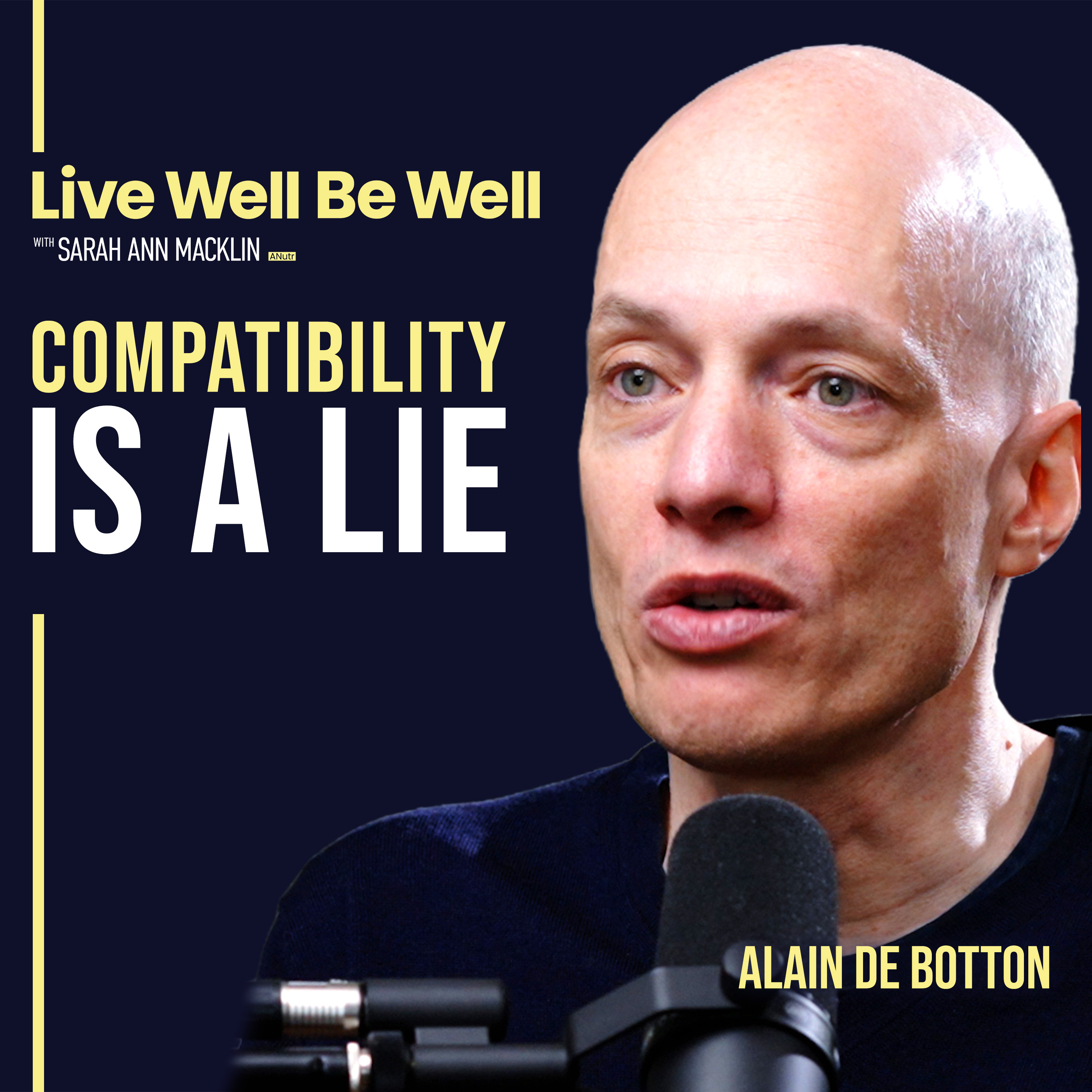
Why Compatibility is Overrated: Alain de Botton’s Guide to Relationships That Last
from Live Well Be Well with Sarah Ann Macklin | Health, Lifestyle, Nutrition
100m 34s
The discussion centers on the necessity of vulnerability for authentic human connection and relationships. True connection requires taking risks by revealing one's true self, which involves accepting potential humiliation. A proposed strategy is to preemptively embrace one's own flaws and "idiocy," thereby disarming fear and fostering genuine interaction. The speaker argues that people often hide behind curated personas, creating a collective illusion of normality, while everyone shares similar inner complexities and fragilities. Meaningful conversation serves as a gateway to deeper bonds when participants choose to share vulnerable truths rather than stay on the surface. Furthermore, the conversation highlights that while high-quality relationships are the hardest yet most significant factor for life satisfaction, modern society paradoxically does not dedicate proportional effort to nurturing them, often relying on romantic impulse over rational work. Ultimately, personal and creative insight is frequently born from engaging with one's own pain and curiosity, which then resonates with others' shared human experiences.
People that I've connected to the most are the ones that have been the most vulnerable with me. Connection is about taking a risk with someone. If you want to break through loneliness, you have to take a risk. And it's a risk around potentially being humiliated. I've got a trick for you. If you want to get over humiliation, rather than going, I won't be humiliated. Humiliate yourself. Tell yourself every morning, I'm a bit of an idiot. Throw dignity out the window and start to live. Today on the show. Best-selling author, a lander botan. Alander botan. Alander botan. Everybody's got a fantastic advertisement for themselves going. And we believe the advertisement and we forget is just a billboard. People are always blocking each other from revealing their true self. One of the biggest videos of all time when YouTube that I found is, "Am I going to marry the wrong person?" The bad news is, you'll marry the wrong person. The good news is, there's no right person. We live in a culture that is obsessed by the idea of a soulmate. This is one way to get to disaster. A good functioning relationship is the hardest thing in the world for a human being to achieve 70% of a person's life satisfaction is dependent on the quality of their relationship. We've built a very odd world in that if you look at what people are doing, they're not spending 70% of their time working on their relationship. Do you think that heartbreak is one of the most important life lessons that we can learn? It is a major life event. It is an annihilation of yourself that existed in the life of another person. The worst heartbreak are those that are not properly explained. I think there should be almost a government law that you cannot leave a relationship without giving the other person a maximal closure. And I speak with experience, authority, and a lot of pain. Hey guys, I am very bad at asking for this, but I wanted to stop for just one minute and ask a huge favor. If you want to hear more diverse conversations from female voices, such as myself, I would love if you could hit subscribe. We work so hard on this show to bring you some of the best guests in the world. And having a female voice sometimes gives a different perspective. And I really want to elevate more of that on this channel. So please hit subscribe if that's important to you as it is to me. So, where do you think that we've learned the idea that vulnerability is a weakness when every meaningful experience requires it? Let's make an argument for the fact that vulnerability is sometimes a bad idea, particularly in professional life, particularly with people who are not friendly. We do live in a hard world in many ways. And I think that the confusing bit of the conversation around vulnerability is that sometimes vulnerability is very important, and sometimes invulnerability is very important. It wouldn't be an issue unless there were two polls of this debate. And the tricky thing in modern life is how to navigate things so that you can be vulnerable when you need to be vulnerable, when vulnerability pays, and also draw boundaries and know how to say no and know how to put your wall up when that's necessary too. And both belong to a healthy life. And I'd say that you can suffer at both ends of the spectrum. Why does telling the truth about our fragility make us stronger, though, not weaker? Well, I think there's a way in which if you're able. If you're fully at peace with things that are so-called weak, you oddly do become quite strong. So to be able to declare. You know, to be able to. Even if I said to you now, "Sir, I've been crying all night." You might go, "Well, this is quite strange, because this guy's sitting here, his podcast, he's looking serious, and he's admitting to something, which normally people would admit with enormous shame, reservation, doubt, etc." And yet he's coming out with it in a manner that seems fairly self-confident and blithe, etc. And then you think, "Okay, so in order to be this strong about something weak, there must be an interesting balance in this person around weakness and strength." And I think that's often what we look for. We look for weakness well-handled. I think that's a very desirable trait. If someone is able to take you into the broken bits of their personality, but do so with relative self-confidence, if that isn't a paradox. It's meant to be a little bit of a paradox. Yeah, well, it is a paradox. What I find interesting is the people that I've connected to the most, sort of the ones that have been the most vulnerable with me, yet we struggle to do that ourselves. If stories are an amazing example of that, people that can story tell really well, you can connect to. I mean, connection is about taking a risk with someone. If you say to me, "What have you been doing for the weekend?" And I say, "Oh, I've just been looking at the clouds." That's not going to get anywhere. But if the moment that I say to you something like, "Well, actually, I was speaking to my ex-girlfriend and it was quite painful, and we both felt a lot of emotion," immediately we're into rich herterratory and something is beginning to happen. So conversation is filled with little gateways that you almost don't notice. It's like somebody says, "Oh, you've gone holiday. What happened?" You've got a choice. You can either stay on the surface or you go a little bit deep. And what deep means is to show something that an enemy could use against you. And if an enemy can use it against you, a friend can use it for you. So that's why it's a gateway to friendship. And that's why all friendship is always a gamble that you could be exploited. You could suffer from the gift that you've given. But it's a risk worth taking, ultimately. You know, we can always sit alone under the bed surrounded by our armour. Fantastic. It's just a bit lonely. So if you want to break through loneliness, you have to take a risk. And I think we're so scared of humiliation that we miss out on so many lovely things. And I've got a trick for you. If you want to get over humiliation, rather than going, "I won't be humiliated." Humiliate yourself. Tell yourself every morning, "A bit of an idiot. Life's not right for me. I've made a hundred million mistakes." You know, doctors have seen me naked and strange positions. You know what I mean? Medical examination. It's like, throw dignity out the window and start to live. I mean, we're so hampered by an exaggerated notion of how dignified we need to be in order to have a good life. Well, throw that out the window. Take a little bit of a risk. Make yourself fully at home with being a bit of an idiot. We spend so long fearing that someone might think as an idiot. You know the best way to cope with that? Just declare yourself an idiot way before anyone else gets a chance to. You know, get ahead of the opposition. They're saying, "Well, I think that person might be so clever." Don't worry. We've factored that in a long time ago. Idiocy is being baked in. You're not telling me anything I didn't know. And with that kind of assurance of your own vulnerability, you actually become invulnerable to all sorts of attacks. But why do you think we struggle with worrying about our dignity and vulnerability? Like, what is it that is stopping us being humiliated? Role models. You know, we get very unhelpful role models. Think of how a child looks at an adult. Most of the way that adults present themselves to children is full of deceit. Some of the deceit is necessary and some of it is pretentious. You know, when a child sees its teacher in the supermarket in the weekend, the child always goes, "Oh, goodness, the teacher actually likes traffic cakes. The teacher is filling their basket." The teacher is a human being. But that humanity is not revealed to the child during lessons. And I think that it takes us a hugely long time to realize that people, especially people in authority, are essentially human. You know, one of my favorite philosophers is the French 16th century philosopher Michel de Montagne, and in his book The Essays, he has a wonderful moment where he's trying to remind his audience that everyone, however high and mighty, is actually at the same level. And he comes out with a phrase, a very redulent phrase. He says, "Kings and philosophers shit and so do ladies." And so he's picking the three iconic things. "Kings, philosophers and ladies." And he says, "They shit." And he uses that word, a very pungent word in French deliberately to shock his audience. And then he says, "He follows up by going on the highest throne in the world with seated still upon our arses." And again, this kind of language from a philosopher, very unusual at the time. But what he's trying to do is to say, come off it, guys, we're all in this alike. What is this constant fantasizing that there are people who don't go through the things that we go through? It takes a hugely long time to realize that if it's in you, it's likely to be in the other person. And it seems implausible because you think, hang on a minute, I'm really weird. I should be running through a list. Sexually, very odd, all sorts of odd thoughts. Vulnerability, crying, weeping, getting anxious, getting furious, sort of. Surely no one else does that. Frustration, regrets, hung up still on things that happened 20 years ago, worrying about something one said 15 years ago, regretting some choice that you've made. This is just a starter list of the ways in which one might be nutty. Now, the thing is, everybody's nutty. It's just everybody's got a fantastic advertisement for themselves going. And sometimes that's fine, but the collective cost to our psyches is enormous. So that we keep thinking that being normal is different from the way we are. But in fact, everybody's so-called normal, we just don't know them well enough to see that all the stuff in us is in them as well. So what you have to do is take a leap of faith. So every time you see somebody and they're giving off absolute, you know, signs that they're the crazy banana that we know we are. The leap of faith is to go, hang on a minute. I don't know what your crazy is, but there's something in it. So I'm going to choose not to fully believe in it. And once you, and interesting happens, once you give space to their crazy, you don't know what their crazy is, but you know it's there. Once you give space to it imaginatively, you just go, I know you're a weirdo because I'm a weirdo because everybody's a weirdo. Then they will come towards you. There's something interesting, almost natural, osmotic process.
where by if you give space to their oddity, then they, and oddity, I mean that warmly, their humanity, then they will come forward. People are always blocking each other from revealing their true selves. For example, if I said to you, do you have a good evening last night? That is a leading question. That's not an open question. I'm a psychotherapist. One of the things they teach you in psychotherapy training is all your questions have to be open. You never say to someone, did you have a good weekend? Because that's essentially silently coercing you that the answer has to be yes. You have to say, how is your weekend? How was your weekend? That allows everything from weeping and screaming to joy and ecstasy. But you're giving space. And it's too often we shut people down. We'll say, somebody's gone through a break up and we'll say, you're getting better then? You're getting better then? Wow, you don't mean ill. That's such a reduction of the other person's chance to actually reveal how they're feeling. So we don't necessarily give each other the room we need to expand as we would need to. So do you think our communication is actually them blocking our authenticity to be our crazy selves? Look, I think one of the really fascinating things about interpersonal communication is we don't feel the same way with everyone. The chief difference between human beings is how they make us feel. With some people, I feel I can't shut up. I've got tons to say, my mind is buzzing. And other people, I literally don't know. I feel boring inside. And we all had that experience. Some people make us feel boring. And others make us feel interesting. And why is this? It's them. It's not us. We're not changing. They are. And the thing that's going on is how much room do they have in themselves to go where we might want to go? So if you feel that someone is very broad-minded about human experience, you will immediately have access to the broader bits of you. If you feel that someone is closed, then you will almost by instinct close down. And you will feel boring to yourself. So those people around whom you go, and also we always blame ourselves. We go, I went out of dinner with this person. I didn't have anything much to say for myself. And you think, oh, what was wrong with me? It's not you. It's them. And the particular thing that they haven't done is to go far inside themselves. You know, that all saying, you can only go so far with somebody else as you've gone with yourself. So if you've not opened 35 doors inside your mind, the other person can't comfortably open those doors in your presence. They won't want to, because they'll be a suggestion of danger. I attended Ted earlier this year, and I found myself in conversations with the founders of No Watch. You've probably seen me wear something on my wrist. And lots of you have messaged me, asking me what this is. It looks like a classic watch, but it's actually quietly tracking something much more meaningful. Your autonomic nervous system. This is a system that governs everything from how you respond, from excitement, to anxiety, calm to overwhelm. Most variables just give you a score, but if you're anything like me, that score can sometimes thank you for worse. Like you're already behind before your day even begins. No Watch works differently. There is no judgement, and there is no dopamine chasing dashboard. It simply reflects what your body is already experiencing, and also helps you notice what it might be missing. It gives you minute by minute timeline of your stress responses and your recovery. The recovery is the most important part, and it's the part that no one talks about. And it is often the most revealing marker of our long-term health. In just five days, it calibrates your body, and it builds your personal health fingerprint. You can try for free now for 30 days, and if you use the code LWBW, you can also get 15% off. If you want to understand your body, not just through performance, but through self-awareness, then this is where I begin. For your life, doing School of Life, your curiosity, the wisdom, I guess, that you have built since 2008, since you started School of Life. What drove you into this? What drove you into this curiosity? Because there's so much vulnerability that comes along with that you speak so eloquently, and so confidently at the same time, but also with the reassurance in you. What was it for you? Well, what motivated me was very far from some dispassionate academic exercise to raise human awareness and spread knowledge. It was always built out of crisis and my own crisis, and my own curiosity is a survival mechanism. What I do with pain is get curious about it. You can divide people into what do they do when they're in trouble, some people jog, some people drink, some people chat, so I start thinking. I go into a room and I think what Earth's going on, and I try and put logic to things that are very complicated and hard to understand, and I stay true to my own pain. And sometimes people come up to me and they say, "Oh, it's amazing, you know, you made a film, "it was just right for me." And how did you know that about me? And frankly, I've got absolutely no clue about you. I'm just using myself, and you know, if you're faithful to your own experience, it's likely to hit a nerve with other people if you're doing it right. And so the School of Life is just a set of journeys that I've undergone inside myself, presented for an audience. What's been the biggest hitting for you? Biggest hitting. Yeah, the biggest hitting experience. One where you've put something out, and it's connected and resonated, but it's been the biggest shift for you, personally. Look, the topic that is perennially of interest to me and to everyone is relationships. It's the area, it's the litmus test of emotional maturity, and most of us come unstuck here. They are, I mean, I want to say that a good functioning relationship is the hardest thing in the world for a human being to achieve. You know, Korea is a very hard as well, really hard to get a good career off the ground. I'd say it's harder to get a good relationship off the ground. It is the hardest thing, particularly if you've had, you know, difficult challenging upbringing. So I had a challenging upbringing. I went through divorce, as Marin for many years, went through divorce, entered the dating world as a fairly elderly person, et cetera. It's not easy, these things are not easy. They are very, very complicated. Good news is, it's so fascinating. I mean, my goodness. I don't stop learning. I'm constantly learning. I look back 10 years ago, what did I know, et cetera. I'm constantly expanding my body of knowledge. And as I say, it's relationships that really strikes a chord, so much of our material is around the difficulties of getting in and out and sustaining a relationship. We could talk about this for millennia. It is the great challenge in people's lives. It's also, by the way, the great source of joy in people's lives. You know, I think it's been estimated that something like 70% of a person's life satisfaction is dependent on the quality of their relationship. We've built a very odd world in that if you look at what people are doing, they're not spending 70% of their time working on their relationships. The economy is not devoted 70% to the sustaining and development of relationships. So a visiting Martian would go hang on a minute. There's this thing that's really important. And most of the time, none of you guys are actually doing very much about it. And then you're surprised that they goes wrong. You know, we're still living in a romantic age that's about 250 years old that has all sorts of assumptions about relationships, one of which is don't think too much about them, that true love should not be philosophy. It shouldn't be logic. It should be an impulse. A kind of free wheeling spontaneous feeling. And if you get that feeling, don't ask too many questions of it, which is why still nowadays among respectable people, you can say, I've met somebody. I had an amazing feeling. We're getting married in Vegas in two weeks. And people will go, ah, so romantic. That's brilliant. Rather than get these people to an insane asylum, get these people to a therapist. They don't know what's going on. So we have a tremendous amount of respect for instinct in a way that we don't have in any other area of functioning. I mean, if you went to a boardroom and said, I've got an instinct that we should start a company in Shanghai and divest ourselves of the Australian market. People go, how do you mean an instinct? But we have some data on this. Could we proceed logically? In love, you say, I'm divorcing this one. I'm going to marry that one, etc. And everyone just goes, oh, well, that's fine. We're not asked to submit our emotional movements to rational analysis with tremendously difficult effects. I mean, impulse is as liable to be wrong in matters of the heart as it's likely to be right. And I speak with experience, authority, and a lot of pain on this. We like to believe that our impulses are going to lead us to the right people in the right situations. That's fine if you're training. Your impulse training has been healthy. But most of us, many of us have come from difficult backgrounds where our impulses, far from reflecting logic and health, are actually geared towards the management of a rather traumatic situation. And therefore, when those impulses are activated and add our life, they're likely to be pushing you towards a disaster as they are towards health and happiness. You know, there's a very normal quote that goes, "The head or the heart." How do you know which one's right? It's so complicated. I would say, nothing fast. Listen to what you call the heart or maybe the gut, which is another interesting thing, or the unconscious. In other words, the bit of your experience to which you can't immediately have access, you may need to quiet in yourself.
may need to go into a sort of liminal state, you might need to be in a bath or in a walk or just as you're going to sleep or something. You try and access a part of you that isn't there in the chatter of the day. And you can ask yourself some of those deeper questions like, what do I really think about them or what am I really trying to achieve? And often there is an answer, rather an interesting answer, waiting for you in the backdrop. It's like an analogy might be, it's very noisy during the day and then as the hubbub of the day goes down, if you're living in a city, you might suddenly hear church bells, those church bells have been ringing all the time. So only once the noise and the city goes down that they're audible. And there's as it were, a little church bell inside us that sometimes is trying to tell us things. Now, we mustn't think that is the truth and everything else is false. No, it's more complicated than that. Let's explore that church bell bit, submit it to reason and come ultimately to a committee decision, a kind of, we need to sit a variety of ourselves around the table, you know, the child's self, the bell ringing self, the rational self. And we need to hear everybody's voice and then come to a measured view. We spoke about vulnerability at the beginning and I read that you argue that loved demands vulnerability but also being on edited selves can ruin relationships. How do we reconcile those two truths? Because it's very hard to be vulnerable and communicate, but also not too much. Yeah, I think what we need is a meta perspective on vulnerability. In other words, you've got to be in touch with vulnerability, you've got to be able to communicate your vulnerability, but that doesn't mean you need to act out from a place of vulnerability always. Look, I think a great ideal in relationships is to be quite polite. I know this is really, it's ideal and, you know, many of us lose our tempers at moments and we should apologise etc. But the idea of not submitting another person regularly to your rage, your disappointment, your confusion, not to make them feel ashamed or guilty unnecessarily etc. These belong to the rules of adult life and many, many people are not there yet. There's a lot of substandard behaviour in relationships. And to simply go, oh, well, that's just me being me. That's not quite good enough. I think, yes, we need to try and access the vulnerable parts of us, but does that mean that you've got to shout out at your partner every time you feel frustrated or let out every comment, even a devastating one simply because you feel it. No, there has to be censorship. There has to be an ability to manage the data that comes from your vulnerable self and share it in a way that it can be digested. So I'm afraid a nuanced position on this one, vulnerability, yes, but a lot of politeness and a lot of patience and a lot of an attitude of criticism towards your own first impulses. You know, when I asked you what's been your kind of most heavy hitting video that you put out or moment or theme and you said love, I was, you went back and looked at all of the content and I've been obsessed with the School of Life for years just for my own self and that's why this conversation to me feels just probably one of my biggest because I feel so connected to the work that you do. And it's true, universally love. I think the substrate of life is love to ourselves and to other people. Yet a lot of us will put most of our pressures at work on ourselves and even if you're a founder, finding your co-founder feels like the biggest the biggest connection that you're ever going to do in life. Yeah, actually the person I'm going to marry really is your co-founder. That's how I think about things. And one of the biggest videos of all time on YouTube that I found is, am I going to marry the wrong person? And that came from an, an article that you wrote, I think it was in 2008, might be later for the New York Times. And it's absolutely blown up. People are too afraid to ask that question or think about that question. The actual title, sorry to be annoying, is why you will marry the wrong person. Why you will marry the wrong person? And I think that the reason that title resonates is because it's a fear that we all have that we're going to make, marry the wrong person. It's such a cataclysmic fear to name that fear is ticklish but also hopeful. And the message of that film and the article was, is a hopeful one, which is to say, okay, the bad news is you'll marry the wrong person. The good news is there's no right person. Once you do away with the idea of a totally right person, you actually liberated, you know, we live in a culture that is obsessed by the idea of a soulmate, somebody who will understand us totally, somebody with a round of whom there will be no friction. This is a one way ticket to disaster. App culture, for example, is based on the idea that there is a so-called right person and you just keep swiping and keep changing and keep dating. It's until you find this so-called right person around whom there will be no major in compatibility. Compare this with pre-modern societies. Pre-modern societies, they didn't date very much. You more or less had three or four meetings and then you would marry. And we look at them and we go, well, that's crazy. What you don't even know the person. And the pre-modern answer is you know one thing about a person that's absolutely key. Perhaps the only thing you need to know. And what you need to know is they're very committed to having a relationship with you. So we don't know at all who they are, but they're very committed to a relationship and you're very committed to a relationship. And the suggestion, it's a full-to-are is, but provocative is maybe that's the most important thing about making a relationship work. Because if you, you know, in our day, what we do is we spend about four or five or ten years checking out if we're compatible. He likes golf, she likes yellow curtains, it's like the novels of this, etc. And it goes on and on and on. And then finally after seven years, oh, sorry, I've got to leave because we're not quite compatible. And so I've got to upgrade to a more compatible person than everybody's devastated. And you think hang on, is this right? Isn't it better in a sense? Go on four dates, think, hmm, okay, probably speaking, I'm getting a good feeling. The number one thing we need to do is commit and then from there what we need to do is to work on compatibility. The compatibility is an achievement of love. It's not a precondition of love. We've got it the wrong way around. So what questions you'll be asking when we first go on first dates? Well, I think a very useful question to flush people out on a first date is how you are crazy. How are you crazy? And you know, if somebody goes, have you, I'm not crazy at all, that's a really insulting question, leave because if somebody has such a brittle and unexamined relationship to their own flaws, it's not a good starting point. It was someone goes, well, where do we start the list? And it's playful and knows exactly what you're saying. And it's basically happy to go in there. That's really good because in love, we don't need perfect people. We need people who know that they're imperfect, have a kind of handle on what's imperfect about them and are able on a good day to tell you about their imperfections before they've hurt you too much with them. That's gold. And we don't have enough of it. I want to talk about something important to you guys. People today are lonelier than ever. Most long-term relationships aren't happy ones and a third of people under 30 haven't had sex in the past year. Sexual issues among young people have surged over 3,000 percent. But what most people miss, the vast majority of relationships and intimacy struggles aren't physical problems. They're psychological. And yet, most people never get traditional therapy because it feels awkward, expensive or just impossible to access. So much about Live Wild Me Well's mission is aimed to reduce stigma around health and help us understand ourselves better. And that is exactly why I wanted to tell you about Mojo. An app for dating, sex and relationships that I am genuinely excited to tell you about. They are partnered with the world's leading experts in sexology, including some that you're actually here on this podcast to create expert-led courses. Now, their AI personalises everything to your specific situation. So you can work through it privately at home and on your own time, suffering in silence doesn't help anyone. And I don't say this slightly because I've believed in Mojo so much that I've personally invested in the company. Now, if any of this resonates, go to mymojo.com/livewellbwell and use the code LiveWell15 for 15% off. Our sexual being matters and everyone deserves support. Heartbreak is an absolute nightmare. I would say that it is one of the worst things that anyone can go through. I didn't know that I didn't go through heartbreak till later on in life. And I used to think, "Oh, what are those songs about? What's this drama about?" I mean, lots of people have not really had heartbreak. They've had breakups and they felt a little bit sad for a week or two. It's not heartbreak. Heartbreak is the serious thing. Heartbreak is, "Yeah, two years, three years of your life where you are in pieces." Okay? This is no fun at all. I mean, it is a quasi-medical condition. It is, you know, you should get time off work for it. We can take a lot if they've been explained. I think there should be almost a government law that you cannot leave a relationship without giving the other person maximal closure. Why did this happen? What's going on? How did you come to this decision? The thing that will devastate anyone is a relationship that seems to be going well, you feel invested, you trust, you love, you adore, you're planning a future.
And then from one day to the next, the person goes, "I'm so sorry, I'm not feeling I've got a leave "and I can't really explain why." You probably lost the next two years, just then and there, you lost the next two years, at least. And it will have a massive impact on your ability to trust other people, et cetera, et cetera. So as I say, you get fined about 100 pounds for dropping a Coca-Cola can on the ground. Not great, but what do you get fined if you do this to another human being? Nothing is in the realm of private life. Now I don't want to call the police in, but guys, let's raise our game here. You cannot just exit somebody's life after a five or 10 or 20 year relationship with a, oh, sorry, I wasn't feeling anymore, I'm off and I'm gonna block you now. We can't do this to people. It's devastating. It is probably one of the most soul-destroying moments. I mean, it's very connected to trauma when those things happen. Is a trauma? It is a trauma. It is a trauma. And because it literally is an annihilation of yourself in the eyes of another, another person knows everything about you, everything. You've told them everything. You've shown everything about you. You've shown yourself in total vulnerability. And then for no reason that witness, that friend, that lover vanishes from your life. And it is like you have to be born again, as it were. Not in a nice, not a nice way, religious people talk about. I mean, in the grimest way, you have to start again. And yeah, so anyone who's suffering from heartbreak, I mean, they need so much help, they need so much kindness, so much support, they are not gonna be themselves for months and years. - But do you think at that point, they develop a different type of self once they heal and grow from the pain that they endured? - Sarah, I'm not from California. We're recording this in the UK, in the United Kingdom. We're recording this in Old Europe. Europe is tragic. America is optimistic. I know many of our viewers from United States. I say this with love and compassion and desire to be helpful. Some things are tragic. Some things are not always the road to some beautiful future. Some things are just shit. And we need to, you know, some things shouldn't have happened and nothing beautiful happens. You just have to describe, I mean, look, imagine we're living, we're staying in a lovely apartment. Imagine this apartment is torched and burnt thing. And you might go, well, after the torching, you know, some wallpaper was better, et cetera. You might also want to go, this was a total waste of time. Like, my life was fine. And then my apartment burnt down. And it was a disaster. And I think there is a little bit of that with heartbreak. Yes, sometimes we get stronger. Yes, sometimes we learn about boundaries. Yes, sometimes we learn that the next person we go on a date with, we better ask some sharper questions and we better behave. So of course, there are good lessons we can learn, of course. But I want to make a case for just the pain. And sometimes there are lessons we wish we hadn't had to learn. And bless those who don't have to learn some of life's hardest lessons. Yeah, I may have a completely agree with you there. I think one of the most interesting moments for myself, maybe personally on this, was that it made me have to understand myself more. Like, it took me to a place that I probably would never have had to go to without that. And I think that is something with one of my favorite terms of all time, which you just said, we're in Europe and Old England, that everyone will cringe when I say this word, quite rightly I did for many years, which was self-compassion. It's I think it's one of the hardest concepts for anyone who is English to connect to. It's just something that makes you want to go, "Oh, to that word." But they're the moments I think that we really develop the understanding of what that means. Let's think about what happens when your heart is broken. So your heart is broken and the rejection is immense. So somebody has known you, seen you, and decided you were not good enough. And so from there, you've got some choices. You can side with that person's view. You can essentially go, they knew me. They saw something defective in me. And therefore, I'm at an end. I'm at rock bottom. And everybody goes through that period. For a long time, they side with the view of the person who hurt them. And then if things can go well, at some point, they have to start to go, hang on a minute, that person was not right. I'm going to be on my side rather than on their side. Because otherwise, well, I've got to live with me. I've got to find an argument for being me. Otherwise, I will never get off the floor. And so slowly, as you say, learn self-compassion. You learn to think, okay, I'm not a perfect person, but there's got to be a way in which I deserve to live as well. And then the slow process of recovery. How important do you think self-compassion is for our mental health? Look, I think what we mean by self-compassion is an ability to interpret one's own flaws, mistakes, weaker sides with the kind of kindness that we would give to a friend, even frankly, a stranger. And the always interesting thing is, why we cannot be as kind to ourselves as we can to any random stranger. So a random stranger, if they said to us, you know, I've made a mistake at work, I've done something wrong, we'd go, "Oh, poor you." We'd immediately go, "Oh, poor you." That would be very natural to us. We go, "Blythering it, what are you doing?" We speak to ourselves with the harshest possible voice, which is often an internalized voice. The way we speak to ourselves is largely to do with having incorporated the voice of somebody else who spoke to us normally when we were small. And some of us have had the misfortune to have inner voices that are not very helpful. What are you doing? You silly idiot. Why did you forget your to tie your shoelaces? Don't touch the kitchen cabinet. Get out of my way. I'm busy. You silly little nonsense, et cetera. Unfortunately, there are childhoods in which those messages are being drawn in. And then that becomes, you see, people who have bad childhood suffer twice. They suffer in the childhood. And then they suffer because the negativity has been incorporated in their own mind. And they then start to be the negative caregiver to themselves. And they take that out into relationships and the workplace, et cetera. So that they've got, you know, what Freud called a super ego, that the voice inside themselves, that is the voice of an unkind person of authority. And sometimes people have good internal voices. But many of us have quite bad ones. So it's really interesting to ask oneself, how do I speak to myself when I mess up? Do I speak kindly to myself? Or do I hate myself? And who's is that voice? It's not yours. It's a voice you've heard and you've taken inside yourself. And then you need to say to yourself, do I agree with that voice? And you might need to say it, do a little bit of a goodbye ceremony and go, thank you, voice. And now I've taken you inside me. I don't want this voice. Life's too short. Get out. It's true. I sometimes find it really helpful to name that voice. So I don't feel like it's part of me. Yeah, that's right. And it won't be the voice of a great aunt, a parent, usually it's a mother or father, but we don't need to point that, make that point too hard. How important is that to recognize, though? Because a lot of people will say, well, that voice drives me, it motivates me, it connects me to being a better person and all ways and the way I work and the way I am. Yeah. Look, there's a lot of equivocation around the value of a whip. A whip could be a good thing. It gets people going. Whip yourself a little bit harder and off you go. And then there's the moment where the whip ceases to be very helpful at all. It's got to be a balance, isn't it? There's got to be motivation and part of motivation has got to be moments of self-hatred, self-criticism, et cetera. But those of us who are suffering from an excess, it's become really unhelpful. Think of the number of books that don't get written because people are so worried they're going to be bad. Think of the number of businesses that don't get started because people think, oh, that's a silly idea. Think of the number of initiatives sort of quashed at birth because somebody is ahead of their own more hopeful sides with that critical voice. So for every person who didn't bother to get up off bed because they were just too easy on themselves, there's a million fantastic things that have not happened because people were too critical of their projects and their dreams. How do you advise people to deal with criticism? First of all, don't be too stoked too quickly. It really hurts. Some people go, I can't believe it. I heard somebody saying something bad about me last month and it's just moving around my brain even now. And I'm just from such an idiot. You want to go, don't worry. We're built like this. This is very normal. We are acutely sensitive to criticism. There are probably biological reasons for that. The view of the tribe mattered immensely when we lived in a village of 15 people. If one of those people had a very bad opinion about you, you should probably know about it and worry about it. The irony is in so many impulses that we have physiologically almost, they are growth their uses. So it was also tremendously useful to eat any sugary thing that came your way because that way you would preserve your calories. Nowadays, disaster, right? You must not do that thing that you're impulsive. Same thing around gossip and criticism. It doesn't matter. If somebody ate 100,000 miles away posted something negative on a blog about you, forget it. Forget it. It doesn't matter. It's not anything that you need to worry about. But we bring to the conditions of the modern city and the modern internet world that some of that sensitivity that was essentially honed in the savannah. And it doesn't belong. And it causes problems that are unnecessary. Do you think social media was making this 10 times worse? Social media-- look, let's really make a social media being the root of all evil. Everybody thinks so really. and it true.
really is. So, sorry if you work in it, sorry if we all use it, but look, it aggravates so many fragilities of the mind. For a start thinking, thinking is really important. There are lots of thoughts that we need to have in order to unlock our full potential. Thoughts around, what should I do next? How did I behave with someone I care about? What do I really regret? Where do my true talents lie, etc.? The answers to those questions are not at the top of our minds. We need quiet, we need space, we need an undistracted environment in order to access those thoughts that will save our lives and give us the direction we need to go in for the next stage of whatever we're trying to do. The problem with damn social media is it's so seductive that it gets in the way of the conversation we're trying to have with ourselves. It's alienating from ourselves. There's an irony. We talk of phones as communication devices. They are miscommunication devices. For all the fact that we can get hold of somebody on another continent at short order, the person we can no longer get hold of is us. Us, the owner of the phone, we can no longer communicate with ourselves because we've got phones, these communication devices that are actually miscommunication devices. That's so true, the miscommunication with ourselves. I think one of the things that I found really interesting that you've said that kind of connects to that, is that a lot of us are disconnected from how we feel in a somatic experience. A lot of us are very cerebral, very much in our minds and those devices pull us more into our minds and more cerebral thinking. How important is it? Do you think it's connected back to ourselves in a somatic way? It's totally paradoxical. If you say to somebody, you said to a Martian, think about these human beings, they often don't know what they're feeling. The Martian would be a bit puzzled. How do you mean? They don't know their own feelings. They feel and yet they don't know the feeling quite paradox, but it's absolutely true that we have layers of consciousness and there's lots of things going on in us of which we're not fully aware. Some of those things are digesting lunch. We're digesting our lunch. We're not fully aware of it and that's great because it means we can get on with having a meeting or something. If we had to know everything that was happening in our bodies in real time all the time, we wouldn't be able to think about other things. The mind is usefully split into conscious and unconscious, but only so far. There are also very valuable bits of information that are lodged unconsciously that should become more conscious. This is the basis of psychotherapy. Psychotherapy is essentially a discipline that tries to rescue important bits of exiled, alienated knowledge and feeling and try to bring it in to our more conscious awareness so that we can make better choices and know what's actually going on. There is a way in which some of our exiled feelings have serious secondary effects when they've not been made conscious. Anger is the classic one. Anger that's not been felt and understood and very often anger is not felt and understood because we're afraid of its volcanic potential. We're afraid of hurting people or demeaning ourselves. We don't register anger as it should be and it then starts to breed secondary characteristics like irritability. We're irritable with everything because we don't know that we're angry with something. We might go off sex. Most sexual problems are anger that hasn't found its way out. Most inability to have sex is really an argument that you forgot to have and that's why you don't want anyone to touch you because you're partner to touch you because you're so furious with them. But you've forgotten your furious because you're supposed to be a nice person. The feeling that we have, which is, "I'm a nice person, I don't get angry," is really noxious. We need to go, "Everybody's angry," all the time. We had all sorts of things and what we need to do is connect with that anger and dispel it like a bad smell. Then it will be okay. But if it has to fester, then it gets really, really dangerous. To the point where people end up twitching, they end up cynical. Synicism is a kind of congealed anger, years of congealed anger. People who are sensitive to certain people who they're in a quiet rage with the whole of existence, normally because of something that went wrong. This is not good. A lot does get lodged in our bodies unconsciously. So many illnesses, I don't need to start telling you, so many illnesses are essentially ideas that have not found their way into the mind. So they're finding representation, metaphoric representation. An inability to speak has given rise to nodules on the throat. An inability to express anger has ended up as backache. The back is the spinal cord is the place. It's psychology central, really. It all ends up in the spinal cord. On and on. One very useful exercise that we do at the School of Life is to simply say to people, close your eyes, think of your body. We're going to ask a rather odd question. The question is this, what does each part of your body need? Need from you? Need to say, keep it open. What are your shoulders need? What is your stomach need? What are your hips need? What does your hand need? And the answers people give to those questions are amazing. People kind of get it immediately. Even if they're quite normally, quite sort of straight people, they'll go, okay, I get it. And it'll be things like, I need my mother to put her arms around my shoulders. Wow. Okay. That's an interesting thing. Or my stomach says, I've had enough of dot, dot, dot. And there is an answer waiting for us. So, you know, there's a lot of talk about how you reconnect the bodies. Very simple exercise. Just ask what different parts of your body need and there almost always will be an answer waiting for you. You've referenced quite a few different people there that I really like Dr. Garber Matty. He talks a lot about. And so there's Basil Bendurbicoff, the body keeps the score. It's a huge thing, but I don't think people connect to it as much. I mean, we go to the doctor a lot about different issues. And normally it's a prescription of an SSRI, an anti-depressant, anti-inflammatory for the back. But very rarely is it something to do with emotional health. Yeah. Again, I mean, so much thinking has been done on this area, but obviously our medical therapeutic model is hopelessly split down the middle, hopelessly segmented. You know, we all know it. In fact, GPs know. GPs know that people go to them essentially for therapy. I've friends who are GPs and they go, they struggle to shoulder them and they go, "Huh, you know, I've got five minutes per patient." And I know that what they really want from me is a therapist. And they slightly laugh as though, "Huh." And they've come to the wrong place. You want to go, "Where does one go?" You know, the doctor and the therapist occupying poles that really need to be closer together. In the ancient world, say in ancient Greece, a doctor was seen as somehow a priest and also a philosopher and a healer of the body. Those roles were much more combined because it was understood that illness is, you know, contains metaphoric elements or psychological elements. And, you know, even though we're sophisticated in a lot of ways, we find that still very, very hard and it's podcast like yours that are trying to bring this home. I'm interrupting for one moment to ask one small favor, please subscribe to the show. This helps it grow more than you know. And I'm so bad at asking this from you. I'm so bad at thinking about this. But you know, my goal was 100,000 to get to on YouTube and I really want to bring you more content and better guests and bigger episodes. And we can only do that with your help together. So please do hit subscribe. Thank you. I think it's one of those, one of those moments that I've had from doing this in the show. And I'd love to know what your experience is because you started school of life in 2008. When I was 21, I lived in New York. I'm now 36. So we're going back a while. And I would go to these dinners and I'd sit down and I was very English and someone would say, he's your therapist and my body would like jump out of his cell and go, what would you mean? I don't have a therapist. And why do you not have a therapist? And it was this really odd moment where I hadn't been surrounded by anyone that would ask me that because if I thought I had a therapist, for me, I was nuts. That was just how my mind and the environment that I grew up in was looked at. And then I remember turning on the Ellen show and dude Lulf was on that and he said, "Geneal was really odd about being in America because everyone has a therapist and it's really normal. I feel unnormal, not having a therapist." So I went into this really interesting culture, which I was exposed to in still quite a young age 21, wherever I was talking about therapy very openly. But it was something that was really prevention. French medicine wasn't spoken about very much even in general health. It was more about go to the doctor when you're ill, not go to the doctor to reduce illness. And then when I started studying and really got interested in mental health, I was like, for me it was like, I'd opened so many doors in my mind of understanding myself, which made me feel stronger. I thought I would feel weaker. And there's been a really interesting shape shift in the landscape over the last 15 years of mental health. What's your understanding of this being like? Because you've lived and breathed it during this time, like how have you seen the difference, especially in Europe and in England change? Yeah. I mean look, psychoanalysis and then psychotherapy has been in existence since the beginning of the 20th century. But I think we've definitely seen a huge expansion in its uptake and ideas like attachment theory, which were in textbooks and therapists knew about are now language that 16-year-olds speak. That's wonderful. There are some dangers and we could go into that, like with many broadly positive things, there are some dangers. But I think an interesting thing to ask myself is what does it mean that we live in a culture where people go to therapy? You see, therapy is something you might do for 50 minutes.
life's a lot longer than that 50 minutes. It's really a therapeutic attitude. And if I can try and summarize what a therapeutic attitude is, a lot of what it is is teaching you to be very respectful of the complexity of your mind. That your mind is not exactly obvious to you. That's the primary starting point of psychotherapy. It's like, why do you need a therapist? You need a therapist because your own first thought about you might not be right. You might not have access to the richest data about who you are. And that's an insight you can hold on to throughout the week. It doesn't just mean that you have to do this with a therapist. And it also is very relevant to relationships, all relationships, colleagues, romantic relationships, etc. Because really what it's saying is there's two unconscious minds meeting. Whenever two people meet, it's conscious and unconscious. And if you give room for the unconscious in yourself and in the other, you'll have a much more interesting time, much more human time. And also, let's come back to it. You've got some bodies as well. You've got two bodies. So you've got a rational mind, a body, and an unconscious mind whenever two people meet. There's already a lot of elements there. And it makes for much richer encounters if you can keep all these different bits in mind. I think there's an interesting moment with therapy. And I don't know if you've seen this where people are still scared to open up to their therapist. How can people become comfortable with that and also still not bias at the same time? Well, you know, my background was in philosophy. And one of the things that I've got interested in, I trained at psychotherapies much later in life. And so one of the questions I asked myself is what's the difference between philosophy and psychotherapy? And I think that philosophy has this idea that the truth will solve every problem. So if you work out the truth about somebody, it could be personal truth, a political truth, etc. You just give people that truth and then abracadabra everything will change. And literally the dialogues of Socrates, iconic dialogues in history, philosophy, they literally have that. Socrates wanders around trying to find people's truth and then goes, "Hey, that's the truth for you." What we've discovered and what psychotherapy discovers is, that's not going to work. You could go up to somebody and go, "You're avoidant because your mother, when you were three, left you and your father, wasn't really faithful after he had an affair." And the person will go, well, they probably go, go away. Or they'll go, "That's true, but I'm not sure what it really applies to me." So there will be a resistance to it. So most psychotherapists, when they see a client, can work out the broad dynamics of what is wrong with that client, what's going wrong in 50 minutes. An initial encounter, the psychotherapist gets the picture. All the rest of the work is trying to bring the client gently around to insights which, if they're delivered too harshly and too nakedly, will simply frighten the client and will not go in. So psychotherapy is an education in how slowly we need to absorb important truths about ourselves. We need to cut them up into very small pieces and eat them just a little bit day by day. You can't present people with the truth. I used to do this in my personal life, but still sometimes do it. Is that I'll say to somebody, "The thing you need to bear in mind is this that and the other." And they'll go, "No, I don't." And then I suddenly put my therapy back on and I go, "Can't speak to people like that." They can't absorb that. "No, none of us can." I mean, if somebody came up to me and said, "What's up with you is, I go, you crumble." So psychotherapy is a method. It's not just a set of ideas. It's a method for how to get those ideas safely into people's minds. And if there's one word that's key, could sound odd, it's love. Love helps ideas to get absorbed in somebody else's mind. What the therapist does is to create an atmosphere that is a kin to an atmosphere of love, gentleness, kindness, consideration, modesty, sweetness. These are the preconditions in which people can learn. If you go up somebody, "Oh, you need to learn." Like, that no one learns when they're being humiliated. We only learn an atmosphere of love. And that is modern psychotherapy's great insight. It's relatively recent. It's 50 years old. It was not 100 years old. Initially, those Freudian people just thought, "Sidians are chair and Vienna, and we will tell the patient what's going on." And it found it didn't work. The insight was perfect. The method of delivery. Catastrophic. No one ever learns from a strange German accent delivered sternly. It's, well, it's like that, anything in life. Absolutely. Anything. I mean, think of the teachers you learnt something from. But they were ones that harangued you, or they playfully, gently, got you into something that you could understand and love. Well, one thing I find really interesting when we think about therapies, you've got an hour with yourself and another person. It's a very intimate moment, right? And you've said in the, "Will you marry the wrong person?" Or, "Why you will marry the wrong person?" You talked about that we're all addicts. And that addiction is basically any behaviour of pattern where you cannot stand to be with yourself. You can be addicted to anything. As long as it keeps you away from yourself. That's right. I mean, we are not, you know, self-awareness does not come easily. It's something we have to work at. We, every important idea that you need to learn about yourself will be surrounded by coating of anxiety. You will not want to go there. It's a paradox. The ideas that we really need are also those that we tend to run away from. Which is why we tend to have to wait until pain comes along. Pain provides us the incentive. So there are lots of thoughts that you don't look at until you're rock bottom. And then you're so in pain, you think, "Okay, right, better open that cupboard door." With all that stuff I haven't looked at. Because you're already so down that you then go off and, you know, take that risk. But until then, you're flat-lining and you're avoiding and you're using your phone to get away from the stuff you really need to think about. So yeah. And in Somnia, I sometimes think of Insomnia as a kind of revenge for all those thoughts that you carefully manage not to have in the day and the day you push them away. And they come back at you three in the morning. You can't sleep because some thoughts need to be heard. You know, there are truths that we will die if we don't get to hear them and they press against us. And that's the wonderful thing about the mind. We have a conscience. There are sort of emotional conscience. There are things that we need to know about ourselves. And if we're not up for knowing them directly, a bit of our minds is going to make damn sure we'll hear about them somehow. Maybe it will be through a piercing headache. Maybe it will be through, you know, a bodily ailment of some sort. But that truth is going to come knocking at the door. It wants to be heard. And we should try and give it space. We should try and say, "Some part of me is trying to tell me something." So let me just sit a bit quietly, cancel that party, put my phone away and listen to me. It can be hard to do that, though, car now. Terrifying. Just hard, scary. Let's name it, scary. Self-knowledge is scary. Why? Because imagine how awful you'll feel if you realized you left somebody that you shouldn't have left. Oh my God. That's terrifying. You've ended a relationship. You shouldn't have ended. That will make you feel very worried. Or you left a job that actually was perfectly good. Or it was because you lost your temper with someone that you destroyed something that was really important to you. I mean, these are agonizing realizations. And therefore we'll do anything other than face up to them. Ultimately, the kind of, the better you have to have with your self is, the truth is always worth knowing that there are benefits to knowing these uncomfortable facts that outweigh the discomfort that you will need to experience in order to get to them. Do you see men and women going down different paths with this in self awareness? Do you feel like women can connect more deeply to it than a man or? Absolutely not. Both men and women are equally blind to the really important insights. Maybe they use different methods of distraction. Sure. Men might use, I don't know. I don't know. They chop wood. I don't know what men do. Who knows? I'm barely a man. Sort of a man. But anyway, yeah. So some men might chop wood women. I don't know what they do. Alright. Klee Shays. But I think that both genders are equally mired in the business of self avoidance. It's universal. Sadly. I often think, you know, they're real battles of the genders because people tend to date and experience only one gender. The people really understand the true mess of human life are bisexual people. But heterosexual people, the men go, "Oh, the women are so crazy. They're so they do this that and the other." And the women in their cap, heterosexual women are like, "Oh my god, the men, they do all this that and the other." And the real truth is human beings are totally maddening and nutty. But most of us don't date the full range of human beings. So we have this siloed vision. The bad news is everybody's crazy. But that's also the good news. There is no gender that is saintly and there is no gender that is totally impure. We're a fabulous mixture of the two. It's wild that we think they're not crazy, right? Absolutely. We insist on our normality to comedic extents. And it's only when we're watching Larry David or John Cleese or David Brent that we can kind of go, "Okay, let's laugh along because actually a part of us is that crazy, ridiculous person." But yeah, most of the time we cannot find a safe way, an off ramp from our normalising philosophy to something broader and more human. We need an off ramp. Yeah, what was your off ramp to feel comfortable? I don't know. I mean, from quite a young age, I didn't place great store in. thinking, yeah, I'm one of those normal chaps. I think I just felt like it wasn't really an option for me. I was obviously slightly on the unusual end of things and I just thought best thing to do is put my hand up and not pretend to be any more normal than I feel. And I also found that it was a route to friendship. It was a route to laughter and friendship. And so initially at school I was better at the house clown and then you know, and it sort of carried on. I still think that laughter, you know, laughter is immensely important and immensely sophisticated thing. It fills the gap between how we would love life to be and how it actually is. You know, whenever you sense that gap as a role for laughter, which is why we're sitting in the UK, the UK is quite a funny culture. Why? Because there's quite an acknowledgement that lots is not as it should be. It's like no life's a bit shit. And so because we know life's a bit shit, we can laugh. Whereas in other cultures, less are American cousins. They, you know, it's like we don't accept nada nada. We don't accept failure. We don't accept that things might go wrong. We're building rockets to go to Mars and we don't we're not laughing here because it's and this has led to an amazing achievement. It's also led to lots of mental unwellness because there's not that safety valve of of of being making your peace within perfection. You know, United States was founded by people who wanted to build Jerusalem in this world, not in the next world, in this world. You know, Europe had been building Jerusalem's in, you know, not in the future for centuries. The people who built the United States thought this was the promised land, not in the next life now. And that's why it's been the most productive economy that the world has ever seen. And it's also a fabulously tormented place. What is interesting because when I think about that, I think about optimism versus pessimism because there's these moments, I don't know if you've had them, but when everything just seems to be going wrong at one point and everyone goes, it doesn't happen once, it happens in threes. And all these different things happen and they all go wrong. Yeah, it's when I was thinking about that. It's like we've built our lives thinking it's all going to be optimistic. It's all going to be running smoothly. Yet actually, is it that our lives are just not meant to be running smoothly ever? And that's actually a very pessimistic way of looking at it. Look, it's so natural to expect that we want life to go well for ourselves. But that has to be balanced. Any sane life has to be balanced within awareness that at any point you could get an aneurysm and you're done for. And that applies to everybody. We are hugely exposed to accident of all kinds. A human being is a very vulnerable creature, physiologically, emotionally, status wise, politically, etc. To expect that you're going to go through life and have, you know, no very serious reversal is just naive. I mean, I think that young people should be educated that they are to expect at least five major reversals in an average life. Someone close to you will die and it will devastate you. Someone will leave you emotionally and it will devastate you. You will have a massive career setback that will blow you out of the water. And you know, you'll be lucky if you're not living through some very bad health crisis and also some political crisis that is completely out of your hands. Those are just the facts of life. And we have this sunny view that it's not going to happen to us. We need to go back to the ancient Greeks. The ancient Greeks were obsessed by hubris, all their stories. Weed Herodotus, Euryophonies, it's always about the idea that the human being starts to think that it's like a God, that it doesn't have the vulnerability of humans. And the stories of the Greeks, the Greeks told themselves again and again and again is look at that king. He thought he'd worked it all out and boom, the God's got to him. Look at that woman. She thought is all perfect and then boom. And it once story after another and then Sophocles ends Ederpus Rex with that famous line, call no man happy till he dies. In other words, however high and mighty you are, however grand you know, one's happy to in other words, accident is written into the story of life. And one could go, well, that's a bit grim. It's not grim at all. I mean, it's true, first of all, and also what's it a gateway to friendship and laughter and kindness? If we can accept that everybody is massively exposed to accident as we are, we won't be grandstanding. We won't be lauding it over people. We'll be thinking, okay, things are going well for me now. God knows when this is going to end. Could be in the next five seconds. And therefore, everybody is our brother or sister, the homeless person, the person who's about to die on a cancer ward, the person who's got severe mental illness, it's us. It's just a version of us in a future that might start to unfold in the next 30 seconds. We've set a lot of friendship through a lot of these conversations that we've had. What's the most important quality of a friend? I think being able to go to the dark places with you in a way that's upbeat, kind, broadly on the side of the sunlight, but really going to the dark places. We all want that friend, we can call it three in the morning and go, I'm not in a good place. And that they weren't panic. Some people panic, that's not helpful. They're like, oh my God, I love you so much. I can't bear that you're suffering. That's no use. That's not helpful. You don't want that. I mean, bless them. They're only trying to help, but there are these people who lose it when you want people who are calm and you want people to go broadly speaking, I got it. First of all, it'll be okay. And even if it's not okay, it'll be okay because everything's okay. The worst thing can happen as we die. So very worst thing. So don't worry. At worst, you're going to die. And I'm here. And I'm here. And it's no surprise. Welcome to being human. That's the kind of voice we need. And we talk about achievement and people, founders, a lot of founders, and they're launching a tech company and they've raised 300 million in their first thing. Bless them. But can they fuck off as well? Because really, the real achievement in life is three good friends. If you've got three good friends, you've been, I mean, bless you for doing your A round and you'll be round. And you know, I'm a bit of a ceaseless. But that's not real achievement. Real achievement is three good friends. You can call them middle of the night. Then you've made it. If you do that and float your company, then you're really swimming. Then you're really swimming. Well, I mean, there's so many things I want to ask you in that question. Sorry, I'm really trying. That was, as a lot of moments, I think, where we look at life on achievements, we talk about what life balance. Simon Sinek taught me a lot about friendships when he came on this show, talking about people that sit in the mud with you. I loved that phrase and terminology that he used. And he taught something to me that I really used through the last year of my life, which was eight minutes. Have you heard of this? No. So a lot of us, especially being English, maybe this is like a broad generalisation, but can feel burden to call our friends and say, we really, really need you. And sometimes you might go around it in a quite hard way to show that we're struggling. So maybe say, are you free for dinner next week or can I see you? That's not really, you know, you're not a mind reader. So no one really knows that's a cry for help. And he had this situation where a friend of him, a friend of his, a text him, and said, can I see you? Anyway, a couple of weeks have gone on. And when he saw her, she said, oh, I really was going through a hard time. And he said, well, why didn't you, why didn't you tell me? She said, what I did, tried to text you. And I said, well, where? And he looked at his phone. And it was just very average text messages like, are you around? Can I see you? And he was like, this, this is a cry for help. I don't know that. And they came up with an amazing theory of eight minutes. So just text me eight minutes. I know the word eight minutes, because in those eight minutes, whatever I'm doing, I can have eight minutes of time. And I can dedicate an hour to you maybe later on in the evening. But I can be there to answer that phone call, because I know that I can step out of an interview out of a boardroom, out of whatever, to give that person eight minutes of space. And I've actually used that where I haven't wanted to explain and say, well, I'm having a really, really hard time. I really need you to call me. It's a simple eight minutes, which I think is really interesting concept. Yeah. I mean, look, I think the greatest gift you can give a friend is to bring them a need to be able to say to them, I'm in a bit of difficulty. I'd really like to speak to you. It's amazing. The number of friendships where that never happens. If you do that with someone, it does something very important. It allows them to do it back. If ever they need to do it, it's open that door. You've done it for them. Oh, sorry, they've done it for you. So you will do it for them. It's a reciprocity. And to get it going, why don't you do it? As it were, even if it's, you know, you could even act it out a little bit. It doesn't need to be as urgent. Just to say, I'm feeling a bit low. I'd love to have a chat. It's particularly men. I mean, the average man never says that to his friends. Never, ever. But how wonderful to be able to say to a friend, I'm actually feeling a bit low. And would you like a chat? I mean, you know, eight minutes. Sure. Great. It's nice thing. Why not just try. I'm feeling a bit low. Do you have time for a chat any time? Simple as that. That is a gift because it opens up the possibility for mutual vulnerability and mutual pain. I put my Instagram yesterday and one of your posts.
about work, life balance. I've been struggling a lot with this concept of work, life balance. And so you speak about friendships there, having three core friends is really important for I guess a life well lived to feel supported, to have community, to feel hurt, to feel seen. To feel seen I think is one of the most important things in life. I think a lot of people might go through and have friendships when never feel truly seen. Then we come into this concept of the work, life balance. Trying to balance your friendships, maybe a romantic relationship, a career. I mean as a woman you have like another extension of being a mother and a family and also not losing that autonomy over your career. How, like, is there a thing of work, life balance? Does it even exist? - Look, I think we have to think about how we imagine a good life. Most of us, if you look at it meteorologically, imagine a blue sky. We imagine that a good life is one where there is a permanent blue sky. And we think right now there's problems. But soon I'm gonna get to that blue sky. And I think we have to accept a more complicated nuanced picture. If you live in a northern climate like the UK or if you live in Seattle or something, you'll know that there are breaks in the clouds but there are always clouds. Even if you're on a sunny day, you will get some clouds. That's a much more accurate picture of actually what life is like. We're made of moods. We're not made of stone. We're not made of arguments. We're not made of silicon. We are made of moods. We're made of water and fog. And our moods are constantly shifting from one thing to another. If you're in a good mood for 15 minutes, good for you. A bad one will come along later. If you're feeling serene and calm in the evening, you will feel agitated and nauseous at another point. It's nothing to do with you. It's the way we're built. We're constantly cycling through emotions. And I think we long too much and unhelpfully for an idea of reaching a state of eternal solid calm. We have to embrace the mobility and the kind of roiling quality of our moods. So if you're having a working life that's complicated, a personal life that's complicated, etc. Of course, you're going to be up and down and sideways and round about all the time. And rather than fighting about that and thinking there's something's gone wrong. No, this is just a sign that you're human. Happiness comes in 15 minute bursts. If things are feeling more or less settled, don't worry, they will feel unsettled soon. It's just the norma. And if they're feeling totally unsettled and you think it's the end, don't worry, it will become a more hopeful moment. It's just the way we're built up and down, up and down, up and down. That's the way we're built. There's always this external pursuit for happiness. Well, the pursuit of happiness is the pursuit of a stable good mood. And it doesn't exist. Which is why resort hotels are so funny. The hilarious thing about resort hotels is, you know, the kind, four seasons, I can name some brands, they're very expensive places and beautiful parts of the world. And they take, say to you, we'll take your money. And you're going to be happy for 10 days in, you know, wherever it is on the coast of some beautiful place. And we can't be happy for two weeks, 10 days, even four days, even one day, it can't happen. So you're there and there's the beat is much like buffet and everybody's saying, can I get you anything and you're having a juice, et cetera. And there are hilarious, tragic, comic moments. Someone's shouting, someone's unhappy, someone's having a nervous breakdown, someone's planning their divorce, someone's planning, you know, et cetera. And, you know, that's what makes these places funny because they're heubristic, they are arrogant. They're not. And at three in the morning, when you're sad, you can't call out the concierge and go, I'm going nuts. They'll just go, can I get you a papaya? I mean, they just, they don't, they can't respond spiritually to the agonies of being human. So we've built these, and these places are symptomatic. These resort hotels are symptomatic of a world which we've created, which has forgotten about the needs of the psyche. At its elite level, it's like, I'll notion of a really good life, private air or plane, you know, resort hotel, et cetera. These things do not factor in the psyche and its demands. And it's, and the way in which it hilariously undercuts all the pretensions and all the achievement. You'll have a fantastic private plane. You know, if you're being left by someone you love, good luck to you. That, you might as well go on a bike, you might as well crawl across broken glass to your destination because that's how it's going to feel. So chuck the plane away, it's not going to work. So, you know, we are susceptible to our emotional agonies and indeed physical agonies. That's where we have to start. - The interesting point that came to my mind then was the worst success. Do you know what it says in the Cambridge Dictionary and also Dictionary how they describe success? - Tom. - It's got three words. Fame, wealth and social status. - Amazing. I mean, in an older definition, what success actually means is doing well at something. That's really what it means doing well at something. And that introduces much more oxygen into the definition because you can then be in a position of thinking, okay, I want to do well at something. I don't want to be a failure and a loser, but I want to choose what I want to do. And it might not be fame and money and status. It might be something else. So, you know, the person who sits, but a like and contemplates the universe and achieves in a calm, it calm. They're also really ambitious and really successful. They've just focused on a particular area. The person who's decided to become a gardener and rake leaves might be a real success at interpersonal relations and keeping steady. So, all of us are successes in some areas and failures in others. The so-called successes that we hear about and read about in the press are almost always successes in some material element and almost always very unsuccessful. And everything else because there's only so many hours in the day. So, you know, if you've been doing brilliantly at accumulating money, shorting, stock market, probably, you know, your relationships might be, might be suffering. - Do you know when the term change from accomplishment of a desired end into fame, wealth and social status? - No. - It was when the newspaper started. - No, so interesting. - And you just connected part of that to media. Which is where exactly where our understanding of success has changed from all of the work that you've done in the School of Life. And I really believe that, you know, so much about this show is everyone has their own individual understanding of what living well, being well means to them. And I do think living well being well is your own definition of success. How would you describe success from all of the kind of wisdom that you've been collating over these years and going further and further into the understanding of personal growth, happiness, all of the areas? What would you see as success? - I think success is working out your unique nature and trying to fit that nature to the conditions of the world. In the personal space, I think it means finding somebody who kind of respect your unique nature and you can respect theirs. Connecting over a high level of self-awareness around who you really are. And then in the working environment, again, being able to make a contribution to some part of the world economy that is particularly suited to your interests and tastes. These are immense challenges, huge challenges. They're the work of a lifetime. Many of us will never get to even a fraction of that. But I think that's the meaning of life. And we need a huge amount of help to get there. - What would you say the first piece of advice to someone who is on that self-awareness journey to start with? - Give yourself an enormous amount of time to work it out. A lot of people, when they're 22, go, "I don't know what to do with my life. I need to choose a career." And as though the answer's got to come immediately or if it's not there immediately, it means something's wrong. Assembling the plan for a career is such a subtle work of self-knowledge and also exploration of the world. A beautiful mixture of self and world has to come together. You have to give it time and you do a lot of support. And as I say, thinking, it requires thinking and detective work. We need to be detectives of ourselves passing over the ground. Like somebody with a metal detector, listening out for faint beeps of our true selves that are lying scattered under the surface that we need to try and recover. - I do think that's our life's journey as to really understand who we are. - And we won't get there. I mean, we won't ever get to a point where we'll know the whole thing. We will go to our deaths with the library of ourselves with only a few volumes read. A lot of, this is what makes death so tragic that the entire library is tipped into the sea and we start again. We should talk about self-commercial. We shouldn't berate ourselves. We do our best. If we've managed to open one or two books of the true self of our natures and read one or two chapters and one or two lines resonated, that's all right, we can die happy. - How many books have you written? - I've written about 70 books under the School of Life brand and I've written 15 books under my own name. So that's a lot of books. - That's a lot of books. I've been busy boy. - I mean, I've only just finished writing one and it's taking me on a real journey. What, I mean, I can't quite get my head around 90 books. One, where do you have the time? But two, what's been the one that stuck with you the most? I really like a book I wrote called The Course of Love. I think it's the best book I've written. I think it's the book that summarizes everything that I. It's actually done in the form of a novel. But I think, yeah, it's a really good book. I can say modestly. And, yeah, it had to be written in blood, as it were. It was very painful to write because it was very hard to get the ideas out and arrange them properly. - What was so hard about it? - There were big painful truths that didn't want to come out easily. so they had to be cooked out like a. little animal. You may ask which ones? Which truths? Oh, I mean not one thing. Just observation, properly, lots and lots of thoughts about love, relationships, children, family, lots of stuff. What would you say, I guess, the understanding of so much about this conversation today has been understanding about love with yourself and with others, whether that's romantic or friendships. What would you say is, so I'm 36, to have hopefully a long-term successful relationship? What is the advice that you would want to distill a meal or pass to me? I think you have to have a therapeutic atmosphere within a couple. And what I mean by a therapeutic atmosphere is an atmosphere whereby you can safely both of you acknowledge how peculiar and demanding and wobbly and not optimal you both are and that that can be done safely. Someone can go, I felt a bit jealous then or I've been a bit obscure or I've wanted to push you away, I don't even know why. I love you but actually I kind of hate you at the moment or whatever it is. These difficult truths can be aired safely. The sexiest thing you can do in a couple is become as close as possible to the truth in a way that's gentle and kind, even difficult truths that you reconnect around those things. As I say, it could be really difficult material. I slightly fancy somebody at work and I'd love you to know that because I love you and I don't know what to do with this feeling. That is not disloyalty, that is the beginning of ultra-loyalty. That's like wow, you really trust your partner because you're able to get that kind of message across or I really love you but I kind of want you to be a bit more distant from me because I'm feeling a bit engulfed. Wow, if you can say that to someone and say it in a way they'll understand, with enough love, that's the kind of dialogue that keeps relationships going. When they say communication, what we really mean is a certain way of communicating at depth around difficult material with love and tenderness. To me also that has to emulate you understanding yourself. Absolutely. If you're a mess who doesn't understand that you're angry or lustful or needing space or needing proximity, etc. You can't begin to tell the other person and I think I want to berate bits of the audience, bits of ourselves, bits of me. People will say something like, well I was really angry, I just didn't know it, I didn't tell you. I want to go, oh my goodness, that's not a good look. That's not a good look. It's like try and get in touch with your feelings. You have to get in touch with your feelings because as you say, if you're not in touch with your feelings, you can't communicate those feelings and then it's a double mess. I think the biggest mess is in relationships. When someone goes through an experience and they go, oh I'm so sorry I couldn't tell you what I was going through because I didn't know. I think, oh my goodness, you're acting blind and I then had to pick up all the pieces. People can do serious damage by not understanding themselves properly in time. Do you think couples therapy is an important part to integrate into a relationship or not? What couples therapy means is really important. There are actual couples therapists who are no good, there are actual couples who probably don't have enough time or enough money, etc. Let's keep aside the actual couples therapists. What couples therapy symbolises, which is an examined relationship, a relationship where two sides are quite committed to hearing how the other side feels without quashing it. The worst thing that couples do is to deny each other their reality. Someone will go, you've been angry and it's because of your mother. The other person goes, hey I don't think I'm angry and I don't think it's going to do my mother. There's suddenly you're in a conflict. If someone goes, I feel that you're angry and I feel that I'm actually your mother. Then we're talking, which is why therapists bang on about saying, I feel, always locate your vision of what's happening in the couple in yourself and your own experience. You do not give a metronalysis. That way the other person can have their own truth. So you go, I feel that you're angry. The other person goes, I feel that you are actually depressed or whatever it is. There can be two realities. The number one thing that helps couples is to keep in mind that in one couple there can be two realities. Just because you see it very strongly this way, it might look different through somebody else's eyes. It sounds basic. It's one of the most major pieces of moral education if you like where you're able to understand that other people exist and other people have a legitimate viewpoint. It's dazzling. You think, hang on, what? We were sharing the same apartment. I know what's going on. No, no, no. Because in somebody else's mind it looked very different. To be able to just give to that person a room, how did it feel for you? I've told you how it felt for me. How did that feel for you? So for me, I just thought that you were mocking me and the other person goes, I hear that you think I was mocking you. The way I felt was I felt you were crushing me. You think, okay, both things are true. Both things are totally true and then you make progress and then you make love and it becomes re-exciting. That's when relationships make progress. I asked a friend the other day who married for ten years what's your greatest piece of life so far into a marriage. They said something quite surprised me. They said, actually go to bed on an argument. When you wake up, you're actually disentangles from those emotions and you can think a little bit more clearly. I like counter-duertive advice. Just on that basis, I love that argument. Maybe I mean look what I don't like in arguments is when people say I don't want to talk to you about this and freeze someone out. It could be a night or it could be a day. People who go, I can't address this because I'm too busy, etc. Get to the table as quickly as possible and start communicating as quickly as possible and communicate with yourself and then communicate with the other person. I think all those methods of provocation, and look, one of the big nightmares we have to say, we talked about phones. WhatsApp is the cancer of modern relationships where it's made and it may be a full angstress. You look at your phone, where's the message from the person that I was expecting to hear from? Oh my god, I've received 12 messages and now I'm flooded, I'm overwhelmed. If you're anxiously attached or avoidantly attached, that WhatsApp's going to drive you nuts. There needs to be early on in any couple conversation. How are we going to handle this medium? Because it has the capacity to drive us mad to aggravate all attachment issues. Yeah, we haven't spoken about attachment issues yet. What's the most common attachment style that you think that you see? The most common dynamic that you get is someone standing too close and someone standing too far away. In other words, someone proverbially is feeling that avoidance sense, I'm being engulfed, someone's engulfing me and then someone else is feeling an anxious sense of I'm being abandoned. No one loves me properly. These are two of the most common dynamics in all relationships. It rotates. Sometimes one person's feeling abandoned, the other person's feeling engulfed, etc. But what do we need to do with these things? Have grown up sensible kind conversations about them within a couple to be able to find a language? Again, something that should be done in an early date, that a little bit of public education is important here, that on an early date someone should go, "I skew towards being very anxious in my relationships," or "I skew towards being avoidant." Many people don't understand themselves in this. There are lots of people who think they're anxious, who are in fact avoidant because if you're an avoidant person and you are as many avoidant people, if you have experience in a relationship where the other person was avoidant as well, then you will have manifested an anxious pattern. That still might make you deep down somebody who reacts with avoidance, especially when there is somebody who is more secure, more anxious, who comes into your room. It's tricky. Working out where one is is tricky, but at least acknowledging that there are going to be attachment issues all the time is a good starting point and have to go gently and compassionately and kindly and humorously. Is there a way I've heard that you can change your attachment styles through the course of your life? I've heard rumors of that as well. We've got some church parties. They're out there. I think they may have found one person in the South Sea who started 50 years ago and they may now be here. There are rumors out there, never yet corroborated, that there may be a land of hope and honey with formerly anxious and avoidant people who become secure. But in the real world, not much change. However, there could be management of a chronic illness so you can manage your chronic problem around avoidance or anxiety. In other words, warn people, warn yourself, know it's coming, take mitigating steps, you can dial down arguments that might have been running at a 10 and you can dial them right down to a 3. Ask major progress. Major progress. So dialing down the heat is definitely possible. I think knowing that you can get a grasp on it, if it feels like it's running the show, is essential. Absolutely. That's a lovely way of putting it. Getting a grasp, making sure it doesn't run the show. It'll be part of the show. It's not running the whole thing. Is there a reason why we're so drawn to the opposite attachment style? Sure. We're trying to solve something. I mean, this is major insight of psychoanalysis, Freud called it the repetition compulsion, that rather than trying to head for people who won't give us problems, we head for people who will repeat the problem that we knew in our early lives. And the reason we do this is,
is not just that it feels familiar and familiar is good. There's a more hopeful angle. We're trying to solve the problem. As kids, we couldn't solve it. We didn't have the resources, didn't have the intelligence, et cetera. As adults, we want to return to a problem which defeated us as kids and give it a shot, which is why the children of alcoholics want to find an alcoholic and get them off alcohol, which is why the children of avoidant parents want to find and avoidant and say, right, let's go to therapy. That's Nevada to be able to find the problem that you suffered from and solve it with the tools of adulthood. Is that why so many of us are getting to toxic patterns in relationships? And I guess maybe that's quite a heavy word in terminology to use because the toxic can feel very profound. But is there a reason why we can feel that we're getting into that? Because we're drawn, what we call exciting or even sexy is an apprehension of the familiar problem. And so one way is to say you should try and get excited by somebody else. That's very hard. Easier way is that we should manage people that we are excited by more skillfully than we have done to date. So it's learning the management skills. So in other words, if you're drawn, and that's very handy things like drawing boundaries, knowing exactly what you'll tolerate, speaking with relevant authority on something. Now let's imagine you have you skewed towards an avoidant partner. They make you feel excited, that distant look, that sense that you never quite know what they're thinking. If that excites you, right, you might not be able to change that, but you might be able to handle it better. So very early on, lay down some rules here. So like, you may be avoidant, but I need six texts from you a day. I'm not going all day without here. I need to hear. And if I don't get six texts, that's fine, but we'll be ending by nightfall. Now that might take you 30 years of experience to be able to get there. And if you make those demands, strangely, people, as teachers know, if you're a strict teacher and you arrive at school and you go, "Kids, no one's going to shout in this class. "No one's shouting." And they're fine, they don't mind shouting. Not shouting. And similar to the thing happens in a relationship, people will behave to us the way that we ask them to behave to us. So if you go into a relationship and you go from you, Mr or Mrs. avoidant, I want six texts a day, they'll do it. If you go around going, "Oh, do you really love me?" You know, it's not going to work. So you need to slightly bring about the conditions where the behavior you want to see has been asked for directly. So a lot of work to be done internally to get you to that place. Yeah, and confidence that comes along with it, right? Self assurance. And I think the thing that gives you confidence is having completely messed up some relationships, so you didn't do that. And it went completely to hell. And that is why people are a little bit older, dated a while, being in some wars, when they get together on an early date. You can tell, because one of them's going, "Well, the thing I need is Dira." And the other one goes, "One thing I need is Dira." And they're both quite confident. And on a good day, that will be a better set up for the relationship. Is there an understanding that if you have that too much of it, I don't know how to describe this, whether it's toxic, excitement, and actually the happiest relationship to the ones that don't have those intense fireworks in the beginning? Is there any truth to that? Look, empirical evidence would suggest that there are people who excite something really quite perverted and damaged in us. And they can often lead to immense sexual excitement, but it's not a good idea. And there is a way in which, after some experiences, one might go, "Okay, here's somebody, they're not the most exciting person, but they're sane." And oh, my goodness, Sanity's interesting at the moment. They're reasonably calm. They're not fireworks, but there's something much better, which is they're real and they're kind. And we might sometimes not have tolerated such a person when we were younger, and yet we're ready for them now. Well, good for your nervous system. Yeah, that's right. That's right. There's a lot to be said for calm. I don't want to use the word like boredom, but people who don't insist on ramping up tension all the time that are able to tolerate a steady atmosphere, very special people, actually. Yeah, I think the nervous system balance in a relationship, I think about that as friendships. You know, the friends that actually make you feel very calm and relaxed. Are the ones that you tend to gravitate actually more for a long-term friendship? That's really interesting. Sure, that's true. I guess that's my own experience. It's such a different diverse amount of friends and in different parts of my life. I mean, look, sometimes we need to be stimulated and a bit of fun, but I think maybe the people we come back to are the calm ones. Yeah, I think so. So Alan, what's next for you? That's such a good question. First of all, we don't know. We're in hands of the gods, as it were. But in terms of what I would like to do, is just keep exploring matters of the heart. I'm writing a book about love, and I'm particularly interested in the ways in which we turn down love and we say we want love. And yet so much of what we actually do is refuse it because it's challenging, it's frightening. It evokes disappointments that we might have had, particularly in childhood. And so a lot of personal life is arranged. So it's the guarantee that we won't get the love we say we want. And it's just a study really of the strange and dedicated ways we have of not finding love. Not finding love makes it all very sad. Absolutely. But the book is going to be optimistic. The book is trying to get some keys. That's great. I think one of the most beautiful love stories I've heard is with my great aunt and uncle who met when they were 15. They didn't spend a night apart ever. And when she died, he died 12 hours later at Broken Heart. That to me was just profound, was just understanding how powerful love can be. But let's put it in context. What you've described is about as rare as Usain Bolt running as he does. It's like, you're describing the Olympic athletes of love. And one of the taboos is that love is a hierarchy. There are aristocrats of love. There are world champions of love. And then there are most of us who are about as good as love, as the average person is as good at playing the violin. We pick up the violin. We'd like to play. And a horrible screechy sound comes out. And we put it down. We think, oh, my goodness, that was scary. We're mostly like that. And I use that metaphor pointedly because what we really need to do is practice. We need to practice love and try and get good at it. And most of my life has essentially been about trying to practice at love. And the School of Life is a giant machine to help us try and get better at that. I think it's one of the greatest lessons of life. I mean, I definitely haven't had that. It doesn't. It didn't run in the family. But it was an amazing story that, for me, shows how powerful love can be. I think when there's so much, I'm one and two people get divorced now. When there's so many terrifying statistics of love, I think that's something that when I don't hear those stories, they can make me feel unhopeful. You kind of feel like you're all ready to give up because you have all of these stats being thrown at you. You're kind of preparing for a battle. Well, maybe there isn't a battle to be had. Yes. And also that people spend so much time in dating culture, it's said, you're trying to find the right person. And there is so much rightness that you can put into place in yourself, which will increase your chances of any relationship that you do end up in working well. There's a huge amount that one can do to help things to go right by doing the inner work. So if you were to leave our listeners with a tip for self-worth, self-worth has been woven through this conversation, just not in direct question formats. But it is, I think, one of the biggest kind of predictors for a happy long-term relationship. What advice would you give to someone listening to this and how to build that self-worth? I think it's a tolerance of your humanity. The great English icon, Donald Winnecock, famously came up. He was dealing with a lot of anxious mothers. And he came up with a wonderful phrase. He said, no child needs a perfect mother. They need a good enough mother. And you can stretch that concept. No human needs to be a perfect human. They can just be a good enough human. And I think that is the foundation stone of self-compassion and a root to adequate self-worth. Good enough. Good enough, not perfect. Yeah, good enough. Sal, and what does live well be well? Me and to you. It means an ambition to try and learn every day and acquire slowly some building blocks to make life more tolerable, more easy, karma, et cetera. It suggests a rooted, regular ambition. A rooted, regular ambition. I love that. You can have that. Too optimistic. Not too pessimistic. We're just in the middle. Yeah. Balance. Balance. [LAUGHS] And I can't wait to read your 91st book. Something like that. Yeah. In a shop near you, a couple of years, something like that. Who knows? Coming soon. Well, a year and a bit. Something. They take a long time now. Yeah, well, I mean, they don't take that long. You're going 90. This one will take long. Well, thank you for just sharing. I mean, we started it with vulnerability. I started that-- I wanted to start it there. It's so hard when you have somebody sat in front of you who has worse and so many different areas of personal growth. And you go, personal growth is one of the biggest umbrellas to cover. I mean, I really believe that everything in a whole life is about personal growth. It's true, anyway. Yeah.
vulnerability conversation of all of us trying to get to more authenticity in ourselves. I think it's so critical for our own direction in life and our life while lived and feeling comfortable with being vulnerable. And so thank you for being vulnerable with me today. Thank you. And all the work that you've done it's amazing. Thank you for all the work you've done. It's amazing. You have to come back. I will. I love to come back. (upbeat music)
Podcast Summary
Key Points:
Genuine connection requires vulnerability and taking interpersonal risks, including the possibility of humiliation.
Embracing one's own flaws and "idiocy" can disarm fear and lead to a more authentic, less lonely life.
True relationships are hindered by societal facades; everyone is fundamentally "weird" or human beneath their curated self-presentation.
Meaningful conversation acts as a gateway to friendship when it moves beyond superficiality to shared, vulnerable truths.
Successful, satisfying relationships are extremely difficult but crucial for life satisfaction, yet modern culture often prioritizes romantic impulse over rational effort and maintenance.
Personal growth and creative work often stem from curiosity about one's own pain and crises, which resonates universally.
Summary:
The discussion centers on the necessity of vulnerability for authentic human connection and relationships. True connection requires taking risks by revealing one's true self, which involves accepting potential humiliation. A proposed strategy is to preemptively embrace one's own flaws and "idiocy," thereby disarming fear and fostering genuine interaction.
The speaker argues that people often hide behind curated personas, creating a collective illusion of normality, while everyone shares similar inner complexities and fragilities. Meaningful conversation serves as a gateway to deeper bonds when participants choose to share vulnerable truths rather than stay on the surface. Furthermore, the conversation highlights that while high-quality relationships are the hardest yet most significant factor for life satisfaction, modern society paradoxically does not dedicate proportional effort to nurturing them, often relying on romantic impulse over rational work.
Ultimately, personal and creative insight is frequently born from engaging with one's own pain and curiosity, which then resonates with others' shared human experiences.
FAQs
Vulnerability involves taking a risk by sharing something personal, which opens gateways to deeper connections and friendship, helping to break through loneliness.
Preemptively humiliate yourself by acknowledging your flaws, such as telling yourself you're a bit of an idiot each morning, to reduce the power of others' judgments and live more freely.
A functioning relationship is one of the hardest things to achieve because it requires emotional maturity, constant work, and navigating complex dynamics, yet it's crucial for life satisfaction.
Being open about your fragility, when done with self-confidence, shows a balance between weakness and strength, making you resilient and more relatable to others.
Unhelpful role models, like adults who hide their humanity, teach us to present a perfect facade, making it harder to accept and express our own vulnerabilities and oddities.
Use open-ended questions that give others space to express a full range of emotions, rather than leading questions that shut down their true feelings and block authenticity.
Chat with AI
Loading...
Pro features
Go deeper with this episode
Unlock creator-grade tools that turn any transcript into show notes and subtitle files.
 PodcastTranscript AI