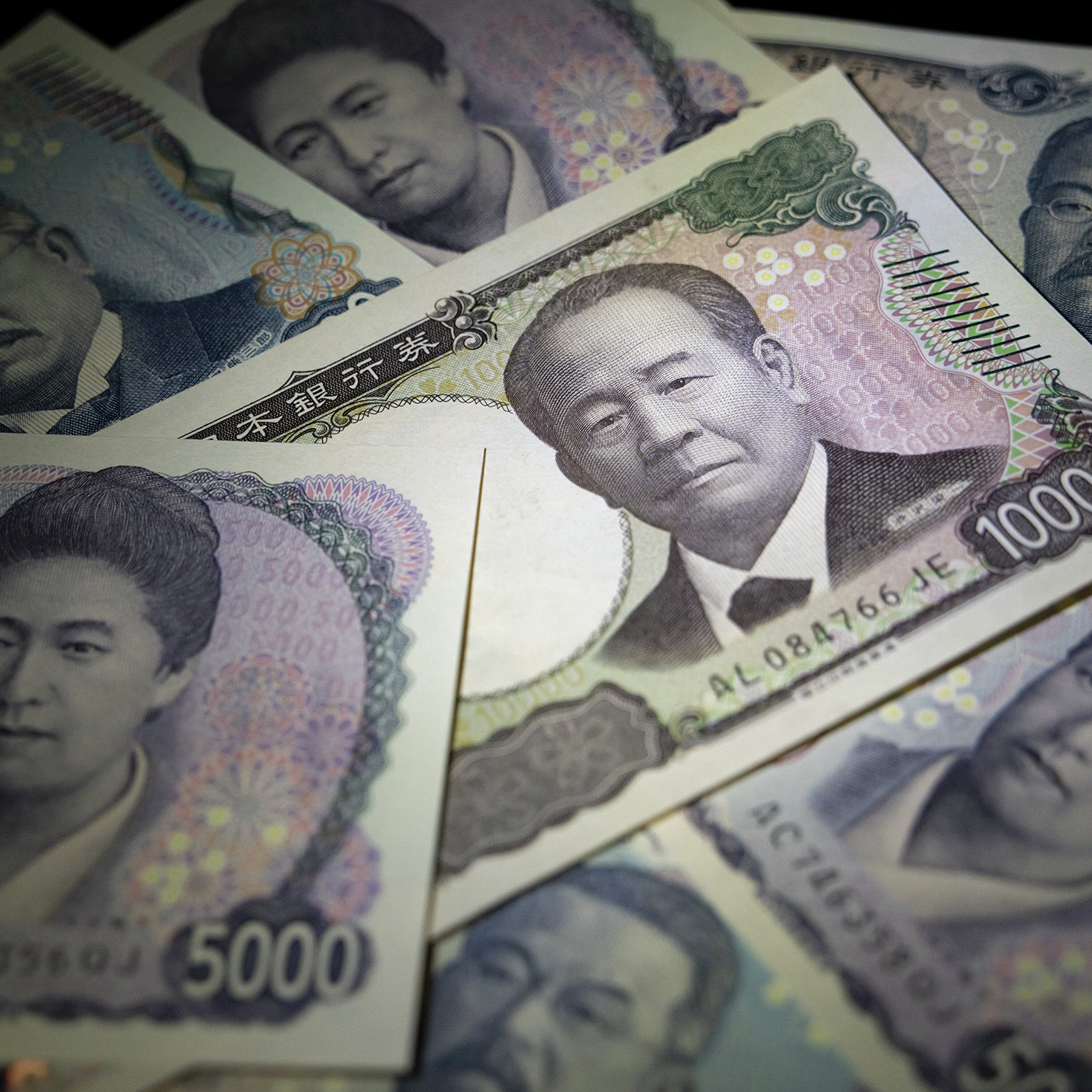
The transcript highlights real-world applications of technology and global financial dynamics. IBM successfully deploys AI in HR to resolve 94% of employee inquiries, proving value over hype. Optum improves healthcare by integrating services for better, more accessible patient care. Meanwhile, the Japanese yen faces severe pressure due to a large interest rate gap with the U.S., driven by trillions in carry trades and high national debt. Investors are aggressively selling yen to fund overseas returns, weakening the currency. In response, Japan and the U.S. have engaged in a rare coordinated intervention—Japan buying yen with dollar reserves, and the U.S. stepping in to buy large volumes—showing that the yen crisis is no longer a Japan-specific issue but a global financial concern. This intervention, while significant, has not yet stabilized the yen, as market forces continue to push it lower. The underlying structural issues—low Japanese interest rates, high inflation from energy costs, and investor flight to higher-yielding assets—mean sustained intervention may be needed. A successful long-term outcome would require Japan to rapidly raise interest rates without destabilizing its economy. The episode underscores how currency fluctuations, especially in the world’s third most traded currency, ripple across global markets, affecting bond prices, borrowing costs, and consumer prices worldwide. Despite efforts, the lack of a fundamental shift in policy suggests ongoing instability and investor caution.
So there's a lot of noise about AI, but times too tight for more promises.
So let's talk about results.
At IBM, we work with our employees to integrate technology right into the systems they need.
Now, a global workforce of 300,000 can use AI to fill their HR questions,
resolving 94% of common questions.
Not noise, proof of how we can help companies get smarter by putting AI where it actually pays off.
Deep in the work that moves the business.
Let's create a small to business. IBM.
Healthcare doesn't always work great.
If you've ever waited on a refill or couldn't schedule an appointment, you get it.
That's the kind of stuff Optum is changing.
They're using data and technology to integrate patient care, pharmacy, and everything else.
So Healthcare is connected, not complicated.
What's that look like?
Cheaper prescriptions that are easier to get and care that looks at the whole person.
How you need it.
Optum is helping make Healthcare work as one for everyone.
Learn more at business.optum.com.
Game night rush or any night of the week, really.
Genius keeps every order moving.
From online ordering to your kitchen to the front counter.
Bigly reliability for any business.
That's Genius.
Bloomberg Audio Studios.
Podcasts, radio, news.
Investors are watching the currency markets with baited breath this week.
As a historic, high stakes intervention by the US and Japanese governments
send shockwaves through the global financial system.
At the center of the storm, the Japanese yen.
It's a quick look at the yen as Japan.
And the US warned of further coordinated action.
In intervention, the US and Japan warned they won't hesitate to defend the currency further.
We haven't seen something like this in 15 years.
President Donald Trump said the joint intervention was a signal of Washington's friendship with
Tokyo.
"They have a weakening yen and they wanted a little bit of help and we're always there
for Japan, Japan."
The Japanese yen had been slumping for months, hitting a 40-year low against the US dollar.
Treasury Secretary Scott Bessent raised concerns about the yen volatility earlier this year.
And currency traders have been on high alert for the US to step in to support the yen.
The most telling clue that the US might make a move came at a cabinet meeting last Friday
at Camp David.
"It's an honor to be here in this historic place."
During that meeting, a photographer looking over Bessent's shoulder spotted something that
caught his eye.
A photographer from Reuters captured an image of Scott Bessent's nightpad and scribbled
across the page were a few words that would soon grab the attention of investors around
the world.
And no peckily displayed online words to do and on it it showed by Japanese yen 5-10 Bill.
That's Bloomberg's Ruth Carson.
She covers Asia's foreign exchange markets from Singapore.
The US stepped in to buy the Japanese yen on Friday.
Ruth says it was a rare move.
The US has intervened in the market for the Japanese yen only twice in the last 30 years.
The fact that you've got the US essentially coming in a way to Japan's rescue shows that
this is not just a Japan problem any longer.
This is the big take Asia from Bloomberg News.
I'm Juan Ha.
Every week we take you inside some of the world's biggest and most powerful economies in the
markets, tycoons and businesses that drive this ever-shifting region.
Today in the show Japan and the US played tag team to rescue the yen.
What's at risk for American consumers if the plan doesn't work?
And why a week yen is a problem for the global economy, not just for Japan.
Ruth to understand what's happening this week.
We actually need to flash back to Japan in the 1980s.
Can you paint a picture of Japan's economy then?
In a word, booming.
The Nikkei gained more than 450 percent over a decade.
It was explosive.
Interest rates were still low.
Banks were gangbusters in terms of landing aggressively.
There was optimism about the Japanese economy, so that fueled a frenzy of buying stocks,
a property, and then suddenly it came crashing down.
In 1989, the Bank of Japan raised interest rates in a big way over the coming months rates
went from 2.5 percent to 6 percent.
It was a mental, crazy increase and suddenly almost overnight.
Growing became so much more expensive.
Credit growth are the bags that were heavily landing just no stifed.
How did that long period of economic stagnation affect Japan's interest rates?
So it went on for decades.
One piece of action over the period of months, a year, ended up being decades of lost growth.
The BOJ eventually cut rates to zero, tried to revive growth, and Japan became the pioneer
in zero interest rates to try and bolster the economy.
But it wasn't until recently that we've seen Japan become to normalize.
After decades of deflation, the Bank of Japan has come under pressure to cool inflation.
In March 2024, the Central Bank exited its zero rates policy, raising interest rates
for the first time in 17 years.
Getting that move, the BOJ's raised interest rates five times in total.
Where are Japan interest rates today?
About 1 percent, okay?
US versus Japan, the interest rate gap at the moment is 275 basis points.
Against Australia is 335 basis points.
Against emerging markets within a nation, for example, there's a 475 basis points difference
with Brazil at its over 1,300.
That's crazy.
So Japan's interest rates are very, very low compared to the rest of the world.
Correct.
As much as a journalist I write about Japan raising interest rates as a trader, you will
look at it and go, "You know what?
I carry trade to buy something like US treasuries or that wind farm in Europe or, you know,
the Cosby, Korean stocks, I'm better off putting my money where I'm going to get growth.
And if I'm going to get a cheap funding currency to fuel that bet, absolutely why not?
And that currency is the yen."
And how does that borrowing in yen and investing overseas put pressure on the yen?
So to answer that question, you need to understand the size of this carry trade investment.
By some estimates, it's over $4 trillion, bigger than the size of India's economy that
is invested offshore.
So investors are selling the yen, trillions of dollars of it, in order to fund investments
offshore that are getting the more bang for their buck.
What does that mean for the yen?
It means continued pressure.
So these low interest rates are really locking in that pressure for the Japanese yen.
And I wonder if you can take through some of the other factors weighing on the yen.
Okay.
So if we take a macroeconomic look at Japan, it's not just a carry trade, which is obviously
fueled by interest rate differentials.
Japan's national debt is over 200% of its GDP by far the highest among developed economies.
On top of that, you've got the ongoing Iran war.
Remember Japan is a huge importer of energy from the Middle East.
And if your import bill is higher because of the war, that only fuels inflation problems
in Japan.
And if the BOJ is seen behind a curve to raise interest rates to combat set inflation,
the yen is another release or escape fall for investor angst.
And one critical component to this story of a week yen is also the impetus of local
investors to invest offshore.
You've got pension titans, life insurer titans that are some of the biggest investors
in the world.
And they have liabilities to match.
They have to pay people their pensions.
If inflation is eating into your returns, do you have an incentive to pull that massive
amount of money offshore back home?
Or do you hedge your bets and continue investing offshore and take only some of that money back
on shore?
All this is not good for the yen.
Now, there are pros and cons of a week yen for Japan, right?
Absolutely.
It becomes more desirable.
It's an edge tube visit, a destination like Tokyo or Kyoto, but there's equally lots
of cons as well.
Well, yeah.
And especially if you are a Japanese consumer, if you're living here in the country, you're
feeling the pain of that week yen, right?
Absolutely.
Import costs and household expenses are soaring.
Spawn businesses are getting squeezed as well.
And that's why we've seen some of the policies that have come through, right?
Prime Minister Sanaya Takahichi with tax initiatives to help with that cost of living.
So that high cost of living has become a huge issue here in Japan.
That's also contributed to really the downfall of the two previous Prime Ministers.
Absolutely right. Voters will vote. And if they are feeling the pain that's stemming from a
weak yen. Absolutely we have seen a downfall of Prime Ministers, leaders who have failed
to address voters' pain and concerns.
This isn't the first time that the Japanese yen has needed support from its government.
After the break we'll find out why the US feels the need to get involved
this time around.
This is the Bloomberg Tech Minute brought to you by ChatGPT.
Now with ChatGPT work, I'm Carol Maser.
Social media posts on sleep outnumber those on exercise by three to one,
and those on diet by five to one according to consumer researcher Rila Global Consulting.
And so it may come as no surprise that there are seemingly no limits to what we will do to get
a good night's sleep. People are spending on everything from pricey sleep trackers,
AI-powered scent therapy machines, to three thousand dollar body temperature regulating
manosphere endorsed mattress covers, and couples outfitting totally separate bedrooms.
As Bloomberg Steena Shanker reports, it all adds up to a sleep support industry
that's a three hundred million dollar business. With growth coming from functional beverages
and sleep powders, even as some experts warned that these products may not be effective,
and can even be harmful. Despite the spend, six out of ten American adults
still don't get the seven to nine hours of sleep the credible science as we need.
As for experts, they recommend making lifestyle changes,
such as getting sunlight and limiting screen time to improve sleep.
That's the Bloomberg Tech Minute brought to you by ChatGPT.
Put ChatGPT to work on your most ambitious ideas and projects.
Get started at ChatGPT.com today by selecting work mode, available on-plus and pro plans.
We believe in starting with your financial goals, not a formula.
At Oppenheimer, we put the full strength of our long-standing expertise to work,
understanding your life and your ambitions, and designing the precise strategies
that build and protect your wealth with confidence across this generation and the next.
Put the power of Oppenheimer thinking to work for you, wealth management,
capital markets, investment banking.
This holiday, the difference between buyers just checking things out
and checking out, comes down to the last few clicks.
PayPal Checkout is a trusted conversion engine fueled by 400 million active PayPal and Venmo accounts.
Add Pay Later and turn Holiday Shoppers into Regulars.
96% of Pay Later Shoppers are repeat users. PayPal Open. Built for all business.
Get started at PayPalOpen.com. PayPal Pay Later Data 8 Markets March 2025 to February 2026.
Repeat users defined as more than one pay later purchase in the past year.
The Japanese Yen has needed a lot of support recently.
Bloomberg estimates that the Japanese government has been spending significant amounts
to prop up the currency, almost $74 billion in April, and more than 80 billion over two days
at the end of last week. It's still unclear how much Washington has actually spent to help lift
the Yen from its four-decade low. The joint intervention was likely larger than those undertaken
in 1998 and 2011, when US contributions didn't surpass a billion dollars. Bloomberg's Ruth Carson
says the huge US purchases show that a week Yen isn't just a problem for Japan.
So the currency market trades at $9.5 trillion a day. A day. Sorry, we're talking the biggest asset
class in the world. The Yen is the third most traded currency every single day in the world.
That shows you the amount of capital that's sloshing about when it comes to YenBets.
So if something goes awry with the Yen, for example in this case it's ultra ultra-week,
its impact isn't felt just in Tokyo or on shore. It's a problem that can fester as far away as
Jakarta through to in a São Paulo. So a couple of key points to note, Japan, for example,
is the largest foreign investor of US treasuries in the world. If they start selling to fund
efforts to prop up the Yen, it pushes down the price of US bonds. It pushes Yen's high and that
means higher borrowing costs for the US. Suddenly, it's no longer just that home owner in Tokyo that's
feeling the pinch. If you have higher treasury Yen's in the US say in the 30-year, that's impacting
that New York mortgage holder. Right. And on top of that, we talked about the Yen
carry trade and it's trillions of dollars around the world and it's cemented, right? So we saw
that. We saw that happen in August 2024 when the Yen suddenly surged and wiped out profits
of hedge funds, stock investors, credit investors were trembling and it's impactful to the point
where it can destabilize global markets. What does it mean for government to intervene in the currency
markets? How does that actually work in practice? In this case, the chain works like this. Japan sells
dollars, which could be backed by assets like treasuries, US treasury bills, to bolster the Yen.
So Japan's finance ministry decides to intervene. We're acting now. The BOJ, the Bank of Japan will
act as its agent. Japan sells US dollars from its FX reserves. It uses the dollar to then
buy the Yen. To put this into context, Japan has more than $1 trillion in FX reserves. That's a
ton of firepower. Yeah. Goldman Sachs in May after April's intervention then said that Japan could
intervene about 30 more times at its April intervention size. And how effective were these
interventions? What happened to the Yen after Japan's government intervened in April?
Okay. So the Yen we can pass $160 per dollar. Japan then conducted a Yen buying operation on April
30th, according to people familiar with the matter. And dollar Yen plunged. It went from around 160
to one of 55 huge, huge moves and wiped off a lot of that bearish Yen sentiment. Did it work?
In short, no, because they had to intervene again recently. Dolly Yen continued to creep higher.
And it comes down to that rate differential story again. So investors came back and it just kept
coming back to sell the Yen. What's your take Ruth on what's different about this latest
intervention? So the US involvement is historic. It's decades since we had seen anything coordinated
like this. But the fact that you've got the US essentially coming in a way to Japan's rescue
shows that this is not just a Japan problem any longer. That sends a strong signal. Whether or not
markets heated is something else altogether. But the fact that they have come out to work together
is highly, highly significant. What's been the message on continued interventions?
Is this the last of it? So if we listen to Donald Trump, he's obviously underlined that friendship
with Japan, which kind of in a way sort of lends heft to further intervention efforts. At the same
time, you've got the finance minister of Japan coming out to say that there will be, there could be
further coordinated interventions. So that definitely puts investors on high alert. This may not
be a one off. It is likely not going to be a one off when that rate differential story is still
very much in play. And Ruth, what does a successful intervention look like for the markets?
It's hard to answer that again because it hasn't worked. So successful intervention one would say
is where the yen does not only strengthen, but keep its strength, where you will get investors
in Japan and mega funds coming out to say we are buying Japanese assets on mass once we are
bullish on the yen. And that sends strong signals to arrest the world that, hey, you know what?
It worked. We are now believing the story of a stronger yen, but I don't see firm evidence of that
Just yet, hmm, and what do you think needs to happen for Japan?
pan to wean itself off of the need for these interventions, race interest rates and raise
it fast and high without destabilizing one of the world's biggest and most important
economies. When I speak to investors, when I speak to traders, the number one reason they
cite as to why they're selling the yen is because of Japan's wide interest rate gaps
with the U.S. and the rest of the world. Now remember we can debate about Bank of Japan
policy and how careful they are and they have to be without destabilizing their own economy
and balancing a week yen so they have their reasons to act the way they do. But while the
Japan interest rate gap with the U.S. is so large, investors will still return to it
and go, that's a juicy trade right there to keep selling the yen.
I'm Juan Ha. To get more from The Big Take
and unlimited access to all of Bloomberg.com, subscribe today at Bloomberg.com/podcastoffer.
If you like this episode, make sure to follow and review The Big Take Asia wherever you listen
to podcasts. It really helps people find the show. Thanks for listening. See you next time.
If you listen to financial news, you know a lot of time to spend thinking about what's
next. The next opportunity, the next investment, the next move. But sometimes what matters most
is being ready for what you never saw coming. For more than 75 years, Cincinnati Insurance
has worked with independent agents to help protect businesses, homes, valuables, and more.
Because planning for the future isn't only about knowing what's next, it's about making
sure you're ready for what you can't predict. Let Cincinnati Insurance make your bad day
better. Find an independent agent at CINFIN.com.
Hey, y'all was up. This is Lonely Rosa from the latest with Lonely Rosa. The podcast.
Remember Varnel Hill from the '97 Crown Martin? He's back. And now a Paramount Plus. More
than 30 years later, Tommy Davidson is stepping back into the spotlight and all new Martin
spin-off. The Varnel Hill show and Varnel has just one question. Did you miss me? Now he's
got network execs, a wild writers room, family drama, and everyone telling him he's passed
his prime. Varnel isn't slowing down, bringing raw unfiltered jokes every step of the way.
From executive producer Martin Lawrence, the Varnel Hill show is now streaming exclusively
on Paramount Plus. Some people use ChatGPT to answer questions. Others use it to get real
work done. With ChatGPT work, you bring the goal. Plus real inputs like briefs, notes,
files, feedback, data, and project plans. It can help turn them into an analysis, tracker,
check outline, prototype, or workflow you can review and keep shaping. You stay in control,
giving direction and choosing the final output. Get started at ChatGPT.com by selecting Work Mode, available on Plus and
Pro Plants.
Podcast Summary
Key Points:
IBM integrates AI into real-world business operations, resolving 94% of common HR questions for its global workforce of 300,000, demonstrating tangible results over noise.
Optum is transforming healthcare by connecting patient care, pharmacies, and services into a seamless, affordable, and holistic system, improving access and care quality.
The U.S. and Japan have jointly intervened to stabilize the Japanese yen, which has fallen to a 40-year low due to low interest rates, massive carry trades, and inflationary pressures, signaling a global financial shift with widespread economic implications.
Summary:
The transcript highlights real-world applications of technology and global financial dynamics. IBM successfully deploys AI in HR to resolve 94% of employee inquiries, proving value over hype. Optum improves healthcare by integrating services for better, more accessible patient care.
, driven by trillions in carry trades and high national debt. Investors are aggressively selling yen to fund overseas returns, weakening the currency. S.
S. stepping in to buy large volumes—showing that the yen crisis is no longer a Japan-specific issue but a global financial concern. This intervention, while significant, has not yet stabilized the yen, as market forces continue to push it lower.
The underlying structural issues—low Japanese interest rates, high inflation from energy costs, and investor flight to higher-yielding assets—mean sustained intervention may be needed. A successful long-term outcome would require Japan to rapidly raise interest rates without destabilizing its economy. The episode underscores how currency fluctuations, especially in the world’s third most traded currency, ripple across global markets, affecting bond prices, borrowing costs, and consumer prices worldwide.
Despite efforts, the lack of a fundamental shift in policy suggests ongoing instability and investor caution.
FAQs
IBM integrates AI directly into employee systems to resolve 94% of common HR questions, improving efficiency and reducing operational noise.
Optum uses data and technology to connect patient care, pharmacies, and other services, making healthcare easier to access and more comprehensive.
The coordinated intervention is historic, showing that a weak yen is now a global issue, not just a Japanese one, and signaling strong financial cooperation.
Low Japanese interest rates compared to the U.S. and other countries have fueled massive carry trade investments, leading to sustained selling pressure on the yen.
A weak yen increases import costs and household expenses, squeezing businesses and contributing to higher inflation and cost of living concerns.
The yen is the third most traded currency globally, so a shaky yen affects markets worldwide, including U.S. bond prices and mortgage costs.
Chat with AI
Loading...
Pro features
Go deeper with this episode
Unlock creator-grade tools that turn any transcript into show notes and subtitle files.
 PodcastTranscript AI