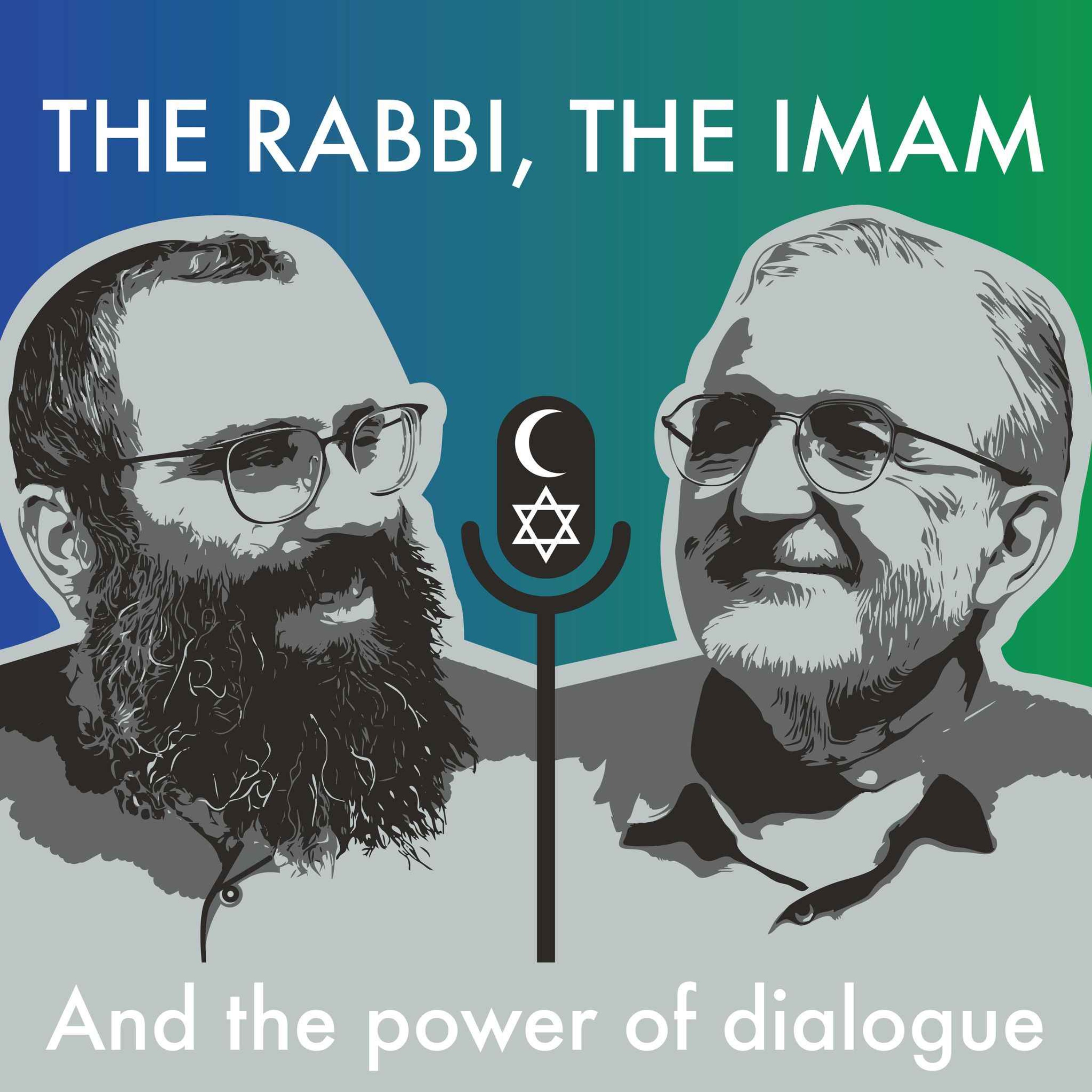
The conversation between the Imam and Rabbi delves into their deep-rooted connections to Palestine and Israel, stemming from religious beliefs and historical narratives. The Imam emphasizes the significance of Al-Aqsa and the Palestinian people, while the Rabbi's attachment is grounded in biblical promises and the longing for the land of Israel. They discuss the complexities of ownership, exclusivity, and the coexistence of different religious communities in the region. The Imam's focus on people's rights and devotion contrasts with the Rabbi's aspiration to live in Israel. They explore the historical origins of the terms Palestine and Israel, highlighting the multifaceted nature of the conflict. The Rabbi expresses a desire to live in Israel, while acknowledging the challenges of displacement and coexistence. The Imam questions the ethical implications of fulfilling religious duties at the expense of others. Their dialogue reflects a shared aspiration for peace and understanding amidst the complexities of the Israel-Palestine conflict.
Transcription
5676 Words, 30814 Characters
Do you know which word we've not mentioned the entire recording?
It's not the Z word, is it?
When you say Zionism has been hijacked, it's hijacked by a group of Jews, just as much
as Islamism has been hijacked by a group of so-called Muslims.
Wow, see, see, NASA, I think we're not going to trouble here.
Hello, Assalamu Alaikum.
I'm Imam Nasser Kourdi.
And Assalamu Alaikum, I'm Rabbi Dovid Lewis.
And welcome to our podcast, the Rabbi, the Imam, and the Power of Dialogue.
Hey, how do we get to do that as one?
That's not bad.
I don't think that was as one, but that was as close as it gets.
So what do you want to talk about today, Dovid?
You know, NASA, in the last show, you said you were Muslim and pro-Palestine.
And you said you are Jewish and pro-Israel.
You weren't born in Palestine.
You weren't born in Israel.
You're from Syria.
You live in Manchester.
You've been living here since 1977.
Why do we both have such strong allegiances to place that thousands of miles away?
We really did not question this, did we?
So how do you want us to answer these?
You know what?
I'll let you go first.
The correction for Muslims is specifically to Jerusalem and the holy sites.
So as a Muslim, that is the quintessential connection for me.
But then there is the cultural connection, which is for the Palestinians.
So it's not now necessarily the land itself, because how do you define the land?
How do you define the borders, etc.?
It's not an easy question to answer if it is asked in a way that would force you to
be specific about it.
But if I turn the question back to you, what is it about you as a Jewish person associate
with the land and with the people of that land?
You know, you soundly very Jewish here, as Jews are renowned for answering a question
with a question.
So when I ask you a question, you've answered it with a, "I've been around you far too
long."
Oh, no.
It's never far too long.
You've been around me long, but it's not too long.
Please God, we should be around and spending time together for a long time.
So what is my Jewish connection, because I'm British, my family is British, my grandparents
fought for King and Country in second and even in First World War for England, but I'm
a Jew.
So what is my Jewish connection to the land?
Theological.
It was a land that was sworn to our ancestors.
So my connection is a religious one with three and a half thousand years of history, that
one strip of land, which when we became a nation, we were promised.
Now as a believer, I don't just look at that as being something written in a Bible, but
rather as a word of God, this will be your inheritance and a place where we got to a
place where we actually developed our kings, our prophets.
It's where our holy books were written and it's also where we've always yearned to go
back to.
It's the place where we lived as a nation for over a thousand years.
So my identity as a Jew is something that's always looked towards the holy land.
When we pray, we pray towards the land of Israel.
When we say our blessings, we refer to the land of Israel.
When we get married, we refer to the land of Israel.
Every Shabbat, every Saturday, we always refer to that land of Israel from a religious perspective,
not talking about the 1948 or '67 borders, but a spiritual land, which is also the physical
land where the state of Israel is now.
Yeah, I'm absolutely listening to that and I feel it because, you know, as a person of
faith, I relate to that, I relate to what you're saying.
But in your answer, there's a couple of points, which is, is it that you have a belonging
to the land or is it that you think the land belongs to you?
Is there a distinction there when one talks about this?
And if that is the case, what sort of borders are we talking about as well?
I'm a rabbi, my map is a map of the Torah, the Bible, and in it, Israel has a number
of different borders in its smallest form.
As my late father always used to remind me, Elat was not part of Israel, yet in its largest
and most expansive form, Damascus and Syria was.
So as a Jew, my connection is to that land.
But you asked the question, does the land belong to me or do I belong to the land?
Does that small strip of land belong to the Jewish people or do the Jewish people belong
to the land?
And you won't be surprised to know, Nasser, that is something that the Bible itself speaks
about, that the land belongs to God.
In fact, it's why the Bible begins with, in the beginning, God created heaven and earth,
telling us that it's by His grace that we're allowed to utilize any of it.
And God says there that if we behave properly, then we will have the right to inherit and
continue to live in the land, meaning to say that we will have an ownership of the land,
but also that it is an ancestral land and we belong to it.
So actually both of them, we are a people, a nation, a religion that belongs to this
strip of land with fascinating borders and no one time we're going to have to delve a
little bit more into, dare I say it, from the river to the sea?
We will be talking about that.
Okay, so I mean, this is something really interesting because we're both talking about
things that probably we would not have been able to listen to each other talking about
if we did not have the friendship that we have.
So the next question is, talking about how, I mean, when I say you, I'm encompassing the
Jewish sort of approach to that, I mean, is it that when you say there's that ownership,
does the ownership extends to the term exclusive?
And the reason I'm asking that is, you know, I mean, I can see all the goodness of what
comes with somebody who is pious, who's God fearing, you know, who, as you say, it's,
it's a trust, you know, not just an ownership, but a trusted ownership, because if you do
well, then, you know, you will inherit the land.
Now when we come to what is happening now, is the fulfillment of what you're talking
about, what we see unfolding on that land, and would the word exclusivity be the stumbling
block?
You know, that's the advantage of having had a friendship for so many years.
But also, bear in mind, this podcast was born out of 16 months of you and I going into schools
and talking about this with thousands upon thousands of students is that I've heard you
use that word before to me, and I believe you said to me once that, David, it's okay
if you own the land, but it can't be exclusive.
And I'm not going to say it triggered, I don't want to get triggered, but it did get
me to thinking, can we have ownership of a land that is shared for a long time Jews and
Muslims lived side by side in a shared land?
Yes, there were problems.
But do we have exclusivity now, we could speak about the Bible, we could speak about it only
belongs to us and any non-Jews that are there have got permission to dwell amongst us.
But I believe we're at the moment in the 21st century.
Is England the exclusive right of an Englishman, or do we allow other people to come along
here?
Of course we do.
We live in a time where they're not even migrants anymore, but everybody moves here,
they're on everywhere.
So does a Palestinian, does a Muslim, be they from Syria, Gaza, Egypt, Jordan, anywhere
have a right to come and live in the land?
But let's go back to that original question now, sir, because I let you get me sidetracked.
I want to ask you again, because I've told you why I believe, I believe I've answered
the question from a religious perspective, but why from a religious perspective does
a Muslim do it?
Explain that to me.
What's holy about the land for you as a Muslim?
My connection is with the people of Palestine, of all backgrounds, and I might even throw
something here, which is, you know, a lot of Palestinians who are now Palestinians and
Muslims, three, four, five, six, seven centuries ago, they were not Muslim.
And some of them are actually descendant of, of the Jews that were living on that land,
who at some stage converted to Islam.
So why am I connected to them?
I'm connected again, you know, Islam tells us that the area in the holy land, which is
around the Temple Mount or, you know, Muslims would recognize Al-Aqsa is there.
So this is what we call holy, and it is in Islam.
Sorry.
What's, what's, what's Al-Aqsa?
In the Quran, the Al-Aqsa mosque was, was, which means, by the way, it means the furthest
away.
Al-Aqsa means the furthest away.
It's mentioned by name in the Quran and is defined as that holy area, which Almighty
God had made holy for the Muslims, the Christians and the Jews.
It's a place where, where these religions meet together.
And it's an area, it's called Masjid in, in, in Arabic.
Masjid means it's a place of prayers.
It's a place, not just prayers, it's a place where people prostrate, so Jude is to prostrate.
So the people who, who would be living on that land are the people who are most obedient
and pious to the Almighty.
And they're there to serve the Almighty.
And that is the connection.
It's that it's termed as the third holiest place for Muslims.
I wanted to know why you as a Muslim really support the Palestinians, included in that,
implied in that, that there are, there are lots of other Muslims, there's over 15 Muslim
countries.
Why the Muslims of Palestine?
Why the Palestinians?
And in your answer just now, you said that when in the Quran it mentions Palestine, it's
a place where the people there are the most religious.
The word Palestine is not mentioned in the Quran in that.
The Philistines is mentioned in a said.
As a different nation.
No, no, no.
As, as people.
And what about Jerusalem?
No, I don't think Jerusalem is mentioned by name.
I mean, if you opened up the books of the Bible, the Jewish Torah from Genesis through to the
book of Chronicles, 24 books, you will find the name Israel as a people, the name Israel
as a land, Jerusalem as a capital mentioned, I think it's nearly 700 times.
For me as a Jew, the land of Israel is absolutely connected, the people, the location absolutely
connected to me from a religious perspective in my holy books.
But I guess you're going to Google it now just to check to make sure is Palestine is
Jerusalem mentioned in the Quran because if it's not, we're going to have to say that
may be why it's your third holy site.
So you've told me why the Palestinians, because that's where they're going, the people that
live in there are going to be the most obedient.
But over there is never actually mentioned.
You as a Syrian could be the most obedient Muslim.
You don't have to be living on that strip of land.
I can see where this may be heading.
But when we talk about Jerusalem, the fact that it is mentioned by name, what emphasis
does that give it?
For us, it is mentioned in the Quran by place and by devotion, but that is what it is intended
to be.
Secondly, the word Palestine, when did that come into existence?
So when we talk about did Palestinians live on that land?
The word Palestinian did not exist five, six hundred years ago when the Crusades were taking
place.
They were not crusading against Palestinians.
They just wanted to go and capture Jerusalem because of what you mentioned, the relevance
of it that Jerusalem has, the holy sites have to the Bible, to the Christians and to the
Jews.
The term Palestine, I think came much, much later and it is now defined as that strip
of land, which is again, as you say, it's not biblical because Damascus is in Syria and
it's not included in that biblical sense.
So the current borders force us to use terminology, which is not that accurate if we want to relate
it to history.
The reason the word, the name Palestine was given, it related to the Philistines which
lived there, but they're not the same Palestinians as we have.
You know it's interesting you mention that Nasser because in 1948, when the modern state
of Israel was formed, all their previous paperwork had the name Palestine written, of course,
in Hebrew letters plus the abbreviation Aleph Yud, which means Eretz Yisrael, the land of
Israel.
But where did the name Palestine come from?
Well, Jewish tradition first has it being imposed on the ancient Jewish kingdom by the
Romans after the Second Revolt in the year, memories correctly, in 135 CE.
That's 70 years after they destroyed the Temple of Jerusalem.
What did the Romans do?
They wanted to add insult to injury as they looked at the Israelite bygone foam, the Philistines,
who had lived centuries before then along the Mediterranean coast.
I know.
And they renamed their new conquest, Syria, Palestine.
I know that story.
They removed the name Yehudah or Judea in the Latin in order to try and sever the link
between the Yehudim, the Jews, and Judea, the land.
They ultimately failed, but the name itself, Palestine, that stuck.
But then in the recent history, talking about from the 1500s onwards, when you spoke about
Palestinians, it was the Jews, but sometimes we might sound as if one up over the other.
It's only when we tease out these answers that we get to understand our own and the
other person's perspective as well.
Yeah.
I mean, our dialogue is not about one open ship.
It's really about, you know, what do I know and what do I need to know and vice versa?
So we often understand each other, but just especially for myself, but I think also for
our listeners, I'm just going to try and figure out if I've understood you correctly.
And I get the fact that you're speaking as a Syrian Muslim living here in England at
the moment and have been living here for a long time.
Your connection and the reason why you feel so pro-Palestinian is about the people that
this is a people that lives in that land and this is a people that might be referred to
as the holy land or the place where they're most devout.
So for you, if I've understood you correctly, is that you're pro-Palestinian as the people
have I got that right?
That is correct.
I mean, obviously I'm speaking as somebody who is not Palestinian.
So I have that connection with the Palestinian people and with their rights to live on that
land.
If that makes sense, that is my connection.
Yeah.
I'm not connected to Palestine.
So Palestine is not a place where I would be dreaming to go and live in.
But my connection is with the Palestinian people and their rights to live on that land.
But I would love to be able to visit Jerusalem.
This is something that's been deep in my heart.
I'd like to go and visit Jerusalem.
I'd like to go and visit the Al Aqsa Mosque.
I would love to go and be able to pray in the Al Aqsa Mosque as a visitor, just as much
as I'm a visitor when I go to Mecca and I'm a visitor when I go to Medina.
These are not places where I'm dreaming to go and live there because of my background.
Now, obviously, if you're a Saudi, you would want to be living in Medina and Mecca.
And if you're a Palestinian, you would want to be living in Palestine and Jerusalem.
Well, NASA, just to clarify for a moment, if we may, you said you would love to be able
to visit Temple Mount, as we call it, but in fact, you can.
So what did you mean you would love to be able to?
From what I hear from friends who visited the place and from people who live there, I will
be given privileges because I will have a British passport.
I'm a visitor.
I'll be treated with some form of respect.
And I know from my colleagues that the locals feel differently.
They're not treated in the same way.
And I just feel, am I actually betraying those feelings by going in there as somebody who's
got a privilege?
So it's not that I can't go.
I know that I can, but it's just in my heart, it feels that I'm the privileged one.
And in our history, there's something close to that, but that's a long story, which there's
no need to mention it.
That's the reason.
On the other hand, my friends tell me, please go and visit because your visit will actually
provide the local Palestinians with a feeling of somebody who knows about us.
So there's these two feelings running in my heart.
Ironically, from a political and Jewish religious point of view, I've never been up onto the
al-Aqsa, Temple Mount, as we call it.
So maybe if you do go and you pray, have me in mind as well.
But why I don't go?
A story for another time, I think.
I think the day should come where both of us can be standing there and our hearts are
feeling good.
That is a dream for me, and I'm sure we share that dream, Dovid.
So let me see if I understood you now.
You've mentioned that you're belonging to the land is based primarily on the biblical
text and that's in the Bible.
Can I say the Bible or should I say the Torah, Dovid?
We'll use the common language, so the Bible.
Yes.
Okay.
No, no, that's fine.
It's all right, my friend.
Thank you.
So with the Bible, as you say, there is that inheritance and the promised land.
And as you said, the mention of Israel, and by the way, the word Israel, even though Palestine
and Jerusalem has not been mentioned, but the word Israel, you'll be amazed how many
times the word Israel is mentioned in the Quran.
And it's referring to the prophet Ya'gu, peace be upon him.
And we always refer to the children of Israel, and we also refer to the point where the children
of Israel were promised to go into that land.
In our religion, we know about that, and we feel with the Jewish people that they have
a belonging because the origin of these religions is from that land.
We share Abraham, peace and praise be upon him.
So we understand that, so have I understood you that your reference to that land is based
on biblical texts and how you perceive that Holy Land to be for you as a place of linking
with the Almighty?
Correct.
Absolutely.
I mean, to reference what you said, you'd like to go and visit Al-Aqsa.
You'd like to go and visit the Holy Land.
For me, I want to retire there, preferably I'd prefer to move to Israel and live there
now, but ironically, as a rabbi, my skillset, such as they are, are not in such demand there
as they are in the diaspora Jewish community.
So I want to live, not just visit, I want to live in the land of Israel, as Jews have
wanted to do for millennia, well before 1948 and the modern state of Israel.
Since before the Crusades, since before the birth of Islam, Jews have been hankering and
dreaming of that land.
We say every single year at the end of Yom Kippur, the holiest day of the year, Lashonah
Habab Yerushalayim, next year in Jerusalem at the end of the Passover, when we celebrate
the Exodus from Egypt, and it's about the journey of the Jews, that first journey to
the land of Israel.
We end the ceremony with Lashonah Habab Yerushalayim, next year in Jerusalem.
So my desire, as most Jews, is to go to the land of Israel.
And I would say to you, inshallah, may Allah grant you that, yeah.
Thank you very much.
I appreciate it.
Amin, as we would say.
So yeah, so that's highlighted a difference.
For me as a Jew, and again, I can only speak for myself, how I was brought up for a lot
of my community here in Manchester, and for the Jews that I speak with regularly.
And I'm listening to that, but there is a problem.
And the problem lies in the fact that there are people living there.
So how does that marry with your vision as a person who's going to the holy land to connect
to the Almighty, while at the same time, there is that niggle in the background that I have
to ask someone to leave in order for me to fulfill my godly duties.
Am I understanding it wrong?
Do you actually feel that way?
You asked whether or not we've got to push somebody else aside for us to go along.
Correct.
No, I don't feel that way.
Because that's the political problem now, isn't it?
Yeah.
We've gone through history, we've gone through religion, we're up 2025, and can there be
two states for two people?
Can there be two nations living side by side?
Do we have to push one out instead of the other?
And for that, we're now going to get bogged down with who said what first, you know, when
there were, when we were both living on that land.
So we should be talking principles rather than who did this, who did that, what happened
there?
That will take us nowhere because it's just looking back at history endlessly and it's
looking back at history in a way that will not move us forward, would it?
Correct.
But it is the crux of it all in that for a Jew, this is that absolute connection to the
land and then for a Palestinian, I need to ask that question and I understand the fact
that you can only speak as a Syrian Muslim, does it have to be a connection to that land?
Now yes, it'd be brilliant if both could live side by side.
Sometimes we speak about being colonizers and I look at a map and I see a tiny slither
that is Israel and I see literally millions of square miles, which are Muslim lands and
I think to myself, come on, how can we be a colonizer?
But that's geopolitics.
I want to know about you.
Yeah, no, absolutely.
And the concept here is in the terminology Muslim land.
There is Jordan, there is Libya, there is Morocco, there is Egypt.
They are nations.
They're not Muslim.
They may have a majority Muslims in them, but they're not Palestinians.
As I said, I wouldn't want to go and live in Palestine and I'll tell you, Palestinians
don't want to come and live in Syria either.
So the concept that just because most of them are Muslim, because don't forget, there's
a proportion of Palestinians who are not Muslim as well.
So they're Christian.
Where would they go and live?
But putting that aside, I mean, I don't want to sidetrack on that point.
The word Muslim countries is a misnomer.
You look at the majority of Muslim countries where the majority population are Muslim.
They're not declared themselves as Islamic.
So that doesn't work.
It doesn't fit that easily.
Yeah, that's fascinating because I have to tell you, it's the first I've heard it describe
like that because as a Jew, I'm sitting there, I'm looking and I see to myself, where is
it?
You know, show me square acreage, if we can, of a place where the central religion is Judaism
with permission for all of that.
Understood.
I understand.
Yes.
Show me all the other places, the central point is Muslim.
And you've just now turned everything on its head for me by saying, these places might
be where Muslims live, but they're not Muslim lands.
I find that fascinating.
There's an interesting point as well, Dovid.
And again, I always like to come back to the off of what we're doing here, which is we're
empowering each other to talk openly and pathetically to each other about very difficult things.
I mean, some of the listeners will be having difficulty, but as a Muslim listening to you
and I'm envisaging now a hundred years down the line, let us say the land of Israel now
is totally Jewish and everybody who has been living there before has been asked to leave
and go and live somewhere else.
How would history look back at that period of time?
And would they look back, you know, what a wonderful thing that has taken place?
Look at that Jewish state, or would they look back thinking, you know, something that just
does not sound or look right?
Well, NASA, I don't know what history would say, but I can tell you what I would say.
If in a hundred years down the line, we have a land of Israel secured borders and to use
your words, 100 percent Jewish and everybody has been asked to leave or God forbid forced
to leave.
That won't be in Israel that I would want to go and live in.
The moment there are two million practicing Muslims living in Israel.
If they were asked to leave, they were forced to leave and the Baha'is and the Christians
and the Druze.
If they were forced to leave, that's not an Israel that I envisage.
You know something, Dovid?
It's not an Israel that the founding fathers envisaged either.
You have said something that is amazing and I need to respond to you because it's important
that we respond.
If you're living in the Israel that you've just mentioned, you would want to live where
people live side by side, I'll buy a place next to you and I'll be your neighbor.
You know, having you as my neighbor with that sort of approach to life, to people, I'd
rather be your neighbor there than be a neighbor anywhere else.
And you know what?
You'll finally be able to make me that Turkish coffee with the cardamon in it and we can
sit there overlooking Jerusalem.
If Israel is a place where everyone of every other religion is asked to leave, that's not
Israel.
But if Israel is a place where people of all faith, as it says in its founding charter
that this is a place for everyone to live in, I'm not sure whether it was conscious or
whether it's subconsciously.
I've just mentioned the founding charter and we haven't mentioned one word.
Do you know which word we've not mentioned the entire recording?
It's not the Z word, is it?
Yeah, because for me as a Jew, Israel is a spiritual place.
I don't think Zionism ever saw Israel as being exclusively Jewish.
They wanted a Jewish state but with room for everyone to live in, irrespective of their
creed or religion.
I've really listened attentively to what you've said and we've mentioned that we've
deliberately avoided using the word Zionism because we know it triggers and it triggers
literally everybody on both sides.
But I'm intrigued.
What you've described to me as your vision of Israel, is that what Zionism is about?
Is that your understanding of Zionism?
Zionism for me is two separate things.
There is a religious Zionism and there is a political Zionism.
What I get really upset about when Zionism gets hijacked is when people take the term
and want to hurl it at me as an insult from a political perspective, when I say, "Well,
in a second, Zionism, the concept of Tzioin, has been part of a religious Judaism for
over 3,000 years."
Remember when I said the religious connection to the land?
That is what Zionism always was.
So I'm a Zionist as Jews have been Zionists for 3,000 years, long before 1948, long before
the birth of a political Zionism.
Is your description of Zionism, are you trying to say that this also means that Israel has
the right to exist?
Is that what I should understand by that?
So that is a political understanding of Zionism.
It's not that Israel should have a right to exist, but that the Jews should have a place
to call home.
To go back to the ancestral homeland, although originally political Zionism didn't necessarily
see it as being specifically in Israel, they just wanted a place where after 2,000 years
of persecution having been kicked out of the ancient biblical homeland that they'd have
somewhere to go back to.
But after 75 years of Zionism being in Israel, being in that ancient homeland, then Zionism
now turns out to be, from a political perspective, Jews having the right to live in that land.
So religious Zionism was the connection of the Jews to the land of Israel from a religious
perspective to go back to their home.
Political Zionism started off as Jews having the right to have a place like anyone else.
And now, after 75 years of Israel, Zionism is Israel has a right to exist for all of
its citizens, Jews, Muslims, Christians and Druze, in which case you could be a Zionist
from a religious perspective, ancient Jewish, and now if Zionism means the right for Israel
to exist free from anything for everyone, Nasser, I think I'm going to call you a Zionist.
That is interesting, Dovid.
Two points, I'd like to come back on that.
You know, when you talk about the word Zionism being hijacked, I fully, as a Muslim, I fully
understand what that means because Islam has been hijacked a few years ago.
And we had the birth of the term Islamism.
And I've been looked at, you know, whenever something happens, you know, these terrorist
activities in the name of Islam, which is far removed from what Islam is about, they've
hijacked Islam and they put an ism next to it.
And over the past 25 years, I've been trying to literally fight that hijacking.
So I fully appreciate what you say.
The second thing is, Israel as a multicultural society that embraces everybody around is
something that I would, I would want to see.
I don't want to see Israel as, as a land of exclusivity, you know, the far right taking
on, you know, when you say Zionism has been hijacked, it's hijacked by a group of Jews
just as much as Islamism has been hijacked by a group of so-called Muslims.
So for me, the struggle, which I have been through over the 25 past 25 years has been
an internal struggle within the Muslims' mindset of rejecting that Islamism, because
when Islamism appeared, it wanted to attract Muslims to it, to fuel the fire.
And it's possible that that's what's also happening with, with Zionism is that a group
of far-right Jews with certain ideology wants to hijack that term on the back of Judaism
in order to further their own sort of ambitions.
I mean, does that sound far, far right?
That's fascinating because when I spoke about Zionism being hijacked, I was speaking about,
you know, the, the really vocal anti-Zionists who join in with the marches to the street
of London and everywhere else, and they heal insults against me as a Jew.
They insult me as saying that I'm a Zio.
So the hijacking of the term Zionism, when I was referring to it, was a hijacking by
those that doesn't want, don't want to see Israel exist for anyone.
Yet, you have now said, has the term Zionism been hijacked by right-wing Jewish, for which
I guess you mean Israeli politicians?
You know what, Nasser?
Yes.
We're going to have to unpack this another time because you've, you've thrown something
right at me over here with, with the best of intentions.
They say, I know it's not malicious, and maybe when I'm figuring that one out, you'll also
have time to think because I've thrown something at you as well.
Can I call you a Zionist according to how I've described it?
Don't answer now, my friend.
Don't, don't give us that answer now.
We're going to come back and revisit it.
We should.
I'm going to leave the listeners hanging.
Absolutely.
Assalamu alaikum to you, my dear friend.
And shalom alaikum.
We can only thank our listeners for listening to the Imam, the Rabbi, and the power of
dialogue.
We're still out of sync, but we'll get it better next time.
Know what?
I think that's the most in sync a rabbi and imman have been in a long time.
Podcast Summary
Key Points:
Discussion between an Imam and a Rabbi on their affiliations to Palestine and Israel.
Different perspectives on the religious and cultural connections to the Holy Land.
Exploration of the historical and political aspects of the Palestine-Israel conflict.
Summary:
The conversation between the Imam and Rabbi delves into their deep-rooted connections to Palestine and Israel, stemming from religious beliefs and historical narratives. The Imam emphasizes the significance of Al-Aqsa and the Palestinian people, while the Rabbi's attachment is grounded in biblical promises and the longing for the land of Israel. They discuss the complexities of ownership, exclusivity, and the coexistence of different religious communities in the region.
The Imam's focus on people's rights and devotion contrasts with the Rabbi's aspiration to live in Israel. They explore the historical origins of the terms Palestine and Israel, highlighting the multifaceted nature of the conflict. The Rabbi expresses a desire to live in Israel, while acknowledging the challenges of displacement and coexistence.
The Imam questions the ethical implications of fulfilling religious duties at the expense of others. Their dialogue reflects a shared aspiration for peace and understanding amidst the complexities of the Israel-Palestine conflict.
FAQs
Jerusalem.
Due to religious and historical ties, including promises to ancestors.
It is the third holiest place for Muslims, representing a place of prayer and obedience to God.
The term was imposed by Romans and later evolved to refer to the land, but the word 'Palestine' does not appear in the Quran.
To live in the land of Israel, fulfilling a historical and religious longing.
The Muslim speaker does not feel the need to displace anyone, while the Jewish speaker acknowledges the political challenges.
Chat with AI
Loading...
Pro features
Go deeper with this episode
Unlock creator-grade tools that turn any transcript into show notes and subtitle files.
 PodcastTranscript AI