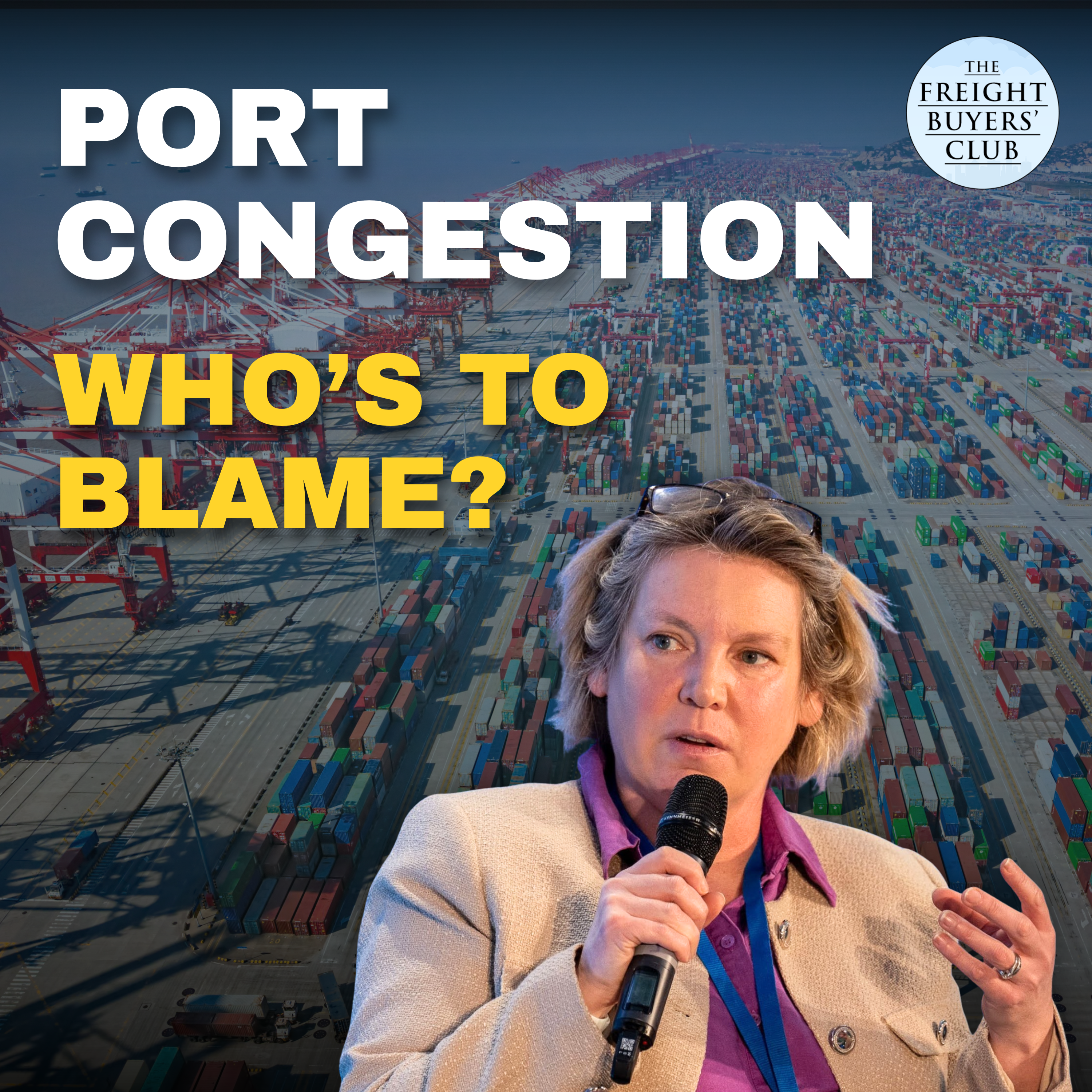
Who's Really to Blame for Port Congestion? Drewry's Eleanor Hadland on Capacity, Carriers and the Hormuz Scramble
37m 58s
Port congestion globally is not primarily due to chronic underinvestment in infrastructure, but rather a complex interplay of factors including the rise in ultra-large container vessels, inconsistent shipping schedules, and weak inland transport networks. While major carriers have significantly expanded their terminal ownership and operations, often to capture higher profits from congestion, these actions have exacerbated supply chain bottlenecks. In Asia, high volume and outdated systems at key hubs like Shanghai and Ningbo lead to severe delays, despite new terminal developments that will take years to materialize. Europe faces challenges from low water levels, workforce shortages, and ongoing upgrades in ports like Rotterdam and Antwerp, with short-term disruptions still affecting regional flows. The Middle East is undergoing a major shift as ports like Dubai and Oman rapidly invest in alternative gateways to avoid the Red Sea crisis, though long-term viability depends on process redesigns and government-backed guarantees. In the Americas, U.S. port development is slow, with automation absent and expansion projects delayed, while the Panama Canal’s shrinking water levels due to El Niño are altering shipping routes. West Africa sees increased volumes and investments, yet congestion persists due to inefficient inland movement and transshipment delays. South Africa’s new terminal concession offers hope, but operational transformation and land transport improvements are needed. Ultimately, resilience is now the key focus, with supply chains adapting to disruptions as the norm. The argument that carriers benefit from congestion—driving profits—suggests that underinvestment is a misdiagnosis; instead, the system is a dynamic, profit-driven environment where ports are merely one node in a larger, fragmented supply chain.
On release of MSQ2 Result CO, Vincent Clegg said it was "port" and their lack of investment
that was to blame for the congestion and delays being suffered by many shippers and forwarders
right now, but was I alone in thinking, "isn't it the carriers themselves who've been
buying up the capacity, both the ships and the terminals, today we'll get into that
plus why the biggest hubs in Asia and Europe are seriously congested. How one closed straight
has triggered a $15 billion scramble to build container ports, the implications of low
water at the Panama Canal, El Nino is striking again it would seem, and we'll look at why West
Africa is attracting lots of investment, but also seeing delays surge. To make sense of
it all, I'm joined by Elna Hadland. She started her career associated British
ports, the UK's largest port operator, before more than a decade, advising ports and terminal
operators as an independent consultant. Today she runs her own advisory practice, Hadland
Maritime and leads Drewy's ports and terminals research. If anyone can tell you where the
report is actually performing or not, it's here. Elna, welcome to the Freight Buyers Club.
Thank you for inviting me, Mike, it's great to be here. You're always very welcome.
Elna, we'll get into all of this shortly, but first some housekeeping.
Hello, if you don't know me, I'm Mike King, and I'm the founder and host of the Freight
Buyers Club, and I'm delighted and very proud to say that in 2026, we're averaging over
20,000 downloads a month across podcast platforms. We're now chasing 10,000 subscribers
on YouTube, and well, you can help. Hit subscribe, hit follow, please drop a comment
to tell us what you want us to cover next. And if you fancy sponsoring a show full of people
who get unreasonably excited about container rate supply chains and air cargo markets,
well, this is what that looks like. Over to Domeco Express Group, literally the best
possible partner you could have if you're in the business of moving cargo out of Asia
to anywhere.
If your supply chain runs through Asia, why not work with a company that's been connecting
Asia with the world since 1971? Domeco Express Group.
Elna, before I get your take on capacity, I want to play something from Mayor Swinson Clare
said around the time of their Q2 call in August. He put a number on exactly the gap you
track for a living. Let's have a listen or a watch of your withers on Spotify or YouTube.
I think that what we're seeing now is as a result of underinvestment in land side infrastructure
for the past 15 years and continued growth in traded volumes, we're starting to hit
and to stretch the limitations of what the land side can actually cope with. It's true
for terminals, it's true for land side infrastructure.
Elna, so Vincent did point to all the failings in the supply chain and more recent disruptions
such as war and weather. That are making these port and hinterland bottlenecks worse and
causing multiple lengthy delays for shippers. But specifically, what was your take on his
claims about the lack of port investment over the last 15 years? Do they stack up to you?
Well, I think it's difficult to say that an industry that's added well over half a billion
to you in capacity has underinvested. And over the same period this 15 years from 2010
to 2025, container volume growth has only been 480 million to you. So we've added more
as an industry is added more capacity than the industry has grown by. And on top of this,
there's also been significant investments to just handle the same traffic so that's the
channel and birth deepening and the ever larger claims to handle the ultra-large container
vessels that now form a really core part of the global container fleet. I guess the question
then is whether this capacity has been built on the right place and where we can see when
we look at the largest ports is that in emerging markets, volume growth is outpaste capacity
growth, whereas the reverse is true in some of the more mature markets such as the US and
Europe. I think it's also really important to remember that port capacity is not fixed.
It's actually a really dynamic concept that is strongly impacted by factors such as dwell
time, vessel sives and vessel arrival schedules, all of which you can largely track back to
shipping lines or shippers. Plenty to unpack, then, Elna. To what degree, as we start out,
should lines be looking in the mirror maybe when we're talking about port congestion?
I'll just throw a few things out there. Mayors can have a gluid and now run in a hub and
spoke network via the Gemini co-operation, for example. And there's also been this concentration
of volumes at a small number of large ports across all carriers. This is a consequence of
bigger ships, the search for economies of scale, networking efficiency, even before we get into
carriers being big term alone as themselves. Is this really the fault of port?
I think you've addressed one of the key things, which is larger vessels. So if we look back
over the last 15 years, then back in 2010, the largest vessels in service were the Musky class
ships, which had a capacity of around 15,000 to you. And concerns were being flagged even,
then that the impact that these larger vessels would have on port operations, on in our transport
networks. Yet the big ships just kept on coming. And we can clearly see, we track 225 major ports
every month using AIS data. And the number of port calls is growing far more slowly than throughput.
And this is indicating basically the increase in vessel sizes. So ports have had to work hard
to accommodate large vessels. And they've had to invest a lot of money to accommodate large
vessels. So as a consequence, the time these vessels spend in port has increased, and much so
has increased at a faster pace than volume growth. But much of this increase in port time is
actually non-productive waiting time. Thanks, Eleanor. Let's get some context before we move to
regional markets. What sort of delays are lines actually seeing at terminals right now? How much
of the global fleet is this tying up? And how is it playing out in terms of the reliability
that ship is actually experiencing? Well, as you can see, average port durations been on a
bit of a roller coaster ride since 2019. And obviously, we can all remember the massive delays
during the pandemic. What would you ever give earn in this everyone working at home and suddenly
needing desks and gym equipment and all of that stuff? Old story. But in what we can perhaps
now refer to as a series of unfortunate events, the war in Ukraine, the Red Sea crisis, the US tariff
policy, and now war in the Gulf. Supply chain disruptions has just persisted, and average port
cool durations have not recovered to pre-pandemic levels. And as I've just said, the high
proportion of this increase is non-productive waiting time. So in 2019, around 17% of total time
spent by container vessels across our sample ports was classified as pre-birth waiting.
And this move rapidly up to hit 24%, at the beginning of 2021, it peaked up at 27%
from more than a quarter of your time on average, which just spent waiting for a birth.
But it importantly, it's not fallen back below that 20% level since. So by 2K26, it's risen back up
to around the 25% level. And that's just not efficient for global supply chains.
No, massive ramifications from those sort of numbers. Just going back to Clegg, what struck me listening
to that? And I know this is true for more than one shipper I've spoken to recently. But all
necks like these are driving huge profits for carriers. We saw that in the mayor's results,
for example. And all the other point here is ocean carriers already control just under,
well, around 45% of the world's marine container terminals. They had a much smaller short
share a decade ago. So what would you say to people in this interview, claim the same companies,
basically the container shipping lines that are benefiting from the squeeze at ports are also
playing a major role in causing it, or is that too black and white? I think probably.
I mean, it's certainly true that major carriers have up the pace of investment in terminals,
and that terminal revenues have increased on the back of these higher storage charges.
But terminal costs have increased as well, because it's less efficient, congested yards are
higher costs to operate. But it's not simply just a demand story, so it's not just a stand-alone
port issue. It's a supply chain issue, and while congestion might be only visible at the terminals,
that's not to say that the problem doesn't sit other upstream or downstream. The root causes lie
all along the supply chain from larger vessels and a loss of schedule reliability. And whatever happened
to fixed earthling windows and a fixed daily schedule where you could rely on the fact that
that service was around my days. The good old days. I know, the good old days. It makes me,
well, it wasn't even that old. It was only 16 years ago. But what are the good old days of excess
capacity and bottom feed in rate where they or not? I'm going back too far. Didn't really affect
the port industry. To a certain extent, yes, you get what you pay for. But the root causes say they lie
all along the supply chain from this loss of schedule reliability, and then onwards towards constraints
on inland transport networks. Portals are simply the joining part in the middle and can't control
everything. So if your port is congested, it's just as likely to be an external cause,
is it is down to maybe a lack of port efficiency or a lack of port labour, which is an internal
factor that as a terminal operator, you might stand a chance of controlling. I'm not really drawing
you on disruption as profit centre for spot rates. Let's keep
going, are we expecting lines? It's just back to that ownership point that I mentioned
at 40, brand 45% of global container term, capacity owned by carriers. That's massively increased
over the last sort of 10, 15 years. Are we expecting that trend to continue and independent
operators continue to be edged out? Is that what liner economics in 20, 26 dictates maybe
that control of the cargo and the ships decides eventually terminally own a ship, at least
where we've got free markets and people can just buy in? Certainly, we see the carrier
investment in terminals as a story that's got plenty more miles to run, especially in
major ports where securing access to capacity is really key. But you need to, I mean, I've
been in the industry since the early 90s and at that time a dedicated birthing agreement
was the route to secure capacity. Consolidation then meant that a dedicated terminal became
a viable prospect and now a dedicated mega terminal is what's needed. But there's still
space for independent port operators that the smaller ports were a single operator who's
always going to be slightly more attractive to the concession authority, but also at major
ports where we're seeing more and more joint venture agreements where carriers, if they're
not able to, if there's not sufficient volume growth to build a greenfield terminal, then
partner up with one of the incumbents and let that local knowledge and experience really
playing your favor, but look into the success of that terminal. A lot of your expense is
going into that terminal, so sharing in the profit is something we see across many industries
and expect this partnership approach to actually be more of a feature as we move forward.
Thank you, Eleanor. Let's look at the Asia Europe trade first that when we're seeing these
delays hit shipers quite a lot on both ends of this. Major storms in Asia to August around
the key low ports really haven't helped this summer, but a lot of ports over in Asia
haven't exactly helped themselves either, I would say in terms of investing ahead of
the curve, that demand curve Shanghai being one example we've covered a fair bit on this
podcast previously has really been struggling for an extended period, but it's not just Shanghai,
there's all the big hubs over in Asia that are having the same problems. Where are these
most evident and are there any investments in the pipeline that might relieve them?
I think it's really important to understand that yes Chinese ports have got behind the
curve, they spent a lot of time with a lot of excess capacity and a lot of consolidation
within the market and perhaps took their foot off the gas, but they spent a lot of time
and money intensifying their operations. And when you're dealing with a large amount
of ultra large container ships, then the IT systems that were in place at the SIPG terminal
operating system is enabled them to run their stacks at far higher levels of utilization
than previously would have been the case. So back when I started in the set to the port
planning manual said stack utilization at non peak time 65%, peaks happen seasonally.
When you move into the modern container terminal peaks happen every single time an ultra large
container vessel comes in and yet you're operating utilization within your stack is 85%
as your norm. The amount of buffer capacity you've got if there's a storm or there's a ship
stuck in the source canal, that's gone now. And when you've got the intensity of coverage
that you've got at Shanghai or Ningbo, it's not surprising that terminals quickly become
overwhelmed. There is some hope on the horizon though. There's a big new terminal opening
later this year in Yangtian. Shanghai and Ningbo are going to be building new terminals,
but they're several years off now. They're under development now, but it takes a few
years to build new terminals and install new cranes. So we do expect to see Chinese ports
continue to be congested. And we've got there are new ports in Vietnam as well and we've
got the, I mean, Singapore's really been struggling despite the tremendous organization
that traditionally had there, but they've got new capacity on stream as well.
Yeah, absolutely. So big investments across the Southeast Asian market, where there's
been this sort of shifting intensity for global export trade, but that's also pushed
a lot of interest in trade between China and Southeast Asia. But as you said, there's
a big expansion project underway now at Port Plan. The two S projects coming online in Singapore,
Tangjiang, Pelopas, which has been under a lot of pressure with Gemini, they're expanding
as well. And then smaller scale investments across emerging markets, so in northern Vietnam,
Indonesia, etc. A lot of money going into the sector in these markets at the other end
of that trade in Europe. Obviously, this summer's low water levels across continental
Europe, but the Ryan particularly hit hard hit, haven't really helped at all. It's caused
more congestion. There's less containers moving by river, more means more moving by road
and rail. We've also had some workforce strikes at various points over the last year, but
your main hubs, they're really struggling at a fair tan in land. How bad is it? And at
which port and when might shippers and carriers see an improvement, are you thinking, if at
all? Well, I think you're exactly right in pointing out the challenges caused by disruptions
on the inland transport network. And this is causing dwell time to rise at these ports,
and as exactly the same situation in Europe, they haven't got that buffer storage capacity.
We are expecting to see some improvements towards the end of the year of Rotterdam as big new
extensions of Rotterdam, well, Gateway and APM terminals come on stream. There'll also
be some relief in Antwerp as DP worlds nearly finished the upgrade of Antwerp Gateway.
But one of the key problems in Antwerp has been the PSA Europa Upgrade project where they've
actually had to take capacity off stream to rebuild births and convert their yard from
straddle carrier into automatic stacking cranes. So in order to make those gains, you actually
get some short-term pain. So challenges abound. And I think Europe is also a very mature
market. It still struggles to get the right labour force over the summer holidays, which
coincide with the beginning of the peak season. And the weather events, that's just problematic.
And once you've got a problem in Rotterdam or Antwerp, which is typically a first port
of call, the knock-on effect around to the German ports just carries on. And right across
the hinterland. Absolutely. So there's problems on the railways, there's maintenance and
upgrade projects there, and definitely problems on the waterways. And I think this is something
in the waterways in particular, much as the you use encouraging sustainable transport.
I think this is a problem that we in Europe are going to have to learn to live with for
quite a long while. Okay, thanks, Eleanor. We'll take a quick break then. Look at what
happening around the world starting with the Middle East.
Is your company expanding into new markets in Southeast Asia and India? Well, why
not let the experts manage all your logistics and regulatory requirements to achieve a smooth
compliant transition? Domeco Express Group, connecting Asia with the world since 1971.
Welcome back to the Freight Buyers Club. I'm my king and I'm with Eleanor Hadland. Eleanor,
I think we've heard quite a lot about ports not doing quite enough to keep up with demand,
but I think there's also plenty of evidence out there about how quickly these investments
can happen when necessity bites. Let's have a look at the Middle East because I think
that's what we're seeing over there. So on the one end of this scale, we've got DP World
flagship, Horba Jabbalali. They saw a 90% drop in throughput in Q2 for obvious reasons
around the Hormuz closure. It's knocked it straight out of the world's top 30 ports.
Before we look at the huge investments happening in the region, can you ever see Dubai or some
of those other big gold ports fully recover their volumes or even their status? Because when
I'm looking at it myself and what if I'm being honest, I find it hard to see a future
where people really view the Gulf and Hormuz as risk-free again, even though I understand
things can change geopolitically very quickly. Indeed, I'm with you, Mike. It's a difficult,
I mean, we're still, it's a live situation. We're still in the middle of it, but it is
difficult to see how you could ever reestablish that status quo given the players involved.
It would need to be a major event for a back to normal type scenario to emerge. So I think
just reinforcing that the future for the ports within the Gulf actually just remains really,
really uncertain at the moment. It's a really challenging time.
OK, what we have seen is a lot of supply chain innovation, basically, frenetic workarounds.
We've covered this quite a lot on the Freight Buyers Club, so I'll just summarise it. Essentially
what we've got is a whole bunch of long, overland routes have been established to reach
the Gulf while also avoiding Hormuz. This is from outside of the strait, or it's across
from the Red Sea, or it's overland from elsewhere, even as far as the Mediterranean. It has been
a good time, let's put it that way, to own a trucking business in that region. There are
signs that these routes might become more permanent over time, trade and oil pipeline investments
are moving forward, but we're also seeing some huge bets on new terminals. I'm going to
run through a few of those. First, Core for Can, still inside the UAE, but outside Hormuz.
We've got a $2 billion investment pledge that the plan from Gulf Tane to the operator
is to take it to $10 million to you capacity port within three years, and already since
start of March, weakly threw up from 8000 to 65000 or thereabouts. Fijero, again, still
in the UAE, but outside the Gulf, DP World, obviously of Jebel Ali fame in Dubai, is investing
hundreds of millions there. Now over in Saudi Arabia, a jetter, we've got a new $434 million
terminal on the Red Sea side. This is a joint venture.
with French container line, CMAC GM, so a container line buying the capacity it needs there.
And in Oman, Salala's revenue up 20% already plus a $3 billion rail line and new
overline corridor is being built, skip the straight entirely. Again, those terminals are outside
the straight of four moves. So there's just four port related developments looking at about 15
billion dollar plus committed in just a few months since the outbreak of war. Is this Eleanor?
Is this just hedging against future conflict around hormones, so like a Plan B? Or do you see this
as a long-term strategy designed essentially to de-risk trade with the Gulf and these developments
are happening almost in real time? Well, also let's not forget that DP World and APM terminals have
done a joint venture in Jedda as well. So certainly, I'll just take Jedda, that's a separate thing,
separate market. Jedda is a viable commercial port in its own right, very different prospect.
So I think we just need to look at the UAE in Oman projects separately. So Jedda, commercially
viable, although predicated on Red Sea security situation improving. When we look at the projects
that are in direct response to the straits, I think it's important to remember that some of these
were in process before the situation. So it's always been an issue at the back of the mind.
Oman wanting to have rail links to the upper Gulf and seeing it as a potential gateway,
albeit with obstacles to overcome. They've been talking about rail for a long while. This has been
an accelerator. For the UAE ports, it's very much seeing this whole situation of efficiency versus
resilience playing out in real time. Absolutely. So in port to view these, as you've already done
in the context of what else are they doing? Because there's more important trades to the Gulf than
containers. So obviously a lot of containerized traders, the food and provisions and the
manufactured goods that people rely on. But the wealth comes from the liquid bulk trades.
So what are they doing there? And if they're putting in place resilient options for these
trades, then putting in place resilient investments for the container trade is just as important.
So I very much doubt actually looking at them that these projects would stack up commercially,
which is why they've not been delivered to date. There must be some kind of government
guaranteeing that into all of these concession agreements or contracts for the construction.
And I think it comes back down to necessity accelerating and pushing forward
processes. So core for carners definitely moved up, but the processes you would normally have in
place to basically shift from being a can shipment hub to being a gateway hub. They haven't
got the gate facilities. They haven't got, they're doing bonded corridors and they're moving goods
towards ports, which have got the processes set up because they've had to. So longer term is
alternative gateways. They're going to need to look at those processes and almost like move them
back into the customs processes, the finance processes and everything else that goes on
at a port will need to be relocated and redesigned around alternative gateways as well. So it's
not just about the infrastructure. It's about getting those processes that sit behind trade,
upgraded and not realigned to the new normal as well. Just on Jedda, I was over there less than a
year ago. So before the war, that's a grain and bulk shipping confidence actually. And it struck me
that maybe they were ahead of the game here because Saudis being freeing up the grain market.
It wants to become a hub for the GCC. It was built in storage facilities. The rail system was
being upgraded. So it could always be the like almost like a reserve in case of these sorts of
problems happening in the future. It's almost like they would already imagine done like some of the
major players on the geopolitical front that hall moves could be closed. But do you, with these
investments on the container side of Jedda, with these moving forward prior to war or they'd be
and then they've been accelerated or have these been started because of war. I think the two
investments of Jedda were prior to or the two announced investments were prior to the Iran crisis
as it stands now. But I think Saudis got unique geography and the fact that it has two major gateway
ports at Demand and Jedda and a major market in the center of the country. Therefore investments
in cross-country transport were already in place. Plus its Vision 2030 projects
were looking to diversify the economy and carve out a new role for Saudi Arabia as a regional
logistics lead amongst many other things. Tourism, sustainable energy, all kinds of other things going
on under Vision 2030. Certainly the war will have accelerated this but they've got common investors
across majority of the ports sector with the public infrastructure fund holding shares in all
major ports and they've been very proactive in developing ports beyond oil and gas. So I think we
just need to recognise Saudis. It wasn't that it was doing this specifically in case of war.
It just happened to be better prepared when the war came because of its unique geography
and its long-term vision to diversify its economy. Okay thanks Elna. Let's move over to the
Americas. The port sector in the US has been rather quiet since the two big dock worker unions
completed negotiations with lines and port are in interest a couple years back. Any major changes
there in terms of investment speed or like service improvements perhaps. What should US
shippers expect from their local terminals over the next few years? It's not going to be more
automation based on those union deals, is it? No, definitely not automation. There is a few
expansion projects in the pipeline but an American port development pipeline is very, very long
and torturous. So there's going to be further upgrades at Savannah. They're well advanced with
converting the ocean terminal into container handling facility and ongoing expansion at Garden City.
It's going to be a new terminal in Baltimore, the TIL joint venture at Sparrow's point.
And they're also ITS are going to upgrade PIRG in Long Beach but these things take a long time
and there's no prospects of any major dredging below the current vessel size. We're not going
to see ULCVs into the west coast on a routine or regular basis anytime in the near future because
I haven't got the permits to dredge down in Mexico which we still count as part of North America,
APM terminals and Hutchinson have expanded Lazaro Cardenas and there's going to be a new green
field project in Manzanero in Mexico so they're still hoping that they can trade with the US.
Things are somewhat tricky and of course in the Great Lakes Lake Ontario is no more. Lake
America will be counted. For today, for today, for today. Depend, Depend, who's asking a
news telling? Yes, we've heard of Canadian shipers trying to direct as much cargo through Canadian
port as they as they can as well where that's suitable for their supply chain but those
USMCA negotiations are really dragging out. Another thing, while we're on the Americas and I've
mentioned it at the start, Panama Canal's water levels are dropping by the day it seems. This
is the El Nino effect. We're not sure how bad things will get but people are talking about it being
one of the worst on record. What's due results forecast on how this might affect container
shipping choices because using the Panama Canal can be a factor for carriers and shipers in
deciding which coast a service or their shipment comes into. I think you're right there that the
cost is already going up due to the driver's restrictions, those surcharges are in place.
But I think when we look at the market as a whole, there's already been a shift towards the east
coast for via Suez or Cape of Good Hope routeings as more and more American imports shift from China
to Southeast Asia where the traditional routeing via Suez actually had a bit of an edge on that.
So we've got a good understanding of what the magnitude we saw it during the strikes. We've seen
it during previous draft constraints. It's unlikely to be a mammoth shift back to west coast because
of the cost of rail transits and the bulk of the volume demand being on that east coast seaboard.
And also a lot of the investments that ports in the east coast such as Savannah of May to really lock
in volumes and customers into the supply chain or the transport chains that link into the ports
is helping to keep those customers happy. Okay, continuing the mic and Eleanor a global
trek. Let's carry on with Southbound to South America. Where's congestion worse? Is the
much investment going in? What should the trip as expect? Well, looking at my database, the longest
average of birth weighting time in July, which was our most recent full month was Monteverdeo,
Itagia and Buenos Aires all up around on average one day per container vessel.
Santos is back down at about 0.5 days, which is about half where it was this time last year.
But I have to say that given that the largest port, it's a key transshipment hub as well,
for in-region transshipment, congestion remains a really high risk in Santos, probably until at least
the new STS-10 concession comes on stream. All the terminals are operating at really high levels
of utilization. There's limited scope to expand or intensify existing terminals.
And there's been a lot of delays with this concession. So the Brazilian government needs to stop
flip-flopping around and actually get it awarded. Now you've been told, guys, you've been told. Absolutely.
Get a move on. Get a move on. With apologies to India and Australia. Well, Australia. Sorry,
my friends in New Zealand. We're going to be running short of time to reach you, but I do want to
finish on something we've covered quite a bit on this podcast. It's quite a dynamic
market. We've seen some huge inbound volume increases into West Africa over the last year
and a half seem to coincide with tariff policy changes with the US. Some people have called
it dumping. We've also seen a lot of major investments in those ports over the last
sort of decade, but it hasn't stopped port delays increasing. What's going on?
Yeah, I certainly not fair to say that there hasn't been investment in West African ports,
and to a large extent the inflow of capital into these ports is basically unlocked trade potential.
Those carriers now feel confident that mainline vessels into the ports, largely their own.
Lots of bigger ships. Yeah, very modern terminals in Temer, Lomae, Aberjane Point,
while operating vessels far more efficiently often than more established ports in Europe or North
America. But moving the cargo in and out of the port remains a real bottleneck. And some of the
upswing in port time we've seen is down to larger vessels, which obviously need more time in port.
But there is a large amount of waiting time at these ports. And congestion is still prevalent
at some of the out ports which are now served on a transshipment basis from these hubs.
So if you've got a 14 day waiting at maybe an out port in Guinea, then that cargo is waiting
at that hub and causing your congestion. So they've sorted out the main gateways,
stroke, transshipment hubs within the West Africa region. And we now need to see that efficiency
overflowing investment moved down the tiers of ports. And we also need to see greater involvement
between port authorities, customs and thermal operators to get cargo moving efficiently in land.
Just a quick word on South Africa from me and feel free to jump in if you would like to
elnter. We've seen huge delays recently in in Derb and if anyone want to check out how badly some
of those ports in South Africa have been performing and why a flagship on screen now,
like an explainer I did less than a year ago, it's still totally relevant, called the good,
the bad and the ANC. And that will explain some of the challenges that people in supply chain
are having as a result of the lack of investment in ports in the exactly the opposite of what we've
seen in West Africa. I don't know if you want to say anything about South Africa, Edela Eleanor.
Well, I think it's good that they finally resolved, at the beginning of the year, they resolved
the award of the Derb and Gateway Terminal Concession to ICTSI. ICTSI have a strong track record
in coming into markets where as shall we say, challenging labour conditions and challenging
operating conditions. But this is by far one of the biggest investments they'll be making.
And they're still only a joint venture partner with transnet. So actually having executive
control over that change, they need to negotiate carefully with their partner. They're typically
typical port concession. They would have 100% control. This one is a joint venture. So we're
hoping they can make some changes, but it's not going to happen quickly. It's going to be take time
to upgrade the equipment, but more importantly, change the operating and working practices.
And then importantly, we'll start to see them push back at those inland transport networks
where there's inefficiencies on road and rail as well. Just feeling a slight gap there. So if anyone's
listening, oh, transnet. So that's the state-owned port operator or port owner. It's been slightly
mired in corruption. Lots of things disappearing. It's been one of the main problems. Now there is
hope and optimism in South Africa. That new management is going to turn that around. So good
look everybody there. A couple of quick fire questions, Eleanor. It just as we're finishing up.
If you're afraid by what should you actually be watching over the next two years,
where do you think we'll see real terminologistics improvement and where do you think things will
stay stock or maybe get worse? Well, I think resilience. We're moving into a world where resilience is
key. My favourite word. Hey, I've made you happy today. Yes. As I say, this series of unfortunate
events, disruption is now the norm. So ensuring that you have a plan B is important. We should see
some relief. We're moving to the winter season in North European ports and there's more capacity
coming. It's visible. The cranes are on site. They are being commissioned as we speak.
But there's a longer time frame on many of these Chinese port upgrades. So much as
Asian markets are able to construct far quicker than say they're European and North American
counterparts. They didn't start during the pandemic or in the immediate post pandemic. So they're
only starting now. So expect to see ongoing congestion issues in Shanghai and Lingbo,
in particular, the two of the largest ports in the world. Huge volumes moving through them.
Usually efficient port operations, but just overwhelmed by the volumes that are moving forward.
I don't want to be like a dog with a bone, but yeah, I'm going to go take you back to Vincent
Clare at Mexico, because that's where we started. So the more I think about this, Elner,
the more I do cast some doubt, and this is not just me. There's other people have said this to me,
so I'm like, I'm conveying their thoughts. And their doubt is about whether lines really don't
really want an end to poor congestion or other disruptions, because disruptions are bottlenecks.
There's no doubt that these drive carrier profits to a degree. So I guess is chronic
under-investment really something to complain about when it's good business for them? And looking
ahead, will the Vincent Clare of five years from now be making the same complaints,
or will he be saying something completely different? Well, I don't think you can argue chronic
under-investment. The terminal has expanded. It's just each terminal operator is invested to make
their business, which they get paid for more efficient. So, oh dear me, terminals are no longer
providing spare and free buffer capacity for the rest of the supply chain. I've been in the port
sector 30 plus years, so that's always what I'm going to say. Why would they? Why would they?
Why would they? Because they're business. You could pay some more, and get some more.
They go vintage. That's how the world works. But he operates ports, and APM terminals
banked profit of over a billion in the first half, so he's probably not complaining about that either.
And I don't want to upset APM terminals or masks. They're both brilliant companies.
You can blame me. Elma Hadlin, thanks for joining me today on the Freight Buyers Club.
And thank you very much for inviting me to join. As always, it's a pleasure to discuss the critical
world that ports playing global supply chains. It's my thing. It's your thing, isn't it? Just,
I love talking about it too. Okay, thanks everybody. A couple of shout outs. DeBerco Express,
thanks so much for supporting independent journalism. They really are the best partner if you need a
shipping or air cargo solution on the trans-Pacific trade and beyond. And also gratitude, of course,
to Karen Ball and Tom Matthews for their stailing production skills. Apologies, I left you out
on the last podcast. Please forgive me. And don't forget you can find us on all major podcasts,
platforms at the Freight Buyers Club.com. And of course, in video on Spotify and YouTube. If you
enjoy what we do and want to help us keep this content free, please take a second to like,
subscribe and leave a comment. It really does help us keep things rolling. We're specifically
trying to reach 10,000 YouTube subscribers. So please click the button below if you're watching there.
Thanks everybody. I'm Mike King. This is the Freight Buyers Club. We'll be back soon.
[Music]
Podcast Summary
Key Points:
Port congestion is driven by a combination of supply chain disruptions, including larger vessel sizes, reduced schedule reliability, and inadequate inland transport networks, not solely by lack of port investment.
Major carriers now own about 45% of global terminal capacity, using terminal investments to boost revenues and efficiency, which contributes to congestion through higher storage charges and less operational flexibility.
Regional disruptions—such as low water levels at the Panama Canal, storms in Asia, and geopolitical conflicts in the Gulf—have intensified delays, while new investments in alternative ports (e.g., outside the Strait of Hormuz) reflect a strategic shift toward resilience rather than just short-term fixes.
Summary:
Port congestion globally is not primarily due to chronic underinvestment in infrastructure, but rather a complex interplay of factors including the rise in ultra-large container vessels, inconsistent shipping schedules, and weak inland transport networks. While major carriers have significantly expanded their terminal ownership and operations, often to capture higher profits from congestion, these actions have exacerbated supply chain bottlenecks. In Asia, high volume and outdated systems at key hubs like Shanghai and Ningbo lead to severe delays, despite new terminal developments that will take years to materialize.
Europe faces challenges from low water levels, workforce shortages, and ongoing upgrades in ports like Rotterdam and Antwerp, with short-term disruptions still affecting regional flows. The Middle East is undergoing a major shift as ports like Dubai and Oman rapidly invest in alternative gateways to avoid the Red Sea crisis, though long-term viability depends on process redesigns and government-backed guarantees. S.
port development is slow, with automation absent and expansion projects delayed, while the Panama Canal’s shrinking water levels due to El Niño are altering shipping routes. West Africa sees increased volumes and investments, yet congestion persists due to inefficient inland movement and transshipment delays. South Africa’s new terminal concession offers hope, but operational transformation and land transport improvements are needed.
Ultimately, resilience is now the key focus, with supply chains adapting to disruptions as the norm. The argument that carriers benefit from congestion—driving profits—suggests that underinvestment is a misdiagnosis; instead, the system is a dynamic, profit-driven environment where ports are merely one node in a larger, fragmented supply chain.
FAQs
While underinvestment has contributed to congestion, the industry has actually added more capacity than volume growth over the past 15 years. Much of the issue stems from dynamic factors like vessel size, scheduling, and inland transport inefficiencies, not just lack of investment.
Larger vessels, especially ultra-large container ships, require more time in port and have increased dwell times. This has led to longer port durations, with non-productive waiting time rising from 17% in 2019 to over 25% by 2026, despite volume growth.
Major carriers own around 45% of global terminal capacity and have invested heavily in terminals, boosting storage charges. However, congestion is a supply chain-wide issue, with root causes including vessel size, schedule unreliability, and inland transport constraints.
Asia’s top ports like Shanghai and Ningbo face congestion due to high vessel intensity and limited buffer capacity. Europe struggles with low water levels, labor shortages, and transit delays, especially in Rotterdam and Antwerp, where upgrades are underway but take time to deliver relief.
Yes, major investments in ports like Dubai, Oman, and Saudi Arabia are being made outside traditional routes to avoid risks like the Hormuz Strait. These projects are both a response to current disruptions and part of long-term strategic diversification efforts.
Improvement is expected only gradually. While new terminals in Shanghai and Ningbo are under development, they take years to build. Current congestion remains severe due to high vessel traffic and lack of buffer capacity during storms or delays.
Chat with AI
Loading...
Pro features
Go deeper with this episode
Unlock creator-grade tools that turn any transcript into show notes and subtitle files.
 PodcastTranscript AI