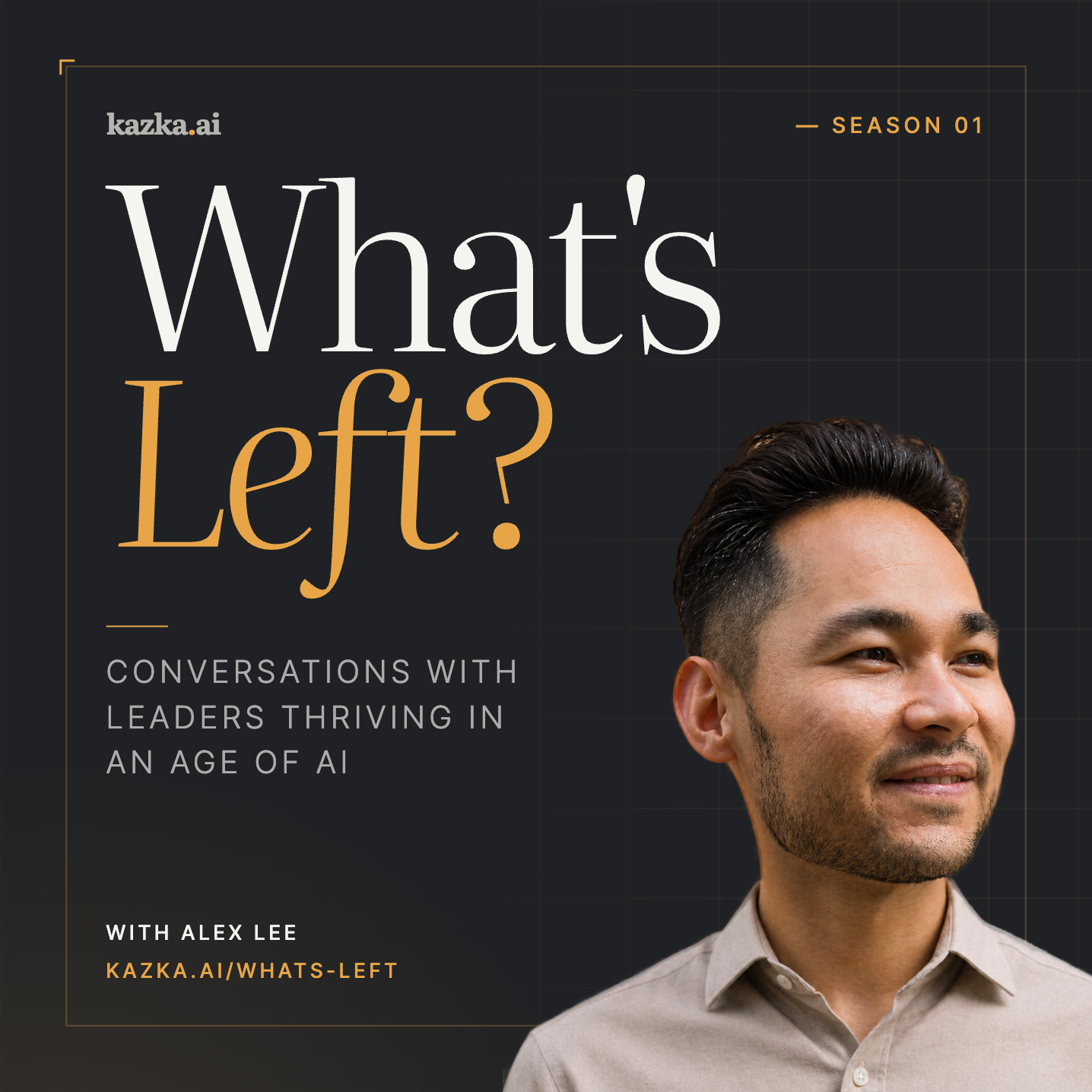
Where We Don't Put AI | Marian Pulford, Founder of Kestrel Labs | What's Left Ep. 03
38m 54s
Marian Pulford, founder of Kestrel Labs, shares her journey from an art background to building a platform that helps architects navigate building code compliance. Inspired by her experience managing a $5 million adaptive reuse project, where permitting was painfully slow, she co-founded Kestrel with her architect husband. Using AI tools, she created a prototype that compared building designs against dense legal codes, which resonated strongly with architecture firms. After validation, the company joined Techstars, hired a CTO, and launched a robust product now used by paying firms.
Kestrel strategically integrates AI: it processes vast legal documents and explains violations to users, but core error detection is deterministic and auditable, building trust in a high-risk industry. The company also tackles institutional knowledge loss by allowing firms to share approved interpretations from local jurisdictions. Pulford sees AI as a tool to eliminate tedious work, giving architects more time for creativity and innovation. She stresses that while AI accelerates creation, it raises the bar for taste and accuracy, urging creators to consume quality media and avoid producing generic content. She also values mentorship and external perspectives over a solo-founder myth, emphasizing that strong support systems and clear judgment are essential for effective AI use. Ultimately, Kestrel aims to make construction smoother, not frictionless, maintaining accountability and professional expertise.
The actual detection of errors within our system is all deterministic. It is all a logic system so people can audit the response, really believe what this software is telling me. We take away the less fun parts of people's jobs and give them more time to be creative and think and be a little bit more abstract.
It is so easy now to create things that the bar for both taste and accuracy needs to be significantly higher than it has been before.
We are here today with Marian Pulford, the founder of Kestrel Labs.
Marian and I had the chance to meet at an AI conference in 2023, right?
I think it was.
I think it was 2020.
2023, yeah.
Yeah, Imagine AI, and this was probably the first AI-focused conference that I went to.
I would love to hear about your side of the story, Marian, and we just had a great conversation, and we had the chance to work together, and over the past year and a half, Marian's been building Kestrel Labs.
So today, I want to hear about her journey, the problems that she's solving, and kind of the role that AI has played for her as a founder for the problem that they're tackling.
And for the team that they're building, welcome to the show, Marian.
Thank you for having me, Alex.
I'm really excited to be here.
Yeah, no, that conference was the first AI conference I'd been to also, and I think it was back when we were talking about custom GPTs.
I think that was like the hot thing at the moment, which is funny because that seems like ancient history, and it was really, I think, almost exactly three years ago today.
So, yeah, how quickly the world has moved on since then.
Yeah, right.
And then in a couple of years, skills are going to be gone, and we're going to be on to something else.
I know.
Yeah.
I'll try to keep what I'm talking about today not time-bound and more kind of best practices from a first principles perspective.
Love it.
Love it.
Well, why don't you explain to the audience a little bit about Kestrel Labs?
Kestrel is a platform that helps architects see whether their designs will get through permitting while they're still in the design.
What happens today before Kestrel is architects spend a huge amount of time reading dense legal text and then comparing it manually to the minutia of what is in their building model.
That is incredibly time-consuming, inaccurate, because no human being can compare a thousand items to each other with accuracy, and is very expensive when something is inevitably missed.
So what we have done is. So what we have done is create a way to see every day inside your existing design tools whether the change that you have made is or is not compliant before that exact decision goes on and affects dozens of other pieces of the design down the road.
What was the original spark that led you down this path in the first place?
It was kind of a convergence of two things.
So I have a fine art background.
With that fine art degree, I went and worked for something called the Rhino Art District.
Here in downtown Denver, we had a plot of land that we wanted to turn into a public park, and that piece of land had dilapidated buildings on it.
So instead of tearing them down, we decided to make an adaptive reuse art center.
So we took those buildings, came up with a design to put in a library, a performing arts center, artist studios, a gallery, a community kitchen, and I raised $5 million for that project and then helped the team through that.
That was my kind of foray into the wonderful world of code compliance and permitting.
It was maddeningly slow, even though our architects had done an incredible job designing the project.
So while we were going through that process, I was talking to my husband and now co-founder, Austin, who's a licensed architect.
And I was asking him, is there something that we are doing wrong here?
This is taking forever.
We keep getting all these comments back.
What is the deal with this?
And he was like,
Yeah, that's just how the industry works.
That's what happens when you go in for permitting.
You get comments back.
It takes a bunch of time.
Everyone loses money and sleep and hair.
And my response was kind of, and everyone's okay with that.
So that put the idea in the back of both of our heads that there would be something that we would both be interested in working on in this realm.
When the chat GPT moment happened, I realized that this was kind of our chance to go in and use the incredible advances.
In AI, to actually process these two massive, unstructured sets of data, the written legal text and the geometry and the 3D design models and compare them to each other to help people see whether their design was compliant and get through permitting more quickly.
I had the lucky chance to see, I think, the first prototype that you built in Replit.
Before then, obviously, you did a lot of incredible work for the Rhino Art District.
And raising all this money and doing all the permitting work.
But did you ever think that you'd be able to build that initial prototype that you did?
And how did it change your point of view into starting this new startup, really?
That's a good question.
The tech world had always kind of seemed like wizardry to me.
You know, I was so impressed with people who were able to take ideas and turn them into something tangible that was actually useful for other human beings.
It's, in a way, very interesting.
It's very similar to what I've done in art and what Austin has done in building design.
You are taking something that lives only in your head or somebody else's head and you make it real.
Something that exists in the world that other people can work with.
So I'd always had so much interest and admiration for that.
And the ability to go in and use these early tools to create something myself really did feel like magic at first.
And the fact that it was all done with.
It was such a natural language and I could just freely think and say, actually, I think it would be great if we could now put in a section where people could enter the interpretations they've gotten from the city and it would automatically make that change for them instead of them having to go through each one and dismiss that violation.
And then the prototype was just like, OK, great.
Here it is.
That was a really miraculous moment for me, honestly.
I love how you put it, because I think about it in this sense, too, of being able to get it from your head into somebody else's.
Head with my background in product management, that's really the number one thing you're aiming to do is whatever vision or workflow or whatever you have in your head and you're trying to get into other people's heads.
It's always been historically very, you know, I think from an architect's point of view, it's the drawings that they do and how they come to life from a fine art point of view.
It's the emotion or the feeling that you want someone to walk away with and being able now to take advantage of that and build it with natural language truly is, I know for me personally.
It did feel magical as well.
What was the path from that first prototype that you built to where Kestrel is today?
So we took that prototype and we showed it to probably 50 architecture firms and essentially said, if this was real, would you buy it?
How much would you pay for it?
What would need to be different about it for you to be really excited about it?
And we had what I believe is a very unusual experience for startup founders where the product that we initially created.
Conceptualized was actually pretty much exactly what people wanted.
They were like, oh, no, that's great.
That's it.
You kind of hit the nail on the head.
Like, can we buy this today?
And we're like, no, this isn't real software.
This looks like software.
This is like a pretty picture that moves that you can click buttons on.
We will go build this real thing for you guys now.
So we built up a wait list of several dozen firms, got some LOIs signed, raised some early angel investment.
And then we got into Techstars, which was a huge turning point.
For the company, we moved to Boston last fall, spent four months living out there, going through Techstars in Boston.
While we were in Techstars, we met our CTO, Brian Kersminski, who's been with us, you know, since then.
And he came in and took the vision that we had put into this prototype and these kind of they weren't even MVPs.
They were really just kind of almost clickable prototypes that gave people the ability to do essential like chatting with.
Building codes.
And he took that and architected this incredibly robust piece of software that is now live with paying architecture firms all over the country.
It's incredible.
And when he first got those prototypes, was it like, did it make sense in his head?
It sounded like it made sense to all of these architecture firms that you went to.
Would you say that that initial prototype was kind of the key to success of making whatever was in your head and your husband's head and translating it to everybody else?
I think it would be so much more difficult to have done this before we could vibe code prototypes just the amount of institutional.
knowledge that you are able to transfer when you have something that functions as kind of a
simulacrum of the real thing that you want to build. It is instantaneous. You can get people
to really feel what you want the user to feel rather than having to conceptualize it for them.
So I think the ability to create our own prototype and really give the sense of what we wanted the
software to be put us months ahead of where we would have been if we'd just been like,
okay, so we have this idea. There's this piece of software that does 3D design and this is how
that would have taken ages. And instead we were just like, here's a prototype. Do you think you
can build the real thing? And he looked at it for a while and did some research. He was like,
yep, I got you. And he did. Amazing. Architecture in general and the whole AEC
industry can be a bit considered legacy sometimes. And it seems like you had really positive
reactions from the firms that you went to, you know, in an industry where AI does these businesses
have some trepidation to adopting technologies like AI. What do you think made you stand out or
what do you think pushed them kind of to really want this for them?
I think it was a few things. We were able to come in the door with a lot of trust just because of
my co-founder's background. He's been in the industry for 20 years. He's done around a billion
dollars worth of work. And he's done a lot of work. In that time, he's worked on massive projects all over the country. So he really
knows construction. He knows architecture. He knows the industry inside and out.
And that gave us a baseline level of credibility that I think a lot of other people have to
manufacture rather than have natively. And then I think that the way that we have chosen
where to put AI in our software and where to intentionally exclude
it from our software has built a lot of trust with the industry. There are places in such a high
risk, high trust industry where a probabilistic system will never be able to gain trust. So
the actual detection of errors within our system is all deterministic. It is all
a logic system that says this element of the building is out of compliance with this section
of text. And it's not just a logic system. It's a logic system that says this element of the building is out of compliance with this section of text.
We can run that same check a thousand times and get the exact same answer. So people can
open up a log, audit the response that they've gotten from us and be able to say,
okay, yeah, I can really believe what this software is telling me. There are, of course,
places where we do use AI because it's 2026 and no competent technologist would build software
without AI in it. But it's to do the things that AI is really good at, not the things that
still require human oversight and auditability.
What is the, if there is a process or isn't, or maybe it was a feeling, how, you mentioned it a little bit earlier, what you're deciding to hand off to AI versus not, and it sounds like what AI is really good at. Can you walk us through an example or some thinking that y'all have done to be able to make those decisions?
AI is a great thought partner. We, there are two places, two kind of distinct places that we use AI in our software. The first is on the front end to process these thousands,
hundreds of thousands, millions of pages of legal text into our database that we can then run these
deterministic checks against. AI is great at that sort of work. So that's the first kind of
foundational place we use AI. Then on the user facing side, we use it as a thought partner
to help explain the violations that are found. So every place in our software that we find a
violation, whether it's a building or a building, you can open it up and see this is the element of the building. This is the section of text, but then there's an explain this violation button that the user can click and read. This is what this violation means. This is why we detected it. This is why it's important for safety or accessibility or energy code. And here are some suggested ways to fix this issue without creating a thousand other issues in a different part of your building. So those are places where AI is really good at.
Is incredibly beneficial for users. Having it do this kind of black box interpretation of where those legal issues exist is not where I would ever feel comfortable placing it.
Did you ever experiment with having it there?
Yeah. And that was some direct feedback that we got during our design partnerships with a lot of early customers is great. I know that this error is correct because I'm an architect who's been in the field for 30 years.
How would my youngest member of staff who got out of grad school a year ago, how would they know to verify this? How can I make sure that this tool is actually teaching people on my staff how to do this work and making them better at their job rather than taking away their critical thinking skills?
And so it was with those design partners and that year of work we did before we released the product that we realized you have to be able to, if somebody really needs to be able to do this, you have to be able to do it.
We wanted to open up a 10,000 line error report and check every single one by hand. And you can if you really want to.
And I think it's interesting how, you know, even though you and I have gone, most people who are building anything AI related always come back to this notion of, yeah, we should probably make that deterministic in some of the things that we've built is like an underwriting system, you know, first using Claude to be able to interpret.
All these different matrices and decisions. But at the end of the day, it's just a giant decision tree to be able to go down. But on this topic of, you know, this individual who has 30 years of knowledge and they're able to just have so much domain expertise, how are you capturing that nuanced kind of knowledge or are you working with these design firms to capture their own individual knowledge? Is that even particularly useful for them? Kind of a random thought from my head, but there could be something there.
Yeah, no, it's it is something that a lot of firms are asking for. We're in this interesting time in the architecture industry where a lot of people are about to retire. And there's kind of this lost middle where people who got out of school during the Great Recession, a lot of them left architectural practice. So there's this kind of missing middle layer for a lot of firms where people have very senior staff who are
retiring and very junior staff who don't have that experience themselves of doing code compliance. And there isn't that group of kind of not really middle managers, but people with a medium level of experience who will be there as the more experienced people retire. And so capturing this institutional knowledge specifically around code compliance and jurisdictional interpretations of the kind of fuzzier parts of building code is something that a lot of firms
do have anxiety around. Bob's going to retire. He's the guy who always knows these answers. Like, what are we going to do? And so we're building something into our software where firms can have an internal library of interpretations from different jurisdictions, and they can keep that kind of silo to their own firm if that's something that they feel like they want to keep in a proprietary database, or they can contribute to a shared database
with other firms who submit in the same jurisdiction with interpretations that they know have been approved by that AHJ in the past. So it is something that is very real. People are concerned about gathering and formalizing institutional knowledge.
And you use the specific word interpretation, and it's because they're, in my layman understanding of this space, a lot of the times code is an interpretation of the code. So you could have
two different subject matter experts with two totally different interpretations of the code. Where does the human judgment play into all of this? And how are you, from a systems point of view, almost kind of like handling bias when there's some different points of view to manage?
So there is about 80% of the code that is truly black and white. It's really like you shall, you shall not, you must. Yeah, there are very clear parameters and conditions that trigger.
Those parameters. Those are the things that a deterministic system like what we have built is perfect for handling. That is what we check today. That is what we give you this auditable report about. That 20% of much more interpretive, much more subject to, let's not say like the whims of the reviewer, but their personal, you know, preference for how a line of text is read is that area where over time,
we can use AI to build up a library of suggested interpretations that are then sent back to the user. And we can say, this is something that in 80% of cases, the AHJ has said, this is the interpretation we go with. You are welcome to follow this interpretation and hope that it is the correct one. You are welcome to contact the AHJ and try to get this interpretation approved. And then we're also building up a library where
with our earliest partners in the
jurisdictions themselves for them to create an approved interpretation library that they have
signed off on that we can then give to people and say okay denver says that for this section
here are the three approved interpretations you may select one and you know that that will be
approved so there are quite a few ways around this that we're working towards but in those
instances where it is a question of interpretation rather than a really black and white yes this has
to be 42 inches we will always show the user this does not have the same degree of confidence yeah
did you ever think you know in this original problem that you would have to be solving for
things like subject matter expertise how to train new employees dealing with the cities themselves
to get official approvals like the problem that you started with sounded so
similar to the problem that you started with but it's not the problem that you started with
it's like i'm just going to tell you where you're off code and now there's all these other things
are these things that are exciting for you how do they make you all feel it is definitely one
of those things where i think if we had known the exact scale of what we were going to tackle
when we started the company we might not have started it because as you say like these new
opportunities do keep appearing in front of us which is absolutely thrilling and exciting
and we're very grateful for them but the nerve that we have hit does go not only throughout the
construction industry but through construction lending insurers government policy at the local
and federal level there are so many facets and nuances to this problem and it affects vertical
construction horizontal construction whether people have roads houses hospitals schools so
this really has a lot to do with the fact that we're in a time where we're in a time where we're
you know the constellation of ways in which what we are building may eventually affect the built
world is humbling it's very exciting but it is also humbling and i think we feel a very strong
sense of responsibility as people who have been in this industry and have a great deal of respect
for it to make sure that what we are providing to people maintains the need for that education
expertise and licensure of the
architect rather than saying we fixed it with ai you don't need to worry about it you don't need
to think like your background isn't relevant anymore so i think we feel incredibly excited
and grateful we also feel a huge sense of responsibility in the scale of the opportunity
that we have in front of us the the thing that stands out to me across all those different
opportunity spaces is that you know historically there's been some sort of relationship between the
architect the constructor even the the local and federal level of government how do you think your
tool and your approach using ai here may or may not have impacted those relationships and how they
exist our hope is that it will make them smoother i don't think frictionless is ever an area that we
will get to in the built world because the stakes are so high and i think a certain amount of
friction keeps everybody very honest but by providing a single source of truth to the
truth that follows a project from its earliest concept all the way through its built life will
provide a degree of certainty around something that is currently very nebulous is not recorded
in any permanent way for every stakeholder and will create a degree of both accountability for
people in a way that will be beneficial to all of them but also opportunity because
when you know the limits of how far you can push a design or what you can build on a site
as early as possible you are then free to be creative up to the very edge of that limit you
are able to make less conservative choices because you know if i do this thing i'm not going to get my
design sent back to me from the city i know this is the exact boundary of where i can take this
design and if let's let's go and
to a potentially imaginary world let's say your system completely solves code review and like that
snap of a finger it's gone it's a thing of the past how do you think the industry would change
and how would people operate in this new world i think that architects themselves would be able to
take a lot of the time that is currently spent reviewing pixels on a screen against lines of
paper they would be able to make a lot more of the creative work that they actually got into the
industry to do more hand drawing more iterations of design more time on site more time with the
clients more time going to museums more time researching more time actually doing that kind
of intangible work that drives creativity itself there is never a limit to the amount of ways that
people can fill their time i think that this fear around if we take away this repetitive
soul-sucking work that people spend their time in every industry doing that we're going to take
away jobs i don't think that's true i think we take away the less fun parts of people's jobs
and give them more time to be creative and think and be a little bit more abstract rather than
sucked into the details of whether every turning radius is correct in their building i love that
and i think that's why we've always kind of resonated with each other is that just focus of
you know giving time back to people and
making them more creative and more impactful but that i agree is a hundred percent the place where
ai has the biggest opportunity and impact in your own personal journey as you've become a founder
co-founder you know how do you use ai in your day constantly it definitely would not have been able
to move as quickly or effectively as i've been able to without heavily relying on
ai i'm able i've always been able to do a lot of quality work quickly but this has really you know
10x my ability to do everything i was able to build our website myself in about two weeks using
quad code the combination of having an art background and tool where i could iterate that
quickly just unlocked a level of creativity that i didn't think i would be able to experience with
web design it was incredibly fun i do think
that the balance between having very strong mentors and advisors and using ai to move
quickly is really important for founders we have several investors whose opinion i
heavily rely on because they've been in the industry for so long they understand startups
they understand risk they understand how to view opportunities in slightly unconventional ways so
if i was just running ahead full steam completely on my own i think that you know the the ability to
move quickly does not always mean that you are moving quickly in the right direction i think the
ability to move very quickly but also giving yourself strong checkpoints and external opinions
that you depend on is a way to create a highly effective company right now that's so interesting
to hear that because you know there's so many people talking about the solo corn
and being able to do that billion dollar company by yourself and for me personally i i wouldn't even
want to do that i i find it so much more rewarding to have different people's opinions to just kind
of shape what you might be kind of siloing yourself into um and get out of that silo just i i think the
one line i use the most in our company is i have strong opinions loosely held yes exactly exactly
and having other people come in with their strong opinions i think is a better way i don't think i
could ever do a solo corn just because a it's super lonely but b to your point you build something way
better and higher quality when you're working with other people yeah people want to mythologize the
idea of being a founder and it's you know there is nobody who gets where they are purely by their own
grit talent ambition i mean you have to look at everything that exists behind them and around them
and supporting them so i think yeah this commentary around the idea of like a solo corn
is really funny to me it's like well if that is the narrative that we want to build up i'm sure
somebody will fill that niche like where did they grow up what does their mom do do they have
somebody doing their laundry who cooks them food like who does their bookkeeping come on like there's
you can do a lot with ai you need a really strong support system around you if you're going to do that
also for anyone new joining your team how are you helping them get to the level of ai adoption that
you're at or are you helping them or is there is that just an expectation that they already have
that type of fluency for there are kind of two tiers here the first is for our engineering staff
um i love hiring people
people who have spent decades writing code by hand and use ai coding tools as a way
to enhance their own abilities not something that makes judgment calls for
them. All of my software engineers have several decades of experience and I trust them to know
exactly when to use AI and when not to use AI. To my earlier point about how we build our software
itself, it's the same thing with using tools to write software code. You have to know when you
trust it and when you need to have oversight over it. But I do expect that everybody has a very high
degree of fluency in the most current AI coding tools. I think that anybody who has enough
ambition to join an early stage startup would naturally have that no matter what. And then for
kind of our design side of the team, our architects, they're both a very interesting
case because they have described themselves as AI skeptics. I don't think that they actually
use the word Luddite, but I think it was near that. And that's been very interesting,
because a lot of what I rely on them for is to draw that line of, no, this is not where we can
trust AI. This is where in professional practice, the architect's liability will come in if they
are not able to say, I made this judgment call based on deterministic information that I was
able to read myself. That being said, they both are getting very into AI because being around
people who are using AI every day, you inevitably see a lot of people who are using AI every day.
But that's been a fun experiment for me to be like, we go back like three or four steps further
than where I am to start explaining how we use these tools. So it's been a good kind of
culture building exercise to say, where do we set kind of expectations? Where do we say,
make your own judgment? Where do we say, really, actually, please don't use AI for that? Because
there are definitely places where I'm like, oh, no, you can't have AI write your LinkedIn posts.
They all sound the same. Please, please don't do that. You have to write your LinkedIn posts
yourself. I hate LinkedIn sometimes. I'm just like, come on, guys. Yeah. You actually can't
use the sentence structure. It's not X, it's Y. Like, you just never, never say that.
Man, that's funny. If I read the word silently one more time, my head is going to explode
loudly, not silently. Man. So, you know, at the end of the day,
you know, you're, you've built something. I love how you've taken an approach of
really looking at a small problem. And a lot of the times and kind of the impetus of this
entire podcast and kind of the question that I see a lot is people have this notion that AI can do
everything we can do. Right. And I love how you have really honed in on a very specific problem
in a historical sense. Like I wouldn't even call you a quote unquote AI company. You're just,
you're solving a real problem. Do you, you know, if we were to apply this grander question,
does this question of kind of if AI can do everything we can do what's left even seem
like a concern to you from your point of view? It's a concern to me because it's a concern I
hear from my customers. I think that there is just this kind of endemic fear, especially in
younger people coming out of school, that they don't know what the future of work will look like
for them. We will figure it out. There has never been a permanent period of time where
advances in technology have put a significant amount of the workforce out of work. People find
new ways to fill their time. There is always more value to be created. We are inherently
productive creatures. People like to create things. People like to have a sense of meaning.
People want their work to feel valuable. The things that AI can take away are not the things
that are inherently human and interesting. They are the things that are very boring,
and redundant, and that nobody actually said, I want to spend 40 hours a week doing this for the
rest of my life. But yeah, I mean, it is a concern to me because it is a part of the cultural
commentary that's happening right now. And I don't think that anybody who is building software that
uses AI can avoid answering this question. I think that it would be naive to say that people shouldn't
be concerned because we create concerns with the narrative that exists, and this is the narrative.
The only thing that I can say that I find reassuring is people are not going to stop
wanting to create just because they have ways to work more quickly. I think people are always
going to want to produce things that they find interesting and that create value.
What do you think is the most important thing to kind of keep in mind when creating nowadays
especially using AI tools? Maybe even not using AI tools? What should folks kind of value or
thought that they should keep in mind? It is so easy now to create things that the bar for both
taste in terms of the aesthetic output and the quality of the output and for the accuracy of what
you are creating needs to be significantly higher than it has been before. You can swapify the entire world.
If you're not careful, you can put anything out there regardless of whether it creates anything of
substance or if it's just regurgitating the collective consciousness that exists on the
internet. People have a responsibility to make sure that what they put out, no matter what tools
they're using, whether it's old tools or new tools, is actually something that they would be
proud to have their name attached to. I think we do have a responsibility to not just drown each other in
a pool of 16-page documents created by Claude and create the exact same bland, shiny, chat GPT images and really have a sense of
discernment about what we create. And I think a way to get there is by spending a lot more time consuming valuable media than just creating. I mean, going to museums, reading actual news, reading books, listening
to music that actual human beings have created, having conversations with other people. It is more important to do that now than ever before because there is just so much nonsense. There is a proliferation of absolute garbage, and we are all going to drown in it unless we each take responsibility for both consuming the good things that are out there and not creating a sea of waste.
Preach, Jess.
I could not agree more on the responsibility.
Yeah, I think that's a big responsibility that, you know, all of us have today. And even at work, if somebody sends me something, and I know, it's not that I know or assume or I judge that they made it with Claude, but it's, did you read every single word that's in here?
Yeah.
Because if you didn't take the time to read every single word that's in here, it's almost disrespectful for you to consider me to read everything that's in here. And that's where I think a lot of that responsibility and accountability lands on.
Well, Marion, it's been so fun to. Yeah, it's been so much fun to kind of hear where your journey has gone, you know, from that first Replit prototype, which I still remember in my head very, very well. I was amazed that Replit at that time built something that was 3D and kind of to the specs of what you're looking for. I personally remember being blown away by it. So I can see why you've had such an impact on your customers and your users and the industry as a whole. Before we hop off, is there anything that you'd like to shout out or bring attention to that you're working on?
I mean, obviously, the work that we are doing is now open for architecture firms to use. You can find it at kestrelabs.com or people could reach out to me directly. But more than that, I would just say I hope everybody takes time to continue to be creative and think about what they're doing and have a sense of kind of shared responsibility for using AI to its best use, not its sloppification use.
I love it. Thank you so much for hopping on today. It was a great chat.
Thanks, Alex. Good to see you.
I'm Alex Lee. I run Costco AI. And over the past two years, I've had a front row seat to how real people and businesses are adopting and shifting. Every episode, I bring in someone who's in the trenches, founders, engineers, operators, owners, and we have a real conversation about navigating AI's impact on their own profession. This is What's Left.
Podcast Summary
Key Points:
Kestrel Labs, founded by Marian Pulford, helps architects check building code compliance during design, reducing time, cost, and errors in permitting.
The inspiration came from Pulford’s experience with a $5 million adaptive reuse project, where slow permitting revealed industry inefficiencies.
Early prototypes, built with AI tools like Replit and vibe coding, were validated with 50 architecture firms, leading to waitlists, LOIs, and Techstars in Boston.
Kestrel uses AI for front-end text processing and user-facing explanations, but relies on deterministic logic systems for error detection to ensure auditability and trust.
The company addresses industry challenges like retiring experts and “missing middle” staff by building libraries of jurisdictional interpretations for firms.
Pulford emphasizes that AI removes repetitive tasks, freeing architects for creative work, and stresses the importance of taste, accuracy, and responsibility in AI-generated outputs.
She credits AI for accelerating her work as a founder but values mentors and external opinions to guide direction.
Summary:
Marian Pulford, founder of Kestrel Labs, shares her journey from an art background to building a platform that helps architects navigate building code compliance. Inspired by her experience managing a $5 million adaptive reuse project, where permitting was painfully slow, she co-founded Kestrel with her architect husband. Using AI tools, she created a prototype that compared building designs against dense legal codes, which resonated strongly with architecture firms. After validation, the company joined Techstars, hired a CTO, and launched a robust product now used by paying firms.
Kestrel strategically integrates AI: it processes vast legal documents and explains violations to users, but core error detection is deterministic and auditable, building trust in a high-risk industry. The company also tackles institutional knowledge loss by allowing firms to share approved interpretations from local jurisdictions. Pulford sees AI as a tool to eliminate tedious work, giving architects more time for creativity and innovation. She stresses that while AI accelerates creation, it raises the bar for taste and accuracy, urging creators to consume quality media and avoid producing generic content. She also values mentorship and external perspectives over a solo-founder myth, emphasizing that strong support systems and clear judgment are essential for effective AI use. Ultimately, Kestrel aims to make construction smoother, not frictionless, maintaining accountability and professional expertise.
FAQs
Kestrel Labs is a platform that helps architects check whether their designs will pass permitting while still in the design phase, by comparing building models against dense legal code text.
It solves the time-consuming and error-prone manual process of architects reading legal text and comparing it to building model details, which is costly when mistakes are missed.
AI processes large volumes of legal text into a database and explains detected violations to users, while the actual error detection is deterministic and auditable for reliability.
In a high-risk industry, deterministic logic ensures consistent, auditable results that architects can trust, unlike probabilistic AI that can't be fully verified.
It focuses on the 80% black-and-white code deterministically, and for the interpretive 20%, it builds libraries of approved interpretations from jurisdictions and firms.
Founder Marian Pulford faced slow permitting while developing an art center, and after discussing with her architect husband, saw an opportunity to use AI to streamline compliance.
Chat with AI
Loading...
Pro features
Go deeper with this episode
Unlock creator-grade tools that turn any transcript into show notes and subtitle files.
 PodcastTranscript AI