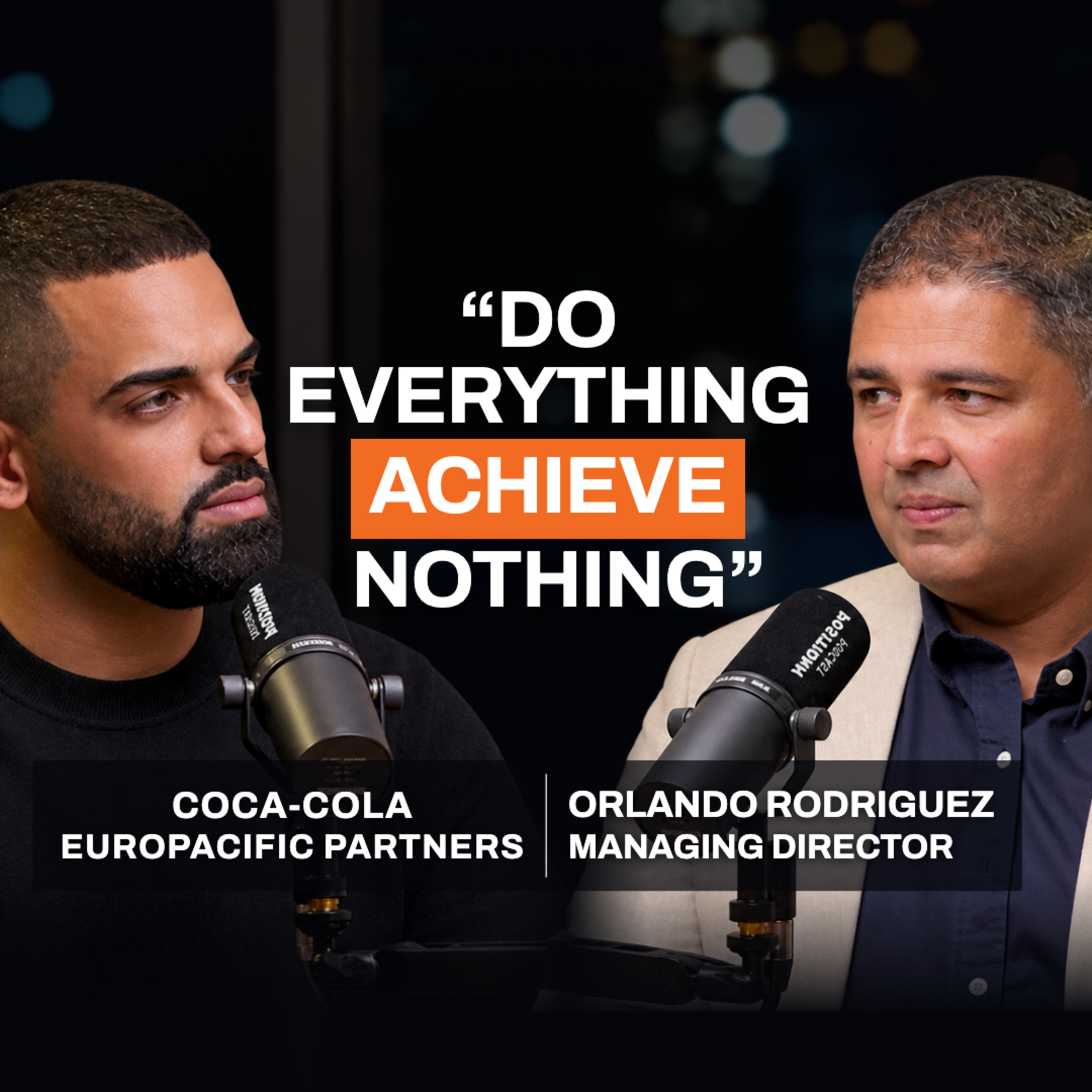
Speaker 1AI can't live in the technical or the IT domain. It is center to business. It has to be led by the business leaders.
Speaker 2My question is, does it matter? How do you draw the value between Johnny producer versus Johnny and their AI producer? Does it matter? Do you care? No, I don't care. MIT's 2025 research found that 95% of organizations are getting no measurable P&L impact from generative AI investment. Now, if you take a multi-billion dollar organization, how do you find the right use case and function? Every team can start with something, but where do you actually start? What do you back and what do you scale? And how do you stop activity turning into very little progress? Welcome to Applied AI Australia. I'm Ramon Rodriguez. This show translates AI complexity into growth, margins, and time. Today, I'm in conversation with Alanda Rodriguez, Managing Director of Coca-Cola Europe Pacific Partners Australia. Alanda, welcome to Applied AI Australia. Good to have you here. Great to be here, Ramon. Thanks for having me. So for anyone that's probably thinking these guys have got the same last name and maybe look similar, well, he is my brother. So I've had the opportunity for a first-class seat into what's going on in his world and his career. We were talking prior to the show about AI and the opportunities and how does an enterprise face it. And you mentioned that a lot of your peers and a lot of the industry are going to be thinking there's so much up and going, where do we start? So let's start there. Tell us a little bit about yourself and what you do today. Well,
Speaker 1clearly I'm your brother. Hopefully people can see somewhat of a resemblance, but I've been with Coca-Cola Europe Pacific Partners for nearly eight years now, four years in the leadership position, which has been terrific. When you say Coca-Cola, most people think about synonymous with lives, not only in Australia, but all around the world, you think of Coke and Diet Coke and Sprite. And we've got other wonderful brands like Powerade, if you're into sports, Mount Franklin and Kirk's, which are iconic Aussie brands. And then in coffee, brands like Grinders, Monster Energy, and in alcohol as well. So there's a plethora of brands, but to me, it's very much like the tip of the iceberg. The largest part of our business, is in the back end. We operate in some way, shape or form in every postcode around Australia. We manufacture in four big locations across the country, and then another dozen or so smaller locations. We've got thousands of vehicles on the road. We've got thousands of technicians and truck drivers all around Australia. And we're really proud to have been here for about 90 years. We're one of, if not the largest food manufacturer in Australia. We create jobs. We've been part of every local community for a long period of time. So it's terrific and a real privilege to be leading that organization, especially in periods that are synonymous with change and the topic we're going to talk about today.
Speaker 2Where do we start? There's a whole heap to unpack there. Things are moving very, very quick. And if I think back on some of the previous conversations I've had, we've had a lot of leaders and executives from the mid-market, from the technology sector, but Coke is different. It's a different end product. You can't just digitize your soft drink, right? But also the scale of your organization. And I'm sure a lot of enterprise leaders are going to be thinking the same question. We know we need to do AI, but where do we start? How do we do it effectively? How are you approaching it? Do you have a thesis?
Speaker 1I've got several trains of thought and we're, we're working through it, but essentially we're an asset rich business. We make things in manufacturing plants, then we use trucks to move them around and we call them in our coolers. So as we think about technology, we've been on a journey for, for several years now. And given we're very heavily into the industrial segment, we've been on a journey through machine learning and digitizing for, for a couple of decades now. So we've learned the lesson around getting, your data, right. And then using insights to then improve productivity. But there's three core tenants that we're always focused on super powering our team members, because we see this as augmenting and enhancing what our team members do. Then ensuring that we make it easier for our customers to work with us, removing friction, improving speed. And then the third aspect is building platforms for our business to grow sustainably and then thrive. And create some competitive advantages. So for us, it's definitely not about bespoke experimentation alone using AI. It's a technology that's wonderful. That's got enormous potential, but for us, the real value is going to be how we leverage it across our ecosystem. So if I can give you an example, we've got a hundred thousand ish customers, roughly 500 SKUs. So there's 50 million permutations of what product we could have in one customer at any given time. And you think about the maths and the potential there in getting it right. And we've been doing that in a manual way with some very clever people and some good toolkits that we had. But when you overlay the AI potential, the realization of speed, speed and precision is immensely different to doing it the manual way. So that's one example, but we're at the beginning of the journey. There's a lot to leverage. And for us, it's really about the full ecosystem coming together and not doing things in isolation because we're large, we're sustainable, we're asset heavy. We've got a great set of platforms to build on. And for us, it's about realizing it all together to leverage what we already have to maximize the value in the years
Speaker 2to come. Obviously a very big organization. One of the things that I'm seeing frequently in enterprise is little pilots going on within the organization, testing and experimenting, which is great. But if you look at the data from MIT as of 2025, 95% of AI investments and strategies are unfortunately failing in some cases. And I think a lot to do with some of the root causes for that would be some of the things that you've alluded to today. So to the point of not doing things in isolation, how do you work out where to start? Because putting AI together is, you know, pulling together all your use cases in your organization and just doing it isn't easy. I would imagine you would have thousands, but yeah. What does that look like for Coca-Cola? And also the way, you know, a typical organization would think about using AI and getting value out of AI may be a little bit different for you as well, because there's probably different areas that we probably haven't unpacked around agriculture and so on.
Speaker 1I think AI can be very exciting, but it also can be a distraction if you're not disciplined in how you think about it. For us, it's very much thinking about business opportunities and business problems and then applying this technology or other technologies to help us solve business needs. So if it helps out, our team be better, more efficient, allowing them time to focus on the things that really matter. If it improves the life of our customers and takes out friction and improves speed and effectiveness, or if it builds a platform for future growth, they're all squarely in our area of focus. But doing something for the sake of it can be interesting, but in my experience and in my opinion, doesn't really give you traction and doesn't give you scale. So you really have to apply it to a real genuine business problem and opportunity. So if we were, let's start in the back end of our business, typically a line operator. So we've got dozens of lines that manufacture products around the country, and they run typically 24/7 to different speeds. There's different componentry involved in manufacturing a product. And as you'd know, with machines, they all operate slightly differently. And we expect and strive for the top level performance, 100% performance of its rated capacity at any given time. And that invariably doesn't occur because life happens, the environment happens. And then at the end of a shift, or when the equipment comes down, somebody would analyze the data, work out what's happened and look at tuning it to make it better. And that could take us several hours. In the last year, as an example, we've used AI to do live dive diagnostics and come in with a menu of things in a prioritized way for a technician on a line to go and address to improve performance. And that becomes integrated into how we do work. It's not something that's bespoke off to the side, and that's scalable across all manufacturing sites, all across the country. And then if you go into our commercial domain, as I mentioned before, we've got a hundred thousand customers, 500 products, 50 million combination combinations. And typically our customers would go through periods in the year, like we're going into the warmer season of the year. Certain products sell faster than others, and they go through a space change in the large ones, and smaller customers open and shut or change locations, and you need a level of insight to ensure that you have the right product in the right location. Typically, we'd run a manual process that would take us six or seven hours a fortnight to do that type of review. We've used AI to create a level of automation and a suite of solutions and recommendations moving into the generative area where you can then spend the time instead on discussing the priorities and then focusing on how we execute that in the best way possible for our customers. So less time on presenting, less time on diagnosis, more time on prioritizing, allocating resources, and then executing against that plan. And then if we move into the broader spectrum and domain, one of the areas I'm really excited about, and you mentioned agriculture. Before, and I don't know whether that was Freudian or by chance, as you know, our business a little bit, but we're working with an agribusiness called Avalo, who specialize in improving the genetics of crops, and in this instance, sugarcane. And we're working with them using AI to enhance the quality of those crops. So in an environment where there's perhaps less rain, like the season we're going into, where there's more water scarcity, where fertilizers got some scarcity because of, you know, circumstances like in the Middle East, where you're always looking for better yield and better efficiency in your equipment, using AI to produce a crop that has better yield, that's more drought resistant, that requires less water, that requires less fertilizer, that allows it to be milled better, is something that delivers genuine value, and that's with all the sugar associations nationally and in Queensland involved. So it's good for agriculture, and it's good for us, and it's a sustainable way of doing business. And as we think about decarbonizing across the value chain, one of the largest parts is scope three, and for us, it's in agriculture. So finding solutions using AI that humans and with models available now just can't solve is an absolute game changer. And we're really proud to be pioneering in this area with our partners, such as Avalo in this segment, because we've been here for 90 years, and we want to be here sustainably for 90 years more.
Speaker 2Just going back to your point, but being interesting doesn't mean it's going to be a good use case, right? That goes back to what we speak about as well in Applied AI, growth margins in time, and even time sometimes can get a little bit gray. So does it increase revenue or does it decrease costs, effectively is what you're saying. So how does your organization determine whether something is going to impact the bottom line or be valuable versus just being interesting whilst not putting a cap on productive experimentation and development? I think
Speaker 1that's a balance, and it's often a point in time. I think experimentation and curiosity are the genesis of problem solving and creating things that didn't exist before. There's definitely a time and a place for that. We're quite disciplined as a very large-scale, supply chain-centric, manufacturing-oriented, large-scale customer business to ensure that everything we do is done in a way that's methodical, scalable, repeatable, because our customers demand great service. So applying those solutions to core business processes, for us as an example, sales are an operation that's planning. Just about all businesses our size in our industry and retail would use a very similar approach. So getting all the inputs right, and then when you think back into the value chain, there's hundreds of ingredients often coming from, you know, with six months lead time coming in. Think about the calculations that go into getting that right, to have the right amount of stock at the right time without creating waste and without having excess to optimize the value chain. It's incredibly important for our business and most others I'd suggest that are operating in similar segments to us. So we apply those solutions into core business processes. So sales and operations planning is a live one that we're working through at the moment. Whilst we think we're good and our scores are solid, when you apply the technology and you see the time that it can free up to then have quality conversations about how we could go faster, how we could accelerate. There's definite potential for the top line to grow faster and for it to be realized on the bottom line, but to do it on scale requires discipline, requires sequencing, and then prioritization. In my view, if you let everything go all at once, you do nothing well, you become very average, and then you have a higher propensity to achieve low results and a higher risk of failure. And I think just like anything, confidence builds. As you achieve successes and having discipline to do it in a methodical way, I think improves the chances of success, then builds confidence, then you can build momentum. And for a scale business like ours, that has to be where we start.
Speaker 2What does that actually look like in terms of innovation and transformation of AI in the organization? How are you prioritizing? Because what does good look like? It's questionable. Depending on if it's contextual.
Speaker 1Yeah. So again, back to, we're quite disciplined in our approach. So we would look at the headroom to grow. So where can we grow the top line or categories faster or fastest? Where is the money or the business value to be realized? And then we apply the solutions to that. For us, it's not about the technology set. And it's arguable, you know, whether this one's better than that one or whether there's use cases. This is where one's better than the other. And I'm sure at the margins, that's absolutely true. But when we're trying to do it on scale, it's more the principle and the application that really makes a difference, whether that be culturally how you lead something or the discipline to achieve execution, realize value, build platforms, good data quality, good governance, doing it in a secure and a safe way, all make a difference. Because if you build the right platforms, then you're going to be able to do it in a secure way. And you can scale and you can accelerate, but there has to be a good level of discipline.
Speaker 2So an organizational effort, right? When did Coca-Cola start to really have a little bit more of a focus on Gen AI? Has it been a recent thing or last couple of years?
Speaker 1We've evolved with the times with technology. So for the last 20 years or so, we've been using an increasing level of robotics. 15, 18 years ago, you would have come into any of our sites and seen robots of some description. We've got a robot dog at the moment that does quality checks for us in Sydney. We've got driverless forklifts in many of our sites that's been around for about 15 years. So we don't use people to do some of those manual repeatable tasks, especially where there's heavy lifting involved and people then end up doing more value add tasks. So relationships matter. Even more than they did before. Judgment matters even more than it does before human context overlaid to then prioritize resources and sequence things matters even more than before. So you might have a wonderful trusted advisor that gives you real time, good quality information, but ultimately it augments a human to make better quality decisions, to help run the business even better than they did yesterday.
Speaker 2Are you starting to think about skill sets and fit and capabilities?
Speaker 1It depends on the role, but a good quality leader has a good balance of both. And perhaps the waiting is tipping more into that domain. And historically people with depth of experience, someone that's been around for 20 years and has seen the cycles before, or knows where the widget came from, or the Genesis might've been valued in a different way to an era where all of that's accessible, you can synthesize and synchronize in a way to generate what might've been experience. Oriented previously, but, uh, but ultimately you're looking for a leader that's curious, you're looking for a leader that has learning agility, you're looking for a leader that can lead, bring people on the journey and take people with you. And, and I think I've heard it from one of your guests before. And I believe in this as well. If you wanna go fast, you can go alone, but if you wanna go far and you do it sustainably, you have to do it together. And ultimately we're not small. We're not a startup. We've been here for a long time. And we do things on scale. So, you know, decimal points and percentages really matter to us. So you have to have the team on the journey. So as we think about this technology, the executive team and I, we're, we're all learning as well. I, there, there might be some unicorns out there who have got absolute proficiency and have got good experience in application, but I think they're few and far between. I, I think. all of us are learning and then application in our individual business context to deliver value is really where the unique deliverable comes from. And the other aspect that I think we've realized in maybe in the last 12 months in particular is AI can't live in the technical or the IT domain. It has to be led by the business leaders and it's applicable to everything in every bit of your job if you choose to allow it to be and then you prioritize where you have to put resources into.
Speaker 2Obviously, IT has their role to play in the broader technology stack. I've always been a big believer from the CEO to the frontline, AI is just an enabler, right? And it's going to drive business transformation and commercial outputs if you do it right. So definitely not just them. Who carries the accountability for your AI strategy or the governance or doing it right? And doing it safely. Is that you, the CEO or?
Speaker 1Each of the leaders of the functions. So we've got an executive team or VPs who are responsible for each of the functions. Each of them has accountability. It's increasingly integrated into how we do work, but it's domiciled primarily now in the commercial area because that's where we see the biggest value to be delivered over the next little while. Of course, the technology team are heavily involved. But it's not just the technology team. It's the technology team. It's the people involved and deliver the technical solutions. But as we see more and more projects delivered, and we're going through a series of systems changes at the moment related to the SAP for HANA transition, and we're integrating AI into all of the solutions we put in. It's not about the stack. It's not about the toolkit. It's about the leadership and how you use it. And the more we stick with the discipline of applying it to business problems, whether it be personal productivity on how I spend my time and how I get more out of my week or to team productivity, but most importantly to enterprise productivity that allows us to then create time for our team members to do an even better job, to work with our customers, to create even more value and to build platforms for future commerce and for a sustainable business into the future. That's where we're really seeing the value. And we've had experiences along the way. Just like I'm sure most would where the data wasn't very good. We had some assumptions that didn't quite work. So you test and learn. In practice, we used it in some routing software where we thought a customer was on this side of the street, but it was on that side of the street. So the AI directing the driver took it to the wrong side of the street. We didn't recognize where the parking locations were or the local council changed the spot or the amount of time or the size of the vehicle that could go. So we've had some assumptions that didn't quite work. So there's a plethora of minuscule levels of detail that goes into making a really quality output, but that comes with time and reps that goes with it.
Speaker 2Okay. So with your AI strategy and your investment technology and whatnot, have you seen tangible benefits that you are confident in that the technology can actually deliver a result? Because there's a lot of hype out there as well.
Speaker 1I think the journey is still at its early stages. And I'll just speak for my personal experience. There are signs there that there's value to be gained. I'm saying with time saved, we're doing more value adding tasks. And in larger organizations, things you plant now bear fruit in a couple of years time, but you need the time to do the thinking, to then create the plan, to then put into place that realizes over time. But you can see time being freed up. Everything from a, you know, I don't know, I don't know, I don't know, but I had a business review conversation this morning. Normally you'd talk about the analysis and the time that went into it, but we spend all the time on discussing, prioritizing, and then how we're going to action it.
Speaker 2So, well, you mentioned the AI strategies largely with the commercial part of the business. If it goes poorly, who's accountable? Who do you hold accountable to it?
Speaker 1I think AI is part of how we do business. So we don't think about it as a bespoke set of things. We have a set of business opportunities and problems that we're trying to solve. Either problems that we need to course correct or opportunities to accelerate growth. We're obsessed with growth. So we look at where the headroom for growth is, and then AI might be a means to achieve the outcome that we're looking for, not a means to an end in itself. So through that lens, there continues to be business opportunities for us to grow, and we use it as a toolkit to help us get there. And just like, all accountability, it, you know, stops with me, but then individual functions have their accountability and it's going to be woven in through how we do business. Everything from how we diagnose a risk profile on a site for trips and falls, or how we evaluate the best path for a truck to take from A to B or how a refrigerant works in a cooler or a chiller. There's a plethora of areas where it can be applied to, but if it doesn't solve the headroom to grow, it doesn't typically end up being a priority unless it takes a material amount of cost out or there's sustainability examples. There's so many opportunities to apply this, but we'll stick to our discipline of following the growth opportunities first, laying out platforms that enable us to scale whatever solutions we're playing, putting into place. And we're, we're going to be able to do that. And I think that's where the AI makes sense. And there's almost everywhere. There's opportunities to do it. We integrate it in and we create time for our team members to be super powered to do an even better job, win even more business, grow the categories we've got even faster and support our customers to also accelerate their growth.
Speaker 2What were the two metrics you just said? A big sustainability win and what was the other one you just mentioned?
Speaker 1Well, there's definite opportunities to improve revenue. There's opportunities to improve profit. And there's, you know, dozens, hundreds of levers you can apply to do each of those things. You know, back to that sugarcane example, there are periods in the, you know, multi-year cycle where the crops are strong or where they're not. Yeah. If you can have more consistency in the cropping, you get better yield from the land, you have lower waste, you have lower processing cost. All of that can be commercialized at the right point in time. If you can take kilometers off the road when a truck's moving from A to B, that's carbon off the road. That's, you know, trucks off the road. That's hours saved for our team. That's more efficient for our customers. So we're, we're thinking about this through the lens of optimizing business for, for our team, optimizing solutions for our customers and building platforms that are
Speaker 2scalable. You mentioned, Orlando, that you're early on in your journey and, you know, might I say everyone really is because this technology is still quite new, generative AI anyway. How do you actually make a clear distinction between generating real business value and just big activity and noise?
Speaker 1So initially it can be hard to tell. Some activity turns into outcomes and other activity doesn't. I think having the discipline to evaluate at the right intervals and then make some decisions, and sometimes they're unpopular decisions, but saying no to something, progressing is also an answer. And then following up and doubling down on the things that are delivering value. We'll often talk about a business journey as a point of departure. Where are we now? And a point of arrival, where do we see, have ambition to get to? And it's usually dictated by some modeling or evaluation of the potential to grow as an example in a category. And we talk about the point of departure and what would need to be true to achieve it, to arrive at the point of arrival successfully, acknowledging that we might not know every step, acknowledging that there's going to be twists and turns on the journey, and being agile enough to recognize them and then do something about them, but staying the course where there's a commercial reason to do so, or if there's a sustainability reason to do so, if there's a safety reason to do so. And sticking with that discipline allows us to focus on the real business problems and opportunities, and I think get less distracted than potentially we could be.
Speaker 2Thanks for everything you've shared so far, Orlando. Have you had any lessons that have made you think we wouldn't do X or Y again? We'd do it a little bit differently.
Speaker 1I wish I got my hands dirty earlier on and just learned what the conversation was about. Because sometimes in the senior roles, you can feel like it's somebody else that needs to learn and somebody needs to experiment and become familiar. And I feel the sooner I got involved, the more conversant I was, and I feel like I can add a bit more value than I did three or six months ago. But the one that's obvious to me now in hindsight is the data aspect. It sounds really boring, but getting the data in the right format, the right way, in a unified form that allows you to leverage it is critical and the governance that goes with it. and ensuring the parameters for safety and security are also met at the same time. It feels like very boring stuff, but it's basement building that you often can't see in the shiny new building. But unless the basement's right, the building has challenges as it gets bigger and bigger. And I was a little bit impatient at times as that came together, and I assumed it could be faster. But in hindsight, the time taken to build the quality in the basement building phase was absolutely mission critical.
Speaker 2Orlando, you mentioned we're quite early on in this journey, and I certainly agree with that. But retrospectively, looking at the progress you've made, if you had to look back, what broke, what worked, what didn't, would there be anything you'd do differently?
Speaker 1I wish I applied it more consistently to everything I do earlier. Right, got it. I use it for everything now as a sounding board. As a storytelling helper at night time when I put my youngest Oscar to sleep, to how I plan an agenda, how I synthesize different aspects of my job and as it comes together, how I might prepare for a discussion. Typically, I've got thoughts in my head and I've got a shape of it. So if you've got thoughts and a shape to what you want to talk about or what you want to say, it's unbelievable how much more efficient you can be with your time and then double down on investing it in other areas that you need to invest it in.
Speaker 2And then just moving to the next part I wanted to unpack with you, Orlando, is the human side of it, right? How are you feeling your staff and organization personnel are feeling about generative AI? I know there's a lot of fear mongering going on in the market, which I don't believe in at all. But how are the people feeling about it? Are they nervous? Are they embarrassed? Are they nervous? Are they embracing it?
Speaker 1I guess in a large organization like ours, we'd be representative of society. So we'd have a little bit in all the categories. Of the people I interact most with and where I see firsthand, I'm really encouraged by the practical application and the use cases. I'm seeing more and more discussion and then execution discussion rather than analysis and huge PowerPoint decks that delve into it. I'm seeing more and more discussion and then execution discussions. And whilst that's important, moving into execution discussions and then prioritizing resources, whether it be human, management time, capital, etc., we're getting much more into that part of the conversation far, far quicker into that cycle. So I'm really encouraged. Agents are doing more for some of my team. I can see that in some of the emails that come through to me and I can see it in some of the presentations that come through. That's what I'm seeing. It's also a good thing. You can see that people are spending time on more value-add activities. You can see more relationship building, more context setting, more prioritization. There's more of the EQ side coming to the fore and less on the analysis side because a lot of that's done for you. And by no means can you dismiss experience and context because there's still hallucination and there's still a lot of things that are happening. There's still elements that aren't quite right, not in the right context for us or not in the right context for as we see the next six, 12 months. But it certainly supercharges the speed at which you can get things done. And it's a really good reflection point if you think about how a particular stakeholder, internally, externally, government, etc., could react to a situation. So it's a really good sounding board for we run an enterprise risk management, management framework. So you think about risk, risk management, mitigation, scenario management, like the potential to use it for those type of environments, which we do more manually, is enormous. So we're very excited about the benefit realization in the years to come.
Speaker 2You mentioned you get a few emails and you can tell the agents have supported them. How do you draw the value between, you know, Johnny produced it versus Johnny and their AI produced it? Does it matter? Do you care? No, I don't care.
Speaker 1As long as the recommendations are solid. My pet hate is getting something, you know, reading the news type of email or a presentation. You really have to get to the so what, who, when, where, what are we going to do about it? So if it's important, someone's got to be accountable. There has to be an action associated with it. And it has to be specific and time bound. And if it's for interest, it's going to be a warmer summer. That's kind of interesting. If it's going to be a warmer summer, what's the implications? What are we going to do about it to maximize the potential? And then we go into the business discussion that follows it.
Speaker 2This is a little bit left to feel, but thinking about a large organization, there are some studies out at MIT in the US, not yet in Australia yet, that I've come across that we're seeing things like zero FTE departments, you know, agents and humans, the org structure is starting to get augmented. Now, is anything like that happening at COVID? I presume you're probably going to say no, but do you have a view on it? Do you think it could happen? Is this something that you guys have considered?
Speaker 1There's nothing like that happening at Coke, but over time, jobs evolve. All of our jobs, my job, your job, everyone's job evolves. And if I look back 20 years ago, we had people on forklifts moving pallets of stock from A to B, or you might have had somebody at the end of a packing line doing it. And robots do all of that work now and humans do. So, I think jobs will change. All of our jobs will invariably change over the time to come, but it's not going to be purely because of AI. It might mean a reprioritization of what work needs to be done by humans and where employees can do their best work. And I think our team members will be augmented in a way that hopefully gives us, some strengths and competitive advantages in the areas that are really important to us and takes away some of the mundane stuff and gives you insights and really evens the playing field in many, many ways, some of which we've got on the agenda. Others we'll discover, I'm sure, in the time to come.
Speaker 2If you were sitting on the other end of this and you were listening and you were another executive CEO, what do you think you would want to be getting as a question retrospectively?
Speaker 1Who's doing it really well? Who's realizing benefits, unique solutions to common problems? They'd be areas of interest to me. So, if I screen through yours or other type of podcast, irrespective of topic, I'm looking for somebody that's done something better than me. And in CCP, we're obsessed with benchmarking this factory, this line, this shift versus any other in the world. And where are we? Ideally, we want to be top quartile on everything. And if anyone's doing it better than us, mapping the difference between us, if we're not in the top quartile and who is in the top quartile on any topic, every topic, and then working out how we get in the top quartile on everything.
Speaker 2What's Pepsi doing with AI?
Speaker 1That's us, New York.
Speaker 2Okay. So, for the listener out here today, what would you like them to take away as an action point? You know, at the start of this episode, I know a lot of the audience will be thinking, I know I need to do AI. There's capital expenditure lined up. The board's putting pressure on me. I need to do it and I need to do it well. As the CEO of Coca-Cola, Europe Pacific Partners, what do you think? What are your top tips?
Speaker 1As the leader of the business, I'm going through a process of discovery myself. So, I don't want to pretend we're at the end of a journey or we have all of the answers. We're learning and adapting as we go. As well, starting is important. Not getting hung up on the tool I feel is really important because 12 months ago, that was a point of discussion. And now you realize that the tools you have do the vast majority of what you're looking for and then being more personally involved, it's hard to do that from a distance. And definitely, it's not the domain only of IT, it's got to live in the business. And for me, applying it. It's a genuine business opportunities and challenges is where you realize the benefit. When you realize the benefit, you get a positive reinforcement and I feel like it's a self-fulfilling cycle and it becomes more embedded. And I feel that's where we're getting the best uptake and the most amount of buy-in and I feel where the most amount of potential lies in the future.
Speaker 2My closing question now for you then is, we've spoken about the opportunities today. We've equally sort of touched on the risks. I know that there's a lot of risk. I know a lot of corporate Australia is still sort of sitting on, do I jump in or do I not? There's risk and there's opportunities. What do you say?
Speaker 1From my point of view, it's a managed, staged approach. We're not a tech company and I'll speak for myself. We're not a tech company. We're an asset-heavy company that's been here for a long period of time with lots of customers and tens of millions of permutations of what success could entail. So we're taking this. this in a planned, staged way, ensuring that we do the right thing keep it safe, make sure we're abreast of all the regulations and the parameters that go with it, but also encouraging our team to push the envelope to solve real business opportunities and challenges, to superpower our team, to make it easier for our customers and create platforms that deliver sustainable business value. So if something's a hobby, it might be interesting, but if it can't be applied to core business performance, it's perhaps not relevant. So keeping it in the mainstream, keeping the discipline around managing it and the routines really helps. And I don't think it's a flash in the pan. It's here to stay. It's part of our toolkit in perpetuity. And I think the sooner you embrace it and apply it to practical business opportunities, the better off you'll be. CCP has been around for 90 odd years. Lots of customers out there. We're really proud of our Australian roots and heritage. We're proud of creating lots of jobs in Australia. We're proud of the cutting edge technology that we've brought into manufacturing, supply chain, selling tools, lots of examples. And we're proud of the contribution to the country that we make.
Speaker 2Thanks for coming on the show.
Speaker 1My big takeaway from
Speaker 2today, AI progress at scale comes from focus, knowing where to start, backing the things that matter, and changing the work around them. Thanks for listening. This is Applied AI Australia. I'm Ramon Rodriguez. Now, remember, you can't beat the speed of change, but you can control the quick you adapt. I'm Ramon Rodriguez and I'll see you next time on Applied AI Australia.
 PodcastTranscript AI