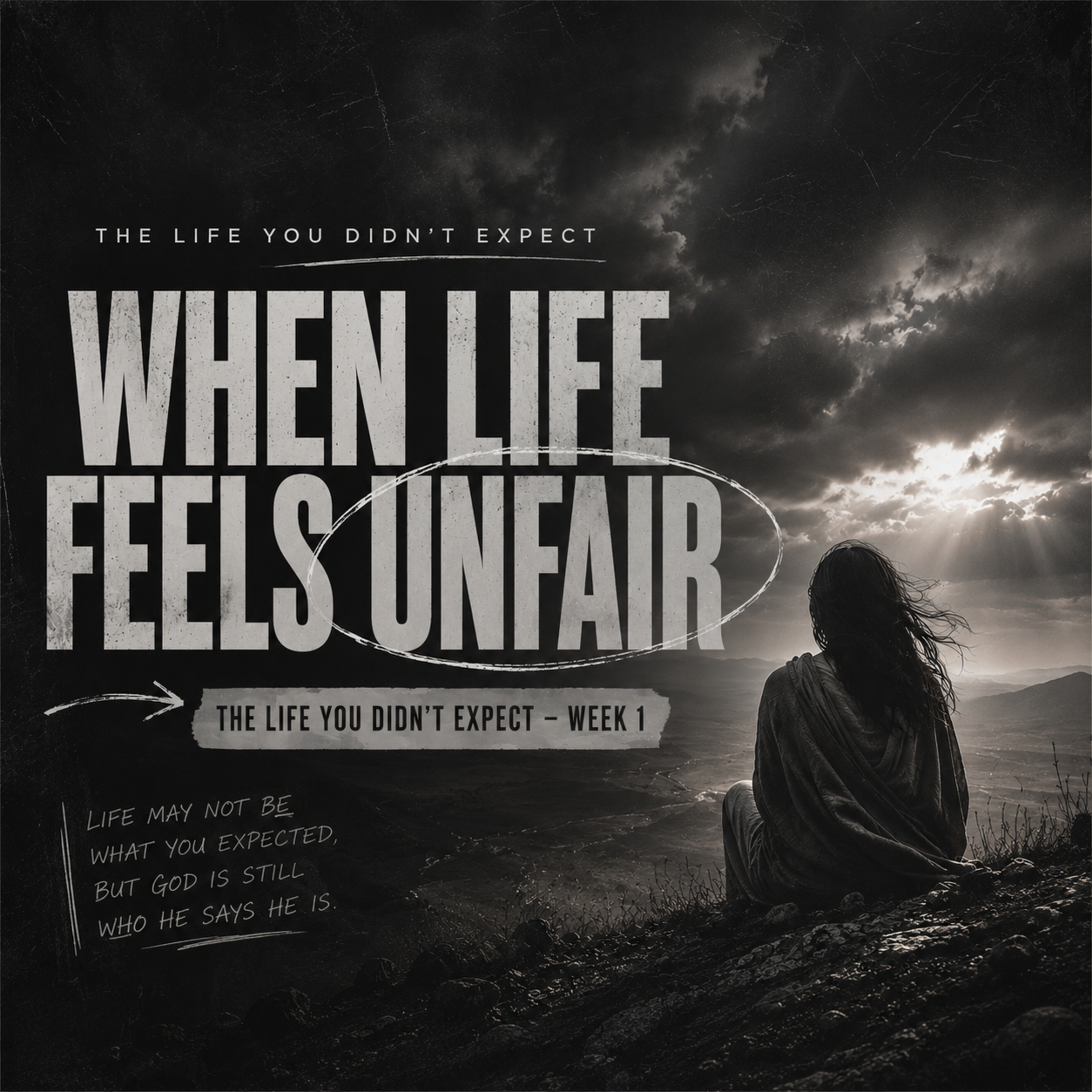
from [Predicas | Sermons] de/of Carlos Concepcion Jr
1h 3m 5s
The Bible story of Leah and Rachel in Genesis 29 reveals a profound truth about life’s unpredictability and the deep wounds of disappointment. Leah, the younger sister with weak eyes and less beauty, is overlooked and given to Jacob as a wife despite his love for Rachel. This sets the stage for a life of emotional struggle, as Leah repeatedly names her sons in hopes of gaining Jacob’s affection—only to be repeatedly rejected. Her pain reflects the human tendency to seek validation from others, especially in relationships and circumstances. Yet, the narrative shifts when, in the birth of her fourth son, she names him Judah and declares, “I will praise the Lord.” This marks a turning point: she stops looking to Jacob or any person for love and begins to trust God as her source of worth and peace. The lesson is clear—disappointment does not define us, and our identity is not in what people do or fail to do for us, but in God’s constant presence. Healing does not come when circumstances improve, but when our focus changes from external validation to faithful praise and trust in God. This spiritual shift, rooted in obedience to God’s character, enables us to carry pain without being broken. The story calls believers to live in the midst of disappointment with courage, declaring that even in suffering, God is seen, loved, and worthy of praise. Ultimately, true hope and resilience come not from fixing the world, but from relying on God as the sole source of identity, peace, and strength.
Genesis chapter number 29 starting at verse number 16. Verse number 16. I'm reading
out of the NIV Bible. You read with the Bible that's in front of you. Here's
what it says. Now, Laban had two daughters. The name of the older was Leah and the
name of the younger was Rachel. Leah had weak eyes, but Rachel had a lovely
figure and was beautiful. Jacob was in love with Rachel and said, "I'll work for
you seven years in return for your younger daughter, Rachel." Jump to verse 25.
When the morning came, there was Leah. So Jacob said to Laban, "What is this?
You have done to me. I served you for Rachel, didn't I? Why have you deceived me?"
Laban replied, "It is not our custom here to give the younger daughter in marriage
before the older one. Finish this daughter's bridal week. Then we will give you
the younger one also in return for another seven years of work." And Jacob did
so. He finished the week with Leah and then Laban gave him his daughter, Rachel,
to be his wife, verse 31. When the Lord saw that Leah was not loved, he enabled
her to conceive, but Rachel remained childless. One more time, verse 31, I could
dismiss the service after that verse right there. When the Lord saw that Leah,
Leah was not loved, he enabled her to conceive, but Rachel remained childless. I
want to tag these verses in talk using as a subject when life feels unfair. When
life feels unfair, would you raise your hands, say, "Lord, speak to us this
morning in the mighty name of Jesus, amen, and amen." You may be seated in the
presence of the Lord when life feels unfair. When life feels unfair.
I think it is an obvious declaration, affirmation, if you will, for all of us to
understand that life doesn't always ask your permission before it changes for you.
Yeah, I already got witnesses right there. Life doesn't usually ask you for
permission when it chooses to do something in your own life. Like there are
moments in our life that happen to us that quietly rearrange us. Not because we
wanted them to, but because we didn't have a choice, it happened to us. For
example, the relationship didn't work out, or the prayer was an answer in the way
that you hoped, or a diagnosis that came into your life that rearranged your life,
or a door that you were praying for hoping that it would open, didn't open, it
actually closed on you. Like life has a way of doing things to us that does
not ask us for permission, like the betrayal that happened, or the family
situation that changed, or the future that you imagined for yourself, but
suddenly disappeared. And somewhere in the middle of trying to stay
strong, you begin to wrestle with a silent question. Why did my life end up here?
How is it that after everything I hoped for and prayed for and worked for,
how did I end up with this kind of life? Because most of us have an idea of how
we think our life is supposed to go. Can you be honest? A lot of us still have
that journal, that paper, that note that we wrote for ourselves about what we
wanted to do in the next five, seven, ten years. We imagined a dream for ourselves.
We had an idea of how our life, we thought was supposed to work itself out.
We imagined our marriage lasting. We imagined our children staying close to us.
We imagined that at this point our ministry would be flourishing, that our
career would be advancing. A lot of us have an idea in our mind as how we think our
life is supposed to go. Like I was hoping that God would answer that prayer for me,
or you had an idea that your body was going to stay healthy forever.
You had an idea that the future unfolding in front of you was going to go
according to the plans that you had carefully laid out. But can I tell you if you
haven't experienced it already, that reality has a way of interrupting your
expectations. Life, life has got a way, reality has got a way of interrupting your
expectation, the thing you dream for, the thing you hope for, the thing that you
had thought of. It has a way, life does of interrupting your expectations.
And so the question is, what do you do when the life you're living looks
nothing like the life you hope for? What do you do? What do I do?
Pastor, when the life that I was hoping for is not the life that I am currently
dealing with because disappointment is more than an emotion.
Disappointment is a gap. It's a space between expectation and reality.
Disappointment is a space between what you hope would happen and what is
actually happening. Disappointment is caring a burden that you never chose for
yourself. It's grieving something that didn't die physically, but it did die in
your hearts. Like nobody wakes up and says, let's plan for disappointment.
Nobody dreams about caring a burden that they never acts for.
Yet sooner, more than later, every one of us will find ourselves facing
something we never saw coming our way. Like some of us are caring
disappointment over things that happened recently to us. Others of us are
caring disappointments of something that happened to us years ago, but we still
haven't been healed from that disappointment.
We're grieving over disappointments in relationships. We are still dealing with
disappointments over our family. We are dealing with whether recently or from
years ago, disappointment over finances, over leadership, over opportunities.
We are dealing some of us are with disappointment over prayers that God
said to pray to him, but then he turned around and didn't answer them.
And one of the hardest parts about disappointment is that it rarely stays
confined to one area of your life. I got to help you. I got to help you.
One of the hardest things about disappointment is that it rarely stays
confined to one area of your life. You see what begins as just a painful
situation has a way of spreading itself into every area of our life.
Disappointment starts to affect how you think. Disappointment starts to affect how
you pray. Disappointment starts to affect how you see your own future.
Disappointment starts to affect how you approach people in your life.
Disappointment even affects your future expectations for yourself.
And if you and I are not careful, disappointment can slowly become something
a lot more deeper to us. In other words, what starts off as a simple hurt can turn
into deep-seated bitterness. What starts off as confusion, it turns into cynicism.
What starts off as grief, it can turn into hopelessness if you don't give it over to God.
Because disappointment has a way of becoming something deeper
if we don't deal with our disappointments in the presence of God.
Disappointment has a way of making us ask our faith some very dangerous questions.
We'll start asking our faith where is God? We'll start asking ourselves why did this happen to us?
You'll start asking, did I do something wrong that now God is punishing me?
We'll ask ourselves some dangerous questions like, does God even see me?
Does God even care about me? And while many people don't say those questions out loud,
a lot of us wrestle with them quietly on a daily basis.
But the good news about Scripture is that God has always been close
to people that are living a life that they didn't expect for themselves.
As a matter of fact, one of the greatest tests of faith is not believing in God when everything is going well.
It's actually trusting God when life becomes the life that you didn't expect before.
It's about believing in God when He is still going to be good to us,
even though the circumstances have not been good to us.
The real test of faith is believing that God is still present when answers seem to be absent.
Because faith is not tested in the moments when everything makes sense.
Faith is tested when nothing makes sense for us.
And all throughout Scripture, we discover something and it is that God often does some of his deepest work
in people who are living through seasons they never chose for themselves.
God often times does his deepest work in people who are living through seasons that they never chose for themselves.
And so this morning, as we are in this series, the light you didn't expect, I need you to understand
that we are going to talk about disappointment, we are going to talk about suffering, we are going to talk about resilience,
we are going to talk about hope, we are going to talk about how to trust God when life doesn't go according to your plans.
Because sooner or later, every one of us will find ourselves standing in a reality that we never expected.
And the question is not whether disappointment will come or won't come.
The question is, what will I do when disappointment shows up?
To answer this question, we need to go to Genesis 29.
Because Genesis 29 introduces us to a Mormon whose life became the life that she never expected.
The text for today that we have chosen, it brings us into one of the most complicated family stories in all of Scripture.
The Bible teaches us that Jacob has left his homeland, and he has arrived in a land called Heyron or Haran.
There, he meets a young woman by the name of Rachel, and he immediately falls in love with Rachel.
And the Bible says that he was willing to work for her for seven years in order to marry her.
And it tells us that those years seem like only a few days because of how much Jacob was in love with Rachel.
Everything appeared to be moving forward towards the future that Jacob had envisioned for himself.
Everything was falling into its place. Everything was going to plan or at least going according to his plans.
But life has a way of changing directions when you and I least expected.
Because the story teaches us that through deception and manipulation,
Jacob finds himself in a situation that he never anticipated.
What should have been a celebration for him becomes a complicated mess of broken expectations,
a family dysfunction of favoritism, of jealousy and emotional wounds.
And right in the middle of this story stands a woman by the name of Leah.
The Bible introduces us to Leah in a way that immediately reveals the tension that she was living in her own life.
Because verse number 17 says that Leah had weak eyes.
But Rachel, her sister, had a lovely figure and she was beautiful.
The text immediately places the sisters side by side. It immediately tells us that Rachel is admired.
Rachel is desired. Rachel is loved. Rachel is pursued.
But it also tells us that Leah was living in the shadow of comparison.
Because standing next to Leah was Rachel and everyone loved Rachel because of how beautiful she was.
But the Bible tells us that it teaches us that she had weak eyes.
Now while a lot of scholars and commentators and Bible nerds are debating still the exact meaning of weak eyes,
that there's a larger point in the passage. The larger point is that Rachel possesses a beauty that drew everybody's attention to her.
While Leah had to live with the painful reality of constantly being compared to somebody else.
It tells us that she had to be compared to her sister.
Had to be compared to her sister's beauty, to her sister's ability, to her sister's youthfulness, and comparison my beloved brothers and sisters has a way of creating wounds long before words are even spoken.
I'll say that again, comparison has a way of creating wounds long before words are even spoken.
Like imagine growing up in a household where every room reminded you that somebody else was preferred over you.
Imagine looking at your life, walking into a room, and immediately knowing that somebody else was noticed and you were ignored.
That someone else was celebrated and you were not, that somebody else was chosen and you were overlooked.
Like Leah knows what it feels like to live with disappointment even before the story actually begins.
And then the situation becomes more painful because through her father's very own deception, Leah is given to Jacob in marriage, even though that was not the agreements that the father had made with Jacob, Jacob wanted Rachel.
Jacob planned for Rachel. Jacob worked for Rachel. Yet Leah becomes a part of a story she never asked for and he never wanted.
And then what follows is years of emotional tension because the Bible tells us plainly that Jacob loved Rachel more than he loved Leah.
And when the scripture tells us this, it does not omit the fact that God saw that Leah was in love.
You just missed what I said. The Bible says he didn't plan for her. He didn't work for her. He didn't desire her. He didn't want her.
She didn't even know that she was a part of the dysfunction and the manipulation that her father was conjuring up.
And now that she finds herself in the middle of all of this, she is in love triangle. She didn't ask for and the Bible makes it clear that Jacob didn't love her.
Like he loved Rachel, but it also says that God saw she was not loved.
The scripture tells us that the Lord saw that Leah was in love and that reveals something powerful about God's character.
That while everyone else was focused on Rachel, God was looking at Leah.
You just missed your opportunity right there while everyone was looking at Rachel and watching Rachel's ability and look how good Rachel sings and look how good Rachel teaches.
And why I love how Rachel prays. God wasn't looking at what everyone else was looking at.
God was looking at Leah who was being rejected and marginalized and alienated while everyone else was celebrating her sister.
God was paying attention to her while everyone was looking at the favored one.
God was noticing the forgotten one and this becomes the entire backdrop of the story.
It becomes the entire storyline of this chapter. Leah spends much of her life longing for something that she herself cannot obtain.
Leah, like a lot of us had to fight and go through her life trying to prove to people that she deserved to be loved until she realized.
I don't need you to love me if God loves me. She was fighting for acceptance and then she realized I don't need for you to accept me if God has already approved of me.
She was fighting all her life trying to get affection and connection until God stepped into her disappointment and she realized as long as I got God.
I don't need anything else in my own life because God is everything that I need.
And as we see her life unfolding with every child that she gives birth to, we gain a glimpse of the cry of her heart.
I need you to catch it because the Bible makes it clear that she was not loved like Rachel was but the fact that she was unloved by Jacob made her qualify to carry children.
because God saw the rejection.
You just missed it.
The fact that Jacob did not want her as his spouse
was exactly what God used to your Bible says,
enable her to be able to have child.
And although Rachel was the preferred one,
Rachel was the more beautiful one.
Rachel could not give to Jacob,
would Jacob needed to build a life and legacy on.
And if I could pause parenthetically and almost preach slash
prophesied to someone,
I will tell you that the fact that no one wants you to be something
is the very reason why God is going to open the door
that they didn't want to open for you.
The fact that Leah was a love was the excuse that God used
to give to her children,
although Rachel couldn't have it.
There are some doors in your life
that God is going to open for you,
not because you asked for them,
but because others didn't want you to have them.
And because God sees those types of behaviors,
He will enable you to do what everyone else said you could not do.
With every sum that she gives birth to,
we see a glimpse of her heart.
We see her cry.
We see her experience.
Her children's names become the windows of her disappointment.
It becomes a glimpse into her hope.
We see the longing that she has.
But as the chapter unfolds,
something begins to shift.
The woman that starts this chapter longing for attention,
longing for approval at the end of the chapter,
she stops looking at men and she just keeps her eyes on God.
And this is where the message begins to speak to a lot of us
because every one of us has experienced moments
when life did not turn out the way that we expected it to.
A lot of us know what it is to have moments when prayers go unanswered,
moments when relationships disappoint us,
moments when circumstances feel unfair to us,
moments when we wondered if anybody actually sees what we are caring,
but yet the story of Leah reminds us that even when life
doesn't become what we hope that it would be.
God is still present.
God is still working.
And God still sees us, even though people
refuse to acknowledge us.
The story teaches us that disappointment
has a way of distorting your identity.
The disappointment has a way of distorting your identity.
One of the most painful things about disappointment
is that it rarely stays in your circumstance.
One of the most painful things about disappointment
is that eventually your disappointments
start speaking to your identity, work pastor.
One of the hardest things about disappointment
is that it would be okay if disappointment just stayed
in the unanswered prayer.
And it would be all right if disappointment stayed
in the failed relationship.
But disappointment has a way of speaking
into our identities because the story says
that Leah was going through a difficult marriage.
It's a story about a woman who is trying
to understand her worth and an environment
where she constantly felt like she was less than.
And from the moment she's introduced to us,
she is compared to her sister.
Rachel is described as beautiful.
Rachel is described as desired.
Rachel is described as pursued.
Jacob worked 14 years just to have Rachel as his wife.
And although scripture never says that Leah was worthless,
you can almost feel the weight of living in somebody else's
shadow because comparison has a way
of making people question their value.
That disappointment has a way of reinforcing the lies
that comparison tries to create in our own minds.
And maybe that's why so many people today
under the sound of my voice are not just hurting
because of what happened to them.
They're also hurting from what they started believing
about themselves because of what happened to them.
Like the divorce happened and now they believe
they're unlovable.
Rejection happened and now they believe they're unwanted.
Failure happened and now they believe
that they are incapable.
Betrayal happened and now they believe
that they will never be enough for anybody else.
The prayer wasn't answered and now they believe
if God even sees them
because disappointment is never contained
with just attacking your circumstances.
It wants to attack your identity.
It wants to convince you that what happened to you
is who you are.
But I came to let you know that what happened to you
is not who you are and what you experience
is not your identity.
And what someone did to you is not the end of your story
just 'cause someone failed you.
It doesn't mean everybody else will, the enemy loves
when people are confused in their wounds
and their identity because if he could distort
your identity, he will influence your decisions.
If he could distort your identity,
he'll influence your relationships.
If he could distort your identity,
he will influence your expectation.
If he could distort your identity,
he will influence your future.
Notice something powerful in the text
before Leah ever says a word.
Before she has her first child,
before she accomplishes anything God sees her.
Verse 31 says that when the Lord saw she was a love.
Please don't miss that because everybody else
was focused on Rachel,
but God was paying attention to Leah.
God looks at those who are overlooked.
God sees what other people ignore.
God sees what other people fail to value.
And this tells us something important
about God's character.
God sees people differently than the world does
because the world evaluates people by appearances.
But God evaluates people by purpose.
The world looks at people and judges
their worth by popularity.
But God looks at people and measures them by their potential.
The world measures people by their preferences.
But God measures value on creation
and because you are fearfully and wonderfully made,
you are just as valuable as anybody else in the room.
And Leah may have been forgotten by people,
but she was never forgotten by God.
And I need someone to know that if God saw her,
then God also sees you.
Just because people overlook you,
doesn't mean that God is not standing with you.
And one of the enemy's favorite tactics
is to take a temporary season and convince you
that it is your permanent identity.
You went through rejection, but that doesn't mean
that you are rejected.
You experience failure,
but that doesn't mean that you are a failure.
You went through a difficult season,
but that doesn't mean that you are living
the worst chapter of your life.
God never intended for your pain to become your name.
I say that again, God never intended for your pain
to become your name.
And the reason identity matters so much
is because people will always live according
to who they believe that they are.
If you believe that you are unwanted,
then you will settle for things
that God never intended for you.
If you believe that you are forgotten,
then you will constantly strive for validation.
If you believe that you are less than,
you will spend your entire life trying to prove yourself.
But can I tell somebody under the sound of my voice
that healing begins when we stop allowing disappointment
to tell us who we are and we start listening
to what God says about all of us.
Here's what I'm trying to tell you.
Don't let a painful season rename
what God already called valuable.
If God says you're the head and not the tail,
then don't let a difficult season convince you
that you are staying in the low place,
that you are in.
Do not allow the enemy to confuse you into believing
that because it happened to you,
that is where you will stay forever.
God saw Leah and God sees us in our painful seasons.
Disappointment has a way of trying to distort our identity.
the other thing that the text teaches us is that we often look to people for what
only God can give to us. God bless you. You can go. I'll let you go after that.
I got to say it one more time. We often look to people for what only God can provide for us.
That's why you're frustrated. It's not because so and so didn't do it. And it wasn't because she
didn't meet that. And it wasn't because they were not there for you. It's because you are looking
to them for what only God can give to you. I'm working in here. One of the saddest realities
in Leah's story is that she spent years, not days, not weeks, not months. She spent years
chasing something that she could not force anybody to give to her. She spent years chasing Jacob
trying to force him to love her. She spent years trying to chase after Jacob and force him to accept
her. She spent years chasing him, hoping that she would be able to make him give her affection,
make him give her validation. Like notice the progression. I need you to read the story when
you get home and look at all of the names of her children. Notice the progression of the names
of her son. When the first born is born, his name is Rubin. And Leah says, "Surely I will call
him Rubin because now my husband will love me." And he didn't. So then God gives her another son
and she calls this one Simeon. And when he is born, she names him Simeon because she recognized
that she is still unloved. And she's still chasing him. And God gives her another son.
And his name is Levi. And when Levi is born, she says, "Now at last my husband will become
attached to me." Do you see the pattern? Do you see the problem? Do you see the dysfunction?
Do you see the frustration? Leah keeps giving birth to children, hoping that the next blessing
will fix a deeper wound. She keeps on trying and chasing and forcing and pursuing. Like if the
next child was going to make her husband change his mind about her, she kept on hoping that the
next child, the next opportunity, the next achievement. Maybe if I do it a little bit better,
they'll notice me. Maybe if I get that breakthrough that I'm asking God for,
then they'll accept me. Maybe if I get another achievement, another accomplishment, another
certificate, a bigger platform, then people will notice me. And the Bible says that we will always
be frustrated just like Leah. If we keep trying to look to people for something that only God
can give to us, God didn't want her to be attached to Jacob. God wanted her to be attached to him.
God didn't want her to look for love in Jacob. God wanted for her to look for love in him.
And when we understand this reality, we will stop chasing after people and putting our confidence
in people and relying on people to do what only God can do for us. Because if we're honest,
a lot of us do the exact same thing. We convince ourselves that peace is waiting on the other side
of something. Like if I get married, then I'll be happy. If my marriage improves, then I'll be
able to have peace. We convince ourselves that peace is waiting on the other side of somebody else's
effort. Like if I get that promotion, then I'll finally be secure. If they finally apologize
to me, then I'll actually be able to heal. If my children come back to God, then I'll be okay.
If the season changes, we say, then I'll finally be able to rest. And the problem is that whenever
we make a person or a relationship or a circumstance responsible for our honeness, we place a burden on
them that they were never created to fix or carry. When we think that if they change, I'll be better.
And if they give me that, then I'll be more secure. We are hoping that they could fix something
that only God can take care of. Let me set you free today. People are horrible saviors.
Be delivered. People are terrible gods. So stop making them that. We live frustrated lives
because we are hoping that people could save us from something only God can. They can fix something
in us. If they do what we want them to do, that only God can do for us. And let me let you know
that no human being can successfully carry the weight of your identity, of your worth, of your
peace and of your purpose because every person in this life will eventually disappoint you. Not because
they're evil, although some of them are, they will disappoint you simply because they're human.
And if we stop treating humans like gods will avoid disappointment. Only God can occupy the place
in your heart that was designed for him. You see, Leah's pain wasn't simply that Jacob didn't love
her the way she desired. Her deeper struggle was believing that Jacob's love was the answer
for the need of her soul. And that's where disappointment becomes dangerous because disappointment
doesn't just reveal what we lost. Disappointment also reveals what we're depending on. I say that
again, disappointment doesn't just reveal what we lost or what we long. Disappointment also reveals
what or who we are depending on. Sometimes, sometimes God will allow us to see instability in people
so that we could discover the sufficiency that it comes from him alone. You didn't like that. I'll
say it again and hold your hand. Sometimes God will let you see the instability in people
so that you can stop trusting in them and put your trust in the sufficiency of Christ.
This is why God told the prophet Jeremiah, "Cursed is the man who trusts in other man." As a
matter of fact, God told Jeremiah, "Don't even trust yourself because your heart will play tricks
on you. But if you put your trust in me and not in your circumstance, you will discover that
yes, disappointments will come, but my presence will be that I'll push you past your disappointment
so you can live the life that I have for you." One of the lessons in spiritual maturity,
one of the hardest lessons in spiritual maturity is learning that some of the things that we desperately
want are not capable of giving you what you think they will. One of the hardest lessons you will
learn in life is that a lot of the things that you desperately want are not going to have the
capability of giving you what you think it will give you. Like we tell ourselves, "If I could just
get that, I'll be okay." Then we get it and we're still empty. Talk back to me here like I'll
let y'all go. We say, "Lord, if you just open that door, then I'll finally be all right." And God
opens the door and you're still not all right because you're trusting in things, trusting in people
because the issue was never that. The issue was the expectation that you were putting on that.
The issue was the dependency that you were putting on that and many people today
aren't suffering because they don't have enough. Many people today are suffering because they
expected things and people to do what only God could do for you. Like you got the promotion,
you're making good money and you're still not happy. Why? Because it was never that.
You were putting your expectation on something and someone that could never give you what you really
wanted. Only God can establish your identity. Only God can heal the deepest wound of your heart.
Only God can give you lasting peace. Only God can feel the emptiness that disappointment
leads behind in you and until we understand that we will spend our whole lives chasing satisfaction
through people until we understand that we will spend our whole lives chasing people chasing
satisfaction through accomplishments and possessions, entitled and relationships that were never meant
to be our source. What you expect from people will always
disappoint you when it belongs to God. One more time. Amen.
Maybe I'll say it another way, you'll never find lasting peace in something that was never meant to be your source.
Leo was looking for something in Jacob that she could only find in God.
Who are you still chasing?
What are you still chasing?
That when you get it, you're going to realize it's not going to help you until you chase God.
Here's the last thing this story teaches us.
Healing begins when praise becomes greater than pain.
See, I told you that every son that she had, she kept naming it something to create an attachment between Jacob and her.
But the story teaches us that about the time she got to the foreson.
She had three previous ones with him.
And each one she thought would bring her closer to him or him closer to her.
And then she finally got the lesson.
She finally learned, she finally understood.
And when God blessed her with the fourth child inside of Leo, something started changing.
For the first three sons, every statement, every name was connected to a disappointment.
Her name reflected her longing, her name reflected her hurt.
The name reveal it exposed a desire that she had for receiving love that she was never going to get.
She was searching for something in those first three sons.
She said, maybe now he'll love me or maybe now he'll notice me or maybe now he'll accept me or maybe now he'll be attached to me or maybe now.
He'll spend some time with me.
But by the time she gets to the fourth boy, the pattern breaks off of her.
Because the Bible says in verse 35 that when she conceived again and she gave birth to this son,
she called him Judah and said this time, I will praise the name of the Lord.
I need you to see the significance first.
She gave birth to Rubin, then Simeon, then Levi, and all of those were attaching them to her husband who didn't want an attachment to her.
But when God healed her mind and heart and gave her another blessing of a boy,
she said, I am not going to miss the significance of this.
I do not need anybody else.
I got everything that I need in my Savior and my Father.
And I'm going to praise God no matter what I'm going through, no matter what I'm feeling,
because the pain will lose its power when our praise starts getting bigger.
Healing begins to happen in us when our praise gets greater than our pain.
She didn't need anybody to notice her.
She didn't need anybody to love her because she finally realized God noticed me and God loves me.
And God is blessing me.
She said this time, not because everything changed because her husband still didn't love her.
Looks straight ahead.
Nothing changed.
Around her, everything was the same.
He still went to bed with Rachel.
He still spent time with Rachel.
He still was entertaining Rachel.
Nothing changed. Her life didn't suddenly become different. It didn't drastically get any easier.
Her prayers were not all answered at the same time.
Her pain did not disappear.
She was still living the same reality, but she still chose in her mind that this time I'm going to praise the Lord.
And this is powerful because it tells us that her circumstance had not changed.
Jacob was still willing to love her.
The family dynamic was still complicated.
Light still felt unfair that disappointment was still real.
The pain was still present, but something inside of Leah was shifting.
She stopped looking horizontally and she started looking vertically.
She stopped looking around for what she needed and she started looking up to where she could get it from.
As David knows, he said they trust in chariot and they trust in horses, but I trust in the name of the Lord.
He said I look up to the hills from where my help comes from.
My help comes from the Lord and Leah understood that she needed to stop waiting for people to become her source of peace.
She understood that she needed to stop looking horizontally for what could only be found vertically.
She stopped allowing her circumstance to determine whether God was worthy of praise or not.
And this is one of the greatest signs that you are growing in your faith.
When your praise is no longer dependent upon your comfort, because anybody could praise God when life is easy.
And anybody could lift up their hands when life makes sense.
And anyone could worship God when God is opening doors.
Everybody could rejoice when miracles are arriving, when their children are serving the Lord.
The promotions are coming when God is blessing but mature faith knows how to praise God even before the circumstance changes.
Mature faith knows that I know I don't have what I want, but I have who I need and who I need is God and God will take care of everything else.
Leah teaches us that healing does not always begin when the pain leaves.
Healing begins when our perspective changes.
I'll say it again, Leah teaches us that healing doesn't happen when the pain leaves.
The pain was very much still there, but her perspective changed.
And because her perspective changed, her praise went up even though her pain was still around.
And you and I have got to come to a moment in our lives where we realize if I wait until everything is perfect just to praise God, then I'll never praise him.
Yeah, I'm going to say it one more time because I want you to get it in your spirit.
If you wait until everything is perfect for them to praise God, you will never do it.
But I need you to understand that you praise your worship and cannot be tied to your comfort or your circumstance.
Because if it is, then God will never get the praise that He created you to make.
And real healing for a lot of us begins when we stop making peace dependent on people changing.
Come here. People may never apologize. People may never change.
Some relationships will never become what you hope them to be. And some situations are never going to make sense completely.
There are some prayers that God is never going to answer.
And if you wait for all of that to be able to give God praise, then you will always live stuck.
You will always live in tension. You will always live in uncertainty. But if you learn this time, I will praise God.
I'm going through pain. I'm going through difficulty. I'm dealing with disappointment. But this time I choose to bless the name of the Lord.
One of the enemy's greatest goals is to convince you that you cannot move forward until everything changes.
Did you hear what I said? One of the enemy's greatest goals is to convince you that you will never be able to move forward until everything changes.
But I need you to understand, healing doesn't begin when everything else gets right.
Healing begins when you surrender your pain to God. Healing doesn't happen when everything gets right, gets in order.
It's in alignment. Healing happens when you surrender it to Him and say this time, I choose you above my pain.
Praise is not denial. I'm not telling you to act like you're not going through nothing.
I'm telling you you ought to be praising because you're going through something and because you are going through it, your praise is a defense mechanism.
Your praise is a defiance. I'm standing in the middle of pain and disappointment. But I choose to declare God is still good.
And God is still worthy and God is still faithful and God will still heal. And maybe as you do that, God starts changing everything.
Your praise is saying, life hurt me, but it will not own me. People disappointed me, but I still trust God that He's going to take care of me.
You start healing when God becomes your source instead of your situation.
I said, you start healing when God becomes your source and not your situation.
See, the reality is that every person in this room is either coming out of disappointment or walking to disappointment.
I just burst into your bubble, you'll be okay, I'll pray for you after service.
You're either coming out of disappointment or you are on your way to disappointment or
maybe you're in the middle of it right now.
Because life has a way of becoming a life that you did not expect.
But Leah's story reminds us of something powerful.
That disappointment does not have the power to define you.
But people fail to give to you, does not determine your worth.
And whatever life tries to take away from you, does not change who God is in your life.
And the turning point in Leah's story was not that her circumstance changed.
The turning point in Leah's story was that her focus changed.
She stopped looking at people and she started looking at God.
She stopped looking at her pain and she started looking at her provider.
She chose praise instead of an imperfect situation.
And maybe that's where a lot of us are today.
Maybe you're carrying hurt still, maybe you're carrying questions still, maybe you're
carrying disappointment still.
But God is inviting you today to do exactly what Leah did to lift your eyes above the
circumstance and to put them on him.
Because healing begins when your praise becomes greater than your pain.
And even if the life you're living is not the life you expected, come here, let me help
you.
God is still faithful.
Pastor, you don't understand what I'm going through.
You don't understand what I'm dealing with.
And still I choose in the middle of it.
I may be going through something but I still know God sees me and God walks with me and
God is more than enough for me.
And if people change, I expected them to change and if people go, I expected them to go.
But one thing I'm sure of that God is with me and he is the only thing that I need to
continue going forward when life is not what I expected, Leah didn't plan for life to
go that way.
And when she finally realized that her whole life changed for her personally because she
stopped looking at people and family and circumstances and just said, I will trust in
the Lord.
Would you stand to your feet all over this room?
Life has a way of being unfair and for those of you who don't believe it, live a little
bit more and you'll understand life has a way of being unfair.
You're planning, hoping, dreaming, writing, strategizing, half of those things, if not all
of those things, don't even go.
It all turns around on you and the question is not will it come?
The question is, when it comes, what will you do?
Will you put your peace in the situation, will you put your peace in God who is the source?
Because if you put your peace in him, you'll still go through disappointments but it won't
finish you, it won't change you.
You won't be conflicted by it.
I'm not telling you denied, I'm saying it's going to happen but God is telling you, make
sure that when you go through it, your focus is in the right place.
Don't ask why is this happening, ask what are you trying to show me through what is happening.
Don't say why I mean, you got to think him that he chose you because he saw something
in you that was able to survive the disappointments and pain that you're dealing with.
But I need to speak to your perspective, where are you looking?
Who are you looking at?
What are you trying to get from where you are?
Because if you continue, the way Leah started, you will never come out and if you do, it
will not be a healthy version of you.
But if you're able to shift your focus from Rubin, Simeon, Levi, to Judah this time, I
choose to trust God and praise God and honor God, I can guarantee you're still going to
go through disappointment but it won't have the effect it wants on you because you will
realize though I walk through the valley of shadow of death, I fear no evil because God
is with me because you bought your head right where you are.
Lord, be coming for you this morning and we thank you, we thank you because although
life has been unfair, although we are dealing with disappointments, Father, our prayer
is that we would keep our trust in you that our faith would not fail us as life is shaking
us.
We didn't plan for these things to happen.
We didn't wake up and say, Lord, let life take everything from us.
No one wakes up, Father, saying shake up my entire family, my job, my business, my health.
Life has a way of doing these things without asking permission but our prayer, my prayer
is that we would put our trust and our focus and our faith and our hope in you the source
of everything.
You made it clear in Scripture, you told your disciples and us in this life we will have
challenges but we do not have to fear because you are with us.
So today, Lord, help us, Hallelujah, to cast our cares and anxieties and disappointments
and frustrations all on you.
Help us to remove our expectations off of people who can never give us what we want, help
us to remove our expectations off of situations, circumstances, things that are just a resource
but are not the source because if not, we will never walk out of it healed.
If not, we will never be able to come out of it victorious.
I'm not saying that we won't come out of it unscathed but what I am saying is that it
won't damage us if we put our trust in you.
You told Israel through Isaiah, though you walk through the fire, that it wasn't if it
was a when, though you walk through the water, that wasn't if, that was a when, when you
go through pain, when you go through waters, when you walk over fire, it will not have
no damage on you because we go with you.
So Father, in the name of Jesus, Hallelujah, I pray for your people under the sound of
my voice and I ask you right now that you would help us like Isaiah says to understand
that we are yours, that you paid a price for us, that you have redeemed us, that you have
selected us, help us to understand like Leah, that although we may be unloved, overlooked,
marginalized, not cared for, not the chosen one, not the selected one, not the favorite
one, to the people around us, that is their decision.
But to you, you say I see you, you say I love you.
of you. You say I care for you. You say that we are yours. And because of those things
and reasons, you pour out blessings over our life. Father, my prayer for your people today
is that you would pour out blessings for the marginalized. Lord, that you would open
doors for the rejected. Lord, that you would make ways for those who have been overlooked.
This is my prayer, just like Paul wrote, that the vial and the weak and the ignored and
the rejected. Those are the ones that you chose to embarrass the strong and the wise.
Father, this is the season of the misfits. This is the season of the overlook. This is
the season of the marginalized because we choose today to put our trust in you this
time. I will praise the Lord. This time, I will trust in you. This time, I will put my
hope in you. This time, I will lean on you. This time, I know that you have a secure future
for me. This time, I will praise the Lord. Lord, we ask you that you would heal the
parts of us that are still processing what we are carrying and although we're still going
through it, Lord, help us to put our focus out of it and onto you. That we would still
meet you in a place of prayer, hallelujah. That we would still meet you in a place of
devotion. That we would still meet you at a place of worship and in spite of what we are
going through, we will lift up our hands and praise you. Not because we aren't going
through something, but because you are strengthening us as we go through it. I'll say it one more
time, Lord, we will lift up our hands and we will keep on praying and we will keep
on believing. Not because we're in denial. Praise doesn't deny reality. Faith does
not ignore circumstance, but it chooses to look above and beyond and say I choose to worship
God and God will take care of my experience. So Lord, in the name of Jesus, as we lift up
our hands and we lift up our voices, I pray that faith would arise right now. I pray
that hope will arise right now. I pray that frustrations would be lifted right now.
I pray that healing happens right now as our praises go up. Healing happens in our bodies
and our minds and our souls. In the name of Jesus, we believe it. And if you believe it,
would you shout a name and all over this room?
Podcast Summary
Key Points:
Leah’s story illustrates how disappointment and unloved status can shape a life, yet God sees and values those who are marginalized.
Disappointment doesn’t just affect circumstances—it distorts identity, leading people to believe they are unworthy or unloved.
Leah’s children’s names reveal her emotional journey
The turning point in Leah’s life is when she shifts from seeking love in people to trusting God, naming her fourth son Judah and declaring, “I will praise the Lord.”
True healing begins not when pain ends, but when praise and faith in God rise above pain, even in unchanged circumstances.
God’s presence is constant through suffering; He sees the overlooked and provides purpose, even when human relationships fail.
We are called to stop placing our hope in people, circumstances, or outcomes and instead trust God as the sole source of identity, peace, and strength.
The enemy seeks to make pain define us, but mature faith responds with praise, declaring God’s faithfulness in the midst of disappointment.
Summary:
The Bible story of Leah and Rachel in Genesis 29 reveals a profound truth about life’s unpredictability and the deep wounds of disappointment. Leah, the younger sister with weak eyes and less beauty, is overlooked and given to Jacob as a wife despite his love for Rachel. This sets the stage for a life of emotional struggle, as Leah repeatedly names her sons in hopes of gaining Jacob’s affection—only to be repeatedly rejected.
Her pain reflects the human tendency to seek validation from others, especially in relationships and circumstances. ” This marks a turning point: she stops looking to Jacob or any person for love and begins to trust God as her source of worth and peace. The lesson is clear—disappointment does not define us, and our identity is not in what people do or fail to do for us, but in God’s constant presence.
Healing does not come when circumstances improve, but when our focus changes from external validation to faithful praise and trust in God. This spiritual shift, rooted in obedience to God’s character, enables us to carry pain without being broken. The story calls believers to live in the midst of disappointment with courage, declaring that even in suffering, God is seen, loved, and worthy of praise.
Ultimately, true hope and resilience come not from fixing the world, but from relying on God as the sole source of identity, peace, and strength.
FAQs
Leah's story shows that disappointment is common and often stems from unmet expectations. It reveals how people may feel unseen or unloved, leading to emotional pain and a struggle for identity.
Laban deceived Jacob by giving him Leah first, following a custom that required marrying the older daughter before the younger one. Jacob had agreed to serve seven years for Rachel, but was misled into marrying Leah first.
Leah is described as having weak eyes, while Rachel is characterized by a lovely figure and beauty. This contrast highlights the societal preference for Rachel and the emotional impact of being overlooked.
God sees and values those who are overlooked or unloved. The text indicates that God enabled Leah to conceive because she was rejected, showing that God’s faithfulness is not dependent on human approval.
Her names—Rubin, Simeon, Levi—reflect her longing for love and acceptance from Jacob. Each name reveals her pattern of hoping that a child would change her circumstances and win her husband’s affection.
Leah’s final son, Judah, marks a shift in her perspective. She no longer names him for the hope of love but declares, 'I will praise the Lord.' This shows that true healing comes not from circumstances changing, but from shifting focus to God.
Chat with AI
Loading...
Pro features
Go deeper with this episode
Unlock creator-grade tools that turn any transcript into show notes and subtitle files.
 PodcastTranscript AI