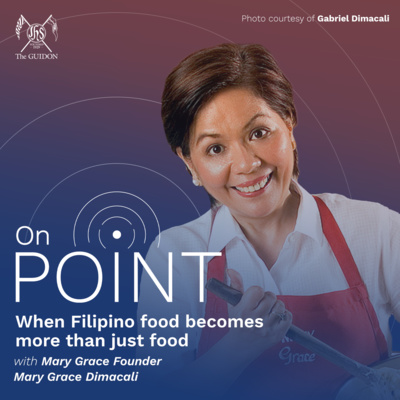
The discussion explores how food and kitchens shape Filipino identity, using Mary Grace Cafe as a case study. Mary Grace shares how her culinary journey began with family traditions and home baking, evolving into a business after formal training in the U.S. She emphasizes intentionally crafting her cafe to reflect Filipino culture, from the ensaymada and cheese rolls on the menu to traditional design elements. The conversation addresses industry challenges, including maintaining authenticity amid global trends and adapting during the pandemic through delivery services. Mary Grace highlights the importance of balancing classic recipes with modern, healthier presentations to elevate Filipino cuisine internationally. Ultimately, she views her business as a mission to represent Filipino values and the "goodness of home," aspiring for it to be a cultural ambassador that inspires pride and togetherness.
[Music] Embedded in people's consciousness is the proverbial saying, "You are what you eat." More often than not, it is understood in the literal sense when preparing food or looking for something to eat in the kitchen. In the process of looking for food in the kitchen, something is often overlooked. The certain kind of magic that kitchen possess. You see, beyond being a place where food is made, a kitchen can be a place of intimacy, where identities are formed, passed on, and further developed. In kitchens, we are able to learn more about life and how meanings are created, negotiated, and shared through food. More than its nutritional value, food represents what we value as individuals, as a community, and as a Filipino nation. Welcome to On Point, the guidance podcast arm where we sit down and talk with the experts on issues in and beyond Leala. As we mark the end to the celebration of Bonan Week on Pambansa, we examine how the Filipino identity is both formed and transformed through Filipino cuisine. With us today is the person behind one of the famous go-to places of Filipinos, which is best known for their Inseimadas and Cheese Rolls. Founder of Mary Grace Cafe, Mary Grace Di Maccali. I am Bel Gregorio. Let's go On Point. When someone says in Seimada or Cheese Rolls, I'm sure I'm not the only one who would instantly think of Mary Grace Cafe's red and gold box, with the words "The Goodness of Home". So let's talk about home. Going up, what was your relationship with food like? I had a grandmother who was a very good cook. I have very good memories of her coming home. I would watch her through the window her home, no? And she would be bringing this bion's left and right. And then she would herself whip up dishes at home. My mom has also natural sense of taste, having grown in a family where she saw her mom cooking a lot. For myself, I was always mesmerized with cakes. The cake's rice in the oven was, well, magic, sense of wonder would always come over me. So that when I got married and I was raising the children, naturally during those hours I wasn't busy with them, I would look through recipe books and I would try my hand with these recipes in my own kitchen. Because I have a sense of the entrepreneurship in me, I think it's very natural. I would put these goodies in plastic trays, you know, and my girls, my Kasambahai, would, in their aprons, you know, wringland doorbells to anyone interested to buy, you know, the pastries and all. So that's how I, how I was leaning to food and trying my hand in baking. You mentioned cakes and goodies. Could you share what your favorite cakes were and what these baskets of goodies can be? Well, my cake, I always bake mocha cakes with layers of butter icing in between because they were the birthday cakes I'd make for my children from you. Here, I have five kids, by the way, so I never bought a birthday cake. Birthdays were always opportunities to get better, you know, baking the cake as well as decorating it. Of course, like all beginner bakers, tried my hand with brownies, that's always the first thing, you know, brownies and chocolate cupcakes, 11 squares, fruit cards, and then because I was the busy mom bell, I said, what will not take my time away from the children? Because they were all growing up, homework and reading them their their books, the basic mothering, you know, I went into fruit cakes. The fruit cakes only took the birth months from September to December. I'd be buying the ingredients September. I would be baking them too and storing them till November when they would be distributed, you know, to friends who would like to make a little something on the cakes. So I was doing fruit cakes for a good number of years. Till I said, let me let me learn more about the craft. And that's when I fortunately found myself in a school in the United States. It was West Valley in California. My parents were green card holders, so they heard about this school for would be entrepreneurs. So we would be baking large batches of bread and cakes and pastry snap, you know, small batches and little baking balls that go into larger, and you know, this one is huge balls. In fact, we use our hands. We washed our hands for support. We wore gloves to you, died into the into this big balls of flour and eggs and water, et cetera, and mix it with their hands to you know. And this would go into an oven which really wow. I have never seen an oven so big in my life. And we would bake batches of wonderful, ripe bread and croissants, all the American classics, you know, and then transport these goodies into a store, which were sold every day. So I really love that experience because it would prepare me for for my business later on. So when you're in the States amongst print nationalities, how did you find or retain your identity as a Filipino baker. I had to adapt to a mix of people. She said international, but I was who I was because when we had parties, you had to bring your own food, you know, I'd always come with my own my own food from the kitchen. I'd come with a double or fancy, a new show classics, you know, where the Iranians brought their own food, you know, the Italians brought their own food as well. We just the Chinese and then we just opened it out in the table and enjoy the food. That sounds so interesting and so cool how different cultures just merge together in one place. So let's now talk about prominent figures and the FNB industry are entrepreneurs among your family or those during your time when you were going up whom you've looked up to as a child. Well, as a child growing up not like you you have a huge array of books now, you know, you get a veil of a hard hard bound or online right during my time there was more a daza. You give your mother that a collection of books in the kitchen was noradaza, they was still very no so. They were my own teacher from my village where I gave Rory what is her name now anyway, her first name was Rory and I looked up to them because this women were so very easy with baking you know like it was under their skin and I like that very much I look up to them. Okay, so let's now talk about conceptualizing Mary Grace Cafe when you were conceptualizing it what did you want it to be known for. Of course the M side mothers I asked myself when it came home from my baking school, not in California, I wonder why I didn't go into croissants and. Right bread and calabret and all this area of American goodies I wanted something closer the hearts of the noise and that for me was the the inside mother and the cafes would be I'd always dreamed of you know customer sitting by the window and cutting freshly baked. And so you know what's the inside mother or cheese rolls and dipping it into a cup of hot chocolate that's really what spurred me on to you know a launch Mary Grace with a flagship of the inside mothers in the cheese rolls. Okay, so you've talked about having a conscious effort to integrate the Filipino identity but now let's talk about how you integrated your own personal identity your personality your values and your own experience that's with food into the business when you see concepts cafe concepts. Mushrooming you think in your head maybe I should be like them maybe I should copy what they're doing because they're already very successful during the time I remember I would be sitting in star box and just looking around and telling myself maybe I should do this too you know. And in my cafe thanks be to God the elements of Filipino design came in the use of breaks because I'm like that know I like the touches of Filipino the use of breaks the use of ventinillas I don't know if you see it you would have a ledge and you'd always have this. So the utensilers are slats ventinillas ventilation in the own Filipino houses you would help them beneath the windowsill or air to come in you know so I use those elements on on the ledges mature cut tiles these are cement tiles not I like to eat being. Part of our culture was very drawn and as a lot of women I think I very drawn to my chokka tiles so it became part and parcel of the look of a merry grace we're talking about them beans here and we're food was concerned you know we brought out the chicken in a cell sandwiches the long and easy for breakfast because my grandmother she was illocana what is close to the heart of every. You know can I see vegan and he said you know so I make that into a sandwich and then it is breakfast fair you come to merry grace you would have garlic rice with no vegan organisa and poor mango and the bit of a comatism with some cilantro I would think this was this came out then I think as part of who I am. Not because I needed to copy someone so I don't know you will probably ask me the question then if you wanted to launch a business what should guide you in coming up with the menu or or the look of your cafe I would say well you know you be yourself not anybody else but who you are what you lean to don't be who you aren't. And I think when you become who you are people will know it then they will gravitate to you as well you know you're not I want to be you know you are who you want to be you know to the market out there. You mentioned a lot of different trends popping up in the industry how difficult is it to maintain the Filipino food identity with an increasing number of few restaurants and creases. If you look at Teresa pasta is Teresa we get from a supplier is Teresa is very part of our tradition you know it's a little bit of Spanish right so Teresa pasta in the use of Teresa the chocolate that's part of our culture as well our sausages which is known as the vegan organisa I think that it's quite refreshing to be able to. To be percent the classics in a new way so I think that was nice and creative to turn it into a sandwich I still have to think of perhaps using others have done it already be back crab talent and making it into a sauce for for pasta or maybe a do long no we have to long by the way in the cafe as a appetizer I was thinking long time ago making it into a pasta as well and I think a lot of our cafes venture to try to do that know to your in pasta maybe that you given me an idea maybe I should explore that. So what significant changes have you observed in the local FNB industry three than years maybe I'll go back a little further western brands came into the country by your McDonald's Kentucky chicken. I really look up to jolly because it's in a way in yeah in fact wherever there was a McDonald's the there would be a jolly bee right it's great that really be no so Tomcat Jones know we're able to stand next to proven western brands and now they're a celebrated brand no also in the United States they're there already you know I mean it's just wonderful that you have this Filipino concepts becoming change it makes me very proud of that when you have max match chicken try chicken and I know better in the one how she eventually became a conglomerate a chain of stores in every province in the country and we look to do that also in time. So that's really what inspires me to see brands become ambassadors of their country and these brands to be looked up to also I mean I have to what you see if Americans lining up when there's a jolly beat store opening in California wherever you want. Okay so you mentioned stores opening and Filipino supporting these stores and for and they're supporting stores like jolly be opening a broad but now let's talk about the increasing number of businesses that have shut down because of the COVID-19 pandemic what difficulties have you needed to overcome as a business owner. When the pandemic hit us I thought to that we should just all fold up anyway there is that risk of of your people catching the disease not getting sick but then the other side of that is the economy and the dire reality that people will have to continue to work to be able to put food on the table. And for us I don't know about the others that's what drove us to stay open because in the end you'll have to try to stay safe but in the end you'll also have to stay afloat not only for the financial health of Mary Grace but also because of the situation that your people would have to bring on the bacon and with this people to continue to live to eat three meals a day. Pay the rent put the children to school and so that was the main thing that I decided to tell my family this is you got to keep going but others have to have clothes. I think maybe because we adapted we've always been proud of the concept of our dying in you know that you can sit amidst the lights that are twinkling and the birds that are flattering and you can hear this wonderful music and find your little corner and open the book. Find your space be be at home you know home away from home that was so hard hard to lose you know masakriya but then we had to roll roll with the times so Mary Grace went into takeaway boxes on to grab a lot of cycles it was great that once all what is this the tick pop is it you know that this this this wife was so happy to have received you know her favorite Mary Grace on her birthday and then she then has been laid it out you know made it look like they were you know going to have dinner in the cafe it's amazing how we can still be part of people's lives in that way. Yeah that's definitely touching because for me I could definitely say that I've also been ordering Mary Grace online since I don't really find the comfort thing to go out. And especially with the new guidelines now I don't think dining in is really an option so I'm really grateful that Mary Grace is able to traverse into the industry of deliveries. So you see a lot of restaurants bell masakriya they have to bring their food in takeaway boxes because they do know and all of us know that fresh from the oven or fresh with the stove into your into a plate and onto the table is really the best thing in the world but thanks to glad the grab drivers are fast and so they get they get the food to you and the food is still warm. Okay well aside from all these ECQ guidelines in the country that Mary Grace Cafe has had to face I think another issue and the FNB industry was the department of trade and industry recently announcing that it established a technical committee in charge of developing national standards for cooking popular. Filipino variant such as a double or synagogue there have been varying opinions regarding this but in your opinion what might be the pros and cons of developing standards for Filipino and the other one is the same as the other one. So I think it's a very good thing about the adobo for example it's a classic it's a favorite right but I think we need to do something about reducing the fact and yet maintaining the numb numb of the adobo I think standards like that will elevate even our cuisine higher. We can learn a lot from the Japanese presentation you need to say you don't put the whole thing in a bowl like a chicken or double chicken right perhaps right and up with some slices of mango or tomato perhaps resting on mango salsa that's all the thing but so after the setting also the nutrition value a manner of cooking the bus you want to see your peanut that don't or no one will need green yeah the bus that fresh but in your greenness and seat out the bus and the okra because there's a way to cook the vegetables without making them lose the greenness which which brings across to you now it's still very full of nutrition. The vitamins are still in there and yet it's it's it's delicious. I guess what people have been worried about is the issue of authenticity because since we are an archipelago there are different ways that different Filipino cultures cook a certain variant which you want to be able to preserve that like the different knowledge and recipes present in the country. Yes, yeah, I think you have to maintain authenticity as well. It's I guess it's a good balance of breathing in the new into the classic. Do you know what I mean yeah yeah and adapting to the growing sophistication of the taste of the people who are now open globally to better ways of presentation etc. I go for that wouldn't you I mean but of course I appreciate yeah authentic a double or authentic in a bit you know be na guongan I guess there's always a market for that. In the end I think I I would like to go into a cafe and be you know at home with home cooked a door from this region or that region. Yes well you mentioned the global landscape again I think it's something that we've been mentioning throughout the conversation like how present the Filipino food identity is when put in the global scale. So for you how else do you think can Filipino dishes be promoted internationally while not compromising the authenticity of Filipino food. Like I said we're very especially Westerners they're very conscious about fact so our adobo you classic adobo that is swimming in fact when and why not actually adobo was food on the gallery on traveling from Mexico to the Philippines so what preserves the meat is fat so so many in our Pinoi natural you fat and fat. Capang pangas did just love to take in that fat right I think it's it's time for us to adjust according to what's healthy for Pinois you know and yet maintaining as you said authenticity as well as the non non factor of the dish well nothing she shared me the street lies all these certain aspects of really thriving in the F&D industry and how it isn't just about food how it's about culture it's about identity it's about safeguarding the people who work in the cafe so it's a trillion understatement to say that operating a restaurant is difficult but still I'd like to explore what inspires you to continue to keep going despite the difficulties of being in the industry. Yeah you know for me I always feel that for business and ever to succeed it must have a higher goal I told you a while ago that I feel very proud for Filipino brands to be out there you know who are ambassadors for the country and one of the reasons why I want to keep going is I hope Mary Grace will be an ambassador also but the goodness of a Filipino home I hope that they will be a part of the world I'm hearing that Mary Grace and I'm not just in cheese rolls are going to Korea and going to Hong Kong and going to Singapore isn't that wonderful isn't that really this bread which by the way is a part of Spanish influence that we also come to tweak through time and the and the mother has become ours you know isn't it wonderful that it's it's speaking for the goodness of Filipino food and culture and traveling all over I like that I like to be an ambassador for our country I like to lift our image to the world and that that's one of the reasons why I would want to keep Mary Grace going for a long time and I want our people to be proud of what they do in the cafe. To know that you're doing something noble too you know it's all about the ability of the a lifting of a country and a people for me is it's a very high goal a very noble goal. You've mentioned what inspires you to keep going despite the difficulties but for you what do you think is the impact of Mary Grace cafe and the products of Mary Grace and just the image of this red and gold box what do you think is the impact of Mary Grace to the two Filipinos. I love it that we are loved by community out there it really warms my heart and this is the very thing that I would sacrifice a lot for me Grace says a lot about family. Mary Grace says a lot about the goodness of home. Mary Grace says a lot about togetherness working together you know moving forward together as a family. I told you about being ambassadors a brand could be an ambassador for the country but I also like to think that the business is speaking about certain values that might be very hard perhaps to preserve in these days. I'm a home grown business I'm all about someone who grew a business at home growing through time I'm all about not an instant business but business that was human into the stages of my life as a mother as a wife stages in my life of bringing up the children. Stages in my life as my town corny to you have but of the blessed mother no blessed mother is all about waiting and I know that these days young people are very in a hurry and I like to visit the program take your time take it slow you know don't have to be so quick and you know be patient. It's all about the process you know good things come from the unfolding through time that's what I want to say to a lot of young people who come into the cafe because I'm not about a year or two I'm I'm about I would say perhaps a lifetime I am a grandmother I grew with as a young mom and I'm a grandmother you know. And I'm a grandmother now and I like to tell that to the young people I think the message I want to bring across to them is let things fall into place in God's own time step along step along with the the maker you know with our creator and wait wait for what he will show you around the bend you know what I mean. Yes, I think today society everyone's just used to instant. Exactly and you know that's probably why why why my divine providence the flagship is the inside mother because and I'm not is never about something quick and instant it's about breathing. You know what with all bread there's two rising so to make an essay mother is from beginning to end something like five hours and more well you know when you wrap it put it into box and it gets to you you know and more a lot more you know that's why I've been thinking about it. This is all about the unfolding waiting in time and so look at the answer mother it's about the very essence weight that which you give time to grow is precious it's it's more lasting it's it's really also about service you know and service from the heart yeah not not service because you know I said there must always be something higher. In what you do and then you'll be okay and it and it's probably why we have people out there who appreciate me regress maybe they say it maybe they understand the story. Yeah I was supposed to ask you for advice to Filipino bakers and cooks but I think what you said. For sharing the goodness of home with us not only today in this conversation that we had but every day through constantly contributing to the creation of the Filipino identity through Filipino cuisine like we really appreciate your insights on the importance of food in nation building as it is through acknowledging the diversity of the Filipino food identity that we can fully capture what it means to be Filipino. So thank you thank you very much you know being able to ponder these things in your head bring my thoughts together make things also more clear to me. Thank you for joining us in another episode of on point the guidance podcast armor we sit down and talk to the experts on issues in and beyond Leola special thanks to our executive producers Samantha Olanco and Martin Dramas as well as our producers that can album you grow Andrea M.K. and Andrea M.K. and Lilianas Neil R.A.S. and Beatrice Serious this episode was edited by Megan Soundchen our cover art and design by Tiffany Kuh and our music is brought to you by Fit Productions. This has been Valegorio see you the next time you go on point.
Podcast Summary
Key Points:
The kitchen is a space for intimacy and identity formation, where food carries cultural and personal meaning beyond nutrition.
Mary Grace's passion for baking stemmed from family influences, leading her to start a home-based business before formal culinary training.
She consciously integrated Filipino identity into Mary Grace Cafe through menu items like ensaymada and cheese rolls, and design elements like capiz and ventanillas.
The business faced challenges during the COVID-19 pandemic but adapted with takeaway and delivery, driven by a responsibility to employees and customers.
Mary Grace advocates for balancing authenticity with innovation in Filipino cuisine, promoting it globally while adapting to health trends.
Her inspiration is to make Mary Grace an ambassador for Filipino culture and the "goodness of home," viewing business as a noble, value-driven endeavor.
Summary:
The discussion explores how food and kitchens shape Filipino identity, using Mary Grace Cafe as a case study. S. She emphasizes intentionally crafting her cafe to reflect Filipino culture, from the ensaymada and cheese rolls on the menu to traditional design elements.
The conversation addresses industry challenges, including maintaining authenticity amid global trends and adapting during the pandemic through delivery services. Mary Grace highlights the importance of balancing classic recipes with modern, healthier presentations to elevate Filipino cuisine internationally. Ultimately, she views her business as a mission to represent Filipino values and the "goodness of home," aspiring for it to be a cultural ambassador that inspires pride and togetherness.
FAQs
The kitchen is a place of intimacy where identities are formed, passed on, and developed. It's where we learn about life and how meanings are created, negotiated, and shared through food.
She began by baking cakes for her children's birthdays and experimenting with recipes at home. Later, she sold pastries through her household helpers and attended a baking school in California to hone her skills.
Mary Grace wanted to offer something close to the hearts of Filipinos, which led to the flagship products: ensaymadas and cheese rolls, often enjoyed with hot chocolate.
She uses Filipino design elements like bricks, ventanillas, and capiz tiles. The menu includes classic Filipino dishes such as chicken inasal sandwiches and longganisa with garlic rice.
The cafe adapted by shifting to takeaway boxes and delivery services like Grab to stay afloat. This allowed them to continue serving customers while ensuring safety and supporting their employees.
She believes standards can elevate Filipino cuisine by improving presentation and nutrition while maintaining authenticity. It's about balancing tradition with modern, healthier adaptations.
Chat with AI
Loading...
Pro features
Go deeper with this episode
Unlock creator-grade tools that turn any transcript into show notes and subtitle files.
 PodcastTranscript AI