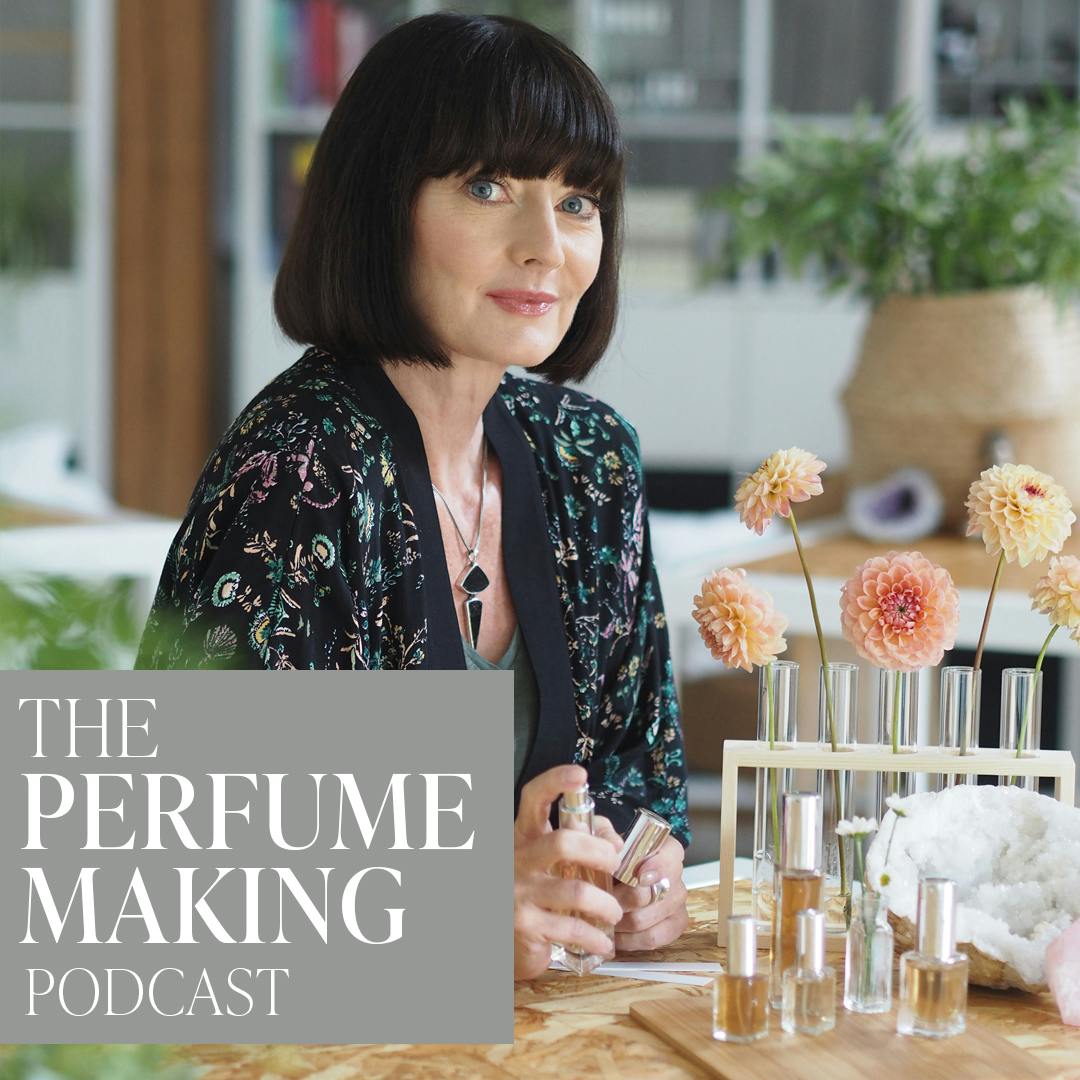
When Chemistry Meets Creativity - A Beginner’s Guide to Synthetic Perfume Materials
from The Perfume Making Podcast
38m 48s
In this episode, Karen Gilbert addresses natural perfumers who feel their blends lack the polished, long-lasting quality of commercial fragrances. She recommends ten synthetic aroma chemicals to start with, emphasizing that these are tools to enhance—not replace—natural materials. The three most essential are Hedione, which adds a diffusive, citrusy lift; Iso E Super, a smooth woody-amber blender that harmonizes sharp edges; and Ambroxan, a dry, salty-amber fixative that anchors and extends a fragrance's lifespan. She then suggests synthetic musks like ethylene brassylate or ambrettolide to provide the soft, clean base notes missing from natural-only palettes, as natural animal musks are restricted. Vanillin is recommended for its reliable, sweet vanilla character, distinct from expensive and variable natural vanilla absolute. Finally, Coumarin, a hay-almond note classic in fougère fragrances, can add warmth and bridge different scent families. Gilbert advises starting with these materials in small amounts to learn their behavior, noting that many are biodegradable or have natural versions available. She encourages experimentation, as these synthetics often work throughout a fragrance's structure rather than fitting neatly into top, middle, or base note categories.
[Music] Welcome to the Puffy Making podcast with me, Karen Gilbert. And in today's episode, I wanted to do a little bit of a materials focus for those of you who have been maybe working with mostly natural materials. So essential oils, absolutes, maybe a few CO2s and isolates. And you are thinking about dipping your toe into the water of aroma chemicals or synthetic materials. So if that sounds like you, listen on. Because I get a lot of questions from natural perfumers who fill a little bit stuck. Maybe your blend, your formulations smell really good. But something's missing, you know, they smell a bit more like an aroma therapy blend than a proper perfume. Which obviously, obviously is fine. You know, if you are sticking to completely natural formulations, then that's absolutely fine. But if you do want to create something that feels a bit more like the kind of commercial perfume that people expect, then you are going to need a few synthetics in your palette. Now, as I've said in many episodes before, nowadays we've got a lot more isolates. We've got natural aroma chemicals via white biotech. So you do have a lot more options to create a natural fragrance. That is a lot more complex than we had back in the day. You can absolutely do that. So, but for this episode, what I want to cover is 10 materials that you should have in your palette. If you are looking to add some additional tools to your toolkit, if you like. So I'm not talking about replacing your natural. I'm talking about what materials would you add if you were just dipping your toe in the water? So if you go onto any of the supplier website, you are going to find such a bewildering array of materials. It can be really, really overwhelming. This episode actually was, I thought about doing this just after I've come off the back of a three day in person class. Now often with my three day classes, I have people who have got a bit more experience. But I often do have complete beginners as well. And what I find is that we, you know, I open up all of my materials in the studio to people, depending on their level of experience. And I do find that complete beginners or people who have been used to working just with natural are really overwhelmed by the sheer volume of synthetics out there. So this episode is going to be covering 10 things that I think you should start with. If you are just dipping your toe into the aromachemical waters, if you like. Now I've already done an episode covering a few of the really big ones. We did an episode way, way back on Heideone, ISOE Super and Broxant. And I think I also covered Calone in that as well, which I'm not going to cover Calone in this particular episode. But if you are into aquatic marine type fragrances, then that is that is one that you should go for. However, I am going to touch a little bit on Heideone ISOE and Ambroxant in this episode as well. But I will link the previous episode to the show notes because that particular one went into the history of their usage a lot more. So I'm not going to repeat that here. But I am going to include them in today's list because if you are starting with synthetics, these three I would still say are going to be the foundational materials that will make the biggest difference to your natural formulations. So let's dive in. This is going to be quite a succinct one hopefully today. And it's more like a checklist if you like. And I'm going to tell you a little bit about each material and why I think you should add it to your kit. And yeah, let's see how we go. How we go from there. I always say this is going to be a short succinct episode and it ends up being really long. But let's dive straight in with Heideone. So for those of you who are not familiar, Heideone smells a little bit like Jasmine, but lighter. When you first smell it on a strip, you might think, well, I don't really see what the fuss is all about. But it's a bit more like petals in the air than the flower itself. So it's not a heavy material. It's not a heavy Jasmine note, but it is described as being a Jasmine note. And I would describe it more as being a citrusy Jasmine. And one of the reasons that I think that you should include this in your kit is one of the most forgiving materials that you'll ever use. It's pretty impossible to overdose it. And honestly, it makes everything around it smell better. And you will see this material in nearly every modern floral. And it will give your fragrances a lift. You know, that breathability, that diffusive shimmer, that natural don't quite do on their own. So if you are finding that your Jasmine or your rose feels really heavy or flat, try adding a little bit of Heideone. It's one of those materials that you actually have to use it in a blend to understand how it works. Just smelling it on a strip is not going to give you any indication. So Heideone itself is often used at between two to 15% in fine fragrance. So you can use it at small amounts. You can add it at a really, you know, a quite chunky amount in fragrance. And you often find fragrances do overdose Heideone. And it's been described as one of those materials that is one of the most overused. I suppose but, you know, it's a really, really useful material. Even if you did nothing else but add a drop of Heideone into an all natural blend, you are going to see such a difference. So I would definitely start there. So Dior's Osevage, this is the original Osevage Cologne. That had a 5% Heideone, which was a overdose at the time, which completely changed perfume history. And the other great thing about Heideone is it also blends beautifully with citrus notes, especially Bergamo. And it will help to extend your citrus notes, those top notes throughout the fragrance. And people often ask me, you know, is Heideone, is it a midnote, a top note, a base note? It's one of those materials that works all the way through from top to base. So what you'll find, if you're used to working with natural, you'll find that a lot of the aromachemicals don't fit neatly into that top middle and base note box. Some of them work all the way through, which is actually to your advantage. Now there is regular Heideone, and there's another version called Heideone HC. Now this one is more powerful. It has got a bit of a stronger magnetolier jasmine effect, and it lasts much longer. And if you want that extra lift without adding loads of bulk to your formulation, then Heideone HC is worth looking at. But I would start with the regular Heideone, see how you get along with that. Often in fine fragrance, Heideone and Heideone HC would be used together. But for the basics, if you're just starting out, I would go for just the regular Heideone. So the next material is isoe super. So many of you will have heard of this. There are lots of different variations. You've got timber silk, you've got silver amber, lots of different isomers of isoe super. And this is again one of the most used materials in modern perfumery, and for a good reason also. So isoe super has got that smooth woody amber recent. So it's almost like cedar, but a lot more transparent and diffused. So what makes this special and what why I think you should have it in your kit as well is not just about the smell. Again, it's a very low impact note in many ways. But it is one of those, again, one of those materials that you don't really, you won't really understand until you actually use it. Because it's the way that it softens the edges of everything else. It's a bit like a blender, a harmoniser, a radiance boost at all in one. So you can have quite sharp naturals. So maybe you've got some vetiver in there, maybe some green floral notes. And isoe super will just smooth it all out. And it also gives you that kind of skin like feel, that second skin feel, that modern, clean, just warm enough dry down that lingers all day. And fragrances often contain isoe super. It's often used between sort of five and 15%. So very similar to head you own. And although again, some minimalist formulations use 30% or more. And you'll probably know this from the famous molecule, O1 perfume, which is basically an isomer of isoe super. And that is a fragrance by a centric molecules, which just has this one material as a perfume. So you can wear it on its own as well. So if your natural fragrance feels a little bit too raw, isoe can help polish things out without overpowering them. And it's also great if you are creating a woody fragrance or an amber fragrance. And you want some transparency and light and air and space in it and you don't want it.
to smell too heavy and dense. So again, more info on Isoy in the other episode. And then the final one for this kind of trio, I suppose, that are the no-brainers for me is Ambroxan. And again, I've gone into this in a bit more depth in the other episode, so I'm not going to go too deeply into that here. So Ambroxan goes by lots of different trade names, Ambrofix, setelocks. Again, I talk about that in the other episode, so I won't kind of go into all of the different variations here, because they are slightly different. But this material is one of my favourites. It's almost like an anchor. It gives weight and warmth and longevity to a fragrance. And it smells like a very dry powdery, slightly salty amber green note with a slightly woody musky edge. So it's one, Ambroxan is one of those materials that it doesn't, I mean, it depends on how much you use really. And sometimes it's overdosed, and it is quite loud in a fragrance if it's used in high amounts, but it doesn't have to. It can be just sitting in the base, holding everything together. So if your fragrance smells really lovely in theory, but then vanishes from skin within an hour, then I would try a little bit of Ambroxan. And it's often used at trace amounts to 1% for fixation. So if you want it to just to underpin your fragrance, use it at a much lower amount. Although a lot of modern perfumes do overdose Ambroxan as well. So 5 to 10%. And Dior Savage has got a pronounced Ambroxan character if you want to go and smell something with it in. You can use more than that. There's no restriction on it, but again, it will start to dominate, especially in simpler blends, which sometimes you might like. I love the combination of sandalwood and Ambroxan, bit of burgermots and vandaline. It's that creates a really beautiful scent on its own. So you can be very minimalist and overdose it. It also pairs really well with woody notes, with masks, with citrus notes. And it really helps naturals. I think you can feel a bit more diffusive, more persistent and more like what people would expect from a finished fragrance. So those are the three. If you're just going to pick three to try, I would go with those. Now, the fourth one that I'm going to suggest is a mask. So masks are one of the biggest gaps when you're working only with naturals. So unless you're using animal products, which most of us aren't, and again, natural deer mask is banned in most countries. You don't get that soft lingering base that a lot of modern perfumes rely on. So the synthetic masks are the thing really that we rely on a lot for longevity and fixation in a perfume. So there are loads and loads and loads of different masks that you can try, you can work with. We often talk about galaxalide, the white classic white mask as being the one to go for. And I would definitely try some of that if you haven't already. But keep in mind that it is problematic in terms of its biodegradability. It is not considered, it's not biodegradable. So if that is something that is a concern to you and it's going to be more and more as we go on, obviously we don't want amaterials to build up in the environment. So a lot of companies are phasing galaxalide out and moving towards other masks. So one of them, so I decided not to include that in today's episode. But what I would suggest you try instead, there are couple actually depending. So ethylene bracelet is also known as a musk tea. So if you've looked at any of the tech old textbooks and you've seen musk tea, that is something called ethylene bracelet. And that is one of the easiest musks to start with. It's a macro cyclic mask. So it's clean, it is biodegradable. And on its own it smells like a soft, clean skin scent. So it is not allowed mask, it's not obvious, it's just that subtle background that makes a fragrance for polished and it's considered to be a workhorse musk. So it's used a lot in commercial fragrances and typically around 0.5 to 5%. Sometimes higher if you've got an overtly musky fragrance, you know, around 1 to 2% in a formulation works really well. It doesn't a hijack your other materials, helps them to last longer. The other option for a musk and also with this one you can find a natural version as well. And that is amberetolide. So this is also a macro cyclic mask. And I'm actually going to do another podcast episode just on musks specifically. So I'm just going to touch on them here and I will go into them a little bit more depth in another episode. But amberetolide has got a fruitier aspect to it. Some people describe it as having a pear skin nuance. Sometimes people pick up a slight berry note in it as well. Again, musks are tricky because I think everybody perceives them slightly differently. A lot of people are a nozmic to many different types of musks. But I find that most people can smell amberetolide. And so again, it's a popular one. And it's designed to be close to natural amberet seed. So it does come across as a more natural feeling musk actually and works really, really well with fruity florals. And the amount that you would use is probably about 0.1 to 2% is average for a fragrance. And this, the musks are really, if your fragrance formulations, if they smell lovely for the first hour and then, you know, tank, then they collapse. Think about adding some musks to your fragrance to give you that finished feel, that a little bit of extra longevity. Obviously, you know, you can't just drop a musk into a fragrance and expect it to fix it. You do have to choose your materials accordingly to what you've created. So it's not about just dropping one of these into any fragrance type. You've got to really learn your materials. You've got to select them accordingly. But really, I'm just suggesting that these are the places that you start to, if you want to explore synthetics, if you haven't done up until this point. The next one that is a definite must for your kit is Vanillin. So Vanilla is one of those notes that people always ask me about. Natural Vanilla Absolute or Vanilla CO2 is really gorgeous. I love natural vanilla absolute. It is so expensive. It is so variable in whether you can forget it, whether you can't, you know, like any natural, the materials are at the mercy of the climate where they're grown. Sometimes you can't get them. Sometimes they're just so prohibitively costly. The thing also with vanilla absolute, it can be really tricky to dilute. And sometimes, you know, with natural vanilla absolute, it has got a very, very different scent to that gormonde confectionery type vanilla. We see in a lot of fine fragrances. It does discolour blends quite badly. And also sometimes you might want a more vanilla gormonde character than the natural absolute can give you. And this is where Vanillin comes in. There's also another material called Ethel Vanillin, which is much, much stronger. And it's more like your ice cream type. But if you're going to pick one, I would just go for the regular Vanillin to start with. Now, this is, Vanillin is the main molecule that gives vanilla beans their sweet and creamy smell. And on its own, it is much stronger and more reliable than the natural extract. So it's a very, very different smell as well. It's like a soft wood evenilla, less animalic and leathery, which is how I see it compared to the natural vanilla absolute. But even a small amount is going to give your blend that familiar warmth that people will instantly connect with. You know that cosiness. So 0.5 to 2% in a formulation is fine. Although you can use it at way higher levels in gormonde or vanilla dominant fragrances. So things like Gaelan Shalimar, I was talking about this the other day and I remember smelling is not this high now. But Shalimar, I smell an original version of Shalimar from the 20s when the Osmo Tech did their rounds a good few years ago. And the original Shalimar had something like 20% Vanillin in it. And it was so sweet. Imagine the sweetest gormonde fragrance that you could smell today. The original Shalimar as it was presented by the Osmo Tech was so much sweeter. And so often with Vanillin, you know just a trace is enough to round things out. It works really beautifully with amber fragrances with gormonde. And you can even use it in florals where you want a little bit of sweetness in the dry down. So again, it depends on the amount you use. So it can be used at small amounts or larger amounts if you are using it to really push that vanilla character. So again, the other thing to note, just like vanilla absolute, not quite as badly, but Vanillin can discolour your blend over time. So if you are working on a pale. Fragrance, the liquid is a light colour and you want it to be very, very transparent. Vanillin, especially at high dosages, can make the liquid go darker. It's not usually a problem in alcohol-based perfumes, but if you are using it in things like lotions and soaps, it's going to be a lot more noticeable. But again, for beginners, it's one of the most useful and affordable synthetics that you can add. And actually, for those of you who are fully natural, you can find a natural vanilla as well. So have a look at that. As always, check your suppliers, because unless it says it is a natural vanilla, it's most likely to be a synthetic. So yeah, double check. But I have seen natural vanilla from quite a few suppliers nowadays. And the other material that I'm going to talk about here is a big, big classic. In fragrance. And you can find this as a natural as well. In fact, the natural, so it's Kumarin. So those of you who have been to any of my classes, or you have listened to the episode on Fujer Fragrances, you will know that Kumarin was a big part of that fragrance family. And the Kumarin that I have in my studio at the moment is a naturally derived one. So again, when we talk about aroma chemicals, sometimes we can't get a natural version. And at time of recording, if I was recording this maybe five, ten years ago, maybe there wouldn't be the availability. But nowadays we can find it. So Kumarin is a classic. It smells like hay. It also smells like Tonka beans. So Kumarin is naturally derived from Tonka beans. So you can use Tonka absolute, obviously. But if you just want the Kumarin component, then Kumarin is on its own. It's something that you might want to look at. It's got this soft almondy sweetness as well. It does add a real tasty note. It works really well with vanilla. And it's one of those materials that does really, I think, make a perfume smell like a perfume. It's very classic, but you don't have to overdose it. It has tiny amounts. It's one of those materials that if you put too much in, it's going to smell very, very sweet. It's going to smell very almondy, very kind of hay like and Tonkaery. So if you don't want that, use it in much, much smaller amounts. So it can bridge floral, herbal and sweet notes and really bring your fragrance together. And as I said before, it is the backbone of the fujer fragrance family, which blends the Kumarin with lavender and oak moss. So if you get some Kumarin, try it alongside some oak moss and lavender to give you that classic fujer accord. But you do not need to be making a fujer to use it. A trace of Kumarin can give body to a rose fragrance. It can soften, sharp herbal notes or add a natural smelling warmth to citrus as well. But even in traces like 0.1%, will add some effect. So typically 0.5 to 2% is used in fine fragrance. If you push it higher, it's going to get cloying. So start really, really small and see how you go from there. And it was the first synthetic to be used in perfumery, way back 1882 fujer royal. So again, we talk about that in the fujer episode of the podcast. I haven't had to listen to that. Please do. And Tonka Absolute again will give you some of that character. But the isolated Kumarin is a reliable way to add that effect without the heaviness or the cost. And also Tonka Absolute is a complete nightmare to dilute into a fragrance. Kumarin is way, way easier. So next up we have got another basic, which is a phenyl ethyl alcohol. So also known as PEA. And if you have ever tried to make a rose perfume using only natural, you will know the frustration, especially commercially. Because rose, absolute rose, auto, they are beautiful stunning materials. Super, super expensive. So quite prohibitive in commercial fragrances. And also they are limited with their allergen restrictions as well. So you can only use a tiny amount of rose in a finished fragrance. So if you are making a rose centric perfume, PEA or phenyl ethyl alcohol is going to be your friend here. Now again, you can find a natural version as well. Although in an ideal world, we would have PEA directly from rose. It would be ridiculously expensive. So it is usually produced by fermentation. So it is naturally derived. But you can buy a synthetic version as well. And this is obviously already in rose oil. It's one of the main components in rose. So it does blend in seamlessly. And on its own, it smells like the airy part of rose. Those fresh, watery rose petals with a slight honeyed sweetness. It's very, very low impact. It is not a big, loud material. But it is a soft floral backbone that you can lean on when natural don't give you enough volume. So you can use it in quite large amounts in a fragrance. As a structural base. And you can then add your rose in there and your other materials. And it works really, really well. And also think about if you are trying to create your own rose accords, phenyl ethyl alcohol, geranium and citronello are the three main components that go to make up a rose note. So if you've got those three, you can blend those in with some natural rose. And I go through this in the perfume making 101 workshop. So if you want a little bit more detail on that, dig into that workshop. And again, you can use this at reasonably large amounts. It's not restricted by ifra. It's often used at between 2 and 5% in rose perfumes to stretch the absolute. And you will also find it in classic fragrances like Nahima by Gaelan and Eve Selleron's Paris. So it is not a big punchy competitive rose note. But it just does give your rose a bit more presence and it underpins it. So it's also useful outside of rose accords as well. It will add a gentle floral tone to almost anything. Moogay notes, peony, citrus works really well with all of those. It's a really, really beginner friendly. So again, add that to your kit. Blend it in with your natural formulations to give that bit more light air and space. And to boost your rose notes. So the next one I want to talk about is another floral. That is something that is really impossible to do with natural alone. And that is a moogay note. So Lily of the Valley or moogay is one of the core trio of florals that go to make up the heart of a floral fragrance. So rose jasmine and moogay are your three. And you can't get a natural moogay. So it's something that we will always have to rely on synthetics for. So it's what's called a mute flower. So you might see Lily of the Valley essential oil for a knockdown price on a website. It will never be a natural. It will always be a synthetic. You know, I think some companies have tried to extract it. But it's either, you know, doesn't give enough of an extract or it's unstable. I've never seen a real one from natural. So I'm not saying that there isn't. But again, it's not one of those things that you see in material suppliers, especially as a natural. So if you want that light, juiced spring like floral note of Lily of the Valley, you are going to have to use some aroma chemicals. Now there are a couple here. So I always recommend starting with something called hydroxy citronella. And that is a classic. We've got an issue nowadays where the two main moogay aroma chemicals, a lyreau and lilyau have been banned in Europe. So I know that some of you overseas can still use them. But we can't. So I'm not going to talk about those. So I would suggest that you start with hydroxy citronella. It's a soft green floral and it was famously the backbone of deorissimo by deor. And it is restricted by ifra. So you can't use a huge amount of it, but you still can use it. So it's worth knowing if you are working to commercial standards. You can use hydroxy citronella to give you that touch of moogay. But the other option that is a bit more modern that I've been really liking is floral. So that's F-L-O-R-O-L floral. It's clean, it's fresh, it's stable. You get that gentle moogay lift without any harsh edges. And it's quite easy to use. And I feel that it's one of the easiest ways to add lightness and freshness to a formulation with with florals. And you can actually use the floral and hydroxy citronella together. And that will give you a nice moogay touch if you want something that's not good.
softer to add to your natural floral formulations. And again, you know, I'm talking about these materials to add to your to your naturals. But for those of you who are using mixed media anyway, and you've never bought any aromachemicals before, I would still suggest that you folks add that, you know, buy these as well. Your kit is going to be slightly bigger. But again, this is not just for the naturals people who are dipping their toe in, this is for everybody. So I've got two more to cover, briefly, and then we will wrap up. So fruity notes are really tricky to do with naturals. And, you know, we've got a lot of fruity notes that are out there in the aromachemical world. But the first one that I would suggest that you try is another classic, one called gamma undecalactone, peach lactone, it's often called aldehyde C14, which is confusing because actually it is not an aldehyde, it's a lactone. I won't dig into the wise and where forse of why it's called aldehyde C14, lots of different versions of that story. But just take it from me that it was misnamed as an aldehyde and it's actually a lactone. So I would refer to it as gamma undecalactone or C14. And it doesn't smell sharp or soapy like an aldehyde, it smells creamy. So lactones are milky materials, milky creamy. And there are lots of lactones, some of them are coconuty, some of them are milky. But this particular one is a good one to try because it smells like ripe peach with a creamy undertone and it works really well if you want a fruity lift in your florals. Also works very, very well with sheepers and even a trace is going to give you that sort of peachy glow to a floral. So you can use it in florals, you don't try not to overdose it because it is a really super strong material. So less is more here. Mitsuko by Gelan was a famous famously used gamma undecalactone as a peach note on top of a classic sheep structure. So you will see it in fruity florals, you'll see it in on some osmantha sacords as well or anything that needs that creamy peach apricot nuance. And there isn't a peach natural essential oil that will give you this. So this is a good one for adding that fruityness. Obviously there are loads of other fruity notes strawberry notes, grapefruit notes, rhubarb notes, raspberry notes, I love a bit of raspberry ketone as well. But if you are just picking one fruity note, I would go with gamma undecalactone to try because it's very, very versatile. It gives you that creaminess as well. And if you're creating white florals, you do want some kind of lack what we would call a lactonic or creamy note to kind of round out the harshness of the floral aspect. So finally, now this one was a little bit of a I don't know, I had a hard decision choosing which one to add here. And it's a sandalwood material. So as you know, if you've been listening to my podcast for a while, sandalwood natural sandalwood is one of my favorite materials to use. Couple of problems with sandalwood. One, it's scarce, it's expensive, it's often adulterated. It is really hard to find a sustainable source of sandalwood. So often we look to some of the sandalwood aromachemicals instead in commercial perfumery. The other thing with sandalwood is that because it is a very, very large, slow moving molecule, it's very heavy, it takes a while to lift off of a smelling strip and often it doesn't pop in the top of a fragrance. And if you want that sandalwoody note to go all the way through from the base to the top, sometimes you have to rely on aromachemicals to do that for you. Now there is a material that I really like called Santa Liff, which is quite strong and it pops in the top of a fragrance. But it is quite overpowering. So the one that I've chosen as a beginner friendly, sandalwood aromachemical is something called polysantol. Now polysantol gives you that smooth, diffusive sandalwood note from the top right through the dry down. Now this does have an ifra limit of 1%, but you do not need very much for the effect to take hold in your fragrance. So don't let that worry you. You don't really need to use, you would never need to use any more than that anyway. You could always combine it with some of, if you want a real strong sandalwood note, you can combine it with some of the other materials. Backed and all is another material that is very, very popular that you could try instead. So polysantol works really, really beautifully with florals, ambas, woods and it gives the whole formulation depth and polish. You know that creamy backdrop that makes everything smell a little bit more expensive. So you can combine it. I would combine it with natural sandalwood as well if you like to do that. And you will find this in modern sandalwood perfumes like santao 33 by la Lago. So if you are concerned about the sustainability of sandalwood oil and you are worried about, you know, that aspect, the endangered sandalwood trees, I would look to some of the sandalwood aromachemicals. I would personally, I've got quite a few different ones that I use because I love sandalwood. But if you are just going to pick one and you're a beginner and you want something that's really easy to work with, I would go with polysantol. So that has been a slightly different list like episode I suppose. But I know that I have a lot of people who ask me this question. So I thought I would just give you a quick rundown of those. And those would be the 10 that I would recommend if you're starting to explore synthetics from a natural's background. Each one of these I've chosen to fill a gap that natural's can't. And together they are going to give you a palette of materials that are going to help your natural formulations feel more professional and put together. And now obviously you don't have to buy everything at once. But again, you know, when you're doing an order from any of these suppliers, these materials also I've chosen because they are readily available from most aromachemical suppliers. So whether you are looking at perfume supply house, pal wall, freighter works, wherever you're buying from, wherever country you're in, you should be able to get these materials. And even if you don't want to buy all of them, pick one or two, pick the top three. So out of the whole 10, you know, see what gaps you have and see what effects you want to create and pick the ones that are going to solve your problems. And again, you obviously you need to smell them, but unless you use them with your formulations, blend them together with your natural's with your other materials, you're not going to learn how they react and how they work. So let me know how you get on. I would love to hear from you if you have never dipped your toe into the world of synthetics before. And you have just been working with natural's and grab some of these materials, work with them and drop me an email and let me know what happened and how you got on. So as always, thank you so much for listening. Anything that I've mentioned in here, I will pop in the show notes. And as always, if you want to go deeper and learn more, please do reach out. I've got plenty of online and in-person programs and courses that are going to help you make your fragrances more professional and polished. So until next time, happy blending!
Podcast Summary
Key Points:
The episode targets natural perfumers feeling stuck, whose blends lack the longevity and complexity of commercial perfumes.
Three foundational synthetics are recommended
Synthetic musks (like ethylene brassylate or ambrettolide) fill the gap left by natural musk restrictions, providing soft, clean base notes and longevity.
Vanillin offers a reliable, affordable sweet-vanilla character distinct from natural vanilla absolute, useful in gourmand and floral dry-downs.
Coumarin (hay-almond scent, backbone of fougère) adds classic perfume warmth and can bridge floral, herbal, and sweet notes.
Summary:
In this episode, Karen Gilbert addresses natural perfumers who feel their blends lack the polished, long-lasting quality of commercial fragrances. She recommends ten synthetic aroma chemicals to start with, emphasizing that these are tools to enhance—not replace—natural materials. The three most essential are Hedione, which adds a diffusive, citrusy lift; Iso E Super, a smooth woody-amber blender that harmonizes sharp edges; and Ambroxan, a dry, salty-amber fixative that anchors and extends a fragrance's lifespan.
She then suggests synthetic musks like ethylene brassylate or ambrettolide to provide the soft, clean base notes missing from natural-only palettes, as natural animal musks are restricted. Vanillin is recommended for its reliable, sweet vanilla character, distinct from expensive and variable natural vanilla absolute. Finally, Coumarin, a hay-almond note classic in fougère fragrances, can add warmth and bridge different scent families.
Gilbert advises starting with these materials in small amounts to learn their behavior, noting that many are biodegradable or have natural versions available. She encourages experimentation, as these synthetics often work throughout a fragrance's structure rather than fitting neatly into top, middle, or base note categories.
FAQs
The three foundational materials are Hedione, Iso E Super, and Ambroxan. They add lift, smoothness, and longevity to natural blends.
Hedione adds a diffusive, citrusy jasmine-like shimmer that makes other materials smell better and extends citrus top notes. It works from top to base and is hard to overdose.
Iso E Super acts as a blender and harmonizer, softening sharp natural notes and providing a smooth, skin-like dry down with a woody-amber scent.
Ambroxan adds weight, warmth, and longevity as an anchor in the base. It provides a dry, powdery amber note and helps fragrances last longer on skin.
Ethylene Brassylate (musk tea) and Ambrettolide are recommended. They are biodegradable, clean, and add soft skin-like longevity without overpowering other notes.
Vanillin is stronger, more reliable, and gives a sweet, creamy, gourmand character, while natural vanilla absolute is expensive, variable, and more animalic.
Chat with AI
Loading...
Pro features
Go deeper with this episode
Unlock creator-grade tools that turn any transcript into show notes and subtitle files.
 PodcastTranscript AI