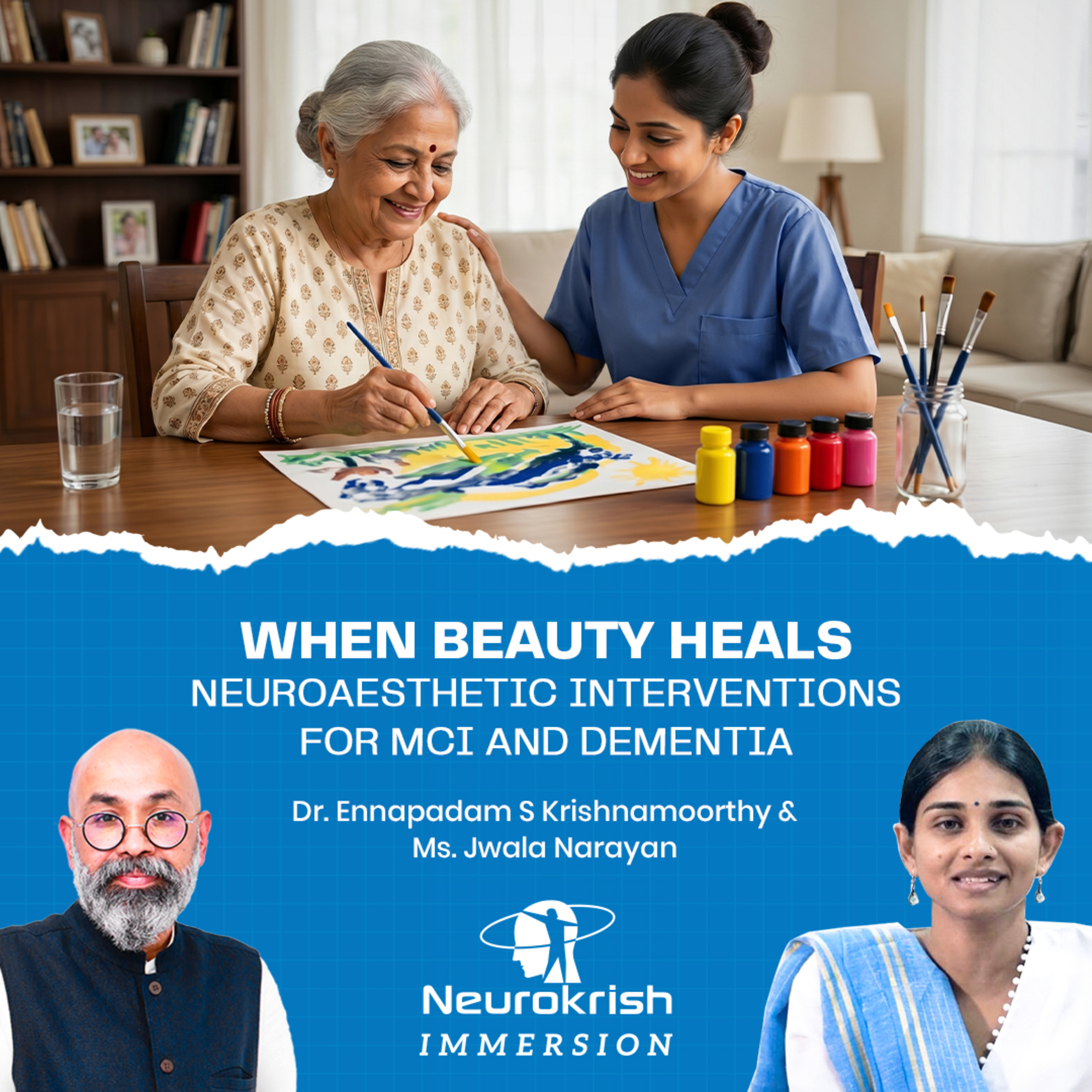
When Beauty Heals - Neuroaesthetic Interventions for MCI and Dementia
from The NeuroKrish Immersion
24m 10s
The conversation with Dr. Juala Narayan highlights how aesthetics—such as music, art, and storytelling—play a transformative role in dementia care. Unlike mechanical repetition, emotionally resonant activities help open the "therapy window," a state where the brain becomes emotionally available and engaged. These experiences reconnect individuals with their identity, especially through cherished memories and long-standing roles, such as being a parent or spouse. The brain’s deeper networks preserve emotional memories even as factual memory fades, allowing people to remember songs, rituals, or familiar rhythms. This emotional continuity enables participation and expression, which in turn strengthens emotional bonds between patients and caregivers. Creative engagement is not just about distraction; it fosters genuine emotional presence and meaningful dialogue. Dr. Narayan emphasizes the need for a shift in dementia care—from a purely medical model to one rooted in community, emotion, and human connection. Local, accessible programs using art and movement could make rehabilitation more sustainable and effective, especially in India. The underlying insight is that the human nervous system is fundamentally relational and meaning-driven. Healing occurs not through instruction alone, but through rekindling rhythm, identity, and emotional connection—restoring personhood itself.
Welcome to the Neuro-Christian Martian.
In this episode, we talk about when beauty heals.
Neuroesthetic interventions for MCI and dementia.
And I have with me in conversation today, Dr. Juala Narayan, who runs the Cognitive Neurologic
Clinic and is an accomplished cognitive psychologist working out of Bengaluru.
One of the things modern rehabilitation sometimes struggle with is that it can become very mechanical.
Repeat the movement, repeat the exercise, repeat the task.
And of course, repetition matters, the brain changes through repetition.
But the brain does not learn equally in every emotional state.
And of course, those of you who have been following the Inspired Brain series of podcasts,
master classes, would have come across me saying this before.
The anxious brain withdraws.
The depressed brain disengages.
The fearful brain shuts down.
And rehabilitation can truly begin. The system itself may need to open.
And perhaps this is where aesthetics matters.
Music can open attention.
Story can evoke identity.
Rhythm can create engagement.
Art can create emotional safety.
In many ways, aesthetics may help create what I have been calling the therapy window.
A state in which the brain becomes emotionally available for participation and change.
And this was one of the themes that emerged repeatedly in my conversation with Dr. Juala Narayan.
Dr. Juala, thank you so much for joining me today.
You work closely with elders living with mild cognitive impairment and dementia.
And one of the things I find fascinating about your work is that you are not merely treating
memory problems in a narrow medical sense.
You are trying to preserve engagement, participation and identity itself.
Let me begin with a question.
Families often ask me this emotionally.
When someone develops dementia, it sometimes feels as though the person we knew is slowly
disappearing.
Have you found that creative and recreational activities can sometimes reconnect people to
parts of themselves that otherwise seemed inaccessible?
Yes, absolutely.
I think identity is a very big part of who we are, you know, right from when we're children
to as we grow up, what we are building on is identity.
And unfortunately, in a condition like dementia, I think that's the most striking part.
It's your identity that's changing.
So you were someone's spouse, you were someone's father or someone's mother and you're not
playing that role anymore or you were working in a company and you're not playing that role
anymore.
Someone was very responsible, someone's always been the head of the family.
So there are different roles that we play, even with friendships and your social circles.
And I think that change is huge.
And then one of the biggest struggles for a caregiver is they say, I can't recognize
this person, this person is not the same.
This is not the person I married or this is not my father, this is not my mother.
So I think what the creative arts does is it really does help you connect with that older
person.
And we see it in small ways, you know, it's the way they approach the art.
It's the way the colors they use when they're doing art or if it's movement or if it's
music, some of them are very traditional karnatic singers and that remains and they still
sing.
So I think those are little ways that we can connect to that old identity of that diminishing
identity, if you like.
And families really cherish that.
I think for some of them, they didn't even know there were these sides to their loved
one, which I think are really has a very organic, very natural way of bringing out.
So I remember this one gentleman, he was 82 when he came to us sessions and he was this
ex-Army man and we asked him, you know, would you like to sketch, would you like to do something
with art and it was very strange because they don't usually, the first reaction is they
say, no, I don't do that.
That's for children.
But he just took a pencil and very quietly on his own just copied something and sketched
a beautiful picture of a girl that he copied, but his family, which is shocked because
they didn't know he could sketch and then he told us that he used to sketch as a child
when he was eight years old.
So in this sort of eight decades he hasn't really done any sketching for anyone to know.
So we always sort of meet with such surprises and different parts of personalities and identities
that come up, which is quite beautiful.
What I found deeply moving in Dr. Jwara's reflections was this idea that meaningful activity
is not simply keeping people occupied, there is a profound difference between distraction
and engagement, activity and participation because participation implies that the person
is emotionally present and that matters enormously in rehabilitation.
Jwara, could you help our listeners understand this distinction a little more?
How is meaningful creative engagement different from simply keeping someone busy?
Yes, I think we do it differently as well, you know, I've been running this program for
about eight years now in Bangalore.
And when we started out, we got an artist who would come and who would do some painting
with them or he would ask them to sketch something.
And that transformed very quickly actually in about two sessions he realized he had to
change his way of presenting art or engaging the seniors in art because the moment you
bring out crayons or paints or paper, it sort of reminds them of childhood which is nice
in a way, but for some of them it feels like this is too childish.
This is not for me or it's also scary for some of them, they're like this is something
I can't do, I can't do art because you've probably been told by your art teacher that
you're a horrible artist when you were in school and since then you've never touched
any form of art.
So then what we started doing is we started looking at upcycling art, we started using different
modalities that they would paint on and what this does is, it sort of includes that cognitive
stimulation that we're also trying to do because they're feeling different textures, they're
using different colors, they're painting on different objects so sometimes they're painting
on bottles.
So there's a lot of conversation that then that generates.
So there's very again organic language stimulation that's happening where as we're sort of using
different textures there's also memory that's being stimulated.
So there is a lot of cognitive stimulation that's taking place, it feels very natural
so it's not like we're sitting down and doing a Sudoku puzzle or we're not sitting down
and you know doing a crossword, but there is a lot of cognitive stimulation happening
very automatically when you use art and similarly when we use other forms of art, when you use
a movement, you know when we're using music to coordinate, to use rhythm, it helps you
ground the person, there's lesser anxiety, they're able to move with the rhythm so there's
some kind of coordination that's happening, there's also a little bit of dance which sort
of gives you some energy and this physical exercise.
But I think what art really does is it offers a very natural way of getting cognitive stimulation
or physical stimulation which otherwise people can be a little reluctant to indulge in.
One of the most powerful ideas emerging from neuroscience today is that memory is not
merely factual, identity itself is deeply emotional.
Like smell, rhythm, prayer, poetry and emotionally meaningful experiences often survive in
the brain, long after ordinary memory pathways begin to fail.
This is why a person with dementia.
may still sing a devotional song from childhood, perfectly even when recent memory is fragmented.
Music does not merely retrieve memory, it retrieves words, a temple, a festival, a young
herself, a forgotten emotional landscape, and suddenly for a few moments the person is present
again. Well, you mentioned reminiscence and emotionally meaningful activities several
times. Why do familiar songs, stories and emotionally charged memories seem to remain accessible
even when recent memory starts fading?
Yeah, I think remote memory is relatively preserved across most of the dimensions, not all but
most of the dimensions. And one of the theories is that it's the older memories have sort of
been rehearsed so much in the brain that the wider network in the brain sort of takes over
those. So sometimes the subcortical areas like the basal ganglion can also play an important
role in memory. So it's really the other parts of the brain that's taken over and that's
why it's supporting the remote memory and people still can remember things that they've
done in school, that they've done as a child, music that they've listened to, and also emotional
memories. They tend to be also sort of preserved in the wider network in the brain. So most
typically it's the sort of temporal cortex that first starts to deteriorate in the most
common types of dimensions. Whereas all these other memories, like our procedural memory,
emotional memory is there in a much wider network and that's why people are able to connect
to that for a longer time. And also things like music, again, connects to a different type
of memory and that's why people still enjoy music. They can still remember songs that they
used to sing as children, they can still sing all the different puja songs that they were
probably sing, they're still able to do that. And also they're able to follow the rhythm
and again that's because it's a different memory that does not require the typical sort
of temporal structures. We also now realize that nostalgia is quite an important sort of
emotion. In fact, I don't know if you've seen the new inside out movies, there's a second
version of the inside out and in that they've added nostalgia as well as another emotion.
It's something that a lot of people really cherish. So I think that's something that we also
connect with and as we get older, it just strengthens those memories, those emotions and that's
another way of expressing how we're feeling and I think that's why Reminiscence Therapy has
proved to be so helpful for people with dementia. Another thing Jwala and I discussed was caregiver
experience because dementia does not affect one person alone, it affects entire families emotionally.
And often what families miss most is not memory itself but emotional connection.
Have you found that shared creative experiences, music, storytelling, art,
games, recreation can also change the emotional atmosphere for caregivers and families themselves?
Yeah, I think honestly we've been struggling to bring caregivers in. So usually what tends to
happen is they drop them off and then they rush off. I think it's also they get just those
three hours trying to themselves. In fact we wanted to always run paddle sort of caregiver sessions
and one day everyone will come and then after that it just fizzles out. But this is not to say
that the arts won't help them. I think there's a lot of evidence on just caregiver stress but it
might have to be done a little differently, maybe separately for them. Some patients and families,
it would work to do a beautiful sort of art session with the family as well. Though for some,
I think it might just be best to leave a cycle. There's a lot of baggage, you know. One of the reasons
why sessions like Hogwarts work is when patients come in, people come in, we have volunteers who come
in. We all don't know enough about each other's lives and we just spend those three hours in that
moment. So it's all very enjoyable but you know you don't know what backgrounds, different people
and the families have had, what stresses they've had in their life. So sometimes it might not
be a great way. I mean they don't see it as a way to bond with their family. Sometimes they
don't want to bond with their family understandably. But I think again if we are looking at healing
those bonds I think art is a great way to sort of help with that healing and mediating that healing.
One of the ideas we kept circling back to during this conversation was this notion of the therapy
window. Rehabilitation works best when the brain is emotionally engaged, attentive, curious,
safe and willing to participate and perhaps aesthetics helps open that state, not because art is
decorative but because emotionally meaningful experiences change brain state.
Do you feel that beauty, rhythm, familiarity and emotionally meaningful experiences help patients
become more open to participation and rehabilitation? Yeah absolutely and you know this has been a
learning journey for me as well because when we started these sessions I was not thinking of art,
I was just thinking of cognitive stimulation and it's really grown so much now with such a big
focus on art and movement, different modalities of art and I'm so grateful for all the people who
you know come and thought us and take in these sessions, they've been volunteers, they've been
people have just been interested in what we've done and in fact now we've collaborated with
Fahi which is the foundations for arts in health India and it's run by my three Gopal Prishnan.
And I think they have brought in a very different side so they sort of bring in puppetry,
they bring storytelling so it's different aspects of art and we've seen how different
modalities really open up differently for individuals because some people love to talk,
some people love to paint, some people like to do very quiet craft work and what these
pieces of art does then is it opens conversation. So then you talk to them, then they might tell
you a little story about what happened as a child or they might also tell you what happened
the previous day and how they had this fight with their daughter and they're so upset about it
and they just felt so misunderstood and you know we always think that oh they don't remember
what happened so it's okay and then we realize that they have and sometimes they might not express it
so I think art really helps bring out, open up and also within the group so we you know we find
people can make very strong bonds even with dementia so they all buddy up we always have like a
back seat or you know your typical back bench who sits there and this passes these comments we have
that also in the group even with dementia so I think you'll have all different types of personalities
and they create beautiful bonds which again helps open up bring out things when they create
something so sometimes you know they might make a piece of art and they say oh this looks like
you know my mother-in-law who's been no more the moment but since it is it brings out a lot of
humor brings out sadness sometimes sometimes we have patience we just suddenly break down
we don't know why and then we just hold that moment for them which I don't think is necessarily
bad because sometimes it's a way that they need to also express so it does yes it does open I think
many doors and many windows for communication I think this is a very important shift in how we
think about rehabilitation because perhaps rehabilitation is not merely about restoring movement
or improving scores on a cognitive test it's also about helping the person re-enter meaningful
participation in life itself looking ahead do you think dementia care in India needs to move
beyond a purely medical model towards something more emotionally
socially and aesthetically enriched.
Yes, absolutely. I mean, I have been pushing for this the last, I think, six years, ever since
we started because we see how effective it is and, you know, I have patients driving
through horrible Bangalore traffic for two hours to get to a session. And I think that's
just not fair for a 75 or 80 year old having to do that. So I think this should, this should
be completely community run. It's not rocket science. I think the local parks, people in
their community should be able to mediate this and run this definitely. I think we need
to go much beyond what we are doing right now and there is a lot of promise in it. We also
see that it could probably bring down the numbers. So there are studies related to this.
If it really brings down other health conditions or visits to the doctors for other things. So
we haven't done a formal study, but it's definitely something we'd like to do and look
at. So I think it could benefit largely at a much, maybe at an economical standard
as well. Listening to Dr. Jwala, one realizes that neuroacetics
is not really about art appreciation. It's about understanding something very fundamental
about the human nervous system. That the brain is not merely a machine processing information.
It's a deeply emotional, relational and meaning seeking organ. And perhaps this is why rhythm
matters, story matters, beauty matters, memory matters, ritual matters, music matters, because
these are among the ways through which human beings remain connected to themselves, to others
and to life itself. There's a lovely story about a cat named Nora who began playing the
piano simply by watching piano lessons in her owner's home. She was never trained and
yet she developed clear preferences. Certain notes, certain tonal ranges, even a preferred
posture at the piano. Why is the story scientifically interesting? Because it suggests that nervous
systems may naturally seek rhythm, pattern, engagement and participation. And perhaps
rehabilitation ultimately depends upon rekindling exactly these capacities. The injured brain
often becomes passive, fearful, withdrawn and disconnected. Aesthetics may help reawaken
participation itself, not just compliance, but participation. Perhaps the future of rehabilitation
will not merely restore movement, speech or cognition. Perhaps it will restore rhythm,
identity, individuality, emotional connection, participation and personhood itself. Because
the human brain does not heal optimally through instruction alone. It heals best when it
reconnects meaningfully with life. If you like what we spoke about today about the healing
tendency of beauty, please do listen to the three editions of the Inspired Brain Master
Class on the Neuro-Christian Martian. Thank you for joining me here at the Neuro-Christian
Martian. Thank you for joining us together. Dr. Jowala, Narayan and I. I am Dr. Anaparata
Masakrishnamoati. And if you like what we do here, please subscribe and share. We are
on Apple, YouTube and Spotify. Thank you.
Podcast Summary
Key Points:
Aesthetics such as music, art, and rhythm can open the "therapy window" by making the brain emotionally available, reducing anxiety and promoting engagement in rehabilitation.
Creative activities help preserve identity in dementia by reconnecting individuals with long-standing roles, memories, and emotional experiences they may have forgotten.
Meaningful participation differs from distraction—engagement involves emotional presence, which is essential for cognitive and emotional healing.
Emotional and remote memories—like songs, rituals, or childhood experiences—are preserved longer than recent memories due to their reliance on broader, subcortical brain networks.
Shared creative experiences improve emotional connection between patients and caregivers, fostering empathy and reducing caregiver stress.
Dementia care should shift from a purely medical model to one that incorporates emotional, social, and aesthetic elements rooted in human connection.
Community-based, accessible programs using art and movement can be more effective and sustainable than clinical interventions, especially in low-resource settings.
The human brain heals best through meaningful participation, not just instruction, as rhythm, beauty, and identity restoration are fundamental to human well-being.
Summary:
The conversation with Dr. Juala Narayan highlights how aesthetics—such as music, art, and storytelling—play a transformative role in dementia care. Unlike mechanical repetition, emotionally resonant activities help open the "therapy window," a state where the brain becomes emotionally available and engaged.
These experiences reconnect individuals with their identity, especially through cherished memories and long-standing roles, such as being a parent or spouse. The brain’s deeper networks preserve emotional memories even as factual memory fades, allowing people to remember songs, rituals, or familiar rhythms. This emotional continuity enables participation and expression, which in turn strengthens emotional bonds between patients and caregivers.
Creative engagement is not just about distraction; it fosters genuine emotional presence and meaningful dialogue. Dr. Narayan emphasizes the need for a shift in dementia care—from a purely medical model to one rooted in community, emotion, and human connection.
Local, accessible programs using art and movement could make rehabilitation more sustainable and effective, especially in India. The underlying insight is that the human nervous system is fundamentally relational and meaning-driven. Healing occurs not through instruction alone, but through rekindling rhythm, identity, and emotional connection—restoring personhood itself.
FAQs
Yes, creative activities like art, music, or storytelling can help individuals reconnect with past roles and identities that may have been lost due to dementia.
Meaningful engagement involves emotional presence and participation, while distraction simply keeps someone occupied without fostering connection or emotional depth.
Emotional and procedural memories are preserved in wider brain networks, making them more resilient than recent factual memories that rely on the fading temporal cortex.
Arts like painting, movement, or music stimulate multiple senses and brain regions, promoting conversation, memory recall, and emotional expression without feeling forced.
Yes, shared activities like art or storytelling can reduce caregiver stress and foster emotional connection, even if not all families feel ready to engage immediately.
The therapy window refers to a state of emotional safety, curiosity, and engagement where the brain becomes open to learning and participation, often facilitated by beauty and rhythm.
Chat with AI
Loading...
Pro features
Go deeper with this episode
Unlock creator-grade tools that turn any transcript into show notes and subtitle files.
 PodcastTranscript AI