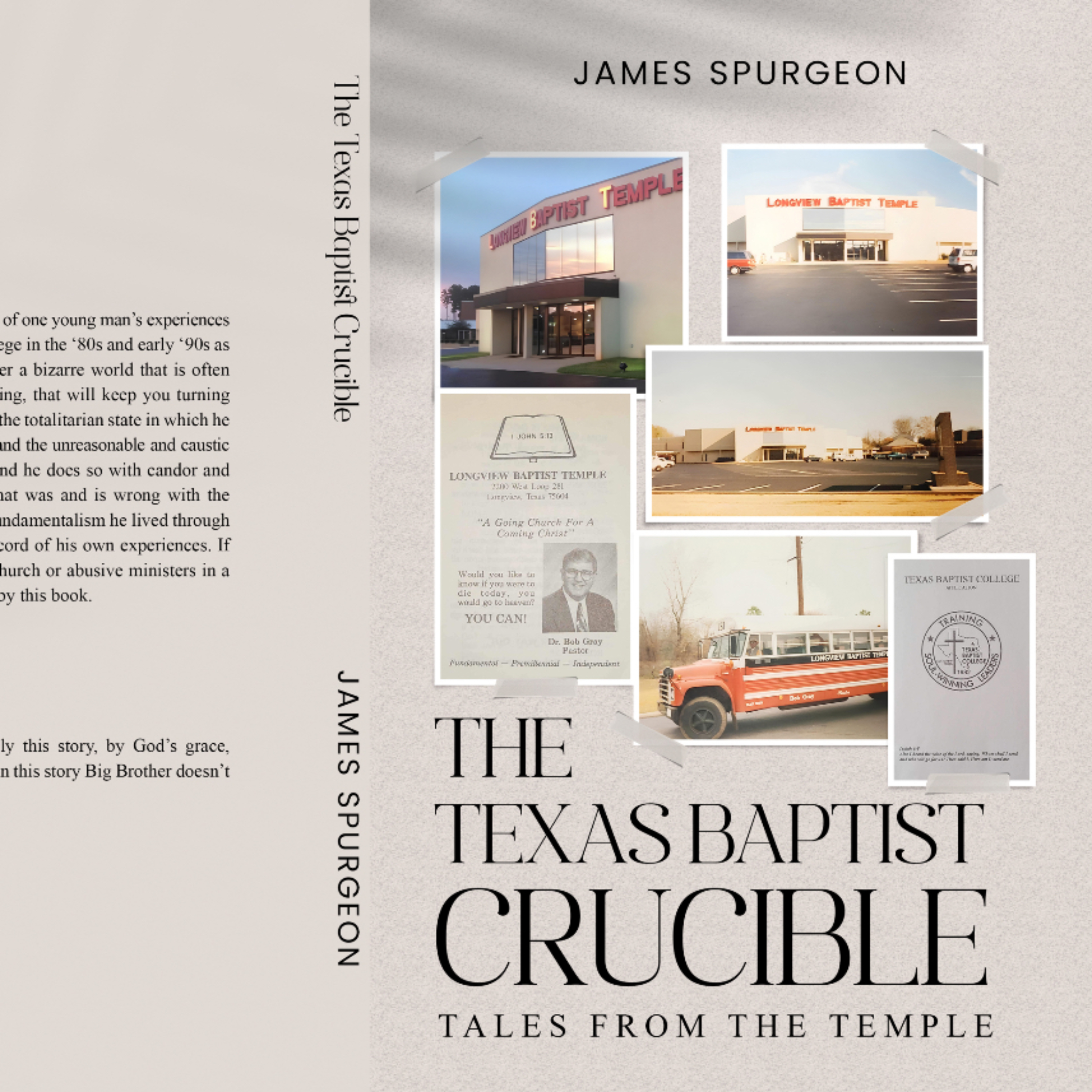
The Texas Baptist Crucible Podcast, hosted by James Spurgeon, aims to provide a platform for survivors of abuse in the Longview Baptist Temple to share their stories. Spurgeon recounts his own experiences of leaving the Temple, finding healing, and writing the book "Tales from the Temple." The podcast and book shed light on the abusive practices within the independent fundamental Baptist movement and seek to offer support and hope to those who have been affected. By exposing the wrongs from a Christian perspective, Spurgeon aims to challenge the misconceptions within such churches and provide a voice for those who need their stories told. The focus is on creating a record of the truth, offering understanding, and ultimately delivering stories that evoke laughter, tears, and hope.
Transcription
2258 Words, 12154 Characters
You're listening to the Texas Baptist Crucible Podcast, a podcast dedicated to speaking
the truth in love, helping the abused and giving a voice to people who were harmed in
the independent, fundamental Baptist movement.
Good morning out there podcast listeners, or afternoon, or evening, or whatever it is
for you, even if it's the middle of the night, I hope you're doing well.
I'm James Spurgeon.
And I wrote the book that goes by the same name as this podcast, the Texas Baptist Crucible
Tales from the Temple.
I want to do two things today.
First I want to introduce you to this podcast and tell you about some things we're going
to be doing so that you'll be sure to come back.
And then I want to tell you what led to me deciding years after the podcast FAD has crested
to go ahead and start my own.
First things first, my vision for this podcast is that it give voice to people, people other
than me, who were exposed to the ministry of the Longview Baptist Temple, Longview, Texas.
I spent seven years there and I experienced so many bizarre and jaw-droppingly ludicrous
things that I wrote a book about it.
And while I was certainly the recipient of spiritual abuse, my stories tame compared
to a lot of other stories I've heard from other people who were there.
So I'm giving them a voice for their stories.
And then I'm going to follow up by talking about what was wrong, biblically speaking,
with what happened to them and to me.
We're going to analyze the ministry and philosophy of this particular independent fundamental
Baptist Church, and hopefully we're going to be able to do it with grace, wisdom, and
humor.
I'm going to try to tell the story of how a place like this could exist, how it came
to be.
And we're going to try to take into account the justification they would give for the
type of behavior that we are exposing here.
More than that though, I want the people who were or are in this mess to know that there
is help and there's hope in where to go to find it.
When I left the Longview Baptist Temple in the fall of 1994, I didn't really know what
I was going to do.
I had repeatedly, repeatedly had it driven home to me that to leave the church without
the man of God's permission was to leave God's will forever.
And think about that.
It meant I would never be used of God, that I was ruining my life and future.
The only way to remedy that would be to come crawling back and submit myself once again
to the man of God.
I had to break from that spell before I could leave.
And once it was broken, I was angry.
I was angry about the years of my life that had been wasted.
I was angry at myself for spending so long there.
I was angry and I spent a few months defying their rules for no particular reason.
But God was gracious in giving me a place to heal.
And that place for me was the San Springs Baptist Church of Minneapolis, Texas.
And I will forever be grateful to them for giving me that place for the first 10 years
after I left.
I was pretty much what people call cage stage nowadays.
The Internet was just starting to take strides and social media as we know it hadn't been
invented yet.
But one day when searching the web, I came across something called the unofficial Jack
Hiles webpage.
The curator was a gentleman named Don Elburn, who was a Southern Baptist pastor down in
South Louisiana.
He had spent a year at Hiles Anderson College, the same college that has spawned a whole
host of fundamentalist preachers across the country, including the pastor of the Longview
Baptist Temple, Robert Glenn Gray, the first.
Now why Don decided to host a webpage for the sermons and writings of Jack Hiles?
I don't know.
Don was neither independent nor fundamentalist.
He was however Baptist and a conservative one.
It was on that webpage that I spotted something very interesting, something that sucked me
in immediately attached to the page were two different forums, unmoderated forums.
One was named after Jack Hiles and the other was called the fighting fundamentalist forum
and fighting is just what I was down for.
I went into those places using my own name blasting with both barrels.
This would have been late 1998, early 1999.
These two forums occupied a lot of my time.
Then one day someone on that board said to me that I sure seem to have had a lot of fascinating
experiences at my fundamentalist Bible college and they wondered if I would share the stories.
Well I had been sharing my stories for years, entertaining and flabbergasting anyone who
wanted to listen.
So of course I was down for that.
I started writing them one at a time and calling them tales from the temple.
Eventually I was convinced to tell the whole story and turn it into a book.
So I did.
And because no one publishes memoirs from a nobody, I had them published on my own through
something called publish on demand.
Publish on demand was new at the time and also expensive, not for me, but for the people
who wanted to buy a copy of the book.
The first edition went out in 2006 and it retailed for $24.95.
Now at that point I was done.
Writing the book was so cathartic for me, I was ready to move on and I did.
I did nothing to promote the book, just made it available, wiped my hands and moved on.
And I was no longer angry.
But people never really left me alone about it.
I'd get phone calls, emails, actual handwritten letters and cards in the mail.
People wanting to thank me for writing the book and telling me how helpful it had been
for them.
I always enjoyed hearing from people like this.
Well then the book went out of print.
And I started getting queries from people wanting to know where they could get a copy.
I sent out most of the copies I had on hand for free and made a mental note to go back
and somehow make it available again.
And more time went by.
All this time I'm further and further away from that bizarre world of independent Baptist
fundamentalism.
I'm so past my experiences there that I don't even think about them anymore.
Once a woman called me out of the blue.
She was a student at Baylor and she was writing her dissertation on cults.
Because she grew up in Kilgore, or maybe it was Gladewater, she decided to investigate
the Longview Baptist Temple.
And of course she came across my book.
So she called me, talked to me a couple of times and I gave her some context.
Contacts, I can't even say that word.
But again, I just moved on.
I never even read her published article.
Then there came a day when I had several people reach out at once talking to me about the
book.
I get added to a Facebook group of hurt and searching people.
People had been hurt by IFB churches and were looking for help, trying to figure out what
they were going to do now.
I began reading their stories, seeing their hurt and struggle and confusion, and it made
me want to help.
Leaving a cult isn't easy.
And I don't use that word lightly.
The Longview Baptist Temple was a cult.
It was abusive, and it was a cult.
Seeing all these people who were hurting and looking, I finally decided to stop procrastinating
and get the book back in print.
So I did.
My first idea was that it probably could use a good editing, because I didn't want to slander
anyone, because I don't want to be like them.
I wanted to make sure I was being gracious and giving the benefit of the doubt.
I was surprised in the rereading how much I had done that the first time around, giving
them the benefit of the doubt.
So I really didn't have to edit much at all.
I did add some perspective from twenty years later and wrote a new forward, but that's
about it.
After reading it again, man was that a roller coaster of emotions.
I found it disturbing.
It had been so long, and I had been out of that world so long that I had forgotten a
lot of it.
I would start a chapter of my own book, not sure where it was going, and then find myself
appalled at what I just read, and I was struck by just how evil the place was.
It was much more evil than I remembered and much more evil than what I understood at the
time, even at the time I originally wrote it.
I was seeing things now I had never noticed before, because I was too young and naive
to notice them.
After the book was published again, I was graciously invited on to a podcast, the Four
Freedom Podcast, hosted by Brett Martin and James Saffret.
Those guys interviewed me about my time at LBT, and the interview went great, but it left
me wanting to say a whole lot more, and then other people began reaching out to me about
things still going on at the church, and still other people who had read the book wanted
me to add more to it.
Not stories per se, but explanations about what exactly was wrong, or how to recover
from something like that, and one of the tactics that people in these IFB cults always use
on the people who leave is shunning.
If you leave, you're shunned.
You may have been friends with someone your entire life, but if you leave, they won't
even speak to you anymore.
But I'm not talking about everyone, realize I'm broad brushing here.
But it happens more often than not.
And one of the things they say about you is that you're just bitter, as if the problem
is you, not the abusers you're seeking to escape, you.
And as soon as I started posting my tales to the old fighting fundamentalist forum, here
came the bitter birds.
Why are you so bitter?
Why are you attacking the man of God?
As if telling the truth about him was attacking him.
Well, there I was, fending off all flock of these bitter birds who were angry because
I was writing my stories and then making them available to the world.
I was defending myself from this ridiculous bunch.
When someone spoke up for me, I don't remember who it was, but a wise old gentleman stepped
in and said, you don't understand what James is doing, and James is not attacking anyone.
James is just making a record.
That's what this whole thing is about.
It's about making a record.
And that is what my book is.
It's a record of what took place between 1987 and 1994 at the Longview Baptist Temple and
Texas Baptist College.
And that's what this podcast is going to do.
It is going to give a voice to people who need their stories told to, who need a record
to be made.
I'm going to help them to do that.
And then I'm going to expose the wrong being recounted from a Christian perspective because
the last thing that churches like LBTR are is biblical Christianity.
They are not historic Christianity, Protestant, or otherwise in any sense of the word.
They are a skeleton.
They are a caricature.
They are neither doctrinally sound nor practicing the faith once delivered to the saints.
They are what happens when a group of people split off the historic church, forget that
they ever belong to it, and then claim they are the only ones left in a world-gone apostate.
The truth is, they are the apostates.
So over the course of this podcast, I'm going to answer a lot of questions about how a place
like LBTR came to be, what it's about, and what's right with it if we can find something.
And I bet we will.
And what's wrong with it?
And we're going to have fun doing it.
So buckle up.
I promise you I'm going to deliver you stories that will make you laugh and cry and hopefully
give you hope.
And I'm going to do it in a humorous way because that's just the personality that God gave
me.
In Matthew chapter 11, Jesus gives an astounding invitation.
And I want you to really hear it and let it sink in.
"Unlike the burdens laid upon your shoulders in the fundamentalist cult, the ridiculous
extra-biblical standards, the lying, the slender, the pressure to perform, the demand to obey
the man of God implicitly, no matter how horribly he treated you.
Unlike all of that, hear the words of Jesus, "Come to me all who labor and are heavy laden,
and I will give you rest.
For I am gentle and lowly in heart, and you will find rest for your souls.
For my yoke is easy, and my burden is light."
See you soon.
God bless you.
Podcast Summary
Key Points:
Introduction to the Texas Baptist Crucible Podcast by James Spurgeon.
Purpose of the podcast is to give voice to survivors of abuse in the Longview Baptist Temple.
Discussion on the abusive practices within the independent fundamental Baptist movement.
Spurgeon's journey of leaving the Longview Baptist Temple and finding healing.
The process of writing and publishing the book "Tales from the Temple" and its impact.
Renewed interest in the book and decision to republish it.
Explanation of the podcast's aim to expose the wrongs in the Longview Baptist Temple from a Christian perspective.
Emphasis on providing hope and support for those who have experienced abuse in IFB churches.
Summary:
The Texas Baptist Crucible Podcast, hosted by James Spurgeon, aims to provide a platform for survivors of abuse in the Longview Baptist Temple to share their stories. " The podcast and book shed light on the abusive practices within the independent fundamental Baptist movement and seek to offer support and hope to those who have been affected. By exposing the wrongs from a Christian perspective, Spurgeon aims to challenge the misconceptions within such churches and provide a voice for those who need their stories told.
The focus is on creating a record of the truth, offering understanding, and ultimately delivering stories that evoke laughter, tears, and hope.
FAQs
The podcast is dedicated to speaking the truth in love, helping the abused, and giving a voice to those harmed in the independent, fundamental Baptist movement.
The host is James Spurgeon, who also wrote a book titled 'Texas Baptist Crucible Tales from the Temple.'
The vision is to give voice to individuals who were exposed to the ministry of the Longview Baptist Temple and to analyze the ministry and philosophy of independent fundamental Baptist churches.
The host decided to start the podcast to help people who have been hurt by IFB churches, offer support, and shed light on the wrongs within such institutions.
Leaving a cult can be difficult due to tactics like shunning, where individuals are ostracized and labeled as bitter for seeking to escape the abusive environment.
Jesus invites those burdened by extra-biblical standards and mistreatment to find rest in Him, promising a light yoke and rest for their souls.
Chat with AI
Loading...
Pro features
Go deeper with this episode
Unlock creator-grade tools that turn any transcript into show notes and subtitle files.
 PodcastTranscript AI