What the history of U.S. protests illuminates about today
28m 5s
The transcript discusses escalating tensions in Minneapolis following the police killings of protesters René Maclin-Good and Alex Prattie, an ICU nurse, during actions against ICE. Officials attempted to falsely characterize Prattie as a domestic terrorist, but video evidence shows he was not brandishing a weapon. This situation is contextualized within Minneapolis's history of activism, notably after George Floyd's murder. The conversation then shifts to a broader analysis of protest efficacy with historian Gloria Brown Marshall. She challenges the misconception that protests yield instant results, explaining they are long-term strategic efforts often met with backlash. Using examples like the fight for the eight-hour workday and labor unionization, she illustrates how meaningful change requires sustained sacrifice and diverse tactics, from strikes to individual acts like boycotts. Marshall emphasizes the critical role of young people in protests, as they often have the time to deeply understand issues and participate, citing historical examples like the Children's Crusade and anti-Vietnam War movements. The overall message is that protest is a complex, empowering, and necessary tool for social change, demanding persistence beyond immediate outcomes.
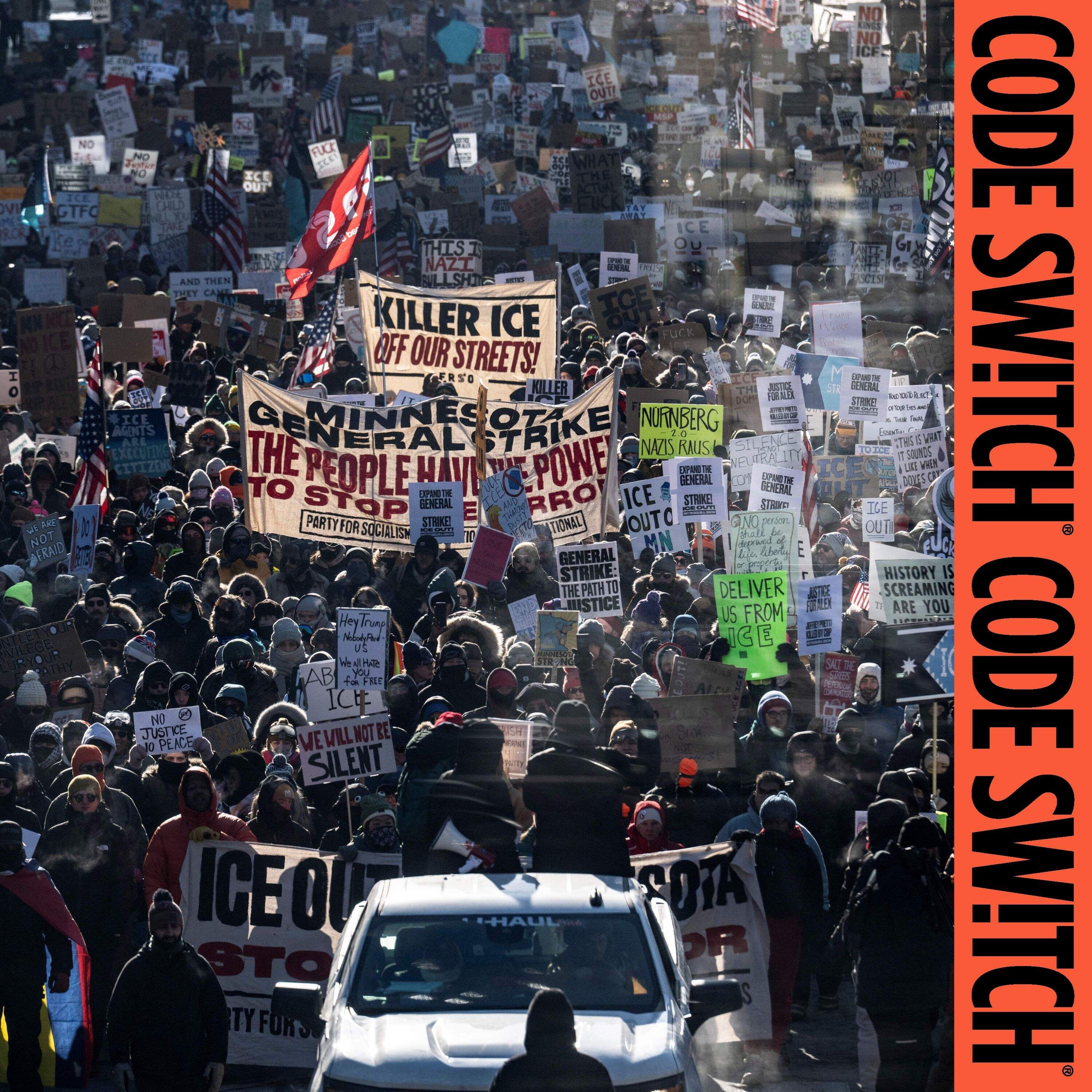
Support for NPR and the following message come from the William and Flora Hullet Foundation, investing in creative thinkers and problem solvers who help people, communities, and the planet flourish. More information is available at Hullet.org. Hey everyone, you're listening to Code Switch, the show about race and identity from NPR. I'm BA Parker. A lot is going on in the world right now, but I can't get my mind off of Minnesota. I mean, things have already been extremely tense Minneapolis for weeks. After interactions between ICE and protesters came to a head when an ICE officer shot and killed René Maclin-Good at the beginning of January. From there, protests and tensions swelled, and then on Saturday, a little after night in the morning, an immigration officer shot and killed a man named Alex Prattie. Prattie was 37 years old. He was an ICU nurse participating in protests against ICE. Over the weekend, Trump administration officials, including Christie Nome and Gregory Bavino, repeatedly tried to characterize Prattie as a domestic terrorist. Video evidence reviewed an eyewitness accounts that have surfaced have refuted assertions that Prattie was brandishing his handgun at any time during the encounter. Here's NPR immigration reporter, Jasmine Garz. There is no evidence in the videos, which, by the way, NPR has verified that Prattie was ever brandishing a gun in his hand. What we do see is Prattie holding a phone in his hand, and then at least six masked federal officers tackling him, beating him, spraying him in the face with a chemical agent, then they pin him down on the ground, then one agent appears to pull a gun from Prattie's waistband before agents shoot him. We counted 10 rounds fired. Watching of us in fold, I've been thinking about what it means to be a protestor these days. I mean, you've got thousands of people coming out in Minneapolis and sub-zero degree weather, fighting against what they see as the inappropriate actions and policies of ICE and DHS. But it's at best unclear as to whether any of this will have a long-term effect on how this country polices immigration. And meanwhile, people are out there in the freezing cold, getting pulled over, detained, pepper sprayed, tear gas, and in two cases, killed by masked government officials. And I don't think it's any coincidence that all of this is going down in Minneapolis. I mean, we have to remember that Minneapolis is where George Floyd was murdered in 2020, and the protests there were enormous. I mean, Minneapolis essentially launched the racial reckoning that overtook the entire country that year, and people in Minnesota have spent years organizing, strategizing, and honing their tactics to protest perceived injustices. So if any city in the country is prepared to take on the fight right now, it's arguably Minneapolis. And it's got me thinking about an episode we did back in July of last year. It was about how protests work, what they do and don't do, and why they matter. One of the people we spoke to was Gloria Brown Marshall. She's an historian, and she wrote a book about protests. And she said one of the things that a lot of people do, and I admit I can't be guilty of this, is they think protests should work almost instantly, like in TV. Because in the TV version, you have the problem, then you have the protests, you have the dark night of the soul, where the protest doesn't work, that it next night it does, and now people are happy and that's the end of the show. And so they don't show that the other side is saying we're going to take this ground back. You just took from us the ground you took is mine. We've talked about this on Coat Switch before. For every movement that pushes for its version of justice, there's another movement pushing back hard against that. Saying no, we don't want those changes. We want things to stay the same, or actually we want things to go back to an even earlier era. So the cycle of protest and backlash can really swing. Which is why I think that today, in the midst of this very scary and deadly clash that's happening in Minnesota and around the country, it's worth revisiting our conversation about what protesting actually means. This message comes from Wise, the app for international people using money around the globe. You can send, spend, and receive an up to 40 currencies with only a few simple taps. Be smart, get Wise, download the Wise app today or visit Wise.com, tease and seize apply. Support for NPR and the following message come from the William and Flora Hewlett Foundation, investing in creative thinkers and problem solvers who help people, communities, and the planet flourish. More information is available at Hewlett.org. I spoke with Professor Gloria J. Brown Marshall to the Professor of Constitutional Law and Africana Studies at John J. College. And her book, A Protest History of the United States, explores how people in the U.S. have always organized, from indigenous revolts to union strikes, to the 2020 protests after the killing of George Floyd. Rebellion and protest have shaped this country. We need to know how to do this and do this meaning protest. And people have said, oh, it's not effective anymore. Nobody does anything with protests. It doesn't really work. And so I wanted to have examples. And I couldn't put everybody's protests in there. But it's got a lot of protests from, you know, the indigenous uprisings. And there are all these different things that people have done large and small that I think is necessary for us to understand today to inform our protests today. Gloria told me that she wanted to write the book because she was seeing a disconnect between the rights we have now and the knowledge we have of the people who fought to achieve those rights. And they were almost dismissed from history. And I felt that they should be, or at least their efforts and that their work should be known. And also I wanted young people to understand that there are protests that have taken place that can inform the protest they're doing today. This is a perfect segue because I was talking to a listener who lives in Austin, Texas, a mom. And she's trying to persuade her teenage son that protest work. My name is Katie Hamill. My husband and I went to the No Kings protest here. And I have been talking to my son about the protest a couple days prior, seeing if he wanted to go come down with, like, let's go out with 12some signs. And his response was almost immediately, what's the purpose? I don't think protests really do anything. Like they don't seem to make any difference. What would you say to his mom to try to like control this kid back into action? Well, depending on the age, they've seen a lot. And they've seen a lot of protests and yet they see a lot of backsliding. And so they have the right to be cynical. So I think she should really see him as someone who's deservedly cynical based on everything they've seen in their short time period on the planet, but also to realize that protest, even if it's street protests or some other protest is empowering. And it allows them to lift that weight off of their shoulders and be a part of something that's social, that sense of empowerment that comes with being a part of something greater than yourself. What would you consider the most successful movements in US history? Eight hour workday. Yes, that's why people wait. You don't think that came from protests. Is eight hour workday a good thing? And eight hour workday is a good thing because people used to work 16 to 20 hours. They used to work whatever amount of time the employer wanted them to work. And so that's why I was saying basic things like that we take for granted and we don't realize that the eight hour workday was in law in 1860s. But in practice, it didn't take place till the 1900s. People had to protest and make it a reality. You had people in the street, you had strikes, you had works shortages or slowdowns, you had works stoppages. And my book is about there are many ways in which to protest. We don't think of Rosa Parks with a bullhorn in the street with a sign, but her protest was internationally known and effective all the same. So for that mother talking to that young person, just think protest doesn't have to be just out in the street. It could be a singular decision not to buy at a certain store. That's protest. So I look at it, somebody wants to take a knee. That's a protest. That's an individual part or could be part of a group. And if we expand the idea of protest, it can involve more people and do more things. You don't have to go out into the street. That's not the way it has to be. Is that what you think people are getting wrong about protest? I think people are getting wrong about protests. One, they get a lot of things wrong. Not thinking there's a strategy to it. And you think that you do the TV version of protests.
because people look at the last protest and they see the change, they think the last protest did it. They don't think of all the years of protest leading up to it because in the TV version, you have the problem, then you have the protest, you have the dark night of the soul where the protest doesn't work, that the next night it does, and now people are happy and that's the end of the show. And so they don't show that the other side is saying, we're gonna take this ground back, you just took from us. The ground you took is mine. They're gonna be interesting to just like go through the strategy of a single protest, like the non TV version of it. - Okay. The coal worker strike was based on the fact that the corporations, the train barons and the coal company barons, and they use the word barons back then because they were basically taking from the European model. They would come here and with these same mindset, many of them, of surfed them, that the worker is a surf, and at the time in Europe, the surf was connected to the land. That's why you get that word, land lord, because yes, they were the lord of the land. It became the version of South of Sherecropping, where the farmer would get a little part of what they produced in the line share of it would go to the plantation owner. And so what we have now are people who are working in the coal mines, they find this massive amount of coal in the mountains of West Virginia. And so there's no eight hour work day. They work them as long as they need to work them. They're going into these dangerous conditions, and people are dying, people are losing a limb. But the corporation owns the land, they own the homes, they own the schools, they own the church, the corporations own the stores, and so the people who are working there are paid in what there's called scripts, their piece of paper, is not real money, is a piece of paper with the company's name on it, pay us $10. And then you go to the company store, and then the company store, which is owned by the corporation, then writes down how much you bought at the company store takes it off of the script and writes it down, how much you now owe from the rent, from the store, from clothes, the worker had nothing. So the workers want to join unions, they want to become united and have a power to sit at the table and decide certain things. So they want to renegotiate their wages. And to do that individually, they would have they call yellow dog contracts. And in the contract is said, you could not negotiate your wage, you could not be part of a union, and if you did, you would be evicted from your home. And so what they had to do, they had someone named Mother Jones. And Mother Jones was this little, she's like a little grandmother, this little white hair, white woman, who with this fierce voice, and she would tell them, you don't get together, everybody come together, so you had this strategy of how much money we should make, what should be the union, how can we bring in somebody from outside to help organize us? Then you have this union organizer and Mother Jones. So you have all these things coming together, but you also had people who were not going to allow that to happen. So folks were evicted, and once they were evicted, they will live in a tent. But then the corporation owned the land where the tents were, so they are evicted from the tents. So you had a high price pay in order for them to continue to have union organizers, but because unions were in other parts of the country, outside people came in to help them organize their unions. So you had pressure on the outside, you had lobbying a federal government to recognize the unions, and recognize the ability to have a union. You think about that, and you can apply that to what happened in the Civil Rights Movement, because a lot of the Civil Rights Movement was based on the structure of what happened with labor organizing. Yeah, yeah, yeah. And I wanted to ask you, so at the beginning of July, I saw these aerial views of Philadelphia, their sanitation workers on strike, and the streets were full of trash, and it was massive and like everywhere. What did you think about that? I used to live in Philadelphia, and I lived in Philadelphia during a trash truck. How'd it go? It was rats were everywhere. Right. You know, they were jumping out of baskets, you know, on my way home, you had a dodge thing. Yes, it was bad. And you know, once again, what is it doing, disrupting? Is making you stop your day to day, going back and forth to whatever you're doing, to say pay attention to this issue over here. And so now you have this standoff, how long are people gonna go without wages? Part of what I say in my book is, my father was part of a protest. And when he protested, you know, they were out so long, we lost our house. Yes, we lost our house. You know, he got another job in the end and worked his way up, and you know, he's passed on now, but you know, he ended up getting back on his feet and all of that, but yes, you can have devastating economic effects. I'm not trying to gloss this over at all. People can get arrested. Please can be, you know, accused of assault, you know, in many instances of those people who are out protesting, will have economic effects. That is part of it too. Well, when you see, when you, like, see firsthand what the cost of protest looks like, what do you, what do you take from that? When you see something like that, have me with your dad? I think about the courage. These people put their lives and livelihoods on the line. They wanted something that was beyond just their individual needs. And so whether or not they're fighting for clean water or for better schools or for higher wages, they're going to be fighting for something that will not entail 100% of people because protests are usually just a fraction of the people involved, yet the whole group gets the benefit. Sometimes I ask the people, you do want to be a freedom free loader because we have a lot of freedom free loaders who don't want to do anything, except reap the benefits of other people putting themselves on the line, but it's always been that way. You know, so that's why a lot of people go, you know, why isn't everybody there? It's never been everyone there if that's proper English. It's always just been a fraction of people who have made the difference in when it comes to protesting. So what happens when you fight the good fight? And it doesn't go your way. How can we lose? This was something very important. This was necessary, didn't I understand? This was the help our education. That's coming up, stay with us. Parker, just Parker, Code Switch. And we're back with a conversation from July 2025 that we've been thinking about given everything happening in Minnesota right now. I've been talking to Professor Gloria J. Brown Marshall about her book, A Protest History of the United States. And she told me that one thing that stood out to her and her research was the importance of young people in protests. So many high school students have played major roles in protests. They haven't recently, because so many people refuse to give young people their due as far as effective protesters. They became effective during George Floyd, because older people like myself who had respiratory issues or whatever couldn't protest as much as we would have. And so that gave the entree for young people to take their true role. But protests are usually by the young. They have the time to read the issues, but they also have the type of jobs that would allow them to protest. And the children's marches, for example, during the Civil Rights Movement, Martin Luther King had children high school students, because if the parents march and they lost their job, the whole family would lose their income. And so they would have high school students participating or college students participating in sit-ins and marches. - What a protest in that night. - They got, get out of school, you got these, dude. - Do you write about it in the book by one of you to say, do you remember your first protest? - I remember my first protest. I was in grade school, and this was during the time period in which a lot of white parents were taking their kids out of school and moving to the suburbs. I didn't understand any of this. All I knew was they wanted to pass what they called a levy, a tax levy. I was even sure what a tax levy was. All I knew was that we needed the tax money to sustain the school. I didn't know as a child that people working people dislike taxes. And no clue. But we went to the streets and we had a little sign, vote for the levy. And I had a little sign, vote for the levy. Do save our school. Vote for the levy. We're depending on you. And so, yes, no, no, I didn't go in to sing it. And so I wrote the little song and we were there. We watched the street with our signs and everything like that. And the levy did not pass.
We did not have the Texas to sustain the school system with all of the people who had the higher incomes, leaving the school district after Brown versus Boy of Education. This wasn't right after Brown. Thank you very much for anybody trying to add stuff up. (laughing) - First of all, 19. - Thank you. Thank you. This was not in the 50s at all. Thank you very much for folks going on Google already. But what really got me about losing was just what you said, that feeling. - Mm-hmm. - How can we lose? - Yeah. - This was something very important. This was necessary. Didn't they understand? This was the help of our education. This was a good thing. So that was my first time going all in on a protest as a little kid, not understanding, not being mature enough to realize all the different levels of what was going on at the time. And that's why I said, a lot of the young people were the ones who had the opportunity to study these things, the high school students, the college students, the study the issues, the different layers of the issues, and not just go out emotionally in protest, but think of the strategies based on what they were actually protesting against. Some of the anti-war protests, very successful protests, because those college students studied the Vietnam War. They understood what they were protesting against. They knew what the votes were. They knew how the money was being spent. They knew what the body counts were. So they would use that in their protest, you know, and trying to change the hearts and minds of people in positions of power. And the presidency, I mean, Lyndon Johnson did not run for a second term because of the Vietnam War and the protests against the war. And the high school students, US Supreme Court case to Tinkers case, is high school students protesting silently. They were an armed band to school as a protest to the Vietnam War. So there are so many ways in which people are protesting. But I think it's important for us to understand the issues that were battling against and what it's going to take that would allow us to have substantive change so that when you have the two steps forward, you have that one step back. The one step back is not so deep that it's devastating. - Golly, I'm thinking about when reading that in your book other than when I was a kid and my first protest didn't go well, that would have devastated me and dissuaded me. But then I remembered my first protest as a teenager long before I was a journalist, please note that. It didn't go well. It didn't work in the way that I wanted it to. And as you were saying that like, oh, I wasn't dissuaded as a young person from protesting. - I think it's very important to know that protesting does give a sense of power. We've been thwarted and our rights undermined for most of the time in this country. So to say I'm so disheartened by this past election that I can't do anything else is to negate all the history of our ancestral work that fought in the face of crooked elections, fought in the face of denial of the right to vote, lynchings based on the right to vote. Look at the nation's history. It feels like this country has been in this perpetual state of protest since maybe 2020, maybe earlier 2017. Does what we're looking at right now seem to be working or have you seen it shift? I've seen it shift because I haven't seen the use of strategy the way it was used previously. And there's an impatience. This is the 21st century. People don't want to reproach us what was already protested in one. Consider the Montgomery bus boycott was in 1955. We gained the civil rights legislation in 1964 and the Voting Rights Act in 1965. And so many lives were lost, so many people were assaulted, so many protests happened during that time period of 1955 to 1965. But people want the TV version and they want to see the march across the Edmund Pettus bridge. And some of the protests happened and it was all done. And it was all done. It was 1965. Yeah, you saw the movie Selma. We heard them say we don't deserve to be here. But today we stand as Americans. You know, it's like, yeah, and you even get a theme song. So I think that there's much more to it because we're in a nation that began with this kind of dual personality of stating we want liberty while on stolen indigenous land and kidnapped African people. So there's always been this conflict between what's been stated as liberty and freedom and what's actually been given. So perpetual protests, I would agree with that. The Enemy Aliens Act was something that was passed by federal legislation in the 1700s. So we had just gotten to be a country when they started to limit the protest rights of immigrants. So that's why I'm telling you what you look at the history of it and you realize this is something that's two steps forward, one step back, but it's two necessary steps necessary. Or else you're always going backwards. That's why it's so important to understand that protest is a necessary part of our work. I think what's missing as well is not that the people before were naive. Yes, they wanted to just live their lives. I think they believed in rest as well. Rest didn't just start in the 21st century. So they wanted to rest, but they decided to use their honest rage in ways that would be progressive for the community, for their families and for the future. And I think that's something I want people to understand that folks before weren't just so giving of their time and money and energy. They didn't think about anything else. They wanted to be with their families. They wanted to enjoy their lives too, but they also knew there was something bigger than themselves that they needed to be a part of. And that's why we have the rights and protections we have today. Because they protested. Those rights were on the paper. Just like the eight hour workday was on the paper in 1800s. But the protests made them a reality that we today can take for granted. So I think we need to think about and look at the future. And are we going to be freedom free loaders? Or are we going to invest in a future in which there are people who gain rights and protections based on our work the same way we gain them based on other people's work? On that note, thank you, Professor. Thank you, Parker. And that's our show. You can follow us on Instagram and NPR code switch. If email is more your thing, ours is code switch at NPR dot org. And subscribe to the podcast on the NPR app or wherever you get your podcasts. You can also subscribe to the code switch newsletter by going to NPR dot org slash code switch newsletter. Just a reminder that signing up for code switch plus is a great way to support our show and public media. And it gets listened every episode sponsor free. So please go find out more at plus dot NPR dot org slash code switch. This episode was produced by Xavier Lopez was edited by Leah Denella. Our engineer was Jimmy Kelly and a big shout out to the rest of the code switch massive Christina Colle just Kong Courtney Stein, Dalian Martotta, Virland Williams and Jean D'Embi. I'm BA Parker. Hydra. Support for NPR and the following message come from the William and Flora Hewlett foundation. Investing in creative thinkers and problem solvers who help people communities and the planet flourish. More information is available at hewlett.org.
Podcast Summary
Key Points:
Recent fatal shootings of protesters by ICE officers in Minneapolis have escalated tensions, with officials falsely labeling a victim as a domestic terrorist despite video evidence contradicting this.
The protests in Minneapolis are part of a longer history of activism in the city, notably following the murder of George Floyd, and raise questions about the effectiveness and long-term impact of protests on immigration policy.
Historian Gloria Brown Marshall argues that protests are often misunderstood; they require long-term strategy, are not always immediately successful, and encompass diverse forms beyond street marches, such as boycotts or silent demonstrations.
Successful historical movements, like the fight for the eight-hour workday, demonstrate that protest is a gradual process involving sustained effort, sacrifice, and backlash, not a quick television-style resolution.
Young people have historically been crucial to protest movements, often having the time and capacity to deeply study issues and participate, as seen in the Civil Rights Movement and anti-Vietnam War protests.
Summary:
The transcript discusses escalating tensions in Minneapolis following the police killings of protesters René Maclin-Good and Alex Prattie, an ICU nurse, during actions against ICE. Officials attempted to falsely characterize Prattie as a domestic terrorist, but video evidence shows he was not brandishing a weapon. This situation is contextualized within Minneapolis's history of activism, notably after George Floyd's murder.
The conversation then shifts to a broader analysis of protest efficacy with historian Gloria Brown Marshall. She challenges the misconception that protests yield instant results, explaining they are long-term strategic efforts often met with backlash. Using examples like the fight for the eight-hour workday and labor unionization, she illustrates how meaningful change requires sustained sacrifice and diverse tactics, from strikes to individual acts like boycotts.
Marshall emphasizes the critical role of young people in protests, as they often have the time to deeply understand issues and participate, citing historical examples like the Children's Crusade and anti-Vietnam War movements. The overall message is that protest is a complex, empowering, and necessary tool for social change, demanding persistence beyond immediate outcomes.
FAQs
The episode covers the fatal shootings of protesters René Maclin-Good and Alex Prattie by ICE and immigration officers, leading to ongoing protests against ICE and DHS actions in sub-zero weather.
It explains that protests are often misunderstood as needing to work instantly like on TV, but real change requires sustained effort and strategy over time, with inevitable backlash from opposing movements.
Examples include the fight for the eight-hour workday through strikes and labor organizing, as well as the Civil Rights Movement, which drew on strategies from earlier labor protests.
Young people, such as high school and college students, often lead protests because they have time to study issues and can participate without risking family livelihoods, as seen in the Civil Rights Movement and anti-war protests.
Protesting can lead to economic hardship, arrests, and violence, as illustrated by stories like a coal workers' strike where families lost homes and Professor Marshall's father faced financial loss.
Effective protests involve careful planning, such as labor unions organizing with outside help, lobbying, and using diverse tactics like strikes or boycotts, not just street demonstrations.
Chat with AI
Loading...
Pro features
Go deeper with this episode
Unlock creator-grade tools that turn any transcript into show notes and subtitle files.
 PodcastTranscript AI