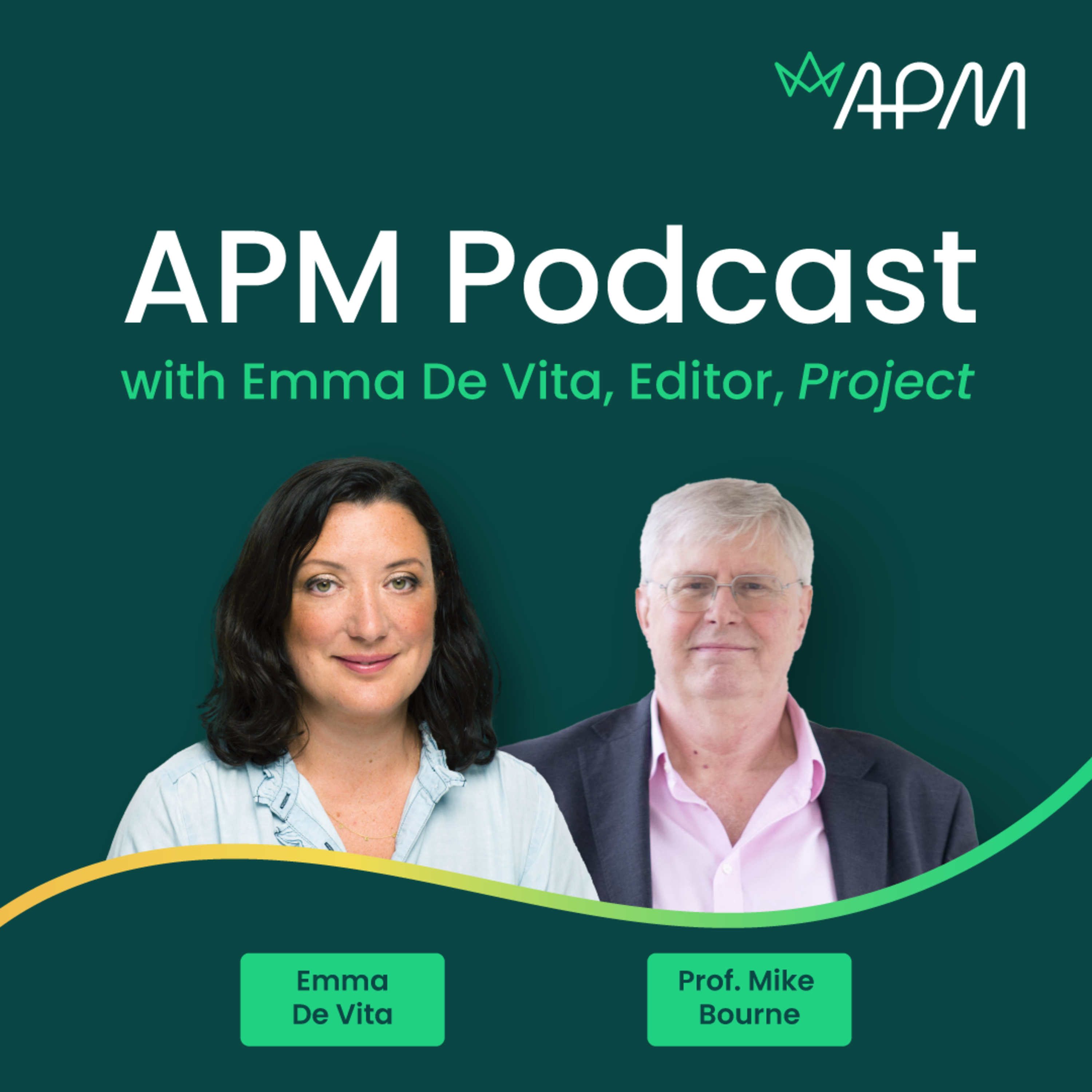
What skills do project professionals need in 2025?
from Project Podcast
26m 49s
The eighth edition of the APM Body of Knowledge reflects a major shift in project management due to a volatile, uncertain, complex, and ambiguous (VUCA) world. Project professionals must move beyond linear, process-focused approaches and embrace systems thinking to understand broader impacts and stakeholder dynamics. Leadership is now about strategic judgment, vision, and adaptability—prioritizing outcomes over deliverables and fostering team development through delegation and psychological safety. Sustainability is embedded throughout project design, requiring foresight into long-term environmental and social impacts. Artificial intelligence enhances project efficiency in scheduling and data analysis, but human oversight remains critical to ensure ethical, transparent, and aligned decisions. Success hinges on balancing technical skills with strong people skills and cultural trust. The future demands continuous learning, agility, and a global perspective, where project leaders act as strategic stewards within complex systems. The core mindset is one of big-picture awareness, active reflection on decisions, and resilience in the face of change—ensuring that project professionals remain relevant and effective in an evolving landscape.
Welcome to the APM Podcast. APM is the charter body for the project profession. My name
is Emma DeVita and I'm the editor of Project APM's courseery journal and your host. In
this podcast we're giving you the cheat sky to the eighth edition of APM's Body of Knowledge
courtesy of its managing editor Mike Bourne, professor of business performance at Crownfield
University, where he leads the project leadership program for senior civil servants. He's also
director for the Centre for Business Performance there. Mike tells me a lot has changed in the
past five years since the previous edition of the APM Body of Knowledge was published and
we focus our conversation on what makes for a great project professional in 2025. How to
get your head around systems thinking, how to approach AI and what sustainability really
means for projects. If there's one takeaway from our discussion, it's about learning to
have the bigger picture on your projects and programmes. Listen on for Mike's invaluable
advice. Welcome Mike, thanks so much for finding the time to speak to us, really looking
forward to our conversation. So what we would like to share with listeners is almost like
a cheat sky to the eighth edition of the Body of Knowledge. It's been five years since
the previous edition so I know from the feature in the spring 2025 issue project that there
were certain areas that would have particular interest for this edition, massive topics
like AI, systems thinking, project leadership. So for someone who doesn't have the time to
read the eighth edition in full right now, what would you say are the main new points
that they should really be paying attention to? I wouldn't read the eighth edition cover
to cover unless you're providing an example or something like that. It's really a reference
guide. It's something to be dug into when you've got a particular issue or problem or
you need to think about something in a bit of depth. So what's new about this, we're
really living in a vaca world. It's volatile, it's uncertain, it's complex, and it's ambiguous.
And that makes project life more difficult than it ever used to be. Projects typically
in the past used to be quite linear. You decide what to do, you decide how to do it, you
do it and wrap it all up. But currently, and especially with complex projects, it's becoming
much more non-linear. We've got turbulence in the world, we've got people interfering
with the project, we've got advancing technologies, and so the project professionals got to live
in that space and that's what it's about. So as you said, yes, the new version does focus
in on leadership, in particular, it's got sections on systems thinking, it's got sections
on sustainability, which are really important too. And we have a whole chapter on AI that
we added right at the end of this to keep everybody interested. And really to reflect
the growing importance of AI as we go forwards. Thanks Mike, that's brilliant. Are there a couple
of topics that perhaps we could just dive into a bit now that you think are really the ones
that project professionals need advice on or need to be thinking about? I mean, I'm particularly
interested in project leadership because to deal with such a vaca environment, it's
about the judgement that project leaders have, the ability to make decisions, and everything
else kind of feeds into that sustainability AI system thinking, crikey, that's a lot
for project leaders to get there. It's around. Tell me what your views are on this.
Yes, project leadership, because it's vital, it's extremely important. It's much less now
about process. Process is really important to run efficient projects and you've got to
know where you are and what you're doing, etc, etc, etc. But the role of the project leader
is to focus on the outcomes and benefits the project is there to deliver and to also understand
the stakeholder environment and those two things come together. Stakeholders do move, unfortunately.
They have an initial understanding of what they want at the beginning, but invariably projects
take a little time to deliver and so stakeholders evolve as the project evolves and it's really
important for the person leading the project to understand this and hold it all together.
And then you've got the situation of if it's about change, if it's about it, emergence,
it's about, it's really it is as you said about judgment. It's about understanding what
is and isn't working. It's about understanding when you need to revisit the schedule or even
when to revisit the whole purpose of the project because something's happened that's blown
it out of the water. And leadership too is about leading the team. You've got to have a
vision and for me, the vision is the kind of the North Star, what you're trying to deliver,
the real outcome, the real benefits and that's the thing that guides the project, not the
delivery of the project itself. And keeping the team focused on the ultimate outcome is critical.
And doing that, the leader also has the chance to develop those working on the project involved
in the project so that they learn from their experience and their time on the project
and therefore can be better project professionals, better project managers or better project
leaders into the future. I mean, this still sounds wonderful, but I imagine it's kind
of easier said than done. Any advice to project leaders about how you reach this kind of
whole world of what successful leaders, what does they do right? For me, a project leader
isn't the project manager. And you've got to remember that all those project management
roles have still got to be done, but the project leaders job is to lead the project and
to delegate the project management role. So the real takeaway for a project leader is
to create the space to lead and not get bogged down into the detail of the project delivery.
And that's difficult because you've still got to have a feeling for the project you've
got to have a gut feel about how it's going, what's going right and what's not. But that
space to interact with stakeholders, to interact with people in the project, to think about
the project and just reflect on what's going on is critical. And delegating stuff to make
that space is how you do it. The art of delegation, which can be hard,
can't it for people to let go and know that the skills that got you so far aren't the
skills that you need to take you further. Yeah, the worst project leader is probably
the best project manager because they're still reassuring the skills that they had before.
You do have to let go. And that's why I talked about developing people during the project
because you've got to bring them up to be able to fulfill some of the roles that you're
letting go with. And you've got to trust them. You've got to understand that they're closer
to what he's going on on the ground and therefore they're making decisions based on their
local knowledge. As a leader, your job is to give them the context in which to make those
decisions. But you've got to let them make those decisions and sometimes makes mistakes
as well. But invariably, those mistakes are no worse than the mistakes you'd make
from a top of an ivory tower looking down and pretending you know what's going on.
Thanks, Mike. Were there any other topics? I know we briefly mentioned systems thinking,
sustainability in AI, but I mean they're huge. Was there any of those that you'd like to
discuss a bit further? Let me just talk briefly about systems thinking because it's about
whole systems thinking and it kind of goes with the leadership too. It's about understanding
if we do this project in this way, what are the consequences outside the project?
What are the, you know, we've got things we're trying to deliver, but what are the unintended
things that are going to happen if we deliver it this way? And so it's really important to think
about the project and the project delivery and the wider system so that you can see what he's
going on and what impacts you're having around the whole of the system, not just in the project.
To ask an obvious question, but why do you need to do that? Why is it beneficial to think about
the bigger picture? So does that directly link to benefits and outcomes of the project or program?
It directly links to benefits and outcomes, actually, because at the end of the day you can
deliver a project that doesn't deliver the benefits and outcomes. So if you're delivering a project
part of the role of the leader is to understand how the project outputs, deliver the outcomes
and the benefits that the wider organization or the client requires. And that's what it's about.
So having a whole systems view, understanding where the stakeholders are coming from,
whether they're for you or against you, whether they're trying to help you, whether they're trying
to hinder you in that project delivery. That's really important. And then just understanding how
the will moves to and also some of the consequences that happened as your projects get to deliver it.
and get passed over into operations.
My next question is what are the skills or knowledge that you need as a project professional
to really thrive in 2025?
So any advice on that, including getting your head around this, like this idea of much
bigger picture thinking?
So what do project professionals need to thrive in 2025?
That's a good question.
Yeah, I think you've got to understand the bigger picture.
I think that's really important and systems thinking will help you do that.
But there are two other things I think that are really there.
One is about people.
You've got to understand people.
People are really important.
Those relationships with stakeholders, those relationships with other projects, professionals
within your team and without it, and also your relationships with the people you're delivering
the project to so that they take it on board, implement, and take the benefits.
So there's a great people side of it, and then the other interesting thing is this business
of AI, which is artificial intelligence, the use of data that's coming into projects
in a big way, and that too is really important.
So we're starting to see some kind of two quite conflicting views of the world coming
through projects.
It's about people, but it's about the technical side of using AI and data as well, and I think
if a project professional can master both of those, they're in a really good place.
Have you got any advice around the use of AI or experimenting with AI or how to approach
it?
Because there's a fear that there's this kind of panic around it and that you just need
to be doing something or be seen to be doing something, but what's the smart way to be
thinking about this and experimenting with it?
So AI is a bit of a panacea or people think of it as that, and it is and it isn't.
I think what we're going to get is some of the technical things that happen in projects.
Scheduling AI over time is going to help us do better schedules and more complete schedules
and things like that.
Starting AI over time is going to start to pull the data together and recognize patterns
and start to report better and better.
And as it goes on, it's then going to start to prescribe things that we should do.
But from my perspective, the decision really needs to stay with the human being.
Is this prescription right?
Is this what we really should be doing?
As AI come to this conclusion based on data that we're happy with, or are we being taken
down a different route?
So the data sources for AI are really important.
And as you go on, it's also about you, you know, artificial intelligence.
It's starting to learn and then you start to lose the transparency of where it's coming
from.
And so you've always got to keep an AI over what it's prescribing, what it's thinking
about, what's coming out, and are you comfortable with that?
What's the governance there?
And that's quite tricky.
When you see it in practice within other organisations or companies, are there any behaviours
or processes or practices that they do that means that they get the best from AI that
they've really taken the right approach?
So one really good example at the back end of last year was within one of the big banks.
And they had multiple AI projects going on.
They started off with the idea that they were going to experiment with AI because it was
going to be something that's going to be there in the future.
And they weren't going to justify each project.
They were going to have a go, they were going to see what happened and see what worked,
but also see what didn't work.
So what they were doing basically was failing fast to use a project expression.
They were kicking off projects.
If they were looked to be successful, they carry on.
If they didn't, they stopped, they learnt and they moved on again.
And it was this continuous reupdating the portfolio that kept it going.
They also didn't try to optimise everything right at the beginning.
They were really learning and trying to feel their way with AI and trying to encourage
people to use it and then reflect on the use.
And I thought that was good because it engaged people in thinking about AI and using AI,
but it also kept people in control of it as it went along.
Okay, thank you.
I immediately am thinking about the culture of a project team to have that, I guess that
where everyone used that kind of psychological safety or that ability to fail, be allowed
to fail and to have that trust and transparency when it comes to project managing teams.
Have you got any advice around the most successful types of culture and how are you, in fact,
to create that?
Project culture is a really big topic, isn't it?
No, I thought I'd ask you, well, this is podcast for the children.
Oh, fair enough.
Fair enough.
They have two or three podcasts there.
But project culture, what's you've got within a project?
It's a temporary organisation.
It's almost the definition of what a project is.
So it's a great opportunity for the project leader to actually decide the culture that
he wants and then do that up most to build it.
And for me, the psychological safety around being able to voice concerns, being able to
challenge is absolutely critical to running successful projects.
It's no good running a project and then finding that you're failing because somebody hasn't
shipped him and said this doesn't work and he's not going to work and he's never going
to work.
And there's a leader you can't know everything in your project.
So you're reliant on your team to keep you honest to tell you what they're thinking.
If you don't let them do that, you're in real trouble.
So for me, that openness, that willingness to admit that something's not working is critical.
So you've got to have that psychological safety, but the leader has to have the resilience
to be able to cope with being challenged because that's the critical bit as a leader.
You can't get everything right.
So why expect everybody working for you to get everything right to?
And if you've got that kind of attitude, that builds the kind of culture that I think
you need to run a successful project.
Some excellent words, Mike.
Thank you.
There was one thing that I particularly want to talk about as well as around sustainability
back in the news, again, with kind of global developments on this side shifting thinking
on it.
How are we at?
Could we be doing more and what really is the role of the project manager or project professional
when it comes to looking after the sustainability side of things of a project?
Yeah, well, there's one way of looking at the project professional delivers the future.
And so everything they're doing is delivering what he's going to come next.
So they've got a mammoth role in delivering sustainability.
They should be challenging to start off with whether what they're going to deliver is going
to be needed in the future because if they haven't got a sustainable solution, then the
project is going to deliver a white elephant.
This is no real, real future.
So that's the first thing.
But secondly, during the project, every stage of the project, they've got a chance to think
about, if we put a sustainability hat on, can we reduce the carbon impact?
Can we make sure that we're using resources effectively and efficiently?
Can we manage the supply chain in a way so that they do develop and deliver what we're
really looking for?
So project management probably has got a big percentage of sustainability for the future.
Thank you, Mike.
And talking of the future might be another five years.
I don't know.
You probably don't want to even think about the ninth edition of the body of knowledge.
What is a bit, another big question, but I'm asking you all the big questions in this
podcast.
But what's the future direction of travel for project professionals?
What do you think might be coming up ahead over the next five years?
And how can listeners prepare for that?
What should they be thinking about right now?
I think we've talked about volatile environment.
That's going to be more so.
I don't think the future is going to come up.
futures are very certain. You know, there are some global things going on that are affecting
all of us and the delivery of projects. Projects are getting much more international with
development all over the world, but it's against a background of global uncertainty, I think.
I think the project professionals got a growing use of data and AI within the projects, so they've
got to manage their skills to stay relevant. I think that's what it's really about. And so for
the project professional, it's about keeping across the developments that are happening,
being comfortable with using the tools. AI is not going to replace the project manager or
the project leader, but it is going to make their jobs, their roles very different. And I think
a project professional in the future is going to have to be much more comfortable dealing with
that and then dealing with their team and helping their team to use some of these news tools and
techniques and deal with the uncertainty and everything else that the world's going to throw at us.
So, tall order isn't it? I mean, the words everyone uses is mindset. If you could
sum up the best mindset to be able to be successful in the future as a project professional,
how might you describe that? They need a bit of a global view. They do need a global view
and just be aware of everything is going on. I think they need to have a mindset that the project
is a small part of a much bigger system and what they're delivering is going to impact that system,
but the bigger system will continue and the projects can be better or worse to hurt actually
influencing the direction of that system by the way it's delivered and where the way it's run.
So, I think that's that's part of a mindset. Project professionals or project leaders
have really got to be more big picture. And project professionals have got to understand
some of the intricacies of it, but not get totally swamped with the detail. I think that's
kind of a mindset you need to have. And judgment, you know, judgment is critical. It's got feel.
Is that something that is just within you or something that can be
worked on and cultivated? I think judgment is partly within you, but you can greatly
improve your use of judgment. And part of it is being honest with yourself.
If you've made a decision and you've got it wrong, first of all, you've got to recognize
you've got it wrong and then secondly think about what happened and why you might have been
blindsided or whatever and did get it wrong. And what could you do differently?
So, for me, judgment is about making decisions, recognizing whether they're good decisions or not,
but also learning from reflecting on those decisions and then creating better experience for yourself.
So, you know, I interviewed project leaders a while back and I found a very young female project
leader who got immense amount of experience at the age of 26. And she'd done it because she thought
about what she'd done and what had worked and what had happened and what she'd learnt from it.
And that reflection piece, I think, is the best way for a project leader to learn and develop
their judgment and all their other skills. Really interesting. Thank you. I should really
be wrapping things up. So, my final question would be what would be the key takeaways of
well, things to think about that you've kind of come across in your work with the eighth edition.
What are the things that listeners should perhaps start thinking about?
I think we think of the body of knowledge as it Bible in some sense. It's got all the terms,
the techniques and everything. And I think it's useful for people to understand that they're there,
but also understand where they are and aren't appropriate to their use and then be open
to understanding and learning all the time. If you've become a charted project professional and
past the exam, that's the beginning of your career, not the end of it. You need to keep learning,
you need to keep developing your skills. And when the ninth edition comes along,
it won't be a surprise if there's something new in that as well that you need to keep up to date
with. But if you've kept up to date, you probably know about it already. And it'll just be a reminder
of a set of terms and conditions that you should keep at the back of your head.
Thanks Mike. That's absolutely brilliant. I want to think about
in the stuff that we've been covering. I guess you're kind of glad to see this publish now.
Yeah, I'm really pleased to see it published. We've had some great writers in here.
We've had some interesting arguments. It won't please everybody. But we've had to make a
decision about what we're putting in and what we're leaving out and the way we're going. So it's
there. It's useful. There's a system's terms that all models are long, wrong. But some models
are useful. And I think this is a useful publication. Mike, brilliant way, perfect way to end a
podcast. So it just leaves me to say thanks very much for your time and to recommend listeners
to go and get a copy of the eight edition of the Body of Knowledge as soon as possible. But thanks
again Mike for your time. Thank you.
Podcast Summary
Key Points:
Project professionals in 2025 must adopt a systems-thinking mindset to understand how projects impact wider systems and stakeholders beyond immediate deliverables.
Leadership is shifting from process control to strategic judgment, focusing on outcomes, stakeholder evolution, and vision to guide teams through volatility and uncertainty.
Effective project leaders delegate technical tasks to empower teams, creating psychological safety where feedback, challenge, and learning are valued and welcomed.
Sustainability is not an afterthought but a core responsibility, requiring project professionals to assess long-term viability, carbon impact, and resource efficiency throughout project life cycles.
AI is transforming project management by enhancing data analysis and scheduling, but human judgment remains essential in evaluating AI outputs and maintaining oversight.
Project success depends on balancing people skills—especially stakeholder relationships—with technical capabilities in AI and data-driven decision-making.
A resilient project culture is built on psychological safety, transparency, and the ability to fail fast and learn, allowing teams to adapt in complex, uncertain environments.
The future of project management lies in continuous learning, staying agile, and embracing a global, systemic mindset to navigate volatility and emerging technologies.
Summary:
The eighth edition of the APM Body of Knowledge reflects a major shift in project management due to a volatile, uncertain, complex, and ambiguous (VUCA) world. Project professionals must move beyond linear, process-focused approaches and embrace systems thinking to understand broader impacts and stakeholder dynamics. Leadership is now about strategic judgment, vision, and adaptability—prioritizing outcomes over deliverables and fostering team development through delegation and psychological safety.
Sustainability is embedded throughout project design, requiring foresight into long-term environmental and social impacts. Artificial intelligence enhances project efficiency in scheduling and data analysis, but human oversight remains critical to ensure ethical, transparent, and aligned decisions. Success hinges on balancing technical skills with strong people skills and cultural trust.
The future demands continuous learning, agility, and a global perspective, where project leaders act as strategic stewards within complex systems. The core mindset is one of big-picture awareness, active reflection on decisions, and resilience in the face of change—ensuring that project professionals remain relevant and effective in an evolving landscape.
FAQs
The eighth edition emphasizes systems thinking, sustainability, and artificial intelligence, reflecting the volatile, uncertain, complex, and ambiguous (VUCA) nature of modern projects. It shifts focus from linear processes to adaptive, non-linear project management in response to global changes.
Systems thinking helps project leaders understand the broader impacts of their projects beyond immediate outcomes, including unintended consequences and stakeholder interactions, enabling better decision-making and alignment with organizational goals.
Project leaders must focus on outcomes and benefits, not just processes, and demonstrate judgment to adapt to changing stakeholder needs and project dynamics, often by delegating day-to-day management to empower team members.
AI should support human decision-making, not replace it. Leaders must maintain oversight, verify AI recommendations, ensure data integrity, and foster transparency, with a focus on continuous learning and experimentation.
Project professionals must ensure sustainability by evaluating long-term viability, reducing carbon impact, managing resources efficiently, and aligning supply chains with future needs to avoid delivering 'white elephant' projects.
They should embrace a global, systems-based mindset, recognizing that projects are part of larger systems and that their decisions influence future outcomes, while maintaining judgment and adaptability.
Chat with AI
Loading...
Pro features
Go deeper with this episode
Unlock creator-grade tools that turn any transcript into show notes and subtitle files.
 PodcastTranscript AI