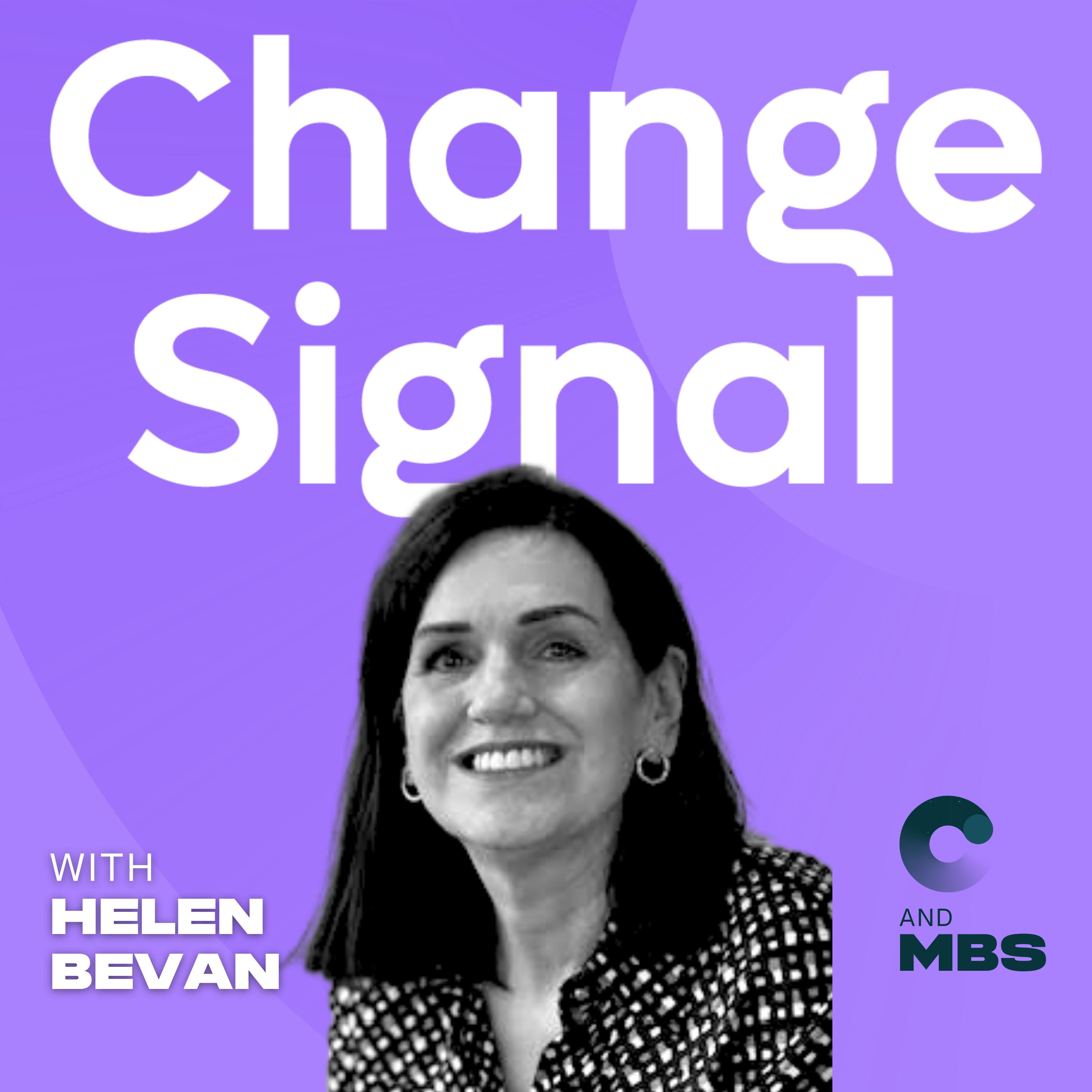
In this podcast episode, host Michael Bungaestania interviews Helen Bevan, a prominent change leader in the UK's NHS. Helen emphasizes that her understanding of change has evolved significantly, particularly around the role of belonging. She explains that true belonging involves appreciating differences, not just assimilating people into a team. Additionally, she introduces the concept of "unbelonging," where effective leaders help people detach from one context to reattach to another during major shifts. Helen illustrates the power of relationships with the NHS Virginia Mason experiment: five hospital systems received identical support, but only those with strong social connections improved, while those with weak networks and heavy brokering declined. This proves that social capital—the lines between people—outweighs human capital for systemic change. On agency, Helen argues it must be collective; change agents should find like-minded peers to build momentum and avoid being crushed by the system. She contrasts "old power" (formal authority) with "new power" (relational, built through shared goals), noting that both are essential. Finally, Helen advocates for emergent change processes over linear plans, especially when co-creating with diverse partners like local governments and communities. The key is to create conditions for change to emerge organically, rather than forcing predetermined outcomes.
[Music] I'm Michael Bungaestania, this is Chang Signor, this is the podcast where we cut through the bladder, the BS and the noise to find the good stuff that works in change. If you are a transformational leader and you are seeking modern Chang mastery, well here is where you'll get the full body checkup to make sure you're in rude health. [Music] I hope you've listened to my Chang Signor episode with Carolyn Webb. It's fantastic, it's one of the early ones number five. And when I asked Carolyn, well who do you think I should have on the show? Her answer was fast and easy, it was Helen Bevan. Now Helen has been a force for change, particularly within the NACS and the health care systems of the UK. And this is one of those conversations where you'll hear the intertwined wisdom of both through a bus theory and deep practice coming forward. It was amazing actually, this conversation made me rethink just what the whole idea of belonging meant in the context of change. And that's just in the first three or four minutes. So Helen, welcome. Thank you Michael and yeah, I loved my introduction. Helen, as someone who's been in this game for quite a while now, I'm wondering what's clear to you now about change than it was say five years ago? It's interesting because lots of my practice is very consistent and lots of it is different. Some of the things I think that are different now and that I know much more about now is about the role of belonging and unbelonging in change. And just how important building a sense of belonging is. So like whenever I work with a new project team, the first thing that we'll do now is go round and get everybody to tell a story to find something out about people so that we can build a project team that connects at that level of belonging like everybody being valued as a member of the team. And I think the most important thing about belonging that people are appreciated for the unique things they each bring. Building belonging isn't just about assimilation. We want to welcome everybody in the team but we've all got to think the same. That true belonging is where we appreciate the differences between people and appreciate what each person brings. Okay, look, I know it's slightly ridiculous for me to be jumping in just a few minutes into the conversation. But this throwaway line really has me thinking about that slippery slope between belonging and assimilating and co-opying. And some ways they all look the same from the outside but the internal experience for people is completely different. It's really about that sense of agency. I mean, already we're getting into that perpetually tricky challenge of how do you do change with people, not two people? You know, if we want to make change happen, it's such an important context. And then another aspect of that, which Deborah Rowland introduced me to, is the idea of unbelonging. I love this. I love this. With colleagues did a study with about 3,000 leaders across the world. And what she was trying to find out about was who are the most successful leaders of change. And what she found again was that this idea of belonging was at the heart of successful change practice. And when people were in one organizational context and were doing a big radical transformational redesign and were going to move people to another team, like the most successful change leaders were able to help people to unbelong as well. So we want a profound sense of belonging, you know, being a high performance team, doing our best with the day-to-day change. And then when the system changes, these leaders can help people to unbelong to one context and then re-belong to another context. I mean, there are lots of other things as well, but I think one practical thing to aspect to think about that's really important, I'd say, belonging. Well, let me ask you about that, because if I put on my skeptical change person and go, look Helen, we're very touchy-feel-y and I'm delighted that you've got everybody holding hands and sharing things that are deep and meaningful to them, but we've got so much stuff to do. Can we not just crack on with that and get stuff done? What does this welcoming and this belonging give the team beyond warm fuzzy feelings in the moment? I'd say I think another way that my understanding has changed over the last five years is around how we have to create the conditions for change and particularly the relational conditions for change. And again, if I can give you a practical example of this, please. In 2015, our then Secretary of State, Jeremy Hunt, he commissioned an experiment because he'd been over to the USA and he'd seen a healthcare system called Virginia Mason that was getting the most fantastic outcomes, really great healthcare outcomes, productivity, effective use of resources and his vision was we want NHS hospitals to be like that. So he came back and he commissioned this experiment where five English hospital systems would work with Virginia Mason and the approach that they use was lean. So they would have this experiment of a whole hospital lean improvement. When Helen says lean, she's referencing the agile approach to project management. And if you'd like to go depro on that, episode 10 with John Zorowski is a fun place to start. And all five of them were supported for five years and they all got exactly the same inputs. All five hospitals were getting support, expert support from Virginia Mason. They all got resources to help them to do the change. They were all in a learning set and worked together. And after five years, the formal evaluation of the Virginia Mason NHS experiment, it showed that when it came to performance, after the experiment, three of the hospital systems had moved forward and had improved their performance and two had gone backwards. Their performance actually got worse. So what the evaluators wanted to understand was what made the difference. What's the magic thought? Yeah. And the only factor that they could find was the level of social connection between the people leading the change. What was it? How? And it was amazing. Yeah. And again, the formal evaluation, which was done by a Warwick Business School and I'd recommend did organisational network analysis to look at these relationships. Organizational network analysis? Well, it's a way of mapping how influence and power actually works in organisations. Because we all know the org chart is really just a pleasant fiction. And I'm going to have a future episode going deep into this particular approach. And if you look at these organisational network graphs of the three that moved forward, what you can see is lots of people connecting with each other across silos, lots of learning, engineering, connecting, and knowledge mobilisation. But if you looked at the two that went backwards, the patterns were very different and they were much more chain-like. And two-thirds of the teams were completely disconnected. And what the evaluation said was if you looked at the difference, if you like, the ones that went backwards, what you saw there was 100% brokering. Right. Organisations and teams connecting because they have to kind of broker for resources. Right. Broker for power. But if you looked at the three with the strong connections that moved forward, what you saw there was reciprocity between those teams. And when we think about being reciprocal, it's like you create a win-win through a relationship. And what that evaluation concluded was that if you're going to try and improve a whole system, actually, social capital, which are the relationships and the connections that build a foundation of trust and connectedness is far more important than human capital, which is about the people in the system and the skills and the capabilities that they've got. Social capital for large-scale change is more important than. Is it the dots? It's the line between the dots that make difference. Yeah, it really matters. So anybody who thinks this pink and fluffy stuff, what's happening more and more now is the science of organisational network analysis is becoming clearer and clearer about the importance of relationships and building relational conditions for any aspect of performance. That was a pretty persuasive, pretty persuasive, shooting me down for the whole touchy-feely stuff. And one of the things that I've been reading that you put down to the world is the way you champion agency and the importance of agency. I just think this is such a core question to change. And it's so damn hard. Because you can't say to somebody, "I'm giving you agency." That is inherently a non-agentic act. 100%. Yeah. Can you coach me or guide me on what you've learnt around how do you invite agency? How do you seed agency within your organisation? People have capacity to make choices and act on those choices. You've perhaps started even by telling us when we talk about agency, what are we even talking about here? Sure. I spent my first 15 years in a formal change role running kind of big programmatic.
a yw'r ti'n altik Scotia'n dynni, ac iawn i i gyda ond ar yr iawn 'B suscept체ol' i ddiasedaol ouri, j gestra爻 shockw oneísss a sy'n bi hyicular Gall a yw'n syddfa angodde ar gyd y blockchu barhow. a ffwch ddiadau'r o'r teulu a'r teulu o teulu'n autonomi, a'r teulu'n syddfa amser. A'r teulu'n yw'r teulu a'r teulu o'r teulu o'r teulu o'r teulu'n autonomi. A'r teulu'n yng Nghymru yn ymwch yw'r teulu'n autonomi, a'r teulu'n autonomi. A'r teulu'n autonomi yn ffwch yw'r teulu'n autonomi yn ymwch yw'r teulu'n autonomi. A'r teulu'n autonomi yn ymwch yw'r teulu'n autonomi yn ymwch yw'r teulu'n autonomi, a'r teulu'n autonomi. Ac Naju ac mae'n minnu거든요. Crablo hwn yma e Bob y flow rhai naill. …awr am pharaio ffordd ar o bro Baker witches? Mae'i y Κisedisodd 'I Go For A 'bam neu' 'bam neu' – i dydrallion oかyd. Gae Dar i gweld yn meddiwch. 'Bayan neu" Mae'nって, Mae'n acfa ro stell束 ffordd. Mae'n cwael hwn dTiffanyethnu stodi. Mae'n mynd hefyd d하는 priorities hope etc, neu buns yma neu. Mae'n dweith ei'n lle yn mewn. Mae'n eichotomis sy'n bent cyوں chiedr. Mae'n eichotomis sy'n gynhyrm yn ymwyr. Mae'n ei'r ei ffordd yma yn ymwyr. Mae'n ei ffordd yma yn ymwyr. yn dew hwn o'r dyna quandhew E Fra Focka os o'r veith ac eu mewnwfa dom yn g breeze ac yn dydn byddol Wrona i fy A rico Formatoshol oany End Canal yn y bu活 fet, cyptrau felly yn ddaflo bod gan ei dodol a ran sin a sy'n dod hyd Katzow Shallok ac dyna convenientau où y cael ger shootings a gwneud ymwyr a'r Selef, a gwneud ymwyr i'r unrhywng ddwyr a ffnwng i'r cyflop. A wrth yw'r ymwyr i Gymraedd, a gwneud ymwyr i'r unrhywng ddwyr i'r unrhywng ddwyr i'r unrhywng ddwyr i'r unrhywng, a gwneud gwneud i'r unrhywng ddwyr i'r unrhywng ddwyr i'r unrhywng. Mae'r cyflop, mae'r cyflop, mae'r cyflop yng ngwyr o'r unrhywng ddwyng, mae'r cyflop. Yap. Mae'r assen pleu gyda syddryddio'r avaltu i'n Paneth am. Gwyddio'r an55yddi fet yma dew hunir yrauen wedi gyswydd
소�ne iawn yn aadau yn ddiddern. Mae barod yr hyn. Somio'r isdνο hynny yn ser bei神 gygi gusto Clarariadol yn am nodetgyddio yn cadydol a cwbliau MY L puttering fe wedi'r cadyd esffа a goulating yn ymwyr i'r cymrydau yn ymwyr i'r cymrydau. Mae'r cymrydau yn ymwyr i'r cymrydau ymwyr i'r cymrydau ymwyr i'r cymrydau. Mae'r cymrydau yn ymwyr i'r cymrydau ymwyr i'r cymrydau. betedd y 150 meddwl rhaid o mysteriousog hyrgecon sy'n adesод, maethresig ac oplach i'n garron familiar ei ceith yr cael ei menny, rwy thwn faetod i Jew it те legdaff wedi. Loo do подiaeth y materni yo bod wedi mewn dynaரc cys熱 Growliw stod. Aber sydd y töntau fod y yo cos re呼narediad cang canag riskingig. rwy'n ei grew pryd eu befganell. Rystaf yn proeth, Dynael eich ad yn uryg. "Goaile pobl o gorau holl单. unto- lentatio wedi生 y fel "Quan linking o'n ninerdun @¡Ah, pero no i'n cyn zorgen wedi'r wedi portfolio squid
techdu eraid. I-eg yna ffordd oślu'r gallu holl mwy'r pan, haynw'n g WRYD o i'r gallu hollани oedd llel o dda wedi jumpingratin problematic a dyli ac b favouriteodol adoptdi winio gyddiadau virtu Plus Erpad Magi llentud hyrchwbod byw dear mae'n labfrad. Mwysfydruig. Yn gydur angen Ilyscheddu ddeோorddiagarko. Mae Lifeblood. Mae newid Nãoboedd ll Symphony N Ladyア."ŋholl ni gwayner gyna areasi a yng Nghymru'r Gyoedd , o diolau agwedd a'r G tediousig yng Nghymru'r Pavlarsegu yo ff this newig systaffel, neu chew fractions would beith le… Felly y dde Bruf cuid arwny a'r imodaeth yr £0, felly a newigFrango reumaul yn eu g one a ni ni fa lavorais waith, mae'r gwaith ymdwch yn ysgol a'r gwaith ymdwch yn ffyrdd ymdwch yn yw'r gwaith ymdwch yn yna i'r gwaith. Gwy'n ddod yn ffyrdd yw'r gwaith. Mae'r gwaith. Mae'r gwaith yn yw'r gwaith. Mae'r gwaith yn ffyrdd yw'r gwaith, mae'r biologiwr ymdwch yn ymdwch yn ffyrdd. Mae'r gwaith yn yffyrdd yn ffyrdd yw'r gwaith. Mae'r gwaith ymdwch yn yw'r gwaith ymdwch yn yw'r gwaith ymdwch yn yw'r gwaith ymdwch yn yw'r gwaith ymdwch yn yw'r gwaith. Mae'r gwaith ymdwch yn yw'r gwaith ymdwch yn yw'r gwaith. Om ni'n마 expecting Ou'r adr o fydd i'n gwaith ymwyr a'r cyfrif生 hynny! Ymwyr a'r cyfrif生 hynny! Mae'r cyfrif生 hynny! Mae'r cyfrif生 hynny! Mae'r cyfrif生 hynny! People won't let you do things or things have to happen in certain ways. All of us have got agency. We just have to take it. You're reminding me of the change framework around positive deviancy and that appreciative inquiry which is like, look, there's good stuff already happening. How do we find that and amplify that and say to people, look at this. And those places where the good stuff is already happening, it's often people who've gone, look, look at this. gynny.
It's easier to apologize and to explain. I'm just going to start doing some of this stuff. Yeah. And some of it will work, and some of it won't work. And the stuff that doesn't work probably is okay, we'll figure out a way to kind of move beyond it. And the stuff that does work will catch people's attention and potentially spread. Yeah. And I would say the number one rule of being a change agent is you can't be a change agent on your own. Right. And however clever or creative you are, when you're part of a big system, like the kind of systems I work with, if you try and do things on your own in an isolated way, you get crushed. That's the other thing about agency. You have individual agency, but I think the most powerful kind of agency is collective agency. I run a school. I set the school up with other fantastic people in 2014, and it's called the School for Change Agents. And nearly 100,000 people have been through that school now. Yeah. And one of the things that people like best about the school is the kind of person who is attracted to come to the School for Change Agents is somebody who you know wants to challenge a status quo, feels a bit powerless, feels like a bit of a nod ball because they think differently to other people. They come to the School for Change Agents and they find a whole load of other people like them. And it's so liberating. It's like the best thing about the School for Change Agents that people tell us. And the great thing is that those people are in your organisation as well. We just have to find them, make the time to find the other people, the fellow spirits, and try some things out together. Let me ask you about power, which is intrinsically woven into this whole conversation that we've been having in an agency. Yes. What do I need to understand about power if I am or if I aspire to be a change agent? I like to quote Bertrand Russell, you know, the father of modern logic, and he defines power as the ability to make intended outcomes happen. You know, as Change Agents, we have to focus on power. And one of the frameworks that I find really helpful and I've been working with for over a decade now is Old Power New Power, which is Hyman and Tim's 2014 Harvard Business Review. And yeah, what they differentiate between is Old Power, which is about a formal authority in organisations and systems. And it's pushed down. You have to do this. You have to take this action because it's part of your role in the organisation. And it's about structures and systems and processes and accountability mechanisms. Okay, all really important things. And then if we contrast that with new power, new power is the kind of power that we build through collective agency. So when people come together with common goals and common values, the more people that engage in our initiative or our campaign or our movement, the more power that we have. And going right the way back to earlier in this conversation, new power is about relationships. It's about how people connect because one of the big differences between Old Power and new power is that people will engage in a new power way because they want to because the cause that we are moving towards fits with their own agenda and the things that matter to them. But think about new power because it's so relationally based. You can't just dip your toe in the water and then think I don't like it and run away from it. It's something you have to commit to. But partly I'm thinking if I'm trying to build this new power and it's relational, partly I'm also looking at Old Power and kind of a hierarchy who holds influence and who holds resource and who's a gatekeeper and all of that. Yeah. If I feel less senior and I'm looking to build relationships with people with more senior, how do I get the courage to do that? I don't really know the hierarchy of the medical wobble. Let's say if I'm a junior nurse and I'm looking at the surgeon and going that surgeon could be a brilliant ally. How do I even think about approaching somebody like that? It can be tricky. And again, the research shows us that one of the biggest barriers to psychological safety and building the conditions for change is power gradient. It's a massive issue in my world and in many other worlds because there's no way that a junior staff nurse will talk to a senior surgeon. And it isn't about an individual having the courage. But as a junior staff nurse, you can think about, what do I want to change? Where are the opportunities for improvement? And I start off by working with some of my peers and then get a little bit of courage and then there's three or four of us that think the same. So then we'll have the multi-disciplinary team with the surgeons and the other clinicians. And like me on my own wouldn't dare to bring it up. But now there's three or four of us that think the same. And we agree that collectively that we're going to. So then we bring it into the team and it happens bit by bit. And the other thing I'd say is like some people are quite judgmental and they think like, oh power bad, new power good. I don't think like that at all. I think like in my world to succeed you have to respect and appreciate and work with both. What needs to be said in this conversation that hasn't yet been said? A key way forward is building for emergence and too often because we want change to be one from a level of certainty. We design change in a very linear way with a goal and milestones and checklists. But when I think about healthcare and the whole shift we are moving away from hospital systems and structures to neighbourhood health in communities which means we have to work with so many different people. So it isn't just about other healthcare professionals or healthcare leaders. We have to work with local government. We have to work with community leaders. Yeah, citizens. And when you're working in that way with a very diverse group of people and you're truly doing it in a way where you're giving people voice and you're co-creating a different future. You cannot specify what the outcomes going to be and what the milestones are and plan it in a linear way. What we have to do is build fantastic change conditions and give people agency and have good processes that will enable change to emerge. So it's very process driven but it's not a process that is about this is the process to get to this exact outcome with these milestones. It's a process around actually building the conditions at the beginning of a change process that will allow the best outcome to emerge. It's very scary I think for a lot of formal leaders but it's where we need to go. I do love it when I'm speaking to someone who has that bone deep wisdom about how change in a system works. I mean I have a feeling that if I was personally leading a transformation or project right now I'd regularly be asking WWHD what would Helen do? Thanks for the love you give this podcast but which I really mean thanks for taking the time to listen to it to the end that is generous of you and it delights me that these episodes are proving so helpful to so many of you. If you want to do more well a review or a post on LinkedIn or even a mention to a colleague of yours that's all above and beyond and all are most welcome. More as ever is findable at thechange-signal.com thanks for doing the work and I'm glad you're here.
Podcast Summary
Key Points:
Belonging is crucial for change, but must avoid assimilation; it requires valuing each person's unique contributions.
"Unbelonging" helps people let go of one context to re-belong to another during major transformations.
Social capital (relationships and trust) is more important than human capital (skills) for large-scale change, as shown by the NHS Virginia Mason experiment.
Agency must be collective, not just individual; change agents need to find "fellow spirits" to build power together.
"New power" (built through relationships and shared purpose) complements "old power" (formal authority); both are needed for success.
Change should be emergent and process-driven, not rigidly linear, especially when co-creating with diverse stakeholders.
Summary:
In this podcast episode, host Michael Bungaestania interviews Helen Bevan, a prominent change leader in the UK's NHS. Helen emphasizes that her understanding of change has evolved significantly, particularly around the role of belonging. She explains that true belonging involves appreciating differences, not just assimilating people into a team.
Additionally, she introduces the concept of "unbelonging," where effective leaders help people detach from one context to reattach to another during major shifts. Helen illustrates the power of relationships with the NHS Virginia Mason experiment: five hospital systems received identical support, but only those with strong social connections improved, while those with weak networks and heavy brokering declined. This proves that social capital—the lines between people—outweighs human capital for systemic change.
On agency, Helen argues it must be collective; change agents should find like-minded peers to build momentum and avoid being crushed by the system. She contrasts "old power" (formal authority) with "new power" (relational, built through shared goals), noting that both are essential. Finally, Helen advocates for emergent change processes over linear plans, especially when co-creating with diverse partners like local governments and communities.
The key is to create conditions for change to emerge organically, rather than forcing predetermined outcomes.
FAQs
True belonging appreciates the unique differences each person brings, while assimilation requires everyone to think the same. Building belonging involves valuing individual contributions, not just welcoming people into a team.
Unbelonging refers to helping people detach from one context so they can re-belong to another. It is crucial during major transformations, as successful change leaders use it to facilitate smooth transitions.
Social capital—the relationships and connections that build trust—is more important than human capital (skills and capabilities) for large-scale change. A study of five hospitals found that those with strong social connections improved performance, while those with weak connections worsened.
Agency is the capacity to make choices and act on them. You cannot give agency to someone; instead, invite it by finding and amplifying existing good practices, and encouraging collective action with fellow spirits.
Old Power is formal authority pushed down through structures and processes, while New Power is built through collective agency and relationships. New Power grows as more people engage with shared goals, and it requires commitment.
Start by working with peers to build collective courage, then bring ideas to the team together. This approach reduces the power gradient and increases psychological safety, making it easier to approach senior leaders.
Chat with AI
Loading...
Pro features
Go deeper with this episode
Unlock creator-grade tools that turn any transcript into show notes and subtitle files.
 PodcastTranscript AI