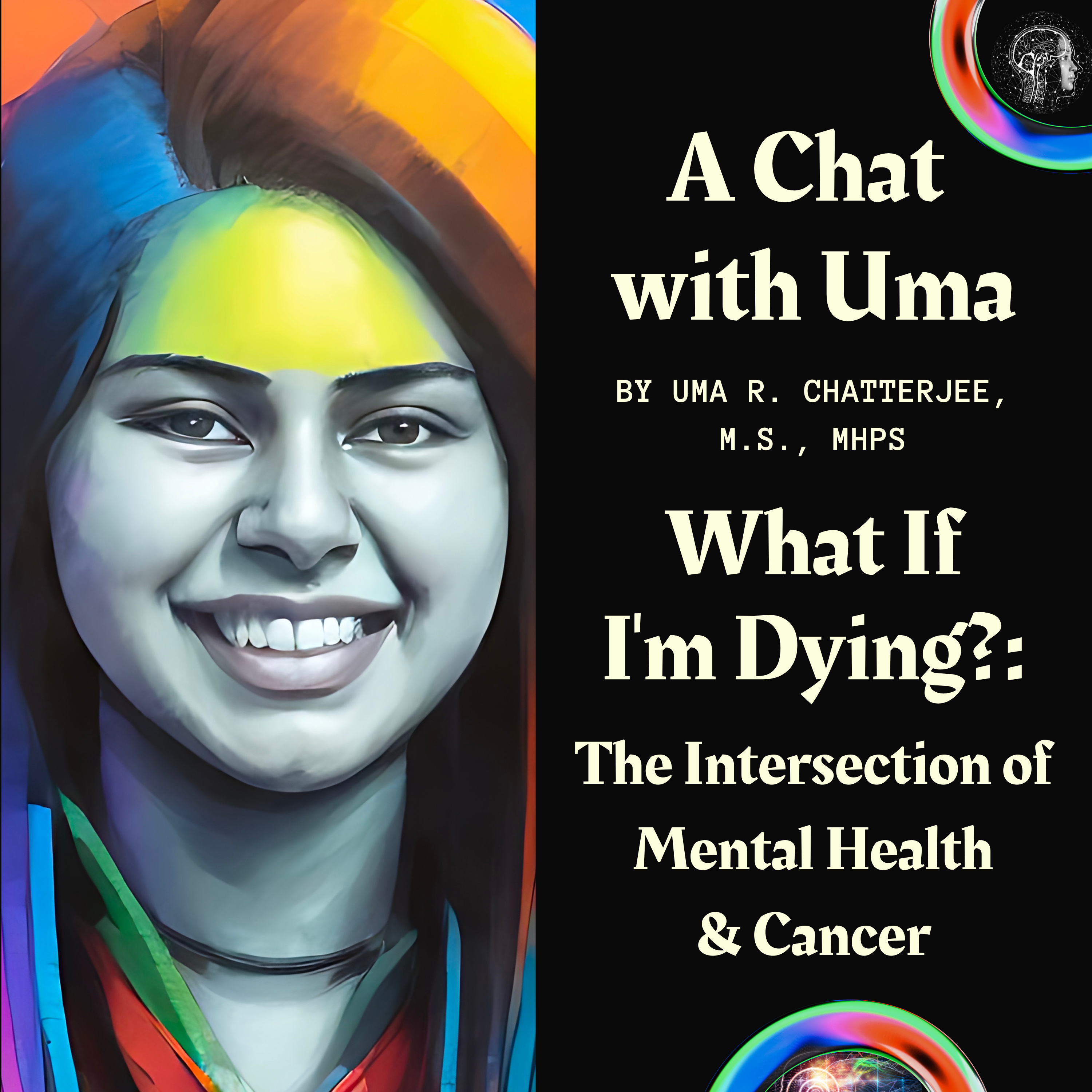
12. What If I'm Dying?: The Intersection of Mental Health & Cancer
59m 20s
In this episode of "A Chat with Uma," host Uma R. Chatterjee continues her deep dive into living with cancer, focusing on the often-overlooked mental health impacts, especially for adolescent and young adult (AYA) patients aged 15-39. She begins by thanking listeners for their support and shares upcoming events: speaking at the Breaking Convention on comorbid OCD in psychedelic therapy for PTSD, and at Digital Cancer Con on psychedelics and cancer, both aimed at raising awareness and accessibility.
Uma explains that while chronic illness is challenging, a life-threatening condition like cancer uniquely forces young people to confront mortality, a deviation from normal life experience. The acute threat of diagnosis triggers survival mode, but after treatment, society often expects patients to return to normalcy with gratitude, ignoring the need to process trauma. This leaves a "backlog" of unprocessed emotions, including the chronic fear of recurrence. She emphasizes that gratitude and fear coexist, and suppressing these feelings leads to worse mental health outcomes, as supported by research on AYA patients. The episode advocates for creating space to acknowledge and process these complex experiences, rather than dismissing them.
(upbeat music) - Hello and welcome to a chat with Uma, with me, your host, Uma R. Chatterjee. On this podcast, I bring together all of my roles as a neuroscientist, researcher, board certified mental health peer specialist, mental health advocate, community builder, and a survivor with lived experience to bring you honest and unfiltered conversations, exploring our true human experiences in their fullest form. Every week, I'm bringing you conversations bridging the gap on all things neuroscience, psychology, mental health, lived experience, advocacy, psychedelics, and more. This is a space for raw unfiltered truth, to truly explore ourselves for who we are and how we are. I cannot wait to connect with you, answer all of your questions and co-create this with you. Welcome to a chat with Uma. Hello friends. Welcome back to another week of chat with Uma. And today, we are going to be doing kind of a part two to last week's episode with last week, me really giving a deep dive on my experience of having cancer and living with cancer and really just putting into perspective my whole story and all of the nuances of the misdiagnosis and mistreatment and the chronic nature of my cancer and the metastases and all of those things and towards the end of that episode, I started talking about just a high level overview of the intersection of living with cancer and my mental health. And I felt like that warranted an epitome of its own because there's just so much in there, so much in terms of comorbidities and the manifestations of how cancer looks like in symptomology of my mental illnesses in particular which I know are not unique to me. And also because of the specific phenomenon of AYA, adolescent and young adult cancer patients from 15 to 39, just having significantly worse and adverse mental health outcomes and why that might be. That is such an underserved topic that really plagues so much of the cancer population especially the AYA community and it really shapes a lot of my life experience and I would be remiss to not talk about it and be open and honest and as I always strive to do, give a voice to these things that are just not talked about and are such a huge part of my life especially given again the nature of this month and currently it's April of 2023 and April in general is AYA Cancer Awareness Month and week as well to really just raise awareness and have advocacy for the underserved community that is AYA's. And then also on a super personal level, it's the month of my cancerversary of being officially diagnosed with cancer the day after my birthday, my birthday is April 25th and I was 22 when that happened and then I got diagnosed with cancer the next day so that brings up a lot trauma anniversaries, you know, every year and that's just a lot of where my mind and heart is at so what better thing to do than to talk about it on the podcast and just be open and honest and live out my values and before I get into everything about cancer and my mental health I firstly just want to thank you all for all of your love and support and kindness as always but especially with last week's episode and I didn't really expect the responses I received of just so much compassion and care from of course people in the AYA community, in the cancer community but also so many of you who are not and a part of me was afraid of sharing myself in that way and it being too specific to me and not really being something that anyone would relate to or find supportive to them I was afraid of, but if that's selfish and just a lot of intrusive thoughts and I did it anyway because I'm living out my values and not that I needed the reassurance not that it was something I was seeking but the fact that so many of you all related to so many aspects of my experience even without cancer or really empathized and more fully understood my vantage point, my perspective, where I come from and developing my relationship with you all in that way just meant so much to me and every week I feel more and more of myself and more seen and heard and in doing so I feel more in my purpose of creating a space for all of us to feel that way and to have permission to solely and surely claim our voices and step into our spaces and extend that love and kindness to the people in our lives and around us and if we can't do that for ourselves how can we do that for other people? So just thank you for creating that for me and creating that model for yourself and right before we get into the episode I just wanted to share a few exciting announcements and reminders about some really really cool events coming up that I would love to invite you to be a part of so starting with this week on Friday I will be speaking at the Breaking Convention in Exeter and I will officially now that I know I will be speaking at 10am on Friday at the psychedelic therapeutic session and tickets are available now it's so exciting my talk will be talking about the consideration of comorbid OCD in psychedelic assisted treatments and therapies for PTSD and all of the considerations and the inverse nature of the disorders and the precautions and just awareness about that comorbidity in this very important part of psychedelic research that's going on right now and the therapeutics that are being developed I'm so so honored to be speaking at this conference and sharing my research and my ideas amongst so many people who I have revered and looked up to for so long who are some of the foundational humans, researchers, clinicians, people in the field and to be able to take the stage alongside them is something that I still have not fully grasped and maybe I'm in a little bit denial about just so I don't totally freak out but until I have the freak out I'm really really excited I'm actually flying out to London today right after I record this and I will be exploring London for some time before heading to Exeter for the conference so if you are in the area I would love to see you there if you're interested in psychedelics it's the largest conference of psychedelics in Europe it's going to be so amazing so if you're around I would love to have you there and to meet you also if you are interested in OCD and the awareness of OCD in this field I would love to meet you so let me know if you'll be around and if not if you'd like to tune in virtually there are virtual streaming options as well which is really exciting to make things accessible to people so I will have all that information linked in the show notes and I really hope to see you there also I'm so excited to share that I will be speaking at digital cancer con hosted by stupid cancer which will be available virtually to everyone for free from April 16th to 30th and I will be giving a talk on psychedelics and cancer and really just creating a comprehensive high-level overview and resource on all things psychedelics psychedelic cystic therapy the state of the research for mental health and cancer indication specifically and just providing a lot of insight and considerations as to what's going on in the field what's available what are precautions to have and just really summing up the state of psychedelics and cancer which is so exciting I'm so honored to be giving this talk with stupid cancer and just bringing this research to the people who really care about it which is ultimately my goal as a person in every way so if you are interested in that and checking out all of the other amazing sessions for the AYA community head over to digital cancer con and check out all of the live and pre-recorded sessions the link will be in the show notes it is completely free and completely open to anybody and we would love to have you there
So, cancer and mental health, where do I even begin? I think that for anyone who has not experienced cancer, which thank goodness, I don't know that that's intuitively linked for you, and I really want to, I guess, set the stage by just putting into perspective how and why that might even come about before getting into the nitty gritty in my own experience. So, you know, living with chronic illness is one thing, and I say that as someone who lives with multiple chronic illnesses that are not cancer, different autoimmune diseases, of course psychiatric conditions, just lots of things. And that is its own version of debilitation and acceptance and so many hurdles to navigate right. But there's something about living with a life-threatening illness, which can be cancer or something else. Oftentimes, it's associated to cancer. It's a more commonly known word or thing to represent a life-threatening illness, but of course there are others as well. Like organ failure or, you know, surgery gone wrong or just something to that nature and the things, right? And there's something so unique about that experience because, like I talked about in the last episode, I think about it being a human being who is thinking about your mortality and thinking about the very real possibility of dying, which we all know, I think we all know, that we are all going to die. That is the one sure certain thing in life, of course. But actively sitting and thinking about dying, especially when you are a young person who is able to comprehend the enormity of death. So not being so young that death is something that you don't quite understand or is very transient and you're almost ignorant to it in a blissful, beautiful way. Or being much older and yes, death is enormous, it is painful, yet you have lived a significant amount of life, which maybe you might still want to live longer, but you've lived a pretty long, decent life. And then being a young person, an adolescent or young adult, and sitting with the idea of losing your life or having the recurrence of something that might result in you losing your life, even if you made it through with luck and treatment, the initial stages of a diagnosis and the immediate threat of cancer. That is not normal. That is not natural, that is not really something that's part of the experience of existing. It's just outside it deviates from the norm. And our minds and brains and systems are equipped to handle a hell of a lot. We are equipped to navigate treacherous situations and threats and fears and survival. That's what we're made for, right? Of course there's dysfunction in that, but that's what we're made for. But a chronic threat, not an acute, but I mean of course there's the acute part of it, but also a chronic threat of death, especially when one has only begun to live, is a form of debilitation and fear and paralysis and struggle that I wouldn't wish on anybody. And it's really compounded by the fact that there is the acute experience of cancer that is both obvious to the person experiencing it and everyone around them of receiving the diagnosis, not being happy about it obviously, being pretty afraid and in pain and shock even. But going into that automatic shutdown, let's do what we need to do, take immediate action. Most things are out of our control, having the disease is out of our control, receiving the diagnosis is out of our control. But what is in our control, taking the next prescribed steps of what to do for treatment to make things better or try to at least depending on how severe the situation is and what the treatments are that are available for people with cancer. And of course I'm lumping all types of cancer into one category and there are so many nuances to the different stages, types, treatments, conditions, all of the things. But I speak as a lumped category because ultimately the word cancer and the meaning behind it, even with the nuances in it all, is a potential life-threatening condition or it is a life-threatening condition that could potentially end your life directly. So having to go immediately into reaction and not having the time to process all that comes up with that immediate experience is effectively step one of the longstanding dysfunction that may come from that experience because that is of course a natural reaction to something that is a acute threat. And going back to how we're supposed to be, a acute threat, go act on it, fight, flight, freeze. Most of the situations in terms of going into treatment is fight, go fight, right? And then one goes through treatment and in the way of survivorship if someone goes into remission, which we talked about as being in less of a threat state and possibly even being cancer-free with of course the threat of recurrence or like in my situation, kind of living with chronic cancer and being cancer suppressed and possibly hypnotizing further or coming out of the risk zone several years later. That form of survivorship after that immediate grueling bootcamp of treatment really, that's when it's less recognizable that there's an issue but maybe all the more prevalent because going into fight mode and going into just reactive, let's do something about it, going into treatment effectively, whatever that looks like for a person, that not only the person going through it is hyper focused on making that work and going into survival mode because that's what it is but the people in their life can actively see that they have been diagnosed, they're going through treatment, they might look sick from the treatment, irrespective of they look sick, they can actively see the person in treatment, they can sympathize more, they can understand the, you know, to some degree the pain and severity of going through that experience, maybe not the threat of mortality but just like the gruesome nature of going through treatment oftentimes. But then after receiving that, of course, hopeful news of being cancer free in the best of situations or in remission or cancer suppressed even or just out of that severe acute threat state, what all to often happens for the vast majority of people is the people around them think, oh well you're okay now, like cancers resolved for the most part and just go back to regular life, go return back to your normalcy and will return back to hours and you should be all good now and on top of that you should be so grateful and appreciative and happy that you made it through and you didn't end up, you know, dying like so many people do. So take that gratitude and that happiness and go live your life and have that second chance at life and all of the platitudes and things that of course they have validity and that's not lost on people with cancer. I can speak for not just myself but anyone I've ever talked to which is so many people in this community. That's not lost on anybody and that's not invalid in that those are parts of the experience but what's really lost on survivorship from the people around us and even ourselves because we're not taught to understand our experience we're often not given that support we need is there is a whole ass backlog whether you have a clinical diagnosis afterwards or not of a mental illness or psychiatric condition related to it. There's a whole ass backlog of experience to prove.
process from going into survival mode. And generally what happens in human nature is to go into fight mode in an acute threat and resolve that threat and then go rest and recover. Do you know what doesn't happen oftentimes for cancer survivors? They don't often get to, quote unquote, "rest in recover," and what I mean by that is, of course, the physical recuperating from treatment, it's kind of like you just immediately have to go back into life. There's financial constraints and already the financial toxicity and the burden of not being able to work or do school or whatever it is that you were stalled in. That's more obvious. But even more so, there isn't a space to recuperate from going through an acute threat for a chronic amount of time to start with. That's just going through treatment and receiving the diagnosis and actively processing the whole experience because granted, there was no time to do that in needing to just get into action mode and go do the thing and be in survival mode. But once you're out of that acute threat, there oftentimes is no space to process all that meant for you and to be meaning or whatever is supportive. And you don't get seen as someone who needs that by the people around you. And so all of the platitudes, all of the discomfort with your own mortality that other people have is projected onto us as because other people reflect to us like, oh, things are over now. We don't care as much anymore because you're not actively dying in our eyes, you're out of treatment, you seem OK, you're looking physically better, whatever. And it's over for us. So therefore, it's over for you. And of course, as humans who internalize stimuli and our communal creatures who take in beliefs and perceptions and create our reality from what's reflected to us oftentimes, that's natural. And of course, there's necessary room for introspection, but we are oftentimes reliant on the outside world as well. Internalizing that equals, well, it's over for them. So it's over for me. And I'm expected to be so grateful and happy. And maybe there's parts of me that are. So why should I feel any other way? What is there left to process? And that's me just in a hyperbolic sense projecting active, conscious thoughts, but in the reality of things for people who aren't really thinking about their state of being or as acutely aware of mental health and maladaptive coping and all of those things, it's less so like a conscious, oh, I guess I shouldn't feel these things and more so, just an ignoring of the things that they're feeling. And that is so harmful to people because there's a lot to feel. And it's not just processing that acute experience. That's step one. But what's the invisible part of survivorship to everyone around them and oftentimes themselves, which is the chronic threat of mortality. Because once you face it, you can't really go back. I have not met anyone who's gone back at least. It's one of those things that, again, if you go and just from an evolutionary, functional, biological sense, death is the most, you know, threat, the biggest threat to us and to actually face it with something that's out of your control, that, yeah, you can participate in treatment, but really, you're not in control of the threat. And then you have the conceptualization of that threat being able to come back. And they're still going back from that. And of course, people can live with it because we are living with it. But how are we living with it? And how can we live with it in a way that doesn't cripple and debilitate us? Well, the answer would be to actually contend with it and deal with it and process it and live alongside it. But that's often not the case because there's not even a recognition of it. An active seeing and allowing of it, because it's suppressed by the people around us, it's suppressed by ourselves. And there's so much shame in living with cancer and being quote unquote the lucky ones who weren't killed by it in the acute sense, which of course, that is valid. There's a coexistence of things here. Gratitude and appreciation and joy and happiness and even feeling the vitality of feeling more alive and being given a second chance. It does not erase or undo the acute threat to your mortality and living with that fear. They don't outdo each other. They don't erase each other. It's not picking one or the other. It's all of it because that's the nature of living as a human, as a human who thinks and feels and is complex because we are. And this is evidenced by, at this point, a massive amount of literature on specifically AYA, AYA Cancer Patients, again, adolescent and young adult cancer patients who are roughly between the ages of 15 to 39. When they first got diagnosed, they were diagnosed between 15 to 39. And they're significantly worse and adverse psychiatric mental health outcomes compared to the general population, compared to their peers, compared to cancer survivors outside of that age range, it's significant. And that shows up in so many diagnoses, particularly, I mean, the more intuitive one is PTSD, post-traumatic stress disorder, as well as depression and anxiety and suicidality and panic disorder. And in fact, there's a higher risk of an induction of a psychotic episode or psychotic symptoms and both increased outpatient and inpatient treatments by multiple fold for that population. And these effects last not just in the years you would think of the few years after treatment, but decades later for people who are far older, but were diagnosed and with their cancer ready on their age. And if you think about it from the perspective of what I just said, that makes so much sense. Having to deal with this unnatural as hell circumstance of dealing with your mortality and actually facing it and going through all of the grief and loss and pain of being threatened in that way at such a young age, not having the tools and the coping skills and the support to be able to actively process all of that yet being conscious and alive enough to grasp the enormity of what happened, that's a lot. And it's compounded by the lack of awareness and access to proper support during and after in survivorship. And by the people around us who to know fault of their own relatively don't support us in that or enable us to seek or access that or create a space for us to talk about it. In fact, in the lesser great cases, there's a negligence from people around AYA's who get annoyed by them talking about their experience and are so deeply uncomfortable with hearing about it that they shame those people into being quiet and talking about like, are you milking your diagnosis? Like, why are you still talking about this? It's annoying, it's over, like move on or just being really dismissive. And you know, there's even more horrible circumstances of AYA's being abandoned by their loved ones, by their families, by their partners, losing their fertility being in toxic financial situations because of cancer, there's just so many things that happen that can coalesce with adverse mental health outcomes for this population in a very unique way. And it's heartbreaking, it's painful. And of course, there are solutions and there's advocacy and awareness that's coming. I mean, this is one of the reasons I'm doing this podcast too. There's so much that can happen, but that requires being aware and having access to proper support and being able to go into that backlog and receive proper support for it all. And of course, I've been talking in generalizations and speaking from more of a removed standpoint from just talking about the general research and statistics and things like that. But the reality of it is, I'm a walking, talking, living example of all of this and more. And that's why I know about this and that's why I'm talking about it. And I'm absolutely not the only one I have worked with so many people as a mental health peer specialist in the Cancer Driver Collective and the Cancer Community and have advocated for this very openly, ever since I have been diagnosed and really dove into this experience and all that comes with it and being the curious person I am trying to understand and conceptualize what it was that was going on in the last four years. And this is nothing new.
to me or my work. But it's often been insulated within the Cancer Community, you know, I gave the keynote at at live cancer comm last year. I spoke at digital cancer comm the year before. I'm of course speaking at digital and live cancer comm this year. And it's been within the community of people who already experienced it and supporting them. But this is so important for people who know in general because first of all, anyone can get a cancer diagnosis. I know that's scary to hear, but you can. And most people live thinking about it in a hypothetical. As we do because we just hear about things and have this kind of underlying assumption that that's for someone else and not me. But that could happen to you. And I would hate if it did. But if it did, I want you to know about this before so that you have pre-frames and references to be able to be supported and going through something already really hard and it being maybe a little more supportive and easier for you. And then also just for people to know what's going on in the lives of people who they love, who might be going through this. There are a lot of people with cancer and who are cancer survivors and who are AYA's especially. And obviously I'm one of them. If you're listening to this podcast, then you know me. And I'm one of those people. And this is also for me to claim and speak my own truth beyond the more safer spaces of the cancer community who already understands and who just needs support in it. This is for me to be seen and heard as I am to everyone in my life, everyone who hangs out with me here on this podcast. So me and my mental health and cancer. And there are extensive episodes on the podcast about my mental health in general, all the diagnoses I live with, the my full story podcast, the mental health part one, two, and three podcasts. And my psychedelic podcast, I mean really every podcast episode, especially those, which give a lot of context to what I'm going to talk about. But in the context of cancer and the intersection of what that has looked like for me, I mean I had severe mental illnesses before cancer. Like that just is what it is. I had PTSD for a long time unchecked. A severe OCD obsessive compulsive disorder since I can remember. Major severe depressive disorder and anxiety, generalizing anxiety, panning disorder, eating disorder, body-focused repetitive behaviors, lots and lots of things, right? And then I was met with all of those things already in place with cancer, which was objective, flea traumatic for me, no shit. And if you heard the last episode, you know about the very windy and scary trajectory of my cancer experience and being misdiagnosed and treated with negligence for a while and the resulting worsened prognosis and outcomes being at the highest risk of recurrence due to everything that the way it played out for me. And so objectively aside from my mental health conditions I already had or rather in addition to the cancer experience I had was very painful, very scary, very long-standingly a threat and a lot to handle. And then you overlay it on the very real issues that were untreated for a very long time that I already had. So PTSD already having many severely life-threatening traumatic events plus complex trauma, but the majorly severe events. And then this one on top of it and we know from psychological research that having a traumatic event already makes the disposition to and the dealing with future ones far worse. So it already set me up for it and had me predisposed to pretty poor outcomes with PTSD in terms of experiencing that specifically around cancer. And that one's more, I guess, intuitive for people now that you've heard the rest, you know, the earlier parts of this episode just talking about how uniquely traumatic it is and how life-threatening it is both in acute sense and acronic sense and having to deal with the impending threat of mortality. And not only that, but for me, dealing with the threat of continued misdiagnosis and negligence and treatment and worsened outcomes and all those things. And that's a lot that's a lot to deal with on its own. And then for me, I have had obsessive compulsive disorder for as long as I know. And so that looks more like the what if and latching onto the future and what if something happens, what if I die, what if I get misdiagnosed again, what if they miss something again, what if I lose my life to something outside of my control, what if what if what if it's just endless. And the tricky part of that is that it gloms onto what has already happened thereby showing the functionally dynamic comorbidity of PTSD and OCD that you've heard me talk about on this podcast before many times. The thing that I research because the PTSD functions in having unprocessed trauma around what has happened and reliving what has already happened, which oftentimes even shows up in my cancerversaries. That's why that's that term is a thing for people with cancer. The cancerversary, other diagnosis and what that brings up for them. And some people it's less maladaptive than others. And it's more so just like a reminder and for other people, it's a reliving and for me, April is a reliving of everything leading up. Like I still just get stuck back into what life was like back then. And there's so many confusing feelings and life gets really warped and weird, especially around this time of year. And it's hard to put that in perspective. And I think about what's going on in my life right now. And then realize like I'm getting taken back to 2019. What was happening in April that year and what was going on. And that's unprocessed things, right. And then there's the OCD that latches on to the very same things, but is so consumed by the intrusive thoughts and debilitating fear of what if it happens again, what if you know, something is that, especially with the you know, random bumps and things that show up on my body or even feeling pain in my neck where I had my tumor, which happens a lot. And it's very like psychosomatic and weird and scary. And it happens in very specific time to the year. It happens around my cancer adversary and it happens around the my surgery anniversary, which is two months after my cancer, and like it feels exactly like the pain that I had with the tumor. And it's very odd. You know, OCD feel like it's coming back and whatever. I think there are so many compulsions that are invited as opportunities to try to ameliorate that. What if anxiety, that obsessionality, that those intrusive thoughts by compulsively checking different parts of my body and checking how I feel. And if I have bumps and particularly checking and booking appointments for biopsies, I've had so many biopsies and I do not scar well. So I have so many like keyloids and random shit on my body and it sucks. But you know, there's a part of it that feels valid because I've had things before. So maybe I'll have them again. And I've had such poor luck with my health and I've been in such poor health that, you know, that might happen again. So, you know, it's been reinforced also by people who are on my medical team and do the biopsies and give that a lot of attention as well. The problem is once the biopsies are done and they come back and there's a result of things not being cancer, it does not ameliorate that fear. My brain latches on to, it's probably missing something. They didn't get the exact right tissue sample. They didn't check properly. It is, they messed up. They makes my sample up with someone else. Things that sometimes have happened in the past and sometimes haven't. But it's so there's no resolve or certainty or like a sense of calm or few her relief ever. It's just a, like being consumed by what if there's something wrong? Not, there is something wrong, but what if there's something wrong? And that's debilitating to live with. It's also really not great medically. And it's really hard to navigate that with physicians and doctors and people who are not necessarily versed in having those conditions or even aware of their patients having PTSD, let alone OCD. And either me coming off as being someone who's just overly fearful at a hypocontriac or to
taking me seriously and engaging in my reassurance seeking and certainty needing and my threat response and giving attention and validity to it, both of which can be problematic in different ways. And this is a way of blaming them. And necessarily it's just highlighting the complication of living with that and having very real threats that have actually happened. The worst fears have actually happened and it's different than what if my worst fear happens. And then there's the health anxiety, which it sounds similar to health OCD or health anxiety OCD versus health anxiety, but the functions are similar but not the same. They do have different functions in the way they play out. And so health anxiety OCD is the fear to me of what if it happens and then doing compulsions to try to ameliorate, set anxiety and fear about what if it happens and doing things like checking and biopsies and reassurance, seeking and research and all that. And then there's health anxiety, which is the consuming belief and fear that something indeed is wrong when it isn't. And so the difference is like the what if versus it is. And I also have the it is in oftentimes acute scenarios where there's a symptom that I am having that I had around the cancer itself and just can be convinced that it came back or having some sort of test often like every six months I have scans and I have blood work and seeing something wonky and just believing without having the full context of those test results they're looking forth to just believing that their indeed is something wrong. I have cancer again and just being consumed by that fear which there's so much overlap with the trauma and the anxiety and even the OCD and so much more. But there's a unique function in just this all-consuming full belief that something is indeed wrong and just acting on it at all times. And again, the complication in that is that because things have been wrong so many things, not just the cancer like my very poor health overall the several chronic illnesses I have lived with and some I continue to live with. The things that went undiagnosed for so long that debilitated me that doctors didn't know or find because I didn't have proper healthcare or people who were looking out for me only for them to find it then and then validate that. Like there's so much compounded in there of so much not fully processed and accepted trauma and experience that then genuinely feeds into a lot of the pathology and to some degree one could say that it's a sort of natural response to going through so much but the level to which it gets to and it being unchecked and removed from reality at a certain point is where things get really, really debilitating and again the cluster fuck of it all is this isn't the scenario which is also valid and a whole other thing of someone who has not experience this but like hasn't had cancer but is deathly afraid of what if it happens or truly believes that they do have cancer you know like the very more classic like health anxiety and health anxiety OCD and things like that. That's one scenario where it's hypothetical there's a really they believe that there's an actual threat but it's never actually happened to them but then for someone to have actually lived with that and for the worst fear to have actually happened and then to experience all of that on top of it there's just so much fertile ground for those fears and that pathology to grab onto because there's evidence of it actually happening which is the case with a lot of trauma and the intersection of trauma and maladaptive responses beyond PTSD of course is PTSD and then also anxiety and OCD and depression and panic disorder and so many other things right? Effectively those things are different versions of unwarranted maladaptive responses to a stimulus and it's just a whole new thing when it's this core like the deepest most existential threat to your life the threat of mortality like I cannot overstate that enough it's just different and that's coming from someone who has experienced so many majorly traumatic threatening events but this is different in the most acute and chronic looming threat and it's not helped by the very necessary and important check ins and scans and the tumor checks and all the things and just this reminder every six months of this could be the time that you find out that it came back which is such a true threat to people it's not helped by that because of the resurgence of everything and of course there are coping skills and there are treatments and there are support and that is all well and good but if people don't have access to that because they're not aware of what can actually happen then none of those things can help and none of them matter which is the point of awareness and being open and honest and creating conversations about this and making this knowledge not just to the people who experience it but to the people in their lives and communities so that we can be supported especially when we're busy being in survival mode for someone else to possibly see us going through this and gently provide us the opportunity to be honest and support us in accessing the proper care through these experiences and not just suffering silently especially when cancer patients are put in the position of comforting other people for their discomfort with our experience and needing to like us patients needing to be the people who are saying it's okay I'll be okay reassuring other people and stuffing down our own feelings to take care of other people this is the opportunity for other people to take care of us which is very hard for me to say as a person I can talk to people I work with and my community all day long about them doing it but for me to actually walk the walk and not just talk the talk that is been such an interesting challenge but this is me trying to actually talk the talk I mean trying to walk the walk by talking the talk on the podcast and being accountable and open and the age old adage of mental health that is extra relevant to this conversation is mental health and mental illness is not a choice at all how we navigate it and how we get ourselves to access treatment to the best of our ability and engage with treatment is partially a choice sometimes fully a choice but the experience of mental illness and mental dysfunction, psychological, psychiatric all of that is not a choice and that's particularly relevant to the conversation of cancer and mental health because so often times when people are brave enough when survivors and patients are brave enough to speak up about their actual experience to the people they trust around them their family, their friends, their colleagues even their mental health providers or providers in general they're even their physical health providers they're oncologists they're met with invalidation and disdain and are basically told we'll change your mentality around that like just choose to think of the positives choose to be grateful to be alive and look at that instead and quit being whiny and to those people I and anyone else experiencing this would say walk in my shoes before you say that because if you have not experienced living with a life threatening illness and the impending doom of your mortality over your head in conjunction with all the good and beautiful things that exist in the world if you have not lived with that part of life first of all lucky you I truly would rather you not experience that but too if you haven't walked in my shoes and you cannot tell me how I should feel in this situation you can imagine what it would be like to be be or to be a survivor and live with us all day but you can't know and nobody wants to choose fear nobody wants to choose depression over the loss of their identities and their sense of safety and purpose in the world and the grief from losing their fertility, their health, their trajectory in life, their goals, their mission, their fighting
capabilities. Nobody wants to feel any of that. Nobody wants to feel compulsive tendencies to emulurate the obsessional fears of what if they get sick again, what if things go wrong. Nobody wants to feel traumatized by facing their mortality. Nobody wants to feel how things are, the of being sick constantly. Nobody wants to feel any of this. Of course, not with mental health in general, but especially not with cancer. It's not a choice. People want to move on. People want to live a life free of cancer, but the truth is that doesn't exist. Plain and simple, it doesn't exist. It can be a part of your life that life grows around it and then in relativity to the rest of your life, it can become smaller, not because it's shrinking, but because life is growing around it. If you can imagine a circle, a dark ugly circle, kind of looks like a tumor, a circle that is cancer and then life. The dark ugly circle and life around it. Life can grow, things can evolve and change and life can be beautiful and I've been flow and evolve and more things can happen and more experiences can happen, but it's around this irrefutable, irreversible experience of facing your mortality and all the consequences that come with going through cancer, especially at, like I said, that age where you are old enough as an adolescent or young adult to be fully aware of the magnitude and normity of mortality and your life and the reality of what you're experiencing, but also at the beginning of your life as a relatively fully conscious functioning adult and building your life on your own terms. And that being a big part of it and robbing you of a lot. That's not victim consciousness. That is not so many of the narratives that are portrayed of people who speak about their realities openly like me. It's not choosing to be victim. It's not complaining. It's not, you know, being a pessimist or anything like that. In fact, personally, I'm maybe all too often referred to as an optimist in a positive person. When that's just a part of me, I stride be more of a realist, but yeah, I do err on the positive side. That is not not being that. That is just being honest and being truthful and acknowledging the reality of this experience that so many people are afraid to acknowledge for us to deal with their own feelings about us going through this and having to deal with how they feel about their own mortality by perhaps putting ourselves in our shoes or comparing themselves to us or dealing with the fears around us. That's not your problem. If you are the survivor or a patient, that is other people's problems and that does not invalidate the reality of this experience and multiple things can be true. As I've said, over and over and over again. And that's really what I want to hammer in here. And so with being open and honest about the reality of it, comes the opportunity to be supported by professionals, by loved ones, by our workplaces, by our education, by whatever it is that you are not feeling supported by being truthful and open and honest and allowing yourself to be seen and validated and advocating for yourself, which sucks that that's even a case that you have to experience that. But that's the only way we can move forward. And part of my role that I've taken on and chosen as my purpose in this world is to be a voice for those things. There's a common thread and everything I share, even if they seem not related or disjointed and have so many different experiences that I speak on. It's because so much of my suffering wasn't just the experience itself. It was the lack of awareness and support that I received to be able to experience and move through whatever it is that came our way because we cannot control things happening in life. Like the nature of life is things happening. Quote unquote, bad, good, happy, sad, painful, amazing, joyful, all of it. We can't control that. That's life. But we are meant to be able to move through life. I mean, that's the nature of existence. But part of moving through life is being supported in the ways that we need and being open and honest. I can say those words over and over. I should probably find synonyms, but you got what I mean. Part of experiencing life is being able to move through things. And you can't really move through them if you can't acknowledge them and give a name to them and describe them and communicate with them and take away the shame and guilt and stigma around being honest. And that's the example of what I'm doing right now. That's what this podcast is. And it's many things. This is one of them. This is particularly what this episode is because this month is weird. It's a lot of beautiful things are happening in my life. And they are valid and true and part of my experience. And amongst all of that, it's extra tough because I'm facing my mortality again. I mean, in theory, you'd be facing it every day because time is subjective. But our nervous systems are wired to pick up on different sensory cues and signals and the the concept of time that we've all subscribed to in this world. And so for me, that is April. That is right around my birthday, right around the duality of the day of my birth and the day I found out I have cancer and really starting to think about what if I die right next to each other. And it all exists and it's so relieving to be able to put words to that and give perspective to that and exist as I am so that I have context for this is why that's happening. And this is why I feel the way I feel and not looking for meaning in the inventory of other reasons why this problem might exist or why I might feel this way. Acknowledging and admitting and processing is brave. It is not being a victim. It is not being a burden. It is brave. It is beautiful. It's empowering and you deserve that. And I deserve that. And this is not just about cancer and mental health. This is for anything you're experiencing. You're allowed to take up space and you're allowed to be seen and heard and then to show that to other people because they're allowed to as well. And that's what we want to do here. Create a space for that. So thank you for seeing and hearing me in my experience today about scary things that are uncomfortable and not what we want to hear in regular conversation. But this is what liberates us and gives us more love and safety and care and openness and freedom and truth and community in the world at least to me. So thank you for being here. Thank you for spending time with me on this podcast and sharing your own experiences and thoughts with me. Hearing from you about how these conversations change your life and bring things up for you and create more safety and support for you is what drives me and keeps me going and keeps me so dedicated to creating this as much as things come up for me. It's why I do what I do and I can't wait to hear more from you. And with that, if you are feeling supported with the podcast, if you're enjoying it, then it would mean so much to me if you could just take one second on wherever you're listening to this and leave a five star rating and review talking about why you love the podcast and how it supports you because that really helps us create this space and help more people come to our community and join us in these conversations and really, really helps me creating a show. Also, if you could share this podcast with anyone you think is interested and who would want to hear these conversations, who you want to facilitate these conversations with in your own life, creating. using this as a primer to just start this level of discussion and thought and connection with people. If you could share this directly with your friends and people in your life and share this on social media, it would make the biggest difference for us and of course, please let me know if any thoughts you have. I'm always open. I love hearing from you. It's the greatest gift and thank you so much for being here. I will see you next week on Chat with Emma.
Podcast Summary
Key Points:
The episode is part two of a series on living with cancer, focusing on the intersection of cancer and mental health, particularly for adolescent and young adult (AYA) patients aged 15-39.
AYA cancer patients face significantly worse mental health outcomes due to the unique trauma of facing mortality at a young age, compounded by societal pressure to feel grateful and move on after treatment.
The host shares personal experiences, including her misdiagnosis, chronic cancer, and upcoming talks on psychedelics and mental health, emphasizing the need for open conversation about these underserved topics.
Survivorship often lacks space for emotional processing, as society expects patients to return to normalcy, ignoring the chronic threat of recurrence and the psychological backlog from survival mode.
The host announces her speaking engagements at Breaking Convention and Digital Cancer Con, focusing on psychedelic-assisted therapy for OCD and cancer-related mental health.
Summary:
In this episode of "A Chat with Uma," host Uma R. Chatterjee continues her deep dive into living with cancer, focusing on the often-overlooked mental health impacts, especially for adolescent and young adult (AYA) patients aged 15-39. She begins by thanking listeners for their support and shares upcoming events: speaking at the Breaking Convention on comorbid OCD in psychedelic therapy for PTSD, and at Digital Cancer Con on psychedelics and cancer, both aimed at raising awareness and accessibility.
Uma explains that while chronic illness is challenging, a life-threatening condition like cancer uniquely forces young people to confront mortality, a deviation from normal life experience. The acute threat of diagnosis triggers survival mode, but after treatment, society often expects patients to return to normalcy with gratitude, ignoring the need to process trauma. This leaves a "backlog" of unprocessed emotions, including the chronic fear of recurrence. She emphasizes that gratitude and fear coexist, and suppressing these feelings leads to worse mental health outcomes, as supported by research on AYA patients. The episode advocates for creating space to acknowledge and process these complex experiences, rather than dismissing them.
FAQs
The podcast explores neuroscience, psychology, mental health, lived experience, advocacy, and psychedelics, aiming to bridge gaps and provide raw, unfiltered conversations about human experiences.
AYA patients (ages 15-39) face a unique threat to mortality at a young age, compounded by a lack of processing time during treatment and societal pressure to move on, leading to significant psychiatric issues compared to peers.
After treatment, survivors often lack space to process the experience due to societal expectations to be grateful and return to normalcy, while the chronic threat of recurrence remains unaddressed, causing hidden distress.
The acute threat involves immediate diagnosis and treatment, triggering survival mode, while the chronic threat is the ongoing fear of mortality and recurrence, which persists even after treatment ends.
Gratitude and fear coexist; feeling grateful for survival does not erase the fear of mortality. Both are valid and do not cancel each other out.
The host will speak at Breaking Convention in Exeter on April 10am about OCD and psychedelic therapy, and at Digital Cancer Con by Stupid Cancer from April 16-30 on psychedelics and cancer.
Chat with AI
Loading...
Pro features
Go deeper with this episode
Unlock creator-grade tools that turn any transcript into show notes and subtitle files.
 PodcastTranscript AI