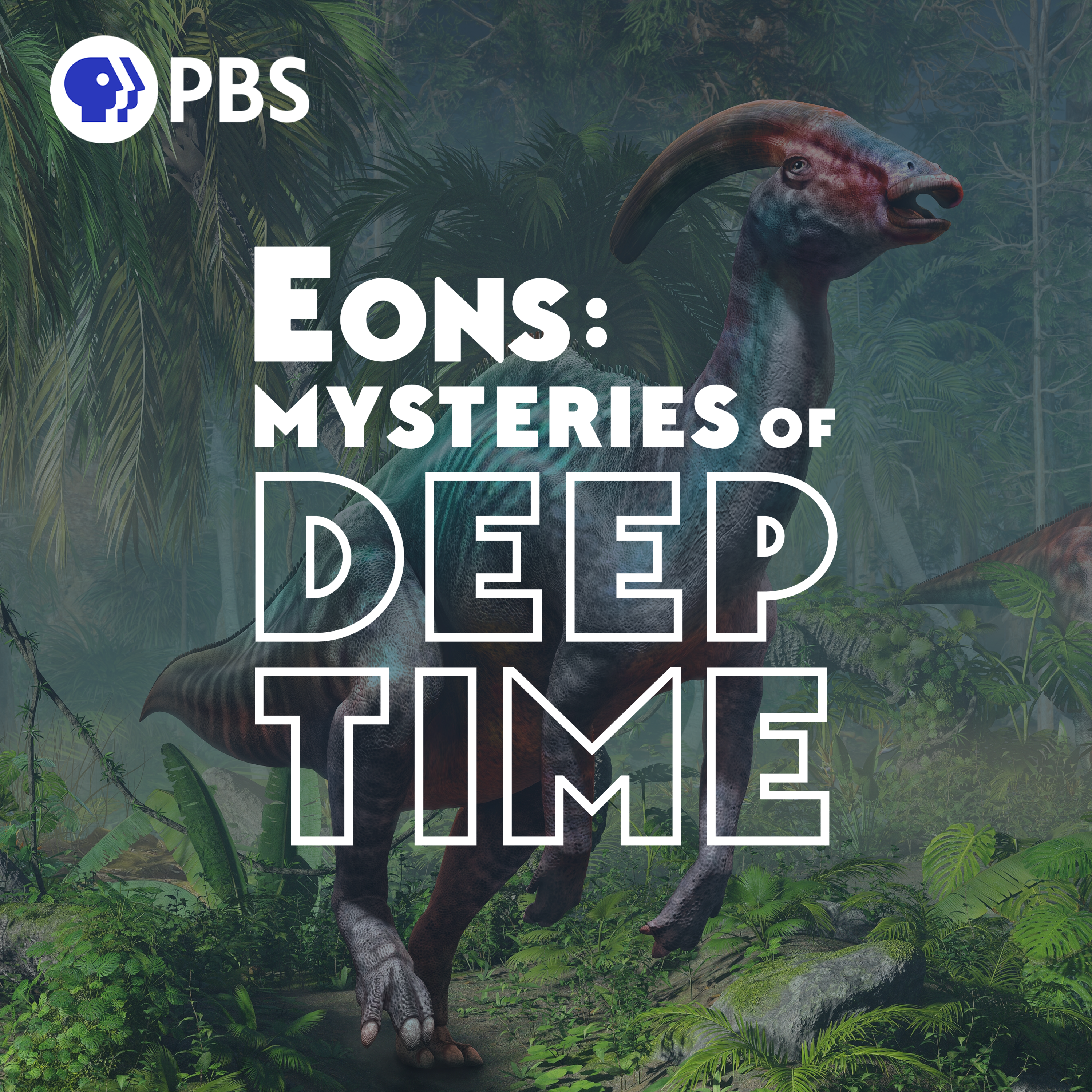
The transcription describes the soundscape of the late Cretaceous period, highlighting the presence of dinosaurs settling down for the night, nocturnal animals like crickets and toads, and the continuity of certain sounds in ecosystems over millions of years. It discusses the challenges of reconstructing ancient sounds as sound does not fossilize, but researchers use modern analogs and fossil evidence to infer how ancient creatures may have sounded. The text explores the vocal abilities of dinosaurs and their relatives, such as crickets and birds, using methods like phylogenetic bracketing and anatomical analysis to speculate on their sounds. The focus is on understanding the past soundscape through a scientific lens, emphasizing the importance of incremental research steps to uncover the mysteries of deep time.
Transcription
2565 Words, 14924 Characters
It's dusk, slowly sliding into a humid summer night in the late Cretaceous period, somewhere
in the world.
There's a bit of a breeze cooling you down from the heat of the afternoon, rustling the
leaves of a nearby ginkgo tree and setting its branches to creaking.
The creatures of the day, the dinosaurs, are starting to settle down for the night.
Some of them curling their bodies into the same positions we see birds roosting in today,
maybe even tucking their heads under a feathered arm.
And you can hear a chorus of nocturnal animals just getting started.
Nearby, crickets are chirping, calling out to potential mates with sounds they produce
by rubbing their wings together.
The noises they make aren't exactly the same as those made by the crickets you might
have grown up hearing, but they're still unmistakably crickets, singing duets in the
twilight.
You head towards the sound, towards a pond you can see in the distance by the last rays
of sunlight glinting off its surface.
Out of the corner of your eye, you catch a glimpse of a small mammal darting up a tree.
It hisses quietly from the branches above, you must have startled it.
As you continue on towards the pond, you begin to hear a chorus of toads croaking.
Several of the groups of frogs and toads we still hear calling today were around by the
lake Cretaceous, but there were no tree frogs yet to peep at you from overhead.
No owls hoot or screech from the trees either.
They wouldn't evolve for another several million years, getting their shot after the
end of the Mesozoic Era.
Amidst the chorusing toads, you hear tiny grunts and squeaks.
There's a nest full of baby crocodilians somewhere at the pond's edge that you should
take care to avoid.
In some ways, the ancient world you're walking through is a lot like our modern one.
Take out the non-avian dinosaurs and most of the sounds you hear wouldn't be out of
place in a park on a summer night.
And there's something striking about the idea that there are things about our planet
that have this kind of continuity that have endured mostly unchanged for millions of years.
Ginkgo leaves, really similar to the ones we see today, have rustled in the breeze for
around 170 million years.
Cicadas buzzed, beetles clicked, and wind shook the needles of pine trees both before
and after an asteroid slammed into the earth around 66 million years ago.
That event changed so much of what we can see in any given ecosystem, especially its plants
and animals, but maybe less of what we can hear.
Insects and reptiles have provided the background hum of our world maybe since as early as the
Triassic period, even as we lost the sounds of the non-avian dinosaurs in the end-cretaceous
mass extinction and gained the noises of the birds and mammals in the Cenozoic Era.
The lead singers changed, but the backup singers remained familiar, at least.
As we move forward in time closer to the present, you'd think the things we hear would become
easier to recognize.
But with the rise of our ancient human ancestors and relatives, new questions about the sounds
of the past emerge, questions about language and music.
But how do we know any of this?
How do we start to reconstruct the soundscapes of the past?
Hello, and welcome to Eon's Mysteries of Deep Time, a podcast about some of the most
perplexing problems and unanswered questions about life in the ancient past.
I'm Kali Moore, co-host of PBS Eon's a YouTube channel about the history of life
on Earth.
And today, we're searching for answers to the question, what did the past sound like?
Depending on the time of day or where you are right now, if you open a window you might
hear a chorus of birdsong, or the croaks of frogs, or the buzz and whine of insects.
These sounds may be so familiar to you that they fade into the background, but they make
up the soundscape within which we live our lives.
So when a paleontologist or a podcaster wants to reconstruct the environment an ancient organism
lived in, sound forms a key part of that picture.
And we know that sound can be an incredibly important part of an animal's behavior, too.
They use it to find mates, warn off rivals or predators, or just to say, "I'm here."
But sound doesn't fossilize.
It exists for a moment as waves created by vibrations, then it's gone.
So how can we study it and then recreate it for you in the first few minutes of every episode
of this podcast?
Solving this mystery means starting from today and working backwards.
In geology, there's this thing called the principle of uniformitarianism.
It's the idea that the geological processes that we observe today must have also happened
the same way throughout deep time.
Basically, the present is the key to the past.
And we can use this idea to think about the sounds of the past, too.
For example, wind, water, and the rustling of leaves in the late Cretaceous period probably
sounded the same then as they do now.
We can also identify patterns in modern soundscapes that are nearly universal, like animals tend
to make the most noise at certain times every day, namely dawn, dusk, and during the night.
They also tend to be noisier in the summer than in the winter.
And if this is true across many different groups of animals in many different environments
today, there's no reason to think it couldn't also have been true in the past.
It gives us a base to start with for re-creating our ancient soundscapes.
It's why we set our intro to this episode on a summer evening.
From there, we have to dig into the fossil record for clues.
But we're not digging blindly.
If we know that a certain kind of animal makes noise a certain way today, we can start by
looking for evidence of that in the past.
Take crickets, for instance.
Today, male crickets and some of their relatives make noise by rubbing their wings.
Not their legs, together.
Each of their wings is equipped with a special vein covered in microscopic teeth, like a
very tiny comb made of chitin, the same material that makes up their exoskeleton.
This structure is called a phile, and when a cricket rubs the sharp edge of its other
wing against it, the vibrations produced are what we hear as the crickets chirp.
So to figure out when crickets first sing, we can look for fossil evidence of that wing-veined
structure.
The oldest cricket relatives in the fossil record come from the Carboniferous period,
sometime around 315 million years ago, and they didn't have files on their wings.
These structures show up millions of years later in fossils from the early Triassic period,
and they stick around.
So it's pretty likely that the dinosaurs also heard chirping crickets, just like we
do.
But that just tells us when certain sounds would have been present.
It doesn't necessarily tell us what they would have sounded like.
To figure that out, we need to get creative with fossil anatomy.
And researchers have done this for one cricket relative, a Katie did from the Jurassic period,
which they named Archiboylus musicus.
Katie dids make noise the same way crickets do, and each species produces a unique song,
based on the spacing and number of the microscopic teeth on their files, and on whether they
have functional files on only one wing or on both.
Archiboylus had large symmetrical wings with functional files on both, and the microscopic
teeth on the files were incredibly well preserved.
Using the wing anatomy of living Katie dids and the corresponding acoustic qualities of
the songs they produce, researchers were able to reconstruct the song of the ancient Katie
did.
And it sounded like this… listen.
Pretty cool, right?
If you were transported to a nighttime forest in what's now northern China 165 million
years ago, that's a sound you might have heard.
But what happens when we want to reconstruct the sounds of an ancient animal that has no
living analog, say for example, a non-avian dinosaur?
Well, you could go the Jurassic Park route and mash up a bunch of sounds from living
animals to get something that sounds appropriately cinematic.
But that's not what we're trying to do here.
Again, we can start with the present as the key to solving the mystery of the past, this
time using a method called phylogenetic bracketing.
Non-avian dinosaurs and their closest living relatives are all members of the archosaur
group.
And we know that the closest living relatives of the non-avian dinosaurs are birds and crocodilians,
and members of both of these groups can be pretty noisy.
The sounds that birds make range from intricate songs to weird low bass notes like a tuba,
and run the gamut from high to low frequencies.
And they have a unique vocal organ called the syrinx that's responsible for much of
their musical ability, but we'll come back to that in a bit.
And while crocodilians aren't exactly known for being singers, the adults of some species
like the American alligator make low-pitched bellows that communicate their size and the
babies make this noise.
Now, based on the evolutionary tree of archosaurs, for birds and crocs to be noisy and for the
non-avian dinosaurs to be silent, the common ancestor of all dinosaurs would have had to
lose their sound-producing abilities after they split from the ancestors of crocodilians.
And then the common ancestor of birds would have had to re-evolve this ability.
This is less likely than the common archosaur ancestor and all of its descendants just being
able to make noise.
But given how many different noises crocs and birds make, the real mystery here is narrowing
down what the non-avian dinos might have sounded like, and there's no reason to think they
all sounded the same.
We probably can say, though, that they didn't seem like birds do.
No non-avian dinosaurs seem to have had a syrinx.
So again, we have to turn to the specific anatomical structures we can find in the fossil record,
and then do some reverse engineering.
In terms of dinosound, there probably isn't a more famous example of a piece of anatomy
thought to be a noisemaker than the crest of parasoralophus.
Parasoralophus was a big plant-eating hadrosaur, one of the so-called duck-billed dinosaurs
that lived in North America towards the end of the Cretaceous period.
All of the species in this genus had a swept-backed headcrest made of bone, some longer and straighter,
some smaller and more curved.
Head of those crests were hollow tubes that started at the nostrils, swept up into the
crest, and then descended into the dinosaur's throat.
And in 1931, a Swedish paleontologist first proposed that parasoralophus used this arrangement
to make noise, because it reminded him of the shape of an instrument called a crumbhorn.
And an instrument's shape is really key to the sounds that can be produced by using
it.
This idea was tested in a paper published in 1981, which saw another researcher building
a model crest out of plastic tubing and blowing through it to produce low-pitched sounds.
Like these.
And in a 1998 paper, two more paleontologists took things one step further.
They CT scanned a parasoralophus skull, reconstructed its crest in 3D, and used a computer to simulate
blowing air through it.
This method allowed them to see that the tubes and chambers within the crest were more complex
than originally thought.
Like the plastic tube model, the computer simulation also produced low-pitched sounds,
which likely carried well-overlong distances.
And while these methods might seem silly, they show how the present can be the key to
the past in unexpected ways, and how scientists can draw inspiration and understanding from
the world around them.
It's worth noting too that neither method is perfect.
For example, we don't have the preserved soft tissue components of the dinosaur's
head, so we have to guess at what role they would have played in sound production.
But each method is an incremental step on the scientific journey to reconstructing the
sounds of the past.
As for what other dinosaurs might have sounded like, well, some relatives of parasoralophus
also had crests of various different shapes, which probably also allowed them to produce
sounds in similar ways, though potentially at different frequencies.
And we have found one ancient voice box from the Mesozoic Era, the syrinx of an avian dinosaur,
aka a bird, from 66 million years ago called vagavus.
The fossil was discovered in Antarctica in 1992, but researchers didn't realize that
it had a preserved syrinx until 2013.
It's not something you'd necessarily expect to find, because it's made up of rings of
stiff cartilage that provide structure to soft tissues, and cartilage doesn't usually
fossilize as well as bone.
In this case, though, we got lucky, and that allowed scientists to compare the anatomy
of the syrinx of vagavus to that of living birds.
They were also able to try to place it on the evolutionary family tree of birds.
In the morphological details of the syrinx, like being asymmetrical in shape and the place
they think vagavus fits on the bird family tree, it could probably honk like a duck or
a goose.
Which given that the syrinx in other living birds is what allows them to sing their complex
beautiful songs, kind of makes it sound like vagavus got the short end of the vocal organ
stick.
The researchers are still working on modeling the exact sound this ancient bird made, but
the next time you hear a goose or a duck honk, consider that the final days of the dinosaurs
might have been full of that sound.
Well that wraps up your inside look at both how we know anything about the sounds of the
past and the kinds of research we dig into to bring you the most accurate version of
this podcast's intro.
The study of sound in the past is fascinating, and it's pretty amazing that we can figure
out anything about such a temporary phenomenon at all.
The thing about this though is that we can't really know for sure if we're right.
So it's probably safest to consider the sounds of the past hypotheses to be tested, and without
a time machine, they might just stay a mystery.
This episode was written by Dr. Darcy Shapiro, hosted and fact-checked by me, Callie Moore.
Her sound design, mix, and editing was by Callie Dishman.
The show is produced by Seth Radley, our executive producer is Nicole Sweeney, and our editorial
director is Dr. Darcy Shapiro.
The executive in charge for PBS is Maribel Lopez, and Nikki Walker is PBS's Associate
Director of Programming.
Eon's Mysteries of Deep Time is a production of Complexly for PBS Digital Studios and we
are distributed by PRX.
Join in next time where we will discuss the discovery of the mysterious Denisovans.
Until then, you can always visit us over at youtube.com/eons for more stories from Deep
Time.
[BLANK_AUDIO]
Podcast Summary
Key Points:
Descriptions of the soundscape in the late Cretaceous period.
Methods used to reconstruct ancient sounds, including the anatomy of ancient creatures.
Evolution of vocal abilities in dinosaurs and their relatives.
Summary:
The transcription describes the soundscape of the late Cretaceous period, highlighting the presence of dinosaurs settling down for the night, nocturnal animals like crickets and toads, and the continuity of certain sounds in ecosystems over millions of years. It discusses the challenges of reconstructing ancient sounds as sound does not fossilize, but researchers use modern analogs and fossil evidence to infer how ancient creatures may have sounded. The text explores the vocal abilities of dinosaurs and their relatives, such as crickets and birds, using methods like phylogenetic bracketing and anatomical analysis to speculate on their sounds.
The focus is on understanding the past soundscape through a scientific lens, emphasizing the importance of incremental research steps to uncover the mysteries of deep time.
FAQs
Estudiando la anatomía fósil y realizando ingeniería inversa.
El sonido es crucial para encontrar pareja, advertir a rivales o depredadores, o simplemente para comunicar presencia.
Examinando evidencia fósil, como la estructura de sus alas.
Se emplea el 'phylogenetic bracketing' basado en los parientes vivos más cercanos.
La cresta de parasoralophus, que se asemejaba a un instrumento llamado crumhorn.
La siringe, que les permite producir una variedad de sonidos, desde canciones complejas hasta graves profundos.
Chat with AI
Loading...
Pro features
Go deeper with this episode
Unlock creator-grade tools that turn any transcript into show notes and subtitle files.
 PodcastTranscript AI