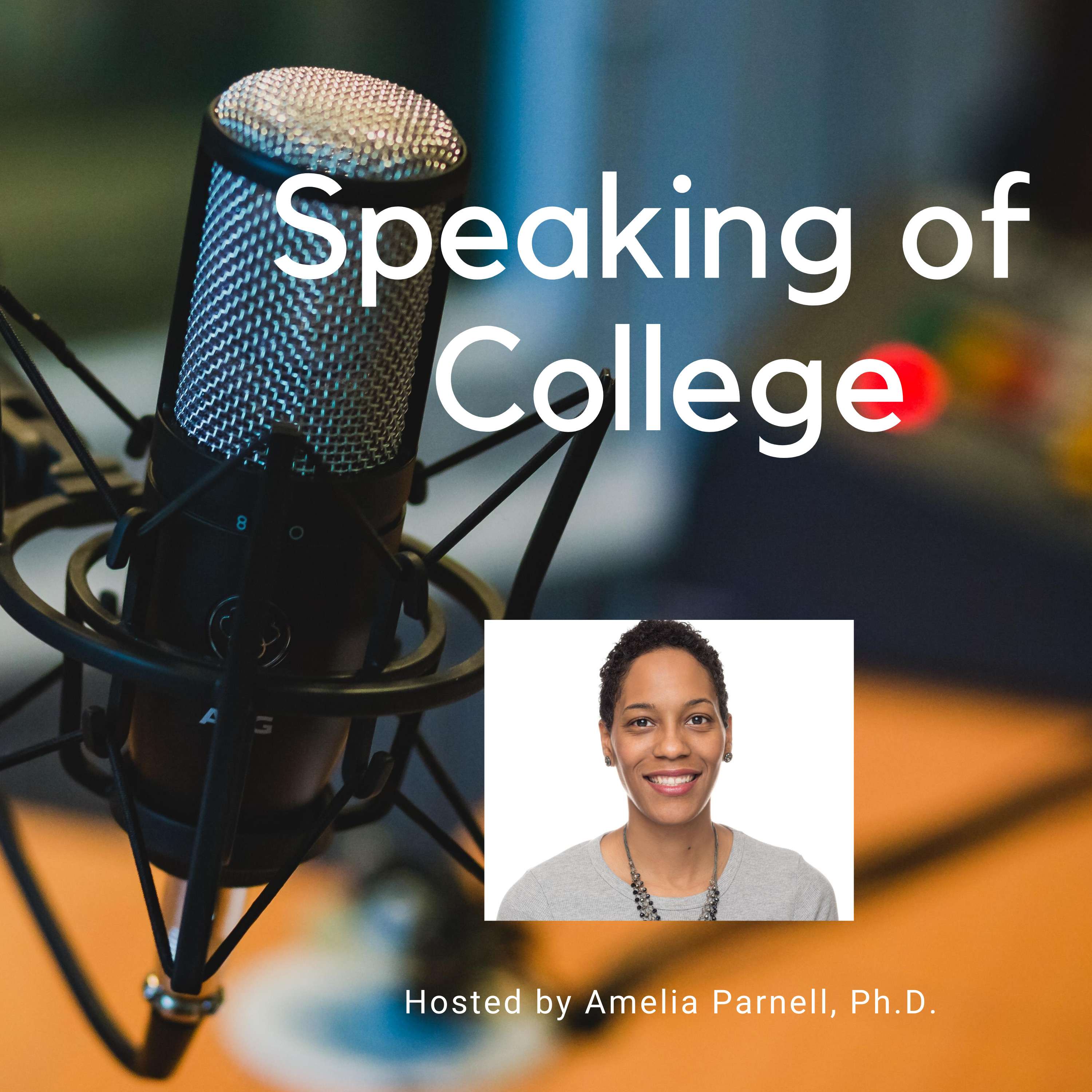
This episode of "Speaking of College" features host Amelia Parnell and guest Dr. Christy Ford discussing the fundamentals of online learning. Dr. Ford clarifies key terminology, explaining that online learning involves virtual classrooms via platforms like Zoom, while hybrid models blend in-person and online components. She distinguishes synchronous (real-time) from asynchronous (self-paced) formats and notes that pandemic-era emergency remote teaching differs from intentionally designed online education. Benefits highlighted include flexibility for students managing work or family, exposure to international peers, and enhanced accessibility for those with disabilities. Dr. Ford emphasizes that success requires reliable technology, institutional resources, and disciplined time management, debunking myths that online courses are inherently easier or less engaging. She advises students to actively build community through orientation sessions, discussion forums, and study groups to counter potential isolation. The conversation underscores that with proper design and support, online learning can be a rigorous and enriching educational experience.
Welcome to Speaking of College Welcome to Source for Reliable Knowledge Oh yeah, we got Dr. P as your host, as your host We gon' tell you what you need to know, need to know The more you know, the more you grow The more you know, the more you grow Get more knowledge, knowledge Welcome to Speaking of College, Speaking of College Welcome to Speaking of College, your source for reliable answers to college-related questions I'm your host, Amelia Parnell, and today's episode is about online learning Now I know many of us have heard of online learning, but if you're wondering about how it actually works and what to do to be successful in an online learning environment this episode is for you and I have the perfect guest, Dr. Christy Ford Dr. Ford serves as the Vice President of Academic Affairs at D2L, a global learning company She brings more than two decades of cumulative experience in higher education, secondary education, project management, program evaluation, training, and student services to her role She offers thought leadership and direction to the Academic Affairs Unit of the organization and her previous roles have allowed her to impact education from secondary and higher education settings, as well as on the international landscape Her reach has allowed her to focus on building online education in the United States and African continent Dr. Ford was selected by the online learning consortium as the 2022 OLC Fellow, which is the highest professional distinction offered by the association She's a tireless advocate for quality online education, where she has leveraged her passion and expertise in the many realms in the education space She is known for utilizing her leadership in extraordinary ways to help institutions build capacity to launch and expand online programming through effective faculty development, instructional design, and pedagogical practices Dr. Ford holds a PhD in Educational Leadership from the University of Missouri, Columbia, and undergraduate and graduate degrees in the field of psychology from Hampton University and the University of Baltimore respectively Christy, welcome to the show Thanks so much for having me really glad to be with you today I'm looking forward to this, and so, with season 4, I've been trying to break into some topics that I think we all feel like are relevant these days And for many reasons, at the top of it probably because we are still enduring the last remits of the pandemic, and because many of us have endured some type of shifts to a virtual environment I thought this would be a good time for us to talk about the basics of online learning for those who are maybe not quite sure if it's for them So the whole purpose of this conversation is for us to learn the basics and to get some tips from the experts about how we can actually do this in a really meaningful way And so, I want to first start with the question that I ask all of my guests, and so I see that you are wearing a Hampton pullover, I have on my beloved fan view And I feel like the answer to your question is going to be what I feel like is going to be the origin story So tell us a little bit about where you got your start in college, and what were some of the factors that influenced your decision to go there Absolutely, I would love to tell you about the real HU How I journeyed into being a student there, and funny story, actually 20 years later than worked there, but that's all a whole other podcast But, you know, as I thought about this question as you're asking me, I really wanted to think about the importance of listeners to understand the importance of the logging And really thinking about finding and seeing yourself wherever you end up, whatever institution that you decide to start your college career And for me, growing up in Texas, outside of Dallas in a small town, I was the student who was in all the honors and AP classes And really enjoyed learning, but when I looked around at my classmates, I oftentimes didn't see people who looked like me And I remember going to Hampton, a 10th grade year, my mother taking me to visit the college, and just I just remember having this side of my leaf Like, this is where I'm supposed to be, like I felt at home, I felt encouraged to be black, to be smart, to be accepted, to want to excel And quite honestly, during high school, that was a challenge for me, I did have some street curators from running track and doing extracurricular like that But it really was such a disconnect in terms of where I saw myself represented in terms of academic excellence And so, you always have to find a place where you can call home, and so that's how I ended up in Hampton That's awesome, so I knew a little bit already that you were from Texas And I would say the same time you were in Texas, I was in Florida going through a similar experience, and I was a 10th grader when we took our trip to Famu and I stepped on the campus and was not the same Because I just couldn't believe all of the exhibits and rich history of the campus, and I wasn't even a student there yet And it changed me, and I said, this reminds me of a different world, the TV shows that I love so much, but it also reminded me that there were big options out there And I chose Famu and this commercial for Famu and Hampton brought to you by speaking of college, but what I didn't know is that you returned to go work at Hampton, and we have that in common as well Because I ended up going back to work at Famu earlier in my career, I tell you, if we had a checklist of things that we have in common, Christy, we're getting up there Now I go, say, are you sure you all too to plan this stage that way? But it was a spectacular moment, and part of the reason why I created the show is because I really do want to highlight college is something that can be fun and exciting and challenging, and I opening in a lot of ways, and so I still believe it's worth it And so as we have more to talk about, I get to bring on really special guests like you So today's episode, as I mentioned, is about online learning, but before we get into all the specifics about how to make it a meaningful experience, let's just start with the basics I'm saying online learning, but what is online learning and comparison to virtual learning or hybrid learning? And are there any other terms that we should know about? Yeah, that's a great question. I think that as educators, sometimes we do a terrible job of really orienting students to what they're walking into, and what all these different terms mean. And so as you hear the term online learning, it is also a term that could be used in your change with distance education, that can also be in your change with e-learning. And so in all of those examples, students are embarking upon a college journey or taking college classes. Instead of walking into a classroom and seeing a whiteboard and assembly of chairs, they are working into a virtual classroom using technologies. They're using a platform. I'm using something like zoom to be able to facilitate some of that learning. I'd also like to bring up a couple of additional terms. You may also hear the term hybrid learning or blended learning. And those are a really nice mashup. You will find that students who are taking linear hybrid courses have some parts of the classes that are in face to face and some parts of the class work that is online. They may meet week five, seven, and ten in person, the other weeks they meet online. And so it's a nice mixture of face to face and online support. The last thing I wanted to share with your guests is sometimes you'll hear synchronous versus asynchronous. And so when you hear the term asynchronous, I want you to think about a way. So the synchronous is the methodology or the way in which we talk about teaching that does not require you to join at a specific time in place. And I won't forgive working with the young man from Donna who was signing up for his first online course. It came to me. So I don't know where to go to show up for this class. And so we had to have some orientation around. It's asynchronous. As long as you're walking in, you're looking at your deadlines, that is not required. Now synchronous will mean that it could be that your professor says to you, hey, it's important that we were going to meet once every three weeks by Zoom at four o'clock on Tuesdays. That means you're coming together synchronously at the same time in place, you're virtual, but you're coming together in that same time in space. So I think those things are important. And the last thing I will say to share with your guests is as we think about the impact of the pandemic. Many people have experienced some version of using technology, but quite honestly, a lot of that technology was used to create. We call emergency remote teaching. We don't have a pandemic for two weeks. It lasted two years. We had to quickly move content online. And so if that has been your only experience with the environment, that's not true online education. It's not true hybrid learning. And so I really challenge your listeners to really think about those experiences and those different types of terms and how they're used in terms of colleges. Absolutely. Thank you for the basics. There are a lot of terms, but I'm hopeful that the listeners now are saying, okay, now that I understand the basics, tell me a little bit more. So what are some reasons why somebody would consider actually taking an online class or a whole curriculum online? Yeah, there are a lot of reasons I hear from students. I'm very blessed to have the opportunity to still spend time and speak to students and state, speak with administrators. But one of the major things that I hear from students is flexibility. And they're caring for children and child care issue and our aging parents. You know, they're working a job that have certain shifts and they're not able to make it to class on Monday, Wednesday, Friday, September 10, 10, 10, 50. So the flexibility that online provides is that you still can get that intro and sociology class as you need, right? You still are able to meet your requirements to be able to continue to move on and matriculate to your degree. The second thing is exposure. I've really been blessed to be able to see groups of communities come together that are from all across the globe because they're taking an online class. So I've talked with students who are taking classes with students in the UK or in other parts of the world. And they're all coming together around this common purpose. This course was around community development and how to think about activism and community development work and really what do you need to do. And so the exposure and the experiences you get in an online course from not just thinking about someone from your own sphere influence from, you know, your own state or your own country is really key. And then the last thing I think that is the reason I can share my story if we have time is access. I started on online education as a leader and practitioner because I used to work with young folks who had high functioning autism for Esper syndrome. And the online environment allowed them to modulate and create support for the disabilities. I was doing a focus group this summer with a young man that had ADHD and he said before the pandemic, he'd never taken an online class. But what he loved about the online experience that I watched his eyes just light up is he said, I could modulate. I could create the supports I needed for my disability and still be successful. And so flexibility, exposure access, there are a lot of great benefits that students are finding to be able to continue their college degree and continually retriculating given life circumstances because you and I know what happens. Life happens, life is happening. I know exactly what you mean. And I totally agree about all the points you just made and on a very, very microscopic level. I'm still currently an online learner because I take Spanish lessons every week and my instructor is in Venezuela. And so all of which you just described feels like it happens for me. We talk about all different types of things related to culture and a lot of different aspects of just where we live and what we're experiencing on a daily basis. So my next question is if we're thinking online learning, I can think of two things we probably do need to have access to. You probably a computer or some type of device like an iPad or a mobile device and the internet. But what else does one really need to be considering before they decide to dive into an online learning experience. So it depends on I think you need to do a little bit of homework in terms of your college or your institution and what kinds of support are available. So when you think about, you know, you're right, you need technology, a laptop, you need to be able to understand what is available from what you're coming to the table with. But a lot of the institutions have support. So seek out that support from the college, understand what the online orientation experiences like. How do you think about going through and understanding time management. I think there's a common myth to people that online is easy. And I'm here to tell you as a faculty member and as someone who's also taking online courses online can be quite rigorous. And so it's really important to come prepared to think about this economic and this educational endeavor as you want any other class. So making sure you provide the time and space and opportunity to be prepared to be a part of the class. And so I think that as I think about those pieces, those kinds of things you need to think about internet connection, laptop are just the basics. But once you have those, what do you then need to be successful? I have a lot of other things to say about that, but I'll stop there and. Okay, well, that's a perfect segue before our last question before the break and it was going to be can you share some common misconceptions about online learning. So we got one of them, which is that some might think that taking a course or whole curriculum online is easy, but are there other common misconceptions. There are I think that there is a misconception given the pandemic of what online really is. And so if you really know well intentioned and well designed, if people take time to care, there's a whole industry professionals who take time and care to do this right. That online doesn't have to be dry and stale, it doesn't have to just all be text. And so as you think about online, it can be dynamic, it can be engaging, you talked about taking Spanish classes, it can be powerful. The ways in which online can really speak to anything a student wants to learn is limitless. But I think sometimes it gets a bad rap for being easy for being stale for being only text heavy. But when the professionals who are out here doing this work really well, it can be a really dynamic opportunity using other technology virtual realities. I mean, it can really be immersive. And so it really is going to be important to go into those opportunities with just open eyes and eliminating some of those assumptions because it can really be a powerful opportunity to connect. I couldn't agree more. I think you've covered probably the biggest misconception because some would think well, if you're not physically in front of an instructor, you have opportunities to maybe goof off a little bit or maybe the rigour is not there. I couldn't disagree with that more. Some of the hardest learning that I have done has been in an online setting. So this is a wonderful first half of the show. Listeners know that we usually go to a break and when we come back, we get to the ask the expert set of questions where we go a little bit deeper into some of the advice you'd offer for someone on the topic. So we'll go to the break and we come back. We're going to ask Dr. Ford some harder questions. We use data to make decisions every day, whether we're checking the weather, managing our budget, or planning a project. Sometimes it's easy to know which information you need and how to use it. While at other times, it's nice to share and analyze your data with a friend. I love data conversations and I want those discussions to be more accessible and beneficial to everyone. So I wrote a book and it's called You Are a Data Person, strategies for using analytics on campus. In the book, I explain why I think we all have a data identity that includes six core abilities that we all possess to some degree. I wrote this book to encourage all of us to leverage our strengths and make some of our most critical data informed decisions together. If you want to learn more, my new book, You Are a Data Person, is available on Amazon and all other major book outlets. Alright, Kristie, are you ready for the Ask the Experts to the questions? Love it. Love it. Okay, so I got to ask something that I think might be on everybody's minds. And so we talked about the benefits of being able to connect with people across the globe if you're doing something virtual. But for those individuals who say, even if I'm connecting with them, I'm still connecting with them from home and it feels a bit isolating. So for some who say, I need that in person interaction more frequently in order to feel comfortable in a class setting, what advice do you have for how to build community in an online setting so that those who are learning online can feel the richness of what we kind of just described with our Hampton and Famous experiences. Yeah, great question. And I think this is important, right? Because we are more than just these computer screens right there are individuals behind these screens. And we spend a lot of time as professionals and online thinking about how to be humanized and experience and how to create communities. And so there's small things that you can do. I think it's really determining what other support to available to your college. So for instance, a lot of colleges will do online orientation sessions. They will create online opportunities through student affairs. And so it's really about seeking out those communities, but even if you're just going to start with your class and you're going to start with your instructor. I've talked to students who've created a WhatsApp group again because they're dealing with international students to be able to have a touch point. Hey, did you know, did you get the study exam for that quiz next week or find ways to really connect with folks. The very first week of class is the very best time to connect because one of the things that most instructors do is ask you to introduce yourself. So one of the things that I asked my students to do is to be able to look at some of those discussion threads and find out, okay, so you're from Texas, I'm from Texas. Or you love animals and I did too like five points of commonality and then reach out, start talking to folks, start making those kind of connections in the classroom. And what I found is those students that I've known come back and taken to the classes from me was say, you know that first class I took with you, I'm in a study group partner that I we've now taken a couple of classes together because now it's been a support. And so I think it's important for you to be proactive and to really understand what is available at your institution to support your journey creating that community for yourself. Great. I think my last or next to last set of questions might be coupled together because this is really more like a just asked doctor for some of the just tips that would be essential to get started today. So we're talking about learning environment, of course, if those watching online would see that we're, you know, both talking from home and we try to do our best to make sure the lighting is okay and that the sound quality is okay for those who are new to this and maybe don't know that much about lighting and sound and things of that sort. First question is, do you have any easy tips that you could offer? And the second is if someone's already in an online class and they're looking for that type of support that you're just mentioned from the campus, where can they go? How can they get that kind of help? So I think in terms of the support, I mean, we've come a long way from dial up and having to carry those heavy computers right there didn't have a webcam installed. And so for many of the folks that I work with, it's about thinking about where you can go to get support. So every college has a help desk. Every college hasn't helped us. So for instance, I work at D to L and our institutions have a bright space help desk. So students can go, they can ask questions about locking in or submitting assignments. They're also places you can go see videos. I even find students that come, they go to YouTube. They type in, you know, bright space or, you know, whatever their institution's name is and they go to YouTube to find out more information. So they take it upon themselves. The other thing I would say is that every college is different. So a lot of colleges also offer support. Think about when you're writing that paper, you know, in person, you would go to campus, you go to the final library and you get that little piece of paper out and right down, you go and find where that book is. But in the online environment, a lot of institutions have created online support. So you can chat with a librarian to get support. Advising support is key. So as you're thinking about what classes to take online, they could tell you, you know, you probably don't want to take a general Kim class and you're going to take a bio class at the same time. That might not be best in an online environment or you're going to take this biology class is a virtual lab and you need these materials. And so that advisor is going to be your best friend and making sure that you know where to go for. And the last thing I would say is just being able to figure out what your other services are. So tutoring services. A lot of institutions offer free tutoring services. I was talking with a colleague yesterday that talks to me about they're going to start offering chat GPT to all of the students so that access is available for students career services disability support. You know, how do you get help from your instructors? Those are the kinds of things that I've seen in my career that that are helpful for students are being able to be proactive. But I'm just reaching out and saying, Hey, I need help. And you'll be amazed at how many people will show up and be ready to help you. Absolutely. Shout out to those and student services and academic affairs, willing to be available. So I think we could talk for a lot longer about any aspect of this. But I try to keep the episode short enough so people can get through the whole thing without having to come back later. Maybe I'll do a part two later on you mentioned chat GPT all kinds of things we can talk about there. All right. So I ask everybody the same first question, which is how do you get your start. And then I always ask everybody the same last question, which is where we get to put ourselves in the space of helping someone who's about to get their start. So let's pretend that you are preparing a backpack for someone who's going to start college very soon was something that you would put in that backpack and why. So that's a great question and I am going to give you an answer that I whole hardly believe it, but it's not something that's tangible that I can pick up and put in the backpack. I'm going to say resilience and I'm going to say that you and I know that the college experience isn't always easy. But if you think about the college experience like a video game, if you think about when you play a video game and you're going through the runs and you hear that one one wall and the game is over right. You try again, you get up and you try again and what you learn from that is how to do it better, how to do it faster, how to do it smarter. And so every college student that I encounter, I want them to have that kind of resilience. I want you to take each new opportunity and think about that as failing forward. Many people who've been successful, most people who've been successful quite frankly have been successful because they've learned from their mistakes or the mistakes. So as I think about imparting knowledge to my own growth, I have an 18 and 19 year old that are in college, one's in college, one's head and off, or the students that I work with, you have to have that resiliency to really be able to take full advantage of the college experience. And so I put on an arm of resiliency and put that in the backpack. Awesome. I've asked that question every single episode and the answers are always cool. You're not the only one to pick something that's not tangible. So we can totally use that. And now that you mentioned video games, I got to just show my age and ask you, I'm an answer to do you have a favorite video game from now or back in the day. Can I tell you I'm a pinball machine person? Okay. Okay. You play with an actual pinball machine or do you have a convertible? Absolutely. An actual pinball machine. I just I appreciate the tactile sensation and and all of that in terms of video games. I will tell you that what I'm seeing the most success in online education is Minecraft. And the opportunity that Minecraft is helping our students to just open our world and minds as educators to create a new reality. So I think that would be my thing. What about you? Well, you know, first of all, gaming could be a whole nother conversation too. I may bring that for an episode of the show as huge now in college campuses. Mine is actually Tetris back in the day Tetris way back in the day for those who like never heard of Tetris Google it. It was one of my favorite games so much so that when I was in calculus class classmate of mine figured out how to hook up my TI 85. I'm not really telling my age the TI 85 calculator to put Tetris on it. So you had to use the buttons of the calculator to play Tetris and at the same time that I was doing my calculus homework. I was also playing Tetris. So I am that nerd that does that. I'm resilient. Yeah, resilience. Yeah, resilience. I have to tell you I really appreciate you joining me on the show. You have made a very popular topic sound super easy, which is the singular goal I have for the show, which is to provide reliable answers to college related questions and you did just that. So when you're not on podcast and not working at D2L, is there a place where people can find you online email you or follow your thoughts online? Are you do social media of any type? I do I do so Christie Ford. I have a Instagram site. I'm on Twitter, LinkedIn. I really try to stay as engaged as possible professionally and then you know other spaces, you know reach out to me. Christie dot forward at d12 calm is a place you can send me an email would love to be able to engage with students or faculty orient and you know, families, you know, as we're trying to figure out this journey. But yeah, I really appreciate the invite. I was super excited to see I'm passionate about this work. So thank you for the invitation. I am as well the succeeded my expectations for the conversation I knew it would be cool. So I'll put a link to all of those in the show notes and thanks again. Thanks so much. If you have a question about college or an idea for a future episode, I would love to hear from you. Just drop me a note at Amelia as speaking of college dot com. I'll be back with another episode soon and in the meantime, I hope you have an inspiring day.
Podcast Summary
Key Points:
The episode introduces online learning basics, distinguishing it from related terms like virtual, hybrid, synchronous, and asynchronous learning.
Key benefits of online learning include flexibility for balancing responsibilities, exposure to diverse global perspectives, and improved access for students with disabilities.
Success in online learning requires proper technology, institutional support, effective time management, and proactive community-building to overcome isolation.
Common misconceptions are that online learning is easy or stale; well-designed courses can be dynamic, rigorous, and engaging.
Summary:
This episode of "Speaking of College" features host Amelia Parnell and guest Dr. Christy Ford discussing the fundamentals of online learning. Dr.
Ford clarifies key terminology, explaining that online learning involves virtual classrooms via platforms like Zoom, while hybrid models blend in-person and online components. She distinguishes synchronous (real-time) from asynchronous (self-paced) formats and notes that pandemic-era emergency remote teaching differs from intentionally designed online education. Benefits highlighted include flexibility for students managing work or family, exposure to international peers, and enhanced accessibility for those with disabilities.
Dr. Ford emphasizes that success requires reliable technology, institutional resources, and disciplined time management, debunking myths that online courses are inherently easier or less engaging. She advises students to actively build community through orientation sessions, discussion forums, and study groups to counter potential isolation.
The conversation underscores that with proper design and support, online learning can be a rigorous and enriching educational experience.
FAQs
Online learning, also called distance education or e-learning, involves taking classes entirely through virtual platforms without in-person meetings. Hybrid or blended learning combines both online and face-to-face sessions, while terms like synchronous (real-time) and asynchronous (self-paced) describe the timing of class interactions.
Online learning offers flexibility for those balancing work or family, provides exposure to diverse global perspectives, and increases access for students with disabilities or other life circumstances that make traditional attendance challenging.
A common misconception is that online courses are easier or less rigorous than in-person classes. Another is that they are dry or text-heavy; well-designed online courses can be dynamic, engaging, and immersive.
You'll need a reliable computer or device and internet access. Additionally, seek out institutional supports like online orientations, and prepare for success by managing your time effectively, as online courses require discipline and commitment.
Be proactive by introducing yourself early, connecting with classmates through discussion threads or study groups, and utilizing institutional resources like online student affairs events. Creating small networks, such as WhatsApp groups, can also foster support and reduce feelings of isolation.
Research the institution's support services, understand the course format (synchronous vs. asynchronous), and assess your own readiness for self-directed learning. Ensure you have the necessary technology and a dedicated space to study effectively.
Chat with AI
Loading...
Pro features
Go deeper with this episode
Unlock creator-grade tools that turn any transcript into show notes and subtitle files.
 PodcastTranscript AI