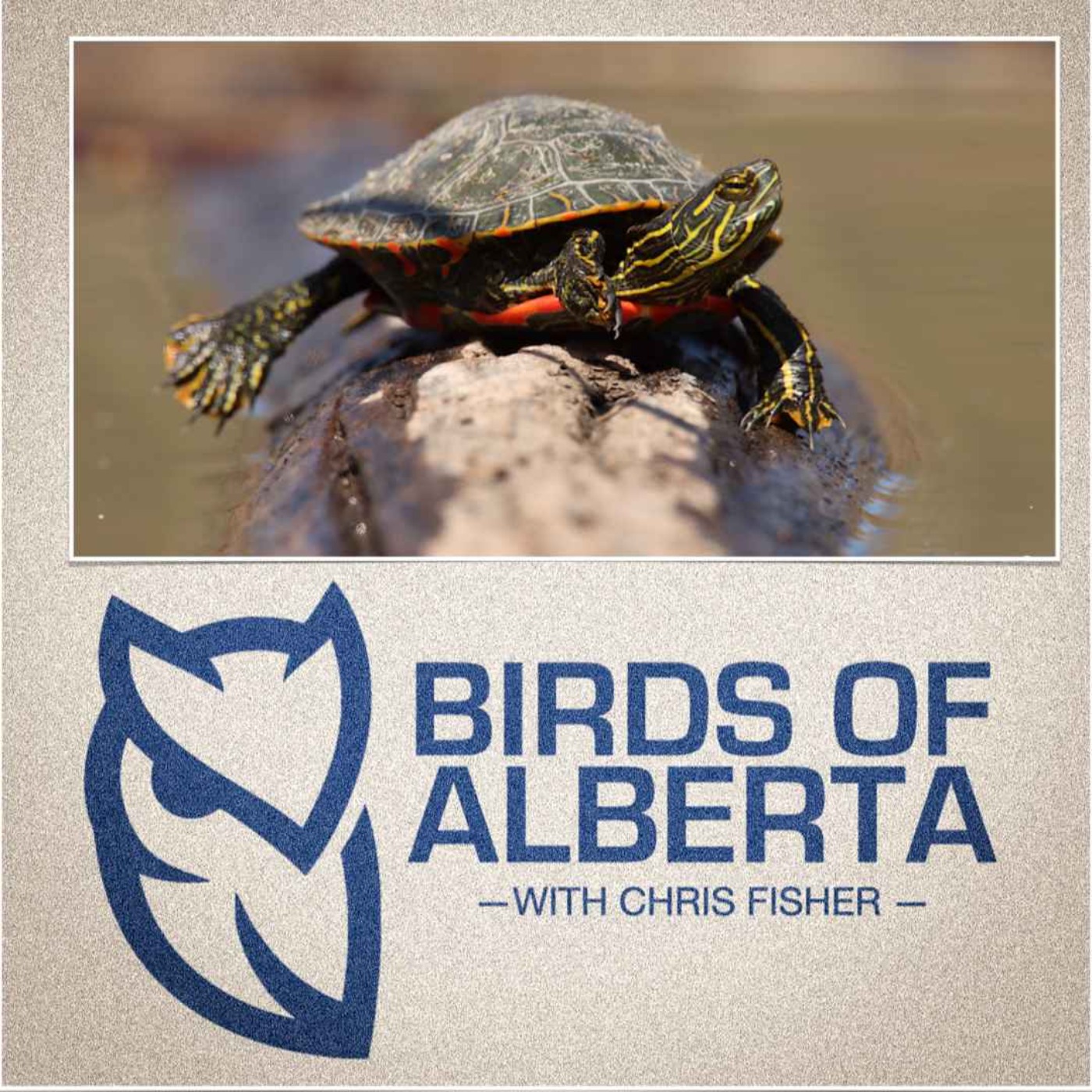
This podcast episode explores the history and status of western painted turtles in Alberta. The species is native only to the Milk River drainage in the southeast, a corridor that allowed migration from Montana after the last ice age. The host recounts a 1992 canoe trip where he observed two wild turtles in a remote oxbow near the U.S. border—a rare sighting due to the area's inaccessibility. In contrast, non-native populations thrive in places like Lethbridge, likely introduced by humans bringing turtles from British Columbia. These introduced turtles now serve as ambassadors for the species, though their long-term survival depends on specific overwintering conditions, such as ponds that do not freeze solid. As Alberta's climate warms, the province may become more hospitable to turtles, with increasing reports of sightings outside their traditional range. However, the native Milk River population remains isolated and rarely seen, symbolizing the delicate balance between natural persistence and human influence in Alberta's ecosystems.
Welcome to the Birds of Alberta podcast. I'm Chris Fisher, co-author of the best-selling field guide, Birds of Alberta. And for this episode, the reptiles and amphibians of Canada. Now hot summer days may be more valued here in Alberta than just about anywhere else on planet after all. In a place that's frozen for most of the year, a few times when the thermostat blows its top off, well they're rightly viewed as a precious rarity. Now of course this always hasn't been like this, but it's been a long, long time since the paleocene like 65 million years ago. When these very lands baked day after day under an equatorial sun, it was a completely different time of course, where dinosaurs, lizards, snakes, and turtles. Well they dominated landscape, unrecognizable to us now, except in our fossil real fantasies. So we are now a northern place where few of these reptile relatives can succeed, but for those that do make it here, they have a life story of persistence that only adds to their intrigue. But there is one of these sun worshiping actotherms that stands out among all others, as it has a story that is both intimately connected to albordance and distant and unreachable. They are our wild sunbaters, soaking up the rays only in our sunniest and southern most areas and making them our ultimate summer solos. They are of course our western painted turtles. I'm a child of Lutperage Albert, a growing up there in the late 70s and early 80s, well really informed kind of character that I do have and the things that I enjoy doing and talking about, including this very, very podcast. I spent a lot of time in the field surrounding my home collecting insects, so I was a really interested kid in all aspects of our natural world. And my interest was for the peat. One day at school with a classmate Jennifer, I remember bringing in a turtle shell and she said that she collected it in and around her home in Lutperage. And I had never seen a turtle up that point, but myself like so many people are always very intrigued with those particular animals, how many little statuettes and collectibles do people have in their homes of turtles, common, just about anywhere you go. Well years later, while I was continuing to develop my interest in the natural world, one of my favorite things was to dip for water bugs in Henderson Lake. Why you suspend a lot of summer afternoons with several of my friends and I remember one afternoon in particular when one of my friends, John Comets, well he caught a real life painted turtle with his wonderfully designed dip net. And I remember that evening, he brought it home along with a whole bunch of other backsoomers and boatmen and Wurligig beetles and he brought it home and he put it in a steel wire. So wash basin for the evening. And I remember as the sun went down, we spent time just watching this turtle and it wasn't very happy scratching at the vertical walls and apparently it did so all night long and probably annoyed John's parents so that the very next day, well John and I headed back with the turtle back to Henderson Lake and we set it free in the very same place that we caught it less than 24 hours earlier. But for several years, we spent a lot of time at Henderson Lake and never saw another painted turtle despite our efforts in collecting bugs. I remember years later hearing of stories of painted turtles nesting, digging nests in the sand bunkers of the golf course there on the south side of Henderson Lake. And I suppose I kind of wishfully think that that was the very same turtle that John caught many many years ago and maybe somewhere in Alberta, he's sharing those thoughts as well. Now while I didn't know it at the time, the truth of the matter is that the actual western painted turtle natural distribution in the province of Alberta is very very restricted. Naturally only occurring in what is known as the milk river distribution in Alberta. Milk river is that tiny little river that comes up actually from Montana. Curls north of the border through the town of Milk River famously by writing on stone provincial park and then not too far after that. It dips back into the United States and forever disappears and the water is merging with the Missouri River, ultimately the Mississippi River, draining all the way down to Bayou Country and Louisiana, those areas very very rich in turtles. So this serves as a turtle highway, a turtle distribution network. And you can think when the final glaciers last receded, these waters were flowing vigorously and these were the corridor in which painted turtles made their way north into the province of Alberta, not only occupying areas of the milk river but all the available creeks that feed into this drainage, which there are not many of. Just a small few select creeks, including those that drain the Cypress Hills. So for this reason, these are the areas that have been famously known to host painted turtles in the province. It is for this very reason, the mythical presence of western painted turtles found in few isolated areas in the most isolated corner of southeast Alberta, that in the summer of 1992, a great adventure was planned to canoe this remote stretch of the milk river and I was joined by Mike Quinn, Dr. Mike Quinn, who is now at my Royal University in Alex Drummond, who has been in the Department of Irrigable Resources for some 30 odd years, both legendary educators in their respective fields. And my graduate supervisor, Dr. Jim Butler, we all organized a trip in 1992 down to this area of the province. And Mike Quinn had been there previously, so he served as a great leader for this adventure. Unfortunately, Dr. Butler had to drop out because of mechanical difficulties with his vehicle at the time. But the three of us, close to the same age, developed a great plan and the plan involved putting in at the legendary Pinhorn Grazing Reserve, which is one of the few public accesses, to the milk river. And this is downstream of writing on Stope provincial park in the Aiden crossing. Actually, one of the last public areas that you can put a canoe into the milk river before you get into the United States. But that area of the milk between the Pinhorn and the United States boundary passes through the milk river Canyon, really inaccessible because it was a private land ownership that aren't particularly interested in a whole bunch of canoeists cross over their land. So very, very challenging to get in or out except for out the Pinhorn. So we spent a few days canoeing down and Mike had identified some key areas, not only for painted turtles, but obviously for things like rattlesnakes and even potentially lizards and yucca and all these very foreign species that occur only in this area of southern Alberta. And it was a couple of days in when we were nearing the American border that we pulled our canoes off to the south side of the river. And their hidden behind a bank of Willows was a oxbow. An oxbow so close to the U.S. border that the southern tip of the oxbow extended into the United States. Now, an oxbow is an area of a river, a river channel essentially that has been cut off. These old meandering prairie rivers, zig and zag and twist and flood and their courses change continually over their lives. So there's all these abandoned little U-shaped bends that remained filled with water and they're just the perfect habitat for what we were looking for. And as we parted the branches of the Willows that were rimming around this oxbow, they're on a massive cottonwood that had been fallen over by the winds of southern Alberta years previously. We're two, two painted turtles. One large one, one small one, I took out my crappy camera and shot off a couple of images and those images remain. of this and we're most
significant images that I ever captured on slide film because they represented a wild western painted turtles in Alberta even though as my Quinn rightly pointed out at the time they no doubt had duelses in ship as they were able to cross into the United States freely whenever they wanted to. Well those were the only two painted turtles that we saw anywhere on our voyage and I suspect very few people have had a chance to revisit that or other oxbows in this part of the world simply for the reason that after 9/11 there's no way one can canoe into the United States of America anymore we were able to do so and take out at the gray tech ranch and actually had permission from the US customs officials in order to do that way back in 92 but yes it's 9/11 you would not be able to do that anymore so now these turtle populations if they start persists are rarely if ever visited by any eyes so it's very fortunate indeed that we took the opportunity of doing it at that time fortunately these weren't the only native populations I spent a lot of time in that southeast corner and while there's not a lot of water in these areas every time you pass by some impounded water boy I I give it a once or twice or thrice look over four turtles and about 25 years ago right around year 2000 on minibaries creek very close to the town of minibaries there was a little bit of water on that creek and a deep pool and their sunning itself was another painted turtle that I recorded at that point in time a few years later while looking for northern leopard frogs and research lake in the Cypress Hills probably the second largest lake kind of on the plateau of the Cypress Hills there I saw another painted turtle and although I've revisited areas of minibaries creek and even resource lake over the decades since those observations I've come up empty every other time I've gone down search the areas of the remote parts of southeast Alberta for painted turtles but here's the thing these weren't the only painted turtles western painted turtles that I have seen in Alberta over the last 20 years in fact I've made frequent visits as as many Albertans to my hometown of leftbridge and that is the hotspot for painted turtles and quite right anyone couldn't go to the Elizabeth Hall wetlands right down under the shadow of the great train bridge there in leftbridge adjacent to the the old man river or even off to west leftbridge by the university there's a park called Nicholas Sheridan Park and there's a pond in there that also has western painted turtles and these are the most famous painted turtle places in all of Alberta my friend Ken Oghrich a leftbridge naturalist has counted over 100 individuals painted turtles in the Elizabeth Hall wetlands and there's no doubt that they're in fact reproducing and overwintering very very successfully there's also a nice another population at Lee Lake Lee Lake is right as you are leaving the crow's nest pass to the west there's a road that turns down to Bove Lake and one of the very first lakes you get to within five minutes of leaving the crow's nest highway there is Lee Lake and there's a small population of painted turtles at that location as well and while these populations are no doubt the most famous populations for painted turtles in the province of Alberta I and most other wildlife biologists concluded years ago that these are in fact aren't native of course they are found in the old man river drainage and if you were to follow the old man river to where it meets the ocean it does not meet the ocean Louisiana it actually meets in Churchill man a Tobin the Hudson's Bay and that's a great place for polar bears allows a place for painted turtles so there's no way that painted turtles could have ascended those river systems or crossed the great distances that golf the the milkerver drainage and into the old man drainage so they must have had some help indeed it's pretty obvious what has happened over the years for there is a lot of native occurring western painted turtles just across the border just outside of Fernie you round this other tip of that initial mountain chain you get into the Columbia River system where so many people from southern Alberta go camping and recreating during the summer months and every one of those small lakes has western painted turtles all the way from Lake Cucanusa to to kick them in creek provincial park where I spent a lot of time in fact camping growing up in Lethbridge all the way up for Invermier all these little parks have an abundance of western painted turtles and there is no doubt in my mind that little boys and girls caught an abundant number of western painted turtles just like my buddy John Cominston and regrettably after a couple of days in their possessions and returning to the province well they were forced to release them either in Lee Lake the very first conspicuous lake where these turtles could survive in the province or making it all away into Lethbridge and releasing them in places like Henderson Lake and more prominently in Elizabeth Hall wetlands and Nicholas Sheridan Park no matter the the source of these western painted turtles they do contribute in a very intriguing way to the natural history of Alberta which is of course a changing place and and those changes maybe making the province more of a turtle friendly place than it has been for quite frankly tens of millions of years it is of course getting hotter in the province and there's no way around a turtles need things to be hot for them to survive now even in the winter the ponds that they live in really cannot freeze solid all the way to the bottom there needs to be like a Goldilocks layer of cold water down there that's cold enough to slow down their metabolism and also have sufficient dissolved oxygen for them to remain kind of in a partial coma for these winter months these painted turtles are in a state where they're not breathing air nor are they eating and and while their natural dispersal capacity is very limited due to the geography of Alberta particularly since the lice ice age we are seeing more and more of them turn up all the time likely the results of more introductions both of release pets and kidnap turtles from southeast BC so it's really not much of a surprise that every year or so we have reports of turtles being spotted well outside of their known range in the deep south including those in the fridge stormwater ponds and Calgary right dear Edmonton well they've all have reports of turtles in recent years and sometimes these individuals continue to be seen for several months at a time but so far none of these release locations have had exactly the secret sauce as the ponds do in lethbridge for overwintering success yet still when I think of turtles on Alberta I just can't help but think back to that remote oxbow on the milk river that we visited almost 30 years ago in the two painted turtles that were sunning on that old cotton wood log you know they used to be alive and sunning on that log to this day or perhaps not occasionally I do talk to people interested in surveying this ultra remote area and checking out things and the status of the milk river turtles I'd like to think that a few continue to make it quite living where they have since the problems begin ice-free tens of thousands of years of normal and they continue living in near complete isolation from the eyes of Albertans but also an isolation from the growing number of introduced turtles which now may be serving as the biggest ambassadors to the originalists there is no doubt that for each of our painted turtles that persists in this province at the each contribute to the story of a species just making it over the cusp of survival and contributing to the legendary endurance of the turtles of Alberta
Podcast Summary
Key Points:
The western painted turtle has a very limited native range in Alberta, primarily in the Milk River drainage, which historically allowed migration from the U.S.
Non-native populations exist in places like Lethbridge, likely due to human introduction from British Columbia, where the species is abundant.
Turtles require specific thermal conditions to survive, including unfrozen winter habitats, which may become more viable as Alberta's climate warms.
The narrator shares personal experiences, including a significant sighting in a remote Milk River oxbow in 1992, highlighting the species' rarity and isolation.
Ongoing reports of turtles outside their known range suggest both accidental and intentional releases, though long-term survival remains uncertain without suitable overwintering sites.
Summary:
This podcast episode explores the history and status of western painted turtles in Alberta. The species is native only to the Milk River drainage in the southeast, a corridor that allowed migration from Montana after the last ice age. S.
border—a rare sighting due to the area's inaccessibility. In contrast, non-native populations thrive in places like Lethbridge, likely introduced by humans bringing turtles from British Columbia. These introduced turtles now serve as ambassadors for the species, though their long-term survival depends on specific overwintering conditions, such as ponds that do not freeze solid.
As Alberta's climate warms, the province may become more hospitable to turtles, with increasing reports of sightings outside their traditional range. However, the native Milk River population remains isolated and rarely seen, symbolizing the delicate balance between natural persistence and human influence in Alberta's ecosystems.
FAQs
Naturally, they are very restricted, occurring only in the Milk River drainage in southeastern Alberta, which includes the Milk River itself and a few creeks feeding into it, such as those draining the Cypress Hills.
They likely migrated north via the Milk River drainage after the last glaciers receded, using it as a 'turtle highway' to enter the province from the United States.
Yes, introduced populations exist in places like Lethbridge (e.g., Elizabeth Hall Wetlands, Nicholas Sheridan Park) and Lee Lake, likely from released pets or turtles brought from British Columbia.
They require warm temperatures to survive and ponds that do not freeze solid in winter, needing a cold water layer with enough dissolved oxygen for hibernation.
Access is difficult due to private land and border restrictions post-9/11, making it hard to visit or monitor these isolated habitats.
Lethbridge has established populations in wetlands like Elizabeth Hall Wetlands and Nicholas Sheridan Park, where turtles reproduce and overwinter successfully, though these are introduced.
Chat with AI
Loading...
Pro features
Go deeper with this episode
Unlock creator-grade tools that turn any transcript into show notes and subtitle files.
 PodcastTranscript AI