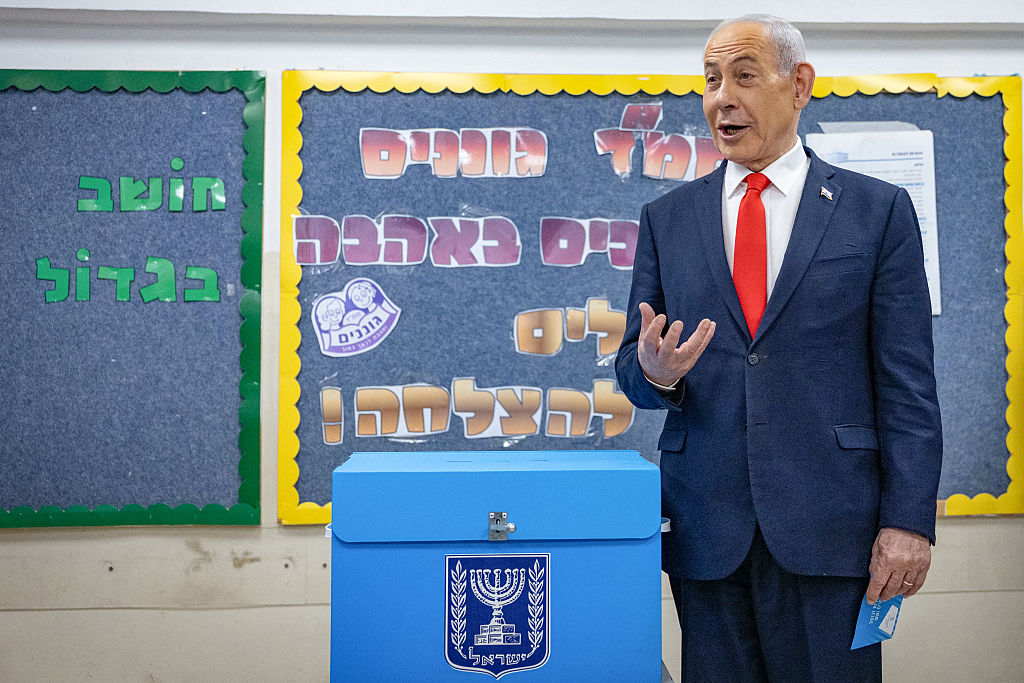
The Israeli election highlights a politically complex landscape where neither major party holds a majority, forcing coalition negotiations to determine governance. Despite the Likud party holding slightly more seats, the absence of a majority means Netanyahu must still negotiate with smaller parties, including Arab factions, to form a government—a process historically seen as both necessary and unstable. The situation is further complicated by U.S. political dynamics, where President Trump’s support for Netanyahu may influence Israel’s political trajectory. In the U.S., late-stage political campaigns are increasingly affected by misinformation, particularly fake polls and AI-generated ads, which exploit voter uncertainty and can sway undecided voters, especially in tight races. These tactics are especially damaging because voters often rely on polls to gauge outcomes, and false information can erode trust and discourage participation. A key religious development is the decision by Highland Park United Methodist Church in Dallas to leave the denomination by a margin of over 90%, driven by concerns over LGBTQ+ policies and theological liberalism. This mirrors a broader trend of conservative congregations exiting mainline denominations, such as the United Methodist Church, where over 7,600 churches have left since 2023. The Highland Park Church’s move—now known as Highland Park Methodist Church—reflects a deepening divide within American Protestantism, where theological issues resurface after decades of dormancy. Ultimately, these developments underscore a recurring challenge for Christian institutions: maintaining doctrinal integrity in the face of cultural and social change, as seen across both Israel and the United States.
It's Wednesday, October 28, 2026. I'm Albert Moeller and this is The Briefing,
a daily analysis of news and events from a Christian worldview. Well, yesterday we saw
one of the most important elections in Israel's history. I think there's no exaggeration about
that, but the outcome is not yet known. Now, some of the numbers basically are known. Going
into election day, it was pretty clear that the political coalition that was connected with
General Gadi Eisenkot, who was the opponent to the incumbent Prime Minister Benjamin Netanyahu,
he had about 52 seats. And when it comes to Prime Minister Netanyahu, he had about
50 seats. That is his own party, the Likud party, and other members of their coalition.
But the Israeli Knesset, the parliament, has 120 seats. So you can do the math. The majority is 61
seats. Well, you can tell already that Netanyahu is the most important member of the coalition.
Well,
neither party has a governing coalition. They don't have a parliamentary majority.
But that's been the norm in Israeli politics. Some form of multi-party block or coalition has
been necessary to come up with a workable government. When it comes to the two parties,
that's the Yashar party of General Eisenkot and the Likud party of Prime Minister Benjamin
Netanyahu, the reality is that it's actually the Likud party with Prime Minister Netanyahu that has
a slight advantage when it comes to seats that will be assigned to the party itself.
Not just to the block and to the larger coalition, but to the party. I'm going to tell you why that's
important. General Eisenkot's party, Yashar, is likely to end up with 22 seats. Prime Minister
Netanyahu's party is likely to end up with 24 seats. And that means that given some parliamentary
precedent in Israel's political tradition, it might be the current prime minister who has the
opportunity to try to form a coalition and thus to remain as Israel's prime minister. That is still a
result. But at least many political observers within Israel think that it's clear thus far that
neither party, neither Likud nor Yashar, is going to end up with a parliamentary majority. Neither
one at the current moment has a workable coalition to get up to 61 seats. The big question is who
will get the opportunity to try to form and put together a coalition that can be a governing
majority in parliament first. And by the way, in Israel, sometimes those efforts fail. And that's
Benjamin Netanyahu, about 19 years plus in that role. He has twice been removed and twice has
found his way back, largely through this kind of maneuver, coming up with a workable bloc,
a governing coalition in Israel. Okay, I want to pause just a moment because sometimes I hear
Americans who get tired of the American two-party system say that it would be better if we had
something of a parliamentary system rather than our constitutional order with a separation of
parties. And there are many Americans who at least sometimes will say, I think we ought to have a
multi-party system. Well, you can say that, but then you ought to look at a situation where there's
an actual multi-party system. And Israel is perhaps one of the most interesting examples here. I think
that most Americans would be extremely frustrated with this kind of coalition-building necessity
built into our national politics. One thing, it means that Election Day doesn't finally resolve
the question almost in every case. There's going to have to be a lot of negotiations thereafter,
and someone's going to have to try to put together a workable majority in the Knesset. Somebody's going
to have to do the negotiations with minor parties. And one of the wild cards here has to do with the
fact that there are at least two parties that are Arab parties. And it might be that one or both of
them ends up on one or the other side when it comes to the attempt to create these coalitions.
It's also clear at this point that the American president, Donald Trump, is really preferring
that Prime Minister Benjamin Netanyahu remain in office.
That doesn't determine issues in terms of Israeli politics, of course, but it could turn out to be
an interesting complication, or let's just say effect upon, influence upon, the eventual shape
of the Israeli government. And that is because of the necessity of Israel maintaining its relationship
with the United States, which, as we know for many reasons, has been sorely tested over the
course of the last few years. But we're going to have to watch the situation in Israel. And by the
way, that situation is not only politically complicated, it's just really important in
light of what's going on in Israel right now. And I think that's something that's going to be
really important. And I think that's something that's going to be really, really important in the
He is evidently leaving or has left Brazil, coming to the United States of America on a visa.
A very similar move was made by his father several years ago. It does tell you something
about the relationship between Flavio Bolsonaro and the Trump administration. It doesn't tell
you everything. We don't know how this is going to turn out. And as of last night,
authorities in Brazil didn't know if Flavio Bolsonaro had left or was about to leave or
trying to leave. Here's the other interesting thing here. One thing to think about, again,
when you compare the relationship between the two, it's not just the relationship between the two,
America's democratic constitutional traditions. Just keep in mind that at least thus far,
no losing American presidential candidate has tried to flee to another country
just about 48 hours after the election was concluded. That's different, but it's currently
in the news. Okay, we're going to watch the situation in Brazil and especially the situation
in Israel because of its importance. But we need to switch back to the United States,
where now in less than a week, we're going to face the 2026
midterm elections. Now, one of the things to keep in mind right now is that most voters
who are going to vote have almost assuredly made up their mind how they're going to vote.
And even if they say they have not, the indications are they probably have. And that leads to a very
interesting observation we've made before. And that is that when you're looking at candidates
at this point in an election, they really can do very little to improve their situation.
But they can do something that would greatly, well, let's just say damage their situation.
And you see that in some cases where breaking news stories affected an election, and usually
to the detriment of a candidate, there's very little that can come in the news that would
make people say, yes, I'm going to change my mind and vote for that candidate. But at
this point, there are still things that can appear in the news that can lead voters to
say, okay, if that's true, I'm not going to vote for that candidate.
A very interesting development has come along in American politics along these lines, and
that is the fact that Americans are being influenced not only by political advertising,
but by political advertising.
That might be basically fake, tied to artificial intelligence.
Now, an interesting development when you think about artificial intelligence and political
campaigns is that you have political candidates and political parties looking at this saying,
this is certainly not a good thing, but we're not exactly how to handle it. We're not exactly
certain what we can do with it. And one thing to think about in this line is that when you get this
late in a campaign, even clarifications or an investigation as to the truth or falsity of some
advertisement or claim, it's pretty hard to come by this late. It's likely the election will come
before some of those questions are definitively answered. But there's another development that
should have our attention, and this is what USA Today is reporting as fake polls that are also
now raising questions. These fake polls are being presented, and sometimes they're just simply made
up. Some kind of authoritative name is attached to the poll, and voters are told, those who
observe the news and are getting this information on social media, by television news,
whatever the source, they're being told, this poll indicates that this is the likely outcome
of the election. Now, here's what's important. Voters, to a greater degree than many of them
want to admit, are influenced by these polls. And that's why the candidates and their parties,
they basically face off in a war of polls. And that's why when you listen to the mainstream
media and academic types, they're generally at pains to say, this is an official poll undertaken
by this firm under these rules with all of these protections and safeguards, a sample of this much
potential distortion level or error level of this much. It's within this kind of range. All that
kind of language is generally used. One of the ways that you should come at least to suspect a
poll or a news report or some kind of media post about a poll is if that information is lacking.
And instead, you just have the name of a poll, and you're told, here is the result.
Now, as USA Today reports, that there is now a very good reason to believe
that it's not official campaigns doing this. That would certainly violate all kinds of rules
and in some cases, laws. But there are all kinds of groups allied with either the Democrats or the
Republicans or against the Democrats or against the Republicans. And they may try this kind of
effort in order to confuse voters at the end. Now, how would it confuse voters? Well, oddly enough,
it is because a certain voter wants to vote with the polls. That's problem number one. But there's
a second problem. It's very different. Certain voters are disincentivized from voting at all
if they hear a poll and think their vote isn't going to make a difference. And that's why,
when you have these false polls and you have the advertisements based upon these false polls,
this can be very damaging to a campaign, particularly at the end stage of a campaign,
an electoral cycle, and particularly when it comes to voters who might not yet have decided,
or at least there could be affected by this kind of report. And let's also face the fact that those
voters really become crucial in extremely tight elections. When you have a wide margin between
the two candidates, well, all of this falls somewhere there in the middle.
But when the election is just razor thin in terms of the margin, this kind of false
false advertising, and perhaps even messaging about fake polls can actually make a difference.
That's why people are trying them, even when they're risking political damage, or in some
cases, potentially lawsuits or even criminal charges. Now, I have to say, the article in USA
Today had one interesting twist I want to share with you. It cited Professor Thad Kuser, who's a
political science professor at the University of California, San Diego. He said that this is a,
quote, newly emerging phenomenon. But then later, the paper tells us this, quote,
Kuser recommended researching a polling organization's record before putting weight
into its latest survey results. The American Association for Public Polling Research provides
a list of organizations that adhere to the group's polling methodology and transparency standards,
end quote. I just want to say that is one of the least practical things I think I've ever heard.
You have a major newspaper telling potential voters that they need to do research on the
polling organization supposedly behind political polls. I just want to step out and say I think
very few voters, if any, will ever do that.
And that just underlines the scale of the problem. It's also interesting that the article
cites a 32-year-old woman who heard about the recent fake news polls and, quote, said it
reinforced her skepticism of election surveys, end quote. That's one of those statements you see
in an article about politics, and it's something which comes down basically to filler. And that is
because if you ask a person, are you concerned about this? The answer is they're almost always
going to say, I'm concerned about this. That assumes they know about this. And if they know
about it because you told them about it before you ask if they care about it, well, don't be surprised
when now that they know about it, they say they care about it when you know where I'm headed with
this. They actually don't care about it. Next, we want to shift to a big story of religious
importance here in the United States of America, and that is the fact that on Sunday and Monday,
by membership, the largest United Methodist Church in the country voted to leave the denomination.
The margin was something.
Slightly over 90%. It was absolutely huge. We're talking about the church that has been known as
Highland Park United Methodist Church in one of the wealthiest, most powerful neighborhoods in
Dallas, Texas. That church, as I said, has had the largest recorded membership of any United
Methodist congregation in the United States. It is by attendance often ranked second. But you look
at this and you recognize this isn't just any Methodist church. This is a church that was
established on the campus of Southern Methodist University. It's a church more than 100 years
old. It's a church that was established on the campus of Southern Methodist University. The current pastor of the church, by the way, told the congregation
that if the congregation voted, as it did overwhelmingly, to separate from the United
Methodist Church, that it would revert to the name that is still engraved on the building as they go
in, Highland Park Methodist Church. And so that is how the church now refers to itself. And it turns
out that there's been a history to this. Going back more than two years, attorneys and leaders
at the church have been working on a transition plan. They were also armed with a legal background
of unfolding law and judicial decisions there in the state of Texas. All that turns out to be
important. And so the leaders had actually informed the annual conference, which is the
region there. And for that matter, the bishop, they had informed him that they were working
through these legal changes. But evidently, it turns out that the bishop and his leadership
really didn't pay much attention to it until they found out that what was at stake was the fact that
the church was claiming a right to leave the United Methodist Church and even immediately was going to
leave the church itself just as a Methodist church, Highland Park Methodist Church.
Now, just about everyone looking at this believes that in the background to this is the radicalization
of the United Methodist Church and its lurch to the left. And that's been going on for a matter
of decades, but it made a major lurch to the left in its most recent annual conference because it
was then with the conservatives, we'll talk about this, thousands of conservative churches leaving,
all of a sudden the liberals can move ahead and just normalize LGBTQ activities, gay clergy,
gay commitment services, same-sex marriages, and all the rest. You see the United Methodist Church
that have been marching to the left, once it lost those thousands of conservative churches,
it went full speed to the left, and it didn't waste any time. It appears that the leadership
there at Highland Park Methodist Church, then Highland Park United Methodist Church,
they must have had concerns about this for some time because they've been at the paperwork for
some time. The local Methodist bishop basically just filed suit against the church, and the
church then claimed that legal action, threatening their own integrity as a congregation. They then
claimed the right to hold this vote. They held it. And by the way, it was pretty spectacular in
terms of the turnout and the vote. All that was required was a bare true minimum, but what happened
is, as I said, over 90%. So let's just say that's overwhelming. Ruth Graham, reporting for the New
York Times in Dallas, stated it this way, quote, one of the largest and wealthiest United Methodist
congregations in America voted over 90% of the vote. That's overwhelming. That's overwhelming.
Overwhelmingly on Monday to leave the denomination, it was a blow to the United Methodists who've seen
an exodus of thousands of congregations in recent years. The leadership of the church said, quote,
this was not an easy decision. We know it has not been made lightly. For many of us, they said,
it is a painful, difficult, and emotional decision. But they also added, for others,
the decision was straightforward. And straightforward, I think, is something
of an understatement when more than 90% of the voting church members voted to leave. Okay, there's a
very interesting historical background here. Let's just go back to the 18th century. How's that? Let's
go back to the 1700s. That is when John Wesley, along with his brother Charles Wesley, formed
what was known as a holy club or a series of holy clubs. They began at Oxford University,
and George Whitefield also famously became involved in this movement. Eventually,
not by the choice of John Wesley, it would be named for him. It would be called the Wesleyan
movement. And eventually, those who were involved in these holy clubs would become known as
Methodists. And this was because it was those who observed them who called them Methodists because
of their methodical form of devotion. Like the Baptists didn't name themselves Baptists, but
people started calling them Baptists because of a distinctive practice of baptism. That's how we got
that name. When it comes to the Methodists, again, they didn't decide to call themselves that, but
they were called that. So guess what? They just went with it. In 1735, both Wesleys came to the
United States. They were in the area of what is now Savannah, Georgia. And of course, that was
America. It was still under British rule. And so they were here basically as British citizens in an
outpost of the British Empire. They ministered here. John Wesley became pastor of a church known
as Christ Church, the minister of the church, highly associated with Savannah, Sea Island,
and other areas there on the coast, St. Simon's Island. And so you're looking at the fact that
Methodism took on an American dimension very quickly, again, before the halfway point of the
19th century. And so it was Francis Asbury who came to the United States in 1771. And of course,
Woodloom is one of the largest figures in the entire history of Methodism in the United States.
Methodists grew fast in the United States, in the colonies, and especially on the frontier.
The Methodists and the Baptists were the fastest growing denominations, not on the coast,
but in the inland, because in the westward expansion in the United States,
as one famous U.S. historian said, the Methodists and the Baptists didn't have to ask permission.
The other denomination needed someone to ask permission. The Methodists would start a society,
the Baptists would start a church, and those denominations just exploded there on the American
frontier. At the time, during the 19th century, the Methodists outnumbered the Baptists. They
were growing that fast, and they were classically evangelical. Even though they were far more
Arminian than the Baptists or the Presbyterians and others, they were clearly identified as
evangelical. Of course, the fact is that we now talk about Methodism as a denomination,
a denomination on both sides of the Atlantic, but it's interesting that the catalyst for this
development on both sides of the Atlantic was not a decision made by the Wesleys. It was an event
known as the American Revolution. Let's just say at that point, there was no way that you could
have Methodism in the United States, any more than, by the way, what became known as Episcopalianism
because of the break with the Church of England. You had to have an American representation. That
meant you had to eventually have American leadership. You had to have American bishops,
and that's what became the
Methodist Church in the United States, known originally as the Methodist Episcopal Church.
That's where you see MEC sometimes referring to the Methodists. They really began to spread not
only on the frontier, but in small town and even in urban America. But especially as you go across
the map, you can see that the first churches in many places would have been a Methodist Church
and a Baptist Church. Now, the Civil War brought division in both of those denominations. The
Methodist Church was established in the north and the south in 1939, and they again established what
was known in the U.S. simply as the Methodist Church. Then in 1968, they reorganized and also
joined with the group, a smaller group known as the United Brethren Church, and that's when the
word united was put in the name of the denomination, the United Methodist Church, often referred to as
UMC. Now, of course, this is a church with bishops, and it's also a church with a particular clause
that goes all the way back to John Wesley saying that if a society is to live in a church, it's going to
leave the Methodists. The property remains a part of the denomination, a part of the Methodist
Church. They actually claim to be a church with many local congregations. Very much the opposite
of a Baptist understanding, so Baptists have to think carefully about this. When they say
the Methodist Church, they really mean the Methodist Church. Okay, so in 1968, you had
the merger that eventually produces the United Methodist Church, but by that time, especially
in the north, but then increasingly in the south, just about everywhere, the church was really
making peace with liberal theology, and thus you had the spread of liberal theology and liberal
liberal preaching, liberal practice, liberal scholarship throughout United Methodist seminaries
and, frankly, throughout the denomination. But there still were many conservatives,
and over the course of my lifetime in ministry, I've known many old, especially Methodist
conservatives who were titanic figures. Many of them held out hope for a long time, even up until
the early 1920s, that there would be an opportunity for conservatives to recapture the church
and to reform it. But that didn't happen. And by the way, there was the interruption of COVID that
held back some special meetings that would have established policy when the conservatives thought
they were at full strength. You fast forward to about 2023, and the conservatives recognized they
were going to have to leave. And thus, the denomination created a limited amount of time
in which congregations, not local associations known as districts, but congregations individually
could take the vote with a sufficient vote to leave and take their property, sometimes
with a settlement with some Methodist group. But it is interesting that by the time that happened,
how many churches do you think left? How many conservative churches left? In the United States,
no less than 7,660 congregations they pulled out from the United Methodist Church. So one of the
things that was obviously said at the time is that you can't be very united if 7,660 congregations
leave. That was estimated to be about one quarter of the congregations, and that included many of
the largest and, of course, by definition, the most evident congregations in the United States.
And yet, when we talk about conservative in the United Methodist context, it's very different
than talking about conservative in, say, the Southern Baptist Convention or the Presbyterian
Church in America. And that's because the United Methodist Church is very open, rather aggressively
open, to women serving as pastors and on many other issues. And so conservative Methodists were
sometimes, well, markedly to the left of, say, conservative Presbyterians and conservative
Baptists on some theological and denominational issues. But it is clear that the evangelical
issues were explosive. It's also clear that they were disclosive, meaning that they disclosed,
they revealed the true extent of theological liberalism and rebellion against biblical
authority in so much of Methodism. That's why the conservatives largely decided to leave,
forming what was known as the Global Methodist Church. It is very interesting. The Highland
Park United Methodist Church did not decide to take this exit, and they didn't do so even as
they were located right there on the campus of Southern Methodist University. They knew exactly
what was going on, but something must have happened about that time that led the leadership
of the church to believe, and given developments, as we said, in court decisions there in the state
of Texas, they made a decision to make their way to leave the United Methodist Church without
making the move to join the Global Methodist Church or anything like it. So basically,
their declaration is that they are an independent Methodist congregation. They're the largest by
membership congregation in all of Methodism in the United States.
And right there on the campus of Southern Methodist University, they're going to strike out on their
own. This is a church with immense membership strength and immense financial strength. I
underline immense financial strength. And so the bishop there has declared that he is going to take
action, and he's going to demand the property and all the rest. It's going to end up in court in
Texas, and this is where the members of Highland Park United Methodist Church, now Highland Park
Methodist Church, believe that precedent in the Texas courts and in Texas law is going to say
that the governing board of the
church gets to decide its identity and the disposition of its assets, etc. There's another
fascinating story behind all of this, and that is that if you go back a generation, it wasn't
Highland Park United Methodist Church, it was Highland Park Presbyterian Church that faced a
similar decision. They, at that time, didn't leave the PCUSA, and instead there was an exodus from
their church, an exodus of almost 2,000 members forming another Presbyterian congregation, what
we call the Presbyterian Church. They're in the same area in Dallas. That church started out no small
congregation. The new church already started out as one of the largest Presbyterian congregations
in the United States. It is now solidly within the PCA, the conservative denomination of
Presbyterians known formally as the Presbyterian Church in America. It's also interesting to know
that some years later, the church out of which the conservatives went to form Park City's church,
that older church was the Highland Park Presbyterian Church, it had been historically
pastored by Clayton Bell, who was the brother of the Presbyterian Church. He was the brother of
Ruth Bell Graham, and in other words, he was Billy Graham's brother-in-law. That church, which had
decided not to leave the PCUSA, eventually also prompted, at least in part, largely by the LGBTQ
issues. It did pull out. It joined another group known as ECO. I guess the interesting thing here
is that the fundamentalist modernist controversy, the big controversy between liberals and conservatives
and so many of these mainline denominations, everybody said it was over by the end of the 1920s.
Not so fast.
It's back. I'm just going to conclude by saying that the bottom line for every single church,
every single denomination, is its responsibility to hold fast to the faith, to contend for the
faith once for all delivered to the saints. The problem of theological liberalism doesn't go away.
It just comes up again and again in different cycles called different things. But it is
interesting that many Christians finally get, they finally understand what's happening when
it comes to, say, same-sex unions or openly gay clergy. You go down the list.
It turns out the LGBTQ eventually gets the attention of people who really hadn't paid
all that much attention to the theological liberalism that came before it. All of a sudden,
they realize and say, wait a minute, we've got a problem. But in this case, it wasn't Houston,
we have a problem. It was Dallas, we have a problem. In any event, it's a problem.
Thanks for listening to The Briefing. For more information, go to my website at albertmuller.com.
You can follow me on X or Twitter by going to x.com forward slash Albert Muller for information
on the Southern Baptist Theological Seminary, go to spts.edu. For information on Boyce College,
just go to boycecollege.com. I'm speaking to you from Jackson, Mississippi,
and I'll meet you again tomorrow for The Briefing.
Podcast Summary
Key Points:
Israel’s recent election results show neither Netanyahu’s Likud nor Eisenkot’s Yashar party has a parliamentary majority, necessitating coalition-building to form a governing coalition.
Netanyahu’s party is projected to hold 24 seats, slightly ahead of Yashar’s 22, giving him a stronger position to attempt coalition formation despite no clear majority.
The Israeli political system relies on multi-party coalitions, making Election Day insufficient to determine government, as post-election negotiations with minor parties—including Arab parties—are crucial.
U.S. President Donald Trump’s support for Netanyahu may influence Israeli politics, particularly in shaping U.S.-Israel relations amid ongoing tensions.
In the U.S., late-stage political campaigns face a surge in fake polls and AI-generated misinformation, designed to mislead voters and damage candidate reputations.
These false polls exploit voter skepticism and can suppress turnout among undecided voters, especially in close elections, where marginal shifts matter most.
The Highland Park United Methodist Church in Dallas voted over 90% to leave the denomination, citing theological concerns over LGBTQ+ policies, marking a major conservative retreat from liberal Methodism.
This exodus reflects a broader pattern in mainline denominations, where theological liberalism has driven conservative congregations to form independent or separate churches, such as the Global Methodist Church.
Summary:
The Israeli election highlights a politically complex landscape where neither major party holds a majority, forcing coalition negotiations to determine governance. Despite the Likud party holding slightly more seats, the absence of a majority means Netanyahu must still negotiate with smaller parties, including Arab factions, to form a government—a process historically seen as both necessary and unstable. S.
political dynamics, where President Trump’s support for Netanyahu may influence Israel’s political trajectory. , late-stage political campaigns are increasingly affected by misinformation, particularly fake polls and AI-generated ads, which exploit voter uncertainty and can sway undecided voters, especially in tight races. These tactics are especially damaging because voters often rely on polls to gauge outcomes, and false information can erode trust and discourage participation.
A key religious development is the decision by Highland Park United Methodist Church in Dallas to leave the denomination by a margin of over 90%, driven by concerns over LGBTQ+ policies and theological liberalism. This mirrors a broader trend of conservative congregations exiting mainline denominations, such as the United Methodist Church, where over 7,600 churches have left since 2023. The Highland Park Church’s move—now known as Highland Park Methodist Church—reflects a deepening divide within American Protestantism, where theological issues resurface after decades of dormancy.
Ultimately, these developments underscore a recurring challenge for Christian institutions: maintaining doctrinal integrity in the face of cultural and social change, as seen across both Israel and the United States.
FAQs
Neither the Likud party nor General Eisenkot's Yashar party has a parliamentary majority. However, Netanyahu's Likud party is slightly ahead in seats, with 24 vs. 22 for Yashar, giving Netanyahu a stronger position to attempt forming a governing coalition.
Israel's Knesset has 120 seats, requiring at least 61 for a majority. No single party holds enough seats, so multi-party coalitions are necessary to form a functional government, making the political process complex and negotiation-heavy.
False polls, especially those presented with fake authority, can mislead voters by creating a false sense of electoral certainty. This can discourage voting or shift undecided voters, particularly in close races where voter turnout is critical.
The church, with over 90% of members voting to leave, became the largest Methodist congregation in the U.S. by membership. This reflects broader conservative backlash against liberal theology and LGBTQ+ policies within mainstream denominations.
The American Revolution created a need for independent American religious leadership. Methodism spread rapidly, especially on the frontier, due to its flexible structure and evangelical focus, becoming a major force in frontier and inland communities.
For decades, liberal theology gained influence, especially in seminaries and leadership. When conservative congregations realized the denomination had moved significantly left, over 7,660 churches left, forming the Global Methodist Church.
Chat with AI
Loading...
Pro features
Go deeper with this episode
Unlock creator-grade tools that turn any transcript into show notes and subtitle files.
 PodcastTranscript AI