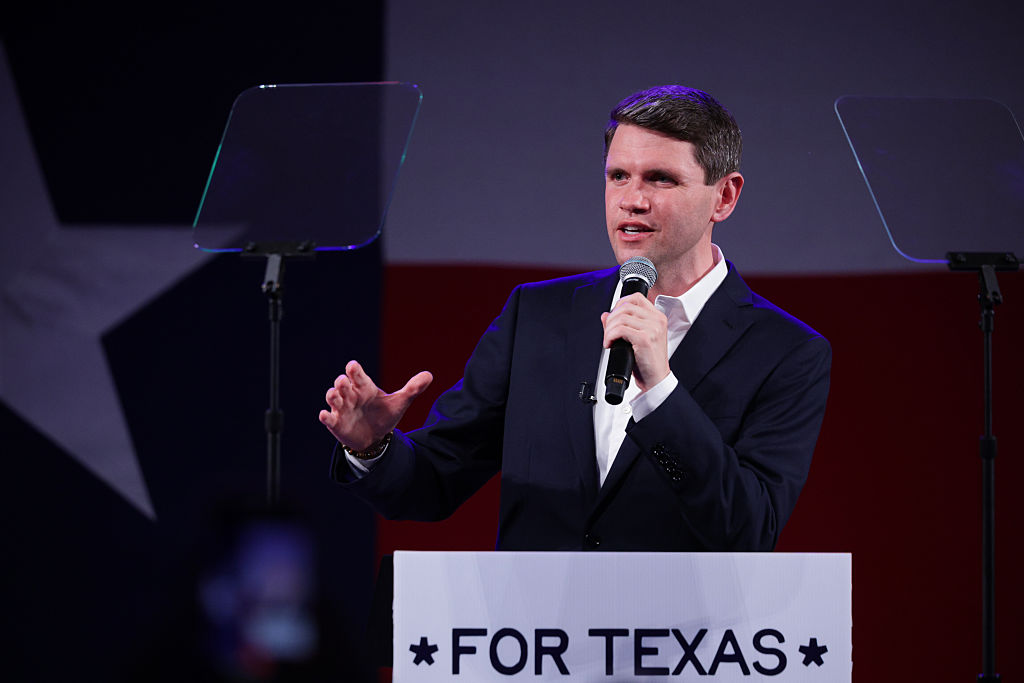
The recent election results have triggered a sweeping political realignment, marking a decisive Republican wipeout across key state and federal offices. Incumbent Republican governors like Greg Abbott in Texas are expected to lose, and major gubernatorial races—including Georgia’s shift to a Black woman governor—signal a profound shift in political power. Democrats now appear firmly in control of both chambers of Congress, with a likely majority that could dominate policy and leadership for years. This outcome stems from widespread voter rejection of high-profile Republican candidates, especially those personally backed by President Trump, many of whom were unprepared or lacked public presence. The loss of Texas, a crucial electoral state, threatens any Republican path to the presidency, while new progressive and ideologically extreme leaders—such as a Muslim candidate in Michigan and liberal Protestants in Kansas and Ohio—are poised to reshape Senate dynamics. Meanwhile, a major religious liberty case in Colorado highlights the conflict between state anti-discrimination laws and faith-based education, with conservative justices showing strong support for religious exemptions. Although the full results are still being finalized, the pattern of electoral collapse and ideological shifts points to long-term instability for the Republican Party. The Supreme Court’s potential decision on religious freedom may set a national precedent, underscoring broader challenges for conservative values. The political landscape now stands at a turning point, demanding urgent reflection and strategic adaptation from Christian conservatives amid a rapidly shifting reality.
(upbeat music) It's Wednesday, November 4th, 2026. I'm Albert Molar, and this is The Briefing, a daily analysis of news and events from a Christian worldview. Well, if you're looking for the word to describe the results coming in last night, one appropriate word would be wipeout that is exactly what it was, and it's going to continue, because we're gonna have continuing results come in about several congressional and senatorial seats, governorships, other big questions, including some huge moral issues that were on the ballot in several states. But the fact is that as of like nine or 10 o'clock last night, the picture was already becoming very clear. And when you talk about a wipeout, you're talking about a loss that is going to reshape the political landscape, and we just need to be honest and say, that's just about the reality. That is what is going to happen. Few Republicans, if any, really thought the picture could be this bad. As of last night, it was incredibly clear that even incumbent Republican governor, Greg Abbott of Texas was going to lose what was considered to be a safe race for a fourth term. Even just in recent days, some Republicans openly speculated that the strength of Abbott's incompetency would be able to pull up even Ken Paxton, as someone who was seen as now a disastrous candidate for the United States Senate. And now we know that's not only a moral disaster, it's now an electoral disaster as well. As it turned out, Abbott could not even rescue himself. When it comes to the House of Representatives, the wipeout was somewhat more expected. And as of last night, it certainly looked like democratic control was inevitable. The only real question at this point is what the scale of democratic control is going to be. How large the democratic margin is going to be. That majority could be large enough to create insurmountable problems for Republicans, at least in the next Congress. As we're looking at this, we also recognize that we just have to buckle up and get ready for democratic Speaker of the House Hocking Jeffries. That is now an inevitability. If anything, the only question is whether progressives left us in the Democratic Party will press for someone even more liberal than Hocking Jeffries. Now, on the Senate side, the big question on the part of some and it appeared to be an honest question is whether or not the Democrats really had a chance at regaining a majority. Well, that's pretty much now assured. And we're not only looking at just one or two or three or even four, that was going to be the magic number for Democrats to win, not just four wipeouts in the United States Senate. It looks like it's going to be many more than that. Just consider the fact that what we are looking at in the United States Senate is a reordering of the political reality. In case after case, Republicans were already in bad shape in terms of many of these elections, but it turned out that the results look even worse than some of the worst case scenarios had painted just a matter of days ago. In any event, when we look at the House and at the Senate, it turns out to be a Republican crash of epic proportions. Something that simply needs to be noted here is the fact that Republicans were actually losing some very crucial elections, particularly special elections, ever since the 2024 presidential election that returned Donald Trump to the Oval Office. Since then, there have been ominous signs for Republicans. And then you had the complications of several of the policies of President Trump that turn out to be very, very unpopular with the American electorate. That includes the war in Iran, that also includes tariffs and other issues. The fact is that President Trump has been immovable on those issues, and he has been, at this point, unable to convince the vast majority of Americans that his policies are right and justified. It is really interesting looking at the Senate seats. It's really interesting to see how many of them actually reflect a major impact from the tariff question. That's just something you need to see in several states will be looking at that in deeper analysis and days to come. Now, when you think about the crucial role played by governors in the United States, just consider the fact that the governor's chair in Austin, Texas, is turning from red to blue. We now know that the same thing is going to happen in Atlanta, Georgia. Keisha Lance Bottoms, the former mayor of Atlanta, has now been elected to the governor ship there in Georgia and it's shifting not only from Republican to Democrat, it's switching to a very progressiveist Democrat. The state of Georgia is now gonna have the first black woman governor of any state in the United States and she's going to be heading in a very, very different direction. Stay by state, governorships, house seats, and you look at Senate seats as well, there's gonna be a lot to figure out. But at this point for Republicans, it looks like an unmitigated disaster. Republicans are holding certain seats, they're even holding certain congressional seats, they're holding certain governorships and all the rest, but the big fact is that where change has happened, it has been overwhelmingly at the expense of Republicans. And we're talking about major states, major political influence. And we're talking about major long-term effect because nothing in the picture from last night, nothing from the unfolding numbers of votes that are gonna be announced in days to come. None of this is going to be reversed anytime soon. We're looking at what may be a new political reality and it's particularly daunting when you consider the fact that if Texas moves in a democratic direction and deso in the electoral college it's gonna be very difficult for any Republican presidential candidate to find a way towards an electoral majority in the electoral college. It's gonna be very, very difficult. Now, Texas at this point is not entirely lost, but let's face it, we're looking at a new political reality. We're also looking at the fact that when you look at voters, I'm not just saying democratic voters or Republican voters, when you look at voters, there is a rejection here overwhelmingly of a certain candidate type. And Republicans are gonna have to take this into account very much, so they're gonna have to look at the future of the Republican party. And it's not just a matter of positions on the issues, it is also a matter of the kind of profile of the candidates. It turns out that President Trump, for example, personally anointed and made clear his preferences in so many of these races. And in the overwhelming majority of those cases, the candidate he chose has lost. Now, think also of someone like US Senator Darling Graham in South Carolina named to that position to fill out the final months of the term of her brother, the late US Senator Lindsey Graham. President Trump personally chose her and then personally told her he wanted her to run for the six-year term. It turned out that in so many ways, she was totally unprepared, frankly, for either responsibility. But on the campaign trail, she was unable to answer a lot of basic questions. She actually was not very visible. She didn't fulfill the kind of role that a Republican candidate running for the Senate, even in a state like South Carolina has to play. And furthermore, she announced that she wasn't all that informed about, for example, foreign policy. And she didn't appear to be very troubled about it. That evidently just added to the perception that acting Senator was the only title she was going to hold. Now, when you think about the very important democratic winds in the Senate, recognize you're talking about six-year terms and just do the math. That means that whoever's elected president after Donald Trump will be up for election to a second term when these Senators come up again for a vote. That's a very long time. It's one of the reasons why the Senate is such a great platform for stability. In this case, it's going to be stability in a way that many conservatives are going to lament from day one. But let's make this clear. When it comes to these senatorial elections, this is not a short term problem. And when you look at the governorships, just recognize that incumbent governors, they have a very strong advantage going into a re-election campaign. And so we could be looking at the fact that we could be six, eight, or more years out from a Republican correction on so many of these seats. And that's especially bad news when you consider that so many moral, cultural, and social issues of central concern to Christians. We're going to have a very hard time pushing those things, or even preserving conservative pro-life, for example, and pro-family gains. When you look at the future composition of the United States Congress, and then also the disposition and the party affiliation of so many governorships, and understand that the party in power has a tremendous advantage in recruiting young talent to come into the party. At this point, when you're looking at the Republican Party, it's an open question as to the future of the party. Now, there's another reminder here, let's Republicans think everything is lost. The Democrats honestly thought everything was lost just two years ago, and now they appear to be in electoral terms in the driver's seat. So understand that things can turn very quickly, but they don't turn really quickly when it comes to the incumbents in so many of these positions. The momentum is going to be a very big challenge for conservatives and Republicans to face. Let's go back to the United States Senate for a moment. Just understand it looks now almost certain that James Tallahuretko is going to be the new Senator from Texas. Adam Hamilton is going to head to the Senate from Kansas. We're talking about two liberal Protestants. They want a seminarian and want a pastor of a mega-church who will now lead to the United States Senate from Kansas who are two liberal Protestants. They're going to vote not only as liberal Protestant Democrats. They're going to vote where conservative Republicans once held the seat. So you're not just talking about voting differently. You're talking about a reversal in these senatorial positions. The list goes on. The hardest news of the night might well be the victory of Abdul Asayat in the Michigan Senate race. That is not final, but it certainly looks very, very likely. He's a candidate whose anti-Semitism is clear, whose family's been tied to Islamic extremism, whose policies represent the far political left, and who will be touted as the first Muslim member of the United States Senate. He heads for Washington even with all these factors well known to voters, and with even, as you know, more controversy just in the last hours of the campaign. Nonetheless, all of this appeared to be irrelevant to voters in Michigan. Go figure. Consider the state of Ohio where former Senator Sherrod Brown, by the way, very much a man of the left, who held one senatorial seat.
there in Ohio for years. He's now been elected to the other seat, defeating an incumbent Republican again. GOP candidates appear doomed from New Hampshire to Nebraska and on and on from there. It's still too early to know the results of votes on a myriad of social and moral issues, and those are a prime concern to us. From transgender teenagers to abortion, a potential tax on billionaires in California, we should have a clearer picture on some of this by tonight. But even then, it could be sometime before we have a final picture on so many of these issues, these pressing questions may not be answered for weeks. For now, however, let's just face the facts. The picture is clear enough. What Republicans faced yesterday, what conservative Christians faced yesterday, was in so many ways an electoral wipeout. It just has to be called what it is. Now the picture is undeniable. The lessons will be hard. Many conservatives will try to minimize the catastrophe, but it is a catastrophe. It is a disaster. Just consider Texas. Again, it looks like Republicans have been routed in a state absolutely essential. Everyone's understood to be absolutely essential to even Republican nationwide hopes. Without Texas, hard to imagine how Republicans are going to win at a national level. When you think about the electoral college, understand that there's basically no electoral map in which a Republican candidate can be elected president of the United States without the electoral votes of Texas. That's simply the way it is. And now you can see where big trouble is showing itself. If Texas goes blue, so does the nation and for the foreseeable future. The truth is that the stakes for Republicans are just incredibly high. Now, consider this. Just a couple of years ago, some conservatives were boasting that the Democrats would likely never recover from President Trump remaking the Republican Party, remaking the electoral map. That confidence now looks pathetic. The full scale of the wipeout experienced by Republicans is not yet even clear. A full accounting for votes may actually be days away. In some cases, due to the fact that some states just are incredibly slow counting votes, it could be even slower than that. There are big issues at stake and it may be sometime before we know how some of these issues are decided. Many issues of central concern to Christian voters. Well, there's now at grave risk. Anyone who assures you otherwise, let me just be clear, is not being honest. We face a massive challenge ahead. This is not a time for the faint of heart or for those who fear big political battles ahead. We're about to face a daunting new world and an ominous political reality. You can count on this. The battles will line up fast and the challenges will come with a vengeance. The question is, are we ready to face those challenges? Of course, we will be watching these developments very, very closely and we'll be discussing them, dimension by dimension on the briefing. At this point, we do know we're going to have a lot to talk about. Meanwhile, we also have to recognize that yesterday, this Supreme Court of the United States held oral arguments in a big case in which religious liberties at stake. The case comes from the state of Colorado where the government there, just a matter of years ago, through the legislature adopted a policy in which families were going to be given basically grants from the state upwards of $6,000 per child in terms of preschool programs, but the preschool programs had to be approved by the state. One of the stipulations put in place by the state is that there had to be a nondiscrimination policy. It didn't say that Christian or religious schools or programs, these preschool programs could not qualify for the program. It does say that the programs cannot discriminate on the basis of well issues that include LGBTQ identity. Now, you're talking about the school in this case, which is grounded in this parish, a Catholic parish, that intends to operate by Catholic official doctrine and teaching, and that means that it does not want to accept children who come from same sex marriages, for an example. And thus, you have the state of Colorado saying, well, then you're disqualified because your program no longer qualifies under the enabling legislation. And of course, also the governance of the program by the state. Now, remember that this case comes to the Supreme Court only because the Supreme Court has agreed to take it. And the Supreme Court agreed to take it after a federal district court and a federal appeals court both turned down the appeal from the Catholic parish in terms of the decision against them. The Supreme Court of the United States has agreed to take the case. Now, that's important just in the fact that Supreme Court has taken it, but it's also important when you consider the fact that a 6-3 conservative majority on the court has ruled on cases like this already in favor of the religious organization or of the parish, the church in this case. And as you're looking at this, well, just consider the fact that NBC News has reported the story this way and I quote, tackling the latest in a series of cases that pit LGBTQ and religious rights against each other, the Supreme Court on Tuesday appeared to lean toward Catholic entities that are seeking an exemption from Colorado's anti-discrimination rules so they can participate in a taxpayer funded preschool program. Now, if you're a family with several kids, this amounts to a lot of money, a massive amount of money. You're talking $6,000 plus per child per year. That's a huge financial investment. And the state of Colorado's interest in passing this legislation was because the state wanted these preschool programs to be available to children to get them ready to attend kindergarten and grade school, but the state was not able to conduct the programs themselves so they had to use other parties. So these basically are like vouchers or credits to be used in these approved programs. Now, it's really important to recognize that the state of Colorado legislation did not disqualify Christian schools, Catholic schools, churches, programs from this kind of funding. You would have the ability of citizens there with children in this age to put their children in these programs. And as long as they were qualified by the state and religious conviction was not supposed to be a qualifying factor, then the funding would be approved. The crucial issue here is that the state put in this disqualifying factor when it comes to discrimination, including LGBTQ. Now, let's just remind ourselves, the official teaching of the Roman Catholic Church is real clear about, for instance, the recognition of marriage. So I'm just going to use a same-sex couple as an example of having a child in the program where the church school is going to teach the same-sex marriage is not even marriage. This leads to a very awkward situation, but it also leads to a situation in which that school, given its Catholic convictions, really can't recognize a two women or two men as the parents in this case. Now, here is where the Supreme Court's conservative majority may make a decisive difference. And they've already done so in similar cases. So even as NBC News reflects, quote, "In the election day session, the Court's conservative majority seemed inclined to see Colorado's refusal to grant an accommodation as a violation of the religious rights of the Archdiocese of Denver and other plaintiffs under the Constitution's First Amendment, where then reminded a ruling is due by the end of June." Okay, so here's another very important data point from the oral arguments yesterday, as NBC reports, quote, "several conservative justices indicated during the two-hour session that the refusal to give the Catholic preschool and exemption had echoes of past discrimination against religious groups, even if the law did not expressly single them out." So let's just notice something. Here's something really slick, and this is really important. And the Beckett Fund for Religious Liberty, for instance, is very much involved in this. The Catholic argument, the religious liberty argument coming in this, is not that the state of Colorado is required to fund this kind of program, but rather that the state of Colorado cannot, if it's going to accept religious programs, and frankly, that would also be an issue, I think, of appeal for the Catholics if that were the legislative turn. But if they're going to fund these programs, they can't then say that Catholic schools can only do this by denying Catholic doctrine. Now, one of the slick arguments made by the state of Colorado is the argument that they're not making a theological argument at all. But, as the attorneys for the Catholic parish pointed out, if you say that this issue of Catholic doctrine is disqualifying, then you are judging on theological and religious liberty terms, whether you admit you're doing so or not. Now, this is a case. Let me just speak to evangelical Protestants for a moment. This is a case in which I think many evangelicals are going to say, well, this isn't exactly how we would handle the situation, even in, say, participating with the state money and all the rest, some Baptist and other Protestants would say, we shouldn't take the state money. But that is not a problem for the Archdiocese of Denver and for Catholic social teaching. But the big point that conservative Protestant evangelicals need to understand is that if this case goes the wrong way, it will not only be to the disadvantage of this Catholic parish and this Catholic program in Colorado. It's going to be a precedent from the U.S. Supreme Court that will be deeply injurious to religious liberty for all. And so the Protestant question is not, would we do this this way? The Protestant question is, what would be the damage to religious liberty if the court rules the wrong way in this case? It's because so many of these issues are tied together. I think the attorneys for the Catholic parish in this case understand how the issues are tied together. But I think it's also clear, as of the oral arguments yesterday, that at least a very clear majority of the conservative justices, and that means a majority of the justices in their conference, it turns out that they really see this as a very clear religious liberty issue. And as several of the justices pointed out, the trajectory of the court's decisions in this case have already been set. So in this case, the state of Colorado had to know it's coming in making an argument that is not likely to have a lot of traction with constitutional conservatives. This is a case. I just want to go back to evangelical Christians. Even if your church would not participate in this kind of program disqualifying a Catholic church based on Catholic doctrine, is a violation of religious liberty and needs to be called out at
as such. Another reminder that a lot of these religious liberty cases, even if your religious group, your denomination, your church, would act differently, the injury to religious liberty, if this decision goes the wrong way, is simply massive. The editorial board of the Wall Street Journal addressed the issue in an article in title, religious schools, deja vu at the court. And the editors of the Wall Street Journal, actually, I think very helpfully point out one of the big issues here, the editors write, quote, the Catholic schools asked new parents to sign a statement on community beliefs and commitments, as well as to refrain from publicly undermining the church. I mean, to stop there, that all makes perfect sense. I continue, quote, Colorado denied them an exemption from its enrollment rule. But does the first amendment demand one? The editors went on to say if that question prompts deja vu, remember the high court's 2022 ruling in Carson versus Macon, rebuking Maine for unconstitutionally barring religious options in a state tuition program. Now, here's where things get really interesting. I think the editors are on to something here, quote, Colorado insists this is different because it doesn't target religion explicitly. Its program has included more than 40 faith-based providers and schools, quote, may continue to teach and shape their curriculum according to their faith. The state says it has neutral, non-discrimination rules, while St. Mary wants to, once tax dollars, quote, without complying with these conditions. Okay, so listen to this, quote, yet St. Mary argues that's the Catholic Parish, quote, the fact that Colorado gladly funds some faith-based schools, not others, makes things worse. Now, I think that's a profound point. The very fact that the state of Colorado says, well, here are these religious schools that will take the money with these stipulations. That's even worse than the state of Colorado saying we're just qualifying the religious organizations. And instead, we're just going to do this ourselves. This is an impossible argument. Now, you have the officials there in Colorado saying, well, we're happy to give the money to the schools of churches that are pro-LGBTQ, or find no complaint with pro-LGBTQ commitments. But if it's an anti-LGBTQ, if it's a church or a parish that holds to the conservative Christian biblical position held by the Church of the Lord Jesus Christ, or 2000 years, well, then that church is just qualified. That is wrongful discrimination according to the U.S. Constitution. And we can only hope that the court's conservative majority will see through the arguments from Colorado and uphold religious liberty. And remember, so many of these cases are tied together. It's not exactly a seamless garment, but it is a net. An awful lot of these arguments really are connected. And a loss here is not just going to be a loss for this Catholic parish and for the parents of that church. It's going to be a massive loss for religious liberty, nationwide. Okay, finally for today, a very interesting obituary appeared in the New York Times as for Judge Alan Kay Hellerstein, who was the judge who, at least to this point, has overseen the case against Nicholas Maduro, the trial upcoming, the legal process heading up to the trial. The big issue here is that judge Hellerstein died, just a matter of days ago, at age 92. So just take this into consideration. This judge was on the bench carrying this load in one of the most significant cases in terms of what will turn out to be American legal history and he was 92 years old. He appeared quite vigorous, although he did appear 92 years old if you saw any of the video of the previous hearings. But the reality is he was respected on the bench and there was expectation he would see this case through, but he did die at age 92. It's also interesting that there's a background to his approach to the law. As the obituary says, "A deeply religious orthodox Jew from the Bronx, the judge was known to hold sentencing on Fridays, so he could reflect on his decisions over the sabbath. Hanging on the wall of his chambers was a Hebrew scripture that read "Justice, justice, shall thou pursue." He went on to say, quote, "I would argue that my Judaism is not a predictable influence on my judgments." He said this in an article published in the Law Review article in 2013. He said, quote, "Yet it cannot be denied that judges are influenced by who they are and how they were brought up. And certainly I would not deny that." End quote. What's really interesting there is that so many people, if this were evangelical, would complain about the citation of the scripture and of Christian conviction. But this judge was massively appreciated and respected, but he did identify very clearly as a conservative orthodox Jew and he conceded as we see in this law article that his Judaism made a difference. And by the way, in theological terms, of course it would make a difference. It's also interesting that some other judges reflected on the fact after his death that Judge Hellerstein had actually cited the Bible in making legal arguments. Again, I think that's a good thing, but it is interesting to note that this conservative orthodox Jewish judge, basically in one sense, got away with that. In a way, I don't think a conservative Catholic or a conservative evangelical Christian would at least, I don't think the crowd will let this go without comment. Let me put it that way. It also turns out, by the way, that Judge Hellerstein has one of those great American stories. As the obituary says, he was born on December 28th in 1933 in New York City and grew up in a predominantly Jewish neighborhood in the Bronx. His father, Max, who under grocery store immigrated from Belarus in the 1920s, while his mother Rose came from Lithuania. And he said this on his own son's podcast just earlier this year. It's also very interesting to note that Judge Hellerstein looking back at his boyhood in the 1930s in the aftermath and still in the wake of the Great Depression, he said this about his life in the United States. Quote, we all thought we were well off. End quote. And in a very real sense, he was. Thanks for listening to the briefing. For more information, go to my website at Albertmolar.com. You can follow me on xr twitter by going to x.com/albertmolar for information on the Southern Baptist Theological Seminary. Go to spts.edu. For information on voice college, just go to voicecollege.com. I'm speaking youth in the Billy Ram Center at the Cove in Asheville, North Carolina, and I'll meet you again tomorrow for the briefing.
Podcast Summary
Key Points:
Republicans suffered a massive electoral wipeout, losing key congressional, senatorial, and gubernatorial seats across multiple states, including a decisive defeat of Texas Governor Greg Abbott.
Democratic control of the House and Senate appears certain, with a significant shift in power that could lead to a new political reality and a major challenge for Republican leadership.
The results reflect deep voter rejection of Republican candidates, especially those personally chosen by President Trump, such as Senator Daisy Graham, who lacked readiness and visibility.
Texas’s shift from red to blue—potentially under new Democratic leadership—could severely hinder any Republican presidential bid due to the state’s critical electoral votes.
Several new progressive or ideologically extreme leaders, including a Muslim candidate in Michigan and liberal Protestants in Kansas and Ohio, are now poised to shape the Senate and state policies.
Religious liberty is at stake in a major Supreme Court case involving Colorado’s anti-discrimination rules in faith-based preschool programs, with conservative justices showing strong support for religious exemptions.
The court’s previous rulings and conservative majority suggest a likely protection of religious freedom, even if the legal arguments are framed neutrally.
The political fallout extends beyond immediate elections, as demographic shifts, candidate inexperience, and policy missteps may destabilize the Republican Party for years to come.
Summary:
The recent election results have triggered a sweeping political realignment, marking a decisive Republican wipeout across key state and federal offices. Incumbent Republican governors like Greg Abbott in Texas are expected to lose, and major gubernatorial races—including Georgia’s shift to a Black woman governor—signal a profound shift in political power. Democrats now appear firmly in control of both chambers of Congress, with a likely majority that could dominate policy and leadership for years.
This outcome stems from widespread voter rejection of high-profile Republican candidates, especially those personally backed by President Trump, many of whom were unprepared or lacked public presence. The loss of Texas, a crucial electoral state, threatens any Republican path to the presidency, while new progressive and ideologically extreme leaders—such as a Muslim candidate in Michigan and liberal Protestants in Kansas and Ohio—are poised to reshape Senate dynamics. Meanwhile, a major religious liberty case in Colorado highlights the conflict between state anti-discrimination laws and faith-based education, with conservative justices showing strong support for religious exemptions.
Although the full results are still being finalized, the pattern of electoral collapse and ideological shifts points to long-term instability for the Republican Party. The Supreme Court’s potential decision on religious freedom may set a national precedent, underscoring broader challenges for conservative values. The political landscape now stands at a turning point, demanding urgent reflection and strategic adaptation from Christian conservatives amid a rapidly shifting reality.
FAQs
A 'wipeout' refers to a massive electoral loss by Republicans, particularly in key congressional, senatorial, and gubernatorial races, leading to a significant reshaping of the political landscape.
Yes, Greg Abbott is expected to lose his fourth-term governorship, marking a major upset and a shift in Texas's political direction.
Keisha Lance Bottoms, the former mayor of Atlanta, has been elected governor of Georgia, making her the first Black woman governor in U.S. history and signaling a shift toward progressive policies.
Multiple Republican-held Senate seats are being lost, with liberal Democrats winning key positions, including two liberal Protestant senators from Kansas and Texas.
Yes, without Texas, a Republican presidential candidate cannot gain a majority of electoral votes, making Texas a critical state for national Republican prospects.
A case involving the Catholic parish of St. Mary in Colorado, which seeks an exemption from anti-discrimination rules in a state-funded preschool program due to its religious teachings.
Chat with AI
Loading...
Pro features
Go deeper with this episode
Unlock creator-grade tools that turn any transcript into show notes and subtitle files.
 PodcastTranscript AI