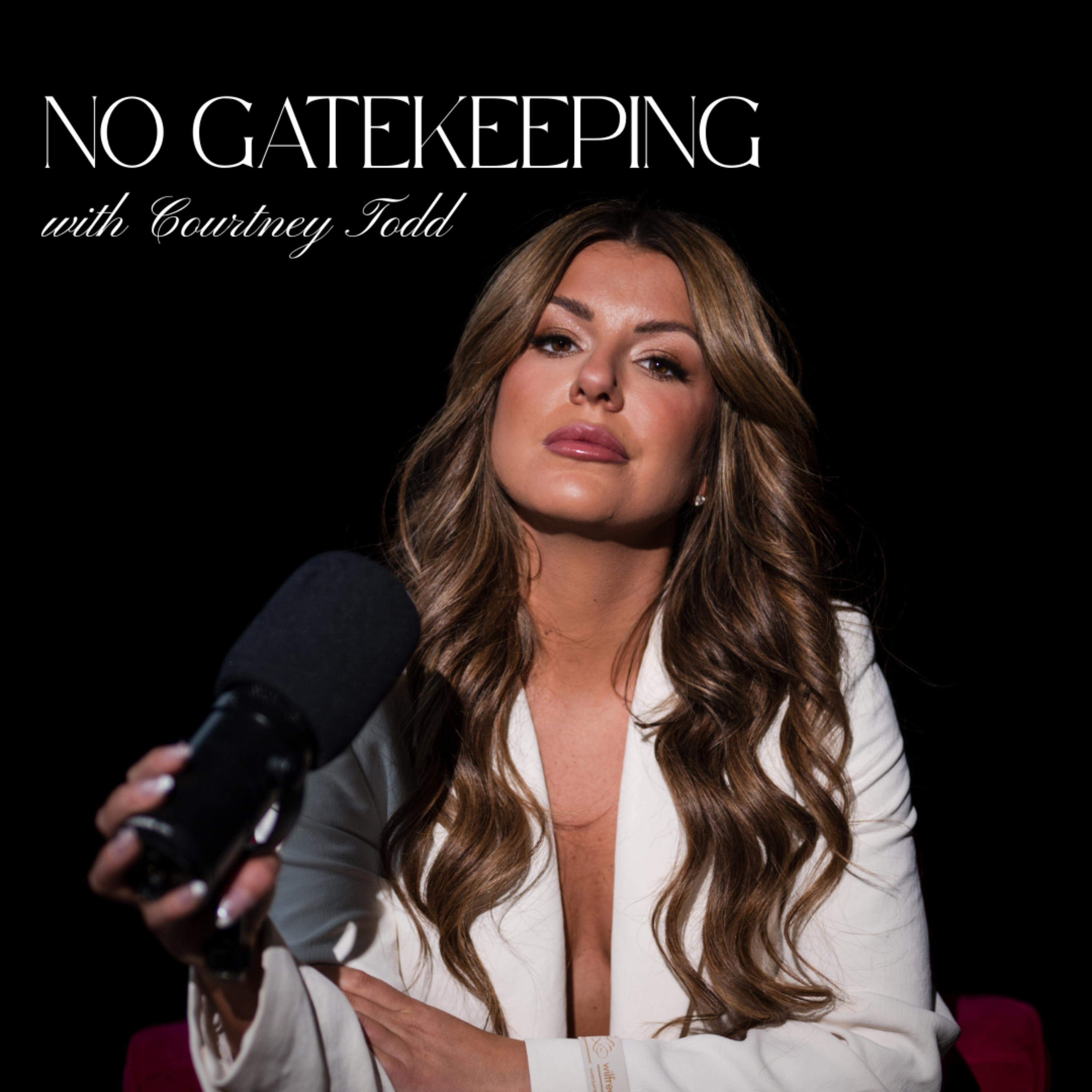
Website & Branding Tips Every Entrepreneur Needs with Meredith Wolf
from No Gatekeeping with Courtney Todd
55m 5s
In this podcast episode, host Courtney Todd interviews Meredith Wolfe, founder of My Wolf Design, about branding and business growth. Meredith shares her journey from a corporate sales role to entrepreneurship after a severe pregnancy forced her to take time off, leading to an identity crisis and a blank slate. She started an Instagram account for home design as a creative outlet, but clients consistently asked for her marketing and branding help, prompting a pivot. Since 2018, her team has completed 100-200 projects annually, serving both new and established businesses. Meredith emphasizes that branding is an ecosystem of 10 pillars, not just a logo, including values, audience, and tone of voice, which must align with visuals to avoid disconnects, like a real estate agent’s relatable brand conflicting with glamorous photos. She also highlights the importance of systems, such as business management tools like Dubsado, to streamline operations and ensure consistency across all client touchpoints. Managing a team requires clear standard operating procedures and shared values, learned on the job. Meredith advises entrepreneurs to start with systems that address their most time-consuming tasks, building a foundation for scalability and success.
Hello and welcome back to the No Gatekeeping Podcast. I'm your host Courtney Todd and today I am so excited to introduce you to Meredith Wolfe. We are going to be talking everything branding, how to elevate your brand, your business. So it doesn't matter if you're an entrepreneur, your content creator, building a personal brand. We are going to be talking about all the things you need to know about branding. [Music] So thank you for joining me Meredith. I'm so happy to have you on. I know you're so successful in business and I feel so honored to be able to talk to you today. For everybody that might not know you, are you able to share a little bit about who you are? Yeah well okay number one thank you so much for having me. I'm so happy to hear. Meredith Wolfe, owner of my Wolf design and we, I like to say we are your go-to people for foundational critical elements for your new business, existing business. It doesn't matter you're going to need what we do. I started the business back in 2018 and have been really fortunate that it has really taken off and we've got to support some incredible clients just starting their entrepreneur journey but also coming in you know 20, 30 years later. Okay so like you said you work with clients that are either just starting or that have been a business or brand for a while. Yeah okay yeah I love that like both sides of the spectrum. Yes so why did you create my wolf design? So I feel like there's a lot of moments in my story that people can relate to. So let's go back. I was working for a really great company. It was like a recruiting and consulting company that I grew with and I was with them for 13 or 14 years. It was a company where it was very like sales driven and productivity which to be honest I thrive in. So I always did very well with the company but if you were somebody who wasn't producing you may not last. So anyways fast forward I meet my husband and we end up getting pregnant fairly quickly and I'm in a leadership role with this company and you know when you get pregnant and this was my first time ever being pregnant. I was very sick but all I know is everyone gets incredibly sick in the first three months. And so I'm just like okay this makes me realize women are warriors and I remember cornea I'm driving down the 401 to the office with a bucket on my lap and throwing up in the bucket. I feel like pregnant people and mothers deserve an entire different type of badge of being the best hardest working person out there because it's wild. It is. That's how nice. Yeah you know what I got goosebumps just thinking about it because it honestly it was awful it was really bad and so you want to tell people but this is a world that's so new to me and I'm thinking no people say you don't tell anyone but this is sort of when you want to tell people because you're struggling so bad. Did people not know you're pregnant? No. No. Typically you wait until you're 13 weeks pregnant before you start telling people. I needed to take time off work and this was the first time in 14 years. I slow down. I was fully drinking the Kool-Aid of this company and it was great Kool-Aid I got the best training and met wonderful people but it was the first time I got to take a step back and literally had no responsibility other than to keep this baby alive and all of that so fast forward it ends up being you know. You need two weeks off three weeks off and it truly just kept extending to the point where I never went back I was so sick no job like talk about mental it wasn't mental clarity at that point it was just. It was an identity crisis. Yeah well it was just a blank slate. Yes. Right. There's so many ways of looking at the negative is an identity crisis of who am I because I was work. Now this is taken away from me. Yeah I'm also becoming a new mom. Yep what the hell. Yeah and the positive side is like you said a blank slate. Yes. I can do whatever I want I can be whoever I want I can work on whatever I want. Yeah and a lot of people don't get that opportunity it doesn't sound like it was in the glamorous way with how sick you were but they don't get that opportunity to hit the reset button on life. Totally. Yeah and you can relate to that right. Yeah. Yeah so I mean it was a new city it was I mean okay PS I was pregnant after three months of knowing him right so this is also a new relationship to like every it my whole life was brand new like I rebranded. Okay so I'm off and then of course baby arrives. Evie is a me. Yes. And so then of course I'm off for a year and so you know if you're doing the math here I'm off for a year and a half at this point away from this job that was my life. And Evie is probably seven eight months at the time I'm like okay I should probably prepare to go back and I'm going to kind of skip over some of this stuff but essentially my job didn't exist anymore and you know so we're kind of dealing with that but also at the same time I have all this time on my hands. I've always had a business background but personally it was a very creative person and that always came through really in decorating my house and things like that. So I finally have time for a creative outlet and so I start an Instagram account showcasing my house and just what it looked like and all of that and then I was like well maybe I could do some staging or some virtual design you know just as like a passion project I guess. So I'm doing this Instagram account and I'm like you know what I'll whip up a website and this is just so fun right motherhood for me I was like this can't be my full identity that just didn't feel right and so having this creative outlet was really helpful so I have this Instagram account and I don't get one paying client it's just all the people that I was like hey can I do this for free to build my portfolio it's all happening at the same time. I get the severance I'm not getting any clients I'm doing up my resume like what the heck am I going to do with my life and all these people are just who's doing your Instagram who did your website nothing to do with design whatsoever like home design. And so that's when I did the pivot I was like clearly people are liking what I'm doing from a marketing and business perspective don't really care about my interior decorating skills and so that's when I create a new Instagram account change over the website and boom clients just start coming in wow and I'm figuring it out literally whipping together a contract. People are asking me well how much would that be and I'm like I don't know what I'm going to get. Yeah good question I'm going to have to try with this price right now. It's a lot of learn as you go. 100% but that's my personality I jump in with two feet always and I'll learn as I go and if it's a mistake who cares you learn from it right so. I think that's an amazing realization of pivoting being like you know what I'm going to do this and sometimes the original plan most times in my opinion the original plan isn't the actual outcome. It's just a stepping stone. And a lot of the times you don't know again you're in a position where like I don't know what this will look like I don't know what my future will look like or my business will look like but I do gently believe that the people that never give up and just continue with working hard. We'll always be rewarded. I couldn't agree with you more so something I want to ask you is why should people listen to you. On this podcast and everything that you're about to say and the value that you're going to give. Okay I love this question but it also terrifies me. So I feel as though I'm a really great representation of the real entrepreneur the one who doesn't know where this is going to go doesn't know if it's going to stick has gone through having to pivot and but also listening to your audience and figuring out what it is that they want but also knowing what it is that they need and working on that collaboration and merging that and so we've been doing brand and website. Projects for again brand new businesses established businesses since November 2018 we tend to average anywhere between 100 and 200 projects a year. That's amazing. So that's a lot of websites. How many of your teams? It has changed over the years and currently one is actually on maternity leave. So we have an operations manager, a creative admin, two brand designers. I'm still doing all of the websites and two copywriters. Well there's three copywriters but one's off. That's a team. Yeah. Do you find. it hard to manage. - No. - You love it? - Yeah. - When it gets to a point of having a team and managing people with my business being the iconic, I've had it for five years. And there has been times where I've had a team of five, there's been a time when I was just me and then kind of in between, but five was my biggest team. And for me, that is when it was the hardest. And it was, we were all in an office, so we had an office in Port de Luzio, so cute. And really enjoyed that space, but that's when it was one of those realizations of when you're a business owner, and this is your first time doing it, you're learning as you go, I had a whole new perspective of the learning as you go, but as a manager. - Right. - You know what I mean? - Yes. - So you're learning as you go being a business owner, and then it's like, okay, I think I got the hang of this. And then now you're in a manager role, you've never gone to school to be a manager, or in my jobs, I have never been a manager either. So it was literally my first time being a manager when I was managing my own team for my own business, which was a really cool thing, but also a very scary thing. - Yeah. Yeah, I guess that's where a lot of my background has helped me because for 14 years, I was leading a team and an entire operation. And so that came very naturally to me. And I'm also hiring people, like the people on my team all have their own businesses doing their specific craft. And so I'm not bringing people in and teaching them how to be a brand designer, or how to be a copywriter. So this might be a bit of a segue to your next question, but the only thing I needed to make sure that was in place was standard operating procedures. And what our brand stood for, and what we believe in and our values. And I mean, obviously that's covered in the interview process, making sure people are in line, or we're both in line on that, but that's where the work came, was making sure like the systems and the processes were in place and not just in the owner's head. - And I think again, as a business owner, it is so hard to make that transition of head to paper. - Yes. - Because when I love working on the business, which again is the systems, but when you have to work in the business and you're busy with work, which is a great problem, you feel like you don't have the time to do the most important things, which is systems. And for my experience, I have had so much opportunity to be able to create systems and then work with one of my team members now who does our daily social media management role. And I worked with her as one of the first people I ever worked with. - Yeah. - So she has been able to see the business grow and fluctuate, but also have those same systems, but then she's been able to evolve while the systems evolve. - Of course, yes. - And then when I started working with Mystery Man, my partner, when he came into the business, he didn't have any experience in social media or content creation, but it was a lot easier for me to get him on board and up to speed because these systems were created. - Exactly. - And could they be better? - Absolutely. It was, they were enough for what I needed, especially going through that really hard, transitional life change that I was going through, where I'm like, am I in the position right now to be the best mentor and leader to teach him how to do everything? No, but because he is so good at learning on his own and taking that initiative and taking that responsibility, it always worked out, which was nice. - You're much younger than me. Do you know the movie Slumdog Millionaire? - I've heard of it. - Okay, so the premise is that he's on, do you remember the show, do you wanna be a millionaire? Where you're asked a bunch of multiple choice questions. Okay, so the premise is basically, you have $50 question and it's easy, and the pot goes up and you can get to a million dollars, right? In this movie, Slumdog Millionaire, he's on this version in India, and it asks a question and then in the film, it flips back to a part in his life, some kind of life experience that explains how he knows the answer to that question. Am I making sense? - Yeah. - So I sort of feel as though I'm the entrepreneur version of that. - Okay. - In this sense that when I started the business, again, not really intentionally, but somewhat, coming from the corporate background, I'm like, well, I worked with systems, so I know I need systems. And so I went to work immediately on the non-sexy things in business, and so it was just always ingrained in me to put these in place, even though it was just me. - And I think that is absolutely amazing because in my opinion and in my experience, the businesses that I've seen that haven't made it is because there are no systems in place or because the systems are loose or they, again, they haven't been made a priority. - Correct. - Like I've told you, depending on how many people, how many employees or team members I have, the systems may shift, but to have systems is so important because like you said, even if it's just you, at least you now know your system. - Yes. - So then when it becomes bigger than you or larger than you, it's, okay, here's our system. Let me know if you have any questions. - Correct. - And it's, you're creating a pathway to success for everybody you're not even working with right now, but that you're potentially going to be working with. I'll likely touch on this later, but the way I view it is every touch point somebody has with your business. So whether that's the proposal you send them, the contract, how you send the contract, are you making them print it versus like e-sign? That's all a reflection of the experience that they're going to have. And so it was incredibly important to me and selfishly because it does make my life a lot easier. And I'm empathetic. I want to make their life easier. All of that was incredibly important. - So the last thing I'm going to ask you about systems before we jump into branding is what advice would you give an entrepreneur that needs to refresh their systems or they haven't built systems in yet? What advice would you give to them? - Number one, when I first started trying to figure all of this out, of course I'm typing in online contract maker and doing it that way and then trying to figure out, okay, now I need to collect money. How am I going to do that? This is the cheapest way of doing that. So it was this quilt, if you will, of systems that nothing talked to one another. It was just the cheapest just to pump it out. So I shared that because I feel like a lot of people don't realize that there's actually tools that are an all in one type of system so that you don't have to operate like that. And so if you've heard of Dubsato, Honeybook, 17 hats, they're called business management systems and they encompass everything from contract schedulers invoicing questionnaires. I would say 80% of what a business needs to operate. And so start there and yes, it's a big setup but take things one step at a time. Whatever you do most, if you're pumping out proposals right now that are eating up a ton of your time, then start there because you can, I don't want to say automate, but you can make things so much easier and still keep it incredibly elevated and customized. So I know a lot of people are like, well, I can't do that because it's customized every single time. Tailored to them. Yeah, you can do that and save yourself. So project management system. A project management system. And then do you have your favorite out of those ones? So I personally, I shouldn't actually call it project management system. It's a business management system. Because project management, we have a whole other system for that. Yeah. So what is your idea about business management? So I love dub sawdow. It's men for creatives. They all kind of tend to gear towards someone. Like Honeybook tends to be more for like wedding professionals. And then 17 hats is more for your accountants, more like professional services. How do I, why I haven't heard of that? Yeah. Yeah. How do I really want it? Yeah. So I'm not an accountant. Right, there you go. You guys are looking for a management system. Check out dub sawdow because it's coming highly recommended from Meredith and her team. So now we're going to pivot a little bit to branding, to start basically at the basics of everything. What does branding really mean? I feel like this is an incredibly cliche answer, but I'll expand. So so many times I think people think brand is a logo. And that is a small little droplet in the grand scheme of things. So we like to break it up into 10 pillars, OK? And one of those 10 pillars is a visual identity. I just try and paint that picture that there is-- I call it an ecosystem-- that it's so much more than just the visuals. So of course, visuals are important. And yes, it would be your logos, colors, font. The meat and potatoes of what even dictates your colors and fonts are the nine others. And that is everything from your values, your differentiator, your audience, what you believe, what you don't believe, tone of voice. And so understanding all of these other nine pillars becomes your brand strategy in a way. And if you want some examples of when there's like a disconnect there. So we were supporting a real estate agent.
and creating her brand. And she was like, Meredith, I don't need to do new photos. I got photos from my friend last month, and I'm like, great. Can I see these photos? And so I end up getting the photos at the same time as I'm getting her-- we do like a branding questionnaire to really understand. Like it's almost like a therapy session, but on your business, okay? Like we go deep. And so we're learning about what it is that she stands for and what she believes. And she was going for this really relatable, authentic, whether it's your first time, it doesn't matter your budget kind of thing, not selling sunset vibes, okay? And then I see these photos, and she's in Louboutins, and a full suit, and looking like a vogue model. And so it's a disconnect. Major disconnect, and she's like, well, I look great, and I look professional. And I'm like, yes, yes, but that's not what the goal is. Like your goal is to look relatable. Your goal is to look like your next-door neighbor. And that's not-- Your goal is to look like somebody that is able to help the first time home buyer-- Right. --by a house, based on the information she gave. Yeah, because if she said, I want to do luxury real estate, then that makes sense. Yeah. Big goal. And so that's where understanding really putting pen to paper and understanding what you do, who you want to do it for, and again, it not being everyone, because everyone is no one. And I think that's something that I've even personally made in a shift in my personal brand for content creation, is I started out working with hotels, restaurants, and experiences, because that's what I enjoyed most. And then I opened it up a little bit more to lifestyle. So it's that, but then it also includes just say the random Get Ready With Me video, or this is my favorite makeup, and all that. And I'm like, OK, cool. I still post that. And what I've done recently is the platform of Instagram and the platform of TikTok. I have divided those up. Yeah, because I have made it more intentional, the collaborations on Instagram. I want to be more elevated and more luxury experiences, restaurants, hotels, no matter what that is. It's more elevated, rather than where to go to get the best $2 hot dog. Right. You know what I mean? Which there's people that their page is free things to do in Toronto. And there is a million people in Toronto that are looking for that, because they want to get the free coffee. They want to get the free muffin, whatever it is. There's an audience for that. But when you're looking at the person of your client that you want-- and again, correct me at any time if I'm wrong, because I know you're the expert at this. But I'm posting all these free things to do. Then I'm saying, oh, I want to partner with Fairmont. That's a huge disconnect, because Fairmont is probably not offering a free muffin. They might offer a free muffin with their hotel rate of $1,500 on a Wednesday night. Yes. But yeah, maybe you get a free muffin with that. But they are not promoting the same things that a content creator promoting free things to do, or cheap eats that. So I noticed my goals aren't aligning. Yes. If I'm posting about free coffee, it's like, OK, well, I need to not be having the goal to work with elevated luxury brands. That's exactly it. Yeah. And so what I've done now is to be best of both worlds is because I love a good free coffee or a free muffin. So on TikTok, I use that as my platform to post those things where it's more than the elevated. Because like I said, I love that. I love getting a good greasy slice of pizza. And it's saying that you can still do both, but being intentional of how you're doing it and how you're positioning yourself. 100%. I'll give you an example here, too. So we have kind of two tiers of branding that we do. So for a long time, it was just custom branding. So that's like your quote, higher price tag where you get the full strategy, all your different logo variations. But again, it's all custom based on your brand, your vision, all of that, with the designers and the strategists. But it occurred to us that we needed an offer for the new business owner that maybe didn't have the $3,000 to invest in brand, but still had that same level of value and understood the importance of brand. And so we created brand kits. So they're incredibly elevated. And it's not just a logo. We see this all the time. But you're getting the fonts, you're getting all of the proper color palettes and everything. So it's still a lower price point. But it's an elevated way of delivering to our audience that maybe just aren't there yet. I like to operate based on a target audience of values versus how much money you have to invest. Yes. And that's the thing because like we talked about at the beginning of the podcast, we both agree that the hardest working people will see the most rewarded if they keep going. Yes. If they don't give up. So the new business owners that are starting, they have nothing to start with when you're starting a new business. But that might be the next person that you are now selling your luxury package to because they're the people that aren't going to give up. And they might have no money now. But in a year or whatever that is, they will. So if they get a brand kit now, it's like, oh great. I feel confident about my branding. My voice, this will help me work with my target audience and build my business in a way that's approachable. And it's not like you're sticking your nose up to these people. I'd be like, oh, you can't afford this package. Then you're not for us. It's like, no, I see your values. I see your goals. We've done a little bit of work together where you've helped us in amazing ways. And that's something where, again, I was super impressed by your systems. And I was super impressed by just the delivery. I didn't even buy a full product. I was just asking some questions. And the delivery of your answers just amazed me. And that was something that was really nice. But again, I replied to one of your stories. It was, I'm giving away a free five minute brand evaluation. Oh, got it. Yeah, we always do those. And yeah. So if you aren't following, you've heard my wolf design. My wolf design. Make sure to follow them because that is literally one of the things I did with Meredith and her team. And I did the free audit. And the amount of value that I got from doing a free thing, it goes to show that Meredith and her team, they're not looking at a price tag being like, oh, you pay $3,000. And if you don't, then you're not valuable. It's no, hey, this is what we're giving and let us help you. And it doesn't matter if they're giving you a free service or a service that you're paying more for, the value you're getting is tremendous. No matter what the package is, what the price point is, I can't even imagine how much value I would have for the business if I were to sign up for one of your bigger packages, because I'm just talking about from a free perspective, which was amazing. So this is not on our agenda, what I'm about to say. But I think that mentality-- so let's call it spade a spade. We do brand audits and website audits to basically show, hey, this can be optimized. We would love it if you chose us, but if you don't, that's OK, you're going to walk away with a ton of value, right? So it's self-serving, right? Like, I don't want to pretend it's not. There is an attention. Of course. There's an opportunity. Yes. And so what I find is that our mentality is just literally we are an open book. We are not gatekeeping, right? You're on the right podcast, right? Yeah, exactly. So we will tell you everything-- we're not hiding anything, right? I think there is this mentality out there where it's like, if I tell them everything, why would they hire me? And it couldn't be more backwards. I always love this example. We've even had graphic designers come to us, because they're like, I'm too busy to be doing this. So think of it this way. You might go and get that greasy slice of pizza. You could make pizza at home. You might go get that greasy burger. You could make a burger at home. But you probably don't have time. You just want an experience out. You don't want to do dishes. There's so much value in the easy stuff. So if your mentality is, I'm giving away all this stuff for free. They're just going to do it themselves. Well, I think you're sort of forgetting why people buy. Yes. I totally agree. And that's very similar with social media management. People that come to us to do their social media, they are most likely and usually a busy business owner. Yes, they know they need help. Right. They don't want to do it. So I'm going to go to the expert that can help me with this. And for you, in your website or a branding, you're the expert in this opportunity to meet them and learn a little bit more about their brand. If you're doing a five minute evaluation, no matter what you're doing, you're like, hey, here are these problems that I've seen and on problems with opportunities. If you want this to be fixed, let me know. Right. I love to help you. Right. And then it's like, perfect. Yes. I want this fixed. Right. Please help me. And then that way, you've positioned yourself as an expert, people trust you. And then they buy from you from the free value that you gave out, because when you're giving free value, I even think of this when I do mentorship with whether people are doing business mentorship or content creation mentorship. And we have a free call. And I offer a free call and kind of exactly you said, if I give everything, will they still buy from me? Will they buy a mentorship program after that? You don't know. But I would rather
give you everything you need so you can realize how much stronger you would feel in yourself, in your content creation, or your business, if you continued working with me. Because I'm giving you all the knowledge I have, but then I also have so much more knowledge in other ways for you to grow. So it makes sense to continue that relationship. Yeah, so I'm a big believer in outsourcing. Yes. And I think we forget sometimes because we hire-- so here's an example, back to systems, actually. I had a really great team build out what's called "Click Up" so our project management system. And of course, that sounds great. This whole thing's going to be built out. We don't have time to do it. But throughout that experience, there's so much more that comes with working with other professionals that you're not necessarily paying for that you're going to see on the invoice. It's just how they operate. What technology is? All of a sudden, you get so incredibly inspired. Like, wow, not on the things that you've paid for, though. You get almost a bit of an insider look on how these other businesses are operating. And I'm constantly improving. And so I think sometimes we forget you're hiring a content creator. Imagine what all of those conversations look like. And what else the bringing to the table, that we as owners, and everyone listening, we're not putting that on the invoice, right? Exactly. It's, again, opportunities that you might not have gone by yourself. And it's opportunities to grow in whatever way that is. When you work with people that are the experts in what they do, you are just positioning yourself in an unstoppable way. You're going to your foot through the right door. So I have another question for you, obviously, about branding and entrepreneurship. But what do you think are the biggest mistakes? You see entrepreneurs or personal brands making with their branding? OK. Number one, they think it's about a logo. And not only that, they go and make that logo themselves on Canva, or just go and buy a logo off of Etsy, wherever you can buy them. And so I think what ends up happening is that there's this tunnel vision on what brand is when you're making those decisions, and not opening your eyes to the full ecosystem. Like I talked about those 10 pillars. And then I think once you do it that way, you realize, oh, yeah, there's really accessible ways of getting a professional brand identity that is more aligned with what I'm doing here instead of almost doing damage with just having that. OK. So you would say that you think the biggest mistake is when people identify branding as basically a logo, and then trying to make shift their own and then thinking, oh, you know, I have a brand. Yeah. OK. So when it comes to brand, I think sometimes people think it's objective, because it's sort of like art, and some people like it, and some people don't. And there is an element of truth to that. But there are so much more that goes into it. From a brand will say, I want to be accessible, inclusion, and then they're picking colors that somebody with any sort of eyesight disability, there's not enough contrast. Because there's a science to all of that. And so you don't, again, realize this damage that's being done-- That's so interesting. --or the size of a font on something. The type of font it is. 100%. And I think like a lot of people, and I can include myself. Sometimes I do fonts that I think look nice, and then I'm like, they're not readable. Right. So I'm making this font, and it looks luxury, and it looks nice. And I'm like, what is this? Yes. I can't see this. So I feel like, even just on Instagram, I have been teetering around with different fonts and being like, what is the best to make this the most readable and also align with my brand? That's exactly it. Yeah. And so a designer-- They know these things. They know that. This is their job. This is their bread and butter. Yes. And does your agency offer consult calls or anything like that? Yeah. So the audit is sort of what that is. Like coming to the table and being like, hey, what is this saying about us? Like unintentionally. So we do those for free constantly, and you can just get that-- Amazing. That's basically your free call. Well, we do have discovery calls as well. Oh, amazing. OK. But-- and I'll ask them right on that call, like, hey, do you want me to do an on-the-fly review? That's awesome. And I'm just like-- I'm very valuable. Yeah. And very candid. Yes, that. And I love that. I think that's the thing too, is this conversation. We discussed about things that we want to talk about to bring the most value. But as everybody can tell, the amount of value that's being shared along the way in the questions that aren't even the ones that we're planning on asking. Yes. That conversation with the right person, that it's like, oh, I didn't know about this, or I didn't know about this. And then it's like, that's what it can look like, working with somebody that does a really good job at what they do. Yeah. So I love that. If someone is starting from scratch, what's the first step that they should take in building a strong brand identity? I mentioned earlier, there's 10 brand pillars. And so what I would say is do an exercise of writing out your answers for each one of those 10 to be able to then figure out what your visual identity is. We're going to link those 10 pillars in the caption. Those 10 brand pillars that Meredith keeps talking about will be linked in the show notes. On YouTube, we'll be in the caption, Spotify, Apple Podcasts. It will be accessible for you. But, okay, so basically is value one of those brand pillars? Yes. Okay, because I feel like that would make sense as a business owner. If you know your values, it is a lot easier for every future decision you make. It's a compass. I know you said that you've worked with around 100 to 200 brands a year, which is crazy. How do you continue to help your clients stand out from their competition? The short answer is leaning into who you are. Because, yes, you can have a bold pink. Yes, you can have a really strong logo. And those help create something memorable, but the way to stand out is repeating exactly who you are and what you stand for. So if you think about it this way, business aside, some of the best people to follow on any social media are just the ones who are truly 100% themselves. Whether you're into star wars, makeup, fitness, it doesn't matter. But what is magnetic is that they're just living their authentic self. That is so crazy to say that because I was having coffee today with a new influencer friend. I met her through content creation and influencing. And we were talking about our friends and talking about how most of our friends aren't content creators. And there's people that are only friends with content creators. If they're a content creator, they only want to have a circle of content creators. And her and I will share the same value of if you are authentically you and you're a good person, I like you. And it is that simple that if you just are yourself, and again, we vibe and everything's good, that's a great person to be. And you don't need to be something you're not. Because I feel like the strongest relationships, the strongest people, they know who they are. So there's no questions or doubts with that. And thinking about it from a brand perspective, if you are unapologetically you, you will know your purpose so much more along the crazy journey of entrepreneurship or of owning a business, everything in between. Yeah, and so I know our plan is to talk about AI. And I feel like this is opportunity for that because we're talking about what is magnetic. That means you need to know what you believe in, what you don't believe in, what is within your boundary scope, you know, all of that. We were going to talk about how AI has changed marketing. And so you're probably already starting to put two and two together is that AI is taking the human out of everything before AI blew up. You had to either have the money or the time to show up on Instagram consistently. Now you can show up, quality is a totally different story. But people can show up. And it's very obvious when it's AI. They're using their AI generated logo, AI generated photos or stock photos. But nothing is them. And so it's creating an incredibly noisy platform because everybody's there using the same captions. And so so much so that in the spring of this year, Google announced that SEO, so search engine optimization, is forever gone the way we knew about it. And the way to win in Google searches is to be more human. - Wow. - So brand should be literally like, it's your, I don't want to say golden ticket as I don't think anything is a golden ticket. It's this thing that if you've DIY'd, there's so much missing there. If you're relying on stock photos, everything is just going into this pool of noise and not allowing you to stand out. Right? So the original question was like, how do we have people stand out? And in all honesty, yes, we create incredible websites and brand. Like I have no doubt. But my more human answer is the confidence that gives entrepreneurs and these
beautiful photos, they start to show up in an easier way. They feel more empowered to do it, and it's all this other not tangible stuff that we don't talk about too much. And that is how they start to stand out. It's almost like a full circle where, again, when AI came out, it was like, oh, everybody's like, this is amazing. And it is amazing. But who would have thought a way that Google would be recommending to stand out is to be human? Yes. If you were to told me that two years ago, I'd be like, you're crazy. Yes. I don't know what you're talking about. I know. But that makes so much sense, because people want human connection. Yes. People want to utilize AI in a way that can be helpful. But there's people, like you said, that their identity is AI. Yes. And it's just like, use it in ways that help elevate your personality, your vision, your values. But the mistake that I keep seeing get made is people are just using it for their entire brand. 100%. And actually, Courtney is funny. So I think I mentioned we have these questionnaires that you need to fill out. We have started to see people fill them out using chat GBT. Wow. And we've actually had to go back and say, we need you to write this as the human. Yeah. You just wouldn't understand the impact when a copyrighter, so a writer who's doing the words of your website, isn't speaking to the human-- Behind it. Behind it, you're not going to get the same quality work. And they'll say same with your brand, right? So we've actually had to go back and change all of our forms to say, you as the human need to answer this. We cannot have. We cannot have. Right. It's just so funny how it's changed things. And you, again, like at someone you said that, I'm like, what? But it makes sense, because I feel like you're asking that person. You are not trying to talk to a robot. Right. You're not trying to get the best answers. This doesn't need to be A plus answers. Yes. It just needs to be you. Correct. And nobody else can do that. Chapshappity can't do it. Your friend can't do it. Your mom. Yeah. Nobody can do it other than you. So give me your real-- The real. The raw and real. Yes. That's exactly it. Well, and I'm sure you know this. And I'm sort of speaking to the choir here. But when it comes to the content that is standing out, it's not the polished-- it's not the-- here's five tips on how to make your own website, because anybody can get that information. So it's now what comes from your own experiences, the trials and tribulations, the crises that might come up. It's the real stuff. Exactly. So-- And I love that. And I think like when I think about social media management and when I even think about the iconic platform, I feel like I'm right now I'm trying to do a blend of content of giving that informative things that people can find on ChatGPT, but I know they won't do it. Or they won't look, or they don't know, or they don't know the prompts to use. Or there-- Yeah. It's information that can benefit them in a way. But yeah, like you said, they can get it from there. But sometimes videos need to be made to show things from the rooftop for people to hear it 10 times. From you, ChatGPT, the iconic platform, this, that to be like, you know what? It was the 10th time I'm hearing this, and I'm actually going to do it. But I totally agree with what you're saying is the content that usually always performs really well is relatable content. And it's human and it's intentional. And it's talking about things that other people can relate to and pain points and everything like that. So it's just-- it's crazy to see how the content game is changing with AI as well. Yeah. So when is it appropriate for a brand or business to do a rebrand? And if they're doing a rebrand, do you think this is a good thing to do? And if you do think it's a good thing to do, how often should they be doing this? OK. So in the branding world, we have the category of rebrand, and we have the category of brand refresh. So I want to make sure that we're all on the same page with the language. A rebrand is typically when a business is changing a lot of its fundamentals. So its name, its services, the client, so who they serve, maybe even location. The lot of the foundational elements are changing. And so that would be a rebrand. A brand refresh might be, you're still the same business, but perhaps your visual identity isn't-- it's dated or it's not as elevated as what your services now offer. And so I would say it's more of an evolution on the brand refresh versus a rebrand. So if somebody was rebranding constantly, I would call them a serial entrepreneur, because we probably aren't changing our whole business that often. And if you're changing your font, I would imagine my first guess that's typically a symptom of not investing in brand properly with a true expert. Because once you've done that, then you're like, I get the connection. I know the strategy as to why this font was used in this color. And so you have a higher reluctancy of changing it on a whim. Of going away from that. Yeah. Because you're like, no, wait, we just built this together. Yes. There's a reason this is my font. There's a reason this is my-- It's rooted. It's rooted. I really like that. Yeah. And again, it's almost new information for me in a way that it just reminds myself. When I think about the iconic, I went to the brand designer way and the way of I hired somebody to create it. And then I've also talked to you about advice of, I feel like I'm pivoting. You all right? Or I feel like, again, we're working with companies that aren't girlly girl companies. And when my entire branding is all pink, is that the best answer? And you're so truthful with me where it's like, I think it's time based on what you're saying to try a different direction. Yeah, correct? Yeah. Yeah. I think pink will always be there. I don't think that there's a bad thing about that. I think it was just about using the pink intentionally in certain places so that it wasn't the only color. The only focus. Yeah. I feel like with pink being the main focus for the beginning of the business, because it sounds like with the branding scene I used, if I could go back in time, I feel like I would use my wolf design. Would definitely recommend that. But I feel like this, it got me to where I needed, feeling confidently, but then also me as a business owner now, realizing I feel like it would be appropriate to do a brand refresh in the future. This is something I can see because from when I got that logo five years ago, to now, there's a lot that's changed. And partnering with the right brand specialists, I feel like is the biggest difference because people can spend money and be like, oh, I used a brand designer and they're like, okay, would they give you? And then they show you a font and one color and you're like, this makes no sense. But you're also like, I don't want to break your heart because you just invested time, money, and energy onto this person. And that's again, like social media managers. There's so many gurus. You don't need there's so many, oh, like I know everything. And that's what's really hard in life nowadays is trusting the right people. It is hard. I sort of have a bit of a joke and maybe this is a little aggressive, but there's like imposter syndrome and I feel like the ones who should have it don't. And the ones who don't need it have it. So it's funny because I get asked that question a lot, like how often should we do a brand refresh? And it's so hard to answer because if I said five years to give you an answer, I've seen some people launch their brands from a brand designer yesterday who are due for a brand refresh. - Wow. - So this is where it's hard to differentiate and I probably should write an article on how to figure that out. But I would almost always say, like leaning into towards a classic and more timeless look on things is the best way to go because it will always look professional and it won't look as dated as quickly. - I love that. So I guess my last question for you and if there's anything else that you want to add because I feel like there's been so much value in all of this, I guess I have two questions for you. Okay. One, what is a tip or something that you could recommend for somebody to find the right brand specialist or what is something that people can look for? Should this be an interview process? If I saved all my money for a brand refresh, I wanna make sure I'm giving it to the right person. - Yeah. - How do I know who that is when there's a million people that offer it? - Yeah. - So I definitely think number one is getting a little bit of education. Just knowing a logo is not a brand. That is huge. And then I would love to see people ask, what is the process? Like how do we create this visual identity? - Okay. - If the answer is, I hand over a couple logos as inspiration and then they take it from there, we don't want that. - Okay. - And then we want the designer to really understand your business as again, I'm talking like, we get comments after somebody's completed our branding questionnaire saying like, I've been in business 10 years and I wish I filled this out sooner because I've never looked at my business this way. - Sorry to interrupt, but I just wanna jump in and say that I love one, obviously this conversation. I'm just gonna say,
My goal, day to day, is finding people that are the best at what they do and promoting them, shouting their names from rooftops, because one of the most annoying things, and one of the things that I've learned the hard way is trusting the wrong people. And it doesn't matter if it's a friendship, a business relationship, anything. So when I talk about everything I do, I want to be able to promote that to everyone, because I feel like, and that's kind of like where the content creation aspect on my page comes into, is I am sharing experiences that I recommend. Yeah, I'm not sharing something that wasn't a good experience that I had a terrible time at. I value people's time and money way too much to be promoting the wrong people. So it is such an honor, Meredith, to be able to talk to you, learn more about your business, but then also feel confident that it doesn't matter if it's tomorrow, a week, a month, or a year, if somebody says, "Hey, Quart, I need help with my website." Do you offer that? No, I don't offer that, but I know somebody that does, and that will crush it. It makes me so happy to have a circle of such powerhouse people, especially if they're women. (laughing) But such a powerhouse circle, because I think it's just a win-win for everyone. Yeah, that's, I love that. I'm also like a huge proponent on finding, like-- The right way. Again, it comes back to just those people that are like in their zone, right? And there's nothing more attractive or magnetic. Yeah. About it. And yeah, so do your research ask how they figure it out? If they say, "Well, you just tell me what you like, "and it's based on personal preference, that's a red flag." We want strategy, strategy, strategy. We want to hear the words like, consult, like say, "Hey, what if I ask you to do this and you, "you don't think it's a good idea? "What does that look like? "Are you gonna tell me or you're just gonna do it?" Yeah. Because you want to lean on those experts, and you want them to not be afraid of having what might be a hard conversation. So you're saying, ask the tough questions. Yep. Would you recommend interviewing a couple? Yeah, like everyone should offer some kind of discovery calls. You can get to know one another. I think there is an element of vibe, right? Like-- I agree with that. Understand, like ask them, like, "Hey, what are your top values in your business? "Like, is it just turn around time? "Are you just pumping them out?" Or, you know, what does that look like? Make sure you're on the same page when it comes to that. Because, I mean, I would love to say every project is smooth sailing, but of course, like, there's lots of emotion when it comes into all of this. It's so close to people's hearts. And so, a lot of the time, it feels like we're almost in therapy sessions with our clients, right? And so, you want to know that you are on the same page when it comes to the values, and you can have a really respectful, collaborative conversation that continues to move the needle. I love that. I feel like my cup is so full after this conversation. And again, I am not a branding expert by any mean or a branding gal, but the things that I've learned today from you are things that I would never have known other than talking to a branding expert herself. So, I really appreciate your time and coming on the podcast and sharing value with everybody listening or watching on YouTube. I want to make sure people are able to find you and your business. So, can you share how people can find you and the best way people can inquire to work with you? I will also drop Meredith's social handles in the caption and show notes below. But Meredith, can you let everybody know who's just listening right now? Yeah. So, website, mywolfdesign.com, handle my wolf design. It is all the same as it should be for everyone. Love that. Take care. You're a little stiff and direct. And if you're interested in any of those, like deep dive audits, you'll find links for that on our website, link in bio on Instagram. You can also book the free discovery call. And as somebody who's done both of those things, I would highly recommend. There's so much value and it's amazing that it's so tailored to your business. And like I said, I can't recommend Meredith and her team enough. I wouldn't have her on the podcast if I didn't feel that way. So, if you are looking for a branding expert, you are looking to start a business and your first phase or you have a business for a million years and you're like, hey, time for a little shift. Call Meredith, call her team. And Meredith, I will see you next time. Thank you so much for coming on. Cheers. Cheers. [LAUGHTER] Bye. [MUSIC PLAYING]
Podcast Summary
Key Points:
Meredith Wolfe founded My Wolf Design after a career pivot from a sales-driven corporate job and a challenging pregnancy, turning a creative outlet into a branding business.
Branding is more than a logo; it involves 10 pillars including values, audience, differentiator, tone of voice, and visual identity, forming a cohesive strategy.
Systems and standard operating procedures are critical for business success, from proposals to project management, and tools like Dubsado can streamline operations.
Listening to audience needs and pivoting based on feedback is key, as Meredith shifted from home design to branding after clients showed interest in her marketing skills.
Managing a team requires clear systems and values alignment, learned through experience rather than formal training.
Summary:
In this podcast episode, host Courtney Todd interviews Meredith Wolfe, founder of My Wolf Design, about branding and business growth. Meredith shares her journey from a corporate sales role to entrepreneurship after a severe pregnancy forced her to take time off, leading to an identity crisis and a blank slate. She started an Instagram account for home design as a creative outlet, but clients consistently asked for her marketing and branding help, prompting a pivot.
Since 2018, her team has completed 100-200 projects annually, serving both new and established businesses. Meredith emphasizes that branding is an ecosystem of 10 pillars, not just a logo, including values, audience, and tone of voice, which must align with visuals to avoid disconnects, like a real estate agent’s relatable brand conflicting with glamorous photos. She also highlights the importance of systems, such as business management tools like Dubsado, to streamline operations and ensure consistency across all client touchpoints.
Managing a team requires clear standard operating procedures and shared values, learned on the job. Meredith advises entrepreneurs to start with systems that address their most time-consuming tasks, building a foundation for scalability and success.
FAQs
Branding is more than a logo; it's an ecosystem of 10 pillars including values, differentiator, audience, beliefs, tone of voice, and visual identity like colors and fonts.
Meredith started My Wolf Design in 2018 after a difficult pregnancy led her to leave her corporate job. She initially tried interior design but pivoted to branding when people asked about her marketing and website work.
Systems create a pathway to success by ensuring consistency and efficiency, even for a solo entrepreneur. They make it easier to scale and onboard team members later.
Start with an all-in-one business management system like Dubsado, Honeybook, or 17hats, which handle contracts, invoicing, and scheduling. Focus on the task you do most to save time while keeping things customized.
She hires people who already have their own businesses in their craft, so they bring expertise. She focuses on standard operating procedures, brand values, and clear systems rather than micromanaging.
A brand must align visuals with strategy. The agent wanted a relatable, authentic image but used glamorous photos, causing a disconnect. Understanding your audience and differentiator is crucial.
Chat with AI
Loading...
Pro features
Go deeper with this episode
Unlock creator-grade tools that turn any transcript into show notes and subtitle files.
 PodcastTranscript AI