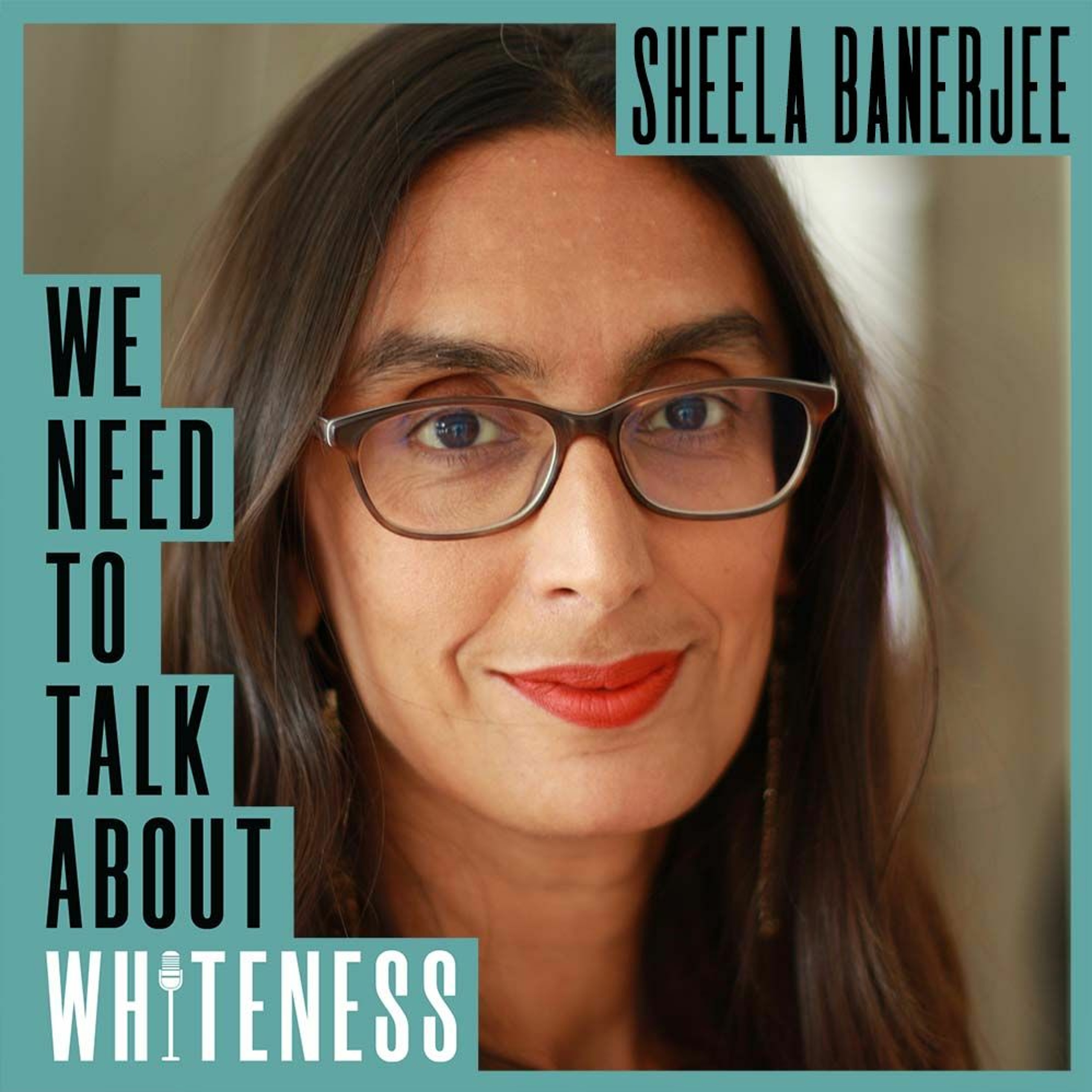
We Need To Talk About Whiteness - with Sheela Banerjee
48m 44s
In this episode of "We Need to Talk about Whiteness," host Miriam Foswa interviews Sheila Banagee about her book "What's In A Name," which uses names to tell the story of 20th-century immigration to the UK. Sheila shares how her own name, Sheila Banagee, embodies colonial history—her ancestral surname was anglicized by the British during their rule in India. She explains that names are powerful markers of power dynamics, showing how immigrants often changed or adapted their names to fit in and avoid racism, as her parents did by giving her a British-sounding first name. However, Sheila chose a distinctly foreign name for her daughter as a deliberate act of resistance against erasure, wanting to preserve her Bengali heritage. The discussion also touches on the evolution of British multiculturalism, noting improvements from the 1960s to today, such as greater comfort in wearing traditional clothing, but also setbacks like Brexit and anti-immigration rhetoric. Sheila emphasizes that while names are fragile threads to history, they can serve as small acts of defiance against assimilation and whiteness’s tendency to erase identities. The conversation underscores the ongoing tension between fitting in and maintaining cultural roots in a society where race and power remain deeply intertwined.
Welcome to the We Need to Talk about Whiteness Podcast. I'm your host, Miriam Foswa, and to all of our listeners. Thank you for joining us. This is a space where we explore the meaning of whiteness. As the term is used in conversations around race and racism, and as the structure pertains to different areas of our lives. Whiteness will very simply, because as someone racialized as white myself, I want to explore the meaning and impact of whiteness at our current juncture. What does whiteness mean and does it matter? Every episode I'm joined by a guest who offers unique insights into these questions and many more. Today, I'm delighted to say that I'm joined by Sheila Banagee, a journalist and academic who worked for many years at the BBC and Channel 4 directing programmes before leaving TV to undertake a PhD on Virginia Woolf and TS Eliot. She's just written a fantastic new book called What's In A Name, which distills the story of 20th century immigration to the UK, told through our names. Sheila Banagee's first book is a blend of history, memoir and politics, and it also tells us the story of multicultural Britain. Sheila, welcome. Thank you so much for being here. Hi, hello. Hey, so Sheila, what is in a name? Why did you choose to focus your book on names? I think it's like, it kind of combines two real passions, probably. I love words. I went back to college in my 30s to study English and I did a PhD and these are two or three or four important, really important words. I love stories. I was a documentary filmmaker before I worked in TV and I just love telling stories of people's lives. When I started thinking about my own name, suddenly, it's almost like a mini poem or a historical record. As soon as you start thinking about why you were given a particular name, what it means in terms of the political context around it, there's so much there, especially as an Asian in Britain, growing up in Britain and spending my adult life here, it seemed to me that it contained so much. Was there anything that you discovered on this journey about your own name? I mean, how much did you actually know? Obviously, you uncover a lot of information about your background, about your family, about your history, how much of that where you were aware of and has that changed how you feel about your own name? I think that's a really good question because I knew a bit and I had my own kind of feelings about it. So, you know, my first name, Sheila, I think, especially as a child, I really I used to feel really uncomfortable with it. I think because, you know, I had this very kind of English sounding name that actually in the 70s and 80s as a child, it belonged to much older English ladies, as my immigrant parents didn't really know that it was an older generation that had that name. So, it felt really like a dress that didn't fit. But yeah, I mean, I had my own feelings towards it, but as I did the research, I found out so much more, particularly about, you know, about the relationship of my sort of Bengali forebears or a group of Bengalis that I'm connected to and the British Empire, but also about Empire itself because in my surname, Banagy, itself is a kind of story of Empire. It's not my actual name. Originally, Banagy, which is an anglicised version of the name, was the Banagy was Bondobudtaya. And when the British came along and took over India, at some point in that sort of very uncomfortable, oppressive relationship, they changed our names and there's that story of colonialism within there. And I found out so much about that during the research. And I guess when I was reading that, you know, that, you know, your own name has a consonance that's linked to the British Empire because actually it isn't your ancestral name, which is a bit mad, really, isn't it? Like you would think it. I know. Yeah, I mean, if you think about it, what, I mean, has it changed how you feel about history and the history of that you contain within yourself as a person, as a, you know, British Asian person who, you know, I guess grew up in the British educational system with a certain telling of history and the colonial history. Yeah, how did it shifted that? I think it's really shifted. I think in terms of what I understood about it as a child, it was just, you know, I just had a funny foreign name because I grew up in a very sort of white working class, mainly working class area on the edges of West London in Hayes. But I, I, I, especially whilst writing this book, I was writing this book during when the whole Black Lives Matter protests erupted and there was so much conversation suddenly about not just slavery, which was incredibly prominent and widespread at the time, but also about the role of Britain in the whole sort of colonial enterprise. And it was right at the time that I was writing about my own name and Britain's own role, not only in India, but also in West Bengal in the very place that my family are from. And I think from growing up here and going through the education system, I studied history for O level because we did O levels at that time. And I also did it for A level and I studied 20th century history and I barely knew anything about Britain's role in India. It was mainly basically the study of Naziism, of Stalinism, with maybe a tiny, tiny bit, maybe like a few days spent on the study of Britain's colonial role. And in terms of just the basic bald facts, I felt like I, for the first time I properly understood about the ruthless extraction of wealth that went on the transfer of wealth from my ancestral country, from India to Britain in terms of the extraction of taxes, of the extraction of cotton, silk, spices, that greatly favourable terms that helped actually provide the basis of the industrial revolution in this country and the basis of the power that exists in this country. And it's not something that I felt like as I was growing up that was really even understood by someone who was studying that in terms of up, you know, up until A level, it just wasn't really a thing that was discussed. Yeah, and I mean, that's a sort of recurring theme, isn't it, that we, the erasure of parts of history means that so many people who are from, er, I guess, non-sort of white majority identities, but I guess even within that, I suppose, you know, if you're Irish, you might not feel like the official British version of Irish history is necessarily yours either. But I suppose to the extent that my normalised identities are not, er, don't have their histories reflected in terms that are going to be intelligible to anyone who lived through those experiences. Do you, um, because you, in the book, you go through the history of several different communities through, through names. Yeah. Was there anything in that exploration that you felt brought, um, understanding of our wider British identity or some of the failings within that to the fore? Was there anything that you discovered in that that you thought, you know, this is just looking at that word, a name, but it's revealed so much about, you know, a part of our history that should be known? I think, I think there were several things that came out in terms of, you know, thinking about it more widely. It was, um, in terms of how much, er, you know, as children, I think that the books about me and my friends and a group of friends, how much we all kind of experienced quite sort of severe racism or in the case of my, my Jewish friend, Marcella, her ancestors, her great grandparents, when they came over here, how much hostility there was towards, um, you know, Jewish migrants that came over here, escaping the pogrom similar to the people that might be arriving on the boats now. And then thinking about our names, um, I suppose what struck me in a way was, was how through this simple thing of your names, you can tell so much about power dynamics. And in a way, the fact that a lot of us, um, you know, in terms of Asian people have had to adapt or change their names or the discomfort that people might feel with their original names in a situation where they've arrived as immigrants and I feel forced to accommodate themselves towards the more powerful host country. It kind of shows through the way that people change their names often or in terms of the names that they choose for their children.
So for example, my parents had arrived here in the late 60s. My mom had arrived in the late 60s and my dad arrived in 1959. This was an incredibly, it was exciting for them, but it was also incredibly difficult for them. My dad was in Wolverhampton for the first few years of being here. And this was a place where his local MP was E-Nought Powell, who was banging on about how immigrants were a real threat to the white population. He had real difficulties finding accommodation. It was all sort of no dogs, no blacks, no Irish, etc. My mother, when she came, she felt like she was sort of, you know, people were treating her as if she was ignorant because her English wasn't that great. And you know, she often felt like she was, you know, that people were looking at her in a hostile manner on the streets. If she was wearing a saree, she was abused. Not saying that all of it was terrible at all, because they both really also found it incredibly exciting being in this new country. But they were definitely a disadvantage in terms of the power relations. And I think the kind of hybrid name that I've been given is a sign of the way in which they were really trying to accommodate themselves to make their kind of almost their child and themselves more, making it more comfortable for the English people around them to be with. I want to pick up on that. You say in the book, and I quote, "Indians of my generation have often felt obliged by constant mispronunciations, misspellings, and casual mockery to change their names." You then go on to say, "I wonder as Indians, if the act of abbreviating our names is a shorthand for the compromises we make." Those compromises were particularly salient, I would say, maybe for your parents' generation. I'd be curious to hear how salient they were in your own choices of, for example, naming your child and whether you or your children, do you feel like that promise has failed in some ways? As someone looking at the ways in which there was so many attempts for various communities to accommodate, and to assimilate the different terms that we hear bandied about around the idea that immigrants have to make changes in order to make themselves, to some extent, inconspicuous, is that how we are? I think that's a great word actually, to make ourselves inconspicuous, trying to fit in, and I feel like often it's a lifelong process. But also, on the other hand, there have been, there have been changes, huge changes in this country. I can't say that they were always easily one. It's been 50 years, if I think about my generation, and what I've grown up through, 50 years of resistance and protest from groups like South or Monitoring Group, or the New Monitoring Group, or all the uprisings in Brextern and Toxter, and newspapers like The Voice and Activists, so many that I can't even begin to name them, all the activists, politicians, the people that are speaking continuously, people like Doreen Lawrence now who's been campaigning for so long, and there have been changes along the way. Of course, there have beginning with probably the Race Equality Act, but also, I think, for my generation, I think we were born here, and as such, we are in a more privileged position than my parents, and I do feel that, whether or not everybody agrees with me, it's a different matter. I feel like I have a right to be, to both be here, but also to be who I want to be. That might not always be comfortable for everybody, but I think there is more space to do that. But obviously, I think it ebbs and flows. You have a shift forwards for a time. As we've seen recently, in 2020 after Black Lives Matter, it really felt like things were changing, but you've seen a huge backlash to that, with things like Stop the Boats, the Way We Treat, a Silent Seekers, the whole kind of anti-so-called woke comments daily in the media. So, it's very difficult, it's sometimes very difficult when you're faced with that, but I do think there is a difference between the 1960s, say, and now. Is that a difference that is in the nature and form, or is it a change in degrees? How would you qualify the shift? Because, to some extent, you might have expected that the promises of multicultural Britain, which I think have long evaporated. Let's be honest, does anyone even use the term multicultural in a positive way anymore? Certainly we're a positive term in the '90s, and I think even in the 2000s, and there's been a shift in the last at least one or two decades that have meant that those terms are now vilified, you know, it's like something went wrong there. So, but the promise of multiculturalism was that all of Britain's, regardless of their background, should be entitled to celebrate their heritage, their identity as part of a kind of hybrid tapestry that we all occupy as what we might call modern British identity. Has that promise actualized in any way? I think, you know, it is a complex picture in many respects. I think there are sort of, it applies differently to different groups. So obviously I'm second generation, and in terms of being accepted in this country, I think it's different for me compared to somebody who's a recent immigrant here. I think life could be incredibly tough, and almost as tough for them as it may have been for my parents, and you see that in the way that the whole debate about immigration at the moment, and I think that filters down to the way that immigrants are treated on the streets, perhaps in places, you know, that where their house, where there may not be that much of a huge, where there may not be that many numbers of other multicultural residents. So, I think it's very different, and I can only speak for myself. I think perhaps in some respects, it's much better, because when I go to my main religious function now, which is Durga Pujal, this is the main religious festival that Bengali celebrate, for example, when I, for example, wear a saree, and I'm traveling maybe on the tube to get there in my saree, I don't feel afraid in the way that I would have felt afraid for my mum being out on the streets in a saree, or I don't feel afraid to walk into a pub wearing that saree, but obviously it depends where you are in the country in London, where I live, I don't think I do, and a lot of my friends will say, "Oh, that's really nice, if they see somebody wearing a saree," whereas I don't think it was a tall comfortable for my mum, my aunts, wearing even their own clothes in the 60s, which is the saree, that was the normal day-to-day wear for them in India. So just in terms of things like that, but also, but on the other hand, what I would say is that I think many of me and my friends were slightly under an illusion and perhaps a whole kind of mythology surrounding new labour, sort of fed into that, we thought, "We're in a different ear now, we've got rid of the Tories, and in terms of race, we're going to be on a kind of upward trajectory." And I think in 2007, when I named my daughter, and I gave her a really obviously foreign name, I think I was in that world where I thought in terms of multiculturalism, in terms of race, that yes, things had been bad, but they were always going to be getting slightly better, and I really don't know if I still feel that, especially after Brexit. Yes, no, I hear that well, especially obviously with how long the conservative has been in power in this country, it's sort of hard to remember that there is an alternative in many ways. So you obviously say you chose, as you describe it, a foreign sounding name, is that how you described it for your daughter? Was this a deliberate attempt to kind of keep her connected to her roots in some way? I mean, how did you come to that decision and what was it about the name that was important to you? I think it was both things, it was some of the things we were talking about, it was both feeling, feeling that, yeah, I do feel more comfortable here as a citizen of this country,
my parents would have felt when they named me and gave me this kind of British-founding name to be kind of, you know, to fit in. But also I think I felt some anger in the fact that I felt that I shouldn't have to hide my heritage, that, you know, why should I? Why shouldn't her heritage and my heritage be present? And I wanted it to be known that it was a Bengali name or at least it wasn't, you know, it not, you know, I really like English names, but for her I felt like it should obviously be a name that signaled a different heritage. And part of that was about wanting to get away from that feeling of always trying to assimilate and I think in certain respects, you know, my community, not a lot of people actually, I often have to explain what kind of Bengalis we are, we're not Bangladesh, we're Bengalis from India. And I think they were always slightly trying to blend in. They, a lot of Bengalis didn't teach their children to speak the language. And we don't have the same presence that say Bangladesh's, or Punjabis, or Gujaratis have, you know, Bengalis often lived away from one another, partly in a way not to bring attention to themselves by living all together in one place. And sometimes, and I know it's, it's, you know, they had a really difficult time here, but sometimes I want to fight against that. And in a way, naming is a small act of, you know, just a bit of personal resistance to that feeling. I don't want to have to assimilate in that way. And have you kind of explored the reason for that? Because I suppose it's interesting you describe naming as an act of resistance. That's something I really relate to. And, you know, I very deliberately gave my son a name that speaks to his Muslim heritage because it was very important for me that because he presents, you know, racially as white, that he is connected to a heritage that goes beyond whiteness, both for himself. But also for wider society, you know, I think, you know, a little moment that could be perplexing, but there's actually really important in, in when people sort of go, oh, you know, they ask him to repeat his name and often anglicise it, actually. Because they assume it's going to be an anglicised name. And I was wondering whether that act of resistance for you felt connected to the fact that the, our children will carry with them a responsibility to uphold parts of our common identity, societal identity, you know, British identity, I guess, that might otherwise be erased. And I wonder whether you connect that to whiteness in the way in which whiteness operates. Obviously, historically, we saw that whiteness operates through erasure, through physical erasure of cultures and peoples and languages. And, but also, you know, with that, the erasure of identities. So, yeah. Yeah, no, I definitely, I definitely wanted a name that almost halted that erasure in its tracks because I think with my own name, there is partly an erasure. When you look at my, when you hear my name, my identity isn't there, you know, if you hear the name Sheila. And part part of the reason why I didn't take on my husband's surname, you know, I'm married to somebody whose English whose surname is Canal, you know, if I was Sheila Canal, then my heritage is gone. And people can't see it there unless they actually speak to me. And I think definitely with my daughter's name, I wanted to stop that. Obviously, you know, it's up to her whether she carries it or not. But I think your name is a quite a fragile thread, but it's still a thread to centuries of history and heritage and identity. And because you say it the whole time, you say it every day, it almost becomes a part of yourself in a small way. And I think that's why it's important. And that's why in a way people find it hurtful or annoying or really traumatic when people repeatedly say or pronounce their names wrong. And so it is important, even though they're just words, and they often feel like they're just mundane things. They're an important way of passing on some kind of identity, some kind of culture from where my parents are from. I'd not know, actually, you raised something that I really wanted to ask you about. Because I think a lot of people might think, "Oh, I'm. because we hear it all the time, people's names being mispronounced." And some people will react and say, "Well, oh, sorry, my name's actually X. Can you try and pronounce that again?" And sometimes they'll get a very conciliatory response. But sometimes they can get an aggressive response, right? Which is a bit like, "Oh, stop trying to annoy us with your name. Can I just call you Sue?" And I'm sure you've probably experienced this or come across it many times. But how do you read those situations when. And this is typically a situation where someone racialized as white might be called out on their pronunciation, which in itself isn't an attack on your person, but reacts quite negatively to being asked to pronounce the name correctly. How do you read those interactions? I think it can feel incredibly diminishing. And I think it sort of speaks of power, really. It may feel like an individual thing. And names are sometimes difficult to pronounce, that are in a different language, that come from a different linguistic heritage. But, you know, for example, I mean, I've obviously not had it because Sheila is both an English name and a Bengali name as well. But, you know, virtually all my cousins, my parents, have had to change their names because of it being mispronounced. And I remember my cousin telling me, my cousin's name is this beautiful name. It's of a film star who was popular in the '70s. And it's Moschemy. So, it's Moschemy. So not that difficult. But, she says every time at school they had a new teacher, there would be sniggering and laughing. And with one teacher even refusing to call her by this name for the entirety of her time at school. So, it became incredibly difficult. And she just changed Moschemy just to Mo. And Mo really is a name that doesn't have any meaning. And it's kind of torn from its linguistic roots. And I think that's death very definitely. It's about not just power over an adult over a child, but the, it speaks of power also within the society, I think, because people feel that they don't quite have to. It's not really incumbent upon them to try and get the pronunciation right. If you reverse that, for example, if you think of the British in India, and obviously they were in an incredibly powerful situation I'm talking during colonial times, you didn't find that the British shortened their names, took on names that were both Indian and English. They kept their original names and expected us as Indians to be able to pronounce them. There was no accommodation or very little accommodation then. So, I do think that individually it might make life easier and that's why people might shorten their name. For example, my dad shortened his name from Balaji, which is B-A-L-A-J-I, Balaji. So fairly easy to pronounce. But he was like I said, he was in Wolverhampton in the 1960s and he was finding it hard enough to get a job, get somewhere to live, let alone trying to get people who were often being completely bombarded by racist statements all around them from politicians and from the media to try and get them to get his name right. And again, I think it tells his speaks of your vulnerable status as an immigrant trying to make a home in a new, often hostile country. So I often think it can really be, it can really illuminate the power structures within the surrounding society. Yeah, absolutely. I'll never forget an anecdote from British Asian friend of mine who got a very, I won't say any names, but it was a very senior job at the BBC and he headed up a big department where he was the only person of colour in the department. And on his first day, he went around and met the other people in the office and they were, you know, it was the Johns and the James and the Mary's and the Suzan character but you get the picture. So he went around pretending to not be able to pronounce their names and rename them all. - Awesome. - I sure.
for the content, for the whole extent of his time there, he only ever referred to them by these names. I just thought this was absolutely hilarious because they were just at Bamboo's all by this, but it was it was it speaks to the power play that you've just referred to, right, which is actually when somebody does that to you, how do you feel about not being kind of fully seen for who you are and sort of being having a name imposed on you that has nothing to do with who you are, but might be easier for the person in front of you. And yes, so I think those those power dynamics obviously are a big facet of whiteness, the big aspects of the way in which sort of whiteness operates as a sort of implicit hierarchy of value, which says well, you know, you know, explicitly or implicitly, whiter sounding names are quote unquote more appropriate or read acceptable socially acceptable. Yeah, and I think it's it's it doesn't, you know, in terms of yes, and at the moment, you know, you would say or in the recent history, you would say that applies to, you know, often darker skin people, but I think at the turn of the century with Jewish people, it was exactly the same. So my friend Marcellus Graham parents who were Russian Jews who fled the pogroms in Zara, Estrusha in in the early 1900s, they were called higher and that was her great grandmother and Maya, her great grandfather, and the surname is unknown what it may have been, it may have been Gates, Gatsky, or it probably wasn't Gates, it may have been Gats or Gatsky or Gershavitz, it's unclear. But as soon as they came over here, we found out in the census in 1901, they had changed those very obviously Jewish first names of higher and Maya to Annie and Lewis. Again, I think as it sort of speaks of the complete sort of paleness and the absolute sort of whatever they did everything they could to fit in and to survive and changing their names was one of their first acts of survival in a very hostile environment. And I suppose a big difference with sort of communities of colours that, you know, a couple of generations down the line, Annie and Lewis just look like any other white British, Annie and Lewis, whereas, you know, Sheila will still be asked questions about, you know, obviously, Sheila here being you would still be asked questions about your heritage or do you also probably would still be asked questions about that heritage because the sort of visibility of difference continues to be carried through as a marker of separateness. Yeah, yeah, yeah, that's always, yeah, which is the skin colour will remain. The skin colour remains as a kind of continued marker of hierarchy in our society and I think that's the bit that sort of the movement for equality can continue, but ultimately we know that the names can change, but ultimately there weren't a race the ways in which people have perceived, you know, once you get face to face ultimately. Now, you say something in the book about names in Britain are a social code that we all understand. I wanted to ask you about that in relation to both, I guess, race and class in this context. Yeah, I mean, I think looking back now, one of the places that I really felt this was when in my 20s, I got a job at the BBC and I worked as an interview both at the BBC and, you know, several production companies and there was such a stark difference in, say, if you just think of the female names that I'd grown up with at my working class school, both my primary and secondary school, you know, names like Lisa, Tracy, Donna, Michelle, you know, where were those people when I got to the BBC, when I got to the BBC, it was suddenly all charlots and loosies and so fees and emmers and, you know, obviously, these people, some of them ended up, as they say, becoming my best friends, but there was obviously the names were a marker of a massive, massive amount of privilege that was going on in terms of class, like who was it that was working in, you know, an organisation like the BBC, who was being allowed through those gates to actually work in what was quite a powerful place to be. And the names were clearly signalling that it was a certain kind of, a certain kind of person, same kind of class and often the same race. So yeah, I think it's not the only thing, but I do think names are a huge marker of class and you can often tell what is going on with class if you look at the names of the people that are working there. And even now, if I kind of go online now, you know, the BBC to a certain extent, a lot of it has been hollowed out and a lot of television programs nowadays are made by huge independent production companies. If you go on to those production companies website pages where you have that kind of meet the team page, a most of them are white and b, again, it's those, you know, the emmers, the loosies, the charlots, the gates, the Julietts, the Laura's, you know, again, not many traces, not many donners, if you're looking at people that are my age, the working class names that were around that were prevalent at the time, I don't see many of those names in things like media, in academia or even in publishing. Yeah, and often if you see them, they're the production coordinator. Yeah, or writing. Very, very, very important role actually, but I'm sort of suggesting that it's still a kind of organisation role rather than a substantive role in terms of the nature of the programs that are being made per se. I wanted to ask you about the other aspect of naming before we go on to the quick fire round, sorry, I wanted to ask you about the extent to which we are when we lose other aspects of naming because in other cultures there are names that are given that have ultimately different meanings, beyond simply giving someone a name that they can be identified with. So I'm thinking, for example, in Turkish culture, which I'm slightly more familiar with on this occasion, which refers, for example, to the, you know, if you're going to talk to somebody that's older than you, you're more than likely not going to refer to them by their first name, probably call them, you know, you'd call them RB or if, you know, women or Abla or, you know, or we often hear in the UK, we'll say auntie, right? You wouldn't call somebody, you wouldn't call somebody's mum by her first name in many communities, you'd always say auntie or hasja, you know, in the Muslim community, you know, it's like as a term of deference. So in terms, yeah, so in terms of names that we, we're almost limited in a way in Western culture to the kind of formalistic naming, but is there another layer to naming that you kind of uncovered that offers new layers of richness to identity that we could maybe benefit from? What, what did you, I know, you've talked a lot about it in the different communities. Yeah, no, definitely. I mean, sorry, am I having something bad to do? Oh, no, not at all. So I was one of the things that became, I started thinking about was how in Bengali culture, you know, when I lived in India, you'd have one person would have, and it would have so many different titles. And as you say, a lot, a lot of it was based on respect for age and that was a huge thing. And so, for example, if I take my aunt, who was my dad's sister, and she was the oldest sister, so she had a dark nom, which was a nickname, and that sort of was a name that was only used in the family. And she was called Luchmi, but her, her Bhalunam, her good name for the official world was Monshushri. But then to me, she was Boral Pishy, Boral means oldest, and Pishy means aunt on the father's side, so your father's sister. But then to my cousins who, you know, to her sister's kids, she would be Boral Mushy, so oldest aunt on the on the sister's side. And then there would be all kinds of other titles as well. So, you know, she'd have a different title for her husband's family's kids, you know, she might be Jettima or Kaki Ma, or, you know, she could be Mami Ma, you know, that's so many.
different titles for one person and it would set what I would call her or somebody else would call her would immediately explain both to her and to the outside world and to me what relationship she is to me and it would be and everybody understands this or exactly and often it's there's a gradation according to age and if you have a title that kind of signifies that you're older you also accompany that you would have sort of rights and responsibilities and also you'd be accorded lots of respect so for example when I went over there my cousins who are kind of regarded as siblings over there and they're called you know born which means little sister or diddi which is older sister my cousins often wanted to call me the title for older sister which is diddi and me being from England I didn't I didn't really like it because I felt like oh no my name Sheila I don't want to be called diddi but actually it's a sign of it's a sign of respect even if I was at just a few months older I still was a diddi and I was to be accorded respect but also it was my duty as the older sister to look after these little cousins so there's a whole layer of relations that when I was writing the book I suddenly kind of realised that oh my god there's so many different titles that are around and I guess the erasure of those names comes with the erasure of community and you know I mean obviously a teenage you probably wasn't a big fan of the responsibility side of community but there's you know in increasingly sort of individualistic societies that we live in I suppose there's something to be said for terminology that carries within it a sense of deference towards the elderly towards older people and responsibility towards those around us so I was struck that you know the name the exploration of names goes beyond just the names that we might have on our passports but to the loss of names that connects us that connects us to community as well and so yeah I mean yes definitely so my friend Maria when she was naming her son you know the the tradition the strong tradition in in Greek Cypriot culture which she's from was to is to name your the first born son after the grandfather the paternal grandfather if he's around or the maternal grandfather if he's not around and so Maria felt this huge pressure to name her son after her father and her father's name was Polycarposs and she just didn't feel in in you know early 2000s London that that would be a name that she could give to her son that she would be confident that it wouldn't become a burden and there was this whole tension you know it's difficult speaking for her you know because she's she's my friend but you know as I understood it there was a whole tension between what she felt was a duty and her desire to kind of honour what her father had been through coming over here but also her duty towards her son and also her own wishes and there is a tension I think in naming and in the titles that you might receive about you know that desire to hold on to your community and holding on to tradition and your heritage but also attention with you know your own desires that are separate from the families role the role that you occupy within the family or the family's expectations of you absolutely well on that note we are going to have to head over to the quick fire round just because we're running out of time so questions with quick fire responses if you can you know us now um what is your definition of whiteness obviously the show is called we need to talk about whiteness what's your definition of whiteness um I suppose a kind of in in the particular epoch that we're in now it's based on skin colour and privileges that you might enjoy just because of the skin colour but I think it also translates hugely into class and it's very intertwined with class I don't think you can completely sort of just focus on one thing that's my personal view what is the root of racism um I possibly think again this is my opinion and speaking for in the in this sort of particular era uh I think it's economics probably it's to it's a useful tool to uh sort of mask what's actually going on in terms of economic structures and inequality um so yeah that's what I would say in a short answer when it comes to race and racism what's one thing you wish everybody knew or understood um that it's rubbish it's it's very silly it's skin colour regardless so it doesn't mean anything so and we're all just people that's that's what I wish they knew and I wish also that they I wish people would understand like currently I you know obviously I think that what's going on with this whole anti migrant rhetoric that's around that we're being distracted by racism from the actual sources of the problems which are about you know too few people at the top a system where too few people at the top have far too much of the wealth and that's how they want to keep it so that's that's what I wish people knew I suppose what is the opposite of whiteness um I suppose being non-white but also uh kind of it dissolving in terms of something that anyone pays any attention to it seems kind of quite ludicrous really we often hear an almost idealized version of the future from some people that speaks to the idea that we could one day be a post-racial society is that universalist ideal ever achievable or even desirable um I I suppose maybe because I sort of you know kind of bought into the idea of multiculturalism I like the differences partly so it's not that I want to get rid of all differences and one of the one of the things that was supposed to be such a compliment when I was a kid you know I just think of you as the same as you know English people you know and maybe maybe I don't quite want that I think we've all got our amazing kind of differences and things that we can bring so I partly want it to to go away and be in a post-racial society because it's horrible racism is awful but at the same time I don't want to get rid of every little kind of difference between us um thank you so much Sheila if people want to purchase your book where should they head do we have a bookstore of choice bookseller of choice um well I live near Stoke Newington bookshop so that's I would say that that's a good place to buy it but um apart from that all the usual places I think bookstore.org and waterstones and if you have two Amazon I suppose or go into your local bookshop with the Amazon page. Amazing Sheila Banagy thank you so much for your time thank you of course to all of our listeners for tuning in to this episode of where we need to talk about whiteness please do subscribe on iTunes, Spotify or SoundCloud and join us next time for more conversations on whiteness thank you so much. Thank you.
Podcast Summary
Key Points:
The podcast explores the meaning of whiteness and its impact on race and racism.
Guest Sheila Banagee discusses her book "What's In A Name," which examines 20th-century UK immigration through names.
Sheila's own name reflects colonial history
Names reveal power dynamics, such as immigrants changing names to accommodate the host country and avoid racism.
Sheila notes a shift from her parents' generation (facing overt racism) to her own (greater comfort but ongoing challenges like Brexit backlash).
She chose a foreign name for her daughter as an act of resistance against erasure and assimilation.
The conversation highlights the fragility of names as threads connecting to heritage, and the struggle between assimilation and identity preservation.
Summary:
In this episode of "We Need to Talk about Whiteness," host Miriam Foswa interviews Sheila Banagee about her book "What's In A Name," which uses names to tell the story of 20th-century immigration to the UK. Sheila shares how her own name, Sheila Banagee, embodies colonial history—her ancestral surname was anglicized by the British during their rule in India. She explains that names are powerful markers of power dynamics, showing how immigrants often changed or adapted their names to fit in and avoid racism, as her parents did by giving her a British-sounding first name.
However, Sheila chose a distinctly foreign name for her daughter as a deliberate act of resistance against erasure, wanting to preserve her Bengali heritage. The discussion also touches on the evolution of British multiculturalism, noting improvements from the 1960s to today, such as greater comfort in wearing traditional clothing, but also setbacks like Brexit and anti-immigration rhetoric. Sheila emphasizes that while names are fragile threads to history, they can serve as small acts of defiance against assimilation and whiteness’s tendency to erase identities.
The conversation underscores the ongoing tension between fitting in and maintaining cultural roots in a society where race and power remain deeply intertwined.
FAQs
It explores the meaning of whiteness in conversations about race and racism, and how it impacts different areas of life.
Sheila Banagee, a journalist and academic who wrote the book 'What's In A Name' about immigration to the UK through names.
She loves words and stories, and saw names as a way to explore personal history, political context, and the story of immigration.
She learned that her surname Banagee is an anglicized version of a Bengali name, changed during British colonial rule, revealing a story of empire and power dynamics.
It deepened her understanding of Britain's ruthless extraction of wealth from India and the lack of education on this topic in her schooling.
Names reveal power dynamics and compromises, such as Asian people adapting or changing names to fit in with a more powerful host country.
Chat with AI
Loading...
Pro features
Go deeper with this episode
Unlock creator-grade tools that turn any transcript into show notes and subtitle files.
 PodcastTranscript AI