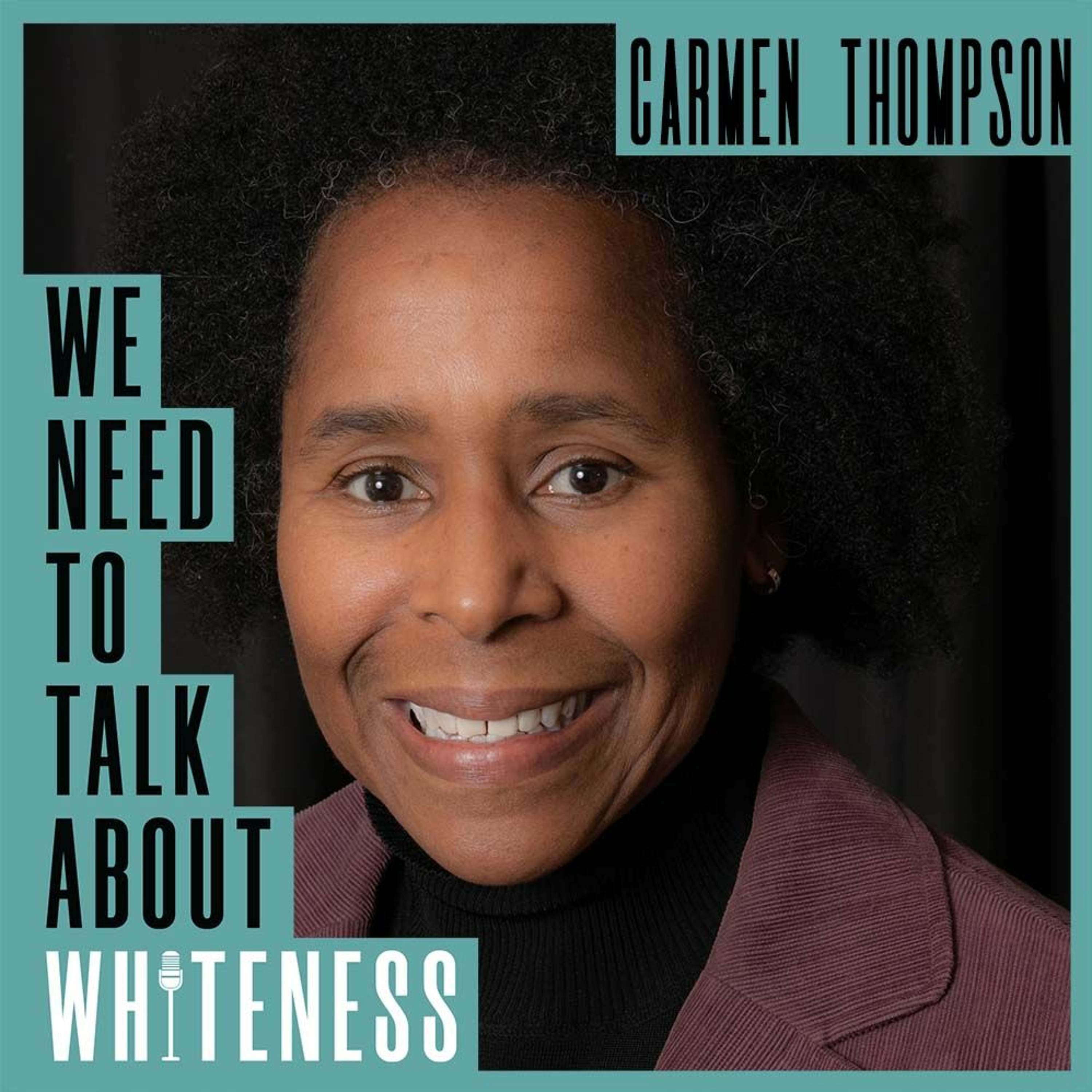
We Need To Talk About Whiteness - with Carmen Thompson
1h 1m 33s
Dr. Carmen P. Thompson, historian and author of *The Making of American Whiteness*, explores the deep historical roots of whiteness as a systemic, not just personal, form of oppression. She argues that whiteness originated in early colonial America through the actions of European settlers who privileged their own status over Indigenous and African populations, long before the word "white" was used. This system of racial hierarchy was institutionalized through policies like land ownership, voting rights, and segregation, which created enduring inequalities. Thompson emphasizes that racism is not merely about overt hatred but is embedded in social, political, and economic structures—such as housing, education, and access to wealth—that maintain white privilege. She critiques the myth of a "post-racial" society, highlighting how the civil rights movement was oversimplified, and how structural racism continues in institutions today. The elimination of discriminatory practices does not erase the systemic foundations that enabled them. Thompson calls for a shift from personal accountability to systemic reform, urging individuals and institutions to audit policies for racial bias and to dismantle structures that perpetuate inequality. She also warns that efforts to silence Black history and African American studies are part of a broader strategy by white-dominated systems to maintain racial division and prevent solidarity. Ultimately, true racial justice requires recognizing the systemic nature of racism, dismantling discriminatory practices, and building a multi-racial democracy where race does not determine one’s quality of life or access to resources. This requires both awareness and active, sustained engagement in transforming societal structures.
Welcome to the We need to talk about whiteness podcast. I'm your host, Miriam Froswa, and
to all of our listeners, thank you for joining us. This is a space where we explore the
meaning of whiteness as the term is used in conversations around race and racism and
as it pertains to different areas of our lives. Why whiteness? Well, very simply because
as someone racialized as white myself, I want to explore the meaning and impact of whiteness
at our current juncture. What does whiteness mean? And does it matter? Every episode I'm
joined by a guest who offers unique insights into these questions and many more. Today I'm joined
by historian and author of the Making of American Whiteness, the Formation of Race in 17th century
Virginia, Dr. Carmen P. Thompson. Dr. Thompson is a highly sought out expert on race and whiteness
in America whose scholarship has been quoted in historic court judgments. She wrote the introduction
to the forthcoming book Protest City, Portland's Summer of Rage, a photo book that chronicles
the year-long protests in Portland, Oregon after the murder of George Floyd at the hands of police
in 2020 and she's held a visiting scholar appointment at the Institute for Research in African-American
Studies at Columbia University in New York and in the Black Studies Department at Portland State
University. We are very lucky to have her with us today. Dr. Thompson, thank you for joining us.
How are you doing today? Wonderful, thank you for having me. Well, delighted. I mean, I always
like to start out by asking our guests to tell us a little bit about themselves. Of course,
beyond the accolades, where did you grow up? How did these subjects come to become such an important
part of what you would dedicate your life to working on? Yeah, I grew up in Portland, Oregon,
my African-American woman, Black woman. I go by African-American or Black. I grew up in Portland,
Oregon, in the United States. Portland is the widest city in the United States with a population
of over 500,000 people. So there's in the whole state of about 5 million people in the state,
less than 2% of the population is Black or African-American. And those people, I'd say 95% of those
African-American or Black people live in Portland. And so that's the city that I grew up in.
So I was keenly aware of my blackness even though I have friends, you know, and get along with
everybody. But I was keenly aware of my blackness and just growing up, I just kind of always wanted
to know why it was, first of all, that African people were chosen by Europeans for enslavement,
thinking of just the transatlantic slave trade, thinking of just slavery in the United States
and how that operated. I just wanted to know why Black people, why was it that white people,
and then this is my childhood self, why was it that white people just didn't like Black people,
that they had all these laws and policies, I'm thinking Jim Crow, fire hoses, lynchings,
just discrimination, just really hating and disliking somebody simply because they're Black.
This as a child is something that I didn't understand. And you know, why is it that Black people
were segregated, that they couldn't live in certain neighborhoods, that they had just all this
vitriol against them? I couldn't understand that even though at the time that I was thinking of all
this clearly, you know, I had lived by whites, you know, people were getting along, we were getting
along kind of day to day. But it really, my young mind didn't quite understand it, but it really
was more kind of the systematic government policies and practices and legislative aspect of it,
that in my mind that I was too young to understand that I was really trying to grapple with.
And then besides just what, you know, general dislike and anti-Blackness that was happening
from childhood that I kind of picked up on, even though I grew up in a household, single mom,
who, you know, had friends of all races too. So it was never any conflict, but I just kind of
noticed from the social cues, even as early as second and third grade that there was just this
difference between Black and White people in particular in Portland. And then I wanted to know,
as I've gotten older, you know, how it was that Black people in America were ranked the lowest
and White people were ranked the highest on the social order of things and all the other racial
groups were kind of ranked in between. So it's like, where did we get this racial hierarchy from?
Where did, how did this come about? And how does it just kind of maintain and sustain itself
over centuries? And I kind of wanted to understand that. And that basically fueled my graduate
studies at the University of Illinois and at Columbia University in New York trying to understand
the Black experience, but particularly just trying to understand whiteness because clearly a lot
of the problems that Black and African-American people have had in the United States is a direct
result of the anti-Blackness that white people have directed towards them. And so I just kind of
wanted to understand what was the origins of all this and where did this come from. And so that
then became the basis of my research and of my studies and then ultimately of this book.
Wow. Wow. That's fascinating. And also so much to unpick there. There's so many questions that I
want to pick kind of follow up. And I guess my, my first one listening to you is thinking about
you as a child and not just you, but so many other children sort of African-American
children, Black children who navigate the world trying to make sense of why they're experiencing
second-class treatment right every turn. And you know, that's something that could only be a
profoundly scarring experience. But then I was also thinking about how the experience of that could,
I feel that there's a discourse around race that tends to focus a lot on hate. And I sometimes
I wonder whether the focus on hate is a distraction from the systems that underpin race. And I was
wondering, you know, as an adult today who's, who's studied this so much, how do you view the
relationship now between kind of the conversational race that says, you know, it's sort of a hatred of
Black people or it's a hatred of people of color. And I guess the other conversation that would say,
well, that's just a byproduct of a wider system that requires maybe a dehumanization of certain
groups. I mean, yeah, what's your analysis on that, of that little girl's interpretation of
the world? Yeah, I mean, it, you know, whiteness and white supremacy in these terms, you know,
hate is an aspect of it, but it is born out of just this system, right, of policies, codes,
implicit and explicit, and all kinds of, you know, mechanisms in society that are overtly and
subjectively used to, you know, subjugate Black people in the United States. And so hate is one
aspect of it, that's an expression of it because all of the policies and practices and treatment
tells you that that is okay. So it manifests itself sometimes outwardly, you know, as hate,
I always tell people that, you know, white supremacy isn't just about, you know, of the KKK,
Donning Rooms are burning crosses, but it can be that. It's not just individual acts of racism by
just this lone wolf person that's racist. And it can be that too, but it really is more of a
systemic thing that then is embodied by group, by people, by humans, by European people that then
are acted out in the form of hate or in the form of, you know, discriminatory practices and policies
that, you know, have redlining or where you can live, where you can go to school, you know,
where you have access to things, money or that or just day-to-day treatment levels of respect.
I mean, there's all kinds of ways, every aspect socially that you can think about as well as
institutionally and politically. So they go hand in hand, but just the outward, you know,
act of hate, that's one aspect of it that really is born out of a systemic aspect of it.
And then it's also about the belief that you think of people of European ancestry are better
than people of African ancestry, that there are more superior that European people have access
to certain rights and they have certain privileges and that their society, their way of thinking,
their laws and policies and practices and ways of being are better than people of African descent.
And that is told in society in a variety of ways, as my young child experience,
I noticed without anybody directly saying this, that, you know, by the way that people are treated,
that obviously if you're treating black people worse,
and white people better, then clearly you have an idea about your own whiteness, about
your own superiority that's implicit and explicit through the various policies and practices.
And that are happening in societies, politics and social customs and all the various ways
in which we come to understand the world that we live in.
So clearly there's this distinction that's both explicit and implied, you know, subjective
and a variety of policies and practices that people begin to then see and look at.
I was able to see and notice it.
And then people come of your pan ancestry to be able to internalize and in doing so as
they internalize that, they then begin to act on that in a variety of ways.
And some people may act on that, you know, more explicitly and directly than others coming
out as hate and, you know, KKK.
Others may act upon it and just, you know, how it is that they interact with people and
discriminatory practices, things on their job, you know, where they live, where they choose
not to live, who they choose to have as their friends.
There's all kinds of ways in which that expresses itself, but it is a culture, it is a system
within a society that people choose to act on or participate in.
And sometimes it's unconscious because people don't quite see it, you know, I always say
a fish doesn't know as in water.
So you don't necessarily see it.
And so when I look back to my studies at the origins of it, I can see how when you structure
an organized society around white supremacy, privileging white people, then your side, the social
structure, the water in which the society is founded in, that then is formed with white
supremacy.
So then as time goes on and it continues to reify itself, a century after century, generation
after generation, people don't quite see the origins of it or that is even a thing because
that's the only way the society has ever interacted.
So it's not going to stand out as being a thing or being a normal or being, you know, kind
of directly or explicitly any black, even though it is or even pro white, even though
it is because the air you breathe, the water you swim in, everything that's around you
is about white supremacy.
So it doesn't stand out as being unusual because that's the only way that it's ever been.
Yeah, no, that makes a lot of sense.
I want to ask you about those kind of implicit hierarchies that I think, you know, a lot
of us are replicating, as you say, more or less consciously day to day.
And I mean, I often use the example of our attitudes here in Europe.
We have this recurrent debate around, you know, the treatment of refugees who are arriving
on boats and, you know, in Europe in the last couple of years, there's been a shift in
policy around the European border control.
We've had basically what they call a let them drown policy, which is that the boats, yes,
do not intervene to assist, yes.
And so to me, because I, whenever we talk about this idea that white supremacy continues
to replicate a sense of white lives being more valuable, I think a lot of people are
racialized as white, kind of instinctively bulk at that, right?
Even myself, I would be like, oh, no, no, no, of course not.
We, you know, I believe in equal rights for everyone.
And I think everyone should benefit.
And I'm sure most of us really believe that.
But actually, when we look at the way that our societies operate at different levels,
we can see that clearly, if a, you know, a white European child was drowning fell off
a boat that, you know, that would be immediately considered someone who should be saved.
And yet, you know, maybe a child fleeing war with their parents, that child now, you
know, by virtue of their origin and their kind of exclusion of the boundaries of the safety
net of whiteness of European whiteness is now left to drown.
And I wanted to ask you about the ways in which you see that manifesting in other areas
that people may not realize, you know, because I do think a lot of people will hear the statement,
oh, you know, white supremacy kind of still dominates in, you know, in our instincts,
in our day-to-day reactions to things and I'm certain that it does.
And I would love to hear what other areas that you think we should all be paying more
attention to that highlight the way in which white supremacy continues to manifest in just
even day-to-day responses we might have to things.
Yeah, I mean, a lot of people, you know, don't like to think of, they think of white supremacy
and they somehow feels like that because they're white and all of a sudden, you know, it's
some reflection on them.
And one of the ways I like to get people to think of it is to detach the personal from
it and look at it as an organizational system in society, how the society is organized
and set up because all governments have a system to which a society is organized and
it's organized to benefit certain people.
We live in capitalist society.
So by definition, capitalism is discriminatory, right?
It's about certain people having more than others, you know, that's just going to be in
eight in the system, it's just part of the system and when you have a system like that,
for example, then certain people are going to have more advantages and others and that's
not, you know, just by organically that way is designed that way so that certain groups
will have more access to money and more access to privileges and advantages and that then
continues to replicate itself in various ways and, you know, who gets tax benefits, who
gets tax breaks, who can have access to capital, you know, who can have access to a variety
of services, who can run for political office, who has access to the franchise and the right
to vote, you know, who can live in certain places, you know, who has access to wealth.
All of those things are set up that way and because I'm an early American, I look at
the founding of the society and you can see how it's set up to be a certain way.
So if you look at the systematic approach to things from the very beginning, the organizational
structure of it, then you can see the inequalities within it and you can take any area or sector
of society but if you just go back, say, for example, in the United States, you know,
and you look at housing, for example, there was this way that black people couldn't live
in certain neighborhoods.
Now, it's like, and that's just like post-slavery, right? I mean, if you just go into the 1950s
or '60s, let's just take that because most people can think of the civil rights movement
and Martin Luther King.
Why were they, you know, spraying hoses on black people?
Why was it that black people couldn't marry?
I mean, these are things, you know, marry other white people.
You know, that was against the law, you know, in that loving case that happened.
I think it was in the '70s before it, federally, that it was legal for black people to marry
white people, that that was against the law.
So, I mean, why would you even have that?
Okay, so that's just, like, if you're not thinking, oh, it's not discriminatory, okay?
Well, then you take a look at, you know, black people marrying white people, you know,
and that being kind of outlawed in the '70s or the Brown versus Board of Education in 1954
took a Supreme Court decision to say that black people could live in, could sit in the
same classrooms and go to school with white people, okay?
There was a long history even before you got to that.
But then why, what was happening in society such that black people couldn't be in the
same space as white people, and in the same school, and it took a Supreme Court decision,
and then it took 20 years of litigation after that.
I was bust myself in the 1970s, that little girl that I was talking about, that little
Carmen, that I was talking about in the second and third grade, I'm a bust, why do I need
to be bust?
Why can't my school have the same thing that the white schools had?
You know, I talked to one of my great aunts, who, you know, there was the white school and
the black school, and she's like 90 years old, and the white, we used to get the hemmedown
books from the white school, and their school was like, you know, some Christine College
campus, even in high school, and theirs was like some rundown check.
And so it's just like, if you just look at how it is that laws and policies and practices
within your society have taken shape over time, even in people's lifetime, and if they
go back and they would like, well, how did it get that way?
What were these policies and practices, and then if someone says, well, it's not like
that anymore, but it's like, yeah, but you had that whole history.
So let's just say for the sake of argument that discrimination stopped, you know, in practice
and in policy, say in 1980, okay, but did that system and structure that caused that
discriminatory practice to be in fruition from founding all the way to 1980?
Did those systems and structures change in 1980?
Or they just simply said, okay, you can live here now, okay, you can vote here now, and
you had no overturn of the policies and practices that allowed that long history of discrimination
to be in place.
prior to 1980. So if everything that led up to 1980 stayed intact other than the fact that now I can go to this school now I can live in this neighborhood and you've made no systemic or cultural policy changes that allowed it to happen in the first place.
And clearly this is just going to continue to produce itself in the same way that like when Barack Obama was elected president in the United States you had this long history of discriminatory practices where black people couldn't vote they were held out of offices they weren't allowed to have the franchise at all.
So just because he got elected in in in 2008 that doesn't mean that that whole system of in the United States of elected presidents that happened all the way from George Washington to Obama that all of a sudden that history was wiped away just because you have a black man in there now that system is still intact.
You just have a black face in this totally white system nothing has changed no laws and practices have changed it just said okay now black person can run but that long infrastructure up until then is still in place.
And you can see that in a variety of areas with electoral college and all of these things that date back to the trend to the slavery within the United States that system that structure is intact.
And the only difference is is now you as a black person have the right to enter into this space.
Well the whole structure is exactly the same that it was the only difference is is that now your face can be here well if that's the case then that means that the way in which the institution replicates itself in the ways in which it makes policy looks at the world.
And sees the world is from that same institutional framework that allows a discrimination to happen in the first place.
And so I want people to kind of move away from the personal and look at the systemic and structural so if you look at what was the housing practices you know in your city or what was the political practices who had access to politics who had access to living in certain spaces who had access to loans.
And then if you look at that whole structure that had to set that up and then you say well now we don't do that does that mean then that all those practices that set it up in the first place to be discriminatory does that mean that they all went away just because we say we no longer do that.
No that structures in place and is just has a black face that can now have access to something that they couldn't have access to before that doesn't mean that structurally and systemically that that system has changed and that's what I want people look at and I think when people look at it from a systemic standpoint then it can take the personal out of it and say I'm not necessarily doing this even though you could be still buying into it.
But that you can see it at least from a systemic standpoint and systematic standpoint how it's institutionalized in the policies and practices of whatever sector or industry that you may be looking at at a particular moment and time.
Well thank you that was that was taking us to of course this this wonderful book that you've written that can help elucidate the history right of the system that we you were just talking about and I and I definitely want to get on to that I wanted to ask you just before if you feel that part of the
problem seems to be that the civil rights movement was maybe perceived by a lot of white people as one moment as opposed to a series of ongoing struggles which are not over and because of that there is
a perception maybe and and you will know far more about this than me but just as an outsider looking at the US I sometimes think it almost feels as if America you know white
America has written the history books in a way that says we have the civil rights struggle you know African Americans got equal rights and now we're done and and then I you know will read African
American scholars who you know will point out a lot of things that you're pointing out of course as well and saying well you know that was just one of the early stages of unpicking the system of white supremacy so so where does the sort
of perception of the civil rights struggle and of what I'm trying to think what I think what I'm what I'm curious about is is the way that we
have depicted in American history the civil rights struggle part of the problem of not recognizing that this isn't just that the work isn't done.
Yeah because you know we just I think it was one scholar panel Joseph said that you know US history you know it's told kind of like a little by like a bedtime story so beginning of middle and a triumphal ending you know you want to just have this story where it's just kind
of all neat and tidy and first of all I would say it's the epitome of whiteness and white supremacy to really say when discrimination is over and what it's about and when it ended and you're
defining even for the people who are being discriminated against what it is that discrimination is how their own lived experience really were by how it is that you talk about it in the history books or with this
anti-woke culture refusing to allow people to talk about their experiences that's why supremacy at its at its height right that you're actually dictating the terms of someone else's own
discriminatory experiences by how it is you're telling them don't worry about this anymore it's all over well you let other people tell the story right and why is it that they had
to struggle for that in the first place they had to struggle because there were laws and policies and practices that allowed that disallowed black people to have access to so many sectors
of society and just because then now all of a sudden black people can vote for example which was always in the constitution in the United States
and then now that they can vote then the problem is all of a sudden solved it's not it's still part of the system and the structure of society
so we have not achieved kind of this multi-gracial democratic society that is equal because the institutional practices that allowed it to happen in the first place
is still there and as I said just bringing a black face into a white space that had excluded them for centuries does not make discrimination go away
does not make white supremacy go away until we look at our policies and practices who has access to spaces including the politics including the right to vote
how it is that we accept people or not and the rules of policies and ways that they have it laid out in society about access and about benefits and about rewards and society
until we can really look at each individual sector of society and do kind of a racial audit of how it is that these systems continue to replicate themselves
whether you're looking at the healthcare industry whether you have disparate outcomes regardless of class regardless of insurance where you still see that black people in the United States have higher rates of illness and disease
even when they have the same insurance even when they have the same income even when they have the same wealth in fact many poor white people's health outcomes are better than wealthier African Americans
so we have to look at it structurally and there's not this sense that okay this is over now that black people can vote and live anywhere that they want because we have to change the systems and the structures and society that allow that to happen in the first place
and then it also just takes this reckoning with our past that we refuse to do so we want to say well the past is just a past now you can both let's move on
well if you have that kind of outlook then you're refusing to acknowledge all that long history and until you do that and recognize that and try to spot you know
a discriminatory practice whiteness white supremacist this type of practices within your society until you're willing to do that and look at it and dissect it and have a clear eye view of exactly what it is
then you're never going to be able to get past it you know it's just like you know telling to somebody you know who was sexually assaulted
well that happened a long time ago and so we don't do that anymore and that happened to you and now it's over let's just move on
well no you need to the person who assaulted someone else they have to make an atonement they have to recognize they have to look within
side themselves to see what it is about them as an individual that allowed them to take out their hate and their anger
and their assault onto another being and they have to have a conversation with that other person
so that they can understand their own position and then the harm that they've done and then after that understanding has happened
then we can move on but just to tell the person who was assaulted or who are discriminated against oh we don't do that
anymore get over it and move on that's the epitome of whiteness that's safe
that whiteness is still intact because the person who did the transgression is the one who's not
want to reckon with their own culpability in the transgression. They just want you to move on
so that things can keep on going as it was and now that you can be next to me you should be happy.
That's not how it is that you resolve or create a cohesive functioning multiracial democratic
society where all people are equal and have equity within society.
In your book, the making of American whiteness, the formation of race in the 17th century Virginia
looks at the roots of that system. It looks at the earliest kind of emergence of the hierarchical
construct of society that continues to inform the way that America and arguably other
predominantly white societies operate. I wanted to ask you about my other readings that I've
done tend to point to baking's rebellion as sort of the earliest point at which the word white
begins to be used as a racial designation. Is that a view that you share or do you take a different
starting point for the emergence of this kind of concept of whiteness as a racial identity?
I'd say it started much early and that's why I call it the making of American whiteness because
it's really about global white supremacy and I just speak about the American version of that.
But it happened long before baking's rebellion because they were wanting to have all the
Native American lands like the wealthy whites have. A lot of this is about this intra-white conflict
between poor whites and wealthier whites that happened when Virginia, the first English colony
that makes up what is the United States. There was this agreement and quid pro quo between
the wealthier whites and the poor whites that really is like the problem, a big problem in white
supremacy today. It's like the other side of the coin of the anti-blackness is just this intra-white
dynamic. And so baking's rebellion was about, hey, I came over here, the poor whites, I came over here,
I did the work, I did a lot of the labor until African people took over as far as the free labor.
I agreed to kind of give up my freedom as European indentured servants and I allowed you wealthier
whites to have a large portion of the Native American land. I allowed you to set up all the
policies and practices. I allowed you to say that me for European indentured servant male couldn't
vote until I own property. I acquiesce to all of these things in the establishment of the new world
which would become the United States. I acquiesce to all this because you kind of told me both
explicitly and implicitly that I would have a larger standing than I would have a higher standing
in society than Native Americans, higher standing than African people, that I would have access
to the land and wealth that the wealthier people had if I just would kind of agree to this system
that you are setting up in the new world that is different than what it was in England that if I
just gave up some of my rights and allowed the wealthier whites to create this system,
then I would then reap the benefits of that rewards.
They can rebellion with saying hey wait a minute you didn't live up to your end of the bargain
and so they then rebelled and that's when the wealthy elites had to then acquiesce and allow
the poor whites without land to have the right to vote prior to that they didn't and they
were poor whites agreed to that exchange as part of this system of cooperation between
the classes of whites and so I argue in my book that whiteness occurred long before that
because first of all when you as a group of people decide to cross the Atlantic and go to another
place right in order to take and colonize somebody else's land that you already knew was there
that to me is an act of whiteness so because I didn't say it out loud call myself white
you thought that you were more superior than Native Americans just from the simple act
of you coming to another land and start doling it out assuming just because there wasn't a fence
around it or a deed that somehow that Native American people were just not using the land properly
by your standards not making use of the land not having a good government and organizing system
because it didn't follow kind of this European kind of hierarchical top down type system
of governance that all the ways in which Native American people had was different from yours and
you assumed that your way was more superior because of those types of actions that you went about
once you landed in the new world and even prior to coming all the work and actions that set up
the whole colonization process of the new world that became the United States and then participating
in and observing and and and the work that European people English people had with other European
nations that were active in the transatlantic slave trade that helped kind of set the foundation
for the social order and racial order of of of Virginia at settlement in 1607 European settlement
in 1607 the acts that took place prior and upon settling in Virginia in 1607 and their
interactions with Native Americans during the colonizations before the African people arrived in
Virginia in 1619 all of those actions I argue in my book the making American whiteness speak to
whiteness seeing yourself as white so many scholars because they didn't utter the word white
that somehow people think that that means that they didn't think of themselves as white I argue that
the whiteness was in their actions in the ways in which they set up the society to privilege whites
even the poor whites over Native Americans and African people and can I ask you because it
often comes up when we talk about colonization that people will say well you know Europeans obviously
were not the only people to invade other people's lands and occupy it and and kind of create
hierarchical systems within that what do you regard as the distinctiveness of that was it in the
attitudes you mentioned to Native populations I know I was reading a book recently where
the author I wish I could remember even the name of the book but the book was arguing that
if you looked for example at Islamic empires that there was a kind of absorption of
local elites so that they were not kind of superseded by external populations that actually there
was a form of collaboration they probably created other hierarchies but sorry I'm digressing but
you get my point like how do you see that distinctiveness I guess in what we would call the
whiteness operating within that form of colonization well again I don't I mean we can talk about
other systems and people say oh there was slavery everywhere let's keep the focus on in my sense
the United States right so the fact that they had slavery you know in another continent somewhere
doesn't get us to understanding what is our problem so if we keep the focus in my reading
of the United States and how it is that they set up their system they came in setting it up
to privilege people of European ancestry regardless of class right and and so and then you look at
the policies and practices so say for like for African people you know when they arrived well first
of all let's start with even within Native Americans they said about colonizing their lands telling
them not to marry Native American people telling them not to trade with Native American people
taking their land and just indiscriminately distributing it and massacring the Native American
people calling them savages calling their religious practices you know kind of heathenistic
when African people arrived and of course they were thinking this about these groups of people
before setting shore in Virginia for example but just for the sake of discussion when African
people arrived always calling them Negro again that to me is a distinction between well if they're
Negro I'm other than Negro and then the Negro here's how you're going to be treated so if you're
Negro from 1619 you couldn't be free if you came over on one of the European slave ships to Virginia
and you got off that ship then your the only way that you could be free is that if you self-purchase
and freeze yourself or that your owner manumitted you from day one that's the only way that you can
be free so there's this argument that there really wasn't slavery in in the new world you know
But yet you couldn't be free unless you were
manumitted by your owner unless you had
their purchase. That, to me, is slavery.
But, you know, people historians, you know,
like to call that something else in the same way.
People like to say it wasn't white.
So if you have this policy of who can be free
from African people that you, if you're your type of
servitude can only be evoke freedom unless
you're manumitted or unless you have self-purchase,
but then the European indentured servant,
who was in a form of bondage, had a contract that stipulated
how long they would be in servitude and what the conditions were
and how they would be treated.
And they was stipulated by law and policy,
whereas everybody of African descent, their servitude is indefinite.
And then you go on to make more onerous and onerous policies
that perpetually keep people who are of African descent in bondage,
like saying that if your mother is enslaved,
then you also, as a her child, will be enslaved to,
that, you know, if you get baptized,
if you're of African descent.
And then that doesn't make you free.
You know, all the things that African people were trying to fight
against and resist to be more free,
European people in Virginia would come back with another
reason why they couldn't be free.
All of those types of systems and policies
tell me and speak to the fact that white people
were kind of thought of African people as being so much less
and so much lower than them.
And in the same way, they thought of Native American people.
And they chose African people for slavery in the new world,
because they were already being enslaved over on the continent
of Africa and being utilized as labor over in the European
colonization of parts of Africa.
And then, of course, with the Portuguese in Brazil in the 15th
and 16th century. So you just see this kind of systematic
way in which it became more and more and more and more entrenched
when it came to African people.
So colonization and enslavement go hand in hand
when you take a look at the distinctions between
what came to be the United States and other countries that had
hierarchical systems and that had systems of slavery.
And scholars across the board say that slavery in the United
States was much harsher and much worse.
And then, obviously, we look at the history of the United
States with Blackness than any other place that had slavery
around the world. And so, again, I get back to the fact that
when people tried to, in my mind, I'll escape the whole
conversation by saying, well, everybody has that.
We're not talking about everybody. In my case, I'm talking about the United
States. Let's look at our problem. Let's look at that history
and let's deal with that. Not concerned about what they were
doing in Europe or whatever. That's their issue
and it overlaps in a lot of ways. But by trying to say, you know, well,
they did that over there. It's just like, you know, a two-year-old.
Well, you did this, Johnny. Well, so-so did it, too. Well,
that's not what we're talking about. We're talking about what you did, okay?
So let's not move the goalposts. Let's focus and nail down this because what
we're trying to do is establish a multiracial
democracy where you are. How can we get to that place?
Okay. And giving to that place is focusing on the actions
of the people and the history and the policies and practices of the place
that you live in and then how it is that we as citizens and societies
can, what can we do in as citizens to make it a better place
given that history and given how it is that society is operating today?
How it is that we can make that better. That should be the focus.
Not worrying about if we're in the United States,
what happened in Europe, what happened in the Middle East,
or all these other places. That's fine and dandy. That's part of another
conversation. But if we're going to get at the US's problem,
then we need to focus on what we have done and what we are doing.
And I definitely want to come back to the ways in which people can do that
at an individual level. But I wanted to actually ask you, so am I hearing you
write that I've often thought of the development of whiteness as
concurrent with capitalist expansion, right? The idea that
in order to justify invading other people's lands, taking their territories,
basically to build your own business or to build the business for the state,
you know, you kind of had to have an argument for why you should
deserve that land and this other person in front of you should not.
And so I always thought of whiteness as sort of concurrent with that sort of
a sort of veneer of moral justification, completely
abjects moral justification for capitalist expansion. But
am I hearing you that you think that it sort of predates even
that whiteness kind of even predates that expansion, that there was something
even before that? I do, but I would, you know,
posit that if you're looking at the transatlantic slave trade, okay, dating
back to the 15th century, I have other scholars like Eric Williams have argued
that that is, you know, kind of early capitalism, right?
So it depends on when you're dating capitalism. I'd say the transatlantic
slave trade is a part of our early capitalist system
through the buying and selling of black bodies and trading in black bodies, right?
So that's where I would just say it just depends on how you look at it. And again,
getting into these terms and trying to say, well, it wasn't fully developed
like X or that nobody uttered the word white or
uttered the word slave until this date. And so therefore everything that happened
before that wasn't that. I think what my work is trying to do
is to get us out of that kind of, oh, here's the pin,
you know, where this happened, but look at the early actions that happened
prior to that. And I would say that those actions
are showing early capitalist formations. I would argue that prior to the
uttering the word white, that all the actions leading up to that
is whiteness. And because I'm conscious of time,
what would you say is the most significant takeaway that you would want
audiences reading your book, readers engaging with your
research to take away from your work in this area?
Well, I would say that, you know, the American whiteness is about a global
system of white supremacy that predates, you know,
European expansion to the new world. I would say that the making of American
whiteness is about this cooperation among European people's
prior to even the rival, arrival of African people in the new world.
I would say that the making of American whiteness is about
the actions of white against blacks. Right. And so it's, and then I want people to
look at it as a systemic institutional policy
framework as more than or as much as I just don't like you because you're black.
Because you're just not going to see this smoking gun in society in any
policies or textbooks or laws and constitutions that say,
I hate black people. So if you're waiting for that to kind of say,
no, but if you look at what you did, the hate is already there. Right. The white
supremacy is there by your actions, not by necessarily what comes out of
one's mouth. And so I would just say for the people who kind of recognize that,
you know, this is a problem because there are a lot of anti-racist white
groups out there. There are a lot of people that are white, for example, that
recognize this. And I'm not saying that all white people are bad or anything
like that. We all get along on a day-to-day basis, but when it comes down to
the practical policy aspect of it, I want people to look at these
systems that allowed certain things to happen in society that were against
black people and that privilege white. I want them to kind of look at those
things and try to affect change by being mindful of the systemic
aspect of it and not so much the personal, even though that's part of it.
But if you're wanting to do something about it,
is recognizing and refusing to cooperate with the systemic institutional
practices that are in society, and that are privileging
whites and disadvantaged blacks and other groups of people, and refuse to
cooperate with that and refuse to buy into that.
So I'm hearing anti-racism less as a sort of verbalization of
a love of others, which sounds almost a little
recent French, a little lovey-dovey with it actually. What's needed is to
recognize the ways in which we continue to participate in systems that
privilege white people above others and to be active participants in
and unpicking and ideally recreating new systems
that are aligned with what we say
we truly believe in ultimately because I guess that's.
- Yes, and making that happen,
'cause after George Floyd say here in the United States,
everyone is like, okay, black lives matter,
and we on our boards we're gonna make sure
that we have diversity, equity, inclusion, okay,
and then I'm gonna look at your board
and everybody on the board is black
and you have nobody of color, not even black
and anybody else.
Well, you know, you're just talking,
let me see what your actions are.
And so it takes all of us to first recognize
and then begin to, like you said, to act on it
to live out, to un-pick those things that we see
in our day-to-day lives and our societies
and our communities to make this happen
because the goal is to have this multiracial society
with equity and equality of everybody.
And the fact that somebody else is getting equality,
don't see that as taking away from you.
And I know it's hard to do in capitalist societies
because it's really about inequality.
So we have to kind of even think larger than the system
in which we operate to see is as people come together
and as all groups, you know, kind of like the tide,
raises up all rising tide, raises all boats
that if inequality within a society is hurting everybody,
it's really about all people in society,
not only having equality, but being equal
and being treated equal and having equal opportunity
and equal access in society that is not based on race.
And so you have to get to the point
where you begin to see everybody in society,
as you were talking about early with the refugee problem,
as your child, as your brother and sister,
regardless of their color, we all are in this same space together.
And you want for somebody who's different from you
and race or religion or background as sexuality,
you want the same for them as you would want
for your own child and own family member.
It's really about a heart change, but first you have to see,
you know, the political, the policy,
the systemic aspect of it and recognize that
and accept that and try to undo that.
And I think that's the beginning of the process.
- Thank you, and that's a really, really powerful note
for us to end on.
I did want to ask you, before we go to our quick fire session,
very briefly, if I may about your experience
of being an academic at a time where African-American studies
are being shut down, entire departments
are being closed that there are, you know,
certain campuses where even mentioning BLM is forbidden now
in the US, for those who are not familiar,
there is a particularly coming from Florida
and, you know, what could be a future US president,
a real pushback against African-American study departments.
Can you give those of us who are outside of the US,
outside of this world, a sense of what does the climate feel like
and what are your hopes and fears for the future
because it looks very dystopian from outside the US
and I have no idea what it feels like from inside.
- It feels the same way, but it's familiar
because really this is just another iteration
of white supremacy that has always been part of the United States.
I mean, there was a time where there was a legal
for black people in the United States, you know,
when they were enslaved to be taught to read and write, right?
So here we are, you know, in, you know, in 2023,
trying to take out any mention of black people
and black history, you know, that's certainly, you know,
common for this country.
So this is just kind of the latest iteration
of white supremacy and whiteness,
trying to not talk about black people,
trying to not talk about black history,
trying to take away their contributions and experiences
out of history books.
And again, it's the epitome of whiteness
to try to tell somebody else, you know,
what they could talk about and what they can say
regarding black people.
So although, you know, it is, has that dystopian feel,
it really feels familiar to black people in the United States
because we've seen that since we, you know,
were captured and placed on the shores
of what is the United States now in 1619
and going forward, there's been all manner of policies
and practices trying to strip away the humanity
of black people and the experiences of black people.
But it really is about keeping this information
out of the hands of whites
because if white children know about the history
and experiences of black people in the United States,
I believe that, you know, these white supremacist
politicians will then see that these children
will then start making connections
between their own experiences as citizens
in the United States and black people
and then move towards kind of coalescing
and collaborating with black people
around these systems of capitalism,
of inequality and classism and that's happening
within the American society.
And then you will have kind of a coming together
of people working class every day,
kind of working middle class people and working class
and lower together around their common
and shared experiences with the elite and with the wealth.
And so creating kind of this boogeyman of wokeness,
creating this boogeyman out of the black experience,
I think is as much directed for every day
of working class white people and their children
to keep them from seeing their commonality
with black people, then it is kind of,
as it is, as much as it is, anti-black,
because then if you get the populist and masses of people
to see their commonality with one another,
then you can really have change and more equality
and by doing so, that will then mean less power
and opportunity for the elite
who are running the United States and running the world.
And that's their fear in my opinion.
And so the way in which this is expressed
because the black lives matter
and all the change that happened
since the murder of George Floyd,
that was creating a more multi-racial society
where people across generation,
across class and racial lines were coming together.
And how do you get back at that
and you create this boogeyman of wokeness,
you create this boogeyman of talking about black people
and black education.
And they're doing that to kind of continue
to create this divide against the races
so that they don't come together and see,
wait a minute, we really have more common with each other
than we do have with these wealthy white men
that are running the nation and the world.
And if we all come together
and then get to looking over there at them
and saying, hey, wait a minute, I want you out.
I want a different change.
I want a different society.
I want to reimagine the society that I want differently
than all the wealth from the riches and the rewards
going to this select group of people
that that is really the threat.
And so I think that's why we have to be mindful of that
and not get played once again by these wealthy people
that are trying to pit people together
across racial lines and using blackness
kind of as a boogeyman in which to accomplish that.
And then this whole woke culture
and teaching black history,
that's just kind of a camouflage to their fear
that people are coming together across racial lines
and identifying with one another across racial lines.
And by doing so, then we'll then begin to want to change society
which would mean less power for them.
- Thank you Tomasin.
Thank you so much for those insights.
Thank you for sharing your wisdom with us.
We have a tradition of the quick fire round
at the end of the episodes where I ask quick fire questions
and I'm hoping for quick fire responses
if you are able to, what is your definition of whiteness?
- I would say an expectation of privilege and advantage
by the government of policies that benefit white people.
- What is the root of racism?
- I would say thinking that your race is superior
to another thinking and believing that.
- What is racial justice?
- Where the color of your skin does not have any impact
on your quality of life, your access to resources,
any of the measurable life outcomes
that there won't be this wealth gap or health gap
or all these other things that it would be almost even
across the board regardless of race.
- What is the opposite of whiteness?
- Opposite of whiteness.
I would say a multi-racial democracy.
Is there such a thing as a post-racial world in your view
and is that ideal even deserved?
desirable. I don't think it's I don't think there's a view that that is even
possible in a society that is organized around race. Dr Thompson I want to thank
you once again for being a part of this podcast for your work, for your
fantastic book, for being here with us. Where can people who want to learn more
about your work find out more about you and what you do? The place that you can
find out about my, first you can find out my book at the Roman and Littlefield
My Publisher. That's the place where you can find out information about me and
about my work. My book is available on Amazon. So the book is published by Lexington
Books, which is an imprint series of Roman Littlefield. And so either through
Lexington Books or Roman and Littlefields you can find information about me
and the book. And then, and of course the book is available on Amazon. And that
just reminded me of the making of American whiteness, the formation of race in
17th century Virginia. Dr. Carmen Thompson, thank you again for taking the time
to speak with us. Thank you to all of our listeners for tuning in to this
episode of We Need to Talk About Whiteness. Please do subscribe on iTunes,
Spotify or SoundCloud and join us next time for more conversations on whiteness.
Thank you so much.
Podcast Summary
Key Points:
Whiteness is not just an individual attitude but a systemic structure rooted in historical policies and practices that privilege white people over people of color.
The origins of American whiteness predate the transatlantic slave trade and colonial expansion, beginning with early colonial actions that privileged European ancestry over Indigenous and African people.
Racial hierarchy was institutionalized through laws, land policies, and social practices—such as segregation, restricted voting rights, and unequal access to education and housing—long before they were openly codified.
The civil rights movement was often romanticized as a "finished" story, masking the fact that systemic racism persists in policies, institutions, and societal structures.
Anti-Blackness and white supremacy are not solely about overt hate but are embedded in everyday systems, including capitalism, politics, and access to resources.
True racial justice requires systemic accountability, not just symbolic gestures like diversity statements, and demands a reevaluation of how power, privilege, and policy operate across society.
The suppression of Black history and African American studies reflects a continued effort by white-dominated systems to maintain racial divisions and prevent cross-racial solidarity.
A multi-racial democracy is possible only when societies recognize the systemic nature of racism, challenge unequal structures, and treat all people as equal regardless of race.
Summary:
Dr. Carmen P. Thompson, historian and author of *The Making of American Whiteness*, explores the deep historical roots of whiteness as a systemic, not just personal, form of oppression.
She argues that whiteness originated in early colonial America through the actions of European settlers who privileged their own status over Indigenous and African populations, long before the word "white" was used. This system of racial hierarchy was institutionalized through policies like land ownership, voting rights, and segregation, which created enduring inequalities. Thompson emphasizes that racism is not merely about overt hatred but is embedded in social, political, and economic structures—such as housing, education, and access to wealth—that maintain white privilege.
She critiques the myth of a "post-racial" society, highlighting how the civil rights movement was oversimplified, and how structural racism continues in institutions today. The elimination of discriminatory practices does not erase the systemic foundations that enabled them. Thompson calls for a shift from personal accountability to systemic reform, urging individuals and institutions to audit policies for racial bias and to dismantle structures that perpetuate inequality.
She also warns that efforts to silence Black history and African American studies are part of a broader strategy by white-dominated systems to maintain racial division and prevent solidarity. Ultimately, true racial justice requires recognizing the systemic nature of racism, dismantling discriminatory practices, and building a multi-racial democracy where race does not determine one’s quality of life or access to resources. This requires both awareness and active, sustained engagement in transforming societal structures.
FAQs
Whiteness is not just a personal identity but a systemic structure of privilege and power. It operates through policies, laws, and social practices that historically and systematically benefit people of European ancestry while marginalizing others, especially Black and Indigenous communities.
White supremacy is primarily systemic, not just individual. It is embedded in institutions, laws, and cultural norms that create and maintain racial hierarchies. While hate is an expression of it, the foundation lies in policies like redlining, segregation, and unequal access to education and housing.
Whiteness began long before the transatlantic slave trade, rooted in early colonial actions—such as European settlers claiming land from Native Americans and creating social hierarchies based on race. These early decisions established a framework where people of European descent were seen as superior, even before the word 'white' was used.
Because systemic racism is not eliminated by individual changes. Laws and practices from centuries ago—like segregation or discriminatory housing policies—continue to shape outcomes today through entrenched social and economic structures, even if they are no longer formally enforced.
Anti-racism should not just be about personal feelings or verbal expressions of love. It means recognizing and challenging the systemic policies and practices that privilege white people, and actively working to dismantle those structures in institutions and daily life.
Yes, racial justice means a society where race does not affect outcomes in health, wealth, education, or opportunity. It requires dismantling systemic inequalities and ensuring equitable access for all, regardless of skin color.
Chat with AI
Loading...
Pro features
Go deeper with this episode
Unlock creator-grade tools that turn any transcript into show notes and subtitle files.
 PodcastTranscript AI