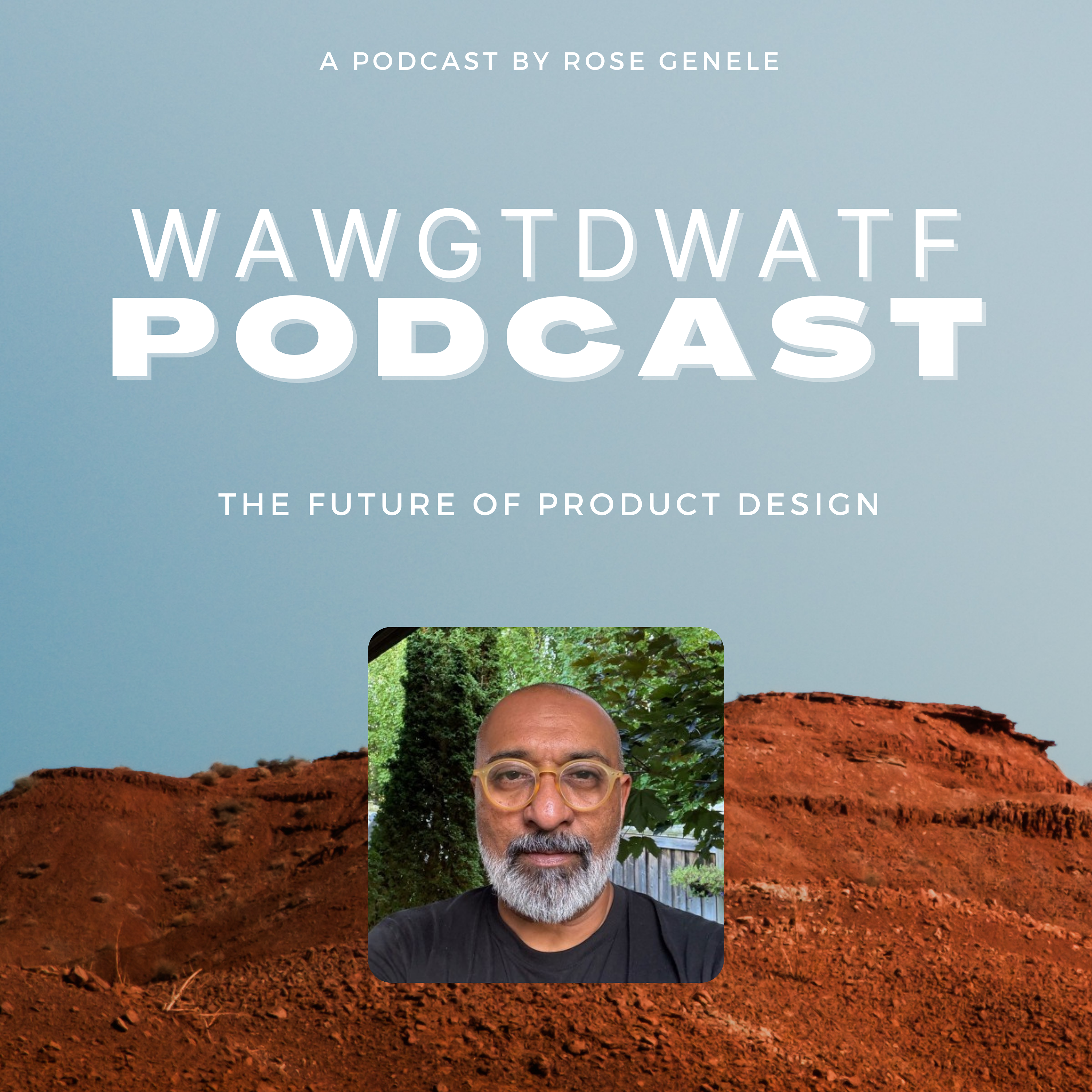
Sage of Surpal, a designer and near futurist, argues that current design and technology trends are dangerously individualistic, creating echo chambers and neglecting the collective human experience. She critiques the dominance of two-dimensional, personalized digital products that serve only one user at a time, calling this a flaw in both design and societal structure. Sage advocates for a shift toward communal, adaptable, and multi-user products that can serve diverse people and persist beyond individual use. She highlights the rise of AI-generated content as a threat to authenticity, warning of "crystal echo chambers" that reinforce sameness and reduce real human connection. Drawing from her background in architecture and product design, she emphasizes the responsibility of long-lasting creations and the need for ethical, human-centered design. Her work, particularly through the project *thinkable*, focuses on enabling individuals to create tangible, intentional experiences that foster self-reflection and mental well-being. Ultimately, Sage is optimistic that society will evolve past current technological biases to embrace shared, inclusive, and human-centered futures—where technology serves humanity, not the other way around.
Welcome to the "What are we going to do with all this future" podcast, where your host, Rose Janelle,
interviews, experts, thought leaders, innovators, and futurists shaping tomorrow. All to answer the
question, "What are we going to do with all this future?" Together we'll explore how changes in
various industries will reshape our world of the next 10, 20, and 50 years. Today, our guest is
Sage of Surpal, a founder, designer, and near futurist. Sage, thanks so much for being here. Hey,
Rose, thank you so much for having me. I'm so honored to be the first guest on your
futures podcast. Amazing. Can you tell us a little bit about your background and your current work?
Introduce yourself to us. Yeah, absolutely. So I go by Sage and I describe myself as a designer
and near futurist. I've spent probably last 30 years in design. I studied architecture first,
and out of architecture, I ended up doing digital product design, working on software,
CAD applications, software applications for the first part of my career. And then after that,
the first part of my career, I started working on both digital and physical devices. So product
experiences that we as humans interact with on a daily basis. Smart TV, smartphones, IoT devices,
things that are in our built environment and that we sort of have to engage with in order to achieve
certain outcomes. That's where I learned my craft. I kind of describe myself as a composer and
conductor. So I both compose the vision behind some of the products and I also conduct the teams
that need to sort of orchestrate themselves in order to achieve the design that's required to
get those products out. That's awesome. I love that. So what initially sparked your interest in
one product design and two in future or near futureism? Well, wonderful. So product design,
I think design was always an idea. I was always somebody that made things and imagined things
in my mind and I wanted to bring into the world. So that's what I started to study architecture.
Initially, when I started my studies in architecture, I thought about the structures that I appealed to
me, the beauty of the buildings. And only through that studying did I realize that I wasn't only
designing the structure, but I was also designing the space. So this idea of tension between the space
and the structure was something that really enamored me with design. And so through the rest of my
career, I sort of sought out what are the structures that I can create that create spaces for other
people to appreciate and to use. So my love of design has always been something that was about
doing and creating those spaces and creating those new experiences. I kind of got bored with
designing things over and over again. So I really jumped into zero to one work and that's taking
ideas that have no form and then giving form to those ideas. And so that is probably what most
designers that deal with zero to one work, they're always dealing with a near future. And so near
futureism was actually my love of zero to one work. And as well as speculating, these are my ideas
that I want to kind of give form to and see how the world reacts to. And so a lot of the near
future work that I do in my studio and my practice, which is the plastic studio, which is sort of my
five to nine job. I have a nine to five job as well. It's more or less design related, but I'll focus
more on the five to nine because that's where the real interesting work happens. So speculative
design really allows me to have a point of view and build form around that point of view for something
that I think I want to see in the world. That's interesting. And so with that, with, you know,
that lens and that perspective, what are some of the challenges or opportunities, you know,
that you think designers will face as we continue to move into an increasingly digital and
interconnected world. I know that you have experience with both digital and analog products. And so
what do you see as some of those challenges or opportunities for designers as digital and
technology seems to really kind of take over our world at all fronts? I mean, that's a really
interesting question. I have very strong points of view on the kinds of things that designers need
to tackle. I find a lot of designers today, they're, I call them single dimensional, not
as a negative, but they're very much about a particular dimension. So for instance,
digital products exist mostly in a two-dimensional plane, right? So a lot of the experiences that we
see, a lot of the work that we do is around the two-dimensional aspect of design. How do we
present something to a human that then interacts with that thing in order to achieve an outcome?
And usually a lot of that design work is happening in this two-dimensional pane of glass, right?
It's on a screen, whether it's a mobile device or whether it's a smart TV or a monitor or
it's a laptop, it's usually two-dimensional. What ends up happening invariably when you only
work in two dimensions is that you end up solving problems in only that dimension. So you start
to ignore the fact that humans exist outside of those two dimensions that we exist in multiple
dimensions, three to four D over time. And so I always tell people of designers, you know,
in order for them to be very versatile and agile in the world of design that they have to expand
their dimensionality. So, you know, so I start with the idea of zero D, zero D is really interesting,
zero D is a point, right? It's a point and I describe that as a point of view. So as designers,
we should all have a point of view. One D is a line, right? So it's a line that gets created.
And that line is usually articulated with words, which is a really interesting way of communicating
what you're thinking and what you want somebody to achieve. The two Ds then get into that planar
space and then 3D gets into the physical world and then 4D is like, I described as all of these
things moving over time. So for designers, as they broaden their dimensional thinking, they
can then impact a larger aspect of the world, right? So their solutions aren't biased just to this
one form. And time is really interesting because then you start to think about the time that we
have today and we have, you know, what does time look like tomorrow? And I think that's the aspect
of it that I'm with what do we do with all this future? Time is really important. And so another
sort of way of looking at design is I look at design as product design. So most people,
when they think of products, they think of things, tangible things or product experiences.
But I look at it from a design perspective slightly different. And I see that product,
if you look at mathematically, the product of two numbers is one number multiplied by the other.
So the product of three and four is 12. And so as designers, I think we need to expand our
ability to design in multiple dimensions, but also expand the skills that we have so that
what we can create is a product of one skill set multiplied by another skill set,
in order to impact a larger swath of work, right? Like a larger impact of work.
So rather than being single dimensional, like stuck in one dimension and only forcing the
solution to go through that one dimension, the versatility of a designer comes from being able
to articulate themselves in multiple dimensions concurrently whenever they need to.
Yeah, that's an interesting perspective. And so the challenge or the opportunity being to
step out of that 1D2D and really look to design and how a perspective from,
like you said, that 3D and that 4D is where you feel like the opportunity is for designers these days.
Well, yes, I do think. I think that, so I have a very strong hypothesis that as today with
digital products and physical products as well, that have digital hearts, that we're actually seeing
devices and experiences that are only focused on one individual. So they will only work for one.
Right, and I think that's a future where I think we have to rethink, right?
So for instance, when we pick up a device, that device today,
or let's imagine a smartphone, a modern smartphone will only work for one individual.
It has scanning technology. It will recognize your face and unlock that experience just for you.
So this is a very important part of the future.
Is the future always going to work for one?
So we are very exposed to echo chambers.
Where our individual experiences across these screens, these displays, these digital experiences,
are only focused on me, not somebody that's sitting beside me,
not somebody that's in my spectrum of world, my current ecosystem of people,
but only for me.
And so what that basically means is that if I have a device that I pick up,
it will not function for me.
It will function only for you.
And that has a huge impact on waste.
It has a huge impact on this idea that we only build things for one people, like one people.
So it's really one people.
And I think that is the flaw, the greatest flaw that we have in the digital world.
And that is that we have designed things and we build experiences for once,
rather than the collective.
We are social beings. We live in social spaces.
We are social. We cohabitate. We're communal.
These aspects, these terms are ignored.
And so what happens is that you might have seen this.
There are certain devices that are in the world.
So typically a device, if you think about it,
let's imagine a tool that you have in your home.
Let's say a series of, let's say you're a chef,
and you have all sorts of interesting tools in your kitchen.
Anybody can walk up to those tools and use them.
We can pick up those instruments and use them.
Now imagine a world where you walk into my space,
but you cannot use anything in it.
And so that is a big problem.
Because that means that we haven't designed the tools for humanity.
We've designed it for one human.
And I think that that's the problem of,
and you'll see this ongoing.
We're continually building experiences,
which only one person can experience.
Sure, you can do this collaboratively.
The collaborative space is 3D spaces and VR spaces.
But they're still just for the single.
And so when we build more and more for the individual,
we ignore the collective.
And I think that is a pretty significant flaw.
A lot of that comes down to privacy and security.
But I do believe that we can,
that's a problem to tackle in a completely different way potentially.
And I think that's what I started to focus on.
It's like, how do I build things that can last for many years
and last for many people,
and that have lives after one person uses those things?
And so I think a future, or future, my speculative thinking
around the future is that we should be designing more communal objects
that maybe have very specialized value for the individual.
But then when they switch out of that individual mode,
they're still very useful for anywhere that picks it up and uses it.
So if we can imagine our tablets,
we can imagine our kindles, we can imagine things of that nature.
If we can design for the collaborative or for the communal,
that we probably are now solving a different problem,
that's more inclusive than designing for the one,
building for the one.
That makes perfect sense.
Awesome.
And so with that being said,
and you've already started to speak to this a little bit,
but what are some of the significant trends
that you're seeing in the industry right now?
So you mentioned about kind of designing for one versus designing for many.
Are there other trends that you are seeing in design or product design right now?
And they can be trends that you're a fan of or not,
but just wanting to get a little bit of a perspective from you on that.
What's happening?
What are, you know, what are the behaviors?
What are people drew to?
Okay, I mean, that's a really interesting question.
I think that we're really in an interesting time.
We're always in an interesting time, right?
Time is always interesting.
But we're in a time where AI has really come to the forefront.
And AI has sort of spurned this new generation of products
that are being built into across all of the existing platforms, right?
So you can imagine the impact of AI.
Let's think about AI as an example from a content creation perspective.
So we're at the stage where I might be an AI voice.
You might not know that,
but obviously you know I'm real because I'm on camera while we're talking.
But I might be an AI voice.
And I can get an AI avatar that speaks just like me by training enough, right?
Which is graded offloads a lot of my, you know, potentially offloads.
It saves me some time.
Then we have AI that creates image images, right?
And so images are just being created.
It's a fire hose of content that gets created.
And it's hyper realistic and it's really biased towards, you know, certain types of people.
You know, you're seeing these beautiful model like exact examples of people's faces
are just in this, you know, moment where, where, where as a result of the content
that's being created through these systems, we are now creating realities that never existed
and that realities that don't have a witness.
And those witnesses no longer exist for the content that gets created, right?
So which means that, you know, is it really valuable to me to see an image
that somebody produced through some sort of a prompt that is now being, you know,
you know, brought into the world where I see it in my field of view.
But am I, I don't even question its reality anymore, thinking it's real when it's not.
So, so, so that's a really interesting part of AI is being able to produce a lot of content,
which we're, we as humans are learning to tell the difference between AI content
and, you know, content that is, you know, potentially real.
So that then potentially creates a counter culture.
Like, how do we create more analog, more real experiences that have real people behind it?
You're seeing that in some, some camera platforms are now, I think,
how I it's a camera that runs on iOS that they've just released a no AI feature.
Okay, so this basically is showing that this camera has been, you know,
taking a picture where very little AI was used to, to identify what was in the picture
in any, any post processing that may have potentially happened.
So you're seeing certain counter movements for technology to sort of potentially balance it.
I believe that when AI gets trained on the same output of content that it's created
that we end, we will end up having a lot of artifacts that are, that are going to be introduced.
Those artifacts basically now create what I call a crystal echo chamber.
It's like a, it's let me just, it's actually a fixed echo chamber that fed itself
and therefore it just reinforced itself.
And as a result, we end up with a lot more sameness.
So, and when we start as a society and we realize that the sameness that's being produced
is not something that's valuable to us anymore because we want to witness the creation of something.
We start to realize that creating the process of creation is almost more important than the end result.
And that's, that's sort of what I talk quite a bit about in, in, in thinkable,
which is, which is a product that I'm, in a company that I'm building around how we can,
realize our own potential and realize and recognize that the act of creation
is really important to us and to us as a species.
So, AI is going down this path. Now, at the same time, you have AI that's doing some really interesting things.
If you think about robotics and, and, and, and being able to, to, to, to maneuver through space and, and to, and to, to now build,
and really truly offload human work, physical work, and have it augmented by robots, real robots that look humanoid
and that, and that can achieve, you know, things that we need and, and that will probably need as we start to age as a population
and not have many people to support us. So, we may need to have these kinds of aids in our lives in order to,
to help us live our lives as, as we live longer and our bodies aren't, our minds might be clear, but our bodies might not be there.
So, then you have some really interesting things happening with AI from that perspective.
And then you have this other culture where we're, we're building these little pendants that, that observe us and listen to us and then act as our friends.
Act as our friends, because we're in this culture of one, so therefore we have no friends, so we need to have fake friends in order to really, you know, value ourselves.
Where it might just be as easy as to walk out and talk to your neighbor, right? So, so, so some, some things will help us and some things will hurt us and other things will hurt us.
will just process out, but AI is doing some really interesting things, but it still hasn't,
you know, without getting too much into the whole AI, the singularity and sentience and stuff,
we're just getting into the pragmatics of things. AI is really at this stage, or it's only doing what
we've done, but better and faster. It's only producing, you know, physical movement for us,
better and faster, repetitively. It is now producing images better, faster, maybe we don't want them,
but it's doing things that we're doing better and faster. At one point, AI will get to the stage
where it's doing things that we can't imagine, and I think that's what's really interesting,
and hopefully we'll get through this like phase of, you know, like voices, the best interface,
and, you know, pendants that absorb us. In the end, for things to really benefit us, AI has to
understand us and has to act on our behalf across, you know, digital spaces and physical spaces,
and that's where our big benefits come from. So from a product design perspective, we are,
and I think the robotic stuff, like we can imagine, robot, robot needs to sense everybody and has to
be understanding of everybody in its environment in order for us to interact, or for it to
interact with our spaces and for us to interact with it. So in that case, when we think about AI
and fueling products, we're probably seeing a more communal device, and on the other end,
you have these pendants that we wear that only see us and only hear us. And so, you know, there's
a spectrum that's being created, and I think, you know, products that we put into our world will
probably, you know, have a bigger responsibility in working with us, right? And for us, while balancing
the efficiencies that we gain in digital platforms, the efficiency of being able to capture every
bit of information, and then decipher what's important and give that to a, or potentially an
organization that needs to act on it. Yeah, there's, there's, I mean, the, the impact of,
of AI is certainly something that is necessary, I think, in our conversations. And I think it's
so important to have different perspectives. It's easy to listen to what feels like the authority
voice on AI, and that's coming from, you know, the engineers, the, the technologists, so to speak,
or, you know, the, the big tech companies, and what they're, you know, what they have to say or,
or what their, their research is, but I think it's valuable for us to take a look at a technology
that is, is, is not just, you know, something that lives in screens, it really does have an
effect on us in the 3D-built world, right? And I think that, you know, we need people with
these different perspectives, whether it's humanities, whether it's, you know, sciences,
whether it's, you know, whatever it is, we need to take a look at it from, from many angles,
because it has such a potential to, to impact and change our world and change the future in,
in such a significant way. So I think it's, I think it's a great conversation, and I'm, and I'm
curious if you have any personal experiences or projects that have really influenced your
perspective on the future. I know that you mentioned thinkable, but I'm wondering, you know,
is it thinkable? Is it something else? Is it a, is it a combination of, you know, personal
experiences or influences that really impact your perspective on the future?
You know, I think, you know, setting architecture was really formative for me, right?
When you build something that's meant to last for decades and then maybe stick around for
hundreds of years, you really have to take into account many different factors when you consider
what you're putting into the world. There's a responsibility when you build something that's
going to last that long, right? You just sort of think about, okay, you know, what's, what's,
what's the journey going to be as it, as an object itself, right? I think we kind of forget that
when it comes to digital products because they come so fast, right? So we build something really
quickly and it gets up the door and then, you know, it's like, maybe it's going to stick, maybe
it's not going to stick. And so we all like, always expect digital things to like, you know,
disappear. They only live in this one plane anyway, right? So you know, it really impact
the physical world. But now when you cross that divide and you're building things that may
autonomously work in this world, there's a greater responsibility. A very significant
responsibility across all of the, the domains, right? Like the social sciences, the, you know, humanities,
you know, responsibility around ethics and things around, you know, still concerns about privacy,
but also the role those things play. So for me, you know, coming back to what I was seeing in the
world, right? And I was like, well, it feels like we almost feels like, this is how I describe it,
it feels like technology is a colonizer. And we, we just assume that tech that comes out
is something that's going to help us, right? And so tech, we've all fall fall into that. We've
all fallen to the notion that, oh, what's the next best thing that's coming out? We don't realize
that we have to choose our future. It's a choice that we have to make to either include these
technologies in these given forms or potentially not choose those technologies. Now, on top of that,
we have this idea of commercialization, evaluations, and, and, and, and, and, and, and, and capitalism,
which is driving a lot of what sticks. And so does that mean that those capitalistic
mechanisms have the humanities build into it? There's responsibility if you humans are built. No,
it doesn't. It doesn't. It's, it's, it's very, it's very matrixy where it's, it's, it's so focused
is its own survival, right? You know, growth growth growth over everything else. And that has a,
and if you talk about those big companies, they are growing, growing, growing, no matter what,
they still have, they have to bring a, the most I can detect that they can in order to continue to
engage us and to grow us in those digital spaces. That is not a choice that we made. And so that's
where the colonialism comes in. And we know that colonizers, they don't care about us. And now,
it's not that those companies don't care. It's the system behind it that, that doesn't care for
us because it doesn't serve its own interests. So when we see technology, we don't have the choice.
We can't say, look, I want technology that's more inclusive. I want technology that, that, that,
you know, considers my humanity, my age, considers the things that I want to do that considers the
fact that I don't want to be on a screen 24/7. But I still want access to that content potentially.
And so I think there's a massive buildup of a future speculative products that don't exist yet.
But the moment you say, hey, let's build something that that will last for 20 years that serves
multiple people, but can deliver this amazing, you know, experience through it. I think that
ushers in a potential future that is probably more inclusive, right? So devices that we can use,
that, and multiple people can use, you know, devices that have lives after you're done with it,
right? Something that you can pick up, you can pick up my phone, right? Just imagine you could
pick up my phone and it automatically goes into a guest mode so that you can make a call, you can
reach out to your world, right? It doesn't have to, you don't have to like, you don't have to like
log in as me, suddenly it has a different perspective. Why aren't we doing that? Well, because there's
nobody asking for it. There's no demand. Well, because it doesn't benefit anybody, right? Because
it doesn't sell more phones, right? If I have a phone that every person in my house can use and
I can hand over a phone to my kid and say, okay, now it picks up and it's his phone for the time
but there's also this vacuum of like, you know, we either have displays but think of everything
else that's in your house. Think of everything else in your home, like your furniture, your,
you know, your chairs, all of these things that haven't been reinvented in a way that can be
imbued with a bit of tech but also potentially conserve us, right? Now, counter to that is this idea
that only elite few have access to technology, right? They think about the eight billion people
on this planet, right? There's such a thing about that, you start to think about this very uneven
future that's being driven by the elite that have access and then the companies that have
that are done, you know, for their own self-serving needs, building things to profit from
in order to give access to those things. So there's a really skewed technology
future if we just let it go on its own. If we don't start to make declarative choices about
wanting a more communal more friendly, I won't say friendly, but a more
realistic in the physical world experience
of the services that are being offered to us.
That will help us.
- One of the, there's a word that keeps coming up
in my mind as you're talking about,
you know, this kind of individualistic view
of, you know, products and design and technology.
And it's this personalization piece.
I think some time ago, not, you know, not too far in the past,
but sometime in recent years we decided
that personalization was something that was the most important
and/or is a priority and is something that we all want.
I'm wondering, you know, how you see balancing.
And if you, and if you, how much weight do you add
to personalization, you know, if there's a way to balance
personalization with kind of a more communal approach
to design, if those two can live, you know,
in the same space at the same time where we can take
the benefits from, from both sides
and somehow bypass most of the negatives.
- Absolutely, so I think they can.
So there's a difference between personalization
and customization.
So personalization is the aspect of me specifying certain things
in an experience which is tailored only for me, right?
And then there's customization which is like,
hey, I wanted to look different.
I wanted to feel different and that.
And so we have to balance those two
and personalization gets into privacy and security, right?
So if you think about it from that perspective,
I could pick up your phone.
It could be heavily customized to you,
but the personalization of it is turned off
because I picked it up, right?
So I'll know it's your phone.
And the experience looks like it's yours.
So I do think that there's the ability to balance those
in quite honestly.
We don't want to eliminate those.
We just have to find a balance of trying to personalize
to the point where my information,
my settings and my app,
like things that belong to me, that I identify,
that, sorry, that belong to me,
meaning privacy and security are removed from a product.
Now, you can build something that can be customized heavily
and not still be personalized, right?
Like, let's just look at the average classic car.
It's like, let's just look at our wardrobe.
So those are customizations and not personalizations.
They're customizations.
So the personalization gets into when these are your,
like, literally, the scent of you is personalized
on your clothes, as an example.
So I do think that there is that is a tension
that will always exist, the individual in a group
and we want to celebrate those things.
We want to ensure that those are protected, right?
We want to make sure that the aspect of you
in the digital product or in physical product
or a physical device still gets to be displayed
so that we can see that there's a difference
between yours and mine and, you know,
I think that absolutely needs to be honored, right?
And I think that adds to a communal environment,
that adds to a society, right?
And so in many ways, different voices,
different perspectives, it's the honoring of each other
in recognizing the difference.
Definitely can be done.
- Yeah, yeah.
No, that's, yeah, I agree that, you know,
it's, it's possible.
I think anything that we desire is possible.
I think that's part of the attention
and the intentionality that we put towards the future
or future or the, you know, future that we want to see,
it's deciding what we want and then being
and then, you know, actively creating it.
A question for you.
What are you most optimistic about when it comes to the future?
Just on a very broad scale.
It could be related to design or otherwise,
but what's something that you are optimistic about
when it comes to the future?
- Well, you know, it's really interesting.
I mean, optimism in the future, usually always intertwined
to some extent, right?
Unless you have a personal experience where, you know,
or you're in a region of the world
where you're on the maslow's higher, higher kidneys, right?
So once we get past that, they're, you can have optimism.
But I think if you're on the other side of that
where you're just dealing with fight and flight and survival,
it's not opportunistic, like, it's not opportunistic.
The optimism isn't there.
So the optimism is really rooted in where
you're using individual art.
I think as a humanity, as a society,
I think that we still have a lot of growth
when it comes to our future.
- You know, there used to be a time when, you know,
we always think about the future and we think,
oh, you know, we're at this conflection point
where everything is stationary and you get this, like,
beautiful view of the future.
Sometimes that view of the future
is really jaded by our current present, right?
So we, you know, like, so, and our localized present.
- Yes.
- So sometimes when we think about that future,
we're stuck in, you know, what we can see.
And we can only change what we know.
And, but we can only see, you know,
we can only change what we see.
We can only change what we know.
And so there's sometimes, there's a challenge that we face
when we look at that future.
And that challenge is that our current present,
you know, is biasing the perspective of that future, right?
So I think you asked the question
of what am I most optimistic about with that future.
I'm most optimistic that we'll get to a point where,
and I, where I think that access to information,
access to technology will become normalized to a perspective
where we have, we will have matured through the echo chambers.
Like, I think we're gonna, we're gonna experience that now
because we're building a lot of echo chambers,
crystal echo chambers.
But eventually if we can mature past that,
we can get past the notion of, you know,
this thing is only for me.
Then we start to recognize that the only thing we have left
is not me, it's us.
And I think that's what I'm most optimistic about.
That we'll get, we'll go through this, this, this period
where it's hyper crystallized, hyper echo chamber,
a lot of scrolling, doom scrolling, zombie tasking.
And we can only as a species do this for such a long time,
or for a, for a period of time where we want a difference.
And I think we're gonna get to that point sooner.
And I think that AI's gonna accelerate that
because we're gonna see a lot of the sameness.
And then we're gonna want, we're gonna want the differences.
We're gonna want something that's a little bit more
intentional for ourselves.
So I think the awareness of the future
and the cost of technology is now becoming a little clearer
and the impact of technology on us as a species.
That we'll get through that.
And we'll usher in a slightly different perspective
and maybe build a different future
that we manifest rather than is given to us
because some tech colonizer is believing that we need it.
- Yes, yes, I agree with all those points.
Where can people find more information about you
or find more of your projects or stay connected to the work
that you're doing, where can people go for that?
- Yeah, absolutely.
So I have a studio, it's a studio for myself.
I'm the only customer and also the provider of that services.
That's PlasticPLSTIC.com.
Out of that, I do some speculative work.
And the biggest project I'm doing of my life is
at thinkable.com.
And it is a system of thinking that takes ideas
out of your head to make them real
by putting them in tangible space.
It's a physical device as well as a book
that I wrote, tangible thinking or less.
That physical device is basically an organizer of your thoughts
as a simple desk organizer.
But the design of it is so much intentionality
that I'm hoping that inspires people to think about themselves,
think about and give space to their own thoughts.
And to be honest, it's tech that's reducing that space.
But where people can actually create the worlds
that they imagine, and I think that's what I'm trying to enable.
That's something I've learned through a decade of design.
I realize that the joy of creating outweighs the results.
And I think the more that people realize that
the more balance they'll have in terms of their well-being
in their daily lives as they battle technology,
as they push technology and give it space,
I think it's important to create your own space
for your own thoughts.
- That's amazing.
Thank you so much, Sandra, for your time.
time. I really appreciate it. And our listeners appreciate it.
Thanks for tuning into the what are we going to do with all this future
podcast. I'm your host, Rose Janell. And I will see you next time to answer
the question, what are we going to do with all this future?
Podcast Summary
Key Points:
Sage of Surpal is a designer and near futurist who emphasizes designing for collective human experiences rather than individual use.
Designers are increasingly limited by a two-dimensional, individualistic approach to digital products, which neglects the three- to four-dimensional, social realities of human interaction.
A key flaw in current technology is its focus on personalization and individual ownership, leading to echo chambers and a loss of communal, shared experiences.
AI is rapidly generating hyper-realistic content that lacks authenticity and real human witnesses, creating "crystal echo chambers" that reinforce sameness and reduce diversity.
Sage advocates for designing products that are adaptable, communal, and durable—capable of serving multiple users and maintaining value beyond individual use.
True innovation requires balancing personalization with customization, protecting privacy while honoring individual identity in shared spaces.
The future of design must include ethical, human-centered thinking to counteract technological colonialism and commercialization.
Sage is most optimistic that society will evolve beyond echo chambers to recognize shared humanity and build intentional, inclusive technologies.
Summary:
Sage of Surpal, a designer and near futurist, argues that current design and technology trends are dangerously individualistic, creating echo chambers and neglecting the collective human experience. She critiques the dominance of two-dimensional, personalized digital products that serve only one user at a time, calling this a flaw in both design and societal structure. Sage advocates for a shift toward communal, adaptable, and multi-user products that can serve diverse people and persist beyond individual use.
She highlights the rise of AI-generated content as a threat to authenticity, warning of "crystal echo chambers" that reinforce sameness and reduce real human connection. Drawing from her background in architecture and product design, she emphasizes the responsibility of long-lasting creations and the need for ethical, human-centered design. Her work, particularly through the project *thinkable*, focuses on enabling individuals to create tangible, intentional experiences that foster self-reflection and mental well-being.
Ultimately, Sage is optimistic that society will evolve past current technological biases to embrace shared, inclusive, and human-centered futures—where technology serves humanity, not the other way around.
FAQs
Sage argues that today's digital products are often designed for a single individual, creating isolated experiences. In contrast, designing for many means creating communal, inclusive products that can be used by multiple people and have value beyond one person's use.
Sage proposes designers think in multiple dimensions—zero to four D—where zero D is a point of view, one D is a line (words), two D is a plane (screens), three D is physical space, and four D includes time. This multidimensional approach allows for more versatile and impactful design solutions.
AI is currently producing content faster and more efficiently, often leading to hyper-realistic but biased images and echo chambers. Sage warns that AI risks reinforcing sameness and suggests a shift toward real, human-led creation to build more authentic experiences.
A 'crystal echo chamber' refers to AI systems that feed off their own output, reinforcing similar content and creating a self-reinforcing loop. This leads to a homogenized digital environment where diversity and real human experiences are lost.
Thinkable is a physical device and book that helps users organize their thoughts in tangible, real-world form. It encourages intentional thinking, personal reflection, and a break from technology-driven distractions, promoting mental well-being.
Sage believes technology is often driven by profit and efficiency, not human needs. She sees a need for more intentional, communal design that respects privacy, diversity, and shared experience, rather than being shaped solely by corporate interests.
Chat with AI
Loading...
Pro features
Go deeper with this episode
Unlock creator-grade tools that turn any transcript into show notes and subtitle files.
 PodcastTranscript AI