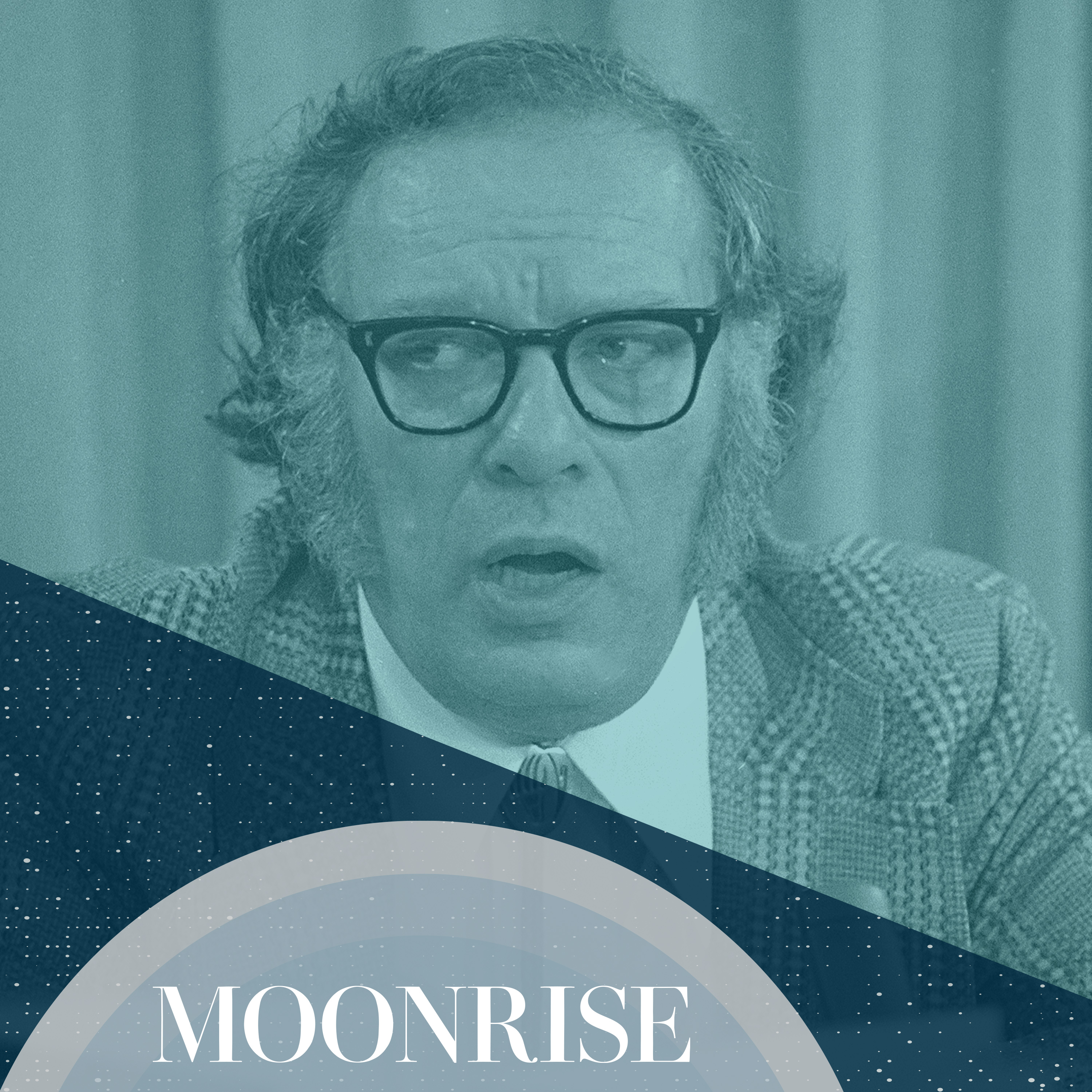
The transcription explores how science fiction fundamentally shaped the reality of space exploration and the U.S. moon mission. It traces a lineage from 19th-century novels by Jules Verne and H.G. Wells, which framed space travel as a new frontier aligning with American myths of exploration. These stories directly inspired pioneers like Robert Goddard, whose liquid-fuel rocket breakthrough in 1926 provided the technical foundation. Culturally, the genre evolved from fantastical "space cowboy" tales into more rigorous speculative fiction under editor John Campbell at *Astounding Science Fiction*. Campbell demanded believable science and mentored iconic writers like Isaac Asimov, whose first published story with Campbell dealt with the societal challenges of moon travel. This "golden age" of sci-fi, featuring authors such as Arthur C. Clarke and Robert A. Heinlein, created a cultural shift. It fostered public enthusiasm and a belief in the feasibility of spaceflight, which experts argue was a necessary precursor to political action, ultimately enabling President Kennedy's commitment to the Apollo program. The narrative posits that without this century-long interplay of fiction and science, the decision to go to the moon might never have occurred.
Moonrise is sponsored by Hunters on Amazon Prime Video. Inspired by true events, Hunters stars Al Pacino as the leader of a rag-tag pack of Nazi Hunters. Watch February 21 on Amazon Prime Video. [Music] John Campbell still had flashes of that mysterious blue orb. It was seared into him. From time to time, the memory would pulse. Even now, five years later and hundreds of miles north, as he worked out of a cramped office on the west side of Manhattan. It was the summer solstice, June 21, 1938. A hot day, no rain. The New York Times that morning carried news of 18 German spies being indicted in the U.S., Soviet dictator Joseph Stalin, executing leaders of his Red Army in Moscow, tuberculosis spreading, Ambassador Joseph Kennedy saying he wouldn't run for president. Another world war was bubbling up, and here was Campbell sitting at his desk surrounded by cigarette smoke and stacks of wild fiction magazines. The magazines could carry you a galaxy away. Beams of light from spaceships, robots, futuristic cityscapes, humans twisted with strange powers, far off planets. They were his magazines. He produced them. John Campbell was the new editor of astounding science fiction. But so what? Did he just publish these galactic stories as mindless diversions from the dark reality of Earth in the 1930s? Or was there something more to it? Some point in sharing all these far-fetched ideas at a time when the world was falling apart. Astounding was the number one science fiction magazine in America. But it had a really small staff relegated to an obscure location on the storage level of a publishing house. The whole place smelled of pulp, paper, and rumble from the printing presses. The only people who were back there in the astounding office were just Campbell, a big, pensive guy, and his one assistant, K. Turant. Well, just the two of them except for today. Because a young visitor was suddenly and unexpectedly standing in their doorway. He was 18 years old with jet black hair parted to one side and wearing these thick rimmed glasses. Campbell looked up from his desk. Who was this who found him all the way back here? It was an enthralled fan, a science whiz, a fellow dreamer, a kid eager to try his hand at a new kind of science fiction, a kind of science fiction that was about to change the course of history barreling toward them. The name was Isaac Asimov. I'm Lily and cutting him with the Washington Post, and this is Moonrise. And now here is your guide to these adventures of the mind John Campbell Jr. Programme who are about to hear is largely fiction, science fiction. We make no guarantees however how long it will remain fiction. I have never been a big reader of sci-fi, so I was kind of shocked to find myself pulled down into a science fiction wormhole. But you know I started researching why President Kennedy decided to invest billions of dollars in the Apollo program in the 1960s. And as I did, I realized that if it wasn't for some sci-fi stories about space travel decades earlier, we never would have decided to go to the moon. I had this revelation when I went to talk with Howard McCurdy, a professor at American University who's an expert on this intersection between cultural trends and the US space policy. I asked him what I thought would be a pretty straightforward question, what prompted Kennedy's decision to go to the moon? Turns out it's not so straightforward. Let me start by saying that anytime you get a new policy, it's invariably proceeded by a culture shift. The people think about something one way and then they change the way they think about it. Take for example, he said, the policy decision to create a national park system. Our original impression of the forest is that it was a place you didn't go at night. The Grim Fairy Tales, a savage wilderness, a dangerous place that started to change, was works like Walden's pond and the Hudson River School painting. It took a hundred years. It could create a culture shift between viewing wilderness as savage and viewing wilderness as beauty. And that laid the foundation for the national park movement. You couldn't have had your Simony National Park and you couldn't have had your old stone national park. Same thing happens in space. American society had to develop an enthusiasm for space travel, plus a sense that it was achievable and worthwhile. Before someone like JFK could come along and put a trip to the moon on the political agenda. So I started asking experts, when did this shift begin? What works steered us toward the modern dream of moon travel? The dream of going to the moon really is a lot older than people think. This is Margaret Y. DeCamp. She is a space historian and a curator at the National Air and Space Museum in DC. And she became one of my core sources. Jewels Verne's from the Earth to the Moon was published in 1865. Jewels Verne is French, but he set his book in the United States right after the Civil War. And the story is about a group of American weapons enthusiasts who had to plan to shoot three men to the moon out of a giant cannon. Now keep in mind this is more than a hundred years before the US would actually send humans there. Here's an excerpt from the book. No words can convey the slightest idea of the terrific sound. An immense spout of fire shot up from the bowels of the earth as from a crater. The earth heaved up and with great difficulty, some few spectators obtained a momentary glimpse of the projectile, victoriously cleaving the air in the midst of the fiery vapors. He thought it seemed a part of the American character that they would be interested in this kind of exploration. For Jewels Verne this seemed like a very American project to want to go to the moon. What do you think? What is the American connection when you say that? That it's like a very American thing. American national identity is built on the set of myths that include the idea of Americans as it explores, as pioneers. Pushing back the boundaries and moving into new areas. And so I think there are ways in which the dream of spaceflight dovetails very nicely with these deep-seated ideas of American identity rooted in a somewhat mythical frontier past. From the earth to the moon became a very popular novel in the United States at the time. There were also a handful of other novels about space that came out soon after, like HG Wells's War of the Worlds. The genre of science fiction, even the term science fiction, didn't exist yet in the late 1800s. But that's essentially what these books were. They used fiction to imagine what the human experience might look like in the future. In 1899 a copy of the newly released War of the Worlds fell into the hands of a feeble 17-year-old boy in Massachusetts. His name was Robert Goddard. His poor health had set him back at school and made him pretty introverted, but he loved science and he was immediately captivated by HG Wells's book about aliens arriving on Earth from Mars. One day he had this story of the Martian invasion still buzzing through him, and he climbed a tree in the yard to remove some of its limbs. While he was up there, he had what we'll call an axial moment. Kind of like John Campbell's experience with the Blue Orb. You know, a moment when it feels like something in the universe clicks or spins and sets you down on a new course. I came across some old writings of Goddard's and he described this experience of his in these words. As I looked toward the fields at the east, I imagined how wonderful it would be to make some device which had even the possibility of ascending to Mars. Then he went on, I was a different boy when I descended the tree. From then on Goddard was determined. This was October 19th, 1899. It was such a powerful moment for him that for the rest of his life, he celebrated it every year as his anniversary day, the day that he felt like he was set on a course toward developing rockets. For the next 17 years, he labored to develop the basic mathematics of rocket operation. He submitted some of his first rocket patents in 1914. He followed up by testing and measuring the actual performance of rockets in the air. He also tested them in a vacuum. He published a huge report on the mechanics of rocket flight in 1919. Then in 1926, Goddard was ready to try the world's first flight of a liquid fuel rocket. Goddard did it. He launched the first liquid fuel rocket in history. When the rocket was ignited, it took off with a steady roar. He rose 41 feet and traveled 220 feet in distance at 60 miles per hour. Until that point, people had only been using solids, like gunpowder, to fire off things like firecracker military rockets. Goddard used gasoline and liquid oxygen. And that opened up a whole new type of rocket tree that had way more control and power. His breakthrough wasn't just about using liquids. Goddard also developed the concept of multi-stage rockets. So these are rockets with additional fuel tanks and engines that can kick in and provide more thrust as the rocket gets higher. Both of these were major innovations that would ultimately be crucial for space travel. Even the New York Times, which had once published an article openly mocking Goddard, had actually started to take his radical inventions seriously. But the Times article predicted his rocket breakthrough would lead to something darker than moon travel. It predicted that a rocket of that power and sophistication would end up in military hands and lead to a new class of destructive weapons. Something was rumbling. The same year Goddard launched his rocket 1926, the very first science fiction magazine hit New Stands. It was called Amazing Stories. The most popular types of mass entertainment in the early 20th century had been cowboy and western stories. But the thing is that by the 1920s, the real life west had become more and more settled, a little less mystifying. So publishers started looking for new fictional settings where they could transfer these successful cowboy adventure plots. And space fit the bill. Space became the perfect next frontier to explore an entertainment, the ultimate wild west. Magazines and radio programs started borrowing tropes from westerns and sticking them in space. So the hero with his sidekick who has a horse or ship that has a name that is heading into a new place with a kind of motley band. Buck Wilmer and one have come to the headquarters building. That includes a love interest with a lot of moxie and a disturbing tendency to get captured. No, no, no, touch me. What? You're a boss, me your girl's home. Get away from me. That fool. My darling. Take your hands off her, Voltaan. A kind of older, avuncular figure who's advising the young, usually blonde, muscular male hero. Why that's for the barter of the grape science instructor, Han Zarkov. Get down this ladder. As you can tell, these early space adventure tales were light on science and heavy on macho hero imagery. So most people in the 1920s find space travel to be amusing, but not real. And that creates then the principle challenge for people in the science fiction movement in the United States who were really rocketeers in disguise wanting to convince Americans that hey, this could happen soon. This could be real. So how do you get from point A to B? From fiction, people buy to a reality that people will buy into. You keep the hero stories, but you make the science believable. And that's just what John Campbell, the man who saw the blue light, set out to do. It was John Campbell who ultimately merged the lower brow with the higher brow, the popular with the fringe, the space cowboy tales with the real scientific inquiries of the day. He spawned what's considered the golden age of science fiction in America. It was the birth of a genre that's a huge part of our culture today, but that didn't really exist before. He created a genre of reality-based fantasy. His heroes didn't just fly around space fighting monsters. They were like scientists who created robots and then struggled to control them. When I started my reporting, I had never even heard of Campbell, but I immediately found him fascinating and difficult and complex. Here was a man whose fingerprints are all over American culture and science fiction today, but his personal story took a dark turn that has kept him from being more popular. We'll get to that down the road. But early in his story, it was the strange details of his life that pulled me in. First, his experience seeing that mysterious blue light in North Carolina in his early 20s. Even though no one believed him at the time, Campbell turned out to be right. It was a real scientific phenomenon, not just some trick of his eyes or his mind. It was an extremely rare thing called ball lightning. Basically a sustained orb of electricity, rather than a quick bolt. It can move across fields or even pass through walls into people's homes, and then it blows things up or vanishes. It's absolutely unreal. Anyway, after seeing this ball lightning, Campbell really dove into science fiction writing. Quite true. His writing was different from so much of the space adventure fluff. It wasn't fantasy because this was no baseless dream. This is archival audio of John Campbell. It was science fiction. He wanted his stories to wrestle with real scientific possibilities. And even when he wrote wild tales about alien encounters and things like that, he still wanted them to be about something more, to provide some new window into the reality of our own human fears and psychology. Now in science fiction, we have the opportunity to explore an alternative postulate. Campbell's most famous story was called "Who Goes There" and it was about an alien that could shape shift and take different human forms. The story marked the beginning of what we now consider modern science fiction. And it's best known today as the basis for the movie "The Thing." This is historian and writer Alec Neville-Aly. His book, "Astounding," was a huge resource for me. It has a ton of interesting details about Campbell's life and his sci-fi legacy, including the origins of "Who Goes There." Still one of the greatest science fiction to spend story is ever written. Now the inspiration for this story is just bizarre. Campbell said the story came to him through a chilling childhood experience. His mother was an identical twin and he says her sister would sometimes masquerade as his mom and be really cruel to him, which is so messed up. It left Campbell with this constant paranoia about whether the person who looked like his mother really was. This wasn't great for Campbell's childhood, but it was a great and enduring story idea. You recognize that image of a sheep shifting evil alien. It's still a popular sci-fi motif today. In 1937 he was tapped as editor of a "Stounding Magazine," which by then had become the top sci-fi magazine in the country. This is how Campbell really left his mark. He kind of saw it as the perfect platform for his ideas. Because Campbell had this role as a gatekeeper for the title in the field, he was able to say, "Okay, this is what science fiction is going to be about." There have been changes. He put his energy into developing other writers. One of the major changes has been the development of a group of authors. He loved to say that as an editor, he didn't have to write anymore because he had hundreds of writers writing up his ideas. So he was able to influence the field that way. He insisted on rigorous science, dictating the subjects his writers explored. Cybernetics, rocket ships, atomic power, things like that. And he hand selected the writers he wanted to mentor and develop into its next set of stars. The best authors are those that surprise you. They do a story and after you've ready to say, "You got to have a thought about that day. You got a good idea." Now let's go back to that hot New York day in 1938 when a young man appeared in John Campbell's doorway. There was a kid who came down to see me. He was an undergraduate student here at Columbia. He'd by the name of Mike Asimov. Campbell was a tough guy to pitch your first sci-fi story too. He was six-foot-one. He had a crew cut and brow line classes and a cigarette and a long black holder. But more than that, he had an imposing personality. He would immediately start to bombard you with questions, became what some writers have called like a boxing match or a, you know, like a intellectual workout. Campbell invited Asimov in. But by the time the conversation was over, he had torn apart Asimov's story and rejected the submission. Still, he could tell Asimov had a great mind, so he encouraged him to keep at it. Asimov wrote and submitted one new story per month, June through December, all rejected. But each time he came in person, wrestled with Campbell over his ideas, refined them together, talked about what made for good science fiction. You can imagine these kind of intense sermons from Campbell to Asimov. Now, one thing, you know, in essence, science fiction consists of stories about human adventures, anywhere and anywhere, anytime and any place, not just on this earth and not just in the present. And after these sessions, Asimov tried again, and again, stories of other times and other places, the implications of what we're doing today on the future and the study of the past and what implications it had in today's world. Homeless Odyssey was a form of science fiction. It was exploring strange worlds. This is what formed Asimov. Finally, in January 1939, Campbell liked one of Asimov's stories enough to buy it. Asimov's story predicted a time 30 years in the future when a man would fly to the moon. But even more intriguing for Campbell, it explored the difficulty of that achievement and all of the ways in which society would initially resist space travel. It was the first of hundreds of stories Asimov would go on to rate. Nightfall, Irobo, robots and Empire, a foundation series, a Martian wave, a bison teniel man, evidence, life, healing of power, dead past, ebbel in the sky, stars like dust. The pages of astounding magazine were soon filled with names that would become the titans of science fiction. There was Isaac Asimov, of course, a Russian immigrant whose family ran a candy shop in Brooklyn. "Hello, you've caught me typing, but that's no surprise. I'm typing all the time. Now I'm talking, which is only a little less likely." Asimov would go on to rate books that many of today's rocket entrepreneurs like Elon Musk say inspired their interest in space and science fiction. But Campbell also discovered Robert A. Highline. "We're going to go on bigger, farther." A young man who had served in the Navy and would go on to lead the genre. "Not only to the moon." With books like Stranger in a Strange Land and Starship Troopers. "We're going to spread." The Ador Asturgeon, a kid from Staten Island, "Join me in gratitude for just being involved in science fiction." Who had become one of the most famous and prolific short story writers. "And I don't think I could ever say anything more than that." Elrond Hubbard, a writer who had started out penning adventure and western stories for other pulp magazines. But then hit it big with science fiction under Campbell. And later transferred his cult following of sci-fi fans into his development of Dianetics and the Church of Scientology. And there was Arthur C. Clark. "I've said written no without science fiction as well as science fact." A Brit who served in the Air Force in World War II. "It also disturbs up inside me and the idea has come out." He wrote arguably the most epic space story of all time. 2001, a space Odyssey. "Never imagined the moon would be reached in my lifetime. Now I'm getting impatient to see what it's like on Mars." These writers didn't just shape the science fiction genre. They shaped the actual science the United States would pursue. Most readers of western fiction didn't become cowboys. But a lot of people read science fiction and became scientists. And they became engineers. And a lot of them can trace their interest in science and STEM fields to the stories they read when they were 12 years old. That's a big deal. And that to me is what sets science fiction apart from most other genres that it really did have the potential to make that kind of impact on people's lives. John Campbell would help inspire a next generation to go into science. And to make these fantasies actually become real. What Campbell had done was to create a science fictional world of computers, of trips to outer space, of missiles, of a science important culture. This is archival tape Abysok Asimov. "No one is going to say that science fiction readers brought a man to the moon all by themselves. But we can say that the kind of science fiction that was published in 1940 helped prepare the public for the acceptance of programs to take a man to the moon." So you could say this new group of science fiction writers had the ability to anticipate trends, predict the future. But the truth is even more incredible. These people who began on the fringe of society as dreamers, fanatics, outcasts, their visions didn't just predict the future, they provided the blueprint. The blueprint for future scientists and policymakers and presidents. The science fictional world of the 1940s was very like in many respects the real world of the 1960s. And so we, in a real sense, we science fiction writers and readers helped create the present world. And yet on the eve of the war, Campbell urged his writers to craft stories that warned of the dangers of a future of nuclear arms, atomic bombs, ballistic missiles, technologies that he could sense were right around the corner. He also urged his writers to write about a future where humans soared through the stars. A world where the race for nuclear weapons would one day give way to a race to the moon. The real climax of science fiction is the fact that on July 20th, Neil Armstrong set foot on the moon. I was watching on television and the appearance of Neil Armstrong in his space shift from which he descended the quality of the terrain, everything about it was precisely what I had been reading about in the 1940s, precisely what I had seen in science fiction illustrations. The world of the 1940s that I've been so immersed in had come to actual life exactly in 1969. [Music] On the next episode of Moonrise, a Nazi scientist comes up with a scary breakthrough that builds off Robert Goddard's rocket experiments and John Campbell's writers predict the atomic bomb. [Music] Moonrise is a Washington Post audio podcast. It's the result of the work of amazing producer Bishop Sand, editor Dennis Funk, project coordinator Alison Michaels, art designer Courtney Conn, and director of audio Jess Stahl. If you haven't already, you can subscribe to Moonrise on Apple podcasts, Google podcasts, Stitcher Spotify, wherever you listen to podcasts. You can also find it on the Washington Post site at WashingtonPost.com/Moonrise. A key source of historical detail about John Campbell was the book "A Stounding" by Alec Nevillelli, who you heard interviewed. I also need to thank Margaret Whiteacamp of the National Air and Space Museum and Howard McCurdy of American University, both of them lent their expertise to this episode. I thank you also goes out to the Adler Planetarium for co-hosting our podcast launch event. Also, if you're enjoying Moonrise, we would love it if you can leave a review on Apple podcasts. It really helps other listeners discover the series. Archival recordings for this episode were provided by Fred Learner by the Gunn Center for the Study of Science Fiction at the University of Kansas by Veritone Digital by Ball State University Archives and Special Collections and by the fan history project, F-A-N-A-C dot org. I'm Lillian Kenningham, the creator and host of Moonrise. Thanks so much for listening and we'll be back next week. The Adam Baum was a very easy thing to predict. Cleve Cardnell in 1944 wrote a story called Deadline, which was sufficiently accurate in its description of the Adam Baum and his consequences to get himself and John Campbell investigated by military intelligence. Good journalism is even better when it's shared. With a premium subscription to the Washington Post, you get three extra accounts to share with friends and family so they can stay informed too. Right now, you can get a premium subscription to the post for $6 every four weeks. Just $6 unlocks trusted reporting to share with other people in your life. After your first six months, it'll cost $19 every four weeks. You can cancel anytime. Head over to WashingtonPost.com/subscribe and get premium access to the Washington Post today. That's WashingtonPost.com/subscribe.
Podcast Summary
Key Points:
Science fiction, particularly through early works like Jules Verne's "From the Earth to the Moon" and H.G. Wells' "The War of the Worlds," planted the cultural seeds for space exploration by framing it as an extension of the American pioneer spirit.
Key figures like Robert Goddard (inspired by Wells) turned fiction into scientific reality through innovations like liquid-fuel and multi-stage rockets, while editor John Campbell revolutionized sci-fi by insisting on rigorous, reality-based stories in magazines like *Astounding*.
Campbell mentored a generation of writers, including Isaac Asimov, Arthur C. Clarke, and Robert A. Heinlein, whose scientifically-grounded narratives helped shift public perception, making space travel seem achievable and laying the cultural foundation for political decisions like President Kennedy's Apollo program.
Summary:
S. moon mission. G.
Wells, which framed space travel as a new frontier aligning with American myths of exploration. These stories directly inspired pioneers like Robert Goddard, whose liquid-fuel rocket breakthrough in 1926 provided the technical foundation. Culturally, the genre evolved from fantastical "space cowboy" tales into more rigorous speculative fiction under editor John Campbell at *Astounding Science Fiction*.
Campbell demanded believable science and mentored iconic writers like Isaac Asimov, whose first published story with Campbell dealt with the societal challenges of moon travel. This "golden age" of sci-fi, featuring authors such as Arthur C. Clarke and Robert A.
Heinlein, created a cultural shift. It fostered public enthusiasm and a belief in the feasibility of spaceflight, which experts argue was a necessary precursor to political action, ultimately enabling President Kennedy's commitment to the Apollo program. The narrative posits that without this century-long interplay of fiction and science, the decision to go to the moon might never have occurred.
FAQs
Science fiction stories about space travel, like those by Jules Verne and H.G. Wells, helped create a cultural shift that made space exploration seem achievable and worthwhile, laying the groundwork for political support for the Apollo program.
John Campbell was the editor of Astounding Science Fiction magazine who pioneered reality-based science fiction, mentoring writers like Isaac Asimov and shaping the genre's golden age by emphasizing scientific rigor and human themes.
Robert Goddard launched the first liquid-fuel rocket in 1926 and developed multi-stage rockets, key innovations that provided the control and power necessary for future space exploration.
Isaac Asimov, discovered by John Campbell, became a prolific science fiction writer whose works, such as the Foundation series, inspired generations of scientists and entrepreneurs with visions of space and technology.
Jules Verne's novel resonated with American myths of exploration and pioneering, popularizing the idea of moon travel and aligning it with the national identity, which helped foster enthusiasm for spaceflight.
Early science fiction magazines transferred adventure tropes from westerns to space, creating a new frontier in entertainment that gradually evolved to include more realistic science, engaging public interest in space travel.
Chat with AI
Loading...
Pro features
Go deeper with this episode
Unlock creator-grade tools that turn any transcript into show notes and subtitle files.
 PodcastTranscript AI