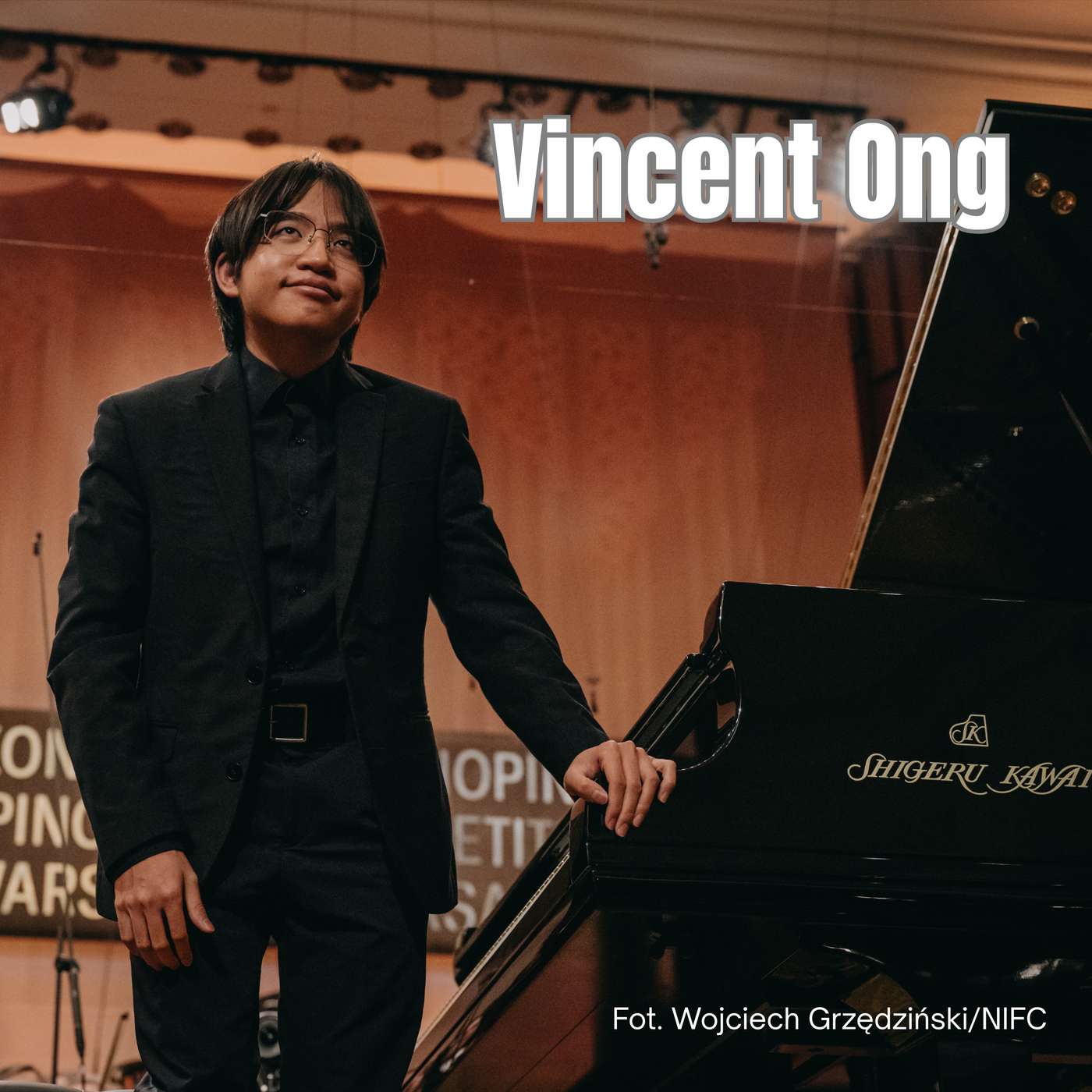
Vincent Ong: I wouldn't call myself a Chopin expert
33m 56s
Vincent Ong, the first Malaysian pianist to reach the final stage of the Chopin competition, discusses the challenges of handling stress, pressure, media attention, and criticism during the competition. He acknowledges differing opinions on his interpretation of Chopin's music and emphasizes that he is still on a continuous learning journey. Influenced by the Russian and French schools of piano playing, Vincent aims to explore diverse repertoire and continue his musical education in Berlin. He reflects on the importance of setting the right mindset before performances and shares insights into his approach to playing in the competition, highlighting the significance of being present in the moment.
Transcription
5431 Words, 29467 Characters
I'm with Vincent Ong from Malaysia, the first Malaysian piano player
to be in the second third stage of the Chopin competition
and then in the final, hello, how are you?
- Hi, nice to meet you.
Doing great, a little bit tired now,
but I mean, it's had been such a long journey,
of course I'm tired and I'm also super happy
to reach the finals, yeah.
- Yeah, we are speaking after the final stage
of the competition, so we can speak a little bit
about how this journey looked for you.
What do you think was the hardest part of competing here?
- Yeah, so I think I have mentioned this
in a couple other interviews before,
but I think what I've learned the most
and what I found the most difficult
was dealing with all the stress
and the pressure that one gets from this,
and as well as receiving all the media attention
and all sorts of reviews and comments and opinions,
that learning how to deal with that,
while also at the same time focusing on the music,
that's probably the most difficult thing, yeah.
- Were you reading all the comments?
- No, not all the comments, I even try to not read that much,
but of course a lot of them slip through the cracks,
you know, like time to time again.
I mean, if you use social media,
you're gonna see some stuff.
- What stuff did you see?
- What stuff did I see?
Well, what do you want me to start with?
- Whatever you want.
Did you, I don't know, did you, for example, see,
because actually you were one of the players
that kind of divided the public?
- Exactly, exactly, yeah.
- Many people were completely amazed
with how you play Chopin
and some of them were also kind of-
- Disgusted, yeah, yeah.
- Maybe not disgusted, but disturbed.
Do you know why?
- Well, I can understand why,
'cause like it's,
let's say maybe that
sometimes the way that I play that makes sense to me
is might not make sense to others,
and that's very normal.
And also like I don't,
I also never claim to like no Chopin.
Like I don't think I'm a Chopin specialist.
You know, even reaching the finals,
I still don't think that I really truly understand Chopin
because like my whole life,
I have a strong connection with Chopin.
I have always been playing his music,
but I wouldn't say that I know him
or that I know what he's all about.
And so it's always still a learning process for me.
But in terms, I mean, back to your question
about like why people might feel disturbed
about how I play.
Maybe they have a certain preconceived notion
of how Chopin should sound
or like how Chopin is meant to be played,
which I'm also not trying to dispute against that.
Perhaps they know better than me, but yeah.
- And do you have something like that,
meaning do you have a preconceived thinking
about how it should be played
and you try to reproduce it?
- We all have, I think as, I mean, as people who,
I mean, all of us who enjoy listening music
or playing music, I mean, we all have our own,
I guess, tastes and opinions and decisions,
especially for performance that we have to make
when we're performing.
And especially for classical music,
something that we are basically playing old music.
Music that's already written, notes are there.
People, there's a long tradition, don't forget,
that over hundreds of years
that have been passed down generation to generation
of how things are done.
So in that sense, there's definitely preconceived notions.
- But do you try to reproduce this history
or do you try to bring something new,
something modern to the music?
- I'm not trying, I don't think I try to bring something new
for the sake of bringing something new
because I don't feel like that's what I'm doing.
I do what I believe is, I mean,
comes out naturally for myself,
for like, with regards to the music.
I mean, like, I don't think that I'm trying to be novel.
You know, I feel like what I do is, for me, feels honest.
And natural, but at the same time,
of course I could understand
if that's not the Chopin that people are used to
and they completely have the right to say that, yeah.
- When you look on the comments in general,
as we spoke about the fact that there is some division
about you, you are not the only pianist
that brings this kind of division
because there's also David Kirikuli who brought it.
And in the earlier stages, there was also, for example,
Jonas Almeder who also kind of brought it,
that it's this, you know, dual way of speaking
about the way he's performing.
And well, what I see you have in common is
that you are the only representation of your country
at the competition.
So there's one Georgian, one Malaysian, one German.
Do you think there is something about the national school
or something like that in music
that you can perform like a Malaysian
or perform like a Georgian or perform like a German?
Is there some national party in the way of playing?
- In terms of classical music, if you look,
100 years ago, definitely there are,
like there are distinct schools, distinct sounds
that you can hear.
This person is like French school, Russian school
or whatever it is.
All have their respective traditions,
great, great, long and important traditions.
Nowadays, it's all gotten very international.
For example, all of the proponents of the Russian school,
they are all teaching all over the world.
French school also as well.
And now you have the internet, you have countless recordings,
everyone could have access to so many pianists of the past,
all the giants, all the important pianists
and pedagogues, educators.
So right now it's kind of got globalized.
And I wouldn't say specifically just because I'm from Malaysia,
then I have a certain Malaysian sound, you know,
because I've gotten influence from many things
from all over the world, not just Malaysian.
- Let's speak about the influence.
What are your main influences?
- Well, I think in regards to classical music,
I guess I would say I owe a lot,
like somehow directly or indirectly to the Russian school,
I would say, because a lot of these teachings of legato
and connecting sound and listening and being aware,
these are all things that of course are not just unique
to the Russian school, I'm not saying that,
but I think that, for example,
my current professor, Eldar Nibblesen,
he's a student of Bashkirov,
who is one of the greatest Russian teachers
and pedagogues, piano pedagogues.
And I think that's just this very long tradition
that I am somehow kind of like a part of,
and even from the side of my Malaysian teacher,
like teacher in Malaysia, Ng Chong Lim,
he, his teacher's teacher is Korto,
like Alfred Korto.
So there's also something French in that, I guess, something.
I don't speak a single word of Russian,
I don't speak a single word of French,
but somehow I think it's somewhere there in the music.
So it's hard for me to describe,
but there is definitely a tradition somewhere there.
- Let's speak of that, because after the final,
there was a scene that I observed from the press room,
your first teacher came to hear you.
I spoke to him.
- That's him, yeah, that's Ng Chong Lim, yeah.
- Yeah, I spoke to him and he was amazed by your performance.
He was very happy to be here,
and from what I understood, it was a surprise for you.
- Yes. - How big of a surprise were you?
- Well, let's just say he kept it as a secret on purpose
to surprise me.
And he actually talked to Kuba, the Piano 14 director,
and he, they basically coordinated this
so that they could capture the exact moment.
He was hiding, you know, in the corner there.
So when I walked out and I turned and I saw him,
it was, yeah, such a shock.
- What did she, because I understand that it was
your absolutely first teacher of piano, right?
- No, he wasn't my first first teacher
when I was just starting, no.
I met him first when I was like,
I had to be around nine or 10 or so,
if I remember correctly.
- So you were already playing Chopin at the time?
- Yes, I think so already, yeah.
- And beginnings with Chopin. - Beginnings, yeah.
I guess, I guess.
- Do you remember something that he taught you?
- Sure, I mean, so many.
I mean, I don't know where to start.
- Is the, for a pianist, for a professional pianist,
such as you are, is the teacher that you remember for,
I don't know, since you were very little,
like, because you were eight, right?
So how much of an importance has the first
or the second teacher for a pianist like you?
- I think it's probably way more important
than I even realized,
because obviously I was so young still,
and I'm not aware of so many things.
I wasn't aware of so many things.
So, you know, as a kid, you don't know anything.
You just do what you're told, basically,
or that you just listen.
But I mean, looking back,
I think he has like, I mean,
such a huge role in my development musically,
and also as a person, I think.
He's a very inspiring person, too.
I look up to, yeah.
So, it's definitely,
I guess I could say I do owe him my life, basically, yeah.
- Every time I got the chance to speak to you,
even for a short time after your performances
in the stages of the Chopin competition,
I always tried to ask questions about Malaysia
and about your culture.
And what I also noticed yesterday
is that you and your teacher spoke English.
Is it your first language?
- English is actually considered my first language
because this is also--
- Is your Chinese Malaysian?
- Yes, but my mom is not Chinese.
She's Thai, so she doesn't speak Chinese.
That's also one of the reasons
why we spoke English at home, actually.
- But you do. - Yes.
I do, because I went to a Chinese school,
like a public Chinese school since I was young.
Yeah, all the way until high school.
- Now, just for me not to make a mistake in English,
but it's Malayan, right?
It's called Malayan.
- The language? - The language, yeah.
- Malay. - Malay.
- Yes, yes.
- In Polish, yeah, it's Malayan.
- Yeah, that would sound probably like that.
Okay, so do you speak the language as well?
- Yeah, I do, but it's gotten really, really rusty right now
because I never had a chance to use it that often.
And this is something that you unfortunately see
with a lot of Malaysian-Chinese people.
I'm sure I'm not the only one.
Because, for example, if we don't have many friends
who are Malay, we don't even get the chance
to use it that much in real life, and I mean, to practice it.
So all we do is we learn it in school.
And then, of course, we learn the language.
But now, if you ask me, it's super rusty.
I'm sure even my German is better than my Malay,
if you're not looking back.
Which, at the same time, Malay is the national language.
We all have to know it.
And if you want to live in Malaysia,
you're gonna speak it, for sure.
I mean, when you're out and about.
But in terms of growing up,
I really didn't use it that actively
compared to Mandarin and English.
- Let's go back to those early times.
You were beginning with piano,
you were beginning with Chopin in Malaysia.
We've already spoke about it
that Chopin isn't the most famous person in Malaysia.
You probably will make him a little bit more famous,
I suppose.
But how do you become a pianist,
a Chopin player in Malaysia?
- Specifically, a Chopin player,
I don't even know the answer to.
Even how do you become a pianist, I don't even know.
Yeah, it's a hard question to answer.
- But okay, do you go to a lot of piano recitals?
- Yes, I mean, yes, that definitely helps.
I mean, to definitely like just listen more,
experience more, that's for sure.
Yes, to attend recitals.
And I mean, of course,
this depends a lot on your parents as well,
whether they are even willing to support such an endeavor.
Yeah, because, you know,
there's this super Asian culture of like,
you have to study hard, you have to get good grades,
you know, you have to become an engineer, a doctor,
you know, music is something for fun.
It's not something you pursue, you know.
- Did you have full support to become a musician?
- In that sense, yes, I was very grateful.
I mean, I'm lucky to have very supportive parents,
but that is quite rare in Malaysia.
I'm gonna be honest, yeah.
It's, I mean, to do music as a profession is kind of,
still, I guess, like laughed at, no, no, not laughed at.
I mean, that's a bit harsh,
but it's just not as realistic, you know?
- Okay, but do you feel like you have a purpose,
except for music, to, I don't know,
bring something new to the Malaysian way
of looking at musicians on the touch screen?
- Perhaps, perhaps, maybe, maybe,
but like, it's not one of my main goals.
Maybe indirectly, maybe.
Maybe, you know, someone could be inspired by my,
I don't know, my life story or something,
but like, that's not like my goal as of this moment yet.
Maybe in the future, when I try to bring back something
to the education, but that's already like so far.
Like, it's not my--
- Maybe you don't, maybe you don't realize it yet,
but you're a finalist of a Chopin competition,
you will become someone very important.
- Yes, yes, that's true.
But I mean, I mean, it's like such a huge topic,
and also like, regarding education,
and like how, like the awareness of music culture
in an entire country.
I mean, that's not something,
that's not an easy topic to tackle,
and like if you ask me what I'm doing about it,
I'm not doing anything much.
I'm just right now focusing on just doing my best
to, you know, to do what I do best, I guess, yeah, yeah.
But it's not, I don't think there's like a greater goal
to like contribute to my country.
I don't feel that way yet,
but I'm definitely proud to be Malaysian though, yeah.
- What is your dream?
- What's my dream?
I don't like that question,
because I'm not the kind of person that likes dreams.
- What is your goal?
- My goal, oh, that's better, yeah.
Well, let's see.
So, for me now, my goal is more like internal,
rather than like external.
Basically, I want to like basically expand my repertoire
in my time of studying in Berlin right now.
My goal was like, you know, originally to basically pick up
and as much as I can, learn as much as I can,
in terms of music, culture, the environment, everything,
the language even, you know,
since I'm in Germany and study German,
and then also just, I guess, try out a bunch of things.
And then maybe after that,
I can slowly see what suits me.
But I think right now at this stage of my,
I guess, education or my journey,
I think it's important to like not be afraid
to try a bunch of different things.
- When you say a bunch of different things,
what do you mean?
- Yes, so like repertoire wise, like there are many--
- It's all related to being a pianist.
- Related to being pianist, yes.
- So you're not talking about, I don't know,
I would like to try--
- To be a barista or something.
No, no, no, maybe not.
Oh, no, in that sense, maybe also.
Composing, I used to, I mean, I still sometimes come,
I'm okay now, of course not,
but I love composing as well.
I mean, I'm not really a good composer either,
and I just compose for fun sometimes, you know,
for piano only, I never compose for other instruments.
- Do you improvise?
- Yeah, I do.
- What do you like to improvise?
- Anything, I usually, when I improvise,
like usually it's just for like,
just warming up, you know, before practicing,
and it's not really like based on a certain team
or anything, like I don't really keep a team,
I just like whatever, you know, comes to mind.
- But it like classical scales or jazz?
- No, no, no, it could be anything.
It could be jazz, it could be,
and it's just like how I feel at the moment, you know,
just play whatever, and it's just for me,
just for myself, it's not me for playing for someone.
- Yeah, speaking of that,
because you performed a huge repertoire
during the Chopin competition,
and all the pieces are in kind of different moods,
different ways of thinking,
how hard is it for a pianist to let's say,
because I can imagine that if you play in the morning
or later or whatever, like,
you might not be in the mood of that.
- Yeah, that's right.
- So how hard is it for a pianist to perform this mood?
Is it like being an actor?
- There are some similarities.
Some people mentioned like the Stanislavski method
or whatever, you know, like,
that could work for musicians as well,
or like these meta, yeah, these method acting stuff,
but I don't know, I don't know much about that either.
For me, it matters a lot how you approach
the stage, how you approach the piano,
and how you sit and how you, you know, the moments.
Oh, yeah. - I'm sorry, yeah.
- No, it's fine, it's fine.
So, yeah, anyway, I was saying like,
basically, I think it's important how you,
how you listen to the music before it starts, basically.
So basically to set your, yeah,
it's kind of weird to say that,
but to basically set your entire body and your mind,
so to be in, like,
the right headspace in the right place
for the music to breathe,
for the music to, you know, to begin, to be born.
So it's like kind of like a whole process
of like, kind of like a relaxed focus, you know,
and it's not easy to always get to this point.
Sometimes when I start playing something,
it feels like, oh my God, what am I doing, you know,
but that's normal, although we are all humans, yeah.
But yeah, definitely the moment before you start playing
is very important for us, yeah.
- So was it hard to perform the final
of the Chopin Competition in terms of the fact
that you have the Polaris fantasy,
you have the concerto, you need to get out of the stage,
go back, hear the applause twice,
there is the whole orchestra watching you.
Did that bother you?
- In that sense, playing, starting the concerto was actually,
I mean, I was still nervous.
I missed that, no, that up there, I'm sure everyone saw that,
but yeah, I mean, it's a classic one, yeah, I missed it.
But because I was nervous about that
and then after that, it was fine.
But actually starting the concerto was not,
so somehow for me at that time, it was not as bad
because, apart from that, because I guess you had
like three minutes of the orchestra like, you know,
playing already, at least you are not the one starting,
you know, so at least they are helping in that sense.
And then for the Polaris fantasy,
such a atmospheric work, no?
It's so much like imagination
and so much like, you know, so many layers of colors.
And the thing is like to start such a piece,
I mean, I think it's also important
to kind of take in the entire like hall,
the entire environment, you know, just to just like,
lift the moment, you know, and not just like,
it's not enough to just like, you know,
go like super tunnel vision and okay, I have to do this,
I have to do that, you know, like, or else I would die,
you know, like, you know, you have to do this,
there's a list of stuff you have to do.
No, but like sometimes to like just zoom out
and just take, like just, you know, realize that,
oh, I'm here, you know, I'm on the stage,
these people are watching me and then there's this huge hall
and then you just like kind of take in everything.
And then I think after that, and then you get into the music,
it's different.
There's something more present about it, you know,
if you do that, yeah.
- And, you know, I spoke about that with some people
from the orchestra itself, and for them,
it was a little bit strange to be there
and to have their instruments not warmed up at all,
wait 15 minutes and then start.
And they were even a little bit afraid
that they might mess up a little bit
because of that.
- Yeah.
- Did you, let's say, rehearse that part
or not with the orchestra before the concert?
- Well, we have a switch bar.
- I mean, did you rehearse,
because you rehearsed the full concerto, obviously,
but was there any like, let's say more rehearsal
of the scenario that, I don't know,
the conductor saying, okay, you will be waiting
for the Polonaise fantasy to, okay.
- No, they just told me from the backstage what to do
and then I just did it and that's it.
I know, you don't need to rehearse these things.
I mean, if you rehearse it, then it will be borderline
like acting already, you know.
Like, if you're rehearsing exactly,
stand here, bow here, smile to that audience
and no, it's not really what I would like to do, yeah.
- From the full repertoire that you played
during the full competition,
which piece are you the most proud of?
- In terms of the performance that I'm most proud of.
- If we had now to say, okay, Vincent Nong performed
during the 19th Frideric Chopin Competition,
you must absolutely hear this piece during this stage,
which would it be?
- None of them, not just kidding.
Preludes probably.
- Preludes, it's a classic stage.
- Listen, there was like tons of things
that I could have done better, but I mean,
I think the Preludes was kind of like a breaking point for me.
Like it was, is that the right word?
Basically, it was, I guess that it was the second round,
it kind of like, you know,
I guess there was something different that happened.
Yeah, and then I started getting more and more comfortable
afterwards, but I think the Preludes were definitely
a special experience for me, at least.
I don't know about what others think,
but for me, I think there's something special
about the energy I had during the Preludes,
that I think it was, because I performed the Preludes
a few times already, and then I think that was the best time
that I did, not in terms of like, how perfect it is,
because of course it's never perfect,
but in terms of like just the, yeah, like I said,
the energy, there's something electric about,
somehow the way I played, yeah.
- Have you ever been to Mallorca?
- No, why?
- Because that's where the--
- Oh yes, yes, no, I haven't been, I haven't been.
- Because many, many, many people, I never been to as well,
but many people say that it's very interesting
to go there and see the little piano
on which Chopin composed it, you know?
We always say about, you know, those grand pianos
that you performed on and pulled Chopin
just composed it on a not very good instrument,
but what, about what you said just before,
your little joke, I saw that you are a person
that is a little bit ironic, sometimes sarcastic,
in a good way, I mean, I really like this kind of humor,
but would you say that about you?
That's, that's--
- Sure, I guess, I don't know.
(laughing)
- Okay, because I would like to meet also Mr. Vincent Ong
from non-pianistic perspective,
what would you say about you?
- Well, I've been told by people
that I'm a very chilled, laid-back person,
and I think, I think at least that I'm a good listener,
and I like listening to other people's stories.
So sometimes when people interview me,
I'm like, what do I say about myself?
I don't know anything, but in terms of,
like, I guess, I like, I enjoy,
I enjoy listening to other people's stories,
other people or rooting for other people.
- If there is a radio competition,
you will be able to interview me,
but unfortunately there is not.
(laughing)
- Yeah, I mean, I'm just interested in people, like, you know.
- Did you discover someone interesting
during those weeks here in Warsaw?
- Yeah, sure, many people, I met a lot of competitors.
Of course, I wasn't like doing 30-minute interviews,
like a certain person, but no, I'm just kidding.
But I definitely have met many interesting personalities,
and yeah, I'm very happy, yeah.
- So in general, just to conclude,
what do you think was the most,
'cause I asked you for what was the hardest thing,
and now the most important thing
from these three weeks that you learned?
- Yes.
- Okay, to put it simply,
to trust in the music or to believe in it.
- Try to explain it, too.
- I make it sound like easier than it is,
but I mean, what I mean is to,
at the end of the day, is the music that matters.
That's what I mean, like, among all of these things
that's happening, like, how should I say?
Literally, even the competition aspect,
at the end of the day, it doesn't matter.
If you boil down to the one thing that matters
of performing music, it's the connection
that you share with other humans through music.
And I think that's, of course,
it's something that you kind of know,
but you don't really experience it until, you know,
you really spend so much time, so much hard work,
and so much effort, and you've been through so much,
and then you, it kind of condenses into, like,
one simple, you know, truth that is,
the music is, like, so powerful.
- You enter philosophical areas.
- Yeah, yeah, okay.
- Is there music without a listener?
- That's a good question.
I'm not sure, actually, because, like,
there may be, but then what's the point, you know?
- Because I spoke to Hioli.
- Yes.
- Who told me that true musician is someone who
is just the bridge between the composer and the listener.
Would you agree with this definition of a musician?
- Well, let's just say that I'm not confident enough
to build the bridge between me and the composer,
because that's, like, the composer's dead,
and I don't know what Chopin was thinking,
or is thinking, up there, but--
- Up there, you think he's up there?
- Maybe down there, I don't know.
I'm not a really religious person.
- But he's somewhere.
- He's somewhere, you know, he's,
or if you're super pragmatic, you know,
he has decomposed in the soil,
and now he returns to the environment.
Okay, anyway, what I'm saying is that
I guess bridge between, from the composer to the audience.
Yes, that's a very common, I guess,
narratives as classical musicians to have,
but also sometimes I think, like, you know,
no matter how much you study, like, the composer,
I mean, you still don't know the composer.
You're not the composer.
You know, there are so many instances
where the composers themselves play completely differently
from how they write the score,
and of course, doesn't mean you shouldn't study the score,
you should still study the score,
the text about their life, about the culture,
everything helps, right?
Every little bit helps, but still, you are not the composer.
And so I think, like, saying that you build a bridge
from the composer to the, I mean,
all I can say is that the composers are the ones
that composed these great music.
And yeah, like, you know, I'm not sure if you've heard,
like, Horowitz in this famous documentary,
"The Last Romantic", I think it was from that one,
where when the director was, or the producer was,
like, saying, oh, wow, that was a wonderful performance,
and Horowitz was like, but I didn't write it, you know?
And then there's some, like, truth to that,
like, in sense of, like,
there's something about music that's just,
it exists by itself, you know?
Like, doesn't matter, like, who is playing it,
like, which pianist, which person,
or even for the composer themselves, you know?
They are somehow, like, reaching for something
greater than themselves, you know?
While, like, writing these masterpieces.
And I think there's just a power there
that is quite hard to, like, you know, to explain.
But you, you know, you don't need to have, like,
a degree in music, or something, to feel that.
Anyone can feel that, you know, when you listen
to such powerful music, that there's a certain,
there's something greater than just the notes,
than just, you know.
- If you had to choose to take from now on,
dancing, acting, or singing classes,
which one would you choose?
- Singing classes, easy, easy.
Because I did some singing before I was in a choir
when I was in high school.
- We always go back to the singing question.
What would you sing if you had to sing now?
What is your favorite genre of singing music?
- Well, I haven't actually, like, sung,
like, for a long time, favorite genre.
- I don't know.
You have to give me some choices, I don't know.
Like, I don't know.
- I don't know, classical, because you're a choir,
religious, pop, I don't know, opera.
What is the best singing genre for Vincent Tang?
No.
- No, I'm a bad singer.
I will not answer that question.
I mean, I haven't sung for such a long time.
I do, how do I say?
I don't sing, like, for pleasure.
Like, just for singing, you know.
Like, that's not something that I've done for a long time,
yeah.
- But there will be singing classes maybe one day,
again, to play piano, even better than now.
- What do you mean?
- I mean, I spoke to a jury member who told me
that pianists should learn to sing and dance,
that would help in certain performance.
- The dance, I do agree, yeah.
I think that would definitely help, yeah, for sure.
Yeah, and the singing, I mean, yeah.
I mean, that could also help.
But like, then again, there are a lot of great pianists
who can sing either, yeah.
- That's true.
- But, yes.
- That's true.
- But anything, yeah.
- Well, to be continued, Vincenang, finalist
of the Chopin Competition, thank you so much
for this interview.
- Thank you very much.
Podcast Summary
Key Points:
Vincent Ong is the first Malaysian pianist to reach the final stage of the Chopin competition.
Dealing with stress, pressure, media attention, and criticism was the most challenging part of the competition for him.
He does not claim to be a Chopin specialist and acknowledges differing opinions on his interpretation.
Vincent Ong's influences include the Russian and French schools of piano playing.
He aims to explore different repertoire and further his musical education during his time in Berlin.
Summary:
Vincent Ong, the first Malaysian pianist to reach the final stage of the Chopin competition, discusses the challenges of handling stress, pressure, media attention, and criticism during the competition. He acknowledges differing opinions on his interpretation of Chopin's music and emphasizes that he is still on a continuous learning journey. Influenced by the Russian and French schools of piano playing, Vincent aims to explore diverse repertoire and continue his musical education in Berlin.
He reflects on the importance of setting the right mindset before performances and shares insights into his approach to playing in the competition, highlighting the significance of being present in the moment.
FAQs
Dealing with stress, pressure, media attention, and reviews while focusing on music.
Yes, there are traditional expectations, but interpretations can vary.
Influenced by the Russian and French schools of piano playing.
Yes, but proficiency has decreased due to lack of practice.
Supportive parents, attending recitals, and overcoming cultural expectations.
Chat with AI
Loading...
Pro features
Go deeper with this episode
Unlock creator-grade tools that turn any transcript into show notes and subtitle files.
 PodcastTranscript AI