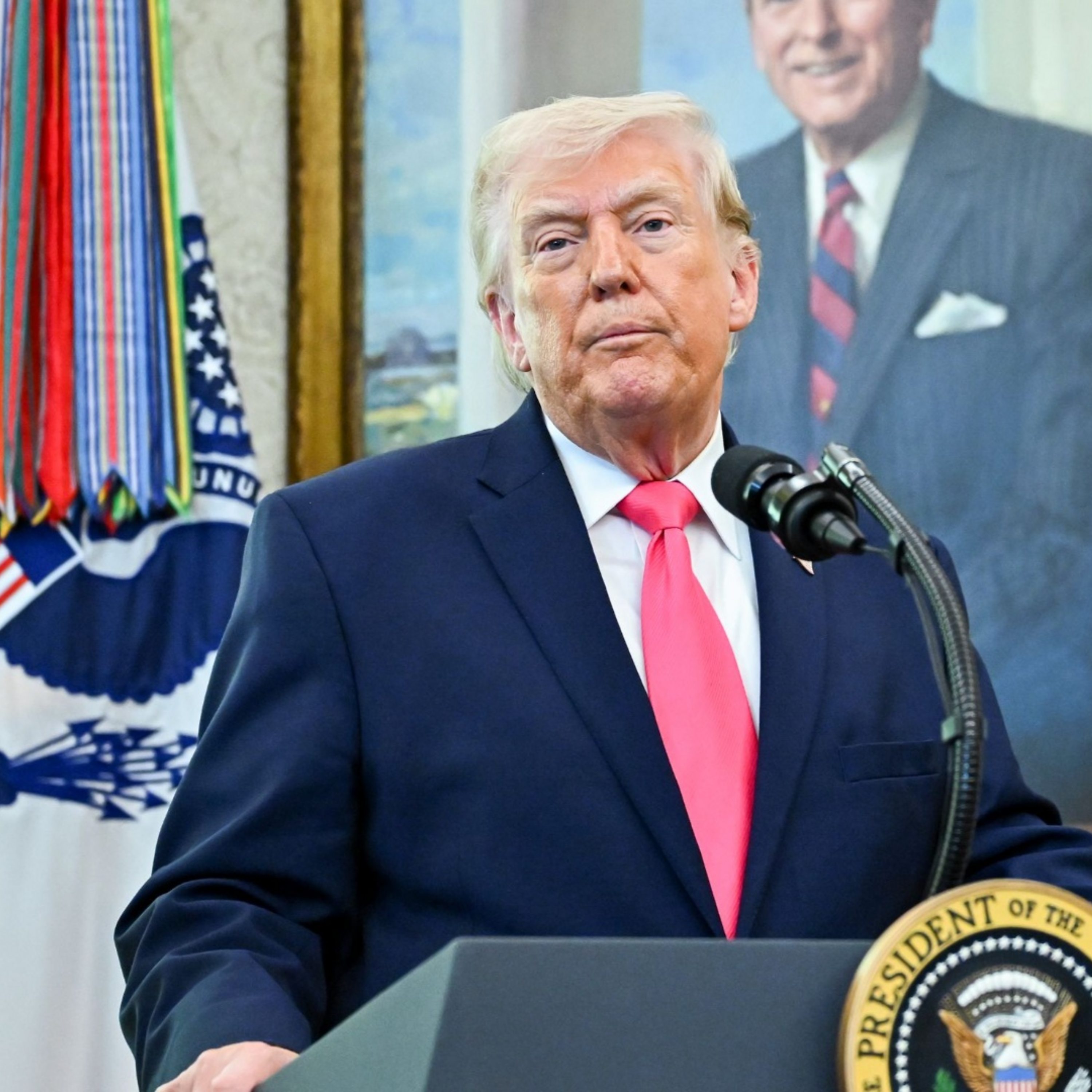
US reportedly offers 15-point plan to end conflict
from Global News Podcast
25m 52s
This BBC Global News Podcast covers several major international stories. In geopolitics, the US has presented Iran with a 15-point plan to end hostilities, focusing on nuclear disarmament and securing the Strait of Hormuz, even as it deploys more paratroopers to the region, leading analysts to warn of a dangerous escalation. In technology, Meta faces a $375 million penalty for deceptive practices regarding child safety, setting a significant legal precedent. The war in Ukraine saw a severe escalation as Russia launched approximately 1,000 drones in a single day, inflicting civilian casualties and damage. In science, NASA's upcoming Artemis II mission aims to send a crew of four astronauts farther into space than ever before, on a crucial test flight around the moon. In sports, Liverpool's iconic forward Mohamed Salah confirmed his departure from the club at the season's end. Additional reports cover a staff pay dispute at Australia's ABC, Denmark's election results leaving a fragmented parliament, and innovative anti-fraud technology in the French wine industry.
This BBC podcast is supported by ads outside the UK. What happens when you design healthcare around people, not systems? On thages aside, special host of resilient edge, a business vitality podcast paid and presented by Deloitte. Learn how Deloitte, AWS and Elevants Health are turning fragmented systems into effortless intelligent care, available now wherever you listen to podcasts. Udet Samsung Galaxy Buds 4 Pro Naptikuloket. Isompi Soundi, Samasta Kossa, 20% of the world's most popular product. Whoop-poo-oh-gan-soundi. Tutusto Samsung Pistekom. You're listening to the Global News podcast from the BBC World Service. Hello, I'm Oliver Conway, and we're recording this at 5 o'clock GMT on Wednesday, the 25th of March. The US has reportedly sent Iran a 15-point plan to end the war. The social media giant Meta is ordered to pay $375 million in damages for misleading users over child safety. And Russia launches nearly a thousand drones at Ukraine. Also in the podcast, we look at NASA's mission to fly humans deeper into space than ever before. And. Moments like this are so incredibly unique, and they give everyone a big morale boost. And they just remind us why this work matters. Delight as a second gorilla gives birth to twins in a national park in Congo. President Trump appears to be pursuing a twin approach to the war on Iran. On the one hand, he's reported to be sending thousands of US paratroopers to the Middle East, raising the possibility that he intends to invade Iran's oil hub of Hague Island. But at the same time, US officials say Iran has been sent a 15-point plan to end the war. Speaking at the White House, President Trump said the two sides were already in negotiations, and the Iranians, quote, "badly" "want to make a deal." He also spoke about a gift from Iran related to the flow of oil through the Strait of Hormuz. It was a very big present worth a tremendous amount of money. I'm not going to tell you what that present is, but it was a very significant prize. And they gave it to us, and they said they were going to give it. So that meant one thing to me would deal with the right people. Is that nuclear related? No, it wasn't nuclear related. It was oil and gas related. Was it related to the Strait of Hormuz in the flow? Yeah, it was related to the flow and to the Strait, yeah. A few hours later, Iran said it would allow what it called non-hostile vessels to pass through the Strait. In recent days, countries like China, India, and Pakistan have managed to negotiate safe passage through the waterway. Despite this report of possible progress, analysts like Ali Vyaez from the International Crisis Group say the situation remains very dangerous. The United States is now getting closer and closer to the prospect of putting boots on the ground. The president seems to have absolute belief in the ability of US military to deliver results. And he believes that taking over Iranian territory would force the Iranians to open up the Strait of Hormuz. This is an absolute catastrophe for the region, and it might come to haunt the US and Israel. I spoke to our US correspondent David Willis, and he told me first about the American peace plan. It's been reported here, Oliver, that the US has sent Iran a 15-point plan via intermediaries in Pakistan for ending this war. The sort of blueprint that the United States believes is needed to be signed up for by Iran. And according to the New York Times, it broadly addresses Iran's nuclear and ballistic missile programs and is said to include the demand that Iran abandoned any attempt to build a nuclear weapon. Now, that is something which President Trump, to the surprise of many, I might add, said today that Iran had already agreed to. And this plan is also thought to include provisions regarding maritime routes, given Iran's recent blocking of the Strait of Hormuz. It's unclear how widely the plan has been shared amongst Iranian officials, or indeed whether Iran is likely to accept it as the basis for negotiation, and nor is it clear whether Israel, which of course has been bombing Iran together with the United States, is on board with the provisions included in this plan. Iran has of course denied that any negotiations are taking place with the United States, and President Trump once again refused to be drawn today on who in Iran the US is negotiating with. At the same time, there are reports that US paratroopers are going to be heading to the Middle East. Is President Trump really thinking of trying to take Harg Island? Possibly. You're absolutely right. It's being reported that as well as two marine expeditionary units, the Pentagon is sending more than 1,000 soldiers from the 82nd Airborne Division to the region, including an elite contingent of paratroopers and rapid response forces. And that's in addition to the thousands of soldiers and Marines that are already in the region. It's not clear precisely where these members of the 82nd Airborne will be stationed, and President Trump didn't address troop deployments when he spoke to reporters in the Oval Office today, but the reports have prompted speculation that all this talk of negotiation could be aimed at, perhaps soothing the financial markets and also buying timers, you mentioned there all over, for the US to get troops in place ahead of a possible ground invasion. David Willis, talking to me from Los Angeles. A US jury has found that meta-violated New Mexico state law by misleading users over child safety. The tech giant was accused of allowing predators to get access to underage users, thus enabling child sex abuse and human trafficking. It was ordered to pay $375 million in damages, less than the $2.2 billion requested by the state. The New Mexico attorney general who brought the case said the firm's executives knew their products harm children and lied about it. Meta says it will appeal. I heard more from our North America technology correspondent, Lili Jamali. Well, this trial is significant because it's the first time that a US state has managed to sue this company, Meta, over child safety and win. And Meta is one of the world's biggest tech companies. They own Instagram. They own Facebook. They own threads and WhatsApp. These are products that nearly all of us use in some form or fashion. And for years, states like New Mexico had a really hard time getting cases like this one on child safety in front of juries because the tech companies would say that under US law, they're not responsible for content that people post on them. Here, the state was able to successfully argue that this case was really about design choices, the algorithms that push certain content and potential contacts to these kids. The fact that this case made it to a jury always carried a sense of historical consequence, but this verdict with this $375 million judgment only adds to that sense. And what exactly has Meta been found to have done wrong? So Meta is specifically found to have willfully engage in unfair trade practices in violation of consumer protection laws in New Mexico. The allegation, which the jury bought here, is that they misled the public when it comes to the safety of its platforms. Meta has said they disagree with this verdict. They're planning to appeal, as you mentioned. They also say they work really hard to keep people safe on their platforms. All along, they have taken issue with this idea that they don't do enough to protect children. In 2024, about a year and a half ago now, they launched something called Instagram Teen Accounts, which they say helps limit screen time and interactions with strangers, gives parents more control. But critics have said that that program is just window dressing. It doesn't do a lot to meaningfully address child safety concerns. This is just one of a series of cases brought against Meta and other tech firms. Will the industry be worried here? I think they are. And I would say certainly there's a feeling among advocates that I've been speaking to that there is a change in the works here. There's another case being considered by a jury right now in Los Angeles, brought by a young woman who alleges Meta's Instagram is addictive and caused harm to her mental health. There, there are parents all through the courthouse who have lost their kids to what they believe with social media addiction. And then you also have laws all around the world being considered or enacted to keep kids off social media. Lily Jamali in San Francisco. Starting on Monday night and continuing into the day of Tuesday, Russia launched nearly 1000 drones against Ukraine, according to the Ukrainian military. The low cost but deadly weapons hit targets across the country, leaving several dead and more than a dozen injured. Our correspondent in Kiev, Vitaly Shepchenko, has the details. Normally attacks of this scale happen at night and they turn into a real threat.
not to focus on Western Ukraine. Overnight, five people were killed in attacks across Ukraine, and then in the afternoon, wave after wave of Russian drones flew west in broad daylight. And the damage they caused is severe, including to a 17th century church in Elviv. This was the attack. President Volodymyr Zelensky called this attack an absolute perversion, which only Vladimir Putin can like. In neighbouring Ivana Frankivsk, two people were killed, and a maternity hospital was damaged. The Ukrainian Air Force says that this country was attacked with the largest ever number of drones dispatched by Russia on a single day, 948, according to President Volodymyr Zelensky. The sheer scale of this attack shows that Russia has no plans to end this war. Vitaly Shevchenko in Kiev. Volgoz to plan this time next week. Four astronauts will be heading for the history books, as NASA's Artemis' two mission carries them further from Earth than any human has ever been. They're due to fly around the moon as part of a plan for a man's return to the lunar surface for the first time since the Apollo era half a century ago. Our science editor, Rebecca Morell, has been taking a closer look at the living conditions for the crew and how the mission will play out. The astronauts making this epic journey are three Americans. Read Weisman, the missions commander, who's had a lifelong love of flying, but says he's scared of heights. Pilot Victor Glover, whose nickname is Ike, he says it stands for I Know Everything. Christina Cook, the only woman in the crew, she made history with the first all-female spacewalk and Jeremy Hansen from the Canadian Space Agency, who's never been to space before. The astronauts will spend 10 days in the Orion capsule. The compact living space is where the four will exercise each work and sleep. The astronauts will use a water dispenser for drinking and to rehydrate their food. They've each chosen their favourite meals for the trip. And a step just beneath the hatch doubles up as a flywheel exercise machine. The astronauts will work out for 30 minutes every day. The mission to the moon and back will last about 10 days. The first day, the astronauts will orbit the earth, checking the spacecraft's vital systems. On the second day, they'll depart for the moon. The journey takes about four days. As the astronauts fly around the moon's far side, they'll see parts of the lunar surface never seen by human eyes before. After that, they'll begin their four day journey home. The return is one of the most dangerous parts of the entire mission. And the crew will be relying on Orion's heat shield. You'll have to protect the astronauts from temperatures of 2700 degrees Celsius as the spacecraft speeds through the Earth's atmosphere. That's half as hot as the surface of the sun. The heat shield was badly damaged during the first uncrewed Artemis mission. But by changing the angle of Orion's reentry, NASA is confident this won't happen again. Once the spacecraft is safely through a series of parachutes will be deployed to slow it down. The astronauts will make a gentle splash down in the Pacific Ocean of the coast of California where a recovery team will be waiting. Our science editor, Rebecca Morrell. One of the premier leagues leading goal scorers, Muhammad Salah, will be leaving Liverpool Football Club at the end of the season. The 33-year-old Egyptian International announced his forthcoming departure in a video on social media. I never imagined how deeply this club, this city, this people, would become part of my life. Liverpool is not just a football club, it's a passion, it's a history, it's a spirit, I can't explain in a word. With his reflection, his or senior football commentator Ian Dennis. Those who know him have always said to me that he would always leave on his own terms. But it will be farewell to a Liverpool legend. 255 goals, only Roger Hunt with 285, and Ian Russia 346 have scored more than Mo Salah. And that's just his goal. You throw in his assists as well, and he's had an incredible 374 goal involvement in 435 appearances. I mean, we are talking of not just a Liverpool legend, a Premier League legend and an African legend, because last week against Galatasaray at Anfield, he became the first African player to score 50 goals in the Champions League. So when you talk about greats, then Mo Salah is definitely one of those. I mean, he's undoubtedly underperform this season, 10 goals. If you compare that to his previous goals, Tally 44 in his first season, then 27, 23, 31, 31, 30, 25 and 34. And I think the manner of his departure as well is fitting for his level of service that he's given Liverpool Football Club over those nine years. But also it's fitting for Liverpool as a football club bearing in mind what happened at the end of November and December when he'd had that fall out. And there was question marks over his future prior to going to the African Cup of Nations because he was on the bench for those three successive games. The first time incidentally that had ever happened in his Liverpool career and that just didn't seem right for the departure of Mo Salah to go with dividing the fan base, that cloud of uncertainty. Whereas this on his terms, he will get the send off that the Liverpool fans will undoubtedly want to give him when he does depart now on his own terms at the end of the season. Ian Dennis. Still to come on the podcast. Somebody could just drink a real bottle of orange juice, fill it again with poor quality wine and sell it again. The man trying to stop French wine fraudsters. Can healthcare really be reinvented? And if so, what does that look like in practice? I'm Tages the S.I. Special host of Resilient Edge, a business vitality podcast paid and presented by Deloitte. In this episode, I talk to leaders reshaping what healthcare can be. Ratnachor Lavu and Elevants Health are keeping the consumer at the center of everything they do. We're really focused on three things. One is simplified personal member experiences. And the second thing is we want to empower the providers to drive the right health outcomes. The third thing is we want to simplify work for ourselves so that we can better serve our customers and members. It's about designing systems that work for the consumer, systems that listen, learn and build trust. We want them to be able to understand their benefits, find the right care, and then eventually we want to be able to schedule that. And this is where we are really excited about the partnership between Deloitte and AWS to bring some of these experiences to life. So how do you start? Especially if you're dealing with legacy overload. The full conversation unpacks how Deloitte, AWS and Elevants Health are redesigning healthcare from the inside out. Creating systems that work smarter, scale faster, and bring the human experience back to the forefront. All of that and more on this special episode of Resilient Edge. Find us wherever you listen to podcasts. Now we're ready. The first thing we want to do is to build a new ecosystem of our own. We need to build a new ecosystem. What it means is some of the big programs we need to build a new ecosystem. What it means is some of the big programs A flagship shows such as 730, which is an evening current affairs program. What it means is some of the big programs that are not going to be shown. That's a big program show such as that's a big program show such as that's a big program show such as that's a big program show such as 25%
So 10% over three years, well, Australia's annual inflation rate in January was 3.8%. But one of the other issues was that staff were also offered a $1,000 bonus, which sounds good, but it's not for casual staff and actually most of the workforce are on fixed-time contracts and casual contracts and so those people would not be part of that. And what are the particular concerns about artificial intelligence? So there's broadly a concern that the broadcaster is refusing to rule out replacing some staff with artificial intelligence now. This is not something that Australia faces alone, but that was just one of the other issues that the union members who voted against this offer. And so ABC now needs to take this to the workplace tribunal, the Fair Work Commission and try and resolve the dispute somehow. Katie Watson. Denmark's governing social democratic party came top in Tuesday's parliamentary election, but with its worst showing in more than a century. The Prime Minister, Madam Featherickson, had been hoping for a poll boost after standing up to Donald Trump's threats to take the semiautonomous territory of Greenland. Despite falling short of a majority, she says she is ready to serve as Prime Minister again. The party's election night gathering in Tyrion Minister Christian Rabjurg Madsen explained why she should stay in the top job. Greenland, a crisis and the totally unacceptable pressure that we have been put under by the American administration have been a tough thing to deal with. But I also think that it's shown that we have the right Prime Minister and the Prime Minister that's ready to take Denmark through also very, really tough times. From Copenhagen, Adrian Murray gave us an update on the results. The Danish Prime Minister and Madam Featherickson heard party, the social democrats have secured the most votes. She's got almost 22% of the votes and that's means she has 38 seats in parliament. Together with the red block, that is, group of allied parties because this is a coalition that has a lot of parliament where there's many parties on the left and the right. But those allied parties together have 84 seats. The opposition, the blue block on the right, they have 77. So that gives the red block this small lead. But neither side has the required 90 seats to have a maturity in parliament. So in this situation now, where it's not quite clear what form the next coalition government will take. Interestingly though, there's a small party in the centre, more the moderates and they have 14 seats. They are led by Larsenl Koresmason. He's a former Prime Minister himself and is also the former Prime Minister and Meta Featherick sends previous government. He is now positioned really with a lot of power to steer the course of what this next government might look like. Adrian Murray in Copenhagen. Imagine spending hundreds of dollars on a bottle of fine wine. Only to find you've actually bought cheap plunk that's been falsely labelled. Well, a vineyard in France has come up with a unique solution to fight the fraudsters, as Richard Hamilton explains. In recent years, French police have dismantled many criminal networks that have made millions of dollars by exporting counterfeit bottles of expensive ventures. To try to stop the fraudsters, vineyards have used secure labels, secreting cravings and even microchips on the bottles. But those methods are still not foolproof. Somebody could just drink a real bottle of frangilus, fill it again with poor quality wine, cork it again even if the original cork of frangilus, if the guy is really good and sell it again. As Benjamin Lafore, the head of research and development at Chateau Angelus in Bordeaux. He's invented a system for identifying counterfeit wine using the unique genetic code of each vine from the vineyard. His team mixed samples of DNA from the grapes with wax from local beehives, which are then used to seal the bottle. If consumers suspect they've been cheated, they can send a sample of the wax back to the Chateau for analysis and a definitive answer. Benjamin says the really clever bit is that the counterfeiters can't recreate this unique seal. If somebody would would like to make a false Angelus wanted to put the wax back again on top of the cork, they would have to melt it. But because of our process, if you heat up the wax to the temperature which makes the wax melt, you immediately destroy completely the DNA inside. Benjamin Lafore says the idea came to him one night when he couldn't get to sleep. After that he spent a year developing this system and has now patented it. It sounds like a lot of work, but since bottles of Angelus are sold for up to $800, protecting them is a good investment. Above all he says, the reputation of his vineyard depends on customers being able to trust that their wines are the real thing and not sophisticated fakes. Richard Hamilton Next to the Congolese Jungle Well that is the sound of a mountain gorilla. Officials at Varunga National Park in the Democratic Republic of Congo have reported that one of them has delivered twins. It's a pretty rare occurrence. Only 1% of these endangered creatures are twins compared to about 4% of humans. And even more remarkable, it's the second set of twins born in the park in the past few months. Laura Parker is head of conservation programs at Varunga National Park. She spoke to Rebecca Kesby about the reaction there. When the Rangers reported the second twin birth there was a real sense of joy across the team. Moments like this are so incredibly unique and they give everyone a big morale boost and they just remind us why this work matters. Two for one, twins do tend to run in families, don't they? Do we think that the two mothers might be related? We don't and in fact there hasn't been a lot of research done on this because they are so incredibly rare. But what we do know is that it's likely due to a rare biological event called hyper-obulation which we see in humans as well. When two eggs or two over are released it is natural but it's a very uncommon occurrence. But it may be more likely when females are in very good physical condition when there's a lot of stability and social cohesion within the groups and when stress is limited. You know mountain gorillas have recovered significantly since the 80s and 90s and not because there aren't the same challenges that we had back then but largely because of sustained long term conservation efforts. And I suppose that these mothers may have similar issues that human mothers might have with twins. Are you worried that it might be a little bit too much? We're certainly not worried it might be too much. But you know gorillas are not biologically adapted for twins. You know gorilla mothers are adapted to raise one infant at a time. They carry them constantly. Now gorillas also walk on all fours. So carrying two babies at one time can be physically demanding for her so survival can be more challenging in that way. But the gorilla births that we had in January those twins are now approaching three months which is already significant milestone in their survival. You know all signs of observation right now point to very little stress on the mother. Gorillas are I think even more exceptional than humans and their ability to work with one another. And the males do a great job keeping the group calm supporting the mother. But it's really up to her. You know gorillas they're not like lions or other species that can share the burden of child raising. It's you know the mother nurses alone and carries the infants alone. We don't want to over anthropomorphize this but it's really such an amazing event. And even when you're observing them when you see the video just how calm the mother is I think there was a video posted on our social media today even showing the mother with you know the two babies in her arms and then she's caressing a juvenile next to her that seems to be quite curious. Laura Parker from the Virunga National Park and the Democratic Republic of Congo. And that is all from us for now. But the global news podcast will be back very soon. This edition was mixed by Daniel Fox and produced by Chantal Hartle and Shavon Leighi. Our editor is Karen Martin. I'm Oliver Conway. Until next time, goodbye. Have you ever received a call from a stranger regarding student loans you don't owe? An unpaid parking ticket for a car that you don't even own. And so you might have been the target of a scam orchestrated by criminals a thousand miles away. I'm Tristan Redman, one of the hosts of the Global Story podcast and we're taking a lind side look at the highly lucrative scam factories of Southeast Asia. Listen to the Global Story on BBC.com or wherever you get your podcasts.
Podcast Summary
Key Points:
The US has reportedly sent Iran a 15-point peace plan addressing nuclear programs and maritime security, while simultaneously deploying additional troops to the Middle East, raising speculation about a potential ground invasion.
Meta was ordered to pay $375 million in damages for misleading users about child safety on its platforms, a landmark case focusing on design choices and algorithms.
Russia launched nearly 1,000 drones in a massive attack on Ukraine, causing casualties and significant damage, described as the largest single-day drone assault of the war.
NASA's Artemis II mission is preparing to send four astronauts on a historic journey around the moon, testing living conditions and re-entry procedures for future lunar exploration.
Liverpool FC star Mohamed Salah announced he will leave the club at the end of the season, marking the departure of a record-breaking player.
Other news includes a pay dispute at the Australian Broadcasting Corporation, election results in Denmark, and efforts in France to combat wine fraud using advanced bottle-tracking technology.
Summary:
This BBC Global News Podcast covers several major international stories. In geopolitics, the US has presented Iran with a 15-point plan to end hostilities, focusing on nuclear disarmament and securing the Strait of Hormuz, even as it deploys more paratroopers to the region, leading analysts to warn of a dangerous escalation. In technology, Meta faces a $375 million penalty for deceptive practices regarding child safety, setting a significant legal precedent.
The war in Ukraine saw a severe escalation as Russia launched approximately 1,000 drones in a single day, inflicting civilian casualties and damage. In science, NASA's upcoming Artemis II mission aims to send a crew of four astronauts farther into space than ever before, on a crucial test flight around the moon. In sports, Liverpool's iconic forward Mohamed Salah confirmed his departure from the club at the season's end.
Additional reports cover a staff pay dispute at Australia's ABC, Denmark's election results leaving a fragmented parliament, and innovative anti-fraud technology in the French wine industry.
FAQs
The US has reportedly sent Iran a 15-point plan via intermediaries, addressing Iran's nuclear and ballistic missile programs and demanding it abandon attempts to build a nuclear weapon, with provisions on maritime routes like the Strait of Hormuz.
A US jury found Meta violated New Mexico state law by misleading users over child safety, enabling predators to access underage users, leading to a $375 million damages order for unfair trade practices.
Russia launched nearly 1,000 drones against Ukraine in a single day, hitting targets across the country and causing casualties, marking the largest such attack by Russia to date.
Artemis 2 is a NASA mission that will send four astronauts to fly around the moon, traveling further from Earth than any human before, as part of plans to return humans to the lunar surface.
Mohamed Salah announced he will leave Liverpool at the end of the season, departing as a club legend with 255 goals, after nine years of service, on his own terms.
Deloitte and AWS are partnering with Elevance Health to redesign healthcare by focusing on simplified member experiences, empowering providers for better health outcomes, and using technology to create smarter, human-centered systems.
Chat with AI
Loading...
Pro features
Go deeper with this episode
Unlock creator-grade tools that turn any transcript into show notes and subtitle files.
 PodcastTranscript AI