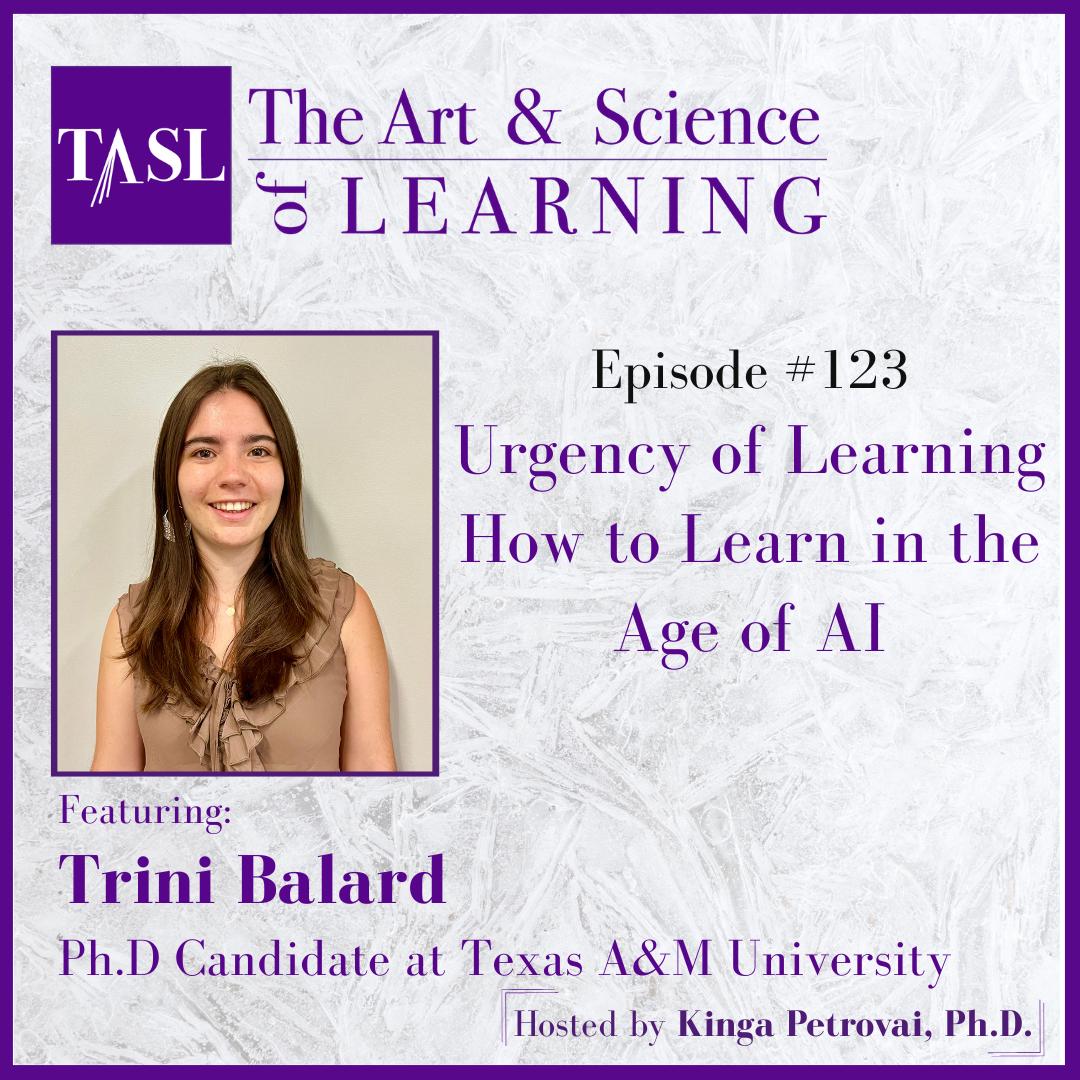
123. Urgency of Learning How to Learn in the Age of AI (Trini Balart)
34m 58s
The discussion centers on the urgent challenges and opportunities AI presents for education. It argues that AI is forcing a confrontation with long-ignored issues, such as ineffective assessment of higher-order thinking skills (e.g., critical thinking, creativity) and the lack of personalized, motivating learning experiences. A primary concern is the danger of losing a human-centered approach, where AI is seen as a tool built to augment uniquely human capabilities rather than make decisions or think independently. The conversation emphasizes that without addressing these foundational problems, AI risks diminishing human agency and intelligence. Consequently, there is a critical call to teach "learning how to learn" as a core skill. This meta-cognitive ability is essential for personal and professional adaptability in a fast-changing world, ensuring individuals can leverage AI effectively while maintaining and developing their own critical thinking and passion for learning.
But I think it's really important to have this human center approach all the time in all the conversation. Yeah, the technology has a lot of problems, the technology has a lot of dangers, but where are the dangers from the human perspective? Because we are building this machine for us and we are building them a chain. So I think sometimes when we are talking about AI, we kind of lose this conception of like, "Oh, this was a tool that we built for us." And now like we are talking about like all this AI agency and AI making decisions and AI being smarter and smarter and it's like, "Do we even know how to become smarter and smarter as people?" Welcome to the Art and Science of Learning Podcast, where we explore the best practices, technologies and research shaping the future of learning in the workplace and beyond. I'm your host, Learning Specialist Dr. King of Petrovai. In each episode I speak with industry leaders, academics, practitioners and learning designers about different aspects of learning and development. These conversations weave together insights from around the world and across industries to inform and inspire innovations in lifelong learning. There are significant challenges in education that have been ignored for far too long and AI is forcing us to confront them urgently. Otherwise, AI will think for us rather than with us. The need to learn how to learn has been increasingly important, but it has rarely been fully integrated into the education system. My guest in this episode is a doctoral student researching how to teach critical thinking with the aid of AI. She is sounding the alarm on the importance of teaching this skill with AI, otherwise she thinks that AI will not only think for us, but it will not allow us to think at all. Trini Bellard is a PhD candidate in the multidisciplinary engineering department at Texas A&M University. She's originally from Chile and holds a background in Industrial Engineering, Computer Science and a major in Engineering, Design and Innovation from Pontific Hall Catholic University of Chile. Her research focuses on engineering education and the impact of generative artificial intelligence on how we teach, learn and think. She is especially interested in how these tools are shaping the development of critical thinking in engineering students and prompting us to rethink the true purpose of education and what we understand by learning itself. Passionate about human-centered development, innovation and progress, Trini is committed to building a future where AI empowers rather than replaces our uniquely human capabilities. She envisions a future where these tools may even help us reach deeper levels of knowledge and societal development. Hello Trini, welcome to the podcast. You're a little kinka, thank you for having me. Before we get started and talk about your research and the work you're doing in AI and critical thinking, can you tell me a little bit more about yourself and how you came to study for PhD in teaching critical thinking with AI? Yeah sure, first let me start with saying how huge fun I am of your podcast, so how I am for being here. Thank you, I'm sorry, I'm doing my PhD on Texas A&M University in the multicepulinary engineering department. We have focused on engineering education, so how we teach engineers and how we envision the skills of the future's professions that are students are going to need for the future and then we'd focus specifically on AI, so how artificial intelligence is impacting the way we teach, the way we think, the way we learn and how we can use it to have a more meaningful learning and teaching process. So I'm from Chile, Latin America, the longest country in the world and I did my bachelor here on, it's kind of like a weird mix but I have engineering design and innovation with industrial and computer science, so it's kind of like a weird mix here in Chile works a little bit different than the states, so I have like all this background with all these different things and I have always believed that is interdisciplinary is like kind of like really really important, so that is why I have always say that I'm kind of like an engineer more focused on the humanities, I have always been like really passionate about like the humanity side of engineering and I have been researching this topic specifically with the race of Chagy Bd since January 23 until now that I'm already my third year of PhD. Looking forward to discussing this topic with you, so we talk a little bit about AI and the importance of critical thinking skills and all of that, what are the major issues that we are having to grapple with in education now and that we are not facing, what are those big issues that we've always had but somehow we've never we've never addressed but now it's the time to do it. Obviously this is a really really big big question and you have like so many different approaches to answer this question because then you have like the psychologists like really worry about like how this can affect like social skills between our students then you have like more the philosophical ethics person that are like really really worried about like how is changing the sense of belonging and like how we interact ourselves like there's so many different approaches but I think I think like a lot of the concerns and a lot of like the challenges that we have right now with AI that are not new as you said I think showing us with more urgency some of like the problems related with for example how we measure learning this how we how we evaluate how we measure how we assess learning in our student has been like a challenge for a long long time because like we know like each of the students like learn differently and like they need different things and they need different approaches to kind of like have like a more meaningful learning process but then we have like another problem with scalability because even though we know that for some personalized learning can be really good for some things we don't have like the capacity to have like one professor for it is doing anywhere so like we have like a lot of issues that we have always had that like AI is showing us with more urgency but like yeah I think some of like the mains are specifically with how we assess critical thinking skills and like higher order thinking skills like creativity and communication and collaboration and like these human essential skills that again have always been really really important but now are kind of like what are differentially differentiating us between them and jeans so so that is kind of like making it more and more urgent and I think really I think this is a big challenge but it's also like a really interesting opportunity because how we can use like these technologies to actually be able to find better ways of assess and find better ways of understand how we can like and haze learning in our students absolutely and those of as you said those have always been big challenges and we've been trying to teach critical thinking and creativity for a long time and not necessarily able to nail it in what the right approach is but you say that AI brings an urgency in addressing these issues as assessment as well which a lot of teachers are very concerned about how do we assess when you can have an essay written by AI tell me a little bit more about the urgency that AI is bringing to these challenges so for example and I think these two connections are like these two questions are really interconnected because for example motivation so a lot we were having a lot of problems with academic integrity so like it's weird that I don't mention that as a major issue because a lot of the people in this area are talking about academic integrity and how our students are like sheeding in these tools but for me it's like more than the challenge of the academic integrity is the urgency of seeing the lack of motivations of our students and again that is not something new you know we have been having issues with self-regulation and motivations for a long time because our students are not, most of our students are not feeling like well motivated or like passionate about what they're about what they're seeing like that is like a really really big problem and again it's not new you know like motivation and fixing and solving that is that something that we can really fix I mean we can't when we have mass education so everyone is going through school certainly we can't fix the fact that a lot of people are not necessarily passionate about what they're studying they need to get through it but of course we don't want them to be cheating we want to assess their actual learning and knowledge not regurgitating from AI how do you see motivation as as part of that right so like motivation by itself maybe it's not something that we can like fix by itself but like definitely if our programs are being able to be more aligned with the needs of the future and like we can show as institutions not only higher education institution also schools that maybe like if they if they are kids you know if they're like less of like 18 years old maybe they are not realizing that and maybe they have like a lot of other like extrinsic motivation things like their parents are like I'm making them go to school but again showing the student the purpose of our educational system is really important for them to see why I'm doing this for me and why this is important for my future but this is a problem right now that our educational system is not preparing our students for the future professions because we don't even know how all the future professions are going to look like you know so like we have like all these urgency is like hey like the students are not maybe are less motivated but it's not like a huge less motivation it's just that now they have the tool that they have been waiting because they're not motivated they have not been motivated for a long time you know so now they're like okay now have the tool to like I don't care about this I don't care what I'm learning I don't see the point
of like learning our profession that maybe it's not going to even exist in a future. And so now again it's urgency. Absolutely there is an urgency to it because it's understanding the big picture which is not only important to help motivate students of course not everybody will be passionate that's that's too much to expect but to provide the big picture of why we are learning something to anchor it on to how it will be used is a very important learning strategy in order to be able to learn the material better to know how to apply it understand that whole the whole process so that is certainly something that should always be done but now you're saying it's even more important. Right and even just a quick thing with it with the last thing that you say about like maybe we cannot expect that everyone is bad especially maybe maybe we can like like you know like having and maybe it's too utopic and maybe I don't know maybe I'm just like dreaming too much but maybe in a in an educational system that allows us to have a more personalized experience but not individualized because a lot of people like talk about personalization and oh like everyone's gonna be like the computer and the person just like doing by the thing by himself and it's not like that is that we have a personalized curriculum we try to have an interest-based methodology where like it is to and can find their passion like I think that's like a really really important word that like that we mentioned and and yeah like we are so used to like I mean school is not to be passionate like you just need to do it because you want you need to have a profession well maybe we are entering into a world that everyone can be passionate about what they're doing and the profession is not the most important thing right now is what you do with that skills that you learn half a line school you know and so what is the danger if we don't address these challenges now that AI is rolling ahead very quickly what are some of the dangers that you there's been a lot of technologies we've been implementing and not necessarily fully integrating so what is the danger if we don't do it now I think there are a lot of vendors related with ethics and privacy and like there is a lot of ways of doing this wrong if that makes sense there's like a lot that could happen in like all the job displacement and the again lack of motivation and people just using it to like become donors and dumber and and there is a lot of dangerous that again you can approach from like different approaches and like point of view but I think like following a little bit with the conversation that we are having right now I think is the lack of humanity you know it's like if we don't make that jump of like being conscious of how important are right now our human skills we are gonna start entering into an era that we are giving our intelligence and giving our cognitive process and giving everything to them a chance and then what is remaining for us you know what what is our point that that but I think it's really important to have like this human center approach all the time in all the conversation yeah the technology has a lot of problem the technology has a lot of dangers but what are the dangers from the human perspective you know because we are building this machine for us and we are building them a chain so I think sometimes when we are talking about it like we kind of lose this conception of like oh this was a tool that we built for us and now like we are talking about like all this agency and AI making decisions and AI being smarter and smarter and it's like do we even know how to become smarter than and as smart as as people like that's a great question absolutely we should ask ourselves that oh my goodness absolutely and and you spoke a little bit about the learning how to learn and how important that is and of course that has always been important but again it's not something that we have focused on or the school systems have focused on intensely on learning understanding the learning process so we can learn better and more effectively so this is something that you are calling for so tell me why you think it's critical that we start helping students and adults as well this is something that we should be teaching in the workplace and for adults as well to learn how to learn right so I think what I love about this question in general or the concept of like learn how to learn the lifelong learner is that we are not talking about just educational context you know like when you learn how to learn how to I don't know how how you learn better in different situations then you can apply it to like okay how I'm gonna learn emotional intelligence you know how I'm gonna learn to like man it's my anger and like I'm there saying what when I'm happy like there are so many things about our personal life that is so important that we understand how we how we learn and how we understand thing and how we process thing and it's interesting because as an engineer I don't have like all these learning background like I have been building that on my PhD but there are like so many different things that we talk for example in engineering for example critical thinking and like we mentioned metancognitional liquid metacognitional little bit you know it's important to like understand your thought of process and reflect but again like you grab a bunch of engineers and you ask them like what is their definition of metacognition or or B.L.I. vlog learner and they have so many different complete different definitions between them self and then if you grab that and you go to another discipline like psychology or like educators is just so different you know but for me it's like really interesting because it's why we are focusing how to learn how to learn different disciplines when it's so important understand how to learn as a human you know like like who's doing the research on the on the person not the engineer or I think the educators obviously have like way more progress than engineering on on kids that I think it's like critical you know because the one once you have like the kids that kind of like understand how they're learning some different in some different context then they can apply that to so many different scenarios and of course we know how people learn because there's a huge body of research on how humans learn but it's not something that is really taught and it's disconnected it's disconnected between disciplines you know absolutely and and it's built into often into good learning experiences but to understand that for yourself and to understand just the process even right right and making and making that process of making this knowledge scalable you know and we talk about that like at the beginning like okay cool like we know how to do it in theory like we have a lot of like literature and this like we can understand that like I was complaining a lot at the beginning when I started with critical thinking with the so many different definitions now I have my definition like I have get to a point that I have a study the the research on this the literature on this and I have my definition but then what is happening actually in the classroom you know like is the teacher that is teaching to his kids actually doing the little or like is someone teaching and yeah like in the educators war like obviously they have made like so much more progress and I'm sorry but again like you have all these K-12 teachers that they don't have this knowledge you know and they and you have the engineers in higher education that they don't have this knowledge either so how you can get to practice all that all that process and like okay like we know how to do it this let's do it and this make it more skull is scalable and I think I could could play like a really really important role on that too so wrapping up a little bit that question I think I think yeah like the connection with AI is that it could help us to make make it more like scalable like applicable in different contexts and also I get like why is critical now it's related with this like adaptability necessity that we have right now you know like we are living in a really really fast changing world that is changing all the time and you have like all these AI news coming up every single day and and you have like all these people saying like oh my oh engineer is not gonna be a profession anymore you don't need to program no you need to program it's like oh my god so much information and I feel lucky right now even though I'm young I feel lucky that I already finished my degree you know because like if I if I had like 18 years old right now I would be like terrified like I'm gonna spend like my next here until six years I'm gonna spend my next six years on a degree that I don't know if it's gonna even exist in six years so I think that's really important with learning how to learn to you know like being able to adapt and being able to like see different opportunities in different contexts. Absolutely as you said there's so much information coming towards us and so much new things that we have to learn that learning is the number one skill that that we need to really master and I mean I found that certainly the PhD offers a deep experience in how to learn because in a big way you learn a lot about yourself and how you react to different different circumstances how you're able to manage so much information. Have you found that experience? Has embarking on a PhD helped you discover who you are and how you learn? Definitely definitely and I also love this question because I think it's again like super connected with my personal experience that I was like that I was living at that moment you know I was like moving away from my home from my country going to a different language a different culture a text culture which yes because you went from Chile to Texas for your university. I went directly yeah I went directly from Chile to Texas when I was 23 by myself leaving by myself and the PhD is a rally super it's already super challenging like everyone that had done it like knows that so like combining all that different and certainty and like and like fears and like so many things were going on on my head you know with all.
also my personal life that I feel that I have a fast-dragling moment of learning that I was like, "Okay, you need two of that. You need to be able to function in this area, in the social part, and in the academic part, and being good, being okay by yourself." I think definitely the piece, the also research by itself is really important. That is why it's important to promote research on undergrad students, because I think that the skills that research keeps you are really, really related, and probably there is a lot of research on these, but I haven't done that when in particular. It had to be a little bit in critical thinking and how to learn. You're always reflecting on your thoughts, and I think that process is so important. Absolutely. No, that's huge. And of course, you go through the experience and you learn a lot about yourself and how you're learning, but of course that needs to be taught for people to understand and be able to apply it a lot faster than necessarily going through life events. What about the role of instructional designers and how do we integrate these tools as instructional designers? Both in workplace learning and often instructional designers are used in university courses as well. What do you see as the role of instructional designers to help use AI to make learning better? So I think the role of the teacher's overall is super important. Absolutely. I think everyone in here right now is super important because what is moving this, we have all this tech conversation and all these tech opinions that like let's put these conversations on the pedagogies. Let's not prevent the wheel. We have this knowledge, we have how to understand different learning patterns, we have all this knowledge and how to create an instructional design that is effective and hazing. We have all that, how we integrate these technologies. I feel like a lot of the conversations, like the first or two years, like 2023 and 2024 with AI was like, oh my god, like this change everything. Like this is going to create new ways of learning and new ways of teaching. And maybe we don't know yet. But right now, let's use it and let's focus on the learning that we already understand and the way that we already understand of how to make more meaningful instructional designs and classes and all that. So there is a disconnection on that and I think it's like a critical point to make that conversation be told the tech people and the instructional designers or the curriculum developers like all that community. So then really for instructional designers, it's being able to make better material faster and using AI to be able to enhance what we're already trying to do. But now we are able to do it better and faster and incorporate those important learning strategies into our designs. Yeah. And then I'm really like coming up, like a lot of like these papers, for example, like AI with project based learning, you know, AI with problem based learning, AI with these socratic conversations, you remember in the panel in the book. Yeah, he was saying a lot about that, you know, like how this is not new, this kind of like conversations that kind of like dialogues between the professors and the teacher and the students and the students having all these groups. And like all that dynamics is something that has been proved to be effective since the 80s, you know, and it's good. And we use it and we know it's good. So like if you already have that, that you know it's amazing that we have had problems as scaling that. Let's see, you know, let's see how what happened if we put AI in and maybe we can have like a more scale version of like this small thing that we already know that is working. So what do you think about what are some practical tips that you would like to share with either individuals or teachers instructional designers? What are some practical tips that you think that they can use in order to use AI and teaching people how to learn? I want to separate this question in the humans aspect and the AI aspect. In the humans one, I think we are living in a really, really exciting and crucial moment as humanity. I think it's really important that we put more energy and more effort on becoming more persons. To becoming more human. Yes, absolutely. Yeah, like let's start like talking more about consciousness or like having more deeper conversations and understand better how we can be happy in the sense that like maybe again like our jobs are not more important things. Maybe the life is going to look really different in a few years, you know, maybe you are not going to have like this lifestyle of like going to school and then going to college and then working the rest of your life. I don't know, maybe this is too millennial. But like I think the world is changing and we need to change with the world and we need to adapt and for that I think the key is humans being more humans. And so like let's start, put more focusing on critical thinking, on creativity, on emotional intelligence, on being able to connect with people, you know, like now you have this machine that is going to give you all the summaries of the meeting. But like it's never going to remove like this in real time conversation that we are having, you know, and I think that is going to be the people that is going to have more success in a few years. The ones that are able to like use the machine in a really, really smart way and a really productive way and a way that enhaves their own skills. But it's always going to be matched with the skills that a human have. So like if that person is not super creative, yeah, sure, like maybe I can help you to brainstorm and be a little bit more creative. But it's not that I create something new out of the box, super innovative or super. You're not going to be caught by a super entrepreneur out of nowhere, you know, you still need to work on your own human skills, on your own knowledge, you still need to know how to read, you know, how to write. Like I think we need to make a better job on defining what are that skills and what are that basic as human basics, not engineer, not law, not psycho, it's not like human basic skills that everyone needs to have. So really we need to define not only the workplace skills, but what are the human skills that we need to write. And the other part with the practical tip of AI, you know, like the information is already out there, like I'm not going to bore you with a lot of like AI tips and AI prompt tips because you can find that. But I think I think my my tech advice is is being proactive, being proactive, being curious, go to chat, GBD and ask, Hey, how can I use chat, GBD? It's going to give you all the tips, it's going to give you all the prompts, work on the personalization of the LLMS. I think. How me a little bit about that? For example, in a talk that I had like last week, they asked me, okay, so like there are so many different ones, you know, you have like Gemini and Bart and Deepseek and blah, blah, blah. Like all these different ones, like which one do you recommend? And my answer to that is like the one that you have personalized the most. All of them have like a different limitations and like strengths, but at the end, the amount of personalization that you have is always going to like be like way better than that, like the tiny differences. And in my case, for example, I have been using my same chat with the account that is paid. And I think that is really important, by the way, since like 2023. So I have like two years of like full data, like this machine knows all my family history. But it knows so much about like myself that when I'm thinking something, when I'm having a problem, I don't use that much for like personal stuff anymore because now it's a work tool. But like when I'm having an idea, when I'm having like a debate of like some conference paper of something that I'm struggling, like it already knows my way of like of the way that I want to be help. I think that's a really, really important thing. Like it already knows the way that I want the answer. And it really knows like the way that is going to help me the most. And that is something that you get only playing with the machine. Like you cannot like don't load a pre-personalized package, you know, like this is only something that you build by yourself. And why I mean by build because some people like get scared with the word build is just like tall with the thing, you know, like explore the machine, ask different questions like see what happens and see what you feel comfortable about to wrapping up that question overall is just like play with the thing. Your research focuses a lot on critical thinking skills. What I'll immerse in the world of AI right now and how we are learning with it and how we need to learn how to learn in order to use it better and help improve our skills in our knowledge. What are you most excited about as you're looking at this research, doing the work? What are you excited about in this? A lot of things. It depends on the day because sometimes also I'm really overwhelmed, you know, like there's this and I think the possibility that the potential of being so good and so on anything is equivalent to the potential of being like really dramatic. So I'm like always in this for real. A lot of good things that can happen but also very bad things can happen absolutely. Yeah, but I think like in a quick way of answer that right now the thing that I'm most excited about is how these tools can help us treat deeper level of knowledge and understanding of ourselves as humans. I think like going on this journey of understanding artificial intelligence that is supposed to be based on human intelligence. I think has been really really amazing because it provides you a different point of view to interpret your own intelligence which is a really crazy thing,
We have always, this is the first time that is intelligence as a concept is not and her is inhuman. I think that's an amazing opportunity that can lead us to feel some of the knowledge gaps that we have had for so much time. I think it's really, really exciting. I think if we use it in the right way to improve our own skills and when we realize that the amount of amazing things that we can do is super related to the level of our own capacities and skills, I think when you realize that, everything changes because you start committing more and more every time with your own human growth and your growth mindset and your adaptability and your passion and your motivation and all these amazing things that, again, if we don't move AI, like if we don't include AI on this conversation, if AI goes away in a few months that is not going to happen, but if all that happened, we still have learned and grow so much as society. I think that's the most important thing. What I'm hearing from you is that actually the best part can be that AI can really teach us to be more human, can be a new reflecting back. Hopefully, yes, reflecting back on to us, helping us understand who we are and how we can be better is that what I'm hearing from you. Yeah, totally. I think we're living in a really interesting point. As humanity, and it's so interesting that I have been saying that for a few years already in different contexts, even though when I was in Chile, and then I was in the States and then a few months ago I was in Europe for two months. I've seen that in a lot of different contexts. It's kind of like an identity crisis with a meaning crisis, with an existential crisis. It's like a whole huge thing of like, "Who are we? Why are we here?" What's the point of this super-superproductive, efficient industry that the only point at the end is making more and more money? I don't know. There are so many things that we question right now. Again, I think we have been questioned for a long time, but I feel I have this urgency right now that it's like, "No, this point of inflection of actually being able to talk about this in a podcast is now." It's like we need to start opening our eyes and be better as humanity. Let's focus on how we can be better, I think. I think that's the point, isn't it, about AI, is that we are in a fork in the road where technology has always amplified the good and the bad. Each technology has, but AI is just so much bigger. The amplification is so much greater. The fork in the road is that we can amplify it into the best of humanity or into the worst of humanity and all the different aspects of it. You're saying that the best use of AI is really as this tool of reflection and understanding and learning who are we as human? What does it mean to be human and how can I be better as a human? Which I think is just so on point. I think it's fascinating. All of that really comes back to learning how to learn, of course there's the theory, but the theory is really based on the fact of reflecting on how you react, how you behave, what works best, and the human aspect of how we can learn better. So that we understand it, we're less afraid of it. It causes us less stress if we understand the process and we're able to do it a lot faster and a lot better. AI can certainly help us to do that. Thank you. Thank you for this space. I think it's really important that this is an essential part of this process, like being able to talk about these things, being able to be open about all these issues and challenges and doubts that we are facing and fears. People are super scared about all this conversation. I think it's important to make this space. Thank you for that. I'm a huge fan. I love your podcast. I love what you do and I love this capacity that you have of like translate the knowledge. So I think it's really, really fun. I'm really excited of being here and really grateful for this opportunity. Thank you and Trini, it's so lovely to talk to you. I'm so happy that you came on the podcast and when we were together in London at EdgieCon, we had such great conversations that I'm glad we can continue here. Thank you very much for joining me. Jenna, thank you.
Podcast Summary
Key Points:
AI urgently highlights long-standing educational challenges, particularly in assessing critical thinking, creativity, and personalized learning.
A core danger is losing a human-centered perspective, where AI should empower human skills like critical thinking rather than replace human cognition and agency.
There is a critical need to teach "learning how to learn" to foster adaptability in a rapidly changing world, making education more relevant and motivating for students.
Summary:
The discussion centers on the urgent challenges and opportunities AI presents for education. , critical thinking, creativity) and the lack of personalized, motivating learning experiences. A primary concern is the danger of losing a human-centered approach, where AI is seen as a tool built to augment uniquely human capabilities rather than make decisions or think independently.
The conversation emphasizes that without addressing these foundational problems, AI risks diminishing human agency and intelligence. Consequently, there is a critical call to teach "learning how to learn" as a core skill. This meta-cognitive ability is essential for personal and professional adaptability in a fast-changing world, ensuring individuals can leverage AI effectively while maintaining and developing their own critical thinking and passion for learning.
FAQs
A human-centered approach ensures AI remains a tool built for human benefit, preventing us from losing sight of our own cognitive growth and the risks of over-reliance on AI for decision-making.
AI highlights long-standing issues like how to effectively assess learning, teach critical thinking, and motivate students, making it imperative to reform educational practices now.
The primary danger is a loss of humanity, where we outsource our intelligence and cognitive processes to AI, diminishing essential human skills and our sense of purpose.
Learning how to learn fosters adaptability in a fast-changing world, enabling individuals to apply knowledge across various contexts and remain resilient amid uncertain future professions.
AI can assist in creating personalized, interest-based learning experiences that are scalable, moving beyond one-size-fits-all education to better engage and motivate students.
Lack of motivation is a core issue; AI tools expose this by enabling cheating, underscoring the need to align education with future needs to show students the purpose of their learning.
Chat with AI
Loading...
Pro features
Go deeper with this episode
Unlock creator-grade tools that turn any transcript into show notes and subtitle files.
 PodcastTranscript AI