Unlocked | NM Reads: Gideon Jacobs, "MAGA as Fan Fiction," LA Review of Books (2026)
52m 34s
The podcast discussion centers on Gideon Jacobs's essay "Maga is Fan Fiction," which frames contemporary U.S. politics under Trump as a form of collective content creation and fan engagement. The analysis highlights a shift from traditional politics to a system where leaders like Trump "prompt" a desired reality for their base, who in turn metabolize and co-author the narrative. This creates a cybernetic feedback loop, akin to writers responding to fan theories, accelerating the transformation of fiction into fact. The conversation expands on how this leads to mass derealization, where the line between online "slop" and real geopolitical action blurs, and where an individual's value is linked to their performance of a character. The hosts connect this to concepts like hyperstition and a "story drive," where internalized narratives gain a powerful, self-fulfilling momentum. Ultimately, the essay is presented not merely as political commentary but as a decoder ring for understanding new, pervasive modes of operation in digital-age reality, where consumption is always production and storytelling directly shapes material outcomes.
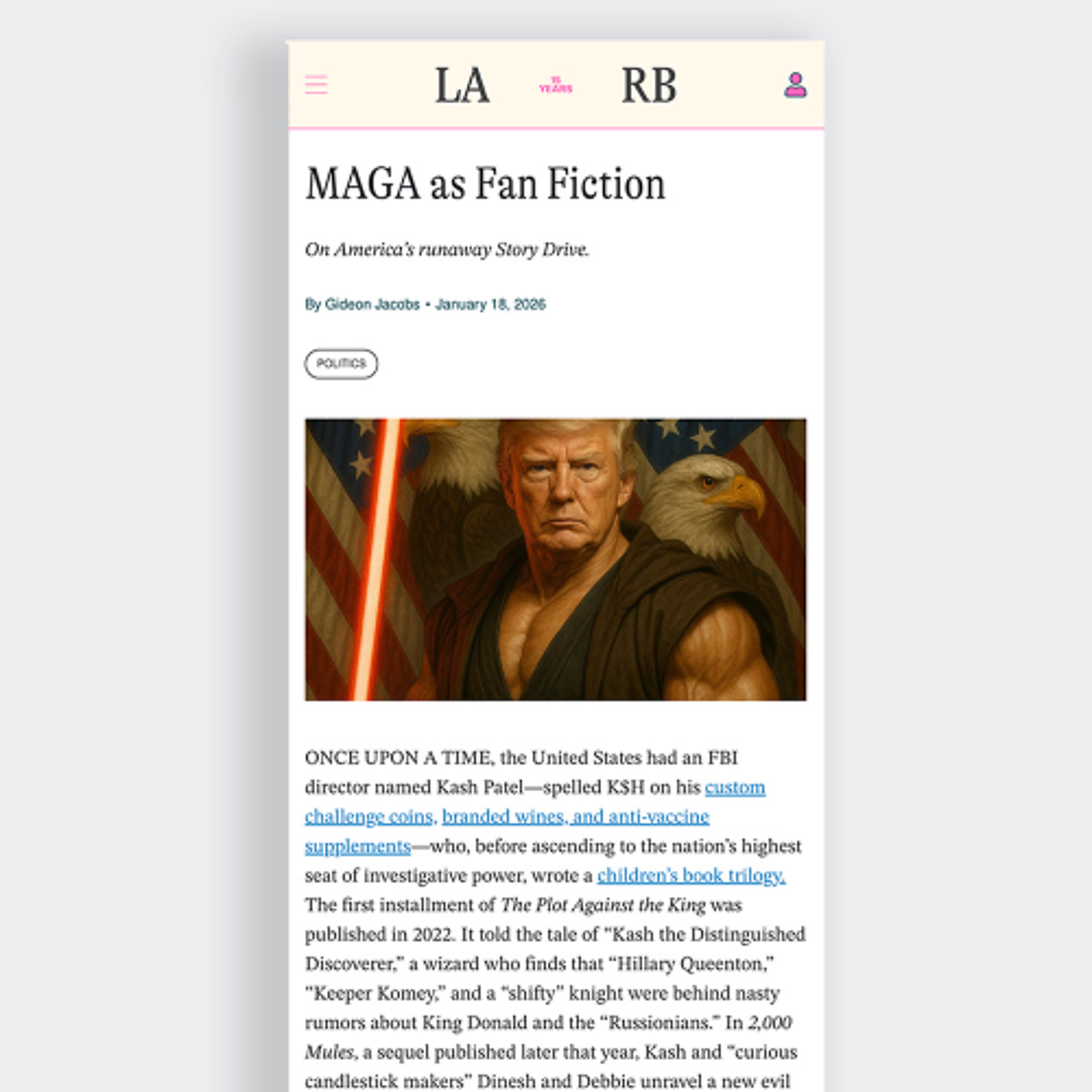
This is an unlocked full episode of new models made possible by our subscribers. From Berlin to your Vloxxist 2018! And there's hundreds more in our archive. Join now on newmodels.substac.com or patreon.com/newmodels And you know the new models this card is popping! Thank you and I'm only! Stop sleeping and subscribe now! New models! You won't get it anywhere else! [Music] You're now locked in with new models! [Music] New models range! [Music] Hi and welcome to new models. I'm Carly Busta. And I'm Lil Internet. On this NM reads, we're presenting a new essay from writer Gideon Jacobs titled "Maga is Fan Fiction." It was published January 18th of this year by the LA Review of Books. Gideon has been on the show several times now. And we hear in this text this analysis of our strange present several frameworks that feel central to the new model's conversation. So as an introduction, Julian and I decided to chat briefly about Gideon's piece, drawing out some of these elements. Yeah, this is Gideon's third essay in a series about capital P politics operating in the Trump era as content creation. And it feels like each of Gideon's pieces expands the scope of the last ending up most recently in really wild territory on a pretty foundational level. Carly, I know you have a good summary of each of these essays. Yes. So the first was Trump-loy, like Trump-loy, but Trump-loy, which he published in November of 2024, just around the election. In short, it's about Trump prompting reality. You can think of the McDonald's drive-through photos. The images look like they're AI-generated. Like, look like they're maybe done in mid-Journey. It had that kind of bad, oversaturated, but it felt very 2024. Meanwhile, Kamala had actually worked at McDonald's when she was younger, but the sad photo she produced as actual evidence was blurry and faded and didn't really register as our real present. Trump is generating the reality that we all, or at least the Maga base, wanted to see. And there's a lot of power in that, right? And there's a lot of power to generate reality. Whereas Kamala and the Dems were still clinging to this 20th century-style truth in photography. Like, within their ontological frame, photography tells the truth. Even though we know, like, Photoshop and we know all the way back to early 20th century photographs of Native Americans at things were staged, there was this idea that one must produce photographic evidence. And Trump was like, yeah, whatever, we just like prompt reality now. Then they have fake ghost photos already by the late 19th century. Pretty sure. Were they fake or were they letting people see something that was there, just could only be sense, but not actually perceived with you that. It's true, though. There's some really interesting scholarship about that. So that was right around the election. He then, a few months later, wrote a piece again for the LARB called Player One and Main Character. And this examined the political intimacy, however short lived, between Elon Musk and Donald Trump. In Gideon's reading, it worked in part because Trump, a boomer, thirsty for his Oscar award-winning role, really wanted to play the ultimate protagonist on screen. And Musk, as Player One, had in Trump an agentic avatar for changing the reality of the simulation that we all experience as real life. So it was showing, again, a shift in the way that we engage with reality. Trump seeing the real as a story that you prompt, and Elon seeing the life that we live as a simulation that one navigates as if in a video game. And so now with Maga's fanfiction, which was written in late 2025, but published a few weeks ago. And I say that only because I mean, how many events happened over Christmas and New Year's alone, like many. But anyway, it was published January 18th, and Gideon shows us politics not just as a realm of content creation, but as is required today. A kind of read, write, k-fabe that understands democracy, vis-a-vis constituent's ability to co-create not just policy, but storyline. So it's not just that we live in a story, and the president makes the story, but that there's a cybernetic relationship between what the audience wants to see, which Trump then prompts into existence, and the way that they process that metabolize that. And it reminds me of that TV series Lost, which is one of the last shows of its kind to be shown on broadcast television at a certain time every single week. But digital channels like Reddit or whatever already existed. So people would talk about the show and what they thought was happening on the show, and the writers would read those comments, and would play into the anxieties or desires of the readers on those comment boards. And it was like the readers were kind of prompting into existence, what the story would be. And you have a bit of that happening now, except for a larger scale and an accelerated timeline. Also, I think people talk about Trump as the reality TV president, but because of social media, everyone's performing, you have a reality TV constituency, basically, right? So it's all performers performing in this one giant media assemblage. Yeah. I mean, when I first read the essay as totally bonkers as all the facts about the Trump administration are, like, winced a little bit because I'm just so exhausted by the pull of that administration. And it's like tax on emotional bandwidth and attention. And we're only a year into a second term. But I think all of these ideas, which Gideon neatly, maybe not so neatly, but bravely ties together into a single piece, all can kind of be expanded as these modes of operation that I think just are part of every day life now. Totally. So it's like we're interested in this piece, not because we really care what's happening with the Trump administration. Well, I mean, our home country is like the most fragile and dangerous it's ever been. So obviously we care about it. We care, right? I don't think we care to make more content about it. Totally. But we do see it as a decoder ring for revealing how a lot of stuff works right now. Some of the things that came to mind as I was reading Gideon's piece are, yes, we are no longer reading, which was the basis of democracy. Second, of course, is this idea of content as raw material for fanfec. And over the past couple of years, we've been thinking a lot about what's happening to content. And I mean, it's just so true. Content is empty. All it is is a stimuli for eliciting fan response. And its meaning is encoded by the audience. I had a, I read a, I forget where I read it, but it was interesting word, prosumption. It's just like you're actually never consuming content. You're, prosuming is not dry hair. It's a dry hair storm because it's very much like in that too. I don't know, but I really can't remember. But the fact is every, every time you're actually consuming content, you're generating all this data you are affecting the algorithm. You are using that content to produce text through replies, et cetera, et cetera. So nothing is actually, you're not ever consuming something online. Right. I mean, I guess what Matt says is consumption is production. Right. But yeah, exactly. And it was this chilling thought that Kevin Munger aired on our podcast a few months ago where he's like, yeah, you know, any piece of content is more valuable for its interactions than the content. And it's more valuable for the content that we see online. And then it's only when that event is acknowledged within digital channels again that it's made real in the popular imagination. And we are getting in on earlier this fall to talk about the Charlie Kirk assassination. And that's like an excellent example of this where you have an assassin who goes out, he inhabits this IRL avatar who assassins Charlie Kirk. And then he goes back online in his discord and he's like, oh, LOL, my doppelgangers trying to get me in trouble. Yeah. Like full digital IRL split. Well, it's just like there is to some sense, I, and this is one thing I'm very worried about is just a kind of mass derealization. Totally. And it's totally starting to feel a bit like that. It is. More and more each, each year. Yeah, it is. You know, there's also this relationship to personal value that's now tied up in one's ability to convincingly perform a character. And in part, that's interesting. We've talked to Jay Springer about authenticity versus puppeting a character. And now we're seeing that happen. You know, I can't help but think of Christy Nomes transition from a relatively relatable every woman South Dakota Congress woman of the 2010s to this Mar-a-Lago-faced US Secretary of Homeland Security. Her cheeks and eyes threaded back in a mask. This administration requires women to wear when they serve at the pleasure of poteas. You know, it's like in order to serve in that administration, you have to have this specific whatever sex doll face that just looks fake and- The whole administration is basically trans. They can't expect the word. Totally. So you have this thing where, okay, Trump's able to prompt reality literally to the point of the women in this admit- I mean, and men in his administration. They look AI-generated. But we had this realization, I know we said this at the beginning of Julian's monologue the last episode, but we were at the Digital Life Design Conference a couple weeks ago. My thought was just, you know, we're in Munich, the site of the security conference where Vance had given his speech saying, "You're up needs to like get their acts together a few months earlier." And I'm just imagining people refreshing their FT apps and having this geopolitical slop just fill their screens. Like Trump extraditing Maduro. Trump invading Greenland. And then, of course, shortly after these tragic killings in Minneapolis, and you're like, "This sounds like what somebody would prompt late at night like Wall-Un Discord with their bros." Well, it's all, I mean, Trump didn't invade Greenland. This is all real, but the thing it shares with slop is this kind of aggressive spamming of the attention field, like aggressively and relentlessly spamming of the attention field with this hyper-potent affective vector, and also just kind of both like lazy and overpowered. 100%, that's exactly the note. But it seems like LOL, what if this image LOL, what if that image? I mean, I'm thinking back to that horrific Trump Netanyahu Gaza-Slob video, right? And so at what point does that slop, de-vertualize, into stuff that people have to take action? I mean, the EU sent troops to Greenland, right? Like conversations are now being had between Europe and China. Now Europe is saying- Canada just made a big deal with China. Canada just made a big deal, right? So you're seeing real world decisions, hard factual material decisions being made in response to slop. Because geopolitics can't operate without a shared ground reality, right? Right, right. And the US has kind of just floated off into its own- Exode off into its own world, totally. That's a world. Also, Gideon's piece sensitized me to this story drive, as he calls it, it gets like a play on Freud's death drive. And how there seems to be this real possibility now of rewriting reality with a deliberateness, effectiveness, a sustainability, and also a speed that wasn't possible before networked media. And I was finding January 6th clips for the audio version of Gideon's essay, and that event was so shocking and violent. And Trump successfully just kind of rewrote what happened after winning the election. And something also here ties into the landian elements within, and adjacent to the administration and the mainstreaming of hyperstition as a concept. And there's this shrinking of time between the initial fiction and its concretization, it feels like. Yeah, totally. You were saying some were starting recording about like, jinksing something? Yes. That's like really good. Because it keeps thinking about like, you know, if you were throwing a big house party and your friend said, "Oh, I hope the cops don't come." You'd be like, "Oh, don't jinx it." Like, as if speaking, it makes it more likely to happen. But it's kind of like hyperstition, right? And it's also weird to think of LLMs as a kind of jinksing singularity. Like all that has ever been spoken being there in the machine. And hyperstition is like this applied jinksing, right? And I feel like we probably need to strongly consider positively jinksing our future more often. Because right now it's being jinst by. And it's like the power of positive thinking. It's a movie crack, right? It goes back and it's very occult. But as we've been kind of been saying, we're in very occult magical woo-woo times. Definitely. That distinction's kind of collapsed. And you know, when I say Gideon's piece sensitized me to story drive and narrative, I think about how the accelerationist idea of the permanent underclass or of achieving AGI as fast as possible being the only possibility. That's also a narrative that is made more likely only because we have begun to internalize it. And once you start to check yourself for stories that you've internalized as inevitable, you really begin to feel how hyperstition and what Gideon calls story drive operates like on you and me. Well, there's one other chilling and key part of the essay you're about to listen to. And we'll wrap this up shortly. But he talks about Walter Benjamin speaking about how fascism didn't give the underclass power to act, to give it power to express. Right. And so you definitely feel that in the present configuration of politics. The people don't get to act, but they get to express, and then they get to see those in power act on that expression. But in these like fun house, nonsensical, cool ways, like the ASMR videos of Britannies being locked up. So I do think that's happening again. Also a note like the power of defense, tech, aesthetic, seems ascendant at the same time. There's a lot more to unpack here in the months that come. I want to thank Gideon for offering us this piece to put into a audio design. So in the spirit of new orality, I hope you enjoy this piece and take something from it. Really curious to hear what you do to tap and Gideon's reading. We'll be offering some other frameworks and looking beyond US politics in the months that come, but this might be a good key for some of the things that are in operation now. Yeah, so let's get into it. Let's get into it. "Maga as Fanfiction" on America's Runaway Story Drive by Gideon Jacobs. Once upon a time, the United States had an FBI director named Cash Patel, spelled K-$ sign H on his custom challenge coins, branded wines, and anti-vaccine supplements, who, before ascending to the nation's highest seat of investigative power, wrote a children's book trilogy. The first installment of the plot against the King was published in 2022. It told the tale of Cash the Distinguished Discoverer, a wizard who finds that Hillary Quintan, keeper Komi and a "Shifty Night" were behind nasty rumors about King Donald and the Risenians. In 2000 Mules, a sequel published later that year, Cash and Curious Candlestick Makers, Dinesh and Debbie unravel a new evil plot, poor, pathetic, stinky Joe and his right-hand woman, Kamala-la-la cheated on choosing day. The book summarized Dinesh to Susa's thoroughly debunked conspiracy theory that Democrats used Mules to stuff ballot boxes in the 2020 election. Dinesh's film and book on the subject had been withdrawn because of lawsuits, though Patel's series for "Children Ages 3 and Up" remains unsale. The trilogy concluded with the return of the King, which arrived a few months before the 2024 election. This time, Baron von Biden, now in dad with the title, Kamala-la-la, now the Baron's assistant, and Shifty, now a jester, sick their pet dragon of Hallopayneus, DOJ for short, unbelovied King Donald. In the telling, the land of the free remains so thanks to the great and powerful Cash. He stomps on the dragon's foot and borrows a line from a more iconic trilogy. "You shall not pass." Observed and horrifying as these books may have been, propaganda aimed at children was nothing new. In 1938, a Nazi-associated press published their gift-pilts, which taught that distinguishing Jews from Gentiles was as critical and subtle an art as distinguishing poisonous mushrooms from nutritious ones. In 1945, the Japanese Navy produced the Disney-inspired Momotaro sacred sailors, the country's first feature-length animated film to prepare children for a potential invasion. In 2005, the CIA commissioned a former Hasbro executive to fabricate demonic-looking Osama bin Laden action figures, program codename, devil eyes. What made Patel's contribution to the genre feel distinct was their artlessness. Mechanically paced, arbitrarily specific, and full of discontinuities, the books were slapped-mad lips designed to trigger the lips. This may have been a result of their author's biography and personality, Patel, 42 at the time of the first book's publication, had no children, and once joked, "I can barely write a level above grade two." It was also possible he didn't write the books at all, that they were ghostwritten or made with AI, though one might have assumed that the average large language model, even in 2022, would have noticed the opportunity to turn Kamala into something more sensible, like "Kami-la." The book's production value, too, was notably low, the kind of paraphernalia found on a CPAC folding table rather than in a bookstore. Of course, President Trump, the apple of Patel's famously sick-of-fantic eye, had made a career out of ignoring quality. Whether in real estate, retail, political campaigns, or government, Trump focused on quantity and branding, overwhelming audiences with a day-lose of low-quality products, and, more importantly, aggressive messaging that insisted those products to wear the best. Trump's stakes are the world's greatest stakes. This isn't just any watch, it's one of the best watches made. The plot against the King trilogy was, in a way, the Trump's stakes of children's propaganda, or the K-$8H Patel of FBI directors. But unlike Trump's revise, the book sold well, reportedly over 110,000 copies. Commenting on success, Patel once said, "I think parents are having more fun with the book than the kids are." It seemed the trilogy's threadbare veils and lazy parallels were not deficiencies, but precisely what made it effective and popular. It seemed that, at this point in American politics, children's propaganda no longer required artful translation, or coded metaphors. The median maga supporters' reality already resembled the structure, logic, and tone. A fairy tale. In everyday adult life, after all, the president and his surrogates were framing politics as a cinematic epic of universal good versus evil. Republicans, as DC Comics' Justice League, Democrats as the Legion of Doom. Republicans as Star Wars' Rebel Alliance, Democrats as the Galactic Empire. The stakes were, as in any captivating legend, "existentially high." Before polls opened in 2024, Elon Musk posted, "There is nowhere to go. This election is a verdict on civilization." Before Trump defeated Hillary Clinton, Michael Anton, senior fellow at the Claremont Institute wrote an influential essay that identified 2016 as the "Flight 93" election. "Charge the cockpit or you die." Of course, Trump was also nicknaming his political foes using puns and alliteration. Ancient tricks of storytelling that make phrases easy to remember and share. Gavin Newscom, Tampon Tim, Ron DeSanktimonius. He was using direct descriptors and relentless repetition to turn his enemies into caricatures, archetypically evil, insane or weak villains, crooked Hillary, crazy Nancy, cry and chuck. The internet was flooded, often by White House accounts, with images of Trump's visage atop bodies of emblematically good, strong and brave heroes. Trump is gladiator, Trump is rocky, balboa, Trump is top-gun pilot, dropping feces on protesters. This mode extended well beyond the president. Heroes need sidekicks. See, for example, ISIS acting director Tom Homan as the "Sunbaby from Teletubbies" and "I in the Sky" spotting immigrants in the desert. Or, cash's aforementioned challenge coin featuring the Scumotif from Marvel's "The Punisher." Even policy was being presented via pop myths. The administration's trade wars were framed using game of thrones. Sanctions are coming. It's gleefully cruel immigration enforcement using Pokémon, got to catch 'em all, and the Batman. They think I'm hiding in the shadows, but I am the shadows. The videos and memes grew even more absurd when functioning as pure agit prop. Uncle Sam is edge lord. Anti-immigration ASMR, the soothing sounds of deportees clinking handcuffs and chains. Christmas after mass deportations, a kaleidoscopic EDM soundtrack to AI Slotfest with flashes from holiday films like "Elf," "The Santa Claus," "Die Hard," and "Inexplicable but Intriguing," "Blade Runner 2049." This level of integration of story into government was jarring, but made sense considering that Trump and his staff were far more steeped in storytelling than governing. Other than loyalty, experience on reality television, as in any show where people play themselves, was the administration's common hiring prerequisite. Secretary of Education Linda McMahon was the CEO of and performer on the World Wrestling Federation. Linda McMahon's surprise that she is here with the circumstances of her daughter's little world daughter! Secretary of Transportation Sean Duffy was a contestant on MTV's The Real World Boston and Road Rules All Stars. People try to downplay it like it's fake and you know these emotions that you feel aren't real and it's stage and it's like this most real experience that I've ever had. That's 25-year-old Sean Duffy! The administrator for the centers for Medicare and Medicaid Services, Mement aaz hosted the Doctor aaz show. Coming up next on Dr. Ozz, he's a notorious online fat shamer, bullying women. And then of course there were the many staffers and appointees who'd been hosts on Fox News. Secretary of War Pete Heggseth, Director of National Intelligence Tulsi Gabbard, Deputy Director of the FBI Dan Bungino, United States Attorney for the District of Columbia, Gen. Piro, Ambassador to Israel, Micah Khabi, and more. Appropriately, their boss was the most credentialed of them all. On IMDB, Trump had 35 actor credits, 21 producer credits, and 726 credits as "self". The perennial fear, expressed by thinkers from Plato to Geed Board to John Bojard, that politics could be corrupted by performance and transformed into pure spectacle, seemed to have been finally and fully realized. It was just three decades before the rise of Trumpism, that media theorist Neil Postman wrote his seminal book, "Amusing Ourself to Death". Reacting to television's effect on public life, Postman hypothesized, as reflected in his book's subtitle, that society had exited the age of typography and entered the age of show business. It was an argument built atop Marshall McCluen's famous aphorism, the medium is the message, the claim that societies are shaped more by the nature of the technologies with which they communicate, then by the contents of their communications. Print media, Postman believed, with its inherent linearity, abstraction, and permanence, had been conducive to a few centuries of discourse that, for the most part, allowed for rationality. Television, on the other hand, emphasized visuality, brevity, and fragmentation, which rendered information simplistic, non-substantive, non-historical, and non-contextual. The result was discourse that increasingly favored emotion over reason and style over substance. In a moment that saw Ronald Reagan, the United States's first actor, turned president, as the leader of the free world and Trump rising to international fame and wealth, Postman posited that the rules for what made for "good TV" had become simply the rules. But for all his pessimism, Postman could not be dismissed as a cranky ladite. He didn't have qualms with TV or entertainment in themselves. Television, he wrote, "serves us most usefully when presenting junk entertainment. It serves us most ill when it co-ops serious modes of discourse. The A-Team and Cheers are no threat to public health. 60 minutes, I witness news, and Sesame Street are." It was programming that purported to be serious or real that Postman worried about. These shows by mudding the lines between information and entertainment, reality, and story, were birthing a new gray area in which everything would be forced to live. In a sense, what the prophetic theorist who died in 2003, the year Trump began filming the apprentice, was warning about, was proto-reality television. His book, considered a classic, sold 200,000 copies. Trump's show averaged 20.7 million viewers per week in its first season. "Next Thursday, in all you apprentice, the tension is out of control." "You think he was unethical?" "He's extremely dishonest." What would Postman have made of the internet of 2026? Long gone was the web of the Techno Optimistic 1990s, the internet is an experimental place space, populated by early adopters. When the United States crossed the 50-yard line in 2000, over half its population online, the internet quickly grew serious and real. In 1999, 0.4% of US households were online banking. Four years later, that number had risen to 31%. Wikipedia launched in 2001, and the internet began its transformation into an authoritative repository of facts. Social media, largely introduced by Facebook in 2004, made screen names to the anonymity, "Anish Mode," and the internet became a place where people used their real names and real faces to say things that were as consequential as speech in real life. The New York Times and BBC created Twitter handles in 2007, and soon the internet, which had subsumed the previous century's media of video, images, audio and text, was presenting users with the entire spectrum of serious to unserious and real to unreal in a single glance. Postman's worrisome gray areas of television gave way to a gray realm, that murky, low chroma gray that results from mixing all the paints in the set. And yet, there was another significant line, the internet muddied, that between performer and audience, or as scholar J. Rosen called them in a viral blog post in 2006, the people formerly known as the audience. Whereas TV was experienced passively, the internet was participatory. Companies built platforms on top of which users could buy and sell, speak and listen, watch and stream, sparking a transformation that Rosen's contemporary, clay-shurkey, dubbed "mass amateurization." As Web 2.0 transitioned to 3.0 in the 2020s, even Postman's beloved written word was thriving in this new mode. Billions of them were being typed in red on Twitter, X every day. Amid reports that reading for pleasure in the United States had dropped 40%, fan fiction site Archive of Our Own was receiving almost 2 billion page views per month, more than the New York Times or ESPN, and WAPAD boasted 665 million uploaded stories. The masses were no longer trained to sit back and be entertained by elites on the tube performing using birth names or screen names in shows presented as real or fictional. The masses now expected, and were expected, to play. The binary of celebrity and everyday person grew spectral. All citizens on the internet, regardless of size of following, grew practice in playing themselves, and as the country crossed a new 50 yard line, over half of its waking hours spent online, living a good life increasingly meant living a good story. As experience itself became charged with the subtle but omnipresent pressure to contain qualities that make something watchable, comedy and tragedy, conflict and resolution, meaning and stakes, and most importantly, once feeds went algorithmic, effective intensity, regardless of direction. Reality TV was replaced with TV reality, and the right-ish room contained everyone. What was the phenomenon of QAnon but a popular mixed reality fanfiction unfolding in real time? That kludgy, Byzantine conspiracy saga about Donald Trump bringing a cabal of deep-state enabled pedophiles to justice began with a single author, an anonymous user on 4chan who claimed to be entrenched in the government, but quickly became a collaboration between the one in five Americans who believed its core conspiracies, a cottage industry of QAnon content creators, and even a few government officials, including Cash Patel. The distinguished discoverer had come under scrutiny for signing his children's books with the QAnon catchphrase #WWG1WGA, where we go on, we go all. When asked to explain himself, he said it was just a line from a great movie that I watched a long time ago. They came from different places. I don't want to be what I was when I left anonymous. But it was only a calm before the storm. Where we go on, we go out based on a true story. What was the storming of the capital on January 6, 2021, but a fanfiction IRL meetup, a live-action role playing or alternate reality game that some took more seriously than others? The grey ontology of that grey afternoon in Washington, D.C., manifested in a surreal scene that was part war, part war, reenactment. Some participants in body armor, some in costumes, and a few carrying concealed props with bullets in them. In his controversial speech earlier that morning, Donald Trump said, "We fight like hell, and if you don't fight like hell, you're not going to have a country anymore." Like MAGA, like the medium on which it was incubated and thrived, was participatory and hybridized. "I'm 49 hours declaring it right." "I'm going to die, I'm going to die, I'm going to die, I'm going to die." It was telling that after allegedly assassinating conservative personality Charlie Kirk, Tyler Robinson told his friends on Discord, "My doppelganger is trying to get me in trouble, as if the killer were his alt, an avatar in a parallel plot line whose consequences were leaking into this one." It was equally telling when, later that week at the news conference to announce Robinson's arrest, Patel spoke as if in character, inhabiting a medieval epic. "It's my friend Charlie Kirk, rest now brother, we have the watch, and I'll see you in Valhalla." Patel was referencing the realm in Norse mythology, where noble warriors reside after death, a concept that was often fetishized by Nazis and neo-Nazis. The phrase "see you in Valhalla" was how far-right mass murderers in both Christchurch, New Zealand, and Buffalo, New York, signed off their manifestos in 2019 and 2022, respectively. The internet turned out to be, as the technoptomist of its early days dreamed, a revolutionary democratizing force, though mostly in the very specific way Walter Benjamin saw as a hallmark of fascist societies. In his 1935 essay, The Work of Art in the Age of Mechanical Reproduction, Benjamin wrote that "fascism attempts to organize the newly created Politarian masses without affecting the property structure, which the masses strive to eliminate." Fascism sees its salvation in giving these masses not their right, but instead a chance to express themselves. Benjamin was writing in Germany as the Nazis were using the newly ubiquitous radio to build a living myth the population could inhabit. Arguably, Edolf Hitler was not trying to return his nation to a specific past or even realize a material future. He aimed to transmogrify it into fiction. As infamous Nazi-essertarisists, Syventure Devi once wrote, "The world of the Vognarian sagas was precisely that which, more decisively than anything else, conditioned Hitler's historical and political views. It was the consciousness of the world to which he felt he actually belonged." Benjamin called it the "estetization of politics." Later, philosopher Ernst Kassier called it the "mithecization of man's political life." But radio was consumed passively, like television, about which Postman had said, "The single most important thing was that people watch it," which is why it's called "television." Playing with that semantic logic, the single most important thing about the "internet" was that people got caught in its net. The worldwide "web" was an entangling and enveloping medium, something inhabited as much as observed, blurring yet another line, that between the act of being and what Benjamin called "expression." Of course, long before advanced communication technologies, humans had been drawn not just to stories, but also the possibility of living as characters within them. Stories appeal had always been precisely that it's not like reality. The two words in theory were antinemes, just as reality television was oxymoronic. The dream of living inside a story was a dream of existing free from the pesky flaws intrinsic to reality, uncontrollability, unpredictability, vulnerability, mundanity, complexity, and coherence, confusion, pain. The word "human" used as an adjective was a synonym for flawed, being realistic meant accepting the unavoidability of flaws. The word utopia, a flawless place, when broken down to its Greek roots, meant no place. So at a fundamental level, the desire to be a character was, like the Silicon Valley rights desire for immortality, a desire not to be human, at all. In secular terms, humanity's story drive was a cousin of Freud's death drive, the instinct to return to the inanimate state. To exist as an image, object, robot, or pure data. In religious terms, it was a transcendence drive, a strain of the perennial desire for divine salvation. Simone Vé, amending Karl Marx, wrote, "It is not religion, but revolution, which is the opium of the people." Benjamin wrote, "All efforts to render politics aesthetic culminate in one thing, war." The fiery movement to make America great again was a classic example of soteriology and messanism taken to literally. An absence of the simultanity of metaphor, the narrowness of flesh or spirit rather than flesh and spirit. People living in story rather than with stories. Trump had weaponized a struggling nation's understandably desperate appetite for reenchantment, helping his followers shove a painfully imperfect square peg through a perfectly round hole in order to make America meaningful again. A more perfect union wasn't enough. Maga wanted mama. The chaos the internet had unleashed on politics was the same chaos it had unleashed on everything. Not true chaos, which in the mathematical sense is illegible and therefore meaningless and therefore boring. This chaos, Trump branded, was anything but. Its drama was the frenetic ferment of too much meaning, the disorder of too much order, structure, and other qualities that make narratives compelling and images watchable. Story drive and hyperdrive at scale. For years Elon Musk had been regularly posting versions of the sentiment that "the most entertaining outcome" "It's the most likely. It's almost like we're in an alien Netflix series that's trying to have the highest possible ratings." A self-evowed simulationist, he usually framed this pattern as a result of our simulations overlords wanting, like any audience, a good show. Regardless of what one made of Musk's cosmology, his pet theory offered an alternative to conspiracy in an era regularly delivering suspiciously iconic events and images such as, say, Trump's perfectly choreographed near assassination. Quantum physicists, as well as the religious magi of the past and the chaos magicians of the present, had long known that observation affects the observed, that reality is a collaboration between subject and object. Considering that for the first time in history, there were many more cameras in the world than there were people. It seemed possible that reality was, quite literally, performing for them, obeying rules of story as it does laws of physics. Maybe the Aristrangianus was the result of a small, but palpable decrease in the genus Aquanthropy that had always made reality feel real. An increase in the uncanny neatness we tend to associate with what is scripted or staged. If one entertain these speculative notions about entertainment, at some point a question would arise. How might such a story driven history end? In 2024 and 25, Peter Teal, one of Trump's earliest and most prominent champions, had become preoccupied with the ending. He was regularly writing and talking about the New Testament's grand finale, John of Patmos' apocalyptic book of Revelation. He even gave a series of off-the-record lectures in San Francisco about the concept of the Antichrist, who or what it might turn out to be. It was sometimes difficult to parse Teal's theology. His conversation with New York Times columnist Ross Douthat sounded like a prime example of someone who knows what they're talking about interviewing someone who does not. But it was clear his end times anxieties were, like the political movement he'd funded, fueled by story drive. Risking flippancy. It often appeared his thesis was simply this. In the sci-fi fictions of his childhood, the 21st century was rendered far more technologically advanced than it turned out to be. He told Douthat, "Back to Future 2 was, I think, 1985 to 2015, which is now a decade in the past, and that's where you had flying cars." In 2011, he said, "They promised us flying cars and all we got was 140 characters." Reality hadn't fulfilled the image of the future Teal had been promised. And that, he flew around the country arguing, was indicative that something had gone terribly and cosmically wrong. The forces that caused technological stagnation then were the problem. So he replaced the failed fictions of his childhood with a new one. A biblical prophecy come to life in which he could play hero and people like AI, Alarmus, Eliezer, Yudkowski, or Climate activist Greta Thumberg could play villain. The Antichrist. It was a theology of resenting reality's realism. Teal wanted an image. Utopia. His desire to go back to the future was a desire to go back to the garden. To be clear, StoryDrive had no left-right valence, and the battlefield of politics had long been society's containers of communication, McCluen's media. In the 1952 presidential campaign, Adelaide Stevenson tried to resist this fact, refusing to appear in campaign commercials. This isn't ivory soap versus palm olive. He was unsurprisingly crushed in the electoral college, 442 to 89 by Dwight Eisenhower, whose catchy ads were produced by Roy Disney. "You like ice, I like ice, everybody likes ice, I'm for a present, hang out with better people than we take ice to Washington." In 2025, Zoron Mamdani rose from obscurity to become mayor of New York City by harnessing StoryDrive better than any politician since Trump. With short-form videos and well-executed characterization of policies and self, Mamdani quickly established a highly legible image, a smile in an affordable suit. The Peter Parker, the Trump's kingpin. "There's a lot of things to make New York City special. For me, it's the deli's and bodegas. Happy to get an egg and cheese on a roll with jalapeno." Mamdani's sincerity and authenticity were unfakably real, which is true of all great performers. But setting aside politics, morality, and decency, looking at medium rather than message, the difference between the two politicians' approaches was taste. Trump came out of crass reality TV, while Mamdani was raised by an Academy Award nominated mother. Third place mayoral finisher Curtis Sleewa chalked up their surprisingly chummy White House summit to the comradery of actors. Trump's unwarranted warmth appeared to be an instance of game, recognizes game. He asked about your comment calling the president a fascist. The question of endings then. Was it necessarily one of good or bad stories, serious or unserious videos, realistic or unrealistic images? But whether this ancient accretive arms race was sustainable. Postman didn't think so. There's nothing wrong with entertainment. As some psychiatrist once put it, we all build castles in the air. The problems come when we try to live in them. But in a way, Trump had proven him wrong. For decades, armed with his own version of Norman Vincent Peel's power of positive thinking, Trump existed in a precarious limbo between reality and story. Halfway between ground and sky, staying afloat like Wiley Coyote before he looks down. But then, unclear exactly when, something shifted. And even if Trump allowed himself the occasional peak, he didn't fall, barely stumbled. Their gravitational pull from above was now able to compete with that coming from below. The clouds mass, rivaling the earths. To his supporters, he appeared to be walking on air. A prophet. A miracle. Much to their excitement and relief, he invited them up. Up, up, up. Like the rockets of the world's billionaires, whose missions, too, were now algorithm-genic celebrity stuff spectacles and gray-area productions that sent fictional space captains into outer space. Up, up, up. Like the world's financial markets, which, after centuries of drifting from materiality, had finally become free-floating bubbles, probable only if their surface tension wasn't maintained. Up, up, up. Like the tower of Babel, in which humanity, united by one language, attempts to build to the heavens until God intervenes and scatters them across the earth. If one reads that fable, with tealian tealiology, it could be understood as an urgent cautionary tale. Humanity is, after all, united by a single language, computer binary this time, and seemingly like the Babylonians and also Prometheus and Icarus, etc., doomed to fall from our heubristic heights. But if one reads the fable with McClune-esque metaphoricity, as in the miraculous and distinctly human ability to see message and sense medium at the same time, this tragic but reasonable conclusion can be paired with the contradictory truth. These are just words, just images, just stories. That is, even if the issue of happily ever or never after seems to have been the subtextual questions of post-modernity all along, could the revolution, in fact, be televised? Could cameras indeed replace God? Any answers will lie beyond the plain of ideas, sights, and sounds. As philosopher Graham Harmon puts it, "The real is something that cannot be known, only loved." As many stories conclude in a reality that never does, the end. Thank you for listening to this episode of NM Reads. And thanks to Gideon Jacobs for reading his essay, "Maga as Fanfiction", published January 18th, 2026, on LA Review of Books. A link to the original is in the show notes. Hope everyone is safe from the winter storms. Our first interview of the year is coming soon. See you next episode. This is Graham, post-about and all that. We out! [Music]
Podcast Summary
Key Points:
The essay "Maga is Fan Fiction" analyzes Trump-era politics as a form of participatory content creation, where reality is prompted and co-written like a narrative.
It traces an evolution from Trump "prompting reality" (e.g., with AI-like imagery) to a "read/write kayfabe" where constituents co-create storylines, not just policy.
This dynamic leads to a derealization of politics, where content's value lies in audience reaction, geopolitical actions resemble online "slop," and personal value is tied to performing a character.
The piece introduces the concept of "story drive"—akin to a death drive—where narratives, once internalized, can rapidly concretize into reality, demonstrating the power of hyperstition.
Summary:
S. politics under Trump as a form of collective content creation and fan engagement. The analysis highlights a shift from traditional politics to a system where leaders like Trump "prompt" a desired reality for their base, who in turn metabolize and co-author the narrative.
This creates a cybernetic feedback loop, akin to writers responding to fan theories, accelerating the transformation of fiction into fact. The conversation expands on how this leads to mass derealization, where the line between online "slop" and real geopolitical action blurs, and where an individual's value is linked to their performance of a character. The hosts connect this to concepts like hyperstition and a "story drive," where internalized narratives gain a powerful, self-fulfilling momentum.
Ultimately, the essay is presented not merely as political commentary but as a decoder ring for understanding new, pervasive modes of operation in digital-age reality, where consumption is always production and storytelling directly shapes material outcomes.
FAQs
The essay argues that MAGA politics operates as a form of fan fiction, where reality is prompted and co-created by an audience, shifting from traditional truth-based politics to narrative-driven content creation.
Trump treats reality as something to be prompted or generated, like AI content, rather than adhering to traditional truth-based frameworks such as photographic evidence or factual accuracy.
Story drive refers to the accelerating force where narratives, once internalized, can rewrite reality quickly, akin to hyperstition, making fiction concretize into real-world events at an unprecedented pace.
Content is seen as empty stimuli meant to elicit fan responses, with its meaning encoded by the audience, turning consumption into a form of production (prosumption) that fuels digital interactions and algorithms.
It cites Cash Patel's children's book trilogy, which uses simplistic, low-quality storytelling to mirror and reinforce MAGA's fairy-tale narrative of good versus evil, appealing more to adults than children.
Hyperstition is linked to events like Trump rewriting the narrative of January 6th, where fiction rapidly becomes reality, and to the concept of 'jinksing,' where speaking something makes it more likely to happen in a networked media age.
Chat with AI
Loading...
Pro features
Go deeper with this episode
Unlock creator-grade tools that turn any transcript into show notes and subtitle files.
 PodcastTranscript AI