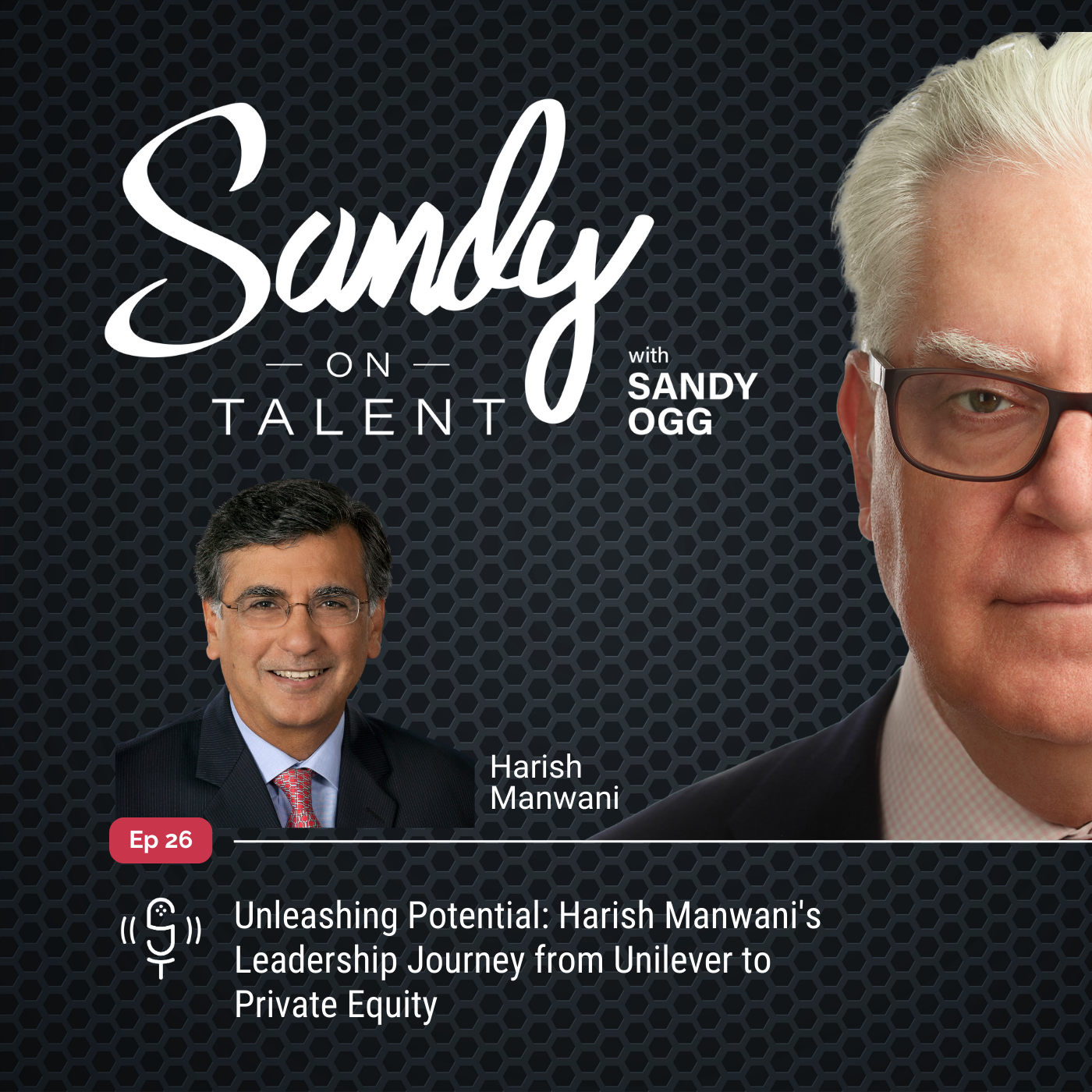
026: Unleashing Potential: Harish Manwani's Leadership Journey from Unilever to Private Equity
57m 25s
"Sandy on Talent" is a platform focused on unlocking individual and team potential for career success and fulfillment. Harish Munwani, a prominent business leader, shares his journey from Unilever to Blackstone, highlighting key lessons in leadership. He emphasizes managing by vision in India, transitioning from roles to relationships in Latin America, and focusing on execution in North America. Harish's approach of setting audacious visions, changing behaviors, and prioritizing outcomes resonates in his leadership style across diverse regions. His ability to capture the essence of challenges, like emphasizing everyday great execution in North America, showcases his impactful leadership style. Harish's insights shed light on the qualities required to be a successful global leader, navigating cultural differences and inspiring teams towards common goals.
Transcription
10109 Words, 54056 Characters
Hey there. Welcome to Sandy on Talent. Have you ever been stuck in an awful job? Or maybe your current job is good enough but not great.
Sandy Og is here to help change that. Through decades of experience as a CEO advisor and a renowned talent expert, along with the insights from his distinguished guests,
Sandy will explore ways to unleash the vast potential within individuals and teams. His goal is to help everyone achieve fulfillment, dignity, and success in their jobs, whether you're leading a team or just starting out.
Sandy on Talent will deep dive into an array of topics from executive leadership to entrepreneurial success and everything in between.
So buckle up and discover your own unique click where your talent meets your dream world. Join us and ignite your journey to personal and organizational excellence right here with Sandy on Talent.
Hello and welcome to Sandy on Talent. Really excited tonight that we have Harish Munwani and I'm going to take the opportunity to introduce Harish here in a bit but I want to start by saying that I was someone who was making a transition from one global company to another.
And when I arrived at Unilever, I had heard the stories about this guy Harish Munwani and that he was an absolute force of nature and someone that I really needed to get to know if I was going to understand how Unilever really, really worked when what made it special.
And then I had the chance to meet you Harish and I've got to say that it was an inspiration to me, you know that that I don't know if I've ever told you that that you know when you walk into the room, you always have a smile and you are the person who can say the toughest things with a smile on your face and people are ready to run through walls for you, me included, by the way.
And so this is an important night to me because I think people having the opportunity to get a little bit of insight in how in the world does somebody become Harish Munwani.
For everyone, let me introduce Harish a little bit. And so I would firstly describe Harish as a truly global business leader and we'll come on to what that actually means even in Harish's own words.
He has decades of experience leading in and around some of the world's most iconic companies.
Harish spent nearly 38 years at Unilever where he rose to become the Chief Operating Officer.
He ran the whole thing and he was overseeing the operations and the P&L across every global market in Unilever.
After retiring from Unilever, Harish joined Blackstone as a senior operating partner where he continues to guide businesses on growth and transformation.
He's served on the boards of Gilead Sciences, Whirlpool, Tata and Sons and Qualcomm, spent over a decade as non-executive chairman of Hindustan Unilever.
He's also chair of the executive board of the Indian School of Business and a sought after voice on leadership having spoken at Ted and was on a part of the faculty and taught at Harvard.
Along the way, Harish has been honored with CNBC's Asia Business Leader Award and the public service metal from the Singapore government.
He holds a master's degree in management and studied at Harvard Business School. He brings a uniquely global perspective to leadership, purpose and performance.
So I've just got to say, Harish, that I'm so glad that you're here. It's long overdue for us to have this conversation and welcome.
Thank you, Sandy. I'm great to be here. And wow, what an introduction. I certainly didn't recognize myself in that.
Yeah, amazing, amazing. And so Harish, what I'd like to do is to start. And I know everyone will be keen to understand your story. And if you would tell us the story from the beginning.
And go back as far as you like, go into much as much detail as you like. And I know it's going to be entertaining.
Well, thank you, Sandy, for this opportunity. You know, when I think back on my own story and my own journey, it's interesting.
It doesn't involve a lot of interventions really from me. I just let it happen. And I just load organically and naturally.
So I joined Unilever in India in 1976 as a management training a straight from business school. And I was a management trainee in marketing.
And like all of us, we did several, you know, we had to go through an intensive training for a year and a half. And then we were given some leadership roles starting really primarily with customer management and sales.
And I must say that right through that early part of my journey, what I really enjoyed was being part of Hindustani Unilever and being part of Unilever.
I enjoyed the idea that I could be part of a team and excited about really delivering whatever outcomes that were given to us as a team.
So there was not a lot of intervention. And over the course of the years, I sort of rose in the organization. I don't know how and why, but I did. And then, of course, I got an opportunity to head one of our businesses, which was the personal care business in India, which was a growing business.
But albeit a smaller business is compared to some of the other businesses that we had primarily the detergents business and the home care business, et cetera.
And that is where, you know, my journey as a general manager started. And that is where I really began to enjoy or feel that joy of business.
That's the only way I can define it is a joy of doing business. And what does that joy mean? That joy really means the ability to convert a plan into a PNL.
That's the joy. And then organizing and working with teams to be able to deliver outcomes to outcome being here in terms of converting the plans into PNL.
And to my mind, that's probably the thing that really excites me even today. And I'll come back to how I transition after 37 years with Unilever to working where I do today.
So I started with personal care. And then I went off after that to Latin America to be the president of our Latin America business. And then onwards to North America to do the same to be a business leader in North America.
And then I became the business leader in Asia, Africa, Middle East, Central Eastern Europe, and later the CEO of Unilever.
So you're aware of most of my journey in the latter part of my career. And you know, in each of these, I think in every role that I did starting from the beginning, I think it just prepared me better for the next role.
And there were learnings and key lessons in every one of the roles that I did. But let me start really with the general management roles and talk about what, what was some of the highlight learnings in each of these roles in personal products.
I think it's worth just sorry to interrupt you, but it's worth putting a pin in the idea of turning a plan into a PNL. And that is the heart of business and the joy that you get from business is turning a plan into a PNL.
And having watched you do that a couple of times, it's like magic.
So I think it was one of the American authors who said, don't let the organization come in the way of growth. He actually said, don't let school come in the way it was Mark Twain, I think who said, don't let school come in the way of education.
Don't let the organization come in the way of growth, delivering a PNL converting the plans into PNL to me. That's the joy of business and then building teams and organizations around it to be able to do that with agility.
Anyway, I'll come back to that theme as we go along. But what were the key lessons in some of the general management roles that are done through my life. And like I said, each role prepares you a little bit better for the next role.
So when I looked at personal care in India, growing business small and I learned the most important probably lesson there early on in my general management career, which is, you know, in business schools that you to MBO management by objectives.
I learned the beauty of managing by vision mbv how do you manage a business through an audacious vision for the business. And I always tell people you have to separate MBOs from mbv vision is not about targets vision is about changing behaviors.
That's what a vision is about, okay, you may not ultimately get there, but did it change behaviors to my mind. That's what I learned there. So we said we had the audacity to say that we were going to become a billion dollar business and the most profitable business in terms of its contribution to Unilever in India.
Now, just to put this into context, we were a hundred million dollar business, we talked about the billion dollar business. And we talked about being the most profitable business, okay, and being the largest contributor to Unilever in India.
All this sounded, you know, a bit like, you know, this guy is, you know, young and crazy, I guess. But it motivated people to change behaviors in the way that I did not anticipate.
So, for example, out of that game, this relentless drive for innovation and just to give you an example of that, this was not innovation which talked about, you know, okay, let's start a process of innovation. Of course, all that was going on.
But it talked about, for example, TPM, that's not a production thing that we do on the factory floors. TPM was about two per month. Every profit center meeting who had to present either two actual products that we were launching in the marketplace every month, TPM.
And or a process that would be game changing in terms of delivering an outcome and the outcome was simple either growth or profit, okay. So that was if you like the big learning, the audacity of putting together a vision that changed behaviors and then making the team believe that we can do this.
At the end of the day so that you know the outcome, we did not deliver a billion dollars, okay, in the period that I was there, but my God, we were the fastest doing business and by God, we landed up with being the largest contributor, largest contributor, not the most profitable, largest contributor to Unilever in India.
So we achieved part of our vision, but the important thing was we changed behaviors. That was my first lesson. Then I went to Latin America and you know that it's crazy. It's crazy. I'm sitting here. I wasn't even a part of it and I can feel it.
So I can tell you I enjoyed every bit of it, okay, and I enjoyed enjoyed the fact that we built a team, a great team that was hugely motivated, energized and we changed the way we worked, we changed the behaviors. By the way, we did not change organization and so on and so forth.
We just changed people's behaviors and to my mind, the energy that was sort of disseminated across the business was something that was palpable and from there, of course, as you know, I took on a role of being the president for our Latin America business, something where I think our parts really crossed at that stage.
You were, I think the first part of the business. I was in the home, get part of the business, home and personal get part of the business and there my biggest learning was we were going through two major challenges.
One was a competitive battle that we were fighting, okay, and this was probably one of the biggest competitive battles that Unilever has fought, which was the laundry battle in South Latin America, which is our bastion.
Okay, we have very large market shares, we have by far market leaders and we had a challenge from a competitor there.
At the same time, we were undergoing the first really organizational transformation where we wanted to go from local to being regional.
In other words, all the power was not with the local countries and it was being, because we said we must use the scale of Unilever.
And therefore we created an organization, the first start of quote unquote one Unilever, you know, the category organization was created so that we could have innovation running right across Latin America.
It was still I can remember people telling me you got up this guy, Harishman money because he's figuring it out.
Okay, so we started this and I found that there was a lot of discontentment around this new organization, the countries are feeling disempowered because they felt that, you know,
they didn't really have all the levers in their own hand and so on and so forth.
And too much of a process was coming in, new organizational charts, racy charts, who does what and so on.
And the big mantra was all about operating frameworks.
And I decided that somehow the most important job to be done here was not just to fight the competitive battle, but to get the hearts and minds of people aligned.
And I still remember our first leadership meeting when I took everyone across to Mexico and we were sitting as a son was sitting on the pyramids of Chichen Itza.
And I told them all to pull out their operating framework and they thought I'm going to now give them a lesson 101 on what an operating framework and how we need to follow the new system because I was a new, you know, young dude who's coming into the business in Latin America and so on.
And I said, now I want you to each pull out a match box, which are given them and light the operating framework as the sun was setting.
And I said, from now on, we are not going to follow the operating framework.
We are going to transition from roles to relationships.
That was the big, big learning.
We are going to move from operating frameworks from roles to relationships.
With each other, we're going to be focused on outcomes and it doesn't matter who does what as long as we can get a better outcome for Latin America.
And you know the rest, you know, the rest is history.
We had a major crisis in Argentina is a big business for us, almost a billion dollar business at that time.
And we had a major competitive battle, but everyone got aligned because there was a purpose.
And that purpose was to deliver what we call the 15% growth, double digit growth and a double digit operating margin.
And that kind of excited people to say, hey, this is the outcome we are seeking.
Forget about the problems that we've got.
I mean, in Brazil, people would say, so the way and so the joy, meaning, you know, all is well.
And Argentina said, okay, we're going to have we're going to major crisis.
Okay, we're going to launch a new product of value product in 45 days.
They can't do it on their own. Let's contact the category guys, Robert Davidson and gang who got the resources.
And suddenly, okay, it was outcome oriented.
So what was my big lesson there?
Like in personal care in India, my lesson was managed by vision, which changes behaviors.
Here, it was about roles to relationships.
Okay, so, you know, this visa, then I went to North America.
What was my lesson in North America, North America, which you know better than I do.
You know, that's a tough business. Okay, highly hugely competitive.
And I was quick to learn a very important lesson there.
Execution strategy strategy is execution.
If you cannot execute in America, in the United States, you don't get anywhere.
You can talk strategy as much as you want.
But by God, you've got to make sure you're on top of your game in Walmart, in Target, in Costco, all your key customers.
And that's where we invented something called Edge, which was everyday great execution.
It was inspired, of course, from Walmart, which talked about everyday low pricing, EDLP.
And I said, we're going to talk about Edge in my first equivalent of a podcast at that time to my leadership team and beyond.
And I said, it's all about Edge.
And the, you know, people say, Edge, what does Edge mean is everyday great execution.
I said, you know what, we're going to win by ensuring that we can actually make fewer mistakes in execution than anyone else in the marketplace.
Okay, so let's not screw up.
We've got plenty of opportunities to screw up.
We've got millions of outlets, millions of shops in which we've got to sell.
We've got a great bunch of products.
But at the end of the day, we're going to make sure that we are executing every one of our brands in every one of our stores with the millions of consumers that we serve.
And we created a metric around it.
So the big lesson in North America was it's all about Edge, everyday great execution.
And then I moved to Asia, as you know, okay, when we were into one Unilever and so on and so forth.
And there I discovered a very important lesson again.
And what was the lesson there?
It was a, it was an amalgamation of everything I'd learned in India, in Latin America, in North America, which is growth, growth, growth.
Everyone gets motivated by growth, as someone said, growth solves most problems and more growth solves the rest.
And it was all about growing the business and every vision that we set for the business was about being the fastest and the biggest contributor to Unilever.
It had to serve a larger purpose, but at the end of the day, it was about growth growth and growth.
So that was, if you like, you know, the building blocks as a general manager, which served me well.
And as I went into my role as a chief operating officer looking after the PNLs across our markets.
It is really, I guess, an amalgam of each of these learnings that played an important role in ensuring that I could do for Unilever what we did in every individual part of Unilever.
So that, to my mind, is, is the learning. Now, I think the question that you may want to ask me is, that's all right.
But at the end of the day, what does it take, I mean, to be a global leader?
Are there any, is there any sameness? Are there any differences? I don't know. But that, you think that could be of interest?
Well, Bereesh, I mean, I think it's enormously interesting. And, you know, when I think about the way you are able to bring something down to its essence, you know, M-B-V, and contrast it with M-B-O.
I mean, it's so clear. And it's just right on the point. And roles to relationships. People are struggling with roles. And we know that roles can be incredibly disabling for people when they're poorly designed and all that kind of stuff.
But if you have people that have that vision of where it is that we're trying to go, and they are concentrating on outcomes and relationships, I mean, I mean, but getting it down to its essence like that.
And then showing up in the U.S. And again, the essence of the problem was execution, but being able to capture it in a way, because everybody knows Walmart's slogan. But by building off of that, it's almost like, you know, I heard the story about Thomas Edison, you know, was introducing electricity.
And people were afraid of it. They're absolutely afraid of it. And so he described it in a way that they could relate to it, calling it an electric lantern. Everybody knew what a lantern was. Everybody knew they wanted the benefits of a lantern.
But imagine if you had a lantern that could be on all the time and you could switch it on and you could switch it off and so on. And then people, it lights them up. I think you have a gift of being able to capture the essence of something.
And then of course, inspire people, but I would be more than interested to know, since you have, you've had this magical sort of impact in India, in Latin America, in North America, running the whole world of Unilever.
It must be, you know, unique, you must be unique. There must only be a handful of people who have operated successfully in all of these different places. And of course, people talk about cultural differences and, you know, at this and that.
So when you think about being a global leader and the contrasting and comparing and how in the world could you step into Latin American, basically become Latin American and then step into North American, basically become North American.
And of course being an Indian in India, that would come natural, but it's not so natural to think that, oh, all of a sudden, you know, I show up in Latin American, I inspire all these people to follow.
So talk to me about what it means to be global. What that really mean.
Yeah, and I think you probably alluded to this in your question, which is that there are of course differences, cultural differences, but there are a, there is a large amount of sameness.
Yeah, and I'm talking in the context of business.
Okay, so let's let's talk first about what are the differences and I'm again going to sort of summarize it at the risk of sort of not being 100% accurate, maybe, but it pretty much gets the essence.
You know, when you work in Asia, the most important cultural thing is to get consensus.
Okay, when you sit around in Asia, top table, okay, and you've got people from Japan and China and India and Southeast Asia sitting around the table with you, you get a sense that, you know, it's a little bit is crucible.
People shape their heads, but you don't quite know whether you have a consensus or not.
So there is a lot of stuff that has to go on in terms of one-on-ones before or after the meetings to build a consensus, do it quickly, but you've got to build consensus.
That's the Asian cultural difference in Europe, where I worked, of course, also extensively.
Yes, they want to see a robust process underpinning the key decisions, okay, so you know, if you don't have a method in a madness, they don't buy into it, if you know what I'm saying.
So you've got to make sure that there is a robust process, okay, underpinning your key decisions.
I always said, when I went to Europe, I said, because I come from India, I'm going to try to be Indian, but at the same time try to be European.
Or start with the conclusion first, okay, is the outcome that we are seeking.
However, this is based on a process and an objectivity that underpins this decision.
In the US is about speed and agility and a bias for action, okay, and that are some of the cultural differences that doesn't mean that, you know, it's one or the other, but this is predominantly the culture.
And you got to figure that out, okay, the picture is important, but so are the pixels, yeah, okay, you've got to create the big picture for everyone.
But at the end of the day, there are a large number of pixels that you have to manage, and you've got to learn to manage the picture and the pixels.
If you get too involved in the pixels, you'll never see the picture. If you get too involved in the picture, you'll never see the pixels.
So it's a balance of both and that to my mind are the cultural differences, but what are the samenesses? The samenesses are that no matter where you go, it's not the quality of the people alone that matters.
It is the energy in the people that matters and the role of a leader is to unleash energy.
That's it. If you ask me, there are only two roles of a leader, unleash energy and manage the reputation of the organization or the division that you're managing.
But unleashing energy is so important. And I've seen this that as soon as you begin to unleash energy in an organization, things happen more organically, okay, people feel empowered, people feel good.
The second rate, which we've alluded to several times, focus on outcomes, okay, don't get caught into irrelevant stuff, irrelevant stuff, you know, organization structures change, focus on outcomes, okay, and that really matters.
The other bit is about this combination of what the phrase that you may have heard before in Unilever, magic and logic, but in a different context, okay, you need to make sure that both the hearts and minds are aligned of people.
People either, you know, work on the mind or they work on the heart, oh, I think you should do this. You know, it's good for us. Great Ra Ra. Or they say, you know what, this is what makes sense.
This is the size of the market. This is the market share. We've got to go for it. No, you've got to combine the mind and the heart.
And once you win the minds and the hearts of people, that's where magic begins to happen.
So you've got to combine magic and logic. And finally, and the most important thing, which you learn across in every geography, caring is a competitive advantage.
Respecting people, caring for them is really important. And a lot of people think this is bullshit or this is, you know, soft speech.
No, it's not. By the way, I spoke 70% to 80% of the time on outcomes and delivering out results. But at the end of the day, you don't win the hearts and minds of people.
You don't need unleashed energy in people. You don't get followership. Okay. That's the most important thing in leadership, as you know, to get followership.
That's it. That's a definition of, and you don't get followership if people see you as something that is who's self serving, caring is a competitive advantage.
I learned this also, or sorry, the message came through loudly when we were having COVID, for example, and companies that cared for their people survived the crisis in Argentina in my early days as a president of Latin America.
When we had the first Argentinean crisis, we had a choice of letting go people or finding different ways to grow the business.
We spoke the truth to people. We said if we can continue to grow the business, we don't have to lay off anyone. Be honest, but at the same time, be caring.
So caring is a competitive advantage. So those are some of the same nurses, you know, surrounding the cultural differences.
Amazing. Amazing. It's got to be pound for pound. The most wisdom packed into 30 minutes. I've ever heard unbelievable.
I mean, from the essence of, you know, of your general management, this collection of general management experiences through to what does global actually mean in terms of differences.
And sameness and, and, but it's right back to this superpower that you have, Harish, of capturing the essence of something and then expressing it in a way that you go, of course, but I never thought of it.
You go, of course, and the essence of what is the difference between leading in a European context and a Latin American context and an North American context and seeing the essence.
And what is different and respecting the difference and what is the same and what does that mean? What is sameness? You know, I've heard a lot of people talk about global, but man, that was like right to the heart of it, the essence of it.
You know, lastly, Harish, I think you're point about caring and is caring soft. And I think the way that you captured it, I worked on on a project long time ago, which was about human dignity.
And the program was called individual dignity entitlement. It's quite a mouthful, but what the essence of it was was that, hey, you know, in, in, in business, you're not entitled to a job, you're not entitled to a salary increase, you're not, you're not entitled to a lot of things, but the one thing that you are absolutely entitled to is your dignity.
And what, what, what does that mean? And if, and if you have a leader who doesn't care, there's a slippery slippery slope there where dignity and respect go right out the window. And of course, then you have nothing. You have nothing. So that was cool.
You know, and Sandy, if I can just add to that, people often think of caring as being soft and subjective and, you know, not talented. And I say that there are, there are really two aspects to caring.
One is to really make sure that you are building your people to operate in a fast changing environment. It's a cliche to say that the only constant is change.
But how do you prepare people to operate in a fast changing environment? How do you skill up skill them? How do you create capabilities? How do you train them? And it is such an important aspect of caring.
And I'll come to the other aspect, but this aspect of ensuring that people have a license to operate in today's world and tomorrow's world, not yesterday's world. I was a market here, okay, by training in my old days.
I don't have the license to operate as a market here today because where people shop and what people watch has changed dramatically, okay.
People are buying online people are doing deferred viewings online streaming and so on. How do I reach my consumers, which is the holy grail of marketing has changed totally.
I am not trained for it. And therefore you have to make sure you devote time.
You will recall we went for this as a UX as a leadership team of unity. We went to Florida to attend this camp or workshop or whatever you call it, where a gym lawyer, I think, was the guy who trains athletes.
Yeah. Corporate athlete and he made a very important statement. He said athletes spend 85% of their time training and 15% of their time performing.
Corporate leaders spend 90% of the time performing and 10% of the time training training that holds good for all our people.
So when we talk about caring is a competitive advantage, I really mean to aspects. One is license to operate. How do you have a license to operate in tomorrow's world, train them for it.
Second, when there is a crisis or when you have to when you have some difficult decisions to take to your point may be respectful, you know, respect the dignity of human beings.
Yeah. And to my mind, it's a combination of both these. There is a hard aspect to it and a soft aspect to it.
Yeah. Amazing. Amazing.
Well, Karisha, I'd like to to shift gears a little bit here and with this amazing career that you've you've had. And I think that we need to kind of move into chapter two about, you know, your decision to retire from Unilever and begin working in the world of private equity and private equity, of course, when you and I first started working in it.
You know, I can remember, you know, I had a conversation early on in my experience at Blackstone, where I was talking with Steve Schwarsman.
Gee Steve, why did you hire me? I mean, you guys have been stupidly successful and you didn't have a role like mine or a person like me.
And he said, well, you know, you're absolutely right for the first 25 years of this business. We didn't want guys like you and we didn't need guys like you.
Because 70% of the value in anything we bought occurred on the day we bought it because we were able to buy cheap and there were lots of assets that were available and we were relatively new to the game and so on.
He goes, but the world has figured out that this is a good idea and there are literally thousands of private equity firms that are, you know, that are being born every day and there is an avalanche of money that is moving from public equities to private equity.
It's going to be trillions and he was absolutely right. The result of that is that the prices are going to be bit up, prices are going to be bit up and therefore we are going to have to underwrite transformation and transformation has to be led and we need transformational leaders.
And he goes, I think you know, something about that and so that's the point. And shortly after I was at Blackstone, you know, you had made the decision to to retire and you know, we were so fortunate to have you join Blackstone at that time.
But what was behind that decision, Harish and what in this all the lack of knowledge that you have accumulated? What have you added to your to your arsenal since transitioning from Unilever to Blackstone?
Yeah. So, you know, there were two things that were important to me as I was transitioning from having worked with Unilever for 37 years, thank God in different roles and different parts of the world to really now moving into my, if you like, my next trainings.
And the two things that I said I need to do is I still love business. Okay. So I need to make sure that I remain associated with business. I love business, the joy of business, the joy of working with people as I said.
And therefore I said I need to do two things. Number one, I need to be engaged with companies where I can both input and output. I don't want to just work for companies or beyond boards of companies where all I'm doing is outputting.
Now that I'm a senior citizen or something that I'm told telling them in my days, we did it like that. Okay. In our days, we did it like that because I understand I at least have the basic sense to understand that the world is changing fast.
And maybe what I knew and what I learned in terms of in the operating sense may not be as relevant today. And therefore I said I will select only those assignments where I can input as much as I'm outputting.
So when I joined the board of Qualcomm or I joined the board of Giliad sciences, frankly, what the hell do I know about semiconductor chips? What the hell do I know about bio farmer? Okay. But the fact of the matter is that I know something about business.
Okay. And I can therefore both input, which is learn about another sector. And at the same time, I can output because I know how to run a global business. And I think it was this decision, first decision that I took, which is that I don't want to necessarily get involved with consumer goods.
Because my learning will stop and then came blackstone, which as you know, because you already there and we engaged in many conversations and is coincidental that I also had similar conversation with Steve Schwarzman and others in the organization.
And I said, why do you want someone like me? And it was the same answer. We've got plenty of smart people who know how to do good deals, but we also need people who know how to operate companies and how to unleash operating leverage.
Okay. In other words, we create value now, a large part of our value gets created through operating interventions. We recognize that and we need people with some operating experience.
So, of course, we need people who can raise money. Okay. So you got lots of great people who know how to raise money. You need people who can do good deals. And we know we've got a lot of smart people who can do deals, but we also need smart operators because that's where the value gets created exactly to your point.
And I think that to my mind was an important affirmation of why this could be the place I could work for, but for me, the deal maker was something else that they said, which is that the most important part of our organization, the most important asset of organization is our reputation.
And we'll walk away from anything, which comes in the way of our reputation. And this, in other words, I resonated with the values that Blackstone had because that's the way I was brought up integrity and trust and reputation is really what is important.
And therefore, those were the two reasons why I decided to take the plunge.
Amazing. Yeah, amazing. And I really love this, your distinction again of, you know, I specifically chosen it would have been so easy and the world would have wanted you to be on boards and continue doing things in consumer goods, because that's what you specifically knew.
But this your input output that I know not only want to give something, I want to get something from it.
And I want to be continuing to develop myself that natural curiosity that you have of wanting to stay fresh and so on and learn new things, but at the same time, be able to benefit from the people you're working with.
This is working both ways. There's a give and there's a get. I never thought of it that way, but man, it makes a lot of sense.
And it keeps you engaged. Yeah, keeps you sort of wanting to go back because in our lifetime, we've seen plenty of people who can come and talk to you about what they did and what was successful and so on.
But that's only half the story. Yeah, because today, the reason you and I are talking is not because of everything I did in Unilever or Blackstone or whatever, but we are also talking because I do believe that I'm a little bit relevant, even in today's context.
No, I mean, there's just no question. And it's because of that learning or a learning machine. I mean, that's who you are. You're curious and you're, you know, you're hungry for, hey, what is it that I'm going to learn it and take from this and your generous in that you want to you want to also give that to others.
Yeah, exactly. That's an important segue to another critical point about my second innings with Blackstone. What's the difference? I still want to be involved with business. I still love the joy of business.
But it's so liberating not to be doing it either for compensation or career. Yeah, I love it that I can mentor and coach senior folks who are starting off becoming general managers and so on and so forth, CEOs of companies in terms of what is it that they can do and how I can help them and the beauty is then seeing them succeed because it's not just about coaching and mentoring.
I've seen them succeed on the job and I love it. I love that. So that's a tradition from doing it myself being a leader. I now love to watch, you know, building leaders. I love to see leaders performing and if I can give them a little bit of input that helps them fantastic.
And there you go again at the right back to it's about outcomes have had many conversations along the way about people who are looking to fill a CEO job, for example, and they see empty seat full job done and that makes me sick.
Because I'm not interested in seat empty seat full job done seat full value delivered. That's fun. Yeah, because I'm like you an outcomes output results. That gets me excited. I want to be a part of that and that's what's really, really fun.
I wanted to I have been thinking a lot about what makes for a really great job and what makes for a not so great job. And so in reflecting on this great career that you've had this great life that you've had, maybe you could talk to me a little bit about the worst job you ever had and then the best job you ever had and what were the circumstances and the conditions and so forth that surrounded the worst job and what were the conditions and so forth that surrounded the best job.
Yeah, you may not believe this, but I've never seen a job to be good or bad. Like I said, I just fell into it and then I think it helped me do my next job a little bit better.
And that's been my experience. So it's difficult for me to define good job and best job. The one criteria that I have used always if I don't enjoy what I do or if I don't enjoy the people I work with.
I was job, yeah, I'm not had that experience, okay, but that's the only way I judge good job back job. It's not about did I get what I wanted because quite frankly, like I said, I was fortunate.
I guess that I got I managed to get some things which I enjoyed and enjoying your role enjoying your job is the most important criteria.
But in life in every career, there will be times where you will land up in a role where you know, you don't see the value for yourself because you say, hey, am I being sideline? Am I being sidetracked? I'll give you one example.
This was the 80s early 80s, I'm not mid 80 early 80s, mid 80s. I was sent off to the UK with Unilever on my first secondment and I had a very successful secondment.
I just got married, everything was going well and so on and it was time for me to come back. And at that time, they told me the role that I'm going to be doing and I said fantastic, you know, I'm going to be getting a leg up and doing a more senior role and so on.
And for some personal reasons, which were family reasons, I had to postpone my return by about four to six months, okay, and the company fully understood why I was doing it because there was a legitimate family reason for doing it.
And the role had gone by that time because companies have to move on. And when I came back, they said, I remember then the vice chairman of the company who was an expatriate, Mike Fleming said, you know what, what this company really needs at this stage is someone who can coordinate between manufacturing and sales and marketing.
Because we lack planning because we've always been in a situation of being shot and supply. And as a consequence, we were selling everything we could produce, you know, I'm sort of exaggerating a bit.
And therefore, what we now need to do since we are moving into a more open liberal era is to actually plan better in terms of ensuring that our working capital is being managed well, that we are producing to demand and so on.
So our technical folks are doing what they want to do, which is to maximize capacities. They are producing, for example, pack size of 250 or 500 or one kilo, because that gives them the maximum output.
Now, we may not need that in the marketplace. So and we had, by the way, at that, even at that time, we had about 15 or 16 major factories and other 20 ancillary factories and so on.
We were a large outfit in India. We still are, by the way, I mean, just as a matter of reference, a market cap even today is about 80 billion US dollars in India alone.
So it is a big operation. Now, planning manager was a job that no one had quite done seriously because it wasn't required.
And so me to become a planning manager was like, you know, I said, oh my god, I'm not being sidetracked because what the hell am I going to be doing a job that has been done by people who are passed there, you know, sell by date and, you know, retiring and so on.
And they've been put into this role and suddenly I'm being put into this role.
Anyway, I said, you know, I have no choice. I did the role. I did that only for a year. And then I got moved on as as the youngest regional manager in the country with Unilever.
And I can tell you the amount of learning in that particular role that I had. I would not have been able to do my general management role much later.
If I hadn't the culture of our organization was residing in our factories and technical people because that was it was a technology lead company technical lead company, okay.
And I got to know all the factory managers, the general factory managers, the technical heads because of the role that I was doing here was a market here who was arriving into factories in the far few young areas of India to talk to them about as a young guy telling them what they should be producing.
Come on. So I've got to able relationships with them get their trust and get the job done. And at the same time I got to know these people and I can tell you it was such an enormous help to me in my future roles.
So, you know, what you think doesn't work for you often lands up adding value, but the criteria always has to be if you're not having fun, don't do it.
I have always enjoyed I enjoyed that one year of just traveling around and meeting going to our factories every month I was every one of our major factories, okay.
And it was it was great. It was great. And I was talking to people who look down upon marketing and sales folks by the way, okay, because you know these guys are doing random jobs and all that.
This will you know what I mean every one of my chairman by the way, as you know, had come from the technical stream at that time every one of them.
All right. So it was a function that was most respected. So that's just another example of a role that I could have said was probably something that disappointed me in the beginning, but added a lot of value later.
Yeah. Yeah. Fantastic. Yeah. Fantastic. And you know, where each one of the things that I have noticed about you is that you're always very careful in discussing a transition that you're considering.
You're always very careful and that you want to understand and quite some detail the work. So what am I going to be doing? What is the work and like not only you said the picture, but the pixels described to me.
Okay, I got the picture now, talk to me about the pixels. What are we actually going to be doing and who are we going to be doing with and how's that, you know, and so on.
So and then you'll also talk about the role itself. So let's involve tier. Who am I going to be working with, you know, and how does this fit into the organization itself and so on.
You know, I was reflecting on conversation that we've had along the way about and you're always quite careful before, but then once you did you commit to something it's, you know, full or reach energy, you know, in a way we go.
And you know, I have been looking at, you know, I've been involved, believe it or not, you know, up to this point in the selection appointment and mobilization of something more than 200 CEOs at this point.
And there's a couple of astonishing numbers. First number is, you know, I am interviewing candidates for these jobs for decades now. And most of them come within a resume and an assessment.
The resume describes what they've done and the assessment says how well they did it.
The assessments almost invariably, these people, their assessment is 90th percentile. So, you know, they are, these are 0.9 kind of level talent.
And then it makes my head hurt in the private equity world where you and I've been working now for a while that the CEO success rate, the base rate of success is 27%.
How in the world do 90th percentile talent produce 27, you know, a base rate of 27% and I often will be sitting with some, hey, congratulations, you got just got selected for this job.
What do you think is your chances of success person in almost invariably says 80% and 80. Wow. And they go, well, you know, Sandy, if I'm honest and they start whispering then, hey, if I'm honest, it's actually I'm thinking 90, but I figured I'm talking to you, it has, I had to be modest.
So, then I say, well, would you be surprised to know that the base rate of success is 27 and ban, Harish, they, they look back in their chair and they're like, whoa, and they go, well, I guess you would know that.
Yeah, I know that. And it said, so tell me what makes you so smart and so forth that you're going to defy the odds because only one and four people like you actually make it in these things.
So, if you got 90th percentile talent and you get 27% success rate, something else is going on and I think you have put your hands all over it that, you know, and I've come to the conclusion that the something else is going on is the context.
It's not what you've done. It's who you are and what you're going to do. And therefore, you have to understand. And I was reflecting on how careful you are in, help me understand the work, both the picture and the pixels.
Help me understand the role and the context and how it's going to work and and so on, because then I have to decide how am I going to interact with that work in that role in order to produce the outcomes that I want to produce.
I think that and I call that a click work role talent click boom things happen. And I see so many people. I have a dear friend who called me.
I got this really cool job. I'm going to be the CEO of of whatever major major job. I mean, huge. That takes you into CEO big shot land.
And I just went, oh my god, you've taken that job and you're sitting in a very successful job. I said, but when I look at the work and the expectations that have been set for the sort of outcomes that you're going to produce in the time frame that you're going to produce it. It's not doable.
And secondly, the role you're the fourth guy in the last six years to be in this job. The reputation of the role and the structure of the role and so on is terrible.
So simple calculation would say that, you know, the probability of success here. If you take the work score, the role score, the talent score is probably less than far less than 27 far less than 27.
And oh my god. And this is a 95th percentile talent, but totally disabling kind of situation. And so I'm kind of curious what I see you do is you take the situation like you're describing what could have been considered by anyone to be a sideline job.
But you work, you go at the work, at the role and create the conditions under which your superpowers can come to the fore and make it happen.
And I don't know if if I'm seeing you in the right way, but that's what I observe. And so when you think about the best job you ever had, what were the conditions that made it the very best.
And I know you might say, listen, I've considered, you know, I've made every job a winner. But anyway, let me shut up that that's kind of the framework that I care I'm carrying around these days and I try to help people as it when you're considering a job, be careful because once you take it, now you're betting your happiness on it.
So, you know, before I answer, you asked me, I think two questions. One is you described to me a process on how CEOs normally get into their role and why the success is low.
And the second bit you asked me is what were the conditions that kind of that put me in some context where I was successful, I did a good role.
So, on the first one, I think the recruiters are as much to blame as the person who you are interviewing for the role. And the reason I say that is we spend too much time talking about their work experience when actually all that is on a piece of paper easily referenceable easily sort of checked out and so on and so forth.
So, if you're hiring a CEO, I think you're wasting your time asking them, so what have you done in your life? And he said, well, I've been a CEO of this company. I didn't very well. I created so much value, a price went up by so much and so on.
And I did lots of transformation. It's given. Okay. I think we spend too little time. I think you alluded to that briefly in understanding who that person is that you're bringing in because the cultural fit is unique to every company.
It's that's the DNA of the organization. People forget every organization has a DNA, which is unique. By the way, it's 90 or 95% the same. Okay, but 5% is very different.
And that's what separates you and I and we forget that that it's not the 90% we are checking out on it's the 5% DNA that we've got to figure out will this person click in this situation.
Okay. And to my mind, that is where the recruiters or the person who's interviewing for these roles. We get so excited. I think we've we've found how many times you and I were this phrase rock star.
Yeah. We've found a rock star CEO. Okay. I said great. But the question is, will that rock star be happy in the role that they are getting into and will people be happy with this rock star in that role?
How do you figure that out and people like yourselves who have who's bread and butter is dependent on making sure that you get this right can help in this process, but I always ask people their background in terms of their family backgrounds.
I want to understand their values. Will they resonate with the values of this company and when they tell me about what successful stuff they've done.
Yes, I asked them only about one thing. Don't tell me about your successes. Tell me the most challenging situation you faced and tell me an example of where you failed and where you succeeded.
You know, you get to know a lot about the character of people. Do they talk about people engagement at the end of your role, like I said, is giving energy and managing reputation.
We forget those two very important criteria. How many questions do we ask them about give me an example of how you generated energy in an organization when everything was collapsing around you when geopolitical stuff was sort of changing rapidly when macros.
What did you do differently and do they talk about people do they talk about how they motivated their people and so on. So to my mind, it's a bit of where we focus in terms of recruiting the right kind of leader.
So anyway, I'm preaching to the converted there. And the second bit you talked about is the role and you're right. I mean, I hadn't sort of thought about it, but because you and I know each other.
Yes, I like to be very clear on what does success mean in this role? Okay. Yeah. Okay. And success is not for me. If you tell me that if I do this role, I'll become I'll get promoted to my next level.
That's not exciting for me. What's exciting is I really want to know if I were to do this role, what will success look like? You'll say, wow, this job has never been done before the way it was done.
All right. And to my mind, that's why I ask all the questions I do because I want to make sure that I'm the right casting for that role.
Yeah. First, it's not about whether you're giving me the great role. Am I the right casting for this role because if I'm not the right casting, okay.
There are plenty of examples in Hollywood where you can have the right kind of guy in a wrong role and it doesn't work. It doesn't work.
Okay. So am I the right guy for you? I'd like to know that number two. Do I feel confident that I can deliver the outcomes? And I also ask a lot of questions about my cultural fit into that organization.
Okay. Into that role because to me, that's important. I'm a people guy. You know, I like working with people. I like building teams. I like energizing people and I don't like the shackles of organization.
You know what I'm saying? Yeah. Organization is a necessary evil.
As Mark Twenth said, don't let it come in the way of education.
Yeah. It's fantastic. Yeah. Harisha, I can't remember time flying by this fast on the podcast or having this much fun.
Nor can I remember the density of wisdom in such a short time. And so I want to thank you firstly for your friendship over these many years.
And I don't know if I've ever told you, but I really look up to you and I have respected you since the day that we met and our relationship means the world to me.
And so having the opportunity to have this conversation is not only, you know, fun, but it's meaningful for me. So thank you for that.
Well, Sandy, Ditto. Likewise here. I enjoyed the conversation. I've always enjoyed talking to you and I've always enjoyed being friends with you.
And long may that continue podcast or no part. Thank you. Amen. Thank you, Harisha.
Bye.
Podcast Summary
Key Points:
Sandy Og's talk show "Sandy on Talent" aims to help individuals and teams achieve fulfillment and success in their careers.
Harish Munwani, a global business leader, shares insights on his career journey at Unilever and Blackstone.
Harish emphasizes managing by vision, transitioning from roles to relationships, and focusing on execution in different leadership roles across regions.
Summary:
"Sandy on Talent" is a platform focused on unlocking individual and team potential for career success and fulfillment. Harish Munwani, a prominent business leader, shares his journey from Unilever to Blackstone, highlighting key lessons in leadership. He emphasizes managing by vision in India, transitioning from roles to relationships in Latin America, and focusing on execution in North America.
Harish's approach of setting audacious visions, changing behaviors, and prioritizing outcomes resonates in his leadership style across diverse regions. His ability to capture the essence of challenges, like emphasizing everyday great execution in North America, showcases his impactful leadership style. Harish's insights shed light on the qualities required to be a successful global leader, navigating cultural differences and inspiring teams towards common goals.
FAQs
Harish Munwani's journey in the business world was inspired by his experiences at Unilever and his passion for converting plans into profit and leading teams to success.
During his time in India, Harish learned the importance of managing by vision, changing behaviors to achieve audacious goals, and focusing on outcomes rather than processes.
In Latin America, Harish focused on transitioning from roles to relationships, aligning hearts and minds of the team, and driving a purpose-driven approach to overcome challenges.
In North America, Harish emphasized the importance of everyday great execution (Edge), highlighting that strategy is execution and ensuring flawless implementation in a highly competitive market.
In Asia, Harish prioritized growth as the main motivator, emphasizing the importance of setting ambitious visions and driving business growth to become the fastest and biggest contributor to Unilever.
According to Harish Munwani, successful global leadership requires the ability to adapt to different cultures, focus on outcomes and relationships, communicate clearly, and inspire teams with a clear vision.
Chat with AI
Loading...
Pro features
Go deeper with this episode
Unlock creator-grade tools that turn any transcript into show notes and subtitle files.
 PodcastTranscript AI