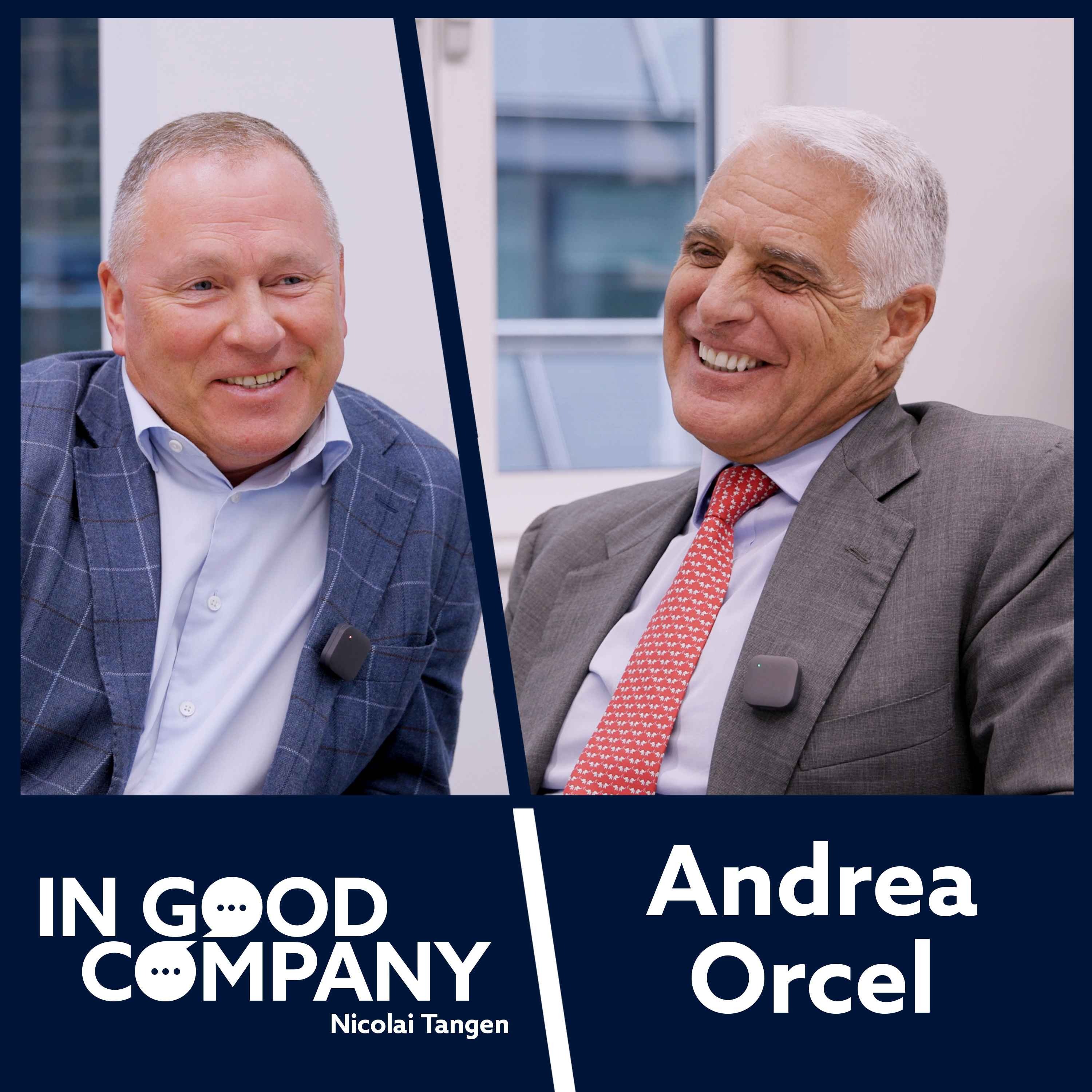
UniCredit CEO: The Future of European Banking, Digital Transformation and Grit
64m 38s
Andrea O'Cell, CEO of UniCredit, discusses the European banking industry's need for scale and transformation to survive. He argues that without sufficient scale, banks cannot invest in technology, while legacy banks and FinTechs are converging, requiring improved client experiences and efficiency. Competition is a balancing act: too much fragmentation hinders investment, while too little reduces service quality, with a 20% market share as a key threshold. Stronger banks are essential to finance Europe's industrial transformation and compete globally, but current regulations are inadequate. UniCredit's stake in Commerzbank was a strategic move for growth in Germany and Poland, though political opposition from coalition governments complicated it. Subsequently, UniCredit pursued Banco BPM in Italy, leveraging its multi-market structure. Banks must evolve to offer seamless, personalized client experiences, reducing cost-income ratios to 40% and boosting returns. AI is critical, as shown by a pilot that reduced credit file processing from six weeks to 14 minutes with high accuracy. However, this requires reskilling staff and managing social impacts. O'Cell emphasizes client-centric innovation, such as reducing consumer loan approval to 13 minutes, and sees blockchain and stablecoins as future priorities for modernizing markets. Overall, banking is becoming more appealing but demands continuous reinvention.
Hi everybody and welcome to InGoodCompany and today I'm in this particularly good company because I'm here with Andrea O'Cell who is also called the Ronaldo O Banking. Now Andrea has really left this mark on the European banking industry, is now the helm of unique credit and just so many exciting things going on in your business and in your life. So warm welcome. Thank you very much. I'm very happy to be here. What is the biggest challenge that the European banking industry is facing just now? Scale and transformation. I think they combine. Scale because without scale you don't have enough innovation, you don't have enough ability to invest in technology and you know the thing that you should invest to then transform. And transformation because we tended to look at legacy banks on one side, FinTech on the other side, we looked at them, we didn't consider them but if you take the next five years, five, seven years they're going to converge and therefore you need to ask yourself can I offer the same level of client journey, the same level of client experience with the same level of efficiency and beat them on what they don't have which is the clients that we start with, primary clients and secondly the ability to deal with multiple products and complexity. There's been a focus on having a lot of competition in each country right so ideally the competition authorities have wanted to have a lot of local competition in each country. Is that changing now? Well, I think local authorities have won local competition and the European Union, the competition authorities are looking at that by and large if you get close to 25% market sharing in any area you get blocked. So that is to prevent anyone from reducing that level of competition. I don't think that that is changing. Actually you have some market Germany's one of them where the market share is way lower than everybody else and it's like everything in life it's a balance. Too much market share, too much size does not support competition and a good service etc. Too little market share and too little size prevents you from offering the clients what they want because you're too little. What's the best for clients? What's the best market structure? I think a midpoint. I think for me it's a midpoint where you have enough competition depending on the market and the client's segment it changes but I do agree by and large that once you move over 20% market share in any place you need to start asking yourself if there is enough competition because competition pushes you to be better. A lack of competition pushes you to sit and to exercise. So is there now two little competition in Switzerland for instance after the merger of UBS in Credit Suisse? Let's see if some people could argue that and it depends again on which market segments because if you take the entire industry from a retail market standpoint. So individual I think they are okay given all the banks that they have. When you start moving on small and meet caps and large caps so the corporate sector that level of competition declines because of how strong UBS with Credit Suisse it is. Do we need stronger banks in Europe to make Europe more competitive? Look the parallel I always use is the industry which we always talk about is the engine financial services banks and capital markets are the gasoline. So now Europe has two things. One it is trying to transform itself because we have never been faced with such a challenge in terms of the structure of our industry, the leadership of our products. I mean if you travel to Spain today or if you travel to Italy I would say Spain is an extreme most car dealers from European producers are empty and most car dealers from Chinese producers are full. And so this for us is a shock as European because we had the leadership in that and there are other industry where Germany or Italy or France had the leadership before that we don't have anymore. We need to transform that. In addition to that if you take Europe in the last 15 years we have been always lagging gross of U.S. and China and we need that gross. So in order to do those two things you need new policies and then you need to finance them. And I think some countries feel that they can finance them as they have done so far through government budgets but government budgets are not enough. They need the leverage of banks and capital markets and our investors to be able to do that transformation and that financing. And I do think that at the moment the environment, the regulation, the framework in which we operate does not allow us to do that. And not many people work with what they studied at university. At university you wrote your thesis on hostile takeovers. Yes I did. And in September 24 you acquired a big stake in commerce bank. What was the thinking behind that? The working for all these time and the same thing. Maybe I'm not as creative as people think. I am one of those very lucky individuals that identified earlier what they loved to do. And hostile takeovers? No I would say well at the beginning for sure. I used to say that if I wanted to be a bean counter I would have gone in management and now I am in management. But at university I was reading so much about hostile takeovers and the attacks on air GR, Nabisco or all of these things that I wanted to do the same thing. I convinced a professor who was awesome to let me do a thesis on something that he neatly was not even understood. And then I got myself through doing exactly what I wanted. I never regretted it. But in life you evolve and then your job evolves and that's where I am now. In commerce bank I think lots of questions about that and usually M&A is viewed like an end on itself. I think after 35 years of M&A M&A can be a fantastic tool to strengthen a company to catapult its server. But it can also be a doom or a bad thing because you don't do it in a discipline fashion. M&A is a tool to your strategy. You decide what it is, you have a vision, you have a plan, you have a strategy, you're doing it organically. M&A can accelerate it if it fits and if it's done at the right terms. How does commerce bank fit into all this? So let's say how can I put it the night before announcing the famous 5% stake that we bought from the German government. It was something that totally fit in our strategy. Germany, we believe in Germany. Poland, we want to strengthen that area. From a client standpoint SMEs, this is our bread and butter across Europe. Affluent, bread and butter across Europe. And we felt we had implicit support by the government and implicit support by the then leadership of commerce bank. But that changed. In the morning we woke up to a very different world. I think we were discussing before this call on volatility and change and every morning you wake up and you find a different reality. We found a different reality. And at that point the choice for us, and this is one characteristic of M&A, was one, not go for and therefore reverse course. We felt at the time that that would be an admission that we had done something incorrect and we didn't think we had. Two stasis and bob around or three get to the maximum we could get without launching a bid and then sit and see how the situation would map. And we chose the third course. That's exactly what we did between the end of 24 and the end of 25. In my opinion and in the opinion of my brody it has been a success. Today we, that stakes will generate close to 800 million euros a year, postags growing, assuming they make their plan. And maybe in a non-defined period of time there will be the possibility to convert that into a combination that would make, in my opinion, us the most truly pan-European bank in Europe because let's say East of Turin would have market share everywhere in leadership across Germany, Italy, all strength of the sea. But why did the Germans change the mind? I think a number of, you know, I usually have learned in life to focus on what I control and not to speculate on what others do. I would say,
the following though, I think one of the things that have changed and many things have changed in Europe is we now almost always deal with coalitions. Coalitions are not uniform. This happens in Germany, it happens in Italy, it happens in Spain, I can take almost every country that I am active is their coalition. And I would say that the part of the government that we were talking to at the time was much more liberal and market friendly. The rest of the coalition was less. And maybe within the government they were less aligned than one would have thought. And when everything came to bear and there was a lot of noise about it, they took at majority a position that was against the position of what anyone's side had taken vis-à-vis us. And then quite soon afterwards you launched a bid for a Banco BPM. Yes we did. So Europe boxer does it make sense to box against two people at the same time? For us it was there were two things or the following consideration. The first consideration is that by the time BPM emerged we were absolutely convinced that while we would convert our derivatives and everything else into a 30% stake we would not launch bid in commerce banking the foreseeable future. So while there was all the financial planning of getting to 30% and converting the stakes there was no integration, nothing industrial, we would just sit on a financial participation. So it wasn't boxing with two, it was boxing with one. And then so we said if actually if now we launched BPM by the time we close the transaction and then we integrate it we will be able to go on the second thing because in Italy differently from Germany we felt we would obviously our evaluation did not come true. We would close the transaction in nine months integrated in 11 and it was in Italy. This is one of the advantages of Unicreddit. We are active in 13 markets for 13 legal entities, 13 boards and 13 everything. So Italian leadership team would run the other 12 markets would not even notice and sequentially if the condition were then right we would be able to box the second boxer as you call it. In another market we have another team, we have another framework and that was possible. So one it was that, two it was frankly shareholders, we could not not at least try to participate in Italian consolidation which is one of our two main markets. If it was going on and just say well because I'm busy there I haven't done that and the market has consolidated away from me. At least we needed to try and therefore we tried and so these were to end at the time and we had waited for three and a half years the terms, the financial terms were aligned. So we could do a transaction which at the time even if we reviewed up for premium we could bring in and look at our shareholder and say well strategically you know it is because you always wanted me to do it and term wise it could return on investment 15%, which at the time was about two points above my shareback to adjust for risks and it would strengthen our business in Italy. So that's why we brought it in. When you look into the future do we need banks in the current forms? I think as we started with this banks will morph. So take some move into what? So let's say that the business model is changing, the way we do business is changing. Translated in financial terms maybe 10 years ago you saw a bank commercial banks legacy bank 50% cost income ratio, we're solid, we're good. 12, 13% return on equity, we're solid, we're good. Today the same terms would be 40. In my opinion if you 40% cost income ratio and probably that means that the cost of 40% of your, those mean that cost of 40% of my income. And the return on equity which was about 12%, I think today you need to have an ambition to be in the height in. So 17, 18, etc, etc. So the industry if you want to look at it positively is becoming more appealing. But it requires rethinking how you do things. You're not sitting back and continuing to operate on the business model you did 50 years ago, 30 years ago, 20 years ago, you need to rethink the organization, the process, the way of working the technology, the AI and change and change and change. So when you then take unique credit and you sit in your chalet and you think about unique credit 10 years from now, just what does it look like? What is it? Well, if you look at it from a client standpoint and for a second let me take individuals, families, I always say that to our people, if you have a session on Netflix or on some other of those platforms that we're so accustomed to be on. And then for any reason, you need to switch off that and move on your bank. Do you have the same experience? Because if you don't, you will not survive in five years. So the client experience needs to evolve to what now in many other facets of our life, we consider the requirement, the bar, the expectation. And that requires a complete rethink of a way we operate. Especially on the front how you're going to change it. So I think it's blocked by block. So obviously banks are regulated. I can't just change it. In needs to make sense, the regulator needs to approve it. But for instance, in my opinion, you start and everybody says they do that, but they don't. The client needs to be at the, you need to flip the organization, that's what we did. The client needs to really be at the center of everything we do. So when you think about the way you do an onboarding of a client, when you think about how you grant a loan to a client, you need to start by thinking, how will the client react to that? I'll give you a very example, a very simple example. Consumer finance. You're going to shop, you want to buy something. At Unicredit, if you were not pre-approved and we didn't pre-approved many people, it would take seven days. Is that an effective way to support a client? It's not. Today, it takes 13 minutes. If you're not approved before and most of our clients have pre-approved before, so it doesn't take 13 minutes, they know their limit, they can spend and they can go. In order to do that, it means my process, which was 23 steps, needs to become two. My credit models needs to be online all the time to assess the risk of that particular client segment, etc. My product needs to be targeted to what they want, and I need to be in a position to react that quickly because otherwise, I can do it fast, but everything will blow up at the back. In order to do that, the entire thinking of how we do consumer finance has changed top to bottom. It has taken us three years. The same will apply to mortgages, mortgages. For example, you as a client, you don't need an answer in seven minutes, but you do want an answer in a week. If you are really keen to buy a house, you want to know if you have a financing or not in a reasonable period of time to move. I can combine that. Let me see another one. I give you a consumer loan seven minutes and I know from where you're spending, that you're buying a trip to Egypt. Do I offer you a flight insurance, travel insurance in general? Do I offer you discount at my clients who are all supermarket chains or whatever to get? I don't know, boots or the right casual wear. Can I do that? Because if I can do that, then I have financed your dream and I am suggesting to you other things to close the experience. How will AI change this further? AI changes that accelerating things. Number one, what AI does and this is what everybody is focused on is it reduces cost massively. I'll give you one example. But are you seeing that already or is it still to come? I think what I would say honestly, certainly for Europe, I'm not in the US. Most banks with very, very, very few exceptions, if any. If you ask that question at the end of 24, they would tell you something about AI but the reality is it was a curiosity. If you ask them today, or at the end of 25, they all talk about
about it. They all know it's a big, big, critical item. But now the question is how do we harness it? And the first reaction that you see in many cases is, and I read it all the time, I gave Copilot to every one of my employees. I sent everybody to a course. I did this. But that AI, while it will make the life of your employee easier, is that changing the way you work and is that transforming and extracting synergies? No. That's what I wanted to say. So now some banks and some are ahead of us, but we're trying to catch up quickly. So if you look at a credit file, very simple. Your big company you want to loan from us. I need to gather information from your accounts, from the internet, from a number of sources, create a credit file, all of the data, reclassify it into my spreadsheets, and then apply my metrics and tell you if you fit or if you don't. I'm simplifying, but that's that. Usually it takes six weeks for one experienced credit officer to do that from zero to the end if all the data is available. We did a pilot together with one of our partners. We developed an AI engine to do the same. It took us one week to develop the engine. And they could do on one where we had taken six weeks to prefer the fire. They could do it in 14 minutes. We have 98% accuracy. And this is the first trial. It will become 100% very, very quickly. So what does that tell you? It tells you that if I take the credit process of the bank 80% if not 90% of the people in the large caps prepare files. So what are you going to do? Because now what are you eliminating 90% of the people? The way of working changes, you need to manage the social impact in many countries where I am. I cannot do that if I don't rescale them. So it's progressive. So what do you do? And so it's that. So for example, we have since 22 and of 22 started a risk killing unit. Usually we have about, well, since then we've done about 650, 700 people. We're people that are not leaving but that are good professional but just their areas are getting disintermediated. So what do you risk kill them to do? To move to other things where we need more of them. I think for example in my opinion banks have curtailed too much the human touch to the client. So I may want everything online. But if I'm taking a mortgage of 250k, I want to see a person in front of me. So do you think banks generally will not reduce cost as much as people think? I think if you don't in five or six years or not here. Do you get people to change as quickly as you thought they would change? I have been pleasantly surprised at your credit. But it is not you get on a podium, you do a presentation but probably some very intelligent consultant has prepared for you. You pontificate for an hour and then you step off and we're all going to do it. It doesn't work that way. Firstly, you need to co-opt them in realizing that this is going to happen with them or without them. So the choice is if we do it at the beginning we have time to risk kill you, we have time to change and we can manage our pace. If you wait to hit the wall you're all on the straight because this is happening. One way or the other it is happening. Once you have that conviction then how do you manage and over how long in order to be able to manage at best the balance between being fast enough but on the other hand not doing things that trade unions and honestly society will not allow you to do. Can that be done? I think it can be done. We have done it again and again at Unicredit and I find that over time if you provide alternatives and if you treat people correctly the outcome is most positive than people expect. Another technology change we are seeing is of course stablecoins, blockchain and so on just where how is that going to fit into your business? Well you know if you had asked me three years ago I would have said you I don't really know. Today I think we are I think it is a priority. I think if you look at the modernization of markets is it bonds is it equity is it contracts for mortgages is it this is just a change in technology eliminating intermediaries blockchain that's what it is. You need to be at it and the other thing is if you're on blockchain you need to mean some payment and it's a very cryptocurrency which we only get involved to the extent that our clients want to do it because we are now we think it's too speculative for a commercial bank like us so we support it but we're not using it. Stablecoins is fundamentally because it is a lot more stable. That's why we join a a consortium of banks in Europe, Kivalis, to launch stablecoin based on euros because that's another threat for Europe at the moment if you look at stablecoin only US dollar. So that would mean that if you go on blockchain and you need a means of payment you're risking to be completely disintermediated by US dollar and the Americans love stablecoin because what is backing them is the dollar and your stressuries. And when will we when we have a European stablecoin? We are aiming to be out with a first-demoled kind meaning that it's working by the third quarter of this year. What are the any other trends in financial markets which make you nervous or worried? No, I do think maybe one thing when we were discussing it at the beginning if you come from having lived let's say the pre-covy area especially in Europe you're talking stable interest rates and low you're talking cost of risk so default which are very low because interest rates are so low that they are very low you're talking very limited to no inflation you're talking you can look at the next three years and very easily we we've in one standard deviation in terms of projection so you budget you break down the budget in pieces you have processes you tell everybody what to do and you track that today diametrically opposite. I remember that we did we launched Unicredit Unlocked in December 2021 or stock price reacted very positively very detailed prime it had taken us nine months to do it a month later Russia invaded Ukraine and the entire plan went in the bin and since then is the same we have interest rates which are volatile geopolitics for a volatile technology and AI that are changing the way we work all the assumption that we make we wake up the next morning and they are changing because we see new things that we didn't expect so now in my opinion to run a company to compete you need to understand what is the general direction of travel and have such a deep understanding across your organization top to bottom of what is your vision your strategy your plan and that direction of travel that the sub teams beat country or subset in countries retail corporate etc can constantly adapt and reject what was the original plan to get to the same direction but adapting to a changing environment and the style of management is diametrically opposite because you're constantly looking at how they have adjusted and seeing if it's going in the right direction rather than monitoring if they are applying what you thought they would apply at the beginning and that adjustment is absolutely critical and unless the volatility we see around us goes down and I don't think it does I think this is a completely different way of running things and if you don't do that the repercussion are very difficult but to do that the level of empowerment the level of trust the culture that gels together your individuals and the understanding of where we're going why we're going and what are the levers that they can use and the comfort of your institution that if they fail within staying in the metrics you gave them it's okay they just need to flag it regroup and start rather than I'm going to penalize you is massive and this is a cultural shift that for banks which are very spliratic is very difficult to do. How important is grit in your life? Very important. It is probably at the essence of what I have always believed I think some people not everybody is equal some people are born
more gifted than others and we see that every day. But by and large, I think that in a number of situations, I would say in a majority of situations, people that are at a certain level, maybe now the most talented in the class, that learn that fail and learn how to deal with failure. They learn how to learn from failure, how to pick themselves back up and how to go further. I think we share a favorite book Grit by Angela Duckworth and we did have Angela Duckworth on the book house. Oh you did. Why did you where did Grit start for you? What was your, you didn't have a particular hard upbringing, right? I mean you were middle-class kind of guy, right? Well first of all I went through the French Lee say and still today, the French Lee say is very Cartesian and the style of teaching, I don't know today, but in my times it was very hard. You needed to deserve the place you had at that chair, at that desk and therefore taught you to regroup and do better because otherwise you wouldn't survive that kind of style of teaching. But in general, it suits me why because I believe that the impossible is possible. Somebody told me either the impossible is impossible until it's done or if it's impossible, be more creative and you will make it possible. And I think human beings are here to improve themselves. And Grit is what tells me that I may start behind but through determination, resilience, consistency, ability to not take a challenge or setback as a disaster. That does not mean you don't react badly, you do. But then at some point say, right, it happened, why did it happen? Pull yourself out and start again. You evolve and you become a much better individual in whatever you set your mind to do. And for me going through this life and thinking if I'm determined, if I really want it, if I work at it, I will be able to get there with a lot of effort but I will, then it's a journey that is worse going through. And that's for me it's at the base of a lot of things that I believe. You speak most of the European languages. Not German but I do Portuguese, my wife is Portuguese. At least I understand that she would tell me that I speak a derivative of Spanish. But I do speak Spanish, I do speak Spanish, Italian, English and a little bit of Portuguese. What do you, this kind of pattern you're being, what is it do to you thinking? It's actually quite interesting and my wife and my daughter always point that out, I still count in French. If there is a mathematical problem or I need to correlate things and I speak loud to hear myself on the logic, it's always French. I do presentation in English because I've been here for 35 years and therefore all my professional life has been that. Maybe I enjoy my life and enjoy communicating in Spanish when I am on holidays. So they have marked different aspects of my life and they shape what I am all together. What kind of temperament or psychic you have? Where is that from? You can probably, you can call it determined, you can call it ambition, you can call it dysfunctional. For me, what parts of it is this? I think for me it's that. So for example, a lot of people kept on asking me what about work life balance. And I think that statement assumes that work is bad and you need something else. And if I am doing the job I chose with the people I like and I am on a journey that is exciting, it's almost like it's not work. I'm actually enjoying the journey with the people I'm doing it. So I will naturally tilt towards more work. And I do think that also these things move in life. So if you hadn't known me when I was 25, yes, I was working a lot. Today I'm still working a lot, but because I have a daughter who is 15, my priority has moved. So this work life balance for me is choices. But what is a lot? What is a lot? What is it to work a lot? I think when I was, I still went through the bootcamp of the investment banks in the US when I was 25, where if you weren't doing three all night or the week did not take any holidays in your analyst years and were working six, if not seven days a week, it was you were not through the bootcamp at the end. I don't think that that's necessarily the right thing to do. Do you work your people really hard? I think the work your people really hard, I don't believe. What I think is because I worked really hard, I'd rag them. So I think, and if you asked many of them when they need time and many times I ask them to take time, I am the first person who will never pick up the phone to call them or to ask for anything. But I do think that if we are on a journey together and we're trying to get there and they see that I am all in, they choose to be all in. Now you could say yeah, but by being all in, you're dragging them, I understand that. So to an extent, it is my responsibility to see if some hours are going too far and I stop it. But I don't demand people to be at a certain time in the office until another time. For me, there is a task to be done. We're all doing it together. You're doing this part. I'm doing that part. Let's get it done. It is important for you to be liked to an extent. I think they are you and especially when you get in more responsible positions or more leadership position. It is very important to keep your feet on the ground and remind you every day that you're no different. You're just having a different role. But at the same time, and you need to be fair to people because you will power that they don't have and you need to really think which I, what I force myself to do, how would I feel if that was done to me and not dismiss it. So we talked about M&A. M&A takes a completely different meaning in that context. When you are 25 years old and you're doing your spreadsheet, it's numbers. When you are 62 and you're evaluating what you're going to do with people, it's a completely different thing to do. But I do think that unfortunately life is not fair and unfortunately life is tough. And if you're leading an organization, they're a decision you need to make in the collective interest and not taking those decisions because not everybody thinks that they are the right decision is wrong. And I do believe, and I have seen it again and again and again, that even the people who disagree with you prefer that having listened to everybody, you say, right, I listen to everybody this time, this is it and we're going in that direction. So it's not important for you to be like this. No. Not in the way you define it. Then I would love to be liked in many cases. You challenge the establishment in many ways, right? I don't know if you can say that. I would say more that for me, the other thing that is important, it happened to be already once when I am through this job. I want to be in a position to look back and don't have any regret. And that means have I done everything that I could and I thought right at the time to do the best by my organization and by what it is and did I leave a better organization as a result. And so I think if we look at your results so far, when you became CEO five years ago, share price was eight and today is 70 and you paid seven individuals. So 10 times. Yes. So that's like totally an old standing, right? Yes, but I would tell you one thing. If you look at the team, so the 69,000 people that are unique, created every day, they live and breathe that. Yeah. They are so it's almost like this gave them back their pride. When we took to Klein who say, you know what? Thank you because I'm financing my holidays with the dividends that I'm getting from Unicredit. They're riveted to have that kind of interaction with clients. So there is an element that is not just performance is what that performance mean in terms of achievement besides. Where did you learn this? Because you've been working at places like Goldman, PCG, Maryland, UBS. So tell us where did you learn to make a bank go up 10 times. I think you go back to if you are very focused, if not obsessive on what does excellence look like and how do I get there? Number one, number two, if you are ready to listen to people who know a lot more than you do. So I arrived at Unicredit. I have
done as an advisor commercial banks for 35, 40 years. But I'm not a commercial banker. I'm an investment banker. Most, if not all, of the good ideas that transform your credit come from listening to people in the branches and in the trenches in general. So I think if you want to achieve excellence and you have a humility to listen to people, and then over time you can bring that together into so that means this work with doesn't work, we need to pull it together. This is the strategy we're going to do. You will find that the process is hard, but the outcome is easier. And the other thing that is very important is that because you went through that process and because the ideas are by and large coming from people who feel that is my idea, and I'm seeing it in action, they're embracing it 150% and want to take it on the other side. So I do think that these are generic things that you have. The rest is I tend to maybe be a little bit obsessive. I think about banks all the time. My wife would say that in the first trip we took, we went to Mexico. And before we even went to Sichi Chinista, I went to Hortissia Branch, because we were the most modern at the time to see how they have a function, because I like the industrial makeup on how it goes from the client to the way back. So it's a number of things, but ultimately you need to love what you do. You need to have that aspiration in order to get it done. When you make decisions, how much is instinct or pattern recognition and how much is analysis? So I think it's both. I would say the following things. The first thing is maybe that helps. Having witnessed trading for a large period of my life, we used to say that the outstanding traders are right 55% of their time, not 100, and not 90, and not 80, 55. But they're very good at cutting their losses on that 45%. Understanding what was wrong, they cut for lossing with discipline. They start again. So that has always defined my view that speed is important. So yes, you need to get as many elements as possible. But there is a point where you need to take the decision, and you will never have 100% all the facts. Is there their element of gut feeling? Yes, by definition, varies when you are taking decision on thorough, but incomplete information. At speed, by definition, varies an element of gut. Various an element of, I would say, I don't know if you want to call it discipline of humility, of saying, I know this may not work. So let me observe it. And then let me be ready to acknowledge if I made a mistake. I cut it off, I start again. You cut your losses. Not it's a decision that the boss made, so it cannot be wrong. Because then you dive into a situation that is not good. And I think if you do that again and again and again, by iteration, you get in the right parameter at the right speed. When you compare how you spend your day now compared to, let's say, three and five years ago, how has it changed? I would love to tell you that it has changed. I think the element that has changed is that I know that people I work with a lot better. And let's say, when I arrive, but definition, I was relatively cold because I was not emotionally invested. I arrived to do a job. Today, I am emotionally invested. I think-- What are the implications? What are the implications? The implication of that is positive and negative. There's certain decision that I need to force myself to take because I know the consequences. And I know the consequences. They have on people that I know the face off. I know what they do. And I know how they're going to react before it was easier. At the same time, it feeds energy. Because it feeds you into-- at least for me, I can't let them down. We need to get that done. We can get that done. What does it take to get that done? So it gives you an energy and a determination, but otherwise you don't have. [MUSIC PLAYING] You are known for spending more time on capital allocation than other CEOs. What to tell me about how you think about capital allocation? I would say that I'm known for a lot of things. Most of them are not true. I would say that if you asked my team-- I spent most of my time-- let's call it on the industrial side of a business. How do the process work? How do the technology work? How do the way of working work? Can we change the organization to make it better? Why that product, rather than that solution, et cetera, et cetera? So I go a lot in the details. So one thing is to ask people who know more than you, the classic subject matter expert on the branch, risk, or whatever. Another thing is to be oblivious and delegate everything because everything is OK. So I try to understand everything that occurs. It is true, however, that one element that banks-- and this comes from my advisory career-- have always underestimated, until recently, is that we have cost operational and we have cost of equity. We have a cost as well. So not factoring in, but my cost of capital is 9, 10, 11, or 12%, or when I started 17, is wrong. And therefore, in the decision that we made, we prioritize the deployment of capital, which is a scarce community commodity. It doesn't belong to us. We're entrusted by shareholders on that, into the places where we could extract the best return. It started with that. Then it became how can I make the places where the returns are lower, better performing, so I can deploy the capital there as well. And therefore, capital allocation became a mantra for driving a business that both grows profitably. Because everybody talks to you about growth or return. If you look at the plan we have now, that is no news what we're saying is we want to be of the optimal intersection of growth and distribution. To do that, you need to have maximization of profitability. And therefore, you need to seek a growth, but we call it quality. A growth that seeks to defend margin, to go in the places where your comparision don't go for any reason, to complicate it. They don't have infrastructure. They don't have a knowledge. It's too painful to create value and find that. And obviously, when we look at it from a financial standpoint, is what is my cost in commeration, that area? So how efficient I am? And secondly, how much capital am I using? And is that capital being rewarded above what it cost me? Or not? We look at that and we rank the businesses. But then we go back on those businesses and we say, how do we run them? Can we change-- it's like building a car. A process, step, step, step, step, everything is a step. Can we change that and automate it? People tend to automate. First, you need to redesign the process. Then you need to automate and use AI. How have you redesigned the corporate culture? So I don't-- so this is-- With a big question, because I believe that culture is the link to being not of everything. Everything. You have the right culture. Eventually, you're going to win. Yeah. I-- So when you came in the first day, and you sit down and talk to people, what part of the corporate culture do you think, wow, I think we need to change this? So I would say this. First of all, changing completely a corporate culture is very difficult and takes an extremely long period of time. Eventually. How long time does it take? Changing it dramatically, more than a decade. Because inevitably, to change it, you need to purge the people who are not in that culture. And if you have 80,000 people below you, and most of them are not in that culture, it's going to take your long, long, long time. So I don't think you can impose your culture. In the way I look at it is you better go in a place where your way of principle value culture matches. Maybe not 100%, but to a large extent. Otherwise, you're going to have a very difficult time. What did I have in Unicredit? I think I knew Unicredit from before. I think they always stroke me as living and breathing Unicredit. They adore Unicredit. We say in Italian, they wear the Unicredit t-shirts. When they are at work, when they are not at work, for them it's an element of pride. They are part of that team. Not many institutions, all like that. Coming from investment banking, not many--
institutional, I have people who have been there 20 years, 25 years, 30 years, and they love to have been there for all that time. Second thing, they used to be the team to beat in the early 2000s, and they were accustomed to be the team to be there were fast, innovative, aggressive. They were not maybe with the benefit of Hans Sattit's always easy, they were not harness in a box that prevented them from bringing that aggression and the speed etc to things that then converted in problems. But the DNA was a winning DNA. And I felt looking at the outside that over the retrenchment that they had to suffer and to a certain extent I would call them in almost humiliation to go from the top to the bottom, they still had it in them. And it was just a question of putting them back in a position to achieve it. So rather than changing the culture, what I did when I arrived is I spent nine months contributing with a small team to interviewing directly and directly about 20,000 people, 30,000 people of the 80,000 that we had, tried to determine what were the principle and values that made them tick. Very interesting, integrity, very many people. I would say an organization that doesn't talk to you about integrity, not very likely. Second already, ownership for commercial bank is quite a lot and thirdly care. Coming from investment banking, I didn't expect to be there. It was the first most voted planet that they wanted to have because investment banks don't care. Well, because probably care about your colleagues, care about your clients, care about a lot of things that have to do with the organization. And I think investment banks are more individualistic than a commercial bank like this was. And I think on those pillars, you started saying, okay, so now we are going to have, do we all agree with that vision? Do we all agree with that strategy? Do we all agree with that plan? Yes. Do you feel passionately about it? Yes. Then we empowered them back. We had a very top down, command and control structure. Now we are probably one of the most empowered bottom up organization. But in order to do that, we need to believe in the vision, the strategy and the plan. They need to be harnessed or structured around KPIs that they believe in and they can understand and one culture. So fundamentally, I talked a lot about the subject matter expert in the branch in risk et cetera. They are much better than I am to doing their jobs. However, I need to understand, when they make the decision, will they have in mind the same concern, principle and value that I have in making them? Because they may be very good. But if they go in the wrong direction, what? How do you control all of that? And so culture is what makes you confident that 95, 98% of the time, you're going to have the right outcome. Is there anybody from outside the world of banking which have inspired you? Any other discipline? Outside of the world of banking. Well, I go back a long way because I am a fan of when I was a child, maybe that shaped me. A Roman general that was called Cepio who did the impossible. At 26, he was leading the Roman legions against Hannibal's in Spain. And then he went and took back. I don't know how you call it in English. Cartagoy, I think. And beat Hannibal with his elephants. It was all about strategy, empowerment, taking the best of individual, spirit of core and doing the impossible. More recently. Is that how you beat the other elephants out there? Well, you know, very so put it this way, your Roman infantry with a nice little shield. And you're there and we charge on you with an elephant and you're told it is possible to withstand the attack. It would be classified as impossible, but he found a way to do around it. So for me, it was that creativity. I'm not suitable because you were actually born in Rome, right? I was born in Rome. Okay. And it's all coming back. It's all coming back to that. I might, it might, but in the more, let's say in the more modern world, I had, let's say, CEO as I was blessed to be an advisor that taught me a lot. Nobody's perfect. I'm not. They were not. But Emilio Botina sent in there taught me a lot on humility, striving for improvement all the time. How to galvanize people, stand on the heel and marriage, meritocracy, empowerment, how to make people take ownership of things. Then all of them, including me, have maybe. Especially as you worked with the new brand advisor, right? So you had a stand on the heel. I was working for him as I was working on marriage. Yeah. Emilio, I was an advisor, yes. Yeah. So you had a unique insight into, into these people. Now, if you were to just, your leadership principles, just the most important ones that you adhere to. So leadership principle, I think there is a quote I like a lot from Almy Role-Macraven who said, "If you want to conquer the world or change the world, start by making your own bed." Yeah. And he was saying, I don't mind being late for an important meeting. If it means I need to finish my own bed. What is he saying in that? He's saying, number one, do small things well before you have an ambition to do big things well. Small decision, big decision. Second thing that he's saying is, this brings you back to, as I said at the beginning, both feet on the ground, humility, etc. These leads into whatever organization, especially of large people that you have around you, you need to listen. You need to be part of them. You need to spend a lot of time with the people you lead, understand them, show that you're not a Martian from out there, but you're one of them, that you value them, explain, listen to what their questions are, get them to guide you on some question that you may have, and be humble enough to accept the challenge not as an attack on you, but as something that will make you stronger. Then there is, and so these things, I think, and then realize what we said before that your job is just one part of the puzzle or bring it all together into something that they share, that they can identify, that they feel passionate about, and then drive them towards excellence. Because at the beginning, the impossible is this guy is asking too much of me. But then it becomes, wow, you know, first of all, many times what I thought was impossible, I did. That gets you to re-rate yourself in a way that makes you almost walk on air. And even if you fail, usually your head of the people who just aim to be to arrive to the media, not to the possible. Where does your drive come from? Who do you want to show? I think to a large extent myself, I don't like contrary to what people believe, the public recognition, I like to think of myself, I set an objective, it was very hard, and you know what, I got there. And I got there, and now I'm going to set to number one, and I will get there. For me, it's a self-satisfaction to a very large extent. You're more the way to the UN. You're right, you did your work in Rome. Has it been important for you to make a proud? Very. All your father. Very. Very important because from a young age, diversity. I was exposed in Rome, both because of school, because Rome is the only city in the world where you have embassy and councilate to the Italian state, the UN, and the Vatican. So it's full of public servants from every part of the world, and they tend to gravitate to a large extent on international schools, but frankly say was one of them. So diversity of views, diversity of religion, diversity of belief, but we're still good friends, that did shape. And I grew up in a generation that thought about openness, attracting people who were different through demonstrating that there was more we could do together, etc. So I'm not living very well, the world of fracture separation distances that we have today. How do you relax? How do I relax? Today, I spend time in order with my wife and daughter or with my dog, or I do sports because it takes my mind. So we took before bad boxing, because while you're doing it, your mind needs to focus on your adversary or you're going to get punched.
I'll be very quickly, but you need to focus on what you're doing. But that forces me to completely let go of everything else around me. And that for me is luxury. I don't get to do that very often. And so physical exercise or endeavors where I need to focus. I love skiing, open air with my family, both on water or on snow. Yeah, this is what I do. I don't do much more. What do you read? I read from time to time. The last book I recently reread because I read it a long time ago. There is a book by a Spanish author. I actually called postergillo, who wrote this book about the cursed religions, which is Cipi invasion of Africa. And obviously it's a story as well as historical facts. It's very good from an historical standpoint, but it's a story. And it's a good to get my mind away from everything else and get absorbed in something completely different. What is your advice to young people? That's always very difficult. Advice to young people. I would be generic. I would say number one, take the time to choose the journey, the job, the trajectory that you love, that motivates you, that gets you there. I remember that being in investment banking, which was a choice as you remember, that I did because I loved it. People were asking me first question, when will I make my first million dollar? And my first answer was, if that is why you chose it, very, very hard to get to that point, because you need to go through bootcamp, there is no money, but it's going to compensate for that if you don't like it. So number one, make sure there is not what your friends like, what your parents like, make sure the choice is your choice, and you really like what you do. The second thing is, choose to do it in organization and with people where you identify. When we're all young, we think that a bank is a bank, a company is a company. Banks and companies are very, very different. I worked at Goldman Sachs, I worked at Merrill Lynch. Arguably, many, many people would tell you, Goldman Sachs is a materially better company than Merrill Lynch was. One went almost bankrupt, we ever one didn't. But for my character, Merrill Lynch was better, because I thrived in that environment, and at Goldman I didn't, that does not mean Goldman is not an exceptional firm, and my best friends are still there, fantastic. But where you do it is very important, because that kind of company will attract people that are with whom you have something in common or not. And if you have those two things, then the rest is going to take care of themselves. The other thing is, do you have an idea of the direction where you want to go, but don't think it's going to happen the way you think it's going to happen, because careers are not straight line, the jigsaws, and actually the failures are probably as important, not much more important, because of what we were saying about grit, than the wins. You don't, you're satisfied with win, you don't learn anything from wins. Failures, you learn a lot about yourself and about what to do better. So if you have those things, and then I would say more recommendation, I hope that the generation that is coming into the ranks today doesn't take no for an answer, does what today seems impossible, which is getting the world to go back to a center that is from which we are going away, that I think as a generation, if we don't do something, we're leaving our children in a situation, but it's not as good as the one we found when we were very age. Well, under, it's very clear that you know where you're going, that you don't take no for an answer, that you love what you do, and you do it with each other. Absolutely. Great, very much.
Podcast Summary
Key Points:
The European banking industry's biggest challenges are achieving scale to invest in technology and undergoing transformation to compete with FinTechs, as the two are expected to converge in 5-7 years.
Market competition is a balance; too much fragmentation prevents investment, while too little reduces service quality. A market share above 20% raises competition concerns.
Stronger European banks are needed to finance industrial transformation and catch up with the U.S. and China, but current regulation and frameworks are insufficient.
UniCredit's stake in Commerzbank was strategic for growth in Germany and Poland, but faced political opposition due to coalition disagreements. UniCredit later pursued Banco BPM in Italy as a separate opportunity.
Banks must evolve to offer superior client experiences, with cost-income ratios dropping to 40% and return on equity rising to 17-18% through process reengineering and technology.
AI can dramatically reduce costs and time (e.g., credit file processing from six weeks to 14 minutes), but requires reskilling employees and managing social impact.
The future of banking includes blockchain and stablecoins, now seen as a priority for modernizing markets.
Summary:
Andrea O'Cell, CEO of UniCredit, discusses the European banking industry's need for scale and transformation to survive. He argues that without sufficient scale, banks cannot invest in technology, while legacy banks and FinTechs are converging, requiring improved client experiences and efficiency. Competition is a balancing act: too much fragmentation hinders investment, while too little reduces service quality, with a 20% market share as a key threshold.
Stronger banks are essential to finance Europe's industrial transformation and compete globally, but current regulations are inadequate. UniCredit's stake in Commerzbank was a strategic move for growth in Germany and Poland, though political opposition from coalition governments complicated it. Subsequently, UniCredit pursued Banco BPM in Italy, leveraging its multi-market structure.
Banks must evolve to offer seamless, personalized client experiences, reducing cost-income ratios to 40% and boosting returns. AI is critical, as shown by a pilot that reduced credit file processing from six weeks to 14 minutes with high accuracy. However, this requires reskilling staff and managing social impacts.
O'Cell emphasizes client-centric innovation, such as reducing consumer loan approval to 13 minutes, and sees blockchain and stablecoins as future priorities for modernizing markets. Overall, banking is becoming more appealing but demands continuous reinvention.
FAQs
Scale and transformation. Without scale, banks cannot invest enough in technology and innovation. Transformation is needed as legacy banks and fintechs converge over the next five to seven years.
No, competition authorities still limit market share to around 25% to prevent reduced competition. A balance is needed: too little size prevents banks from offering what clients want, while too much reduces competition.
Yes, to finance Europe's transformation and growth, which government budgets alone cannot achieve. Banks and capital markets must provide leverage, but the current regulation and framework do not support this.
It fit Unicredit's strategy to strengthen in Germany and Poland, focusing on SMEs and affluent clients. After the German government's stance changed, Unicredit chose to hold the stake as a financial investment, which now generates significant returns.
Unicredit saw it as a separate opportunity since the Commerzbank stake was purely financial. The Banco BPM deal was in Italy, where integration could be fast, and it offered strong returns to participate in Italian consolidation.
No, banks will morph. The business model is changing, requiring lower cost-income ratios and higher return on equity. Banks must rethink organization, technology, and processes to survive.
Chat with AI
Loading...
Pro features
Go deeper with this episode
Unlock creator-grade tools that turn any transcript into show notes and subtitle files.
 PodcastTranscript AI