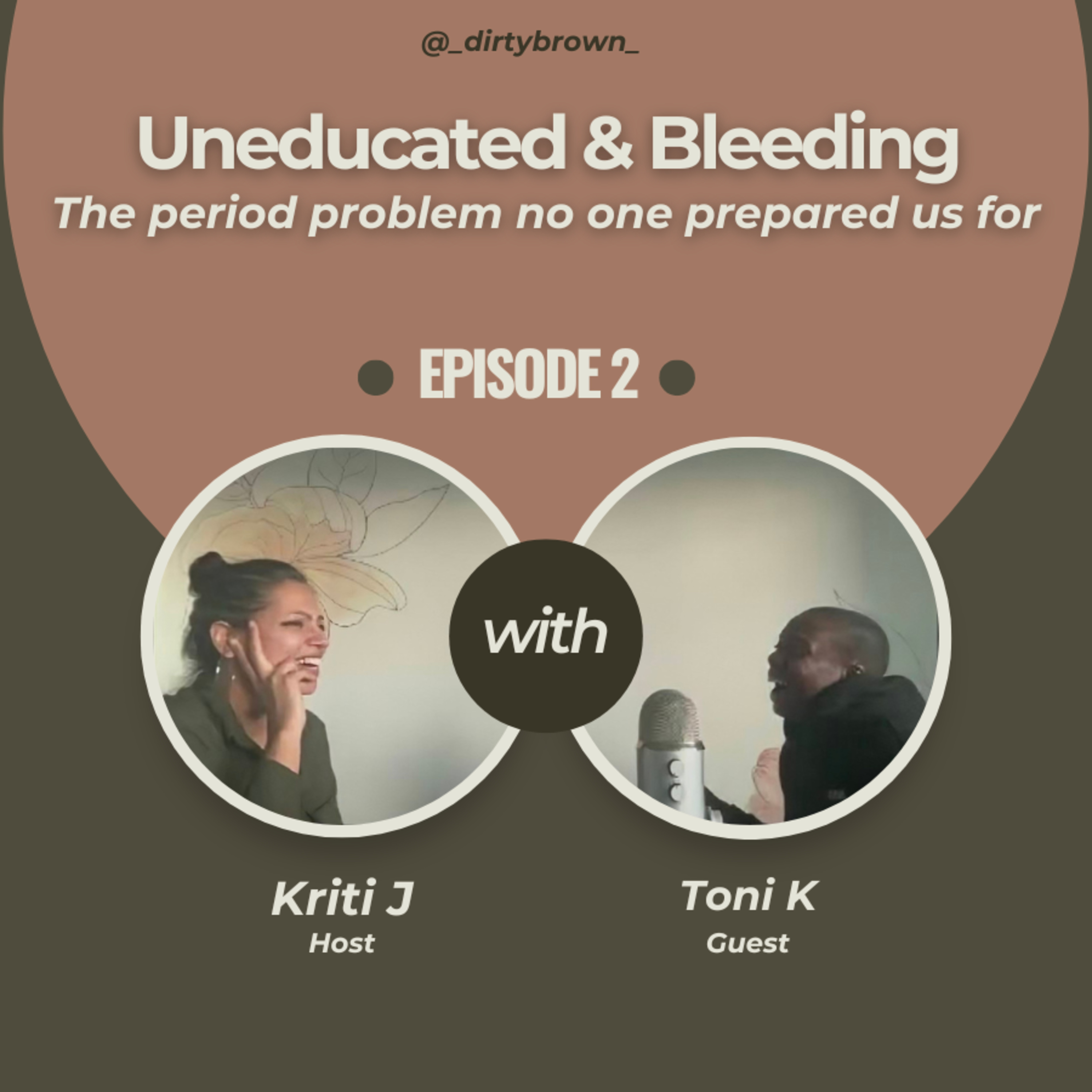
En este episodio del podcast "Dirty Brown", la anfitriona Krithi J. y su invitada Tony discuten abiertamente sus experiencias con la menstruación, destacando la prevalencia de la desinformación y el estigma. Ambas comparten historias embarazosas y aterradoras de sus primeros periodos, atribuyéndolas a una educación insuficiente y a la falta de conversaciones normativas en el hogar y la escuela. Critican la narrativa cultural negativa que rodea la menstruación, contrastándola con tradiciones indígenas que la celebran. La conversación también expone fallas en la investigación médica, como la definición vaga de "flujo abundante" y la normalización del dolor, que en realidad puede indicar condiciones como la endometriosis. Concluyen abogando por hablar sin tapujos sobre los síntomas para desestigmatizar el tema, promover una mejor educación desde la infancia y priorizar la salud menstrual en la ciencia y la sociedad.
Transcription
5811 Words, 30102 Characters
(upbeat music) - Can I share with you names? - Yes, of course. I always felt on flow is very old school. - Okay. - And so my friends and I adopted the name Rosa in high school. And I was just like, yeah, Rosa, fuck Rosa, Rosa's here, yeah, yeah, Rosa got me. Then I went to university and my friends introduced me to the term called Shark Week. - Shark Week? - That's fucked, that's what is wrong with y'all. - And my run from was just like, I fucking love natural geographic shark week, so like, why not? It's like a shark week, look at all the blood. - And it's like, that's wild. - They chose to embrace it. And then blast it out loud and like, say, oh, it's shark week, oh, is it shark week, shark week. Here I am like, why don't we just call it Rosa? - If you hadn't already guessed, today we're talking about periods. Welcome to this new episode of "Dirty Brown". I'm your host, Krithi J. In a conversation recently with my friends, I realize that we don't talk about our period stories enough and what our journeys have been like in terms of understanding our bodies and the symptoms and just how we've navigated around it. So for today's episode, I invited my friend, Tony, to join in the conversation and we're both in our 30s, we're not medical professionals but have been bleeding for decades now. And there has been a lot of learning along the way, a lot of messiness in terms of understanding our symptoms and understanding our bodies better. And for today's discussion, we are going to get into unfiltered lived experiences with Lady Flow. Let's dive in. I was actually reading this journal. It's called "Patterned Assumptions". There was someone's master thesis around how those patriarchy and misogyny in periods. Absolutely. And one of the things was just the way it's referred to. And when you hear about period conversation, everything is so negative. Yes! Nobody ever in a conversation about periods just says, "Oh, I can't wait to get my periods this month or just celebrate it because we just don't have that in our language." 100% agree. And I think this is where anthropology and the study of indigenous cultures is so important because in many indigenous cultures, when a woman had her period, it was celebrated. There was a ceremony. Yep. And there's like, in a lot of cultures, they have these, like, huts where women go gather together and celebrate this year. And was this thing, and people were excited, women were excited, young girls were excited, mothers took this time to embrace their daughter and say, "Today now you are a woman." These are the things that your body can do. Did I ever tell you about my story of my first period? I don't think so. Oh my God. Oh, my God. What happened? So, first of all, I did not know that there's a term called "Minarchy" for your first period. That was what that word was. I was like, "That's either a spelling error or this is a real word, and I'm just going to ask her about it later." Did she mean to write men's ears? What is this? The horn that you knew it? Absolutely. Okay, so for listeners out there who also don't know, "Minarchy" is the term for your first period. I still haven't been doing some research on this topic and that's when I learned about it. Where is that published? Well, you can Google it. I don't know if it's published anywhere. What? What? Why? So, yeah. Anyway. My first period. Yes. I feel like these events happened in the way that they did because the universe knew that one day. They would have been talking about this. And they wouldn't give you a story to tell. So, this is what happened. I think I got my periods when I was 10 or 11. I don't remember. So, they just so happened to come across a cow in the weeks leading out to a period. Please tell me, "Yeah, I'm listening." Okay, yes, I know they're not very related. I noticed a cow and there was a discharge type fluid oozing out of the cow and I was honestly quite disturbed to see it. It doesn't look very nice. I didn't think it was. I thought the cow was ill and I didn't have any adults around me to question what was happening to the cow and also it was kind of disturbing so I try to leave it out of my mind and just forget about it. Only till like a few days later. Sorry. Sorry. Sorry. Sorry. Sorry. Please finish. I think I think I. Yes, like I noticed discharge. Oh my god. I wasn't a fat kid but I'm more on the choppy side so there was a moral bad shaming from society. So, in my head, I was either just as sick as that cow or I had become big enough like I was as big as a cow. And so now I'm scared. I'm freaking out and I'm like, "You know what? It will go away. I'm scared to tell my parents about it." And obviously the next step after a couple of weeks was periods but even that, how it happened was in the morning of the day I got my period and I was eating a lot of fried food. And I had diarrhea. This was the pre-period diarrhea, which I didn't know. And my mom was just like, "Can you stop eating fried food because you're going to get dysentery?" And I'm like, "What is dysentery?" And she was like, "Oh, you start bleeding." And you take the shit you bleed. And I'm like, "Oh, I'll be fine." And I keep eating that food ever throughout the day. Oh my god. And then I get my period and I'm just like, "Oh, I have dysentery." Oh my god. It was so, I'm so sorry. It was all well and good once my mom came home and we had a fun conversation because she came home and I was like, "Mom, I got dysentery. I'm so sorry." Yeah, my mom was, you know, she was very confused and then she asked me some questions and she realized that it was period and that's how that went. But honestly, no girl should ever have to experience that. There should be enough education around this topic. If we treated it like we treat math in the sense that every year you build on the topic that you just learned last year, if we did that with our bodies, then by the time we hit 13 and puberty and raging hormones, we would all the way know what was happening. Yeah. So, what was it like for you? My story starts with this book that was going around school and it was explaining what your body does, right? And at the stage, you feel like this, this happens, these are what hormones are. It's kind of nice. Love it, love it. Yeah. But it was a book full of little white boys and little white girls and I'm a black girl and I was just like, "I'm not that interested." I also was not interested in these types of books in general and my mother thought it would be a good idea to replace my regular bedtime story with this book. Okay. Yeah. Yeah. Yeah. I wasn't interested. Try to avoid hearing anything more about it and I would just go a bit early. But I would hear and would know. And so I knew a little bit about what was coming up to the summer of this grade. I'm going to sleep away camp, I'm packing up this huge suitcase. This is my first time going super excited, slightly nervous. I don't know anybody there. My mother goes, "Wait, wait, you have one more thing to pack." And she brings out this package of pads here. You're going to need this this summer. Don't worry. Trust me, and I was just like, "Okay, she didn't provide any education on how to use a pad?" Oh. She doesn't give you instructions. She just provides you pads and then walks away like a ninja. And so camp happens, whatever would have you, and one day something is not right. I'm just a little too moist. I don't know what this is. Go to the bathroom, looks like a full on murder scene. I cannot come out of this bathroom. I think the good thing about how it happened is I was with my camp counselor and my cabin mates at the time. And my camp counselor moved I was in the bathroom too long. She came, she checked on me. And I was like, "I don't know what to do. There's blood." And she was like, "I think you might have you had two you have pads." Because you don't know if I've ever had my period before. I see crying. She was not prepared for this to happen to me and for her to be the first person I have this conversation with. It's interesting for a camp where you have girls aged nine to twelve. This should be part of something that you prepare for. This is a list of students. These are the girls who get the period, who don't get the period. And if it happens, this is how you can talk to them about it. Correct. We do with it. Can I tell you, I have worked at day camps. Never has that ever been a part of my training. I'm surprised. I also was not an adult. And as a camp counselor, I've had young girls come to me when they had their period. And only because I got my period so early that I was then able to communicate with them and talk to them about my experience and shed some light as to what it is they were going through. Back to the counselor, she brings me the pad. I remember her asking me, "Do you know how to use these?" I think I might have told her, "Yes. Do I know how to?" No. Did I have a flashlight in there and was I just reading the instructions on the little skicker of these always pads? No. Absolutely. And so, I do that. I come out and she's like, "Hey, just so you know, every time you go to the bathroom, you should change your pad." Every time, first off, that was information, never heard from anyone ever. And glad she told me that, because I wouldn't necessarily know how often that needs to change. That's actually true. I think I remember the only way I learned that it needs to be changed is by just not changing and then having it flow everywhere and then having to wash it. This is great information. I'm not sleep away. We're outside. We're camping. We're kayaking. We're in a lake. We're gross. We're gross. Wait, so you were doing all of that with a pad and not a tampon? Do not even get me started on my first lesson using a tampon. Now, thankfully, I didn't have the experiences of some friends that I had where they were told if they used a tampon. They would lose their virginity or they would it be seen as pure and all this other stuff. That was never the education that I was given, but I was also never told about alternate options to this pad that was three centimeters thick. It's interesting to say that because my experience growing up was the same. I'm mom. When I got my period, she hadn't met a pad and I was not told there are other options. And I heard the same thing that, oh, if you were a tampon, you lose your virginity or you were considered a slut. Yeah. If you were a tampon, that is so wild. So wild. Because I've played sports all my life, I'm someone who would have all the way benefited from using a tampon. We would have all benefited from using a tampon and avoid all those stains on the sheets when you wake up in the morning. Oh, listen, don't even get me started on that. Cut now to the end of camp. Yes, to be honest. Sorry. Camp has happened. I have my period. Whatever. I'm, I'm, I'm, I'm a wizard now. Yeah. I come back home. Also, I just want to prep this with, I was a background at camp and my hair was not in a protective style. I got dropped off looking a certain way. And I came back looking a completely different way. I had so much pride in the fact that I had my period, a away from home and that I like, I was a big girl now and like I handled myself like I didn't cry about it. Like I was good. I wrapped up my first pad to show my mother. My aunt and my mother picked me up, my aunt immediately buses up laughing because she was like, what the fuck happened to your hair? Oh, you look crazy. Then I have this huge luggage that they're now putting into the trunk and I was like, wait, wait, wait. I have something to show you. And then I opened my luggage and my aunt is like, what is that smell? And I was just like, I got my period. This is my first pad and my mother goes, oh, you don't know what it is. And you did not need to do that. Oh my God, I'm so proud of you. Yes, but I was so proud and I wanted this show until moment and it did not go the way that I anticipated. I was not happy with the laughing or is that a just look of disgust that I saw across both of their faces and then they looked at me and they're just like, sweet, thank you. You can serve that out, you know, that is a good parent of me. This is why I made a new education around such a, I went to an all-girls boarding school and I was asking a friend of mine that, hey, when you go to your first period, what was that like? And she told me that she was also scared because there was no education around her. All of a sudden you see blood coming out of you. Of course, you'll be scared. You're afraid for your life, like, what the fuck just happened. And then she ran to the housemother to be like, hey, this is happening. The housemother, instead of explaining things to her and managing that situation, ask her to wait and calls her big sister who also goes to the same school and hands her off with the sister to manage. At least there was someone to manage, but why was it on the sister? Why was it not on the housemother who is the older person and also a teacher? Like our job in that moment was to teach this child as to what was happening with her body, right? And you failed her. That day you also learned that I cannot go to authority or I cannot go to teachers for something like this. I have to rely on my friends and family, which is also not great. 100%. So those were our lived experiences when it came to our first periods. And there are other women that I've spoken to who had no idea what was coming and were scared when it happened. And everybody has their own version of it, which looking back today, it's funny, but in that moment can be very scary. So what are the facts do we not know about periods? And specifically when it comes to painful cramps, let's get into it. In our conversation recently, I learned from you that we only bleed three to four tablespoons of this. I was so shocked why. Well, okay. So, and that is a, that is a regular flow. So last year, I learned what a, like the textbook medical definition of a heavy flow. It is how frequently are you changing your pad, your tampon, whatever, right? It's not helpful. It's not a subjective thing. It's not helpful. You're not giving me table spoons or anything like that. But this also just tells you that patriarchy is also involved in our research and our medical field. And we are not a priority, right? Take, for instance, did you know that pads up until last year were not tested with actual human blood? Yeah. And I was, I was surprised by it when I found out all they don't, they still don't show blood in the commercial. They don't show blood in commercials. But when they tell you that it's a super pad, super absorb, super absorbent, that based on what this blue fluid that you were using, that has very different viscosity than actual blood. Nothing. Yeah. Right? And so that just goes to show we are not a priority in medicine. And therefore, there is no research done about the actual quantity, and maybe I'm mistaken. I haven't found any thus far on what is the actual milliliter amount of a heavy flow. It's just subjectively based on if you are having to change your pad, your temple, or whatever it is that you're using to collect. Also, painful periods are not normal, and a lot of people don't know that, right? And there's so many other things. It's not normal to have a consistent heavy flow. But you have like one day, but it's not normal to have three plus days heavy flow. It is not normal to have a painful period. It is not normal to have migraines and things of that nature associated with your period. Ever since I can remember, I've had debilitating cramps, and it's progressed over time. And I've mentioned, I was in a household, grandmother, mother, aunt. All of these women have had their periods and are still having their periods. None of these women had cramps. It was not something anyone in my household was willing to not, not willing. They didn't know, right? So they didn't know how to help me outside of, you know, okay, use this hot water pack and give love and use the medicine, right? That was it. There was no investigation. There was no taking me to the doctor, there was just you have painful periods, right? There was also this idea that maybe she doesn't know how to handle pain. It might not be that serious. I can also recall my mother telling me on multiple occasions. It's mind over matter. And it's not intentional. It's just how society is where it's just assumed that we have to deal with pain. Yeah. And if we are in pain, then it's probably gone. Yes. Correct. I don't think that we are a priority. I mean, we very much live in a patriarchal society. And the way that we move forward, push forward at times is at our own detriment or at the cost of acknowledging what is actually happening to us. Like, is it a benefit to me to really go into this? No. I have other things to do. Like, I just have to suck it up, right? That's what my mother did before me, her mother did before her and everyone else did before them. So this is a learned pattern. Just suck it up. Yeah. Unfortunately, that's true. Yeah. That is true. That is true. And our society today is actually some of the things that I have started doing to just sort of change the conversation in some little form that I can is our work, you know, if I'm taking time off because it's related to PMS symptoms, I don't just say, oh, I'm not feeling well. I say that I'm taking off because I had cramps or I'm taking off because I'm PMSing. Put it out there now. The only reason I'm doing that is when I want to try and reduce the stigma around it because a lot of the women still tend to hide it and normalize it. Like this shouldn't happen. I go through this every month and some months are worse than others. And so if I need to take time off, I'm not going to hide it and I don't want to hide it anymore. So that's one that I'm doing, which is very small. It is. It is. But I mean brick by brick that's how you build, right? So pain for periods and not normal. Pain for periods are not. Have you been able to identify what's going on? Is there, are you able to manage it? So yes and no. It's been a slow progression and a slow disclosure. So in high school, I was exposed to the word called endometriosis. A friend of mine said, I have endometriosis. It looks to me like you have endometriosis. But it seemed too big to belong to me, this friend who had endometriosis. She was organizing and orchestrating her life in such a way that just seemed too large for me. There is this myth and trope that if you have endometriosis, the way around to mitigate it is to have kids. She was family planning, senior year of high school. Everything that she did was around, I need to have my kids early so that I can manage my pain. Yeah. I can understand how that would feel right here. That is overwhelming. I'm in high school, I'm a late bloomer. I don't even know boys are flirting with me. I still don't know about myself. Like I didn't know we were going to school to date. I thought we were going to school to study and get into university. Right. Yeah. And to meet someone a year above me who is family planning, I'm just like you and your end of me. Can you go over there? I do not have that because if that is what I have to start doing, I cannot. My table is full, I'm good. So I knew of the word but I was avoiding and I was just like, I can't because I can't. And now that I'm in university, when I'm both controlled, it helped. My pain is managed. I'm still experiencing PNDD symptoms. I still will get migraines and headaches. I'm experiencing low moods like as like I'm seeing my symptoms as things that are just happening. And I'm not attaching the symptoms that I'm having with my cycle. Like it wasn't until I was living with a roommate and she just randomly said one day, Oh my God, you're about to eat us out of house and home, aren't you? And I was just like, what? I had never put two and two together. I was not self aware enough at that time to even notice that. And then after she said that, I started to pick up on things and it sparked my interest. Now I'm looking into endometriosis. I go back to my friend from high school, we're still in touch and she's had kids. And because I told you it was a myth, still experienced. Too painful to me. It is. Right. That was a myth. I mean, but less her kids, like that wasn't the reason and by the time she has them, she knows that this is a myth, right, and it no longer subscribes to that belief. However, she's like, I manage my pain so much better now. I saw a doctor who all the way knows what he's talking about and sent me to this specialist, this specialist, this specialist, this is a, that he took a holistic approach to addressing her endometriosis, knowing that it has so many other interconnections and overlaps to other health issues and health concerns that I was at even seeing. Not that I'm the expert. I'm saying I still need to continue that conversation because she talked to this doctor and he said something like, how's your neck or how's your hips? And she's like, I'm sorry, what? And he was like, you want to fix the alignment of your pelvis. This is contributing to your, to the cramping and the inflammation, then center to someone to deal with her intestines or because it is what you eat and you are what you eat. First off, that's a lot of work. There's a lot of work right now, but as I'm reading the book in the flow and I'm talking about cycle syncing and I want to try it because it's a bold claim that cycle syncing can help you get rid of all your symptoms. Yeah. I don't know how true it is because I haven't tried it. I haven't tried it, I haven't tried it. According to the book, if your diet is right and if you do the cycle syncing stuff, you should experience nothing. And maybe that's what our ancestors or our mothers may have experienced. So many books in the flow and a lot of different books talk about how our diet impacts our body. And I think even if we just pull out of this niche conversation and just think broad base, if we just look at our diet today by comparison to the diet of our ancestors, right? We experience different illnesses today, maybe with different intensity than our ancestors did. And at times, some of the things that we are experiencing are due to the foods that we eat, right? Whether it be because the seeds are genetically modified or whatever would have you. Or just even as simple as eating foods out of season. Yes, eating foods out of season is a big one actually. I don't think we realize that it can really throw your body out of whack. Yes, these foods were not meant to be available to us at this time because we were meant to eat these other foods during this time for this season because of what nutrients it was providing for our body when it's going through this particular season, right? So I think there is value to the points that are being positive in the flow that our diet has a lot to play with balancing our hormones. And that inflammation is a key factor in there. When I was reading this book, I found myself thinking that from the moment I was a teenager, I've had a lot of eating disorders and just unhealthy relationship with food. I mean, it's decades of not taking care of my cycle and could explain why I'm dealing with the symptoms that I'm dealing with now. And do want to try the psychostinking thing to see that it actually helps. But it still feels too good to be true. It took my friend years to accept her endometriosis and get the care she needed. Just goes to show how much period stigma and lack of education push us to ignore and hide our pain. But it's not all doom and gloom. A way of influencers and advocates are shaking things up, breaking the silence and bringing awareness to period issues such as painful periods and PMDD. So let's get into what else we could be doing to keep the conversation going. Something recently that captured social media with regards to our period is like this whole thing about this is really gross and it's not gross. It's our body. But the fact that like the shit when you're on your period is way different. Oh, there was this, there was something that I swear I haven't like last year, they hear before last. It was this comment or this meme that was going around that this woman was just like wait, that happens to everyone. Oh yeah. I thought it was just me. Yes, that shit is very painful. Yeah. Can you imagine? We have all been experiencing this phenomenon. Uncomfortable. Yeah. Uncomfortable phenomenon. We felt so changed by it. We never told. Anyway, not even our closest friends and then someone somehow shared it on the internet and we all different. Wait, what? That's everyone. It's not just me. It's not just me. Yeah. Can we have a conversation about this? What is that? Did you ever hear about the whole thing with Ruby Kor and her censorship of a post? No. I think in like 2015 or something, she had posted a picture of herself with the stain on the bed. And that was censored on Instagram, that like how this doesn't, this violates our rights forever. So there's a whole thing around it, right? And Ruby Kor talks about how she even got messages like, oh, this is so dirty, this shouldn't be displayed here. I do think that there is a slight change in tide. And I'm hearing more stories of period parties that young girls are having. There's a comedian who retells this story of his daughter and him preparing her period party. Okay. And so first I would like to say kudos to him and his wife because clearly there was education that happened for her prior to that she was looking forward to her period party and knowing that when she got her period that it was on, she was ready, right? Also, they had prepared for her a period kit so that if they got the call from the school that they were already ready and prepared, they had the pack and whatever. So this comedian, he's retelling this story, he's home, he gets the phone call from school. He's like, okay, got the pack, picks her up from school. He's like, what do you want him to do? Just like, period party. She decided to go all out and do like a slasher party, blood everywhere, beat smoothies, a red velvet cake. That's amazing. She invited all of her friends and one boy. And her dad loved it. He celebrated her in this way and I just think that that is so cute and I love that so much because that is such a great way to embrace this experience that's happening to her. Her mother was there, her sister was older and like they kind of like came together and she's like, okay, now you're one of us kind of thing. This is the type of stuff that needs to happen more. Both parents, you know, they should be participating in this conversation, making you feel good about it, telling you to ask as many questions as you want. Uh-huh. If I ever have a daughter, I'm definitely going to turn her on. Yeah. I love that idea. I would have loved a period party but I also loved my story. It was wild. It was wild. It was wild. It was wild. It was hilarious. And honestly, I really do think no girl should have really experienced that but it was so funny. Yeah. It was wild. The only thing I would change about it is that I wish I hadn't known so I wasn't so shocked. Yeah, yeah, I wish there was more education on not just, oh, now your body can like have children but like more on what's taking place, you know, stress can affect your period. What do you eat? All the other different symptoms that exist or that you don't have to use this pad. Just wild that there are women and girls out here that are sharing stories about the first time they learn to use a tampon, not from a mother, a sister or an aunt, but from a friend or from a stranger. Yeah. Right? Like that's so wild. There should be demonstrations of how to wear a tampon, how to wear a pad, how to wear a cup. Oh my god. It had the infant story of my experience with trying out a diva cup for the first time. That was, that's, that's for a different day. Yeah. Yeah. That. I get it. Yeah. Oh, did you? Waring it was not as bad as taking it out because I couldn't get it to release the suction. I had to birth the cup to take it out. That's not, yeah, not comfortable. If you've never tried cups and discs before or had a model of a vagina to practice on, you have no idea. Yes. Is it too far? Is it far enough? Do I need loop? Do you just relax? Yeah. Relax. Actually, I'm glad you said that, just thinking about that, I felt like I had to relax. This was, this was a very interesting conversation and thank you so much for joining me and I think one takeaway from this was, you know, we grew up in different parts of the world. And yet we had such similar experiences in terms of just no education around it. Still, well into our 30s, we are learning every day still how can we manage this and no more about our bodies. We really do need change and I, one takeaway that I have from this conversation is, the world is not helping us since we are second class citizens in this patriarchal world. Let's start at the ground level, at the local level. Let's have conversations and let's talk more about it. And there are so many books about it now, thank you, you recommended like four of them to me. I am reading one of them at a moment and getting a lot out of it already. I'm going to put all of them in the show notes as well. Okay. Thank you so much for joining me in this conversation. And to my listeners, thank you so much for tuning in today. I hope this conversation left you with something to think about or at least made you laugh as we stumble through the messiness of it all. Periods may be messy but the conversations around them don't have to be. I'd love to hear your period stories, whether it's about celebrating milestones or breaking down taboos. How are you challenging the stigma? Stop a comment or reach out on socials. Let's keep this conversation flowing. Pun fully intended. Until next time, goodbye. [Music] [Music]
Podcast Summary
Key Points:
La conversación aborda la falta de educación y los tabúes en torno a la menstruación, compartiendo experiencias personales negativas y confusas sobre los primeros periodos.
Se critica la narrativa predominantemente negativa y la falta de celebración o normalización de la menstruación en la sociedad contemporánea, contrastándola con algunas tradiciones indígenas.
Se señala la desinformación médica, como la definición subjetiva del flujo abundante y la falta de investigación prioritaria sobre la salud menstrual, destacando que el dolor intenso no es normal.
Las participantes abogan por romper el estigma hablando abiertamente sobre los síntomas (como el dolor y el síndrome premenstrual) para normalizar la experiencia y exigir mejor educación y atención médica.
Summary:
En este episodio del podcast "Dirty Brown", la anfitriona Krithi J. y su invitada Tony discuten abiertamente sus experiencias con la menstruación, destacando la prevalencia de la desinformación y el estigma. Ambas comparten historias embarazosas y aterradoras de sus primeros periodos, atribuyéndolas a una educación insuficiente y a la falta de conversaciones normativas en el hogar y la escuela.
Critican la narrativa cultural negativa que rodea la menstruación, contrastándola con tradiciones indígenas que la celebran. La conversación también expone fallas en la investigación médica, como la definición vaga de "flujo abundante" y la normalización del dolor, que en realidad puede indicar condiciones como la endometriosis. Concluyen abogando por hablar sin tapujos sobre los síntomas para desestigmatizar el tema, promover una mejor educación desde la infancia y priorizar la salud menstrual en la ciencia y la sociedad.
FAQs
The term for a first period is 'menarche'.
No, painful periods are not normal and can indicate underlying health issues.
During a regular period, the average blood loss is about three to four tablespoons.
Pads were historically tested with a blue fluid, not actual human blood, which has different viscosity.
A common misconception is that using a tampon can cause a person to lose their virginity, which is not true.
Proper education helps individuals understand their bodies, reduces fear, and prevents negative experiences associated with first periods.
Chat with AI
Loading...
Pro features
Go deeper with this episode
Unlock creator-grade tools that turn any transcript into show notes and subtitle files.
 PodcastTranscript AI