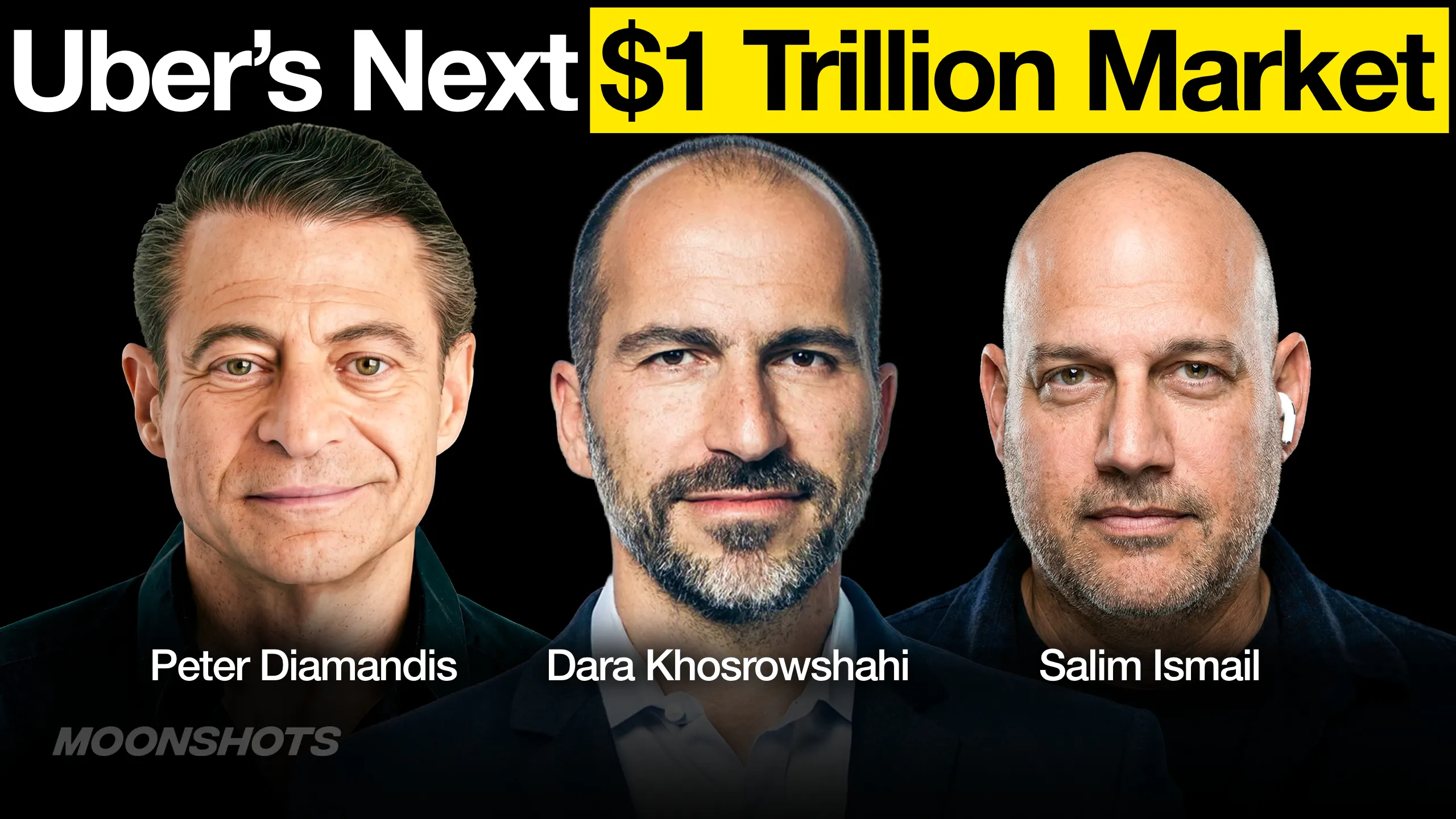
Uber CEO on Winning the Robotaxi Race, the End of Car Ownership, and Uber’s Next $1 Trillion Bet | Dara Khosrowshahi (Uber CEO) | 243
34m 0s
The discussion centers on Uber's strategic vision and progress in the autonomous vehicle (robotaxi) race. Under its CEO's leadership, Uber transformed from losing billions annually to earning over $10 billion a year by sharpening organizational focus. The future of autonomy is seen not as an all-or-nothing shift but as a hybrid evolution, where cities will host mixed fleets of self-driving and human-driven vehicles. Uber is collaborating with numerous partners, including Waymo, Nvidia, and Lucid, to develop this ecosystem, aiming to facilitate more autonomous rides than any competitor by 2029. The transition is expected to be gradual, similar to historical shifts like from horse-drawn carriages to cars, with full adoption taking years due to existing vehicle lifespans and varying global market readiness. Additionally, Uber is expanding its delivery services, such as Uber Eats, into groceries and retail, responding to growing consumer demand for convenience. Internationally, regions like the Middle East and Europe show promise for early autonomous adoption due to supportive regulations and tech-savvy leadership. Throughout, the emphasis is on strategic focus, partnerships, and the societal benefits of autonomy, including improved safety and reduced costs.
The Robotaxi race is heating up. How are you going to win that race? Well, when you joined taking the mantle of Uber, I think Uber was losing $4.5 billion a year. Today it's earning over $10 billion a year. You really focus the organization. Autonomous technology and autonomous vehicles, they are increasingly a reality on the streets. As we speak, there isn't going to be this kind of binary outcome. It's going to develop in a hybrid way. And you are going to have fleets in cities that consist of some autonomous vehicles and then many human driven vehicles as well. 100 years ago we would have this massive shift from person buggy to cars. I took about 15 years to make the transition where 50% of the vehicles were cars. How long do you expect that transition to take where 50% of the cars are self-driving cars? Uh. Now that's the moonshot, ladies and gentlemen. Quite the greeting, wow. Yeah. Uh. The energy is awesome and you deserve it, pal. Thank you. Thank you. First of all, you look amazing. Thank you very much. Staying in good health? Yes, try. Excellent. Well, looks so far so good. I mean, the biggest challenge we have is stress levels. Uh. The weight too much travel. So, you know, I want to not take it for granted. Thank you for coming out. Happy to do it. I'm grateful for your friendship. Yeah, we've known each other since you were at Expedia. And, you know, you had an incredible success story there, right? When the highest, if not the highest paid CEO, you actually walked away from a $200 million stock package from Expedia to take the mantle of Uber. And, I remember, just look this other day, when you joined taking the mantle of Uber, I think Uber was losing, uh, what's the number? Four and a half billion dollars a year. And that was quite the buzz saw to walk into. And today, I mean, this is the hallmark of an extraordinary CEO. Today, it's earning over $10 billion a year. What a turnaround made. Thank you. Thank you. Thank you. Thank you. Really, um, really extraordinary. And just the scope of what it's done, right? I remember, um, you know, you really focused the organization. I think one of the things that a lot of companies fail about is doing too much at once. Yeah. Yeah, right? And I think we were definitely guilty of that as well. And one of the great pieces of advice that I got from a good friend of my Barney Hartford was strategy is just as much about what you're doing and what you choose not to do. It's very easy to say yes to another idea. It's very difficult to say no, but sometimes the nose then amplify the yeses. And it's about pointing the company, having a point of view, pointing the company in a singular direction, and then putting everything you've got behind it. Yeah. Well, you've done that and with huge success. And now you're going back to the stuff that you left on the table before. Yeah. Which is, we'll talk about flying cars and all of that. So the robot taxi race is heating up. Definitely. Yes. And so I'm going to start with the hard question. Well, we are going to win that race with the autonomous community. So autonomous technology and autonomous vehicles, they are increasingly a reality on the streets. As we speak, it's been 15, 16 years of development since the DARPA Grand Challenge. Exactly. With lots of long tails, et cetera. And Waymo is a leader and a big partner of ours in Austin and Atlanta. And what we view is that there isn't going to be this kind of binary outcome, which is either all autonomous or no autonomous, that really the world as autonomous technology develops, we are going to, it's going to develop in a hybrid way. Yeah. And that ultimately, that transition and the part that we play in that transition, because of the incredible demand that we bring to both human drivers and robot drivers, we will have a big part to play in that transition as well. So we partner with Waymo, but we've got over 20 partners now in the autonomous space, including Nvidia, for example. We ride pony, Wabi amongst others. And just like we want every terrific licensed human driver on the platform, we're going to want every terrific licensed robot driver on the platform as well. And we'll be in 15 cities by the end of the year with our partners. And by 2029, we think that we will facilitate more autonomous and robot taxi rides than anyone else in the world. Mason, do you ever think Elon would come on platform or is he just, I'm doing it all in my own, he doesn't play well with others. You know, his, I think Elon's approach typically has been a vertical approach, right? They even own their own refinery. Again, when the day comes, when the day comes when those Tesla's are safe with a camera only approach, we love to have those Tesla's on our platform as well. We've got tens of thousands of Tesla's on our platform now. And some of our drivers use FSD. Sure. So we've got a lot of data. It's a great car. It's a safe car. We'd love to work with them as to whether we will or will not is TBD. But there are plenty of other partners in the space. And we think there are going to be many, many winners. Yeah. When you talk about platforms and for, you know, when Peter and I were at this book, exponential organizations, Uber is a poster child. The, over an organization, the scales as fast as technology scales. And you're turning it into a platform. You have to have so many sockets and connectors to all of these different hybrid robotaxi human, et cetera. How do you think about that? And what are the major obstacles in building that platform? Well, the platform, actually, what we're finding is that humans are actually much more complicated than robots, right? There are many more unexpected behaviors. There are very significant differences as to how you set up your platform to be able to be operational in Bangalore and also be operational in San Francisco as well. So with our autonomous partners, there are standard APIs that you can put out there. We are very big partner in terms of data collect, the amount of data that we are collecting to help in training of the models where you should pick up, where you should drop off fleet management services. You know, if you think about an Uber driver, they drive the car, they take care of the car, they own the car, they repair the car, they clean the car, et cetera. All of those services are going to have to be kind of a part of the autonomous ecosystem. And we are essentially providing all of those services so that our partners can focus on the core, which is how do you build a safe and affordable autonomous driver and we can take care of everything else? So I'm curious. I saw the announcement you had with Lucid and Nvidia. Lucid and Nuro, actually, but we also had another announcement with Nvidia as well. I guess both the same time at CES. Can you talk a little about your tech ecosystem, your automotive ecosystem? Who are the major players that you're building relationships with? So there are a number of players. If you think about the ecosystem, there's the domain aggregator, which is Uber. Then there is the autonomous driver and there are many players who are building out the autonomous driver, whether it's a Waymo, We Ride, Pony.ai, Nvidia's building out its autonomous driver, Nuro, Avaride, and many, many more. Wabi, for example, so there are many companies that are building out the driver and we are helping them in different ways of building out the driver. Zooks is another one building out the driver. You know, play with Zooks as well. Well, we certainly would love to work at that. There are some that we're working with and some that we're in discussions with or different places in terms of partnership discussions. Then you actually need the car, right? And the car needs to have very, very sophisticated compute, needs to have redundant steering, braking, et cetera. So the needs of the car are different and we're working with Lucid, for example, has a great car that already has a bunch of the redundancy and the sensors systems already built into that car as well, which is one of the reasons why we partnered with Lucid, but you can expect many other partnership announcements as well, OEM announcements. And then you need essentially the fleet management and fleet ownership as well. Early on, we will go on and buy cars, but then over a long period of time, just like Marriott doesn't own any hotels. It's actually financial players. These kind of real estate investment trusts that own the hotels that Marriott manages. We think that Autonomous will also kind of move into this asset-like model where we'll be operating the fleets, we'll be repairing the cars, we'll be cleaning the cars, either ourselves or through partners. And then there will be financial players, the black stones of the world who are going to own large fleets of cars that
you know, give a nine percent yield, yeah, so to speak. So it's a big ecosystem that we're building and we're essentially working with everyone in that ecosystem. And we think it's going to be another trillion dollar marketplace and we're very, very excited for autonomous to become a reality, not to also mention that the streets are going to be safer. Right. These cars, these drivers don't get distracted, they don't get tired. And we do think that kind of the regulation is coming to place that will make sure that the safety case is one where the autonomous drivers is essentially. The data's in, it's 10 times safer to be in a test line FS. The early data certainly suggests that it's quite safe. Now, most of those testlers have a driver as well as a backup, but there's no doubt that eventually the drivers are going to come out. The human drivers are going to come out. How do you handle the liability side? You know, when a WEMO gets in an accident, it's very clearly the fault of the WEMO. When something happens on Uber's platform, who's liable there? How do you handle that? Do you have special insurance that navigates that? So as it relates to on our platform, you know, liability laws are different everywhere, but we provide essentially commercial insurance for drivers, human drivers who are on our platform. And I think that with the autonomous model, more the way it looks is WEMO, for example, responsible for their own drivers. You know, they are building a software driver and they speak to the safety of those drivers. These cars are very expensive, but we are quite confident that the driver is going to be much safer than a human being. So ultimately, liability is going to come down in the industry and it'll be savings that we can pass on to the consumer essentially. I'm curious, WEMO right now, the numbers I've seen come in at like 150K of a car, something on that order magnitude. And then CyberCab is saying they're coming in at 30K. How important is the asset cost going to be for a profitable business? And let me ask you a different question. How many different providers do you expect there to be on the streets of LA a decade from now? Put it that way. So I think if you think about 10 years from now, I think every single new car sold is going to have autonomous software associated with it. And just like, you know, we like GMs on the Uber network and we like Toyota's on the Uber network, we're essentially going to have every single model, autonomous model on the network as well. So I think it'll be 10 plus different providers now. The software space may consolidate to some extent, right? So I don't know if there'll be 10 plus software providers, but there's no reason to think that this won't be a very, very big fragmented industry. Just like the OEM, the car manufacturing business is a very large fragmented industry. I can't wait till your original position of Expedia overlaps with Uber because my autonomous vehicle is going to become my hotel room and it's going to transport me from Las Vegas to LA, right? So obviously-- We'll be able to get a real hotel room as well. But yeah. We are in some ways in the business of wiring up things that move, right? And we've tipped out into travels. So for example, you can take in the UK and Spain, you can take trains on Uber as well. You can take boats on Uber, et cetera. For us, it's just like rematch, any of the way the world moves. Anything that moves, we're going to wire it up or anything that you want to move, whether it's food or it's groceries or your local drug store, et cetera. We're going to be there to wire it up to make your life just a little bit easier. Are there certain services like you do health, you do eats, are there other services you've got planned? We have our hands full right now in terms of moving people in every single way and then moving things in every single way. I'd say the focus right now is-- each started obviously as online food delivery. What we're seeing now is the friend of mine, a VC kind of-- who was involved with Uber early on. He said, never underestimate the power of human laziness. And you can build huge businesses there. So what we're seeing is that people want anything and everything delivered to their home, and they want it now. So the expansion of Uber Eats-- and we've debated ourselves as Uber Eats travel to non-food items. What we're seeing, the expansion into grocery, into every single part of retail, whether it's best buy or makeup, as a for, et cetera, has been growing much, much faster than we expected. And so that I'd say is a focus for us, which is delivery of anything and everything to your home within an hour. That business is just exploding for us. 100 years ago, we would have this massive shift from horse and buggy to cars. And it took about 15 years to make the transition where 50% of the vehicles were cars. So I do think that in the next 10 years, I think every single new car sold is going to have autonomous driving software on it. And it'll have a sensor stack. It'll cost a lot or is really coming down. The cost of cameras are coming down. So within 10 years, every new car is going to be autonomous ready. Now, there's going to be a huge inventory of existing cars. And the average life of a car in the US is over 10 years. So it's going to take a very, very long time, a little lifetime of cars is, I guess, similar horses, too. Horses can live for a while. But I think it'll take a while for that fleet to turn over. And then I do think that this product, it is a relatively expensive product, right? Today, now the cost curves are going to come down. And you will see autonomous become a very, very big part of developed markets. But also keep in mind that we operate in 70 plus countries and a lot of developing markets, autonomous is going to take a while to penetrate. There was a moment when I did some of the research years ago and looked at that an electric autonomous car could be four times cheaper than owning a car. I think ultimately, we think the promise of autonomous is exactly that, which is it's just not going to make sense for you to own your own car. As these cars proliferate, the cost of autonomous is going to-- the cost for trip is going to come down. Safety for trip is absolutely going to come up. You'll have your own privacy. You'll be able to have your stuff essentially loaded up in the car in terms of your music or whatever you like. So we do think that autonomous is an enormous opportunity in terms of the expansion of the tan for both mobility and delivery of all kinds. I think, if you might, vision of what it looks like, five years from now. So you're sitting at breakfast with your kids, and you stand up from your breakfast table, and you start walking-- Breakfast delivered by UberEats. But let's do that. And you start walking towards the front door. Your AI knows your calendar. It has cameras in your home. It sees you walking towards the front door. And automatically, it's my favorite term. And an autonomous Uber pulls in front. You didn't have to call it. You didn't have to ask it. And you hop into it. And it knows that you didn't get a good night's sleep last night from your Uber data. So it decided to bring you a car with a lie down bed in the back as well. So that-- I'm the impeter. Yeah, I'm telling you everything. I'm just going to give you some product advice here. So the international side you just brought up, where are we going to see these roll out? Obviously, US and China. But what countries are most pro autonomous vehicles, do you think? So I'd say the Middle East is actually the most open as eating forward in terms of-- You've asked me to lose it? Yeah, innovation of all kinds. I mean, it's not just autonomous. But you look, for example, a joby vertical take off and landing vehicles, whether it's Abu Dhabi or Dubai or KSA, Kingdoms, Saudi Arabia, these are all countries that recognize the transformational power of technology. They are run by governments and administrations that are very young and incredibly tech savvy. And they want to lead. And so we are seeing the Middle East, and so, for example, we are in Abu Dhabi, as we speak, with autonomous vehicles with our partner We Ride. And you will see many more autonomous vehicles on Uber in the Middle East. And I'd say Europe is also opening up. Europe is leading forward. Which country-- Europe, do you think? Which is definitely-- Well, they're a number. But we're pretty excited about the potential in the UK with Wave, who is a terrific partner. They have incredible AI talent. And they're essentially building a software stack that they will sell to any in all OEM. So we're very excited about that model. And I still remember when France made Uber illegal. And I was like, OK, that's a message to entrepreneurs out there not to start your company or tech entrepreneurs. Fortunately, things in France are much better now. Yes, but I do think there's real promise in the UK. And they'll be--
some exciting announcements coming from Wave, who's one of our party partners. People forget the secondary benefits, right? I remember there was this big issue where the finance minister in France was trying to shut down Uber. And around Paris, you have what I've called the volume, the suburbs of the radicalized folks and drugs, etc. Not the kind of place you usually throw. That was temporarily in the 80s, like that. And the French government had spent $40 billion trying to solve that problem with zero impact. It was worse than I've ever been. And then Uber comes in, and in 18 months later, the crime rate has dropped 10x because they're all out driving. And so they're trying to shut down Uber while you're saving them a $40 billion problem. It's just incredible to watch. It's an inflectable living. And, you know, same thing, for example, drunk driving. And when we enter into markets, the incidence drunk driving incidence goes on significantly. So there are many, many ways. It's one of the reasons, you know, getting back to how we started the conversation and why I wanted to come to Uber is, you know, this is a company that is having real impact on society and how society moves. And I think with autonomous revolution, even more so. Amazing. I remember I was one of the first speakers at the first Uber Elevate conference. Yeah. Years ago, when Uber was sort of pioneering the idea of EVTOL, which is a name that rolls off the tongue onto the floor. You can pull it off pretty well. And when you came in the CEO, you ended up selling Uber Elevate to Joby and you put all of that on hold, which honestly, I was like really disappointed about, but it was the absolute right to say that we have issues with that. No, it's turned out all right. Wait, no, it's absolutely the right decision because it was still a decade away. And it wasn't the right place to focus. And again, just for all of you here, so many companies fail from lack of focus. Yeah. I've had companies where Service Chairman, the CEO starts a whole bunch of different divisions. And it just like takes the focus off where you need to be earning your money. So you now partnered with Joby. Yes. And what's your vision on flying cars? I'm going to call them that versus EVTOLs. It is a little bit easier. We had found Elevate as a way to, we wanted to catalyze the industry to get real investment into EVTOLs because with battery technology and battery density, for the first time, the math behind the massive battery and how much power the battery had kind of made sense to actually build these EVTOLs, these electric flying cars as well. And once we kind of provided that catalyst and we saw funding come into the marketplace, we thought, listen, we could then have specialized hardware makers fund this. And Joby was just the best that we had seen of all the lot. Joby is an amazing CEO. He's absolutely extraordinary. And the vision for us is kind of end-to-end trip planning. So a little bit like you said, and what we're hoping is in Abu Dhabi this year towards end of the year, you'll be able to push a button, get an Uber to the verteport where you get onto a Joby and then take a Joby to your destination and then maybe another Uber at the end of it to wherever you're going and save yourself hours of travel. You know, the amount of time that you stress. Yeah, in traffic is extraordinary. And not happen fast enough. Not absolutely. Absolutely. So it's happening again in the Middle East, it's happening now. And hopefully it will come to the US sometime next year as well. These, the technology is absolutely real. Now it's about getting the technology licensed with the authorities. And production up and running and enough of these vehicles and enough experience and enough AI oversight. Well, Joby has a partnership with Toyota. So they have the best in the world in terms of manufacturing and safety. So you know, one of the things I've been critical in the past about Uber being extractive with the social contract, right? Because you're layering on existing society, but you have a plan to turn drivers into autonomous vehicle owners. And I think that's an amazing transition from shifting the focus on labor to capital. We talk about that and how quickly that's being rolled out because when you can enable that, you give people so much agency. That's really a powerful direction. And then there's a few. Yeah, absolutely. So I'd say there are two angles here, which is one way of obviously looking at Uber is, Uber's a transportation on demand transportation company, moving people, moving things as well. Another way of looking at Uber is we are platform for work, flexible work. And so we have consistently over a per-time expanded the kind of work available, whether it's driving, delivering, shopping. And now actually we have a group called Uber AI Solutions where we're doing data labeling. We are looking at models and picking which model is a right model, et cetera. So it's got drivers tagging things. Exactly. Tagging images, et cetera. So we're kind of expanding the kind of work available. And then at the same time, exactly as you said, as the world, to some extent you've got these capital assets, these cars that are going to augment. And then at some point replace some of the labor with their drivers, their approach for us is how do we make sure that there are other kinds of work available that lean into the technology versus kind of running away from the incoming technology wave. And then also give drivers, et cetera, an opportunity to be their own fleet manager. I love that. I love the idea that an Uber driver that gets displaced, gets to buy a car or a couple of cars that work for him or her during the day and you can kick back and work out at the gym. And it's out there. I mean, it's a beautiful place. There's always some work involved in that. I need you to have to maintain the fleet, et cetera. Yes. Yes. But maybe you'll kick back and you'll have some, you know, drivers. I've thought about that. Funny cars for you. You know, buy 100 cars, have them going around LA. You know, and what I'd want to do is put sort of LEDs on the side and then have my clawbottes start experimenting with different marketing pitches as it's driving down the street, differential pricing. I will make sure I give you a call when we open up an LA. Okay. Besides flying cars, drone delivery. I've got Keller Clifton from Zipline here tomorrow. Yes. Amazing company. Yes. And I know, you know, Keller, I've had CEO of Starship, which is the wheeled ground robot. Talk to me about how you're going to start incorporating autonomy in your delivery. I think we're talking to Keller and we work with a number of drone companies, SkyTracks, Monna, et cetera. And delivery is actually a little bit harder because as it relates to mobility, the passenger kind of gets the car and gets out of the car, right? Food doesn't do that. So you need to kind of make sure that the positioning of the pickup and drop off is different. And you see the robots we had here earlier? I mean, they could jump out of your car. That could be part of the solution, right? It's a first mile, last mile issue as well. And there are two modes that we're working on right now as it relates to delivery. One is drone delivery, which is for suburbs, you know, markets that don't have high rises, et cetera. And we're very excited about that because suburb and markets are kind of a new growth opportunity for us. And I do think that drone delivery is going to be one of those surprise and delight moments where you get your food in 10 minutes. Right. And you see prep time is 10 minutes. Maybe take two more minutes. You get it within 15 minutes, which will be absolutely spectacular. In the urban markets, we've got these cute little sidewalk robots, whether it's Coco or number of other cars. We have Coco, it was a kind of a co-operator. They're all over the place. And you know, for those, they're about right for short deliveries within a mile or two because they don't go very fast and they use the sidewalks. And so ultimately you're going to have this multimodal kind of delivery network that we're putting together, whether it's on the sidewalks or in the sky. And eventually you will have specialized delivery robots that go on bike lanes or on the road as well. We're going to be going to your questions next in a couple minutes, so get them ready. Celine. You know, there's roughly a million active drivers in the US. Yes. More than that, but yes. And you've got like 10 million globally. Yes. Okay. As you see the rollout of autonomous vehicles, what's the curve in which you expect the drivers to drop? I think that looking forward at 2030, we're going to have significantly more drivers on the platform, including the US than we have today. Just the growth of the business. The business is growing, you know, over 20%. And we need to add that many drivers, essentially, to keep up with the growth. You know, our audience is growing at almost 20% as well. And so what we see in terms of autonomous is probably around 20% of drivers every year slough off. You know, they find something else to do. They find full-time work, etc. And as we introduce autonomous into a market, what we do is we just slow down the recruitment of new drivers.
so that the drivers who are on the platform have just as much work as they had before. And what an interesting kind of trends that we're seeing is autonomous looks like it is bringing new customers into the marketplace. One of the hypotheses is that autonomous is not gonna replace human driving, but it's going to expand the market. And what we're seeing in in an Austin or in Atlanta, these markets are growing faster than the average market nationwide, which suggests that there's gonna be actually more business to go around. - And especially as the price starts coming down. - Yes. - It's like, my trade right now is buying time. It's like I have 200% to amazing cars, but oh my God, I wanna spend that 30 minutes working on a project not behind a wheel. - That's what we do is essentially give your time back. That is the value that Uber represents, whether it's going, you know, being able to work in your car or not having to go out to the restaurant, et cetera. - Dari, you are in my mind one of the most extraordinary tech CEOs out there. I wanted to drill down for a second for all of, I see I was in a room here, your philosophies about running the company. You're not shy about telling your employees, they gotta work their butts off. - Yes. - Can you talk a little bit about that because we come off of 2020 and the whole COVID era where people are out of the office and such. And what's your philosophy to drive Uber's excess from a, from a CEO, inspiring or directing your employees? - So, you know, I came to, I didn't come to Uber because I thought I was gonna be a layup. Right? I mean, at the time, Uber was going through a very, very difficult time. And I think anyone who joined Uber around my time, and there are a bunch of our teammates who joined - This is around what I did in 2018. - 2017. Yeah, you know, it's like, there's a certain personality at Uber who likes running to the fire, doesn't run away from the former. And ultimately, the biggest reason why I joined Uber was, kind of one of the lessons I learned in life is, go to a place where you can make impact and go to a place that is having impact in the world. And if you wanna have an impact at a company or if you wanna have an impact in the world, it doesn't come with a free lunch. Like, you're gonna have to work your ass off. - Yeah. - And you're not scared to say that to your team. - I'm, it's not, I'm scared. Like, I say it to the team. It's, I think it's a feature of the place. Like, it's an intense work culture. You work with super smart people who are working really, really hard. And yes, that comes with a trade off. It doesn't mean we don't have flexibility around work. But it's fun to work hard and succeed. It's fun to succeed at things that are difficult and are really, really hard. I think it gives us other level of satisfaction. That's what Uber offers. Now we're gonna be very plain spoken about. - You recently introduced an adara avatar. - For employees, could you be an adara avatar? - I'm introducing one of our own employees that have adara avatar. - So they get to practice their pitching from that and get feedback. How's that working out? - It drives me nuts. (laughing) All these prep meetings, et cetera. Like, it's such a waste of time. I'm like, just come in here. Let's talk. We're both human beings. Just because I've got, you know, fancy title doesn't mean that you've got to prep endlessly. But people tell me the avatar is amusing and it helps them prep. So good for them. - You should do a pitch from front of it and see how it goes. (laughing) - I actually prepped for this. - Oh yeah, it's great. - That's a good one. (upbeat music)
Podcast Summary
Key Points:
Uber's CEO transitioned the company from significant annual losses to substantial profitability by focusing the organization and strategic priorities.
The future of autonomous vehicles (robotaxis) will develop as a hybrid model, integrating both self-driving and human-driven cars, with Uber partnering with multiple companies like Waymo, Nvidia, and Lucid to build this ecosystem.
Uber aims to lead in facilitating autonomous rides globally by 2029, viewing autonomy as a long-term transition that will improve safety, reduce costs, and expand into new delivery and mobility services.
The company is expanding Uber Eats beyond food to include groceries and retail, driven by consumer demand for rapid delivery, while also exploring international markets, particularly in the Middle East and Europe, for autonomous vehicle adoption.
Strategic focus and partnerships are emphasized as critical to navigating the complex autonomous vehicle landscape, including handling liability, fleet management, and integrating various technologies and services.
Summary:
The discussion centers on Uber's strategic vision and progress in the autonomous vehicle (robotaxi) race. Under its CEO's leadership, Uber transformed from losing billions annually to earning over $10 billion a year by sharpening organizational focus. The future of autonomy is seen not as an all-or-nothing shift but as a hybrid evolution, where cities will host mixed fleets of self-driving and human-driven vehicles.
Uber is collaborating with numerous partners, including Waymo, Nvidia, and Lucid, to develop this ecosystem, aiming to facilitate more autonomous rides than any competitor by 2029. The transition is expected to be gradual, similar to historical shifts like from horse-drawn carriages to cars, with full adoption taking years due to existing vehicle lifespans and varying global market readiness. Additionally, Uber is expanding its delivery services, such as Uber Eats, into groceries and retail, responding to growing consumer demand for convenience.
Internationally, regions like the Middle East and Europe show promise for early autonomous adoption due to supportive regulations and tech-savvy leadership. Throughout, the emphasis is on strategic focus, partnerships, and the societal benefits of autonomy, including improved safety and reduced costs.
FAQs
Uber plans to win by partnering with multiple autonomous vehicle companies, integrating them into its platform, and focusing on a hybrid model that combines both autonomous and human-driven vehicles.
Uber is building a platform with standard APIs to connect with various autonomous vehicle partners, providing services like data collection, fleet management, and maintenance, while partners focus on developing safe and affordable autonomous driving technology.
Liability typically falls on the autonomous vehicle provider (e.g., Waymo) for their software drivers, while Uber provides commercial insurance for human drivers on its platform, expecting liability costs to decrease as autonomous technology proves safer.
The Middle East, including countries like Abu Dhabi, Dubai, and Saudi Arabia, is highly proactive, along with Europe, particularly the UK, due to supportive governments and tech-savvy leadership.
Uber sees the transition as gradual, taking many years due to existing car inventories and varying adoption rates across markets, but expects every new car sold within a decade to be autonomous-ready.
Autonomous vehicles are anticipated to significantly improve road safety by reducing human error, lower costs over time, and provide social benefits like reduced crime and drunk driving incidents in communities they serve.
Chat with AI
Loading...
Pro features
Go deeper with this episode
Unlock creator-grade tools that turn any transcript into show notes and subtitle files.
 PodcastTranscript AI